
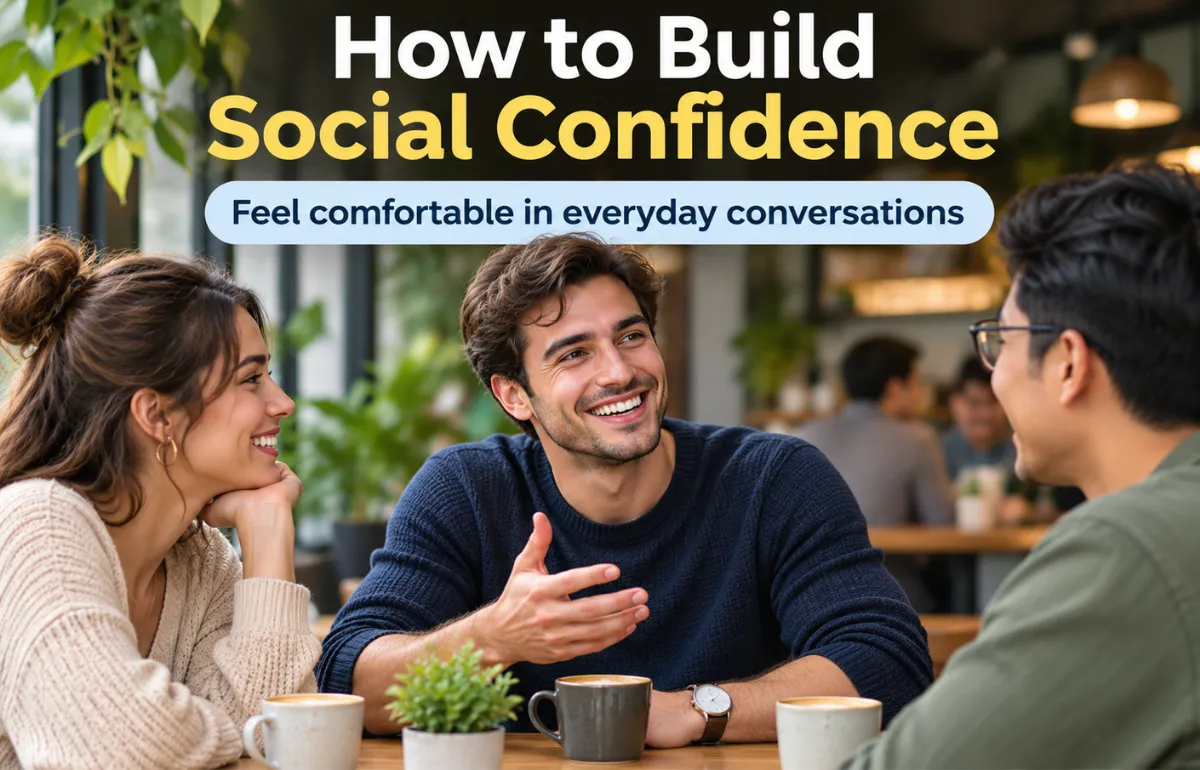
Learning how to build social confidence starts with practicing small, everyday interactions, developing effective communication skills, and gradually becoming comfortable with unfamiliar social situations. Social confidence is the ability to interact with others, express yourself naturally, and handle social uncertainty without being excessively worried about judgment or rejection.
You can develop it by initiating brief conversations, practicing active listening, challenging negative thoughts, and accepting occasional awkward moments as a normal part of human interaction.
I recommend focusing on becoming comfortable rather than becoming impressive. You don’t need to be the funniest person at a gathering, have endless conversation topics, or develop an outgoing personality.
What matters is trusting yourself enough to participate in conversations without constantly questioning everything you say.
Whether you’re talking to a neighbor, ordering coffee, meeting a colleague, or attending a family gathering, everyday interactions offer opportunities to strengthen your confidence.
What Is Social Confidence?
Social confidence is the sense of trust you have in your ability to communicate, interact, and express yourself in social environments.
It allows you to approach people, share opinions, ask questions, and participate in conversations without feeling an overwhelming need for approval.
However, being socially confident doesn’t mean you never feel nervous. Even confident individuals experience uncertainty when meeting unfamiliar people or entering new environments.
I like to think of social confidence as being comfortable with your own presence around others. You don’t feel pressured to entertain everyone, fill every silence, or constantly prove your worth.
Social Confidence vs. Social Skills
Although these two concepts are closely connected, they aren’t the same.
Social skills describe how effectively you communicate with people, while social confidence describes how much you trust yourself during those interactions.
| Social Confidence | Social Skills |
|---|---|
| Trusting your ability to interact | Knowing how to interact effectively |
| Feeling comfortable expressing yourself | Communicating thoughts clearly |
| Accepting occasional awkwardness | Managing conversational difficulties |
| Participating despite nervousness | Using active listening and appropriate responses |
| Relying less on external approval | Understanding social cues |
You can have excellent communication skills and still feel nervous around people. Similarly, you can feel confident while having certain interpersonal skills that need improvement.
Developing both creates a stronger foundation for meaningful social interactions.
Why Do You Lack Social Confidence?
Low social confidence rarely develops for one universal reason. It can result from personal experiences, learned behaviors, limited opportunities for interaction, or negative beliefs about yourself.
Some common contributing factors include:
- Fear of embarrassment or rejection.
- Previous experiences of criticism or bullying.
- Excessive concern about other people’s opinions.
- Limited face-to-face social interaction.
- Constant comparison with outgoing individuals.
- Perfectionism during conversations.
- Low self-esteem and negative self-talk.
Another overlooked factor is the habit of monitoring yourself while speaking.
Instead of enjoying a conversation, you might be evaluating your voice, facial expressions, posture, and choice of words simultaneously.
That mental workload leaves less attention available for the person you’re speaking with.
Understanding what makes you uncomfortable helps you choose practical solutions rather than forcing yourself into situations you’re not ready to handle.
How to Build Social Confidence in Everyday Life
I suggest treating social confidence as a collection of small, learnable abilities rather than a personality trait you either possess or lack.
The following approaches focus on realistic interactions you can practice without significantly changing your daily routine.
1. Start With Low-Pressure Social Interactions
You don’t need to attend crowded events or approach large groups to improve your social confidence.
Start with situations where the emotional stakes are low and conversations have a natural purpose.
For example:
- Greet a neighbor when passing them.
- Ask a shop assistant about a product.
- Thank someone who holds a door open.
- Exchange a few words with a coworker.
- Ask someone about their weekend.
These interactions may seem insignificant, but they provide opportunities to practice communicating without expecting a particular outcome.
I recommend choosing one small interaction each day that you would normally avoid.
If saying hello feels manageable, try adding a simple question the following day. Gradually increase the difficulty as you become more comfortable.
The aim isn’t to eliminate nervousness immediately. It’s to discover that you can participate even when you’re slightly uncomfortable.
2. Stop Treating Conversations Like Performances
One of the biggest barriers to feeling confident around people is believing that every conversation must go exceptionally well.
You might think you need to sound intelligent, tell interesting stories, or leave a memorable impression.
But ordinary conversations rarely require extraordinary communication.
Think about how people discuss their lunch plans, daily routines, weekend activities, or the weather. These exchanges aren’t particularly impressive, yet they help people develop familiarity.
I prefer approaching conversations with a simple question: What can I learn about this person?
This shifts your attention from performing to connecting.
When you stop treating conversations as opportunities to prove yourself, you have more freedom to speak naturally, listen carefully, and enjoy the interaction.
3. Use the Observe, Ask, and Share Method
Not knowing what to say can make everyday conversations unnecessarily stressful.
A practical technique I recommend is the observe, ask, and share method. It’s a flexible conversation framework that doesn’t require memorizing complicated scripts.
Observe
Notice something relevant about your surroundings or the current situation.
For example, you might notice that a café is unusually busy.
Ask
Turn that observation into a simple, appropriate question.
You could say, “Is it usually this busy around lunchtime?”
Share
Offer a small detail about yourself after the other person responds.
You might reply, “I normally come here in the morning, so I’ve never seen it this crowded.”
This creates a natural exchange rather than a series of disconnected questions.
You can use this approach at work, in classrooms, at neighborhood gatherings, or while attending community activities.
The key is to respond to what the other person actually says instead of mentally preparing your next question.
4. Practice Active Listening Instead of Overthinking
When you’re nervous, it’s easy to spend an entire conversation thinking about what to say next.
Unfortunately, this can make it harder to notice useful conversation opportunities.
Active listening involves paying attention to the speaker, understanding their message, and responding with genuine interest.
A 2017 study published in the Journal of Personality and Social Psychology found that asking questions, particularly relevant follow-up questions, was associated with greater interpersonal liking.
You can read the research through the Harvard University repository.
If someone mentions that they’ve recently started gardening, you don’t need to introduce an entirely new topic.
Simply ask what they’re growing or how they became interested in it.
Listening gives you material to work with. It also removes some of the pressure to constantly produce interesting things to say.
5. Develop a Comfortable Social Body Language
Your body language influences how you communicate and may affect how comfortable you feel during interactions.
However, I wouldn’t recommend spending an entire conversation monitoring your posture or forcing yourself to appear confident.
Instead, make a few manageable adjustments.
Try relaxing your shoulders, keeping your hands comfortable, speaking at an unhurried pace, and looking toward the person when they’re talking.
Natural eye contact can help communicate attention, but it doesn’t need to be constant. Cultural expectations, personal preferences, and neurodivergence can influence what feels appropriate.
If direct eye contact makes you uncomfortable, find a way of showing interest that works for you.
The purpose of body language isn’t to imitate someone else’s personality. It’s to communicate without creating unnecessary physical tension.
6. Create an Everyday Social Confidence Ladder
If you’re wondering how to build social confidence without overwhelming yourself, a confidence ladder can make the process more manageable.
This involves arranging social activities according to how challenging they feel and gradually practicing them.
The NHS also recommends breaking challenging social situations into smaller, more manageable parts.
Here’s an example of how your personal ladder might look.
| Difficulty | Everyday Social Activity |
|---|---|
| Very easy | Smile or greet someone you recognize |
| Easy | Ask a straightforward question |
| Mildly challenging | Start a brief conversation with an acquaintance |
| Moderate | Share an opinion during a group discussion |
| Challenging | Introduce yourself to someone unfamiliar |
| More challenging | Attend a small social gathering independently |
| Advanced | Invite an acquaintance to meet for coffee |
Your personal difficulty levels may differ from this example.
Repeat activities that feel manageable before progressing to more demanding ones. You don’t have to complete the ladder within a specific timeframe.
What matters is choosing challenges that stretch your comfort zone without making practice unnecessarily distressing.
7. Learn to Handle Awkward Moments Gracefully
An unexpected silence, forgotten name, or misunderstood joke can happen to anyone.
Socially comfortable people aren’t necessarily better at preventing every awkward moment. They simply don’t always interpret those moments as personal failures.
I recommend developing a few simple recovery responses.
If you forget someone’s name, say, “Sorry, could you remind me of your name?”
If you lose your train of thought, say, “I’ve completely forgotten where I was going with that.”
If a conversation naturally slows down, allow the silence or politely move on.
You don’t need to apologize repeatedly or explain why you’re nervous.
Learning to recover from small conversational mistakes can be more useful than trying to prevent them altogether.
Once you trust your ability to handle imperfect interactions, the possibility of embarrassment becomes less intimidating.
8. Challenge Your Assumptions About Other People’s Opinions
You might finish a conversation convinced that the other person found you boring, awkward, or uncomfortable.
But your interpretation isn’t necessarily an accurate reflection of their experience.
A 2018 study published in Psychological Science identified a phenomenon known as the liking gap. Researchers found that people often underestimated how much their conversation partners enjoyed meeting and interacting with them.
The original research suggests that our judgments about how others perceive us can be unnecessarily negative.
When you notice yourself assuming the worst, consider whether you have reliable evidence supporting that assumption.
Someone giving a short response might be tired, distracted, or simply busy.
I wouldn’t automatically interpret every interaction positively, either. A more useful approach is accepting that you cannot always know what another person is thinking.
9. Build Familiarity Through Repeated Social Contact
A frequently overlooked way to develop social confidence is to become a familiar face somewhere.
Instead of constantly meeting unfamiliar people, create opportunities to interact with the same individuals regularly.
Visit the same local café, attend a weekly class, participate in a community activity, or take your regular walking route.
Repeated contact creates opportunities for recognition and natural conversation.
An initial greeting might eventually become a short discussion about your day, followed by a more meaningful exchange.
I call this the familiarity-first approach.
It removes some of the pressure associated with introducing yourself repeatedly and helps you practice social skills within a more predictable environment.
Remember to respect other people’s boundaries and willingness to engage. Familiarity is an opportunity for connection, not an obligation.
10. Express Small Preferences Without Apologizing
Social confidence isn’t only about starting conversations. It’s also about feeling comfortable expressing who you are.
If you frequently agree with everyone to avoid conflict, you may struggle to communicate your actual preferences.
Start practicing assertiveness in situations where the consequences are relatively minor.
When someone asks where you’d like to eat, offer a genuine suggestion rather than automatically saying anything is fine.
If a friend recommends a movie you didn’t enjoy, express your opinion respectfully.
If you’re unavailable for an invitation, politely decline without inventing an elaborate explanation.
These small decisions teach you that maintaining positive relationships doesn’t require constant agreement.
I consider this an essential part of developing authentic confidence because it encourages self-expression rather than people-pleasing.
11. Keep a Social Evidence Journal
Traditional confidence advice often emphasizes repeating positive affirmations.
While some people find affirmations helpful, I suggest combining encouragement with evidence from your actual experiences.
A social evidence journal records what happened during an interaction instead of relying entirely on your emotional interpretation afterward.
After a conversation, write down three things:
- What I expected would happen.
- What actually happened.
- What I handled well or learned.
For example, you might expect a coworker to ignore your greeting. Instead, they respond politely, and you exchange a few words.
Even if you felt nervous, the interaction demonstrates that you were capable of participating.
Keep each entry brief. You don’t want journaling to become another form of excessive self-analysis.
Over time, these observations can help you develop a more balanced understanding of your social abilities.
12. Practice Social Confidence Without Changing Your Personality
You can be quiet, thoughtful, introverted, and socially confident at the same time.
You don’t have to enjoy crowded parties, speak constantly, or maintain a large friendship circle.
If you prefer one-on-one conversations, build confidence in those environments first.
Choose activities that match your interests, such as reading groups, creative workshops, recreational sports, or volunteering.
Shared interests often provide natural conversation topics and reduce the pressure to make small talk from scratch.
I recommend measuring progress according to your personal needs rather than someone else’s social lifestyle.
Being able to communicate comfortably when you choose to is more valuable than forcing yourself to become someone you’re not.
A 10-Minute Daily Routine for Building Social Confidence
You don’t need hours of dedicated practice to begin improving your social comfort.
Try incorporating this flexible routine into your existing day:
- Minutes 1–2: Choose one manageable social challenge.
- Minutes 3–7: Complete an everyday interaction when an appropriate opportunity arises.
- Minutes 8–9: Reflect briefly on what actually happened.
- Minute 10: Decide what you might practice next.
The interaction doesn’t have to happen at a particular time. You can complete it during your lunch break, morning commute, or regular errands.
I recommend tracking participation rather than conversational perfection.
A successful practice session might simply involve initiating a greeting you would normally avoid.
How to Know If Your Social Confidence Is Improving
Progress isn’t always accompanied by a dramatic change in how you feel.
Sometimes, it appears through small behavioral changes before you notice a significant emotional difference.
You might begin initiating conversations more frequently, speaking without rehearsing every sentence, expressing preferences openly, or recovering more quickly from awkward encounters.
You may also find yourself spending less time replaying conversations afterward.
A useful question to ask yourself is whether you’re doing more of the things you previously avoided.
If the answer is yes, you’re developing greater social freedom, even if nervousness hasn’t completely disappeared.
When Low Social Confidence May Be Social Anxiety
Occasional shyness and nervousness are common. However, persistent and intense fear of social situations may indicate something more than low confidence.
If social fears regularly interfere with your education, employment, relationships, or daily activities, consider speaking with a qualified mental health professional.
According to the National Institute of Mental Health, cognitive behavioral therapy is an established treatment for social anxiety disorder.
Everyday confidence-building exercises can be helpful, but they’re not a replacement for appropriate professional care when anxiety becomes significantly disruptive.
Seeking support can be a constructive part of improving your social well-being.
Conclusion
Understanding how to build social confidence begins with recognizing that ordinary interactions don’t require perfect communication.
Small conversations, genuine curiosity, repeated practice, and greater acceptance of imperfections can gradually help you feel more comfortable around others.
I recommend starting with one social activity you’ve been avoiding simply because it feels uncomfortable.
Greet someone, ask a question, or express an honest preference today. Give yourself opportunities to practice without demanding immediate results.
Social confidence develops through participation, not perfection.
Frequently Asked Questions
How can I build social confidence if I am shy?
Start with brief, low-pressure conversations and gradually practice more challenging interactions. You can develop confidence without becoming extroverted.
How long does it take to build social confidence?
Some improvements may appear within a few weeks of consistent practice, but lasting progress varies depending on individual circumstances and experiences.
How do I stop being awkward in social situations?
Focus on listening, allow natural pauses, and accept occasional conversational mistakes instead of trying to control every interaction.
Can introverts develop strong social confidence?
Yes. Introverts can communicate confidently, express themselves clearly, and build meaningful relationships while maintaining their preference for quieter environments.
Why do I lose confidence around certain people?
Fear of judgment, intimidation, past experiences, or perceived differences in social status can reduce confidence around particular individuals.

FOLLOW YOUR CURIOSITY
A little more to explore
Stay with the topic. Find another perspective to take into your day.
How to Be a Confident Leader: 12 Ways to Earn Trust
By Nattaya Boonmee
How to Start a New Work Project with Confidence: 11 Tips
By Nattaya Boonmee
How to Be Confident in an Interview: 15 Practical Tips
By Nattaya Boonmee