Header — Holistic Wellbeing Living

Different Types of Journals: 25+ Kinds of Journals to Keep And How to Pick Yours

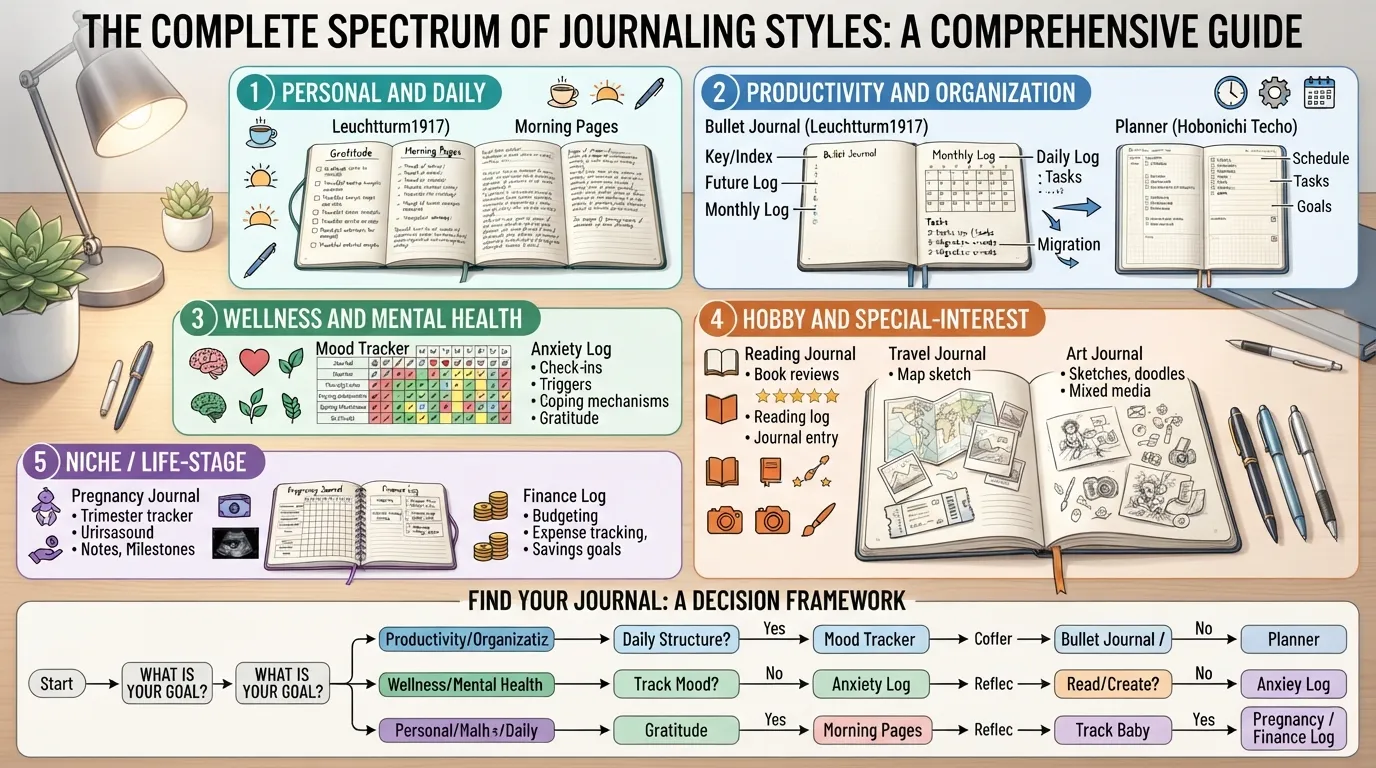
An organized infographic layout categorizing various types of journals including personal, productivity, wellness, and hobby notebooks with a section on how to choose the right one.

Have you ever stared at a blank notebook, bought with the best of intentions, only to abandon it a week later? If so, I want you to know you are not alone. The reason most people quit journaling isn’t a lack of discipline—it’s usually because they picked the wrong format for their actual needs. There isn’t just one type of “journal”; there are dozens of distinct kinds, and trying to force your thoughts into a template that doesn’t fit you is an uphill battle.

That is why I put together this complete map of every major journal type, thoughtfully grouped by what you are actually trying to accomplish rather than an overwhelming alphabetical dump. Whether you want to heal emotional blocks, track your habits, or tap into daily creativity, you will find your match here.

As you explore these options, think of this page as an extension of our core journaling hub, where we dive deep into the broader practice of mindful writing. Once you find a style that resonates with you, our comprehensive journal supplies guide will walk you through exactly what notebooks, pens, and tools you need to bring your vision to life.

Stick with me, and by the end of this guide, I will show you a foolproof method to pick the exact journal that you will actually stick with for the long haul.

Quick Answer: How Many Types of Journals Are There?

Yes, dozens of distinct journal types exist to suit almost every imaginable goal, but you don’t need to feel overwhelmed by the sheer volume. To make things simple, I find it easiest to cluster them into four core purpose-based categories depending on what you want to achieve.

  • Personal & Daily Journals: For processing thoughts, recording memories, and building a daily writing habit.

  • Productivity & Organization Journals: For structuring your days, hitting goals, and staying on top of your tasks.

  • Wellness & Mental Health Journals: For working through anxiety, practicing gratitude, and nurturing your emotional well-being.

  • Hobby & Special-Interest Journals: For diving deep into your favorite creative pursuits, reading habits, or traveling adventures.

(Note: While these four cover the daily essentials, I’ve also included a 5th “Niche & Life-Stage” bucket further down so you have a truly comprehensive view of every specialized option available.)

Personal and Daily Journals

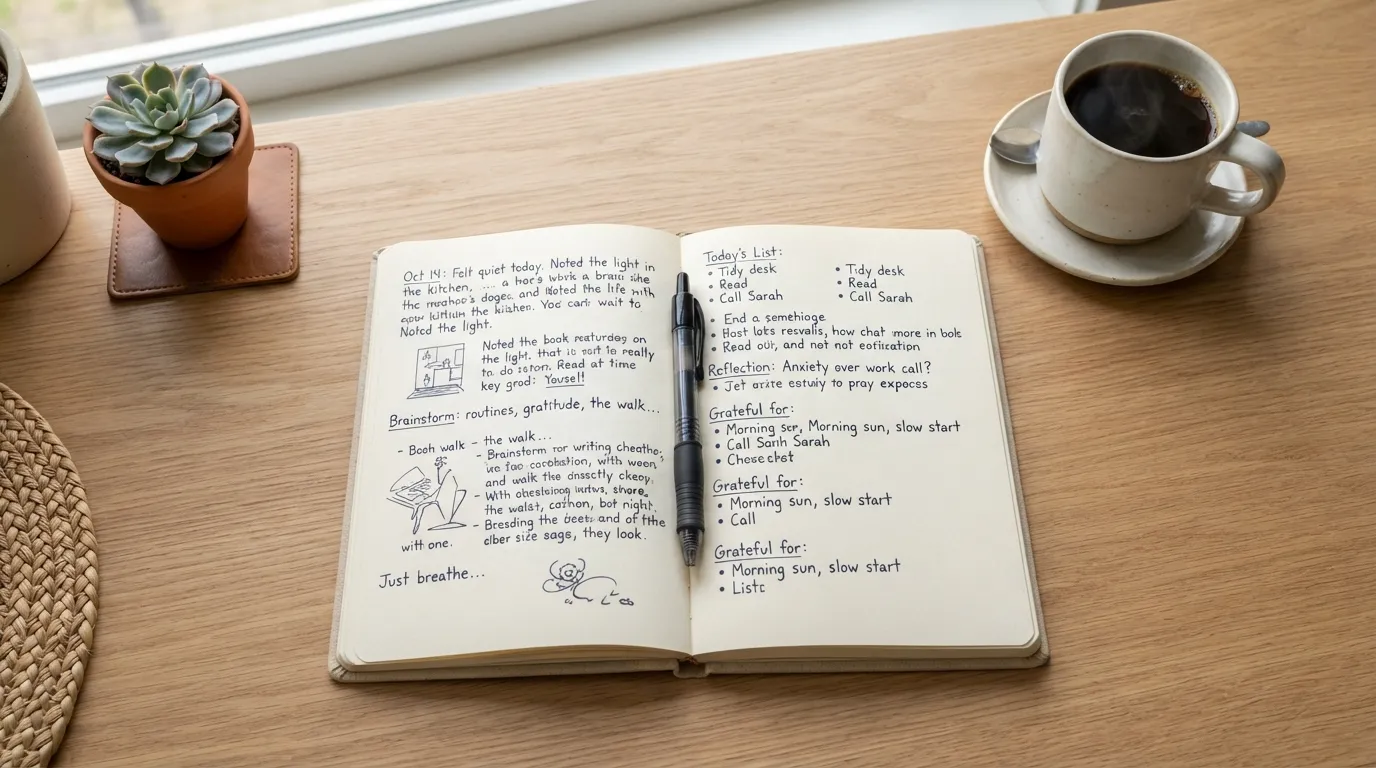
A flatlay photograph of an open minimalist daily journal, a trusty pen, and a warm cup of coffee on a clean wooden desk, representing a personal daily journaling habit.

When I think of the foundation of mindful writing, these are the formats that come to mind first. These are your classic “just write” journals—there are no rigid rules, no complicated systems, and no pressure. It is simply you, a trusty notebook, and your raw thoughts on the page every single day.

Diary / Daily Journal

A diary is a traditional, open-ended space where you record the raw events, feelings, and experiences of your day. Think of it as a judgment-free zone to debrief everything that happened from morning to night.

  • Best for: People who want a catch-all, low-pressure writing habit that acts as a mirror for their daily life.

  • How to start: Pick a time—like right before bed—and spend just five minutes writing down whatever stands out from your day without editing yourself.

Gratitude Journal

A gratitude journal is a dedicated space to intentionally shift your focus away from stress and onto the positive aspects of your life. The most popular approach uses a simple “3 things a day” format, where you list three specific things you are grateful for, ranging from deep relationships to a simple morning cup of coffee.

  • Best for: Shifting your mindset out of negativity bias and drastically reducing daily rumination.

  • How to start: If you ever stare at the page wondering what to write, check out our guide on journal prompts for inspiration to spark your daily appreciation.

Morning Pages

Originating from writer Julia Cameron’s famous concept, morning pages involve writing three full pages of stream-of-consciousness thoughts by hand first thing in the morning. You do not worry about grammar, elegance, or even making sense—you just dump everything onto the paper to clear your head.

  • Best for: Creatives, overthinkers, and anyone looking to clear mental clutter and silence their inner critic before the workday even starts.

Five-Year Journal

A five-year journal is a compact, specialized notebook where each page displays the same calendar day across five different years, with just a few lines allotted for each entry. As you write year after year, you get to see what you were doing on this exact date twelve months ago.

  • Best for: People who crave consistency and want to see their life’s long-term patterns without committing to a massive daily time investment.

  • Why it works better for habit-builders: Because you only have to write three or four lines a day, it removes the intimidation factor of a blank white page, making it infinitely easier to stick to.

Letter Journal

A letter journal involves writing ongoing letters to your future self, your past self, or even unsent letters to people in your life. Instead of standard diary entries, you frame your thoughts directly as a conversation with a specific recipient.

  • Best for: Processing complex emotions, gaining closure, and working through interpersonal conflicts safely without direct confrontation.

Productivity and Organization Journals

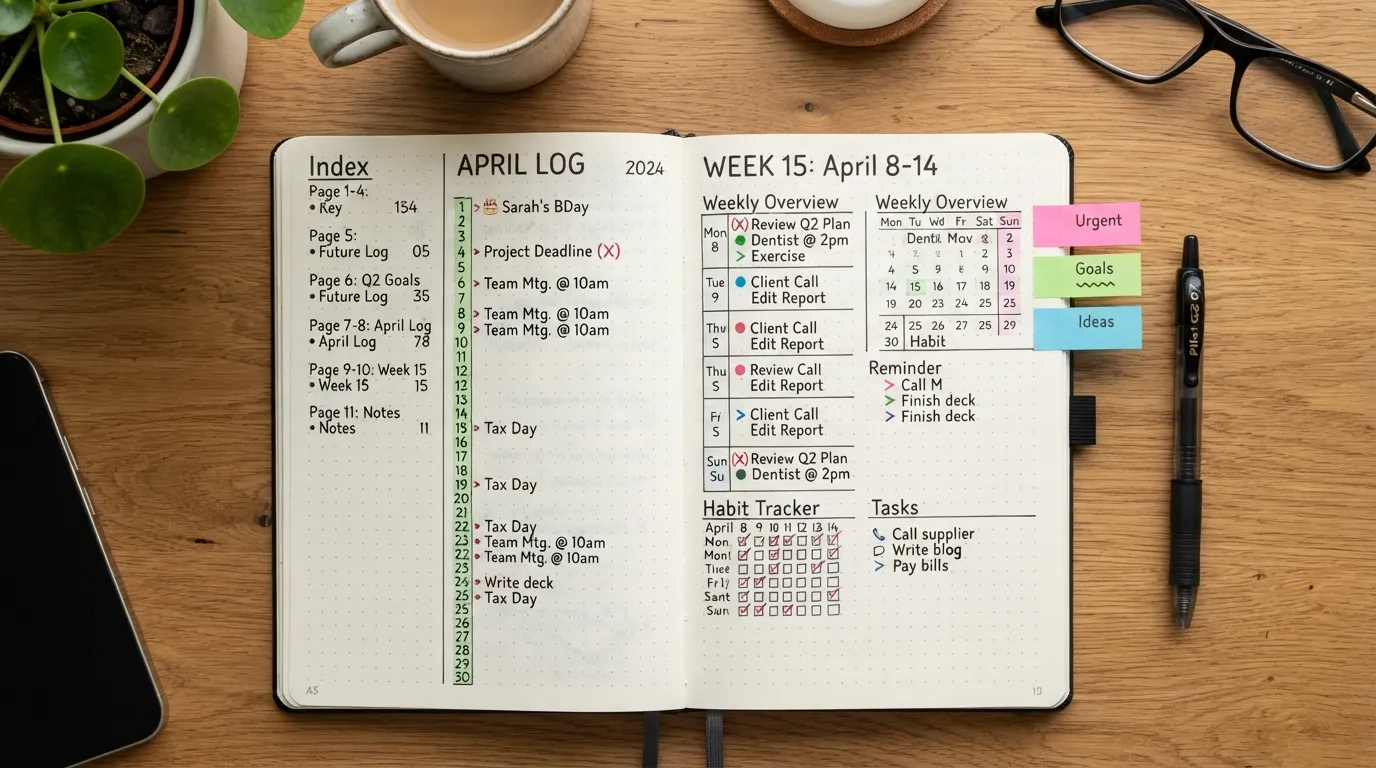
A flatlay photograph of productivity and organization journals featuring a dotted notebook with rapid-logging bullet lists, a colorful weekly planner grid, sticky notes, and a fine-liner pen on a clean wooden desk.

If personal journals are about exploring your inner world, these options treat your notebook as an active operating system. They are designed to streamline your to-do lists, map out your ambitions, and bring order to the chaos of a busy schedule.

Bullet Journal

A bullet journal is a customizable, analog system created by Ryder Carroll that uses “rapid logging” (short bullets, dashes, and checkboxes), an index, and dedicated collections to manage your tasks, schedule, and ideas in one place. It is famously the single most-searched type of journal across communities like Reddit and Pinterest, primarily because you can build it completely from scratch.

  • Best for: Visual planners, minimalists, and anyone who loves total customization over rigid pre-printed layouts.

  • A quick note on gear: Because this system relies heavily on specific formatting, choosing the right notebook is half the battle. If you are leaning toward this style, take a look at our guide on journal supplies to find the best dotted notebooks and bleed-proof pens for your layout.

Brain Dump Journal

A brain dump journal is a dedicated space for an unfiltered, total offload of everything swirling around in your head—from major life stressors down to random grocery items.

  • Best for: Anxious overthinkers and anyone who needs an end-of-day mental reset to stop their thoughts from racing.

  • The difference vs. a diary: While a traditional diary narrates the events or feelings of your day in sentences, a brain dump is purely tactical—it’s a messy, bulleted evacuation of cognitive clutter meant to be triaged, not necessarily read back later.

Goal-Setting / Vision Journal

A goal-setting journal combines strategic planning with personal ambition, utilizing frameworks like SMART goals, milestone trackers, habit charts, and physical vision board cutouts glued directly onto the paper.

  • Best for: Ambitious individuals actively working toward a specific life outcome, whether that is a career promotion, a fitness milestone, or a major financial target.

Work / Project Journal

A work journal is your professional command center, used to document meeting minutes, track project timelines, jot down quick feedback, and log your weekly wins.

  • Best for: Corporate professionals preparing for annual performance reviews, managers leading teams, and freelancers juggling multiple client projects at once.

Planner Journal

A planner journal is a pre-structured hybrid notebook that blends daily or weekly calendars with goal-setting prompts and notes pages.

  • Best for: People who love the tactile feel of putting pen to paper, but who don’t have the time or desire to draw out their own layouts from scratch every week.

Wellness and Mental Health Journals

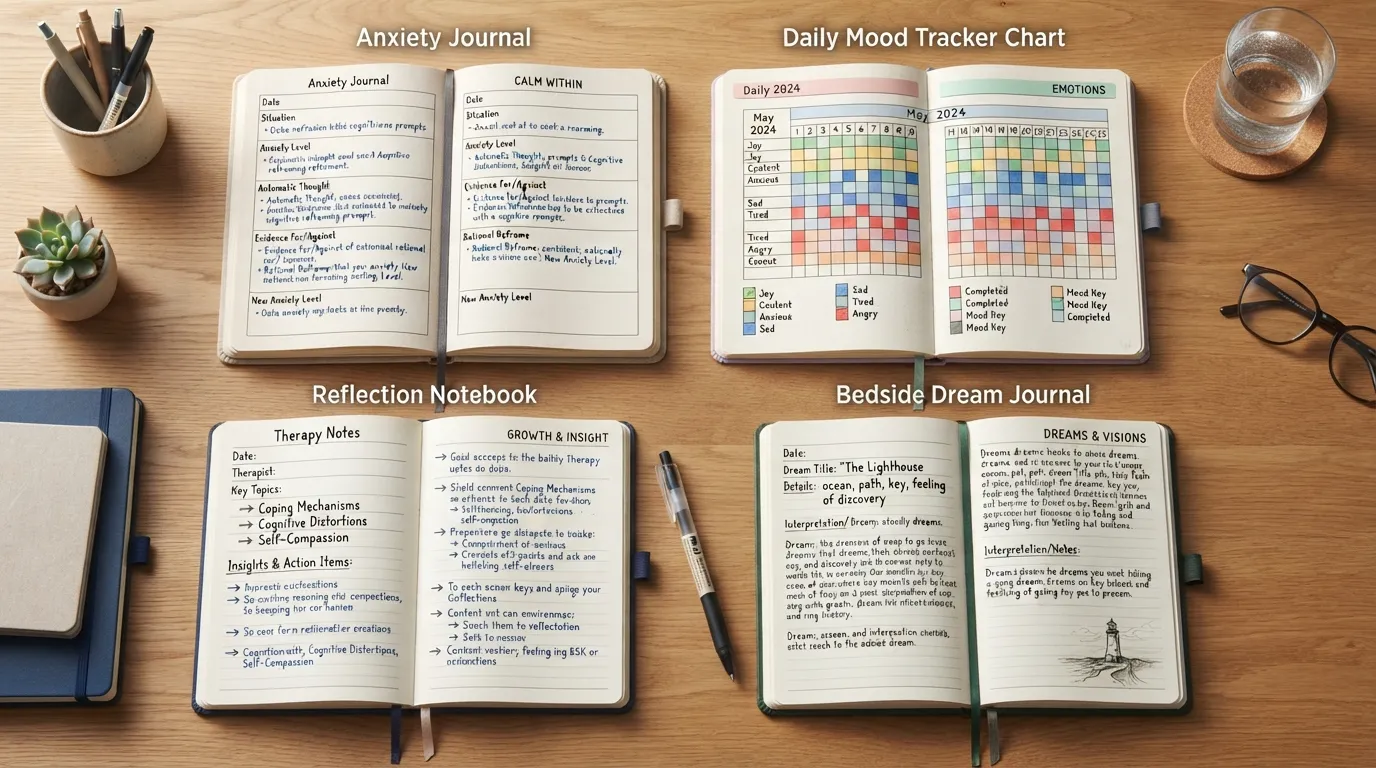
Flatlay photo of wellness and mental health journals featuring mood trackers, anxiety logs, and reflection notebooks with a pen on a clean wooden desk.

If you specifically came here searching for the types of journals for mental health, this is your core section. I want to emphasize that these options are designed purely for emotional processing, self-reflection, and inner healing—not for managing your to-do lists or hitting professional milestones.

Therapy / Reflection Journal

A therapy journal acts as a companion piece to your mental health journey. It is where you process breakthroughs from a session, write down homework assigned by your therapist, and explore feelings that surfaced during the week.

  • Best for: Anyone currently in therapy, considering counseling, or wanting to hold space for deeper self-reflection.

  • A quick note: While a reflection journal is an incredible tool for self-discovery, please keep in mind that it is meant to complement, not replace, professional mental healthcare.

Dream Journal

A dream journal is kept right by your bedside so you can capture the details of your subconscious mind the exact moment you wake up, before the memories fade.

  • Best for: People fascinated by their subconscious patterns, symbolic imagery, or recurring dreams that pop up during sleep.

Mood Tracker Journal

A mood tracker journal involves rating your daily emotions on a structured scale and jotting down quick notes about potential triggers, sleep quality, or social interactions that influenced your day.

  • Best for: Spotting subtle lifestyle patterns and understanding how factors like stress, rest, or environment affect your baseline happiness.

  • How to start today: Try a simple 1–10 scale method where you draw a quick line graph or color in a tiny daily square based on your overall mood, followed by one sentence explaining why.

Anxiety Journal

An anxiety journal uses structured, guided prompts to help you name your physical symptoms, interrogate racing thoughts, and safely reframe cognitive distortions before they spiral out of control.

  • Best for: Anyone specifically seeking out a structured tool for managing anxiety and grounding themselves during high-stress moments.

  • A quick note: Just like a therapy journal, this is a wonderful emotional outlet, but always reach out to a licensed professional if your anxiety becomes overwhelming.

Hobby and Special-Interest Journals

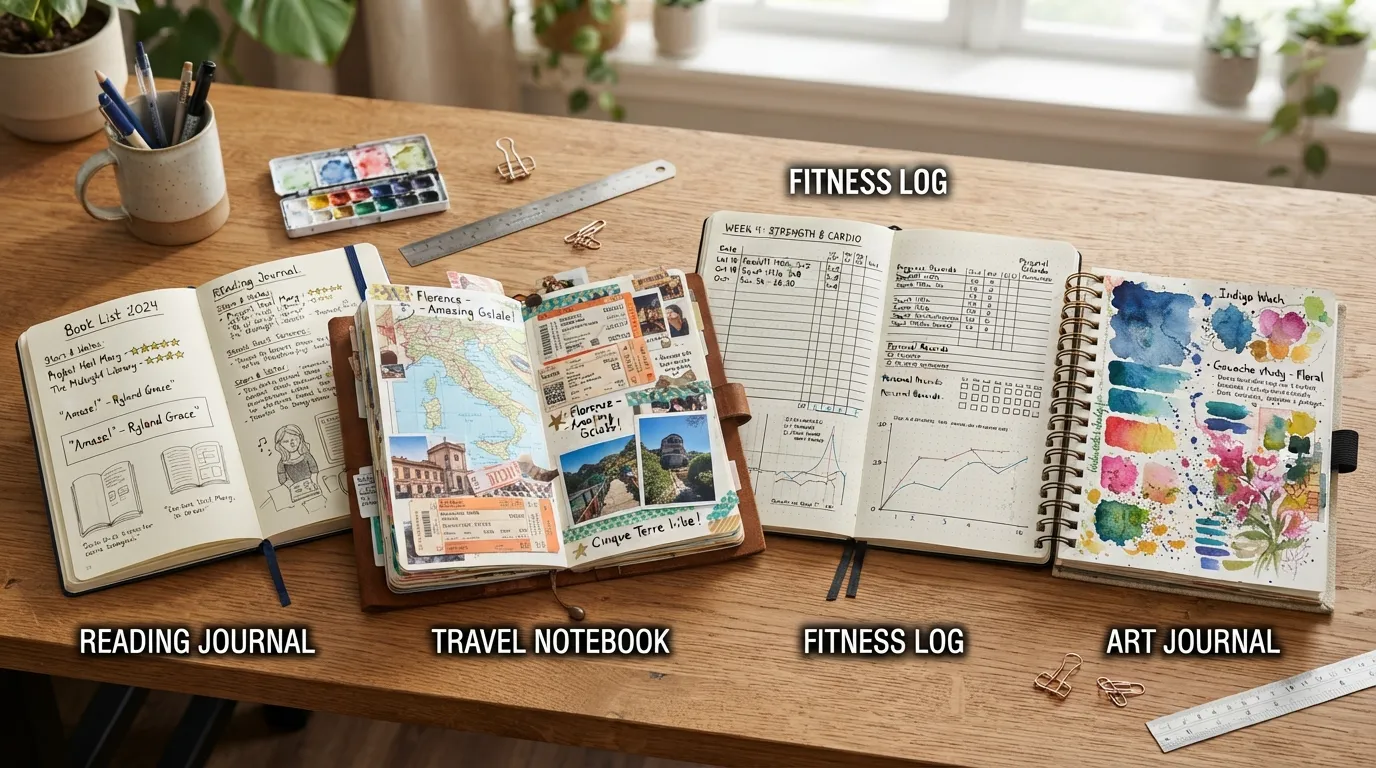
A flatlay photograph of various hobby and special-interest journals, including a reading log, a travel notebook, a fitness tracker, and an art sketchbook spread out on a wooden desk.

Sometimes, the best way to build a lasting journaling habit is to tie it directly to something you already love doing. These special-interest notebooks turn your favorite hobbies into active, creative archives rather than letting your experiences slip away.

Reading Journal

A reading journal is a dedicated space to log the books you read, track your annual reading goals, record favorite quotes, and rate titles with your own custom review system.

  • Best for: Book club members, voracious readers, and anyone who wants to remember the details of what they consume long after turning the final page.

Travel Journal

A travel journal goes far beyond a basic itinerary by capturing the sensory details, ticket stubs, local flavors, and unexpected moments that define a trip.

  • Best for: Frequent travelers and keepsake-lovers who want to preserve the feeling of a place, not just a timeline of where they went.

Food Journal

A food journal serves two entirely different purposes depending on your goals: it can act as a technical log for tracking nutrition and spotting food sensitivities, or it can be a cozy repository for collecting family recipes and restaurant reviews.

  • Best for: People overhauling their eating habits and fitness routines versus culinary enthusiasts looking to curate their personal cookbook.

Fitness Journal

A fitness journal is your physical training log used to track weight lifted, running times, progress photos, and personal records (PRs) session after session.

  • Best for: Anyone training toward a specific physical goal, whether that is running a marathon, building muscle, or tracking daily movement.

Commonplace Book

A commonplace book is a timeless, lifelong scrapbook where you collect striking quotes, fascinating ideas, and passages from the things you read across your lifetime.

  • Best for: Lifelong learners, writers, and curious thinkers who want a centralized bank of wisdom to draw from.

Nature Journal

A nature journal combines observation with creativity, inviting you to sketch plants, document local wildlife, and track seasonal weather changes in your backyard or local trails.

  • Best for: Outdoor enthusiasts, homeschool families, and citizen science hobbyists who want to deepen their connection to the natural world.

Art / Creative Journal

An art journal is a visual, mixed-media space for self-expression using paint, collage, ink, and drawing—often with little to no writing required.

  • Best for: People who process emotions and ideas much better visually through color and shape than they do through traditional words.

Junk Journal

A junk journal is a delightfully tactile, handmade book crafted entirely from recycled ephemera like old book pages, vintage maps, packaging, and ticket stubs.

  • Best for: Crafters, upcyclers, and scrapbook-adjacent hobbyists who love the hands-on process of creation.

  • A quick note on materials: Because junk journaling relies so heavily on physical collage elements, having the right adhesives, papers, and cutting tools makes all the difference. You can explore our dedicated journal supplies guide to find everything you need to start building your own altered book from scratch.
Niche and Life-Stage Journals

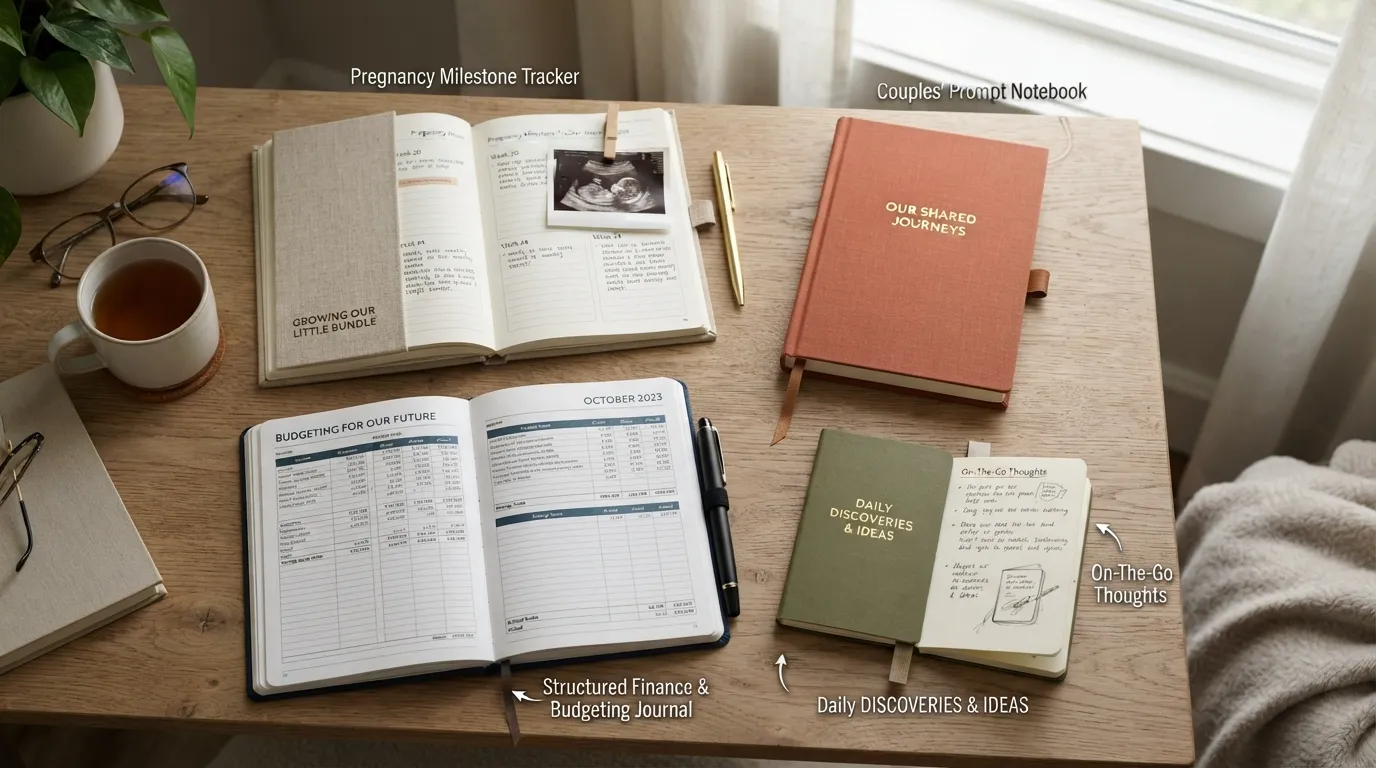
A flatlay photograph of specialized journals categorized by life stages, including a pregnancy journal, finance tracker, and couples notebook on a wooden desk.

While daily and hobby journals get most of the spotlight, there is a whole world of specialized notebooks designed for distinct life transitions. This is the depth section that many guides skip, focusing instead on the types of journals tied to a specific milestone, spiritual practice, or temporary season of life rather than an ongoing hobby.

Pregnancy Journal

A pregnancy journal is a specialized keepsake used to track weekly physical symptoms, medical milestones, baby bump growth, and the emotional journey leading up to childbirth.

  • Best for: Expecting parents who want to document a once-in-a-lifetime experience and pass the filled notebook down to their child as a future heirloom.

Finance Journal

A finance journal provides a physical space for mapping out monthly budgets, tracking expenses by hand, and reflecting on your spending psychology away from the screen.

  • Best for: People who find digital spreadsheets cold and want a tactile, intentional alternative or companion to modern budgeting apps.

Relationship / Couples Journal

A relationship journal features guided, shared prompts designed for two people to answer independently or together, offering a safe container for constructive communication and appreciation.

  • Best for: Couples who want to establish a structured weekly check-in ritual to deepen intimacy and stay emotionally connected.

Family / Group Journal

A family journal is a communal notebook passed physically between family members or sent back and forth among close friends to share updates, inside jokes, and life reflections.

  • Best for: Multi-generational memory-keeping in a household or maintaining deep bonds across long-distance friendships.

Faith / Bible Journal

A faith journal is dedicated to spiritual study, featuring scripture reflection, annotated book passages, and personal prayers written directly into the margins.

  • Best for: Readers and believers pursuing a structured spiritual practice through contemplative writing and study.

Pocket Journal

A pocket journal is a miniature, ultra-portable notebook designed to slip seamlessly into a back pocket or small bag so you can capture fleeting thoughts anywhere you go.

  • Best for: Idea-catchers, commuters, and forgetful thinkers who need an analog safety net the second inspiration strikes.

How to Choose the Right Type of Journal for You

With so many options on the table, it is easy to fall into the trap of overthinking your choice. Instead of hunting for one more format, let’s bring it back to your actual goal and what you realistically want to get out of your notebook each day.

Use this quick decision framework to cut through the noise and find your fit:

  • “I just want to process my day” Head straight to Personal & Daily journals like a classic diary or a five-year log.

  • “I want to get organized” Grab a Productivity & Organization notebook like a bullet journal or a structured planner.

  • “I’m dealing with stress or emotions” Choose a Wellness & Mental Health journal focused on anxiety reframing or mood tracking.

  • “I want a creative outlet or hobby tracker” Pick a Hobby & Special-Interest journal tailored to reading, travel, or art.

  • “I’m in a specific life season” Opt for a Niche & Life-Stage book designed around pregnancy, finance, or faith.

The secret that experienced writers know? You do not have to commit to just one style forever. As industry experts note across the journaling space, combining and overlapping different styles over time is entirely normal—your notebook should evolve right alongside your changing needs.

Now that you know what kind of journal matches your goals, your next step is finding the right physical tools to bring it to life. Take a look at our comprehensive guide on journal supplies to pick out the ideal notebook format, paper weight, and pens. And if you want to explore deeper tips on building a lasting writing routine, be sure to visit our main journaling hub to keep your momentum going.

Frequently Asked Questions

What are 7 types of journals?

While there are many styles available, 7 of the most popular types include personal diaries, bullet journals, gratitude journals, dream journals, travel journals, reading journals, and art journals. Each format serves a distinct creative or reflective habit.

What are the 5 types of journals?

The core categories outlined in this guide encompass Personal & Daily writing, Productivity & Organization, Wellness & Mental Health, Hobby & Special-Interest, and Niche & Life-Stage notebooks. These categories help structure your selection process.

What are 6 types of journals?

Alternative popular journal formats include prayer and spiritual notebooks, fitness and health trackers, food and recipe logs, baby milestone books, financial budgeting journals, and professional career planners. Each style supports specific lifestyle tracking goals.

What are some famous journals?

Several historical notebooks have left a profound mark on literature and philosophy. Notable examples include Anne Frank's poignant wartime diary, Leonardo da Vinci's visionary scientific sketchbooks, and Marcus Aurelius's private philosophical reflections in Meditations.

What's the difference between a journal and a diary?

A diary traditionally focuses on a chronological, day-to-day record of personal events and immediate happenings. In contrast, a journal is a broader space that often includes reflections, creative ideas, goal planning, emotional processing, and structured prompts.

Are academic and scientific journals the same as these types?

No, academic and scientific publications or accounting ledgers are entirely different subjects from personal notebooks. If you want to keep exploring personal writing, you can check out the holistic journaling category instead.

At the end of the day, remember that there is no single “correct” journal type etched in stone. The absolute best journal is simply the one that fits your lifestyle and the one you will actually keep using week after week. If you are ready to take the next step, head back over to our primary journaling hub to explore more prompts and guides, or dive straight into our curated journal supplies page if you already know your style and are ready to pick out your tools.

Link copied to clipboard!

Editorial Integrity

Our content is 100% human-written, evidence-backed, and continuously updated to fulfill reader intent with maximum honesty.

Daily Mindset Shift

"Small, consistent habits compounded over time create unshakeable momentum."

Leave a Comment