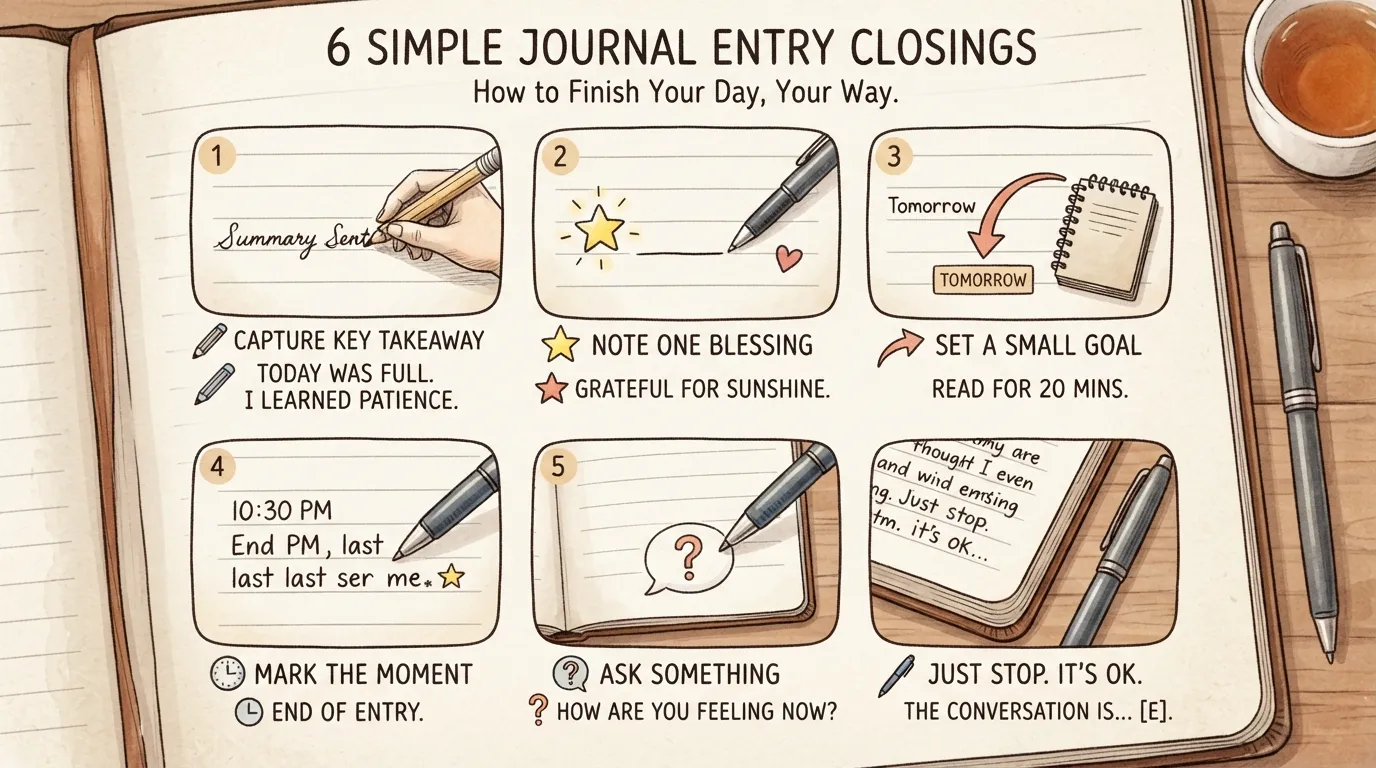
There’s no single “correct” way to end a journal entry — the ending just needs to feel like a natural stopping point for you. Most people close with one of a few simple methods:
- A summary sentence that captures the day’s main feeling
- A gratitude line — one small thing you’re thankful for right now
- An intention for tomorrow — a tiny, realistic goal
- A sign-off — a time stamp, your initials, or a small doodle
- A question to your future self, left open for later
Pick whichever fits your mood tonight. You don’t need to use the same one every time.
6 Simple Ways to End a Journal Entry
Most people overthink the ending far more than they need to. A simple process helps: reread the last couple of lines you wrote, notice what kind of note you want to leave on, write one short closing line, and close the notebook or app. That’s the whole process — no editing, no polishing.
Here are six ways to do that last part.
The Summary Sentence
One line that captures the theme of the entry — not a recap of everything you wrote, just the feeling underneath it. Something like “Today was heavier than I expected, but I got through it” does more work than a paragraph of wrap-up.
The Gratitude Line
A single specific thing, not a general “grateful for my life” statement. Specificity is what makes it land — “grateful for the five extra minutes of coffee before the day got loud” sticks with you in a way a vague line doesn’t.
The Intention for Tomorrow
Small and realistic beats big and vague. “Tomorrow I want to leave for work ten minutes earlier” is something you can actually act on. “Tomorrow I’ll be better” isn’t.
The Sign-Off
The simplest option: just a time stamp, your initials, or a tiny doodle in the corner. It works especially well on days when you don’t have anything left to say but still want a visual marker that the entry is done.
A Question to Future You
End with something you’re curious about later — “I wonder if I’ll still feel this way in a month” or “Will this even matter next week?” It gives the entry a thread to pick back up on, without forcing you to resolve anything tonight.
Just Stop — No Wrap-Up Needed
Sometimes the most honest ending is no ending at all. If your last sentence trails off mid-thought, that’s fine. Closing the notebook is the closing — you don’t owe the page a tidy final line, especially on a day that wasn’t tidy either.
Closing lines by mood, ready to use:
- Calm / reflective day: “That’s where today lands. Onward tomorrow.”
- Grateful day: “Holding onto the good part of today before I close this.”
- Hard / anxious day: “I don’t have it figured out, but I got the words out. That’s enough for tonight.”
- Messy / unresolved day: “Not sure where this thought goes yet — leaving it here for now.”
The 3-3-3 Journaling Method — Does It Apply to Endings?
The 3-3-3 method is a simple structure some people use to keep entries short: three sentences about your day, three things you’re grateful for, and three words describing how you feel. It’s mainly a starting framework, but it doubles as a built-in ending — once you’ve hit your third gratitude item or third feeling-word, the entry is naturally done. If you tend to overwrite and struggle to stop, borrowing this structure can solve the “how do I end this” problem before it starts.
How to End a Diary Entry for School
For a class journal, reading log, or reflection assignment, the ending usually needs to be a little more intentional than a personal diary — teachers are often looking for a clear closing thought, not just a trailing sentence. A good structure: restate what you learned or felt in one sentence, then close with a short forward-looking line. For example: “Reading this chapter made me think about how differently characters can see the same event. Next time I read, I want to pay closer attention to whose perspective the story is told from.”
For IGCSE / Exam Writing Tasks
Directed-writing diary entries on exams (like IGCSE English) are graded partly on register and structure, so the ending matters for marks, not just style. Examiners generally want to see a natural close that reflects back on the entry’s main event or emotion, written in the same informal, first-person voice as the rest of the entry — not a formal conclusion. A model closing line: “I still can’t quite believe today happened. I suppose I’ll find out tomorrow what it all means.” Keep it in character, keep it short, and avoid switching into a more formal tone just because it’s the last line — that shift is often flagged as a register error.
Words & Phrases to Use When Closing an Entry
A short bank of phrases to drop in when you’re stuck for how to finish:
- “That’s where I’ll leave it for tonight.”
- “More on this tomorrow, maybe.”
- “For now, that’s enough.”
- “I’ll pick this back up when I have more to say.”
- “Closing this one on a better note than it started.”
- “Until next time, Kitty.” (a nod to the diary-letter style, if that’s your format)
- “Signing off for today.”
- “That’s the last of it — goodnight.”
Cute Ways to End a Diary Entry
If your journal leans playful rather than reflective, the ending can do a little more than just wrap up the writing:
- A tiny doodle in the bottom corner — a moon for night entries, a sun for morning ones, a heart on good days
- A one-word “mood stamp” in a different color pen (e.g., “soft,” “chaotic,” “cozy”)
- A small sticker or washi tape strip as a visual sign-off
- A short made-up “rating” of the day, like a star count or a made-up grade
- Signing off with a nickname or a consistent little symbol that’s just yours, so every entry ends the same recognizable way
What Not to Do When Ending an Entry
- Don’t force a neat conclusion. Not every entry needs a lesson learned or a silver lining — some days just end messy, and that’s an honest ending too.
- Don’t obsessively reread and edit before closing. Journaling isn’t a draft that needs polishing; rereading to “fix” the ending often turns into rereading to judge yourself, which defeats the point.
- Don’t skip the ending out of guilt. If you started an entry and didn’t finish the thought, you don’t need to apologize to the page or explain why. Close it and move on — the next entry doesn’t need to make up for it.
A Full Example — Diary Entry with a Natural Ending
Dear diary,
Today felt like one of those days that moved faster than I could keep up with. Work was busy from the start, and I barely had a minute to think until the evening. I meant to go for a walk after dinner but ended up just sitting on the porch instead, which honestly might have been better.
I keep thinking about that conversation with my sister earlier — not in a bad way, just turning it over. I don’t think I need to figure it out tonight.
Grateful for the porch, the quiet, and the fact that tomorrow is a slower day. That’s where I’ll leave it for now.
FAQs
Journaling Insights & FAQs
What were Anne Frank's last diary words?
Anne Frank wrote her final diary entry on August 1, 1944, reflecting on the contradictions between how others saw her and how she felt inside — three days before she and her family were arrested. It remains one of the most well-known real-world examples of how a diary entry can end on an open, unresolved thought rather than a tidy conclusion.
What should I write in the salutation for my diary entry?
Traditional diaries often open with "Dear Diary" or a name you've given your journal (Anne Frank famously addressed hers to "Kitty"), but plenty of modern journalers skip a salutation entirely and just start writing. Neither is more "correct" — it comes down to whether that little ritual helps you get into the headspace to write.
For more on getting started, see our guide on how to start journaling.
Pimchanok Srisuk
Pimchanok Srisuk is the Journaling Editor at Holistic Wellbeing Living. She writes about journaling prompts, reflective writing, emotional clarity, and mindful routines. With seven years of experience creating personal-growth content, Pimchanok helps readers use simple writing practices to understand their thoughts and make calmer everyday decisions.