
What "Journaling Daily" Actually Means and What It Doesn't
Forget the pristine leather-bound books filled with flawless cursive and profound philosophical epiphanies. Real daily journaling is messy, brief, and entirely for you. It does not require twenty minutes of silent reflection or a poetic recap of your entire day.
Some days, your entry will be a frantic brain dump about a stressful email. Other days, it might just be three bullet points scribbled while your lunch heats up in the microwave.
Consistency over volume: Writing three sentences every single day beats writing a ten-page essay once a month.
Zero editing: This is not a memoir for public consumption. Spelling mistakes, crossed-out lines, and half-formed thoughts are signs that you are doing it right.
Flexibility of time: A daily check-in can take two minutes. If you have time to scroll through social media, you have enough time to write down a few honest thoughts.
Lower the bar until it is impossible to fail. The goal is simply to show up for yourself, even if it is just for sixty seconds.
Before You Start: Pick Your Format
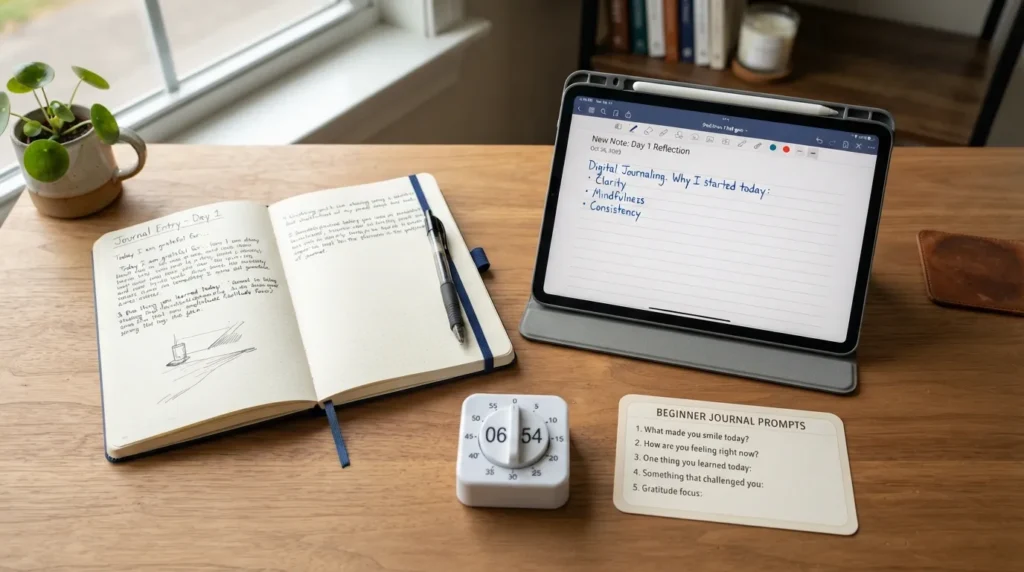
Physical notebook vs. digital/app journaling
Writing on actual paper creates a physical ritual that signals your brain to slow down. Turning off your screens for five minutes gives your eyes a break and keeps notifications from hijacking your train of thought.
On the flip side, typing on your phone or laptop means your journal is always in your pocket. Digital notes are searchable, making it easy to track patterns over months or years without flipping through dozens of physical pages.
Physical pros: Sensory grounding, zero digital distractions, and a tangible archive you can hold.
Digital pros: Infinite portability, lightning-fast search capabilities, and the ability to type faster than you write.
Freeform vs. guided/prompted journaling
A completely blank page can feel liberating or terrifying, depending on how much mental energy you have left at the end of the day. Choosing the wrong format for your current mood is usually why people abandon the habit after three days.
When a blank page works: Use open-ended free writing when you feel overwhelmed and just need to get the noise out of your head. There are no rules here, so let your pen wander wherever it wants to go.
When prompts help: Lean on specific questions when you feel uninspired or tired. A targeted prompt bypasses writer’s block by giving your brain a single, narrow target to aim at.
The 5-Minute Daily Journaling Method
Step-by-step
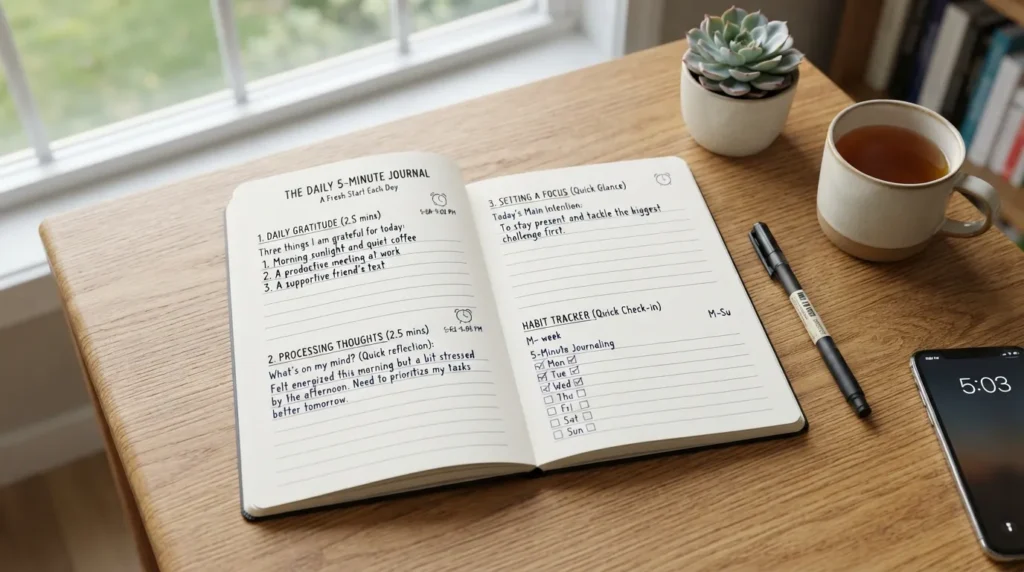
To keep the momentum going, you need a rigid structure that removes decision fatigue. You don’t need to reinvent the wheel every single time you sit down to write. Follow this sequence:
The Date: Write it down. It sounds trivial, but it anchors your entry in time and makes your notes valuable to look back on months later.
The Brain Dump: Spend three minutes offloading whatever is currently taking up space in your head. Do not worry about structure or grammar. If you are anxious about a meeting, write it down. If you are frustrated by a minor inconvenience, put it on paper.
The Gratitude Line: Force yourself to identify one specific thing that went well. Be granular. Instead of “I am grateful for my family,” try “I am grateful that my brother made me laugh during our call today.”
The One Goal: Write down a single, actionable priority for tomorrow. Keeping it to just one goal prevents you from feeling overwhelmed and helps you start the next day with immediate clarity.
Why keeping it under 5 minutes matters for consistency
When you make your journaling habit feel like a heavy chore, your brain will naturally look for excuses to skip it. By imposing a five-minute limit, you shift the task from a “project” to a “maintenance routine.”
Psychological research on habit formation suggests that the easier a new behavior is to start, the more likely it is to stick. If you only have to commit to five minutes, you remove the “I don’t have enough time” excuse entirely. It becomes impossible to negotiate your way out of it because five minutes is a negligible cost to pay for the mental clarity you receive in return. Keep it short, finish it quickly, and move on with your day.
Build the Habit With a Trigger, Not Willpower
Anchor journaling to an existing habit
Willpower is a finite resource. If you wait until you “feel like” journaling, you are leaving your success up to your mood, which is why most people quit after a week. Instead, attach your journal to a habit that is already hard-wired into your day.
If you already drink coffee every morning, that is your trigger. If you brush your teeth every night without fail, that is your anchor. By linking the new behavior to a sequence you already perform, you stop having to make a choice. You simply transition from one action to the next on autopilot.
Keep the notebook or app visible where the trigger happens
Visibility is the ultimate nudge. If your journal is tucked away in a desk drawer, it might as well not exist. You need to create friction for your old distractions and zero friction for your new habit.
If you use a physical notebook, place it directly on top of your phone charger or beside your toothbrush. If you prefer a digital app, move the icon to your home screen so it is the first thing you see when you unlock your phone. You want the tool to be staring you in the face exactly when the trigger occurs.
Good triggers: Right after you pour your morning coffee, the moment you sit down on the train, or immediately after you set your alarm for the night. These are stable events that happen in the same place every day.
Bad triggers: Writing “whenever I have a spare moment” or “after I finish my chores.” These are vague and inconsistent, giving your brain too many opportunities to talk you out of the commitment.
The 3-3-3 Journaling Method Explained
If a blank page still feels intimidating even after you have set your triggers, you need a strict boundary. The 3-3-3 method gives you an invisible fence so you never have to wonder what to write next or worry about how long you are taking.
The structure is simple. You spend 3 minutes answering 3 specific prompts, writing exactly 3 sentences for each one. That is a total commitment of nine sentences and roughly three minutes on the clock.
Prompt 1: What is draining my energy right now? Write three sentences about the immediate friction points in your day. This might be a looming deadline, an annoying household chore, or a lingering argument. Getting it out of your head stops the mental loop.
Prompt 2: What am I avoiding? Write three sentences calling out the task or conversation you are trying to ignore. Naming the resistance shrinks it, making it much harder for procrastination to hide in the shadows.
Prompt 3: What is one small win I can claim today? Write three sentences acknowledging progress. It does not have to be a massive milestone. It could be answering a tough email, going for a ten-minute walk, or simply cooking a real meal instead of ordering takeout.
By capping your output at three sentences per prompt, you eliminate the temptation to overthink or over-edit. You get in, you clear the mental clutter, and you get on with your day.
The 3-2-1 Journaling Method Explained
When you want a quick, wind-down ritual that clears your head before sleep, the 3-2-1 method offers a structured alternative. It acts as a mental broom, sweeping away the leftover debris of the day so you can actually rest.
The numbers represent a descending countdown of prompts designed to transition you from high-stress thinking into calm reflection.
3 things you are grateful for: Start with a small gratitude sweep. List three specific details from your day, like the warmth of your afternoon tea, a productive call with a colleague, or the way the sunlight hit your window. Grounding yourself in appreciation lowers your heart rate and shifts your focus away from what went wrong.
2 things you can control right now: Acknowledge your current boundaries by listing two things within your immediate power. This might be shutting down your laptop, drinking a glass of water, or deciding to go to sleep at a reasonable hour. It stops your brain from spinning out over unfixable problems.
1 thought or intention for tomorrow: Close with a single, clear takeaway or focus area for the morning. Setting one priority stops your mind from waking up in a panic about everything on your to-do list.
By narrowing your focus from three items down to one, you naturally de-escalate your mental state. It takes less than three minutes, requires zero deep soul-searching, and gives your brain a clean slate for the night.
What to Write When You Don't Know What to Write
Staring at a blank page when you have zero mental bandwidth is the quickest way to kill a new habit. When your brain feels like static, don’t try to force a profound essay. Rely on these specific, low-friction prompts to get the ink flowing without needing a spark of inspiration.
Simple daily prompts
Mind right now: A single sentence on the immediate weather inside your head. Are you feeling scattered, annoyed, calm, or just plain tired?
One good moment: Force your brain to scan for a positive highlight, even if it is tiny. It could be the taste of your coffee, a funny video you saw, or a productive ten minutes of work.
How I feel: Describe your physical state. Sometimes, labeling “I feel heavy in my shoulders” or “I feel restless” is all the release you need to move forward.
One goal: Name the one thing you need to move the needle on tomorrow. Keep it small enough that you can actually finish it.
Bullet-point-only technique for low-energy days
If even writing a full sentence feels like heavy lifting, stop writing in sentences entirely. The goal of journaling is to capture your thoughts, not to practice grammar. On days where you are drained, just fire off three to five bullet points.
List fragments: “Meeting was long.” “Need to buy milk.” “Glad it’s Friday.”
Prioritize speed: If you can write it in under sixty seconds, you have succeeded.
Remove the pressure: Tell yourself that a list of bullets is a “successful” entry. It counts just as much as a full-page reflection, and it keeps your streak alive when you would have otherwise skipped a day.
The 7 Types of Journals Pick What Fits You
If you have tried journaling in the past and felt like you were forcing a square peg into a round hole, it is likely because you were using the wrong format for your brain. One of these seven approaches might finally click:
Gratitude Journal: Focuses strictly on the small wins and positive moments, helping you rewire your brain to scan the day for things to appreciate.
Bullet Journal: Uses a rapid-logging system of symbols and short notes to organize tasks, schedule, and thoughts all in one place.
Reflective Journal: Provides a safe space to process complex emotions or past experiences and gain perspective on your personal growth.
Dream Journal: Dedicated to recording your subconscious thoughts immediately upon waking to explore recurring themes or symbols in your dreams.
Travel Journal: Captures the sights, sounds, and specific memories of new experiences, turning trips into permanent, descriptive archives.
Prompt-Based Journal: Uses pre-written questions or themes to bypass writer’s block and force you to look at your life from different angles.
Habit-Tracker Journal: Combines daily check-ins with visual grids to measure how consistently you are sticking to your goals or new behaviors.
Morning or Evening — Which Is Better for Daily Journaling?
The debate between morning and evening journaling often comes down to personal rhythm and goals. However, science and habit formation point to distinct advantages for each. Here is a breakdown of the two approaches to help you decide which fits your daily routine.
The Case for Morning: Intention-Setting
Morning journaling acts as a mental clearinghouse for the day ahead. By putting pen to paper before checking your phone or diving into work, you take control of your narrative rather than reacting to the world’s demands.
Proactive Focus: Clarifies top priorities and sets a deliberate tone for the day.
Mental Clarity: Brain-dumping anxieties or stray thoughts early frees up cognitive bandwidth for complex tasks.
Creative Boost: The mind is often fresh, making it an ideal time for stream-of-consciousness writing or brainstorming.
Best for: Individuals who feel overwhelmed by daily to-do lists, want to cultivate mindfulness, or need a structured boost of motivation to start the day.
The Case for Evening: Processing and Reflection
Evening journaling is the ultimate decompression tool. It allows you to transition away from the stress of the workday and close the psychological loop on tasks, conversations, and events.
Emotional Regulation: Helps process difficult emotions, frustrations, or failures constructively before sleep.
Gratitude and Closure: Reflecting on daily wins—no matter how small—reinforces positive neural pathways and improves sleep quality.
Habit Tracking: Provides a natural moment to review what went well and what you can adjust tomorrow.
Best for: Overthinkers, busy professionals looking to separate work life from personal life, and anyone struggling to wind down at night.
The Verdict: Trigger Consistency Matters More Than Time of Day
While morning and evening offer different psychological benefits, the exact time you journal matters far less than the trigger you attach it to.
Habits stick best when anchored to an existing routine (known as “habit stacking”):
If you choose mornings: Anchor your writing to your first cup of coffee or tea.
If you choose evenings: Anchor your writing to brushing your teeth or shutting down your laptop.
Ultimately, the “best” time to journal is simply the one you can commit to consistently.
Journaling Daily for Different Needs
For self-improvement/goal tracking
Purpose: Built for habit formation, tracking personal milestones, and measuring progress against specific objectives.
What to write: Keep entries brief—focus on daily wins, habits completed, roadblocks encountered, and one adjustment for tomorrow.
Internal Link: Return to our main habit-tracking guide to set up your foundational daily tracker.
Christian/faith-based daily journaling
Purpose: Designed to center your day around spiritual reflection, scriptural meditation, and cultivating a posture of worship.
What to write: Lean into a prayer journal angle. Start with gratitude-to-God framing, thank Him for specific daily blessings, write out a short verse that speaks to your current season, and lift up your daily burdens in prayer.
Looking for something more specific? See our guides on manifestation journal prompts / journal prompts for mental health / anxiety journal prompts.
Troubleshooting Common Journaling Barriers
Worried someone will read it?
The fear of exposure is enough to make anyone censor their true thoughts, which completely defeats the point of writing. If you need total privacy, you have a few reliable options depending on your preferred format.
Physical hiding spots: Slide your notebook under a mattress, inside a locked drawer, or store it vertically between heavier books on a crowded shelf.
Encrypted digital notes: Use note-taking apps that require a biometric scan, Face ID, or a strict passcode to unlock your private entries.
The “burn strategy”: If absolute honesty matters more than preserving your thoughts, give yourself permission to rip up or shred pages that contain raw, sensitive processing as soon as you finish writing them.
Not feeling motivated?
Motivation is fickle, which is why relying on it will stall your habit within a week. When you feel uninspired or tired, do not wait for a lightning bolt of enthusiasm. Instead, manufacture artificial momentum by pairing the act with a sensory ritual.
Pour a fresh cup of tea, move to a specific corner of the couch where your laptop is banned, or light a single candle before you open the book. By turning the physical environment into a comforting ceremony, your brain starts craving the cozy routine rather than resisting the blank page.
Journaling brings up heavy emotions?
Sometimes writing acts as a pressure valve, releasing difficult grief, stress, or anger you did not realize you were carrying. If your thoughts start heading into a dark or overwhelming place, you do not have to force yourself to power through it.
Set a strict timer for five minutes so you know there is a hard stop to the heavy lifting. If the feelings become too intense, it is completely okay to snap the journal shut, step away from the desk, and return to it later. Your journal is a tool to support your mental health, not a torture device.
What Not to Do / Common Journaling Mistakes
Don’t aim for perfect prose: This is not a creative writing assignment or a manuscript for publication. If you spend your five minutes worrying about vocabulary, grammar, or phrasing, you will freeze up. Let the words tumble out raw, misspelled, and unpolished.
Don’t skip because an entry feels “not worth writing”: You will have days where your only thought is that you are tired and have nothing to say. Write down “I have nothing to say today” and leave it at that. The win is the act of showing up, not the profundity of the insight.
Don’t let one missed day become permission to quit: Missing a Tuesday does not mean your habit is broken. Life happens, and skipping a session is just a blip, not a failure. Pick right back up on Wednesday without guilt or trying to “make up” for lost time.
Don’t journal only when you’re upset: If your pen only touches paper when you are venting about a crisis, your brain will start associating the habit with stress and avoidance. Balance your entries by writing about mundane moments, neutral observations, and small wins so the practice feels grounded and sustainable.
What to Do When You Miss a Day or a Week
The 2-day rule
Life is going to interrupt your schedule at some point. That is not a failure, but it is a critical moment for your habit. The 2-day rule is a simple safeguard: it is okay to miss one day, but never miss two in a row. Missing two days is the point where a temporary lapse starts morphing into a permanent abandonment of the practice. If you find yourself hitting that second day, make it a point to sit down for just sixty seconds to jot down a few words, even if it is just “busy day, back tomorrow.”
How to restart after a longer lapse without guilt-journaling
If you have been away for a week or even a month, your first instinct might be to spend your next session “guilt-journaling”—apologizing to yourself on the page for being lazy or disorganized. Do not do this. It turns your journal into a courtroom where you are the defendant.
Instead, wipe the slate clean. You do not owe your journal an explanation. If you feel like your memory is a bit fuzzy, look at your phone’s photo gallery or your sent messages from the past few days to jog your memory and fill in the blanks. Otherwise, just flip to the current date and start fresh. Your journal is a tool for your future, not a record of your mistakes.
Backfilling or moving on: If you really want to capture what you missed, use a few bullet points to summarize the highlights or lowlights of your absence. If that feels like too much effort, just skip ahead to today. The habit lives in the present moment, not in catching up on the past.
Pimchanok Srisuk
Pimchanok Srisuk is the Journaling Editor at Holistic Wellbeing Living. She writes about journaling prompts, reflective writing, emotional clarity, and mindful routines. With seven years of experience creating personal-growth content, Pimchanok helps readers use simple writing practices to understand their thoughts and make calmer everyday decisions.