Mood Tracker Bullet Journal: 25 Creative Ideas for 2026
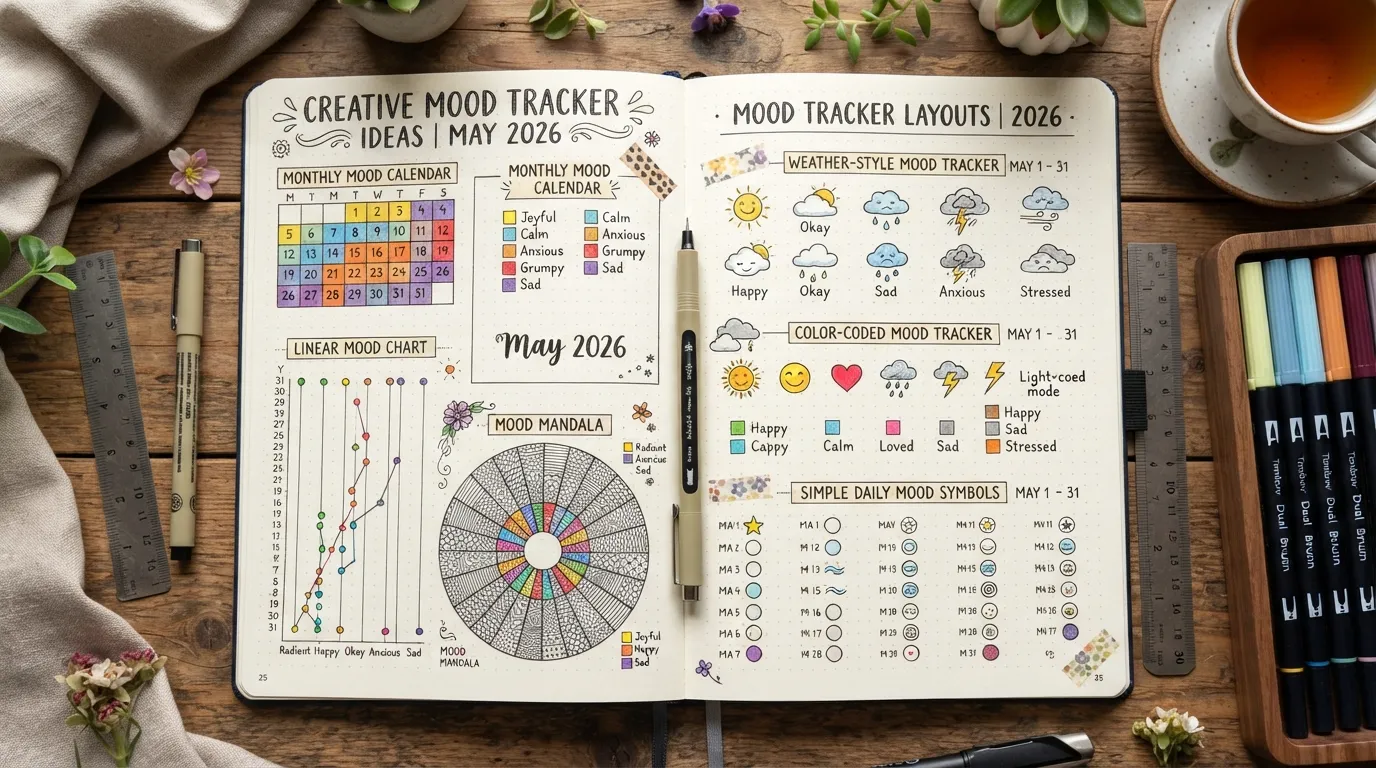
A mood tracker bullet journal is a simple way to record how you feel while also creating a visual record you can look back on later. You can use colors, words, numbers, emojis, drawings, or a combination of them. The best setup is not necessarily the prettiest one—it is the one you can use consistently and that gives you enough detail to understand your own patterns.
In this guide, I’ll show you different mood tracker ideas, explain which format works best for different needs, and help you handle a common problem: what to do when your mood changes several times in one day. I’ll also show you how to add triggers, habits, sleep, or short notes without turning your bullet journal into another chore.
The simplest approach: choose 3–5 mood categories, assign each a color or symbol, record your mood once a day, and add a short note when something important influenced how you felt. If your mood changes frequently, use multiple entries or a small graph instead of forcing the whole day into one color.
What Is a Mood Tracker Bullet Journal?
A mood tracker bullet journal is a dedicated page or spread where you record your mood over a period of time. Most trackers use a visual system so you can understand the pattern quickly when you look back at a week, month, or year.
For example, you might use:
- Colors for different moods
- Numbers to rate mood or intensity
- Words to name the emotion
- Emojis for a quick visual check-in
- Graphs to show changes throughout the day
- Drawings such as flowers, leaves, pixels, circles, or mandalas
There is no single correct bullet journal mood tracker. Current examples across the SERP range from simple color-coded calendars to printable daily trackers and more detailed layouts that combine emotions with short written reflections. The flexibility is one of the main strengths of bullet journaling.
How Do You Make a Mood Tracker in a Bullet Journal?
If you are starting from scratch, you do not need an elaborate spread. I recommend building the simplest version first and adding detail only if you actually need it.
- Choose the time period. A monthly tracker is a good starting point because you can see a complete pattern without filling several pages.
- Choose your moods. Start with about 3–5 broad categories rather than trying to name every possible emotion.
- Create a key. Give each mood a color, symbol, number range, or emoji.
- Create one space for each day. This could be a box, circle, pixel, flower petal, leaf, or calendar square.
- Record your mood. Use the system you chose rather than changing the rules every day.
- Add context when useful. A few words about a trigger, event, habit, or important feeling can make the tracker much more informative.
- Review the pattern. At the end of the week or month, look for recurring moods or circumstances rather than judging individual days.
A useful rule: your tracker should be easy enough that you will actually use it. If decorating the page takes 45 minutes but recording your mood feels like work, simplify the system.
Mood Tracker Bullet Journal Ideas
The right layout depends on what you want to notice later. Here are practical formats you can adapt rather than simply copying a decorative spread.
1. Simple Color-Coded Mood Calendar
Draw a small calendar or a grid with one space for each day, then assign a color to each mood. At the end of the month, the page becomes a quick visual record of your emotional pattern.
Best for: beginners, quick daily tracking, and people who want a low-effort visual summary.
Possible limitation: one color may not represent a complicated day very well. If you regularly experience several strong emotions in one day, use one of the multi-entry methods below.
2. Year-in-Pixels Mood Tracker
Give every day of the year a small square or “pixel.” Each color represents a mood or overall rating. As the year progresses, the page becomes a large visual pattern.
Best for: seeing long-term patterns at a glance.
Possible limitation: a tiny square gives you very little room for context. If understanding triggers matters more than visual simplicity, combine it with short notes elsewhere.
3. Mood Tracker With a Number Scale
Instead of assigning every emotion its own color, use a numerical scale such as 1–5 or 1–10. You can then use different shades to make the pattern easier to scan.
Best for: people who care more about overall mood or intensity than naming a specific emotion.
Tip: define what the numbers mean before you start. For example, 1 might represent a very difficult day and 5 a very good day. Your scale should be understandable to you when you look back at it weeks later.
4. Mood Wheel or Emotion Wheel
Create sections for different emotions and use color or shading to mark what you experienced. You can make the wheel as simple or detailed as you like.
Best for: people who want to distinguish between emotions instead of recording only “good” or “bad.”
Possible limitation: a highly detailed emotion system can become difficult to maintain. Start small and expand your categories only when you notice that your current system is too vague.
5. Leaf or Flower Mood Tracker
Draw a flower, plant, or group of leaves with one section for each day. Color each section according to your mood.
Best for: anyone who wants the tracker to feel creative and decorative while still remaining simple.
The important part is not the drawing itself. Make sure the page remains easy to fill in; otherwise the decoration can become more work than the tracking.
6. Mandala Mood Tracker
Divide a circular design into sections corresponding to the days of the month. You can use colors to represent different moods or shades to represent intensity.
Best for: creative journalers who enjoy coloring and want a visually distinctive monthly spread.
Make it practical: leave a small area for a note or use a second page for triggers and reflections. A beautiful chart is more useful when you can still remember what influenced important days.
7. Emotion Box Tracker
Create rows for different moods and columns for the days of the month. Mark the emotion you experience in the appropriate box.
Best for: people who like organized grids and want to see which emotions appear repeatedly.
Possible limitation: if several emotions happen on the same day, you may need multiple marks, multiple colors, or a short note.
8. Mood + Trigger Tracker
Instead of recording only how you felt, add a small space for what happened around the same time. Your trigger does not have to be dramatic. It might be a difficult conversation, poor sleep, a busy day, a pleasant event, exercise, work, studying, or another circumstance you want to remember.
Best for: people who want to understand possible patterns rather than simply collect colors.
Keep the note short. A few words are enough; you do not need to turn every entry into a full journal page.
9. Mood + Habit Tracker
Combine your mood with a few habits or daily factors you genuinely want to compare. Sleep, exercise, routines, or other personally relevant factors can be recorded alongside the mood.
Best for: people who want to explore whether their mood tends to change alongside other parts of their routine.
Keep it focused: tracking ten different habits at once can make the page overwhelming. Pick only the factors you actually want to review.
10. Mood Graph
A graph is useful when one color cannot capture how your mood moves through the day. You can create several points—for example, morning, afternoon, and evening—and connect them.
Best for: people whose mood changes noticeably during the day.
Why it works: you can keep the overall monthly page compact while still showing movement instead of pretending that one daily mood represents every hour.
Which Mood Tracker Should You Choose?
If you are unsure which layout to use, start with your goal rather than the design.
| If you want to… | Try… | Why | Watch for |
|---|---|---|---|
| Keep tracking simple | Color calendar | Fast visual summary | Limited context |
| See the whole year | Year in pixels | Long-term pattern at a glance | Very little writing space |
| Track emotional intensity | Number scale | Easy to compare levels | Numbers do not name the emotion |
| Understand possible triggers | Mood + trigger | Adds useful context | Do not assume correlation proves cause |
| Record changing moods | Graph or multiple entries | Shows movement through the day | Takes more effort |
| Make it creative | Mandala, flower, or leaf | Combines tracking with visual creativity | Decoration can become time-consuming |
What Are Some Good Moods to Track in a Bullet Journal?
You do not need a huge list. The most useful moods are the ones that help you describe your experience accurately enough to notice patterns later.
A simple starting set could include:
- Happy
- Calm
- Neutral
- Sad
- Angry
- Anxious
- Frustrated
- Excited
- Tired
- Overwhelmed
If those categories feel too broad, add more specific emotions gradually. If they feel like too much work, remove some. Your mood key should describe your experience, not become a test you have to pass every evening.
What If Your Mood Changes Several Times a Day?
This is one of the biggest weaknesses of the traditional one-box-per-day mood tracker. A single square can force a complicated day into one label even when your emotional state changed substantially.
You have several better options:
- Split the day into three entries: morning, afternoon, and evening.
- Use a mini graph: mark your mood at several points and connect the dots.
- Use multiple colors: divide the daily box between two or more significant moods.
- Record the strongest mood: useful when you want a very simple long-term tracker.
- Add one short sentence: keep the visual tracker but explain the day in a few words.
You do not have to make one mood represent the entire day. Bullet journaling is flexible. If a one-square system does not describe your experience well, change the layout rather than forcing yourself to use it.
This is also a recurring issue in bullet-journal communities: people describe using graphs, several daily entries, multiple colors, short written notes, or a combination of methods when one daily color feels too restrictive. :contentReference[oaicite:0]{index=0}
How Many Moods Should You Track?
There is no required number. A practical starting point is 3–5 broad moods. That gives you enough distinction to see a pattern without making the color key difficult to remember.
If you need more detail, you can move toward 6–8 categories or use a separate space for specific emotions.
A good test is simple: if you repeatedly hesitate because two categories feel almost identical, simplify them. If you repeatedly feel that none of your categories describe what you experienced, add a more suitable option.
How to Create a Mood Color Key
Your color key is the legend that tells you what each color means. Keep it somewhere visible on the page so you do not have to remember the system later.
For example:
● Happy — coral
● Calm — green
● Neutral — gold
● Sad — blue
● Anxious — purple
The exact colors do not matter. Your association can be completely personal. If you find that one color is difficult to distinguish from another when you look at the completed page, choose more contrasting colors or add symbols alongside them.
Should You Track Mood, Emotion, or Both?
They are useful for different purposes.
Mood is useful when you want a broad summary of how the day felt.
Emotion is useful when you want to describe a more specific feeling, such as frustration, excitement, sadness, or anger.
Both together can be useful when a broad rating alone does not give you enough context. For example, you might record an overall mood of “okay” and then note that you also felt frustrated about one particular event.
What Else Can You Track With Your Mood?
If your goal is to understand patterns, you can add a small amount of context to your mood tracker.
- Triggers or important events
- Sleep
- Exercise or movement
- Work or study
- Social interactions
- Habits you are intentionally monitoring
- One-line reflections
- Intensity of an important emotion
You do not need to track everything. The purpose is to add context that helps you interpret the mood record later. A mood tracker that contains too many fields can become difficult to maintain.
How to Track Mood Intensity
If simply naming an emotion is not enough, add an intensity score. A 1–10 scale is one option, but you can also use 1–5 if you want something faster.
For example, you might record:
Emotion: frustrated
Intensity: 6/10
Note: difficult workday
The point is not to make the number scientifically precise. It is simply a consistent way for you to distinguish a mild experience from a much stronger one.
How to Review Your Mood Tracker
A tracker becomes more useful when you occasionally look back at it. You do not need to analyze every day. At the end of a week or month, ask yourself a few simple questions.
- Which moods appeared most often?
- Were there days with unusually strong emotions?
- Did any circumstances repeatedly appear alongside a particular mood?
- Did your mood tend to change at particular times of day?
- Did you notice any patterns worth discussing with someone you trust or a qualified professional?
- Does your current tracker still fit the way you actually experience your days?
Treat these observations as patterns to explore, not automatic proof that one thing caused another. For example, noticing that difficult days often occur after poor sleep can be worth paying attention to, but a tracker by itself cannot establish a cause-and-effect relationship.
A Simple Monthly Mood Tracker You Can Draw Today
If you want to start immediately, try this five-mood layout.
1. Draw a 7-column calendar-style grid.
2. Add the dates for the month.
3. Choose five mood categories.
4. Give each category a distinct color.
5. Add a small line under the grid for “important notes.”
6. At the end of each day, color the appropriate space and write a few words only when additional context matters.
If you often have several moods in one day, divide each date into three tiny sections for morning, afternoon, and evening. This keeps the monthly spread compact while giving you more flexibility.
How to Make a Mood Tracker Easier to Maintain
The biggest threat to a useful mood tracker is not choosing the wrong colors. It is creating a system that is too complicated to keep using.
- Start with fewer moods. Add categories only when you need them.
- Keep your key visible. You should not have to memorize your system.
- Use a repeatable layout. A simple grid is easier to maintain than a complicated drawing every month.
- Do not record every emotion if that makes tracking stressful. Choose a level of detail that feels sustainable.
- Modify the tracker. If a format stops helping, change it.
- Review occasionally. Recording information without ever looking at it may not give you the insight you are hoping for.
Can a Mood Tracker Be Used for Mental Health?
Mood tracking can be used as a self-reflection tool, and some people find it helpful for noticing emotional patterns or preparing information they want to discuss with a qualified professional. A bullet journal can also give you a simple place to combine mood notes with everyday context.
However, a mood tracker is not a diagnostic tool and should not be treated as a replacement for professional mental health care. If you are concerned about persistent, severe, or rapidly changing symptoms, use the tracker as optional information to discuss with an appropriate healthcare professional rather than trying to diagnose yourself from the chart.
One therapist-created approach goes further than traditional color-only trackers by combining a visual spectrum with short written emotional expression and intensity tracking. The creator also clearly states that the resource is educational rather than clinical. :contentReference[oaicite:1]{index=1}
Mood Tracker Bullet Journal Printables and PDFs
If drawing a tracker from scratch is not your thing, printable templates can save time. Current mood-tracker resources include monthly, daily, weekly, four-month, and yearly formats, along with versions designed for multiple check-ins during the day. :contentReference[oaicite:2]{index=2}
Before choosing a printable, check what it actually lets you record. A simple monthly calendar may be ideal for one daily mood, while a daily page with room for triggers and notes is better if you want to understand the context behind your emotions.
If you prefer to draw your own, the printable does not have to determine your system. You can use it as a starting point and change the number of moods, colors, check-in times, or note areas to fit your routine.
Common Mood Tracker Problems and Simple Fixes
| Problem | Try this | Why it helps |
|---|---|---|
| One day has several moods | Use morning/afternoon/evening entries or a mini graph | Shows fluctuation instead of forcing one label |
| Too many mood colors | Combine similar categories | Makes daily tracking faster |
| Pretty layout but no useful context | Add a one-line note for significant days | Helps explain the visual record later |
| You forget to fill it in | Use a tiny daily check-in at an existing routine | Reduces friction |
| The tracker feels like another chore | Remove fields you do not use | Makes the system sustainable |
Frequently Asked Questions About Mood Tracker Bullet Journals
Is bullet journaling good for mental health?
It can be a useful self-reflection practice for some people, particularly when it gives them a simple way to organize thoughts, emotions, or daily observations. However, the effect depends on the person and the way the journal is used. Bullet journaling is not a substitute for professional mental health care.
How do I track my mood in a journal?
Choose a small set of moods, assign them colors or symbols, and record one entry each day. If you want more detail, add a number for intensity or a short note about an important event or possible trigger. If your mood changes several times a day, use multiple entries or a graph.
What is the difference between journaling and bullet journaling?
Traditional journaling often focuses on longer-form writing and reflection. Bullet journaling is more flexible and can combine short notes, lists, calendars, trackers, drawings, and collections in one system. A mood tracker can therefore be as visual or as text-based as you want.
What are the negative effects of journaling?
Journaling is not automatically helpful in every situation. For some people, repeatedly focusing on distressing thoughts can feel unproductive or overwhelming. If tracking makes you more distressed, excessively focused on symptoms, or unable to move on from difficult thoughts, it may be worth simplifying the practice or discussing it with a qualified professional.
Is a mood tracker worth it?
It can be worth trying if you want a simple record of how your mood changes over time. The best test is whether the information becomes useful to you. If you never review the tracker or the process feels burdensome, simplify it or stop using it.
What is the best journal for anxiety?
There is no single best journal for everyone. If anxiety is your concern, choose a format that feels manageable and gives you enough space to record what you actually want to notice. A simple mood-and-note layout may be more useful than a highly decorative tracker if you need room for context.
Does journaling rewire your brain?
That phrase is too broad to describe what journaling does. Journaling can support reflection and help you organize or express thoughts, but it should not be presented as a guaranteed way to “rewire” the brain or produce a specific mental health outcome.
Final Thoughts
The best mood tracker bullet journal is the one that gives you useful information without making you work harder than necessary. A simple color calendar is enough for a quick visual record, while a mood-and-trigger layout gives you more context. If your emotions change throughout the day, a graph or multiple entries can solve the biggest limitation of the traditional one-color-per-day method.
Start small, use the system for a while, and then adjust it. Your tracker does not have to look perfect, contain every possible emotion, or follow someone else’s layout. It only needs to make your own experience easier to record and understand.
For additional inspiration, you can compare different visual layouts from ZenART’s mood tracker ideas, explore printable mood tracker formats, or see how a therapist-developed layout combines visual tracking with short written reflection at Lindsay Braman’s mood tracker guide.
Explore Topics
Sub-Topics & Guides
Featured Guides
Top Industry Resources
Editorial Integrity
Our content is 100% human-written, evidence-backed, and continuously updated to fulfill reader intent with maximum honesty.
"Small, consistent habits compounded over time create unshakeable momentum."