Creative Journal Design Ideas: 25+ Easy & Aesthetic Ideas
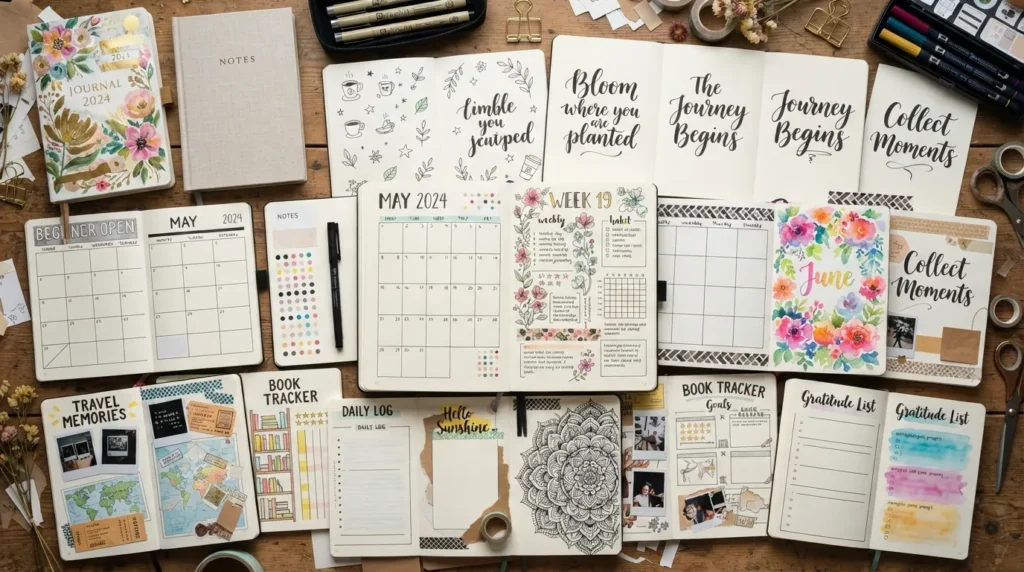
Looking for creative journal design ideas that are actually easy to recreate? You do not need perfect handwriting, expensive supplies, or advanced drawing skills. A good journal page can be as simple as a few colors and a quote, or as detailed as a layered collage with photos, paper, stamps, and doodles.
In this guide, I’ll walk you through creative journal ideas for beginners, students, and adults, including aesthetic pages, cover designs, quote pages, collage layouts, no-drawing ideas, vintage pages, theme journals, and simple ways to decorate a journal. I’ll also show you how to choose an idea when you are staring at a completely blank page.
A simple place to start: Choose one theme, one main color, and two or three decorative elements. You do not need to fill every inch of the page. Leaving some white space often makes a journal spread look more intentional.
What Is Creative Journaling?
Creative journaling combines writing with visual or tactile elements. Instead of using every page only for paragraphs, you might add sketches, color, collage pieces, photographs, stickers, washi tape, hand lettering, painted backgrounds, tickets, pressed leaves, or other meaningful pieces of paper.
The important part is that there is no single correct layout. Your journal can be mostly words, mostly artwork, or somewhere in between. That flexibility is what makes creative journaling useful for people who want to record memories, explore ideas, make art, plan projects, reflect on their day, or simply make a blank notebook feel personal.
How to Choose a Journal Design Before You Start
If a blank page makes you freeze, do not start by asking, “What should I draw?” Start with a purpose.
| If you want… | Try… | Why it works |
|---|---|---|
| A quick page | Quote + border + small doodles | It needs very few materials. |
| A visual memory | Photo or ephemera collage | Images can tell the story without lots of writing. |
| An aesthetic page | Limited palette + lettering + repeated motifs | Repeating visual elements create consistency. |
| A no-drawing page | Collage, stickers, paper layers, or typography | The composition does the visual work for you. |
| A study journal | Headings, diagrams, color coding, and small summaries | It combines creativity with useful information. |
Creative Journal Design Ideas You Can Actually Recreate
The ideas below are grouped by style and purpose rather than thrown into one long random list. That makes it easier to find a page that matches your skill level, available supplies, and the kind of journal you want to create.
1. Minimalist Quote Page
Write one meaningful quote in the center or along one side of the page and surround it with a thin border, tiny stars, dots, leaves, or simple lines. Keep the palette to one or two colors.
Best for: beginners, small journals, and days when you want something creative without spending much time.
2. Layered Paper Collage
Start with a large piece of patterned or plain paper. Add smaller torn pieces, a label, a handwritten word, and one focal element. Overlapping the pieces gives the page depth.
Tip: Use different paper sizes rather than making every piece the same shape.
3. Washi Tape Border
Create a border with washi tape and place your writing, quote, or photograph inside it. You can use one continuous border or make four separate corners for a lighter look.
Best for: anyone who wants a decorative page without drawing.
4. Mood-Board Journal Page
Choose a mood such as calm, adventurous, cozy, focused, or nostalgic. Collect colors, words, textures, small drawings, and images that represent that feeling. Arrange them together instead of trying to tell the story with a paragraph.
5. Color Palette Page
Pick three to five colors and create swatches down the page. Add the names of the colors, small objects that match them, and a short note about why you chose the palette.
Easy variation: Build the palette around a season, favorite outfit, room, flower, movie, or travel destination.
6. Tiny Doodle Garden
Fill a small section with simple leaves, flowers, mushrooms, stars, clouds, or vines. Keep the shapes repetitive rather than trying to draw detailed botanical illustrations.
7. Photo and Caption Spread
Place one or two photos on the page and write short captions beside them. Instead of describing everything that happened, record the detail you do not want to forget.
Try: “What happened,” “what I noticed,” and “what I want to remember.”
8. Ticket and Ephemera Collage
Save tickets, receipts, tags, packaging labels, maps, wrappers, or other small paper pieces connected to an experience. Layer them with a date and a few handwritten notes.
Why it works: The physical objects become evidence of the memory rather than merely decoration.
9. Hand-Lettered Word Page
Choose one word that describes your current mood or goal. Write it in large lettering and decorate the surrounding space with small repeated motifs.
10. “Currently” Page
Create small sections for what you are currently reading, watching, listening to, learning, enjoying, planning, and thinking about. Add icons or tiny illustrations beside each heading.
11. Gratitude Grid
Divide a page into small boxes and put one thing you appreciate in each box. Add simple colors or symbols instead of decorating every box differently.
12. Memory Timeline
Draw a simple line across the page and mark important moments from a trip, month, school term, birthday, project, or relationship. Use short phrases instead of long paragraphs.
13. Before-and-After Page
Split the page into two halves. Record what you thought, felt, believed, or planned before something happened, then compare it with what you know afterward.
14. One-Color Journal Spread
Choose one color and use several shades of it for the writing, borders, paper, stickers, and doodles. Black or neutral text can keep the page readable.
15. Black-and-White Page
Use black ink, white space, and perhaps one small gray element. This is especially useful when you want an aesthetic page but do not have colored supplies.
16. Botanical Corner
Keep most of the page open and decorate only one or two corners with leaves, flowers, vines, or pressed botanical elements. Add a quote or diary entry in the open space.
17. Pocket Page
Create a small paper pocket and store notes, tickets, mini letters, tags, or other flat keepsakes inside. Label the pocket with the date or theme.
18. Fold-Out Page
Attach a folded strip of paper to one side of a page so it opens into extra writing or drawing space. This works well for timelines, long lists, travel memories, or panoramic artwork.
19. Secret Message Page
Hide a short message under a flap, inside a pocket, or behind a small folded piece of paper. The outside can simply say “open when…” or use a small symbol.
20. Texture Page
Combine smooth paper, rough paper, tissue, fabric, vellum, or other safe paper materials. Keep the color palette controlled so the textures remain the main feature.
21. Watercolor Wash Background
Paint a light wash across part of the page and allow it to dry completely before writing over it. Use dark lettering on a pale background so the text stays easy to read.
Paper tip: If you plan to use wet media regularly, choose paper designed to handle it rather than assuming every notebook page will perform the same way.
22. Magazine Cutout Page
Cut out words, faces, colors, textures, or objects from old magazines and rearrange them into a theme. You can make the page abstract or build a recognizable scene.
23. Sticker Story
Use several stickers as the starting point for a short story or diary entry. Add captions, arrows, speech bubbles, and a date so the stickers become part of the narrative instead of random decoration.
24. Monthly Highlights Page
Choose five to ten moments from the month. Give each a tiny heading, icon, or color. This creates a compact record without requiring a full daily journal.
25. “Things I Learned” Page
Record new facts, skills, lessons, mistakes, or discoveries. Use a small diagram or symbol beside each entry to make the page more visual.
26. Dream Board Page
Combine words, colors, sketches, and images representing something you want to experience or achieve. Keep the page focused on one theme rather than trying to include every goal you have.
27. Seasonal Page
Build a page around the current season using colors, weather observations, foods, activities, plants, holidays, or personal memories connected to that time of year.
28. Book Journal Page
Record the book title, favorite passage, characters, rating, questions, and a few thoughts. Add a tiny sketch, color palette, or symbolic image instead of trying to illustrate the entire book.
29. Travel Memory Spread
Combine a map snippet, ticket, date, location, short memory, and one visual detail. Leave enough open space for the story to remain readable.
30. “A Day in My Life” Page
Break a normal day into a few moments: morning, afternoon, evening, and one thing that surprised you. Add small icons or color blocks instead of writing every detail.
Aesthetic Journal Design Ideas
An aesthetic journal does not have to mean complicated artwork. Most of the visual effect comes from consistency. Choose a limited color palette, repeat a few shapes, and give the page enough breathing room.
- Soft botanical: cream, sage, muted green, leaves, small handwritten headings.
- Vintage: brown, cream, muted red, torn paper, stamps, old-looking labels, and handwritten notes.
- Minimalist: black, white, one accent color, clean lines, and plenty of empty space.
- Cute: pastel colors, tiny animals, hearts, stars, simple borders, and playful lettering.
- Retro: bold shapes, limited colors, old-style typography, stripes, and geometric motifs.
- Nature-inspired: leaves, flowers, clouds, skies, mushrooms, insects, and natural color palettes.
Creative Journal Cover Page Ideas
Your cover does not need to explain the entire journal. Think of it as a visual introduction. Choose one central element and let the rest support it.
- Large handwritten title: Write the journal name in the center and frame it with a simple border.
- Botanical frame: Put leaves or flowers around the edges while keeping the title clear.
- Photo collage: Combine a few meaningful images with dates or short words.
- Monogram cover: Use your initials as the main design element.
- Seasonal cover: Create a design around the season in which you start the journal.
- Minimal label: Use a small paper label with the journal name and one decorative element.
Creative Journal Ideas for Beginners
If you are new to journaling, start with a design that has a low number of decisions. The goal is to get comfortable using the page, not to create a perfect spread on your first attempt.
- Write a favorite quote and decorate the corners.
- Create a three-color palette and use only those colors.
- Make a simple gratitude grid.
- Use stickers to create a small story.
- Make a collage from paper you already have.
- Record five things you noticed today.
- Create a “currently” page.
- Draw simple repeating shapes instead of detailed illustrations.
If you are nervous about ruining a beautiful notebook: make your first page deliberately simple. You can also start several pages into the notebook. There is no rule that says the first page has to be your best page.
Journal Design Ideas for Students
A student journal can be creative without sacrificing usefulness. Try combining visual organization with short notes.
- Study summary page: one topic, three key ideas, one diagram, and one question.
- Exam countdown: use a simple calendar with color-coded subjects.
- Vocabulary page: word, meaning, example, and a small visual cue.
- Things I learned this week: combine short notes with small icons.
- Reading tracker: books, pages, favorite ideas, and a personal rating.
- Project page: goal, tasks, ideas, progress, and next step.
Journal Ideas for Adults
Adult journaling does not need to look like a planner. You can use creative pages to capture experiences, organize thoughts, explore interests, or preserve memories.
- A monthly reflection page
- A personal goals mood board
- A travel memory page
- A “what I am learning” spread
- A favorite recipes or food-memory page
- A book and film journal
- A seasonal observations page
- A page of lessons learned from a difficult experience
Creative Journal Ideas Without Pictures
You can make a visually interesting journal without photographs or printed pictures. Use typography, shapes, color, texture, and composition instead.
- Large hand-lettered words
- Geometric color blocks
- Simple line-art borders
- Repeated stars, dots, leaves, or waves
- Color-coded diary thoughts
- Handwritten lists
- Abstract watercolor shapes
- Paper scraps and washi tape
- Stamps and simple patterns
- Borders made from repeated symbols
Harry Potter Journal Ideas
For a Harry Potter-inspired journal, you can create a magical theme without needing to fill every page with character images. Use a restrained palette and visual motifs that suggest the theme.
- A house-inspired color palette
- A “spells and words I like” page
- A magical reading log
- A potion-style mood tracker
- A fictional school timetable layout
- A parchment-style letter page
- A stars-and-moon night-sky spread
BTS Journal Ideas Without Pictures
If you want a BTS-inspired journal but do not want to use photographs, build the design around text, color, music memories, and your own reactions.
- Favorite-song pages using your own short notes
- Album-inspired color palettes
- A concert or listening-memory timeline
- Favorite themes or messages from songs, summarized in your own words
- A lyric-inspired page using only brief excerpts where appropriate
- Hand-lettered song titles
- A “songs I needed this month” spread
How to Make a Journal Look Old or Vintage
A vintage effect usually comes from the combination of paper color, layering, typography, texture, and slightly imperfect edges rather than one single trick.
- Start with cream, beige, kraft, or another muted paper tone.
- Layer torn paper rather than perfectly cut rectangles.
- Add labels, stamps, botanical elements, or old-looking ephemera.
- Use a restrained palette instead of many bright colors.
- Add handwritten notes, dates, or small annotations.
- Leave some areas plain so the page does not become visually heavy.
Keep it safe and simple: you do not need to damage or burn paper to create a vintage appearance. Layering, muted colors, torn edges, stamps, and suitable decorative papers can create the effect without compromising the notebook.
What Supplies Do You Need for Creative Journaling?
You can start with surprisingly little. Before buying a large collection of supplies, use what you already have and learn which techniques you actually enjoy.
| Supply | What you can use it for |
|---|---|
| Black pen | Writing, borders, doodles, lettering, outlines |
| Colored pens or pencils | Color coding, accents, simple illustrations |
| Scrap paper | Collage, layering, labels, pockets |
| Washi tape | Borders, dividers, layering, quick decoration |
| Glue or adhesive | Attaching paper, photos, tickets, and collage pieces |
| Scissors | Cutting collage pieces and creating shapes |
| Stickers or stamps | Fast decorative details when you do not want to draw |
If you want additional ready-made layout inspiration, Canva’s journal template collection can be useful for studying how different page structures are arranged. You do not need to copy a template; use it as a starting point for your own layout.
How to Make a Journal Page Look More Aesthetic
If your pages look messy even though you are using attractive supplies, the problem may not be the supplies. It is often the relationship between the elements.
- Choose a focal point. Decide what the eye should notice first.
- Limit your palette. Three or four related colors are often easier to control than ten unrelated colors.
- Repeat elements. If you use a leaf in one corner, repeat a smaller leaf elsewhere.
- Vary sizes. Mix one large element with several smaller ones rather than making everything equally prominent.
- Leave breathing room. Empty space is part of the composition.
- Protect readability. Decorative elements should support your writing, not hide it.
What Are the Main Types of Creative Journals?
There is no universally fixed list of “seven journals,” because journal types can overlap and different creators classify them differently. For practical purposes, these are seven useful categories to understand:
- Writing journal: primarily words, reflections, thoughts, and observations.
- Art journal: visual experimentation through drawing, painting, collage, and mixed media.
- Idea journal: a place to collect concepts, questions, sketches, and possibilities.
- Project journal: tracks the development of a project, including ideas, progress, problems, and next steps.
- Memory journal: preserves experiences through writing, photos, tickets, and keepsakes.
- Study or learning journal: combines notes, diagrams, questions, and summaries.
- Junk journal: uses collected paper materials and ephemera as part of the page design and memory keeping.
What Is a Junk Journal?
A junk journal is a creative journal that incorporates a mixture of collected or repurposed paper materials. Think old envelopes, tickets, labels, receipts, book pages, fabric scraps, packaging, tags, handwritten notes, and other flat pieces that have a story or visual interest.
The word “junk” does not mean the page should be random. A good junk-journal spread still benefits from a focal point, color relationship, layering, and enough space for the eye to rest.
Simple Journaling Methods to Try
The 3-3-3 Method
There is no single universal definition of a 3-3-3 journaling method. If you encounter it online, check what the particular creator means before treating it as a standard journaling rule. For a simple personal version, you can use three things you noticed, three things you appreciated, and three things you want to remember.
The 3-2-1 Method
The 3-2-1 format is also used in different ways. A flexible journal version is three things you learned or experienced, two things you want to explore further, and one action you want to take next. The value is the structure, not the numbers themselves.
Diary Thoughts and Journal Prompts When You Don’t Know What to Write
A creative page does not always need a complicated design. Sometimes the hardest part is knowing what to put into the journal in the first place.
- What has been taking up most of my attention lately?
- What happened today that I want to remember?
- What surprised me recently?
- What am I looking forward to?
- What did I learn from a recent mistake?
- What small thing made today better?
- What would I tell myself one year from now?
- What am I currently trying to understand?
- What is one memory I do not want to lose?
- What would I like to do differently tomorrow?
Names for a Journal
If you want your notebook to feel more personal, give it a name that reflects what you actually use it for.
- The Little Things
- Pages of Me
- Thought Garden
- The Memory Book
- Ideas in Progress
- The Daily Pages
- Notes to My Future Self
- The Quiet Pages
- Collected Moments
- My Creative Archive
Common Creative Journaling Mistakes
If your pages are not turning out the way you imagined, you probably do not need more supplies. Start by checking these common problems.
- Trying to make every page perfect: creative journals work better when experimentation is allowed.
- Using too many focal points: if everything is large and colorful, nothing gets visual priority.
- Covering all the writing space: decoration should leave room for the journal’s actual purpose.
- Buying supplies before choosing a style: start with basic tools and learn what you enjoy.
- Copying an inspiration page exactly: borrow the technique, then adapt it to your own story and materials.
- Ignoring paper limitations: wet paint, markers, glue, and heavy collage can behave differently depending on the paper.
- Making every page completely different: a few repeated colors or motifs can make a whole journal feel more cohesive.
How to Start a Creative Journal in 10 Minutes
- Open to any page you feel comfortable using.
- Choose one subject: today, a memory, a quote, a goal, or a mood.
- Pick one main color.
- Write the date.
- Add one heading.
- Write three to five short lines.
- Add one visual element.
- Repeat one small decorative motif two or three times.
- Stop before you feel the need to fill every empty space.
- Close the journal and come back tomorrow.
How to Choose the Right Creative Journal Idea
You do not have to choose the most complicated idea. Choose the one that matches what you want from the page.
| Your situation | Good starting choice | Keep in mind |
|---|---|---|
| I cannot draw | Collage, lettering, stickers, or washi tape | Focus on arrangement rather than illustration. |
| I have very few supplies | Pen + scrap paper + simple doodles | A limited palette can look intentional. |
| I want memories | Photo, ticket, caption, and timeline pages | Keep the story more important than decoration. |
| I want an aesthetic look | Limited palette + repeated motifs | Consistency matters more than expensive supplies. |
| I need a creative outlet | Mixed media or free-form art journal | Do not impose too many rules on the page. |
Frequently Asked Questions
What are some creative ideas for a journal?
Try a quote page, collage, mood board, color palette, memory timeline, travel spread, book page, gratitude grid, seasonal page, pocket page, or a mixed-media art page. The best choice depends on whether you want to write, remember, organize, or create visually.
What is the best journal for beginners?
A simple notebook that feels comfortable to use is usually a better starting point than an expensive specialty journal. If you are unsure what you like, choose a basic journal and begin with pen, a few colors, and scrap paper. You can add more materials after you discover your preferred style.
What should I put in my journal if I have no ideas?
Start with what is immediately around you. Write what you did today, what you noticed, what you are looking forward to, or one thing you learned. Then add one small visual element such as a border, color block, sticker, or doodle.
How can I decorate a journal without drawing?
Use collage, washi tape, stickers, stamps, printed or recycled paper, typography, color blocks, photographs, tickets, labels, envelopes, and simple repeated shapes. Good composition does not require advanced drawing skills.
How can I make my journal look aesthetic?
Use a limited color palette, choose one focal point, repeat a few visual motifs, vary the size of your elements, and leave some empty space. Aesthetic pages usually look more cohesive when fewer elements are used intentionally rather than when every area is decorated.
What is a junk journal?
A junk journal is a creative journal that incorporates collected or repurposed paper materials such as tickets, labels, envelopes, book pages, packaging, scraps, tags, and handwritten notes. It can combine writing, collage, memory keeping, and mixed-media decoration.
What are common journaling mistakes?
Common problems include trying to make every page perfect, using too many unrelated decorative elements, leaving no room for writing, buying supplies before deciding what style you enjoy, and comparing your beginner pages with highly finished inspiration pages.
Can a journal be creative without pictures?
Absolutely. Hand lettering, typography, color, borders, doodles, abstract shapes, stamps, paper texture, washi tape, and written prompts can create attractive pages without photographs or printed images.
The easiest way to start
Pick one idea from this list, choose one main color, and give yourself permission to make an imperfect page. Your journal becomes more personal as you use it. You do not need to know your entire style before you make the first mark.
Explore Topics
Sub-Topics & Guides
Featured Guides
Top Industry Resources
Editorial Integrity
Our content is 100% human-written, evidence-backed, and continuously updated to fulfill reader intent with maximum honesty.
"Small, consistent habits compounded over time create unshakeable momentum."