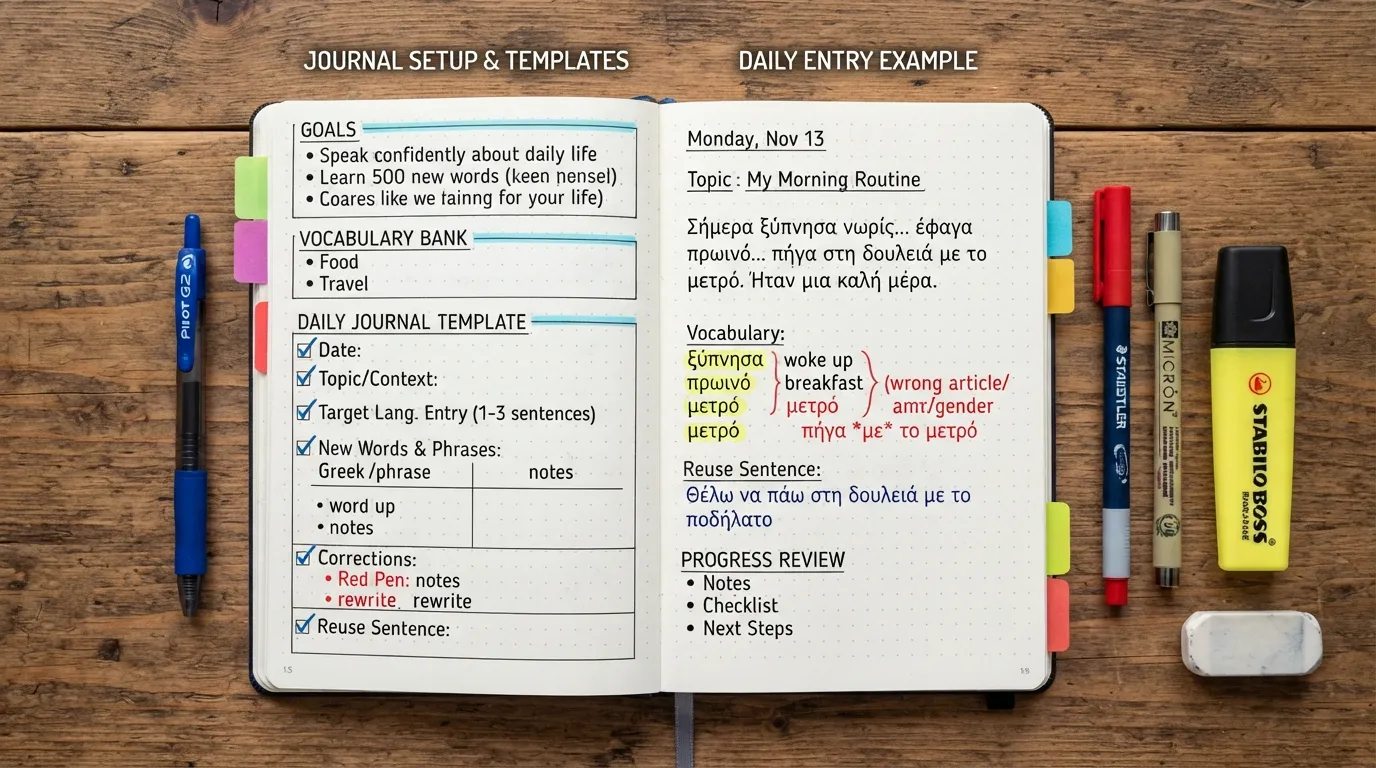
To make a language journal, choose a notebook or digital app, create a few useful sections for vocabulary, grammar, writing, corrections, and progress, then start writing short entries in your target language. If you are a beginner, even three to five sentences about your day, thoughts, plans, or surroundings are enough. The important part is not making beautiful pages. It is creating a system that helps you write, notice what you do not know, correct it, reuse it, and review it later.
A simple language-journal loop: Write → mark gaps → check and correct → reuse useful words or structures → review them later.
What Is a Language Journal?
A language journal is a notebook or digital space you use to actively practise a language you are learning. It can include diary entries, new vocabulary, example sentences, grammar notes, pronunciation reminders, corrections, goals, and short exercises.
I would not treat it as a place to copy everything from a textbook. A useful journal is personal. It should contain the words, structures, mistakes, and ideas that matter to you. That is what makes it easier to revisit and actually use.
How to Make a Language Journal Step by Step
1. Choose Paper or Digital
Start with whatever you are most likely to use consistently. You do not need a special language-learning notebook.
| Option | Best For | Trade-Off |
|---|---|---|
| Paper notebook | Handwriting, drawing, memory cues, distraction-free practice | Harder to search, reorganize, or edit |
| Digital journal | Typing, searching, storing links, reorganizing notes | More distractions and less handwriting practice |
| Hybrid | Handwritten entries plus searchable digital vocabulary or corrections | Requires maintaining two places |
Apps such as Notion or Evernote can work, but so can a plain document. If you prefer paper, any notebook that opens comfortably and gives you enough room to add corrections is fine.
2. Leave Space for an Index
If you are using paper, leave the first one or two pages blank. Number your pages and use this space as a simple table of contents. You might later record where your verb notes, pronunciation page, vocabulary themes, or monthly reviews are located.
You do not need to plan every page in advance. Over-organizing the notebook before you have written anything is one of the easiest ways to turn journaling into a design project instead of a language habit.
3. Create Only the Sections You Will Actually Use
I would start with five to seven flexible sections rather than dozens of rigid categories.
| Section | What to Put There |
|---|---|
| Goals & Progress | Current level, study goals, weekly targets, progress notes |
| Reference Pages | Useful grammar patterns, alphabet notes, pronunciation reminders, verb forms |
| Vocabulary in Context | New words and phrases with example sentences rather than isolated translations |
| Journal Entries | Daily life, opinions, memories, plans, stories, summaries, descriptions |
| Corrections | Recurring errors, corrected sentences, explanations worth remembering |
| Review Log | Words and structures to reuse, patterns you keep forgetting, weekly observations |
You can add sections later for homework, reading notes, listening practice, flashcards, or resources. The journal should adapt to your learning rather than forcing your learning into a complicated notebook system.
4. Write Your First Entry Before You Feel Ready
Your first entry does not need to be impressive. Write about something you already understand well: what you did today, what you can see around you, what you plan to do tomorrow, something you like, or how you feel.
Beginners can start with three to five sentences. If a sentence feels too difficult, simplify the idea rather than abandoning it.
Simple beginner entry pattern
Today is ___.
I feel ___.
I went to ___.
I saw / ate / studied ___.
Tomorrow I want to ___.
5. Mark Missing Words Instead of Stopping Every Sentence
One common mistake is opening a dictionary every few seconds. That can turn a five-minute writing exercise into a frustrating research session.
When you do not know a word, try to describe the idea with language you already know. If you still need the word, leave a small blank, write it in your native language in brackets, or add a question mark. Finish the entry first and check the missing language afterwards.
This helps you discover your real vocabulary gaps without constantly breaking the flow of writing.
6. Correct the Entry After You Finish Writing
Writing and correcting are different jobs. If you try to make every sentence perfect while you are producing it, you may spend more time worrying about mistakes than practising communication.
After finishing the entry:
- Read the entry once without changing anything.
- Check the words or structures you marked as uncertain.
- Correct important mistakes using a second pen color or digital highlighting.
- Keep the original sentence visible so you can compare it with the correction.
- Choose one or two useful corrections to reuse later.
A tutor, teacher, proficient speaker, reference grammar, dictionary, or carefully used AI tool can help you check sentences. Do not assume every automated correction is perfect. If a correction matters, especially when meaning or nuance is involved, verify it with a reliable language source or knowledgeable speaker.
7. Reuse the Language You Just Learned
Collecting a corrected word is less useful than producing it again. If you learned a new phrase today, use it in a new sentence tomorrow.
For example, imagine you wanted to write “I was exhausted after work” but did not know the natural phrase. Once you learn it, add one new sentence such as “I was exhausted after the trip too.” You are now practising meaning, grammar, and retrieval together.
8. Review the Journal Once a Week
A journal becomes much more useful when you revisit it. Once a week, spend a few minutes looking for patterns.
- Which words appeared several times?
- Which grammar mistake keeps returning?
- Which phrases are now easy to use?
- What do you still avoid writing because you lack the language?
- What should you deliberately reuse next week?
That turns the notebook from a storage place into a feedback system.
A Language Journal Template You Can Copy
You do not need a complicated printable layout to begin. Copy this format into a notebook, document, Notion page, or notes app and adjust it to your language.
Date: __________
Topic: __________
My entry:
Write 3–10 sentences in your target language.
Words or phrases I was missing:
1. ________
2. ________
3. ________
Important correction:
My version: ________
Better version: ________
One sentence I will reuse: __________
What felt difficult today? __________
This template is intentionally simple. A language journal works better when the setup takes seconds rather than becoming another task you have to maintain.
What Should You Write in a Language Journal?
You will probably run out of ideas if every entry is a list of what you ate and where you went. Rotate between personal, descriptive, imaginative, and opinion-based writing.
- Daily life: what happened today, tomorrow’s plans, work, study, food, weather.
- Thoughts and feelings: something that made you happy, worried, surprised, or curious.
- Descriptions: describe a room, person, object, photo, or place.
- Memories: childhood experiences, holidays, school, travel, family events.
- Opinions: react to a film, book, news story, habit, or question.
- Micro-stories: write a three-to-five-sentence fictional story.
- Summaries: summarize something you watched, read, or listened to.
- Targeted practice: deliberately use a grammar pattern or vocabulary set you are currently studying.
How Your Journal Should Change With Your Level
| Level | Good Entry Style | Main Goal |
|---|---|---|
| Beginner / A1–A2 | 3–5 simple sentences, lists, descriptions, basic present/past/future ideas | Build confidence producing familiar words and sentence patterns |
| Intermediate / B1–B2 | Paragraphs, opinions, stories, explanations, summaries | Increase range, accuracy, connectors, and natural phrasing |
| Advanced / C1–C2 | Argument, nuance, style imitation, complex summaries, reflective writing | Improve precision, register, style, and sophisticated expression |
The CEFR labels above are only a convenient way to describe broad stages. Your journal does not need to follow a formal level system. Use the type of writing that stretches you slightly without making every sentence impossible.
A Filled Example: From Rough Entry to Useful Review
Here is the kind of process I would use instead of simply writing a paragraph and never looking at it again.
Original entry:
“Today I go to supermarket after work. I was very tired but I need buy vegetables. After I come home, I make dinner and watched a movie.”
Corrections worth noticing:
“I went to the supermarket.”
“I needed to buy vegetables.”
“After I came home, I made dinner and watched a movie.”
Pattern to review:
Past-tense verb forms in a story about yesterday.
Reuse sentence:
“After I came home yesterday, I made tea and called my friend.”
Your real entry may be in Spanish, French, Arabic, Korean, Japanese, German, or any other target language. The process stays the same: produce language, notice the gap, correct what matters, then produce it again.
Should You Keep Vocabulary and Grammar in the Same Journal?
You can. In fact, I prefer keeping important vocabulary and grammar close to your actual writing rather than maintaining huge disconnected lists.
For vocabulary, record useful phrases or short example sentences instead of only writing:
tired = translation
A more useful entry might be:
exhausted — “I was exhausted after work.”
For grammar, save patterns you repeatedly need. There is little value in copying twenty pages of grammar notes into a journal if you never use them in your own sentences.
Connect Writing With Speaking
Once you finish and correct an entry, read it aloud. This adds pronunciation and speaking practice to something you have already prepared.
You can also record yourself reading the entry, listen back, and repeat difficult sentences. A journal alone will not make you fluent—you still need listening, reading, interaction, and meaningful exposure—but it can give you prepared language that is easier to use when you speak.
Common Language Journal Mistakes
Making the setup too complicated
If you spend an hour drawing trackers before every five-minute entry, the notebook may become difficult to maintain. Keep only the structure that helps you learn.
Waiting until your grammar is “good enough”
Writing exposes gaps. That is part of the exercise. You do not need to eliminate mistakes before you begin.
Looking up every unknown word immediately
Too much interruption makes writing slow and frustrating. Mark gaps, finish the thought, and investigate afterwards.
Collecting isolated vocabulary
A list can be useful, but language becomes easier to retrieve when you also record how a word fits into a phrase or sentence.
Never revisiting corrections
A page full of corrections does little if you never reuse them. Pick a small number of patterns and deliberately bring them into future entries.
Writing about the same routine every day
Personal diary entries are useful, but rotate in opinions, memories, picture descriptions, summaries, imaginary situations, and targeted grammar practice so your language range continues expanding.
A Simple Weekly Language Journal Routine
| Day | What to Do |
|---|---|
| Day 1 | Write a short personal entry and mark missing language. |
| Day 2 | Write a description or picture-based entry. |
| Day 3 | Write an opinion or short summary. |
| Day 4 | Reuse two or three words or structures from earlier corrections. |
| Day 5 | Review recurring errors and write a few new example sentences. |
You do not have to journal every day. A realistic routine you can maintain is better than forcing a daily streak and quitting after a week.
See a Language Journal in Practice
If you prefer seeing how another learner organizes and uses a language journal, this video offers a visual example:
Questions About Starting a Language Journal
Can a complete beginner keep a language journal?
Yes. Start with words, labels, sentence frames, and three to five simple sentences. You can also mix a small amount of your native language into early entries when necessary, then gradually replace it as your target-language vocabulary grows.
Should I correct every mistake?
Not necessarily. Correct mistakes that affect meaning, repeat frequently, or relate to something you are actively learning. Trying to analyze every tiny error can make the habit unnecessarily exhausting.
How often should I write?
Consistency matters more than a perfect schedule. Daily writing can work if the entries are short, but three or four useful sessions per week can also be productive. Choose a frequency you can sustain.
Is a language journal the same as a vocabulary notebook?
Not quite. A vocabulary notebook mainly stores words and phrases. A language journal is broader: it helps you produce your own language, record gaps, practise grammar, receive corrections, track progress, and reuse what you learn.
Should I use a physical notebook or an app?
Use the one you will actually return to. Paper is excellent for handwriting and distraction-free study. Digital journals are easier to search, reorganize, and edit. A hybrid system is also perfectly reasonable.
Can journaling make me fluent?
Journaling can strengthen writing, vocabulary retrieval, grammar awareness, and your ability to express personal ideas, but it is not a complete language-learning method by itself. Combine it with listening, reading, speaking, interaction, and regular exposure to the language.
You do not need the perfect notebook to start. Write a few sentences today, mark what you could not express, correct the most useful points, and reuse them in your next entry. Once that cycle becomes normal, your journal stops being a collection of notes and becomes an active record of how your