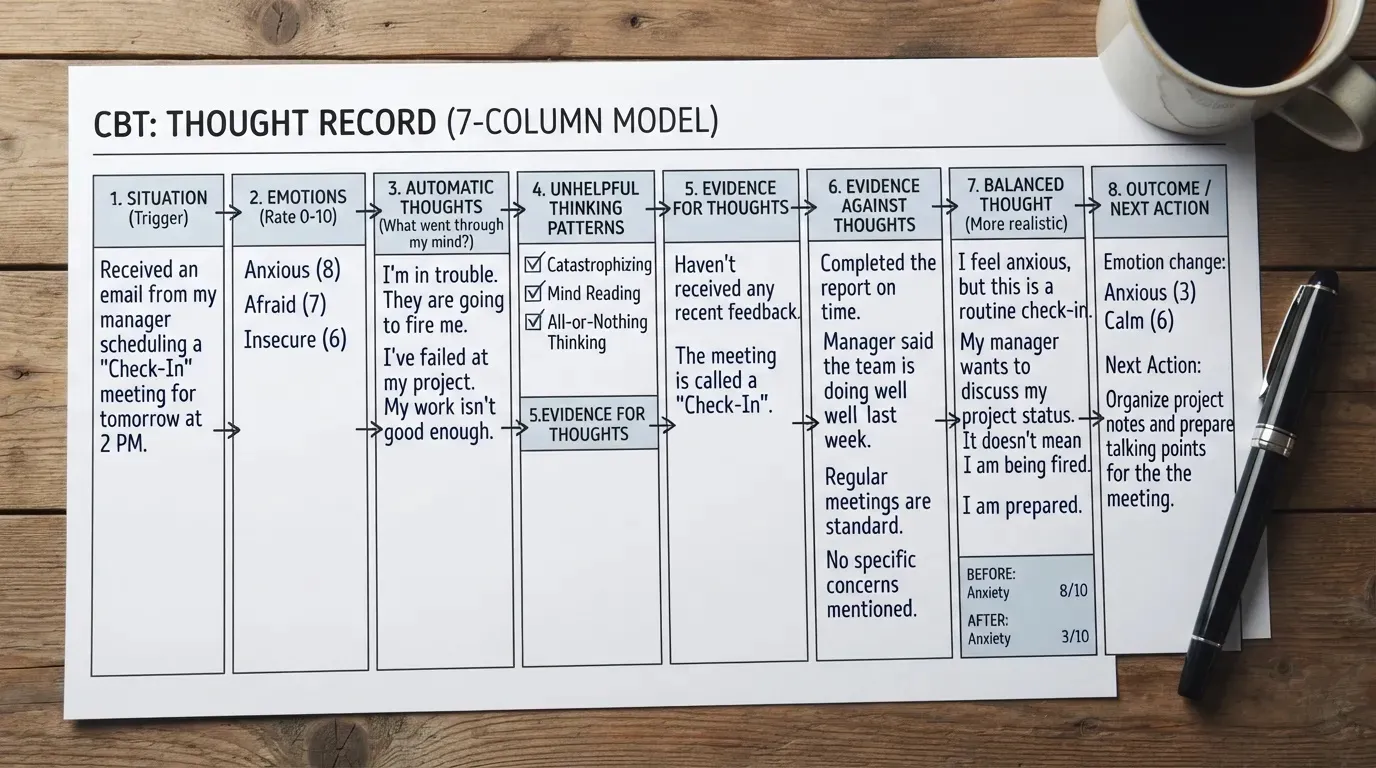
 A CBT journal is a structured way to write down a difficult situation, notice the thoughts and emotions connected to it, examine the evidence behind those thoughts, and work toward a more balanced perspective. It is closely related to a thought diary or thought record, but a CBT journal usually gives you more structure than simply writing about your day.
If you are new to CBT journaling, you do not need to write pages and pages. A simple entry can help you slow down a stressful thought, understand what is happening, and decide what to do next.
A simple CBT journal follows this pattern: situation → feelings → automatic thought → evidence for and against the thought → more balanced thought → next step.
What Is a CBT Journal?
A CBT journal is a guided writing tool based on ideas used in cognitive behavioral therapy (CBT). Instead of only recording what happened, you look at the connection between a situation, your thoughts, your emotions, and what you do afterward.
The important part is not simply writing down a “negative thought.” You are learning to examine the thought rather than automatically treating it as a fact.
For example, imagine that you send someone a message and they do not reply. The situation is the unanswered message. An automatic thought might be, “They are angry with me.” That thought could lead to anxiety and make you repeatedly check your phone or avoid the person. A CBT-style journal helps you slow down that chain and ask what you actually know, what you are assuming, and what other explanations are possible.
CBT Journal vs. Thought Diary vs. Thought Record
You may see the terms CBT journal, thought journal, thought diary, and thought record used interchangeably. They overlap, but they do not always mean exactly the same thing.
| Term | What it usually means | Main purpose |
| CBT journal | A broader journal that uses CBT ideas and structured prompts. | Build awareness and work through thoughts, feelings, and actions. |
| Thought diary | A record of thoughts, feelings, situations, or patterns over time. | Notice recurring patterns and triggers. |
| Thought record | A more structured CBT exercise for examining a particular situation and thought. | Examine and reconsider an unhelpful automatic thought. |
So if you are searching for a CBT journal template, a thought record may be exactly the kind of structured worksheet you need.
How Does CBT Journaling Work?
The basic idea is to make the chain between a situation, your interpretation of it, your emotional response, and your behavior easier to see. Once you can see the chain, you can examine the parts that may be unhelpful or based on assumptions.
A practical CBT journal can use these seven steps.
1. Describe the Situation
Start with what actually happened. Try to describe the event without adding your interpretation.
Instead of: “My friend deliberately ignored me because she doesn’t care about me.”
Try: “I sent my friend a message this afternoon and haven’t received a reply yet.”
Keeping the situation factual gives you something concrete to examine later.
2. Name Your Emotions
Write down what you felt when the situation happened. You can list more than one emotion.
- Anxious
- Sad
- Angry
- Embarrassed
- Worried
- Disappointed
It can also help to rate the intensity of each emotion from 0 to 100. The number is not a scientific measurement of your emotions; it is simply a practical way to notice how strongly you felt before and after working through the thought.
3. Identify the Automatic Thought
Ask yourself: “What went through my mind at that moment?”
An automatic thought is often quick and believable. You may not even notice it until you deliberately stop and look for it.
Examples of automatic thoughts:
“I’m going to fail.”
“Everyone thinks I’m incompetent.”
“Something terrible is going to happen.”
“They must be angry with me.”
Be as honest as possible. You are not trying to write the “right” thought. You are trying to capture the thought that was actually present.
4. Look for Unhelpful Thinking Patterns
Once you have written the automatic thought, ask whether it contains a thinking pattern that may be making the situation feel worse.
Common examples include:
- All-or-nothing thinking: seeing something as completely successful or completely unsuccessful.
- Catastrophizing: immediately assuming that the worst possible outcome will happen.
- Mind-reading: assuming you know what another person is thinking without enough evidence.
Do not worry if you cannot identify a named cognitive distortion. The purpose of the exercise is not to force every thought into a category. The more useful question is whether the thought is accurate, balanced, and supported by what you actually know.
5. Examine the Evidence
Now separate what you know from what you are assuming.
Evidence supporting the thought: What facts make the thought seem believable?
Evidence against the thought: What facts, experiences, or alternative explanations make the thought less certain?
The goal is not to prove that your original thought is always wrong. Sometimes a worry contains a genuine problem that needs attention. The purpose is to examine the thought fairly instead of automatically accepting the first interpretation that appeared in your mind.
6. Write a More Balanced Thought
Create an alternative thought that is realistic rather than artificially positive.
Original thought: “They haven’t replied because they are angry with me.”
Balanced thought: “I don’t know why they haven’t replied. They could be busy or dealing with something else. If I need to know, I can ask rather than guessing.”
Notice that the balanced thought does not say, “Everything is perfect.” It simply avoids treating an assumption as a certainty.
7. Check How You Feel and Decide What Comes Next
Rate your emotion again if that feels useful. You may notice that the intensity has changed, even if the situation itself has not.
Then ask:
- Is there a practical problem I can solve?
- Is there something I need to communicate?
- Is there an assumption I should stop treating as a fact?
- What is one reasonable next action?
A Complete CBT Journal Example
Seeing a completed example can make the process much easier to understand. Imagine that you have an important assignment due soon and you are worried that you will not do well.
| Journal field | Example entry |
| Situation | I looked at the assignment requirements and realized I have several sections left to complete. |
| Emotion | Anxiety — 80/100. |
| Automatic thought | “I’m going to fail this assignment.” |
| Possible thinking pattern | All-or-nothing thinking and predicting a negative outcome. |
| Evidence for | I have not finished several sections yet and the deadline is getting closer. |
| Evidence against | I have completed difficult assignments before, and I still have time to work on the remaining sections. |
| Balanced thought | “The assignment is not finished yet, but that does not mean I will fail. I can focus on the next section instead of predicting the final result.” |
| Next action | Spend the next focused work period completing one section, then review what remains. |
| Emotion afterward | Anxiety — 55/100. |
The important change is not that the journal magically removed the problem. The assignment still exists. What changed is the way the problem was interpreted and the next action became clearer.
What Should You Write in a CBT Journal?
If you are starting from a blank notebook, you can use these prompts:
- What happened?
- What did I feel?
- How strong was the emotion from 0–100?
- What automatic thought went through my mind?
- What evidence supports that thought?
- What evidence does not support it?
- Am I making an assumption about what someone else thinks?
- Am I treating a possibility as a certainty?
- What would be a more balanced or neutral way to describe the situation?
- What is one useful next step?
CBT Journal for Anxiety: How Can It Help?
When anxiety is high, thoughts can quickly move from a possibility to what feels like a certainty. A CBT journal gives you a structured place to slow that process down.
For example, instead of writing only:
“I’m anxious about tomorrow.”
you can explore:
- What specifically am I predicting?
- What evidence do I have?
- What am I assuming?
- What alternative outcomes are possible?
- What can I actually control?
- What practical action can I take now?
This can turn a vague worry into a specific thought that you can examine.
Can You Do CBT Journaling on Your Own?
You can practise some CBT-based self-help techniques on your own, including structured thought-record exercises. However, using a CBT journal by yourself is not the same as completing a full course of CBT with a trained professional.
A journal can be a useful self-reflection tool, but it should not be treated as a replacement for assessment or treatment when you are dealing with significant or persistent mental-health difficulties.
Remember: CBT journaling is a structured self-help exercise. It is not a diagnosis, and completing a thought record does not mean you are receiving CBT treatment.
What Are the 5 Steps of CBT?
There is not one universal five-step version of CBT that describes every form of therapy. Different CBT exercises use different numbers of steps.
For a simple thought-focused exercise, you can think of the process as:
- Notice the situation.
- Identify the thought and emotion.
- Examine the thought and the evidence.
- Develop a more balanced perspective.
- Choose a useful next action.
A detailed thought record can break those stages into more specific prompts, which is why CBT worksheets may contain seven or more fields.
What Are the 3 Cs of CBT?
You may come across the phrase “3 Cs of CBT” in self-help material, but the phrase is not a universal standard for every CBT model or worksheet.
If a particular workbook, therapist, or CBT course uses the 3 Cs, follow the definitions provided in that specific resource rather than assuming that one version applies to every CBT approach.
For a general CBT journal, you do not need to force your entry into a “3 Cs” framework. The more useful task is to identify the situation, thought, emotion, evidence, balanced perspective, and next action.
What If You Cannot Identify the Automatic Thought?
This is common when you are new to thought records. Instead of asking, “What was my automatic thought?” try asking:
- What was I afraid might happen?
- What did this situation seem to say about me?
- What did I assume the other person was thinking?
- What sentence keeps repeating in my head?
- If my emotion could speak, what would it say?
You can also start with the emotion and work backward. If you felt embarrassed, for example, ask what you believed the situation meant about you.
What If I Cannot Find a Cognitive Distortion?
That is okay. You do not need to identify a named distortion for every journal entry.
A thought can be uncomfortable and still be accurate. For example, if you have missed an important deadline, “I missed the deadline” is a fact. The CBT-style question is what you add to that fact:
“I missed the deadline, so I’m completely useless and I’ll never get anything right.”
The second statement gives you much more to examine. A balanced response can acknowledge the mistake without turning one event into a judgment about your entire identity or future.
How Long Should a CBT Journal Entry Be?
There is no single required length for a CBT journal entry. The useful length is the amount that lets you work through the situation without turning the exercise into another source of pressure.
A short structured entry can be enough. If you find yourself writing pages of repeated worry without moving toward clarification, evidence, or a practical next step, the structure may be more useful than simply adding more words.
Should You Use a CBT Journal App, PDF, or Notebook?
The format matters less than whether it makes the exercise easy enough for you to use consistently and thoughtfully.
| Format | May work well if you… | Watch for |
| Notebook | Prefer writing by hand and want flexibility. | Privacy and keeping the journal secure. |
| Printable PDF | Want a ready-made structure to follow. | Check that the worksheet comes from a trustworthy source. |
| App | Want prompts, reminders, or digital records. | Review privacy, data handling, and whether the app’s claims are appropriate. |
If you want a verified thought-record worksheet, the NHS Every Mind Matters thought record is one useful starting point. It provides a structured exercise that you can complete on paper or digitally.
NHS Every Mind Matters: Thought Record
Common CBT Journaling Mistakes
A structured journal is most useful when you use it to investigate your thinking rather than simply criticize yourself.
- Trying to make every thought positive: A balanced thought should be realistic, not artificially cheerful.
- Confusing emotions with thoughts: “I feel anxious” describes an emotion; “I’m going to fail” is a thought or prediction.
- Forcing a distortion label: Not every difficult thought fits neatly into one category.
- Ignoring evidence that supports the concern: CBT journaling is not about pretending genuine problems do not exist.
- Stopping after writing the thought: The useful part is examining it and deciding what comes next.
- Turning journaling into rumination: If you keep repeating the same worry without gaining clarity, pause and shift toward a specific question or practical action.
- Expecting a journal to replace treatment: A journal can support self-reflection, but it is not a substitute for professional care when you need it.
When Should You Consider Professional Support?
A CBT journal can be a practical self-help tool, but you do not have to handle everything alone.
Consider talking with a qualified mental-health professional if your difficulties are persistent, significantly affecting your daily life, becoming difficult to manage, or if you are unsure what kind of support you need.
Professional CBT can involve much more than completing a thought record. Depending on the problem, treatment can include working with a therapist on thoughts, emotions, behaviors, avoidance, problem-solving, and other patterns.
A Simple CBT Journal Template
You can copy these prompts into a notebook or digital document and use them whenever you want to work through a specific situation.
Situation: What happened?
Emotion: What did I feel? How strong was it from 0–100?
Automatic thought: What went through my mind?
Thinking pattern: Is there an unhelpful pattern I notice?
Evidence for: What facts support the thought?
Evidence against: What facts or alternative explanations challenge it?
Balanced thought: What is a more realistic way to understand the situation?
Next action: What is one useful thing I can do now?
Emotion afterward: How do I feel now, and what changed?
Frequently Asked Questions
What is the CBT journaling method?
It is a structured way of examining a situation, the emotions and automatic thoughts connected to it, the evidence for and against those thoughts, and a more balanced perspective or next action.
Can I learn CBT on my own?
You can learn and practise some CBT-based self-help techniques independently, including thought-record exercises. However, learning a technique on your own is different from receiving a full CBT assessment and treatment from a qualified professional.
Can a CBT journal help with anxiety?
A structured journal can help you slow down anxious predictions, separate facts from assumptions, consider alternative explanations, and identify practical next steps. It should be viewed as a self-help technique rather than a complete treatment for an anxiety disorder.
Is a thought record the same as a CBT journal?
Not always. A thought record is a specific structured CBT exercise, while a CBT journal can be broader and may include thought records, mood tracking, reflections, prompts, and other CBT-based exercises.
What if my original thought turns out to be partly true?
That is fine. The goal is not to prove yourself wrong. A useful CBT journal helps you separate the accurate part of a concern from exaggeration, assumptions, or conclusions that go beyond the available evidence.
Final Thoughts
A CBT journal gives you a structured way to pause when a situation triggers a strong reaction. Instead of stopping at “I feel terrible,” you can explore what happened, what you thought, what evidence you have, and what a more balanced interpretation might look like.
If you are just starting, keep it simple. Choose one recent situation, write down the automatic thought as honestly as you can, examine the evidence, and finish with one realistic next step.
The goal is not to write the perfect journal entry. The goal is to become better at noticing the connection between situations, thoughts, emotions, and actions so you can respond more deliberately instead of automatically.
Related Posts