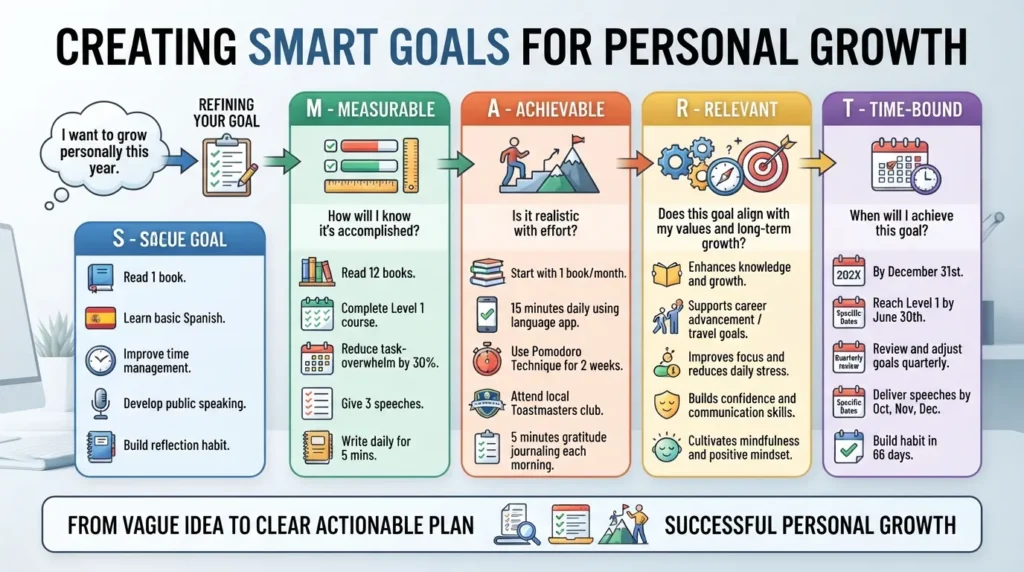
If you want to turn personal growth from a vague intention into something you can actually work toward, SMART goals for personal growth give you a practical framework. Instead of saying, “I want to become better at managing my time,” you define exactly what you will change, how you will measure it, why it matters, and when you want to see progress.
The simple idea: A SMART personal-growth goal is Specific, Measurable, Achievable, Relevant, and Time-bound. The framework turns a broad self-improvement wish into a clear action plan with a way to track progress and a defined deadline.
In this guide, I’ll show you how each part works, give you realistic examples for personal development, health, habits, mindset, learning, and work, and show you how to turn an ordinary goal into a SMART one.
What Are SMART Goals for Personal Growth?
SMART goals are goals written in a way that makes them clear enough to act on and specific enough to track. For personal growth, the framework can help you move from general intentions such as “read more,” “be healthier,” or “improve my communication” to goals with concrete actions and measurable outcomes.
The five parts are:
- Specific: Clearly state what you want to accomplish.
- Measurable: Decide how you will track progress.
- Achievable: Make the goal challenging but realistic for your current circumstances.
- Relevant: Connect the goal to something that genuinely matters to your life or future.
- Time-bound: Give the goal a defined timeframe or deadline.
The value is not in the acronym itself. The value is in forcing you to answer the practical questions that vague goals leave unanswered: What exactly will I do? How often? How will I know I am progressing? Is this realistic? Why does it matter? When will I complete it?
What Are the 5 SMART Goals?
Strictly speaking, SMART describes five criteria rather than five separate types of goals. A single personal-growth goal becomes SMART when it addresses all five criteria.
| SMART Part | What It Means | Question to Ask Yourself |
|---|---|---|
| Specific | Defines the exact result or action you want. | What exactly am I going to do? |
| Measurable | Adds a way to see whether you are progressing. | What number, frequency, milestone, or result will I track? |
| Achievable | Keeps the target realistic given your resources and current situation. | Can I realistically do this? |
| Relevant | Connects the goal to your values, priorities, or desired future. | Why is this worth my time? |
| Time-bound | Creates a defined timeframe or completion date. | When will I complete or review this goal? |
How Do You Write SMART Goals for Personal Growth?
The easiest way to write one is to start with the result you want, then make each part more precise. You do not need complicated wording. A good SMART goal should be easy for you to understand and easy to check later.
- Start with a broad personal-growth goal. Think about the area you want to improve.
- Make the desired result specific. Replace vague words with a clear action or outcome.
- Add a measurement. Choose something you can count, record, or review.
- Check whether it is achievable. Consider your available time, skills, responsibilities, and resources.
- Connect it to a meaningful reason. A goal is easier to prioritize when it supports something you actually care about.
- Add a deadline or review period. Decide when you want to reach the target.
- Write the complete goal in one sentence. Then break it into smaller actions if necessary.
A simple formula
“I will [specific action] [how often/how much] so that [relevant reason] by [deadline].”
SMART Goal Example: From Vague to Specific
Suppose your starting goal is:
“I want to read more.”
That expresses a good intention, but you still do not know how much reading is enough, when you will read, or when you will evaluate the result.
A more specific version could be:
“I will read one personal-development book each month by spending 20 minutes reading before bed every night for the next 12 months.”
Now the goal has a clear activity, a measurable frequency, a routine, and a defined timeframe. You can also review your progress each month rather than relying on a vague feeling that you are “reading more.”
SMART Goals for Personal Development: Examples
Your personal-development goals should reflect the area you genuinely want to improve. Here are practical examples you can adapt rather than copy word for word.
1. Build a Reading Habit
Goal: Read one personal-development book each month by setting aside 20 minutes before bed every night for the next 12 months.
Why it works: The goal identifies what you will read, how often you will practice the habit, and the timeframe for maintaining it.
2. Learn a New Language
Goal: Build basic conversational French skills by practicing with a language-learning app for 15 minutes each day for the next six months.
Why it works: The practice frequency is measurable and the six-month timeframe gives you a point at which to review progress.
3. Develop a Gratitude Habit
Goal: Write three specific things you are grateful for each morning for 90 days.
Why it works: The action, frequency, and duration are clear, making the habit easier to track.
4. Improve Public Speaking
Goal: Practice public speaking by attending a speaking club twice a month and delivering one prepared speech within the next three months.
Why it works: Instead of simply saying “become a better speaker,” it identifies repeated practice and a concrete milestone.
5. Improve Time Management
Goal: Plan the upcoming week every Sunday evening and use scheduled deep-work blocks five days a week for two months.
Why it works: The goal focuses on a repeatable behavior rather than an unclear promise to “manage time better.”
SMART Goals for Personal Growth in Different Areas of Life
Personal growth is broader than career development. You can use SMART objectives for personal development across habits, learning, relationships, health, mindset, and professional skills. The important part is choosing a measurement that makes sense for the specific goal.
| Growth Area | Example SMART Goal | What to Track |
|---|---|---|
| Learning | Complete a defined learning session three times each week for the next eight weeks. | Sessions completed |
| Reading | Read one personal-development book each month for the next 12 months. | Books completed |
| Communication | Practice one communication skill during a planned conversation each week for 10 weeks. | Weekly practices |
| Time Management | Plan the week every Sunday and complete scheduled focus blocks five days a week for two months. | Plans and focus blocks |
| Mindset | Write a short reflection three mornings each week for the next 12 weeks. | Reflections completed |
| Public Speaking | Deliver one prepared speech within three months while practicing twice each month. | Practices and speeches |
What Is a Good Personal Growth Goal for Work?
A good personal growth goal for work should improve a skill, behavior, or capability that matters to your current role or future professional direction. It should not simply say “get better at work.” Define the behavior you want to improve and a way to measure your effort or progress.
For example:
Professional-development example: Improve presentation skills by preparing and delivering one short presentation each month for the next six months, then reviewing the feedback received after each presentation.
This approach connects personal development with a professional skill without turning the goal into an unsupported promise about a specific career outcome.
SMART Goals for Professional Development
Professional development goals can focus on skills, communication, leadership, organization, learning, or performance. The same SMART framework applies, but the relevance test becomes especially important: the goal should connect to a meaningful responsibility, skill gap, or professional direction.
- Communication: Practice a specific communication skill during planned work interactions and review your progress weekly.
- Presentation: Prepare and deliver presentations on a defined schedule.
- Learning: Complete a defined number of learning sessions or modules by a chosen date.
- Time management: Use planned focus blocks and review how consistently you follow the schedule.
- Leadership: Take responsibility for a defined activity and review the result after a set period.
What Are 5 Personal Goals You Can Turn Into SMART Goals?
If you need ideas, start with broad areas that genuinely matter to you. Then convert each one into a measurable action.
- Build a reading habit — choose a reading frequency and timeframe.
- Learn a new language — choose a practice schedule and a defined period.
- Improve time management — create a weekly planning routine and track consistency.
- Develop public-speaking skills — schedule practice and define a speaking milestone.
- Build a reflection habit — choose a repeatable journaling or reflection schedule and review it after a set period.
How Do You Make a Personal Goal SMART?
Take your original goal and test it against the five questions below.
If one of these questions has no clear answer, your goal probably needs another round of refinement.
How to Make SMART Goals Actually Work
Writing a SMART goal is only the starting point. A useful goal should translate into actions you can repeat.
Break the Goal Into Smaller Actions
A deadline alone does not tell you what to do today. If your goal takes several weeks or months, identify the recurring actions that move you toward the result.
Track the Behavior You Control
Some outcomes depend on factors you cannot completely control. In those situations, measure the action you can consistently perform. For example, instead of promising a specific external result, track how often you complete your planned learning sessions or practice.
Review Progress Regularly
A SMART goal should give you something to review. At a suitable interval, ask yourself whether you are completing the planned actions, whether the goal is still relevant, and whether the target remains realistic.
Adjust the Plan Without Losing the Purpose
Life changes. A goal can remain meaningful while its schedule or method needs adjustment. Revising a realistic plan is different from abandoning the goal every time it becomes inconvenient.
Avoid the all-or-nothing trap: Missing one planned action does not automatically mean the goal has failed. Use your tracking to identify what interrupted the routine and decide what you can realistically do next.
Common SMART Goal Mistakes
SMART goals can still be poorly designed. Watch for these common problems.
- Too vague: “I will improve myself” does not identify an action or result.
- Too ambitious: A target that ignores your available time can become impossible to maintain.
- No measurement: If you cannot tell whether you are progressing, the goal is difficult to manage.
- No personal relevance: A goal chosen only because someone else thinks you should pursue it may be difficult to prioritize.
- No timeframe: Without a review date or deadline, an intention can remain indefinitely unfinished.
- Too many goals at once: A long list can make it harder to give consistent attention to the goals that matter most.
- Focusing only on the final outcome: When the outcome depends on outside factors, include actions and milestones you can actually control.
SMART Goals vs. Ordinary Goals
The difference is usually clarity rather than complexity.
| Ordinary Goal | SMART Version |
|---|---|
| I want to read more. | I will read one personal-development book each month for the next 12 months. |
| I want to learn French. | I will practice French for 15 minutes each day for the next six months. |
| I want to manage my time better. | I will plan my week every Sunday and use scheduled focus blocks five days a week for two months. |
| I want to become a better speaker. | I will attend two speaking-practice sessions each month and deliver one prepared speech within three months. |
What Are Some SMART Goals for Life?
SMART goals for life can cover almost any area where you want a defined change. The key is to avoid turning the goal into an unrealistic statement about your entire future.
Instead, choose a meaningful direction and define the next measurable step. Depending on your priorities, that might include:
- Building a consistent reading or learning habit
- Developing communication or public-speaking skills
- Creating a structured weekly planning routine
- Practicing a new language
- Developing a regular reflection or journaling habit
- Working on a professional skill that supports your future direction
Can SMART Goals Be Long-Term or 5-Year Goals?
Yes. A long-term goal can use the SMART framework, but a long timeframe works better when you also identify shorter milestones.
For example, instead of writing only:
“I want to become an excellent public speaker within five years.”
you can define the broader direction and then create shorter SMART objectives for practice, presentations, feedback, and skill development. This gives you something concrete to work on now while keeping the longer-term direction in view.
How to Choose Your Top 3 Personal Goals
If everything feels important, start by choosing only a few areas. Ask yourself:
- Which area would make the biggest meaningful difference in my life right now?
- Which goal supports something I genuinely value?
- Which goal can I realistically give consistent attention to?
- What action can I start this week?
A smaller set of well-defined goals can be easier to manage than a long list of intentions. You can always introduce another goal after you have established a sustainable routine.
A Simple SMART Goal Worksheet
Use these prompts to write your own goal:
Specific: I want to ______________________________.
Measurable: I will track ______________________________.
Achievable: I can realistically do this because ______________________________.
Relevant: This matters to me because ______________________________.
Time-bound: I will reach or review this goal by ______________________________.
Frequently Asked Questions About SMART Goals for Personal Growth
What are some examples of personal SMART goals?
Examples include reading one personal-development book each month, practicing a new language for 15 minutes each day for six months, writing three gratitude entries each morning for 90 days, practicing public speaking twice a month, or planning your week every Sunday for a defined period.
What are the five parts of a SMART goal?
The five parts are Specific, Measurable, Achievable, Relevant, and Time-bound. Together, they help turn a broad intention into a clearly defined goal.
How do I write my SMART goals?
Start with the result you want, define the exact action, decide how you will measure progress, check that the goal is realistic, connect it to something meaningful, and add a deadline or review period.
What is a good personal growth goal for work?
A good goal improves a skill or behavior that matters to your professional development. For example, you might create a defined presentation-practice routine, complete scheduled learning sessions, or build a consistent time-management habit over a set period.
Can SMART goals be used for five-year goals?
Yes. A five-year goal can provide long-term direction, but it is usually more useful when supported by shorter milestones and SMART objectives that tell you what to do during the next few weeks, months, or year.
What are some SMART goals for life?
SMART life goals can focus on learning, reading, communication, time management, habits, mindset, professional development, or other areas that genuinely matter to you. The best goal is one that has a clear action, measurable progress, realistic scope, personal relevance, and timeframe.
Start With One Goal You Can Actually Act On
The purpose of SMART goals for personal growth is not to make self-improvement complicated. It is to remove uncertainty from the goal you already want to pursue.
Instead of “I want to improve my life,” choose one area. Instead of “I want to get better,” define the behavior or result. Instead of hoping you will remember, decide how you will track progress. And instead of leaving the goal open-ended, give yourself a realistic timeframe.
Your next step
Choose one area of personal growth, write down the result you want, and run it through the five SMART questions. A clear goal gives you something concrete to start, measure, review, and improve.
Helpful SMART Goal Resources
If you want a more formal guide to writing SMART goals, these resources can provide additional examples and frameworks:
- University of California Office of the President SMART Goals guide — a practical reference for understanding and writing SMART goals.
- BetterUp SMART goals examples — examples covering work, health, and personal development.
- Peachey Counselling and Family Support guide — a personal-growth-focused explanation of SMART goal setting