Procrastination Obsessive Compulsive Disorder: Causes, Signs & What Helps
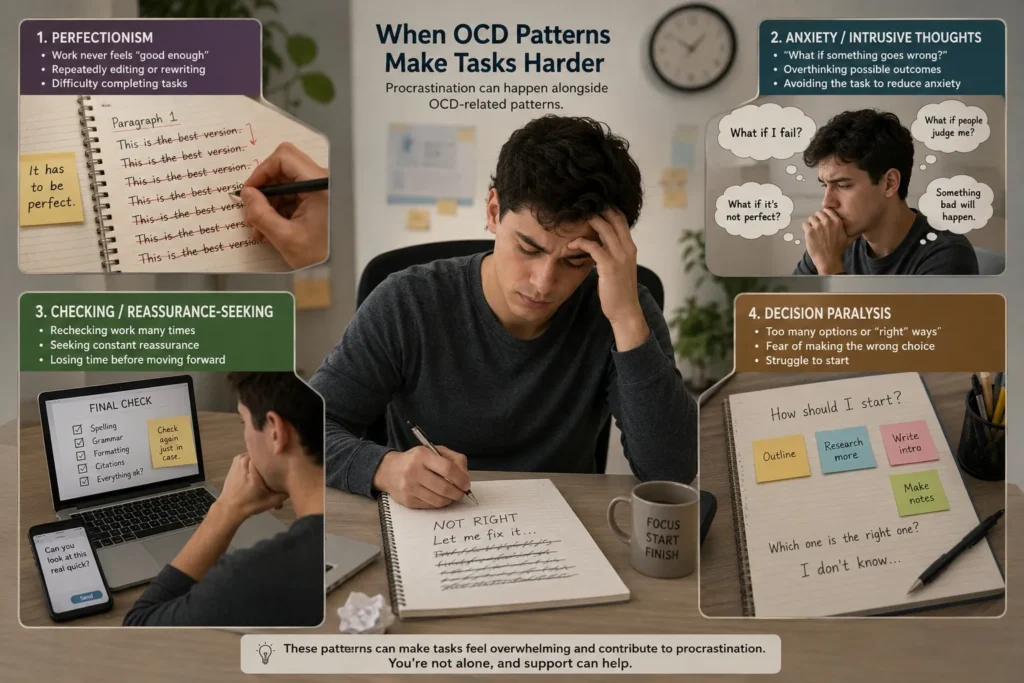
Procrastination and obsessive-compulsive disorder (OCD) can sometimes be connected, but procrastination by itself does not mean you have OCD. The connection is more complicated: perfectionism, intrusive thoughts, anxiety, repeated checking, compulsive rituals, and difficulty making decisions can sometimes make it harder to start or finish everyday tasks.
If you are wondering whether procrastination obsessive compulsive disorder is a real connection, the short answer is yes, it can be—but the reason a person is putting something off matters. Ordinary procrastination and OCD-related avoidance are not automatically the same thing.
The key distinction: procrastination is a behavior, while OCD is a mental health disorder involving obsessions, compulsions, or both. Someone may procrastinate without having OCD, while OCD symptoms can sometimes contribute to delaying tasks.
Can OCD Cause Procrastination?
OCD can contribute to procrastination when obsessive fears, uncertainty, perfectionistic demands, compulsions, or avoidance make a task feel difficult to begin or complete. A person may spend so much time thinking, checking, correcting, or trying to make something feel “right” that the original task gets delayed.
For example, imagine you need to submit an assignment. Instead of simply writing it, you may become stuck trying to make every sentence perfect, repeatedly rereading what you wrote, worrying about whether you made a mistake, or delaying the assignment because starting it brings uncomfortable uncertainty. In that situation, the delay is not necessarily about laziness or a lack of caring. The underlying pattern may involve anxiety, perfectionism, avoidance, or compulsive behavior.
The International OCD Foundation also describes procrastination and postponing tasks as possible avoidance behaviors in patterns of unhelpful perfectionism. :contentReference[oaicite:0]{index=0}
Why Can OCD-Related Patterns Lead to Procrastination?
There is not one single reason. Different OCD-related patterns can interfere with starting, continuing, or finishing a task in different ways.
Perfectionism Can Make Starting Feel Impossible
When a person feels that something must be done perfectly, beginning the task can feel much more difficult than it should. Instead of thinking, “I can make a reasonable start,” the standard may become, “I have to do this exactly right.” That can turn a normal task into something that feels overwhelming.
Perfectionistic patterns can also lead to over-editing, repeated reviewing, and putting work off because the person believes they need more time, energy, or certainty before they can begin. :contentReference[oaicite:1]{index=1}
Intrusive Thoughts and Anxiety Can Create Avoidance
OCD can involve unwanted and distressing thoughts, images, urges, or doubts. When a task becomes associated with uncomfortable uncertainty or anxiety, avoiding the task can provide temporary relief.
That relief can make avoidance feel like an easy solution in the moment, even though the unfinished task may create more problems later. This is one reason an OCD-related procrastination pattern can become difficult to break without addressing the underlying cycle.
Compulsions and Repeated Checking Can Use Up Time
A person may technically start a task but become stuck in repeated checking, correcting, researching, rereading, or other compulsive behaviors. The problem is then not simply “I cannot start.” The task may take far longer than expected because so much time is spent trying to remove doubt or achieve certainty.
The International OCD Foundation notes that perfectionism-related patterns can include repeated checking, excessive effort, reassurance-seeking, and procrastination or postponement. :contentReference[oaicite:2]{index=2}
Decision Paralysis Can Delay Simple Tasks
Some tasks require decisions, and OCD-related doubt can make those decisions feel much more significant than they actually are. A person may repeatedly compare options, reconsider a choice, or look for reassurance before moving forward.
When this happens repeatedly, even a relatively simple task can consume a surprising amount of time.
Is Procrastination a Sign of OCD?
Not necessarily. Procrastination is common and can happen for many reasons, including boredom, difficulty getting started, poor time management, uncertainty, stress, low motivation, or simply wanting to do something more enjoyable first.
Procrastination becomes more relevant to OCD when it appears alongside a broader pattern of obsessions, compulsions, avoidance, excessive checking, intense doubt, or rigid perfectionistic behavior that causes meaningful distress or interferes with everyday life.
Procrastination alone: You put off a task because it feels boring, difficult, or unpleasant.
Possible OCD-related pattern: You repeatedly delay, check, avoid, redo, or seek certainty because of distressing doubts, fears, compulsions, or rigid standards.
This distinction matters because procrastination alone cannot establish an OCD diagnosis. If you are concerned about symptoms, a qualified mental health professional can help determine what is actually happening rather than relying on one behavior as a diagnosis.
What Does OCD-Related Procrastination Look Like?
There is no single pattern that applies to everyone. You might notice something like the following:
- Putting off an assignment because it has to be perfect before you can submit it.
- Spending much longer than expected checking work for mistakes.
- Repeatedly researching or comparing information because you cannot feel certain enough to move on.
- Avoiding a task because it triggers uncomfortable thoughts or anxiety.
- Starting a task and then becoming stuck repeatedly correcting or redoing parts of it.
- Delaying decisions because you keep wondering whether you have chosen the wrong option.
- Feeling that a task cannot be finished until it feels completely correct or complete.
These patterns can overlap with perfectionism and avoidance, but seeing one or more of them does not automatically mean you have OCD.
How Can You Manage Procrastination When OCD Symptoms Are Involved?
The most useful approach depends on what is actually maintaining the delay. If OCD symptoms are involved, simply telling yourself to “stop procrastinating” may not address the underlying problem.
Make the First Step Smaller
Instead of defining the goal as “finish the entire project,” define a small, concrete first action. For example, opening the document and writing one rough sentence is a different psychological task from demanding that you complete a perfect final draft.
Breaking larger projects into smaller steps is also recommended in guidance addressing perfectionism and procrastination. :contentReference[oaicite:3]{index=3}
Notice When “More” Stops Helping
More checking, editing, researching, or reviewing does not always improve the result. If you keep repeating the same action mainly because you cannot tolerate uncertainty, the extra effort may be maintaining the problem rather than solving it.
A useful question is: “Am I improving the task, or am I trying to make my uncertainty disappear completely?”
Allow Reasonable Imperfection
For someone caught in a perfectionism-and-procrastination cycle, “good enough” can sometimes be more useful than waiting until everything feels perfect. The goal is not to become careless. It is to recognize that a task can sometimes be complete without eliminating every possible doubt or imperfection.
The International OCD Foundation specifically discusses reducing unhelpful perfectionistic patterns and recognizing that excessive effort and repeated correction can become counterproductive. :contentReference[oaicite:4]{index=4}
Be Careful With Reassurance and Rechecking
If you repeatedly ask other people to confirm that a decision is correct, reread the same information, or check the same work over and over, notice whether the checking actually solves a problem or only provides temporary relief.
When compulsive checking or reassurance-seeking is part of OCD, trying to eliminate it on your own can be difficult. That is one reason professional guidance can be valuable.
What Treatment Helps OCD?
OCD is treatable. Cognitive behavioral therapy (CBT), particularly exposure and response prevention (ERP), is a well-established psychological treatment for OCD. The National Institute of Mental Health identifies ERP as a specific form of CBT that can reduce compulsive behaviors, while the International OCD Foundation describes ERP as a first-line psychological treatment for OCD. :contentReference[oaicite:5]{index=5}
ERP is not simply “forcing yourself to stop being anxious.” With a trained clinician, treatment involves gradually approaching situations, thoughts, or triggers that produce OCD-related distress while learning not to respond with the usual compulsions or avoidance. :contentReference[oaicite:6]{index=6}
For someone whose procrastination is being maintained by OCD symptoms, treating the underlying OCD pattern may therefore be more useful than focusing only on productivity techniques.
Important: ERP should be planned with a qualified professional when it is being used to treat OCD. You do not need to deliberately expose yourself to distressing situations or attempt treatment exercises without appropriate guidance.
When Should You Consider Professional Help?
Consider talking with a qualified mental health professional if procrastination is persistent and comes with symptoms such as intrusive thoughts, compulsive behaviors, repeated checking, intense doubt, significant avoidance, or perfectionistic patterns that interfere with school, work, relationships, or everyday responsibilities.
You do not need to figure out whether you “really have OCD” before asking for help. A professional can look at the overall pattern, how much distress it causes, and how much it interferes with your life.
If you are already receiving care for OCD, it can also be useful to tell your clinician specifically about procrastination. The delay may be connected to avoidance, compulsions, perfectionism, uncertainty, or another issue that deserves attention.
OCD Procrastination vs. Everyday Procrastination
| Everyday procrastination | Possible OCD-related pattern |
|---|---|
| The task feels boring, difficult, or unpleasant. | The task triggers intense doubt, fear, perfectionism, compulsions, or avoidance. |
| You may delay it and later get started normally. | You may repeatedly check, redo, avoid, or seek certainty before moving forward. |
| The main problem is often getting motivated to begin. | The delay may be maintained by an ongoing cycle of obsessions, anxiety, compulsions, or avoidance. |
| It does not automatically indicate a mental health disorder. | It may be one part of a broader OCD-related pattern, but procrastination alone cannot diagnose OCD. |
Frequently Asked Questions
Is procrastination a form of OCD?
No. Procrastination itself is not the same thing as OCD. It can occur for many ordinary reasons. However, OCD symptoms such as compulsions, avoidance, intense doubt, and perfectionistic patterns can sometimes contribute to procrastination.
Can perfectionism cause procrastination?
Perfectionistic patterns can contribute to procrastination when a person feels that a task must be completed perfectly or that mistakes are unacceptable. That can make starting, finishing, or submitting work much harder. Perfectionism can also lead to repeated checking and over-editing. :contentReference[oaicite:7]{index=7}
Why does OCD make some tasks feel so difficult?
OCD can involve unwanted thoughts, uncertainty, compulsions, and avoidance. When completing a task seems to require eliminating doubt or performing repeated behaviors first, the task can take much more time and effort than expected.
What is the best treatment for OCD-related procrastination?
If procrastination is being driven by OCD symptoms, addressing the OCD itself is important. ERP, a specialized form of CBT, is a well-supported treatment for OCD. A qualified mental health professional can help determine whether ERP or another treatment approach is appropriate for your situation. :contentReference[oaicite:8]{index=8}
Can OCD get better with treatment?
Yes. OCD can be treated, and evidence-based treatments such as CBT with ERP can reduce symptoms and improve functioning for many people. Treatment plans vary depending on the individual, so professional assessment is important. :contentReference[oaicite:9]{index=9}
Is OCD an anxiety disorder?
OCD is a distinct mental health disorder. Although anxiety and distress can be prominent parts of OCD, OCD is classified separately from anxiety disorders in current diagnostic classification systems.
The Takeaway
The relationship between procrastination and OCD is real for some people, but procrastination should not be treated as proof of OCD. The more useful question is why the task is being delayed.
If the delay is connected to perfectionism, repeated checking, compulsions, intrusive thoughts, intense doubt, or avoidance, the procrastination may be part of a broader OCD-related pattern. In that situation, breaking tasks into smaller steps may help with day-to-day functioning, but addressing the underlying OCD symptoms can be even more important.
If these patterns are interfering with your daily life, talking with a qualified mental health professional can help you understand what is happening and identify appropriate support.
Explore Topics
Sub-Topics & Guides
Featured Guides
Top Industry Resources
Editorial Integrity
Our content is 100% human-written, evidence-backed, and continuously updated to fulfill reader intent with maximum honesty.
"Small, consistent habits compounded over time create unshakeable momentum."