CNLawBlog.com is an independent online publication that shares informational articles about law, business, finance, technology, education, health, and everyday subjects. Despite its legal-sounding name, it is not a law firm, government legal database, or source of personalized legal advice. Its main purpose is to explain topics in accessible language so readers can get familiar with an issue before turning to specialist sources when necessary.
The website says it began in August 2018 with a legal publishing focus and later expanded into a broader digital magazine. I reviewed its publicly available pages, policies, and a selection of articles to see what readers actually get.
Here is what I found, including its useful features, limitations, and a few details worth checking before relying on its content.
Reviewed against publicly available site pages in October 2026.
CNLawBlog.com at a Glance
| Question | Quick answer |
|---|---|
| Official website | www.cnlawblog.com |
| Type of website | Independent, multi-topic digital publication |
| Reported starting date | August 2018, according to its About page |
| Main subjects | Law, business, finance, technology, health, education, and lifestyle |
| Reader access | Articles are free to read, according to its FAQ |
| Professional legal services | No; the site says its content is informational, not legal advice |
| Guest contributions | Accepted under published editorial and link guidelines |
Think of it as a general-interest blog with a legal identity: useful for learning terminology and finding research leads, but not a regulator, law practice, or specialist reference library.
Why Does CNLawBlog Have a Legal-Sounding Name?
The name can create the impression that everything on the website concerns legislation or court cases. That is no longer an accurate description of its published material. Its About page describes legal publishing as the original focus, while today’s navigation reaches well beyond law.
I found an older article on labour law consultants beside newer material on finance, data sovereignty, and gaming. That mix illustrates its expanding scope, not a uniform level of expertise.
There is another potential source of confusion: CNLawBlog is not the same publication as China Law Blog, which appears on the Harris Sliwoski law firm’s website.
The similar names do not establish any affiliation. I’ll compare them below, because choosing the wrong website could send your research in an entirely different direction.
What Topics Does CNLawBlog.com Cover?
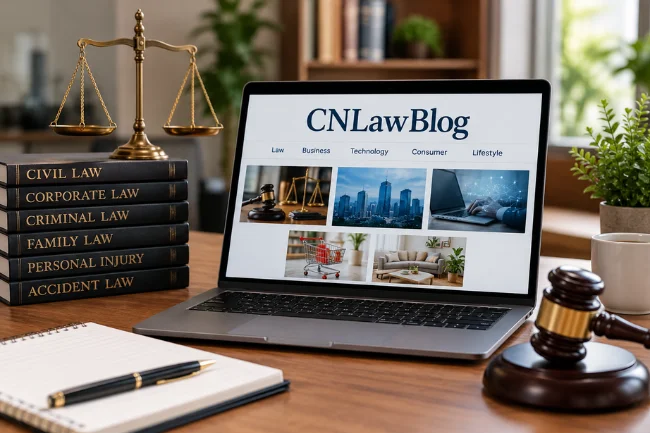
The range is wider than the domain suggests. The homepage and editorial policy show law alongside business, technology, consumer, and lifestyle topics.
Law and Everyday Legal Questions
Law remains an identifiable part of the website. Its navigation includes civil law, corporate law, criminal law, family law, personal injury law, and accident-related topics.
Some articles approach legal issues through practical situations rather than abstract definitions.
For example, a piece about renters’ rights in Los Angeles discusses rent increases, housing conditions, deposits, and evictions. Other titles cover injuries and insurance claims.
Their usefulness depends on the reader’s location and the information’s age.
A legal article mentioning California, for instance, cannot automatically answer a renter’s question in Texas or another country. I would use it to frame my questions, then consult the appropriate local housing authority or licensed attorney.
Business and Personal Finance
Business articles address topics such as trading, operational tools, entrepreneurship, and professional services. The finance section includes borrowing decisions, interest rates, credit cards, and warnings about online scams.
One detailed example is the site’s 2026 article about fake loan websites.
It discusses suspicious loan promises, upfront fees, and how to identify the actual lender. It also refers to Indian banking terms and institutions, which is a reminder that financial rules are country-specific.
The topics address real decisions, but readers should confirm rules and product terms with regulators or lenders before borrowing.
Technology and Digital Trends
Technology coverage moves beyond software tutorials. A post on edge AI and data sovereignty discusses running AI systems on local devices instead of relying entirely on cloud services.
The category also addresses changing digital tools and online platforms.
This material may appeal to curious readers and small-business owners who want an introduction before consulting technical documentation.
It is less suitable as the sole source for designing security systems or making compliance decisions, where implementation details and independent testing matter.
Education, Health, Lifestyle, and Other Subjects
The editorial policy also lists education, home improvement, real estate, gaming, and consumer information.
The navigation includes travel, automotive, fashion, politics, and sports, while published titles range from screen-time habits to an Elden Ring exploration guide.
That variety is useful if you enjoy browsing one site for different subjects.
It also creates a challenge: expertise in one area does not automatically transfer to another. A health article deserves a different level of checking than a casual gaming guide.
How Easy Is the Website to Use?
When I checked the public homepage, the main navigation displayed broad categories such as Technology, Finance, Business, Education, Health, Lifestyle, Real Estate, and Law.
The Law menu broke down into narrower subjects. A search field was also visible, which is helpful when a category contains unrelated articles.
The homepage includes featured posts, a dedicated law area, recent entries, and links to informational pages in the footer.
Individual articles display titles, bylines, dates, and headings. This gives readers several ways to find material without knowing an exact article title.
I would search by subject, then inspect the publication date and byline.
Category labels help you navigate; they don’t establish whether guidance fits your circumstances. If you arrive from Google, verify the domain before reading.
Is CNLawBlog.com Legitimate and Trustworthy?

There are two different questions here.
Is this an identifiable website that publishes articles and policies? Yes.
Should every claim on it be accepted as authoritative? No website earns that conclusion from its design or About page alone.
What the Site Discloses
CNLawBlog provides an editorial policy, disclaimer, FAQ, and contact page.
Its policy describes topic research, writing, editing, corrections, and updates. It says submissions may be checked for readability and factual consistency and that promotional content is identified where appropriate.
These disclosures help explain the publisher’s stated standards and offer a way to report mistakes.
They cannot prove that every article was independently checked by a specialist.
What I Would Verify Before Trusting a Specific Article
I saw named bylines, including Jamie and Mansi, on the pages I reviewed.
A byline makes an article attributable, but it doesn’t establish legal, medical, or financial qualifications. For an important question, I would look for the writer’s background, direct citations, the jurisdiction discussed, and a meaningful update date.
I would also distinguish original reporting from general commentary.
An explanation based on official legislation or regulator guidance gives me something to check. A broad claim with no supporting link requires more caution, even when it sounds convincing.
Advertising, Affiliate Links, and Editorial Independence
The site’s FAQ says it displays advertising and that some articles may contain affiliate links.
Its disclaimer says affiliate relationships may generate commissions and that third-party ads are not endorsements. The guest-post program also accepts contributions containing certain backlinks.
These arrangements are common across online publishing, but they are relevant context.
When an article recommends a service, I check whether the recommendation is supported by evidence and whether a commercial relationship is disclosed.
Revenue models don’t automatically make content unreliable; they make transparency especially valuable.
What I Noticed in Actual Articles
Looking beyond policy pages was the most useful part of my review.
Three examples show why CNLawBlog should be assessed article by article, not through one blanket judgment.
The renters’ article uses accessible examples and links to a legal-service provider. Before acting on eviction guidance, I would check official local housing rules.
The edge AI article explains the concept and links to a related provider. I would check technical documentation before accepting its broad security and privacy claims.
The loan-scam article offers more detail, including India-specific references to RBI-regulated lenders and key fact statements. Its advice shouldn’t be assumed to apply worldwide.
Each article deserves its own evaluation. A small sample tells me more than a blanket verdict on the domain.
CNLawBlog.com vs. China Law Blog: What’s the Difference?
Because the names resemble each other, this distinction deserves its own explanation.
China Law Blog is associated with Harris Sliwoski LLP and emphasizes Chinese and international business-law issues. CNLawBlog.com describes itself as a separate, independent, multi-topic publication.
| Feature | CNLawBlog.com | China Law Blog |
|---|---|---|
| Website | cnlawblog.com | harris-sliwoski.com/chinalawblog/ |
| Publisher identity | Independent digital publication, by its description | Harris Sliwoski law firm |
| Main coverage | Law plus finance, business, technology, lifestyle, and more | China-related business law and cross-border legal issues |
| Typical reader need | General explanations and articles | More specialized international business-law analysis |
| Personalized legal advice | Not provided by its articles | Blog articles are not a substitute for retaining legal counsel |
For Chinese manufacturing contracts or cross-border disputes, the firm’s specialized blog may fit better.
For general finance or legal awareness, CNLawBlog is closer to the mark.
Neither website’s articles should replace advice tailored to your specific legal matter.
Who Is CNLawBlog Best For?
I see the clearest fit for readers who want an accessible starting point, not a final authority.
A student might use an article to understand basic terminology before opening a textbook. A business owner might pick up questions to ask an adviser. A general reader might explore a current technology concept or compare common consumer risks.
Researchers can find leads, but should trace claims to original legislation, official notices, studies, or technical documentation before citing them.
Its disclaimer rules out personalized medical, legal, and financial advice.
How I Recommend Using Legal and Financial Articles Safely
I follow a short verification routine whenever a general-information website covers a high-stakes decision.
First, I identify the precise question: a definition, a deadline, an eligibility rule, or a practical option. Those questions require different types of evidence.
Next, I check location and timing.
Laws differ by jurisdiction; financial rules and fees change; health guidance can be revised. An older post may still explain a useful concept while missing a new rule or exception.
Finally, I trace consequential claims to a primary source.
For legal issues, that might be legislation, a court, or a government agency. For lending, it could be a regulator or the lender’s official disclosures.
For healthcare, it should involve qualified clinical guidance. If a deadline, diagnosis, payment, or legal right is at stake, I would speak to an appropriately qualified professional.
That preserves the value of accessible explanations without overstating their authority.
Can You Submit a Guest Post to CNLawBlog.com?
Yes. The website has a public guest-posting page inviting contributions about law, business, finance, technology, education, and related informational subjects.
This is useful information for freelance writers and businesses evaluating publishing opportunities.
Its rules require original content of at least 500 words, preferably 1,000 or more, with clear headings and accurate information.
It permits one or two relevant dofollow backlinks, excludes affiliate links, and may edit submissions.
The instructions ask writers to email an article with author details and proposed links. The stated review response window is 24–72 hours, not a guaranteed publication date.
The FAQ says guest posting is not necessarily free; fees depend on the submission requirements, so contributors should confirm terms directly.
If I were considering a submission, I would ask about the final cost, editorial control, sponsorship labeling, attribution, and link policy before sending anything.
A dofollow link does not guarantee rankings.
More importantly, Google’s link spam policies say paid placements intended to pass ranking credit can violate its rules; paid links should use appropriate attributes such as rel="sponsored" or rel="nofollow".
I would prioritize audience fit and editorial value over link promises.
Strengths and Limitations Worth Knowing
CNLawBlog offers a wide subject range, straightforward navigation, and openly accessible articles.
Its About, FAQ, and policy pages give readers useful background that some small publications do not provide.
The trade-off is breadth.
A website covering injury law, AI technology, loans, gaming, and wellness cannot be assumed to have the same level of specialist expertise in every article.
Readers must pay attention to sourcing, authorship, updates, and possible promotional relationships.
I would describe it as a convenient discovery and learning resource.
I would not use it alone to settle a legal dispute, choose a complex financial product, or make a medical decision. That is a practical distinction, not an accusation against the publisher.
Final Thoughts
CNLawBlog.com is best understood as a free, multi-topic information website with roots in legal publishing.
It gives readers accessible starting points across law and everyday subjects, publishes basic editorial disclosures, and accepts guest contributions. Its usefulness depends on which article you read and how well the claims are supported.
My advice is to browse the official website, open an article relevant to your question, and verify anything consequential against an authoritative source.
For unfamiliar topics, that’s a sensible place to begin.
Frequently Asked Questions
What is cnlawblog.com used for?
It’s an online publication for reading introductory articles about legal topics, business, finance, technology, and other everyday subjects.
Is cnlawblog.com a legitimate website?
It is an active publication with public contact and policy pages, but the accuracy and expertise behind individual articles should still be checked.
Does cnlawblog.com offer legal advice?
No. Its disclaimer states that articles are for general information and do not create a lawyer-client relationship.
Is cnlawblog.com free to read?
Yes. Its official FAQ says articles are freely accessible, although guest-posting arrangements may involve fees.
Can I publish a guest post on cnlawblog.com?
Yes. The site accepts original submissions under its published guidelines; review timing, link conditions, and any charges should be confirmed directly.
Related Posts

Voozon.com Review: Essential Facts Before You Visit
Domikyo.com: Essential Facts on Safety and Content
Crackstube: 7 Key Facts About Safety & Guest Posts
Adstotally.Com: Essential Facts Before You Trust It

charfen.co.uk Review: 7 Facts to Know Before Visiting

Sosoactive: Essential Facts on History, Sites & Safety