
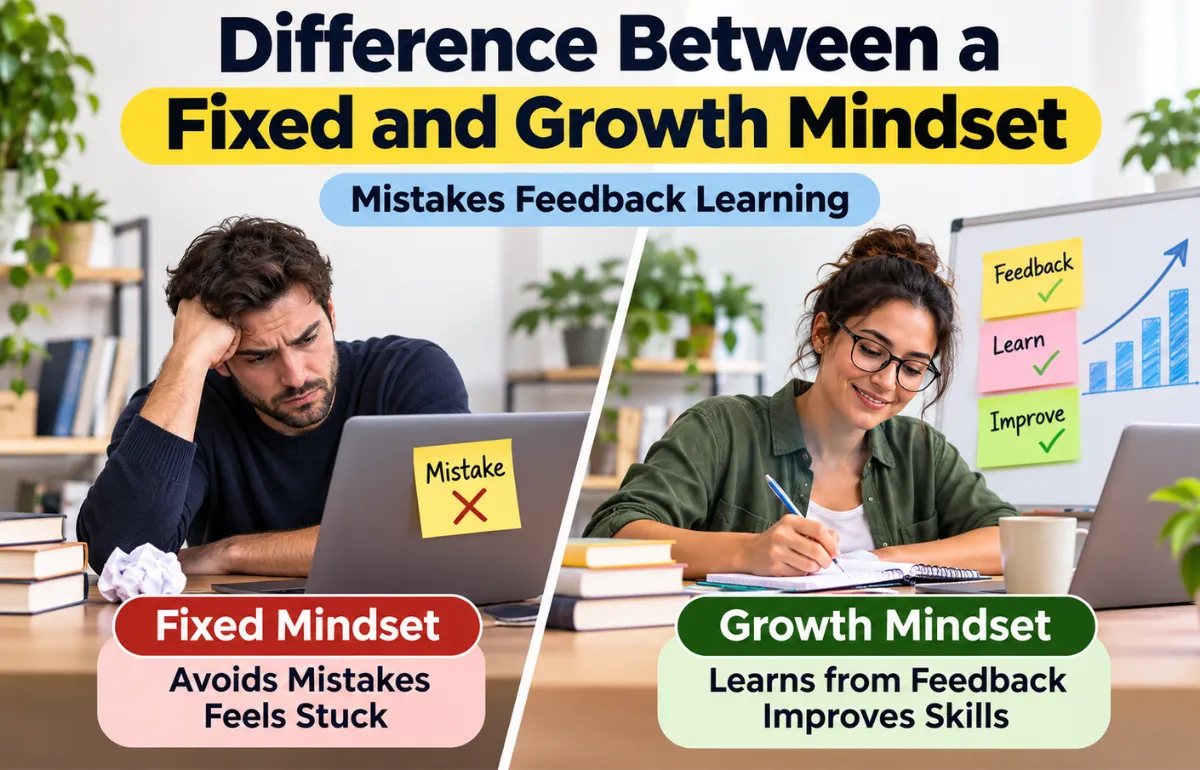
The difference between a fixed and growth mindset lies in how people perceive their intelligence, talents, and ability to learn. A fixed mindset is the belief that abilities are largely permanent and cannot change significantly. A growth mindset is the belief that abilities can develop through practice, effective learning strategies, constructive feedback, and support from others.
For example, someone with a fixed mindset might struggle to learn a new skill and assume they lack natural talent. Someone with a growth mindset may experience the same difficulty but recognize that their current performance does not necessarily determine their future potential.
I find this distinction particularly useful when looking at how adults respond to unfamiliar situations, professional setbacks, and everyday mistakes.
The real difference becomes visible when things stop going according to plan. How you interpret those moments can influence what you learn, how you respond, and whether you continue improving.
What Is a Fixed Mindset?
A fixed mindset is a belief system in which people consider their intelligence, skills, and talents relatively unchangeable. They may assume that being good at something depends primarily on natural ability rather than learning and development.
This concept was introduced through the research of Stanford University psychologist Carol Dweck, who examined how people’s beliefs about their abilities influence motivation and learning behavior.
Someone with fixed mindset thinking may perform exceptionally well in familiar situations but feel uncomfortable when asked to do something outside their expertise.
For instance, an experienced accountant might avoid learning new software because struggling with technology could challenge their perception of being a competent professional.
The problem is not necessarily a lack of intelligence or motivation. It is the assumption that difficulty reveals a permanent limitation.
Common Characteristics of a Fixed Mindset
- Avoiding unfamiliar or challenging tasks.
- Feeling uncomfortable about making mistakes publicly.
- Viewing constructive criticism as a personal judgment.
- Believing natural talent matters more than skill development.
- Comparing personal abilities with other people’s achievements.
- Giving up when improvement does not happen quickly.
- Hesitating to ask questions for fear of appearing incompetent.
Fixed mindset tendencies can exist even in highly successful individuals. Professional achievements do not automatically eliminate the fear of being seen as inexperienced.
What Is a Growth Mindset?
A growth mindset is the belief that intelligence, knowledge, and abilities can develop over time through meaningful effort, effective strategies, experience, and appropriate guidance.
People with this perspective generally recognize that their present skill level is a starting point rather than a final measurement of their potential.
Imagine a 45-year-old employee learning digital marketing after spending two decades in a different profession. Instead of assuming that younger colleagues have an unbeatable advantage, the employee recognizes that experience, training, and consistent practice can help them develop new competencies.
This does not mean everyone can achieve identical results or overcome every limitation. It means that improvement remains possible in many circumstances.
Common Characteristics of a Growth Mindset
- Being willing to learn unfamiliar skills.
- Accepting mistakes as potential sources of information.
- Seeking specific and constructive feedback.
- Adjusting strategies when progress slows.
- Recognizing the importance of practice and guidance.
- Learning from other people’s experiences.
- Measuring improvement rather than demanding immediate perfection.
I prefer to understand this mindset as a realistic approach to development rather than an endless pursuit of achievement.
Fixed Mindset vs. Growth Mindset: Comparison Table
The following table summarizes how these two perspectives can influence everyday decisions and learning behaviors.
| Area of comparison | Fixed mindset | Growth mindset |
|---|---|---|
| Belief about intelligence | Intelligence is largely permanent. | Intelligence can develop. |
| Learning new skills | Depends mainly on natural ability. | Improves through learning and practice. |
| Challenges | May expose personal weaknesses. | Can reveal areas for development. |
| Mistakes | Evidence of insufficient ability. | Information about what needs improvement. |
| Effort | May indicate a lack of talent. | Supports skill development. |
| Feedback | Can feel like a personal attack. | Can provide useful direction. |
| Other people’s success | May feel threatening. | Can offer learning opportunities. |
| Setbacks | Reasons to reconsider personal potential. | Reasons to evaluate the current approach. |
| Asking for help | May reveal incompetence. | Supports learning and understanding. |
| Long-term development | Limited by perceived natural abilities. | Influenced by learning, resources, and experience. |
These differences describe common tendencies rather than permanent personality categories.
7 Key Differences Between a Fixed and Growth Mindset
Understanding the definitions is useful, but I think the comparison becomes more meaningful when applied to ordinary situations adults encounter throughout their lives.
1. Beliefs About Intelligence and Natural Talent
A fixed mindset places considerable emphasis on existing abilities. Someone may believe that being intelligent, creative, or technically skilled is something a person either possesses or does not.
This belief can discourage adults from exploring opportunities outside their established strengths.
A growth mindset recognizes that natural aptitude matters but is not the only factor influencing performance. Knowledge, previous experience, instruction, practice, and access to resources also contribute to skill development.
Consider someone who has always believed they are terrible at mathematics. Their difficulties might partly reflect gaps in foundational knowledge rather than an inability to learn numerical concepts.
These are two very different explanations for the same experience.
One treats current ability as permanent. The other leaves room for development.
2. How Adults Approach New Challenges
Learning something unfamiliar can feel uncomfortable, especially when adults have established professional identities.
A manager who has spent years making confident decisions might suddenly feel inexperienced while learning data analysis or a new project management system.
With a fixed mindset, that discomfort may encourage avoidance. The manager might delegate unfamiliar responsibilities to protect their reputation.
With a growth mindset, the same manager may seek training, ask questions, and accept a temporary reduction in confidence while developing competence.
I consider the willingness to become a beginner again one of the most revealing differences between these perspectives.
Adult learning often requires accepting that previous expertise does not automatically transfer to every new situation.
3. How Mistakes Are Interpreted
Mistakes can produce embarrassment, disappointment, and frustration regardless of someone’s mindset. What differs is the meaning attached to the mistake.
Fixed mindset thinking may turn an isolated error into a broader judgment about personal ability.
For example, someone who delivers an unsuccessful presentation might decide they are naturally poor communicators.
Growth-oriented thinking separates the outcome from the person’s overall potential. The individual might examine whether the presentation lacked structure, relevant examples, sufficient preparation, or audience engagement.
This distinction matters because different explanations create different opportunities.
If the problem is considered permanent, further learning may seem pointless. If the problem involves identifiable skills, there is something specific to investigate.
4. Responses to Constructive Feedback
Feedback often reveals the difference between a fixed and growth mindset more clearly than success does.
Imagine receiving an email explaining that your latest report lacks supporting evidence and contains unclear recommendations.
A fixed mindset response might involve defensiveness, embarrassment, or an assumption that your manager doubts your overall competence.
A growth mindset response may involve asking which claims need stronger evidence and what a clearer recommendation would look like.
However, having a growth-oriented perspective does not mean accepting every criticism without question.
Some feedback is inaccurate, poorly communicated, or influenced by personal bias. Evaluating its usefulness is part of responding intelligently.
I would distinguish constructive feedback from personal criticism by examining whether it identifies something specific that can reasonably be improved.
5. Attitudes Toward Effort and Practice
People with fixed mindset beliefs sometimes interpret excessive effort as evidence that they lack natural ability.
They may assume that genuinely talented individuals should learn quickly without much difficulty.
A growth mindset recognizes that meaningful practice is often necessary, even for talented people.
However, repeatedly using an ineffective method does not automatically produce improvement.
Carol Dweck’s research emphasizes the importance of learning strategies alongside effort. If someone spends months studying a foreign language without practicing conversation, additional hours of the same activity may not address their actual weakness.
The distinction is between working harder and learning more effectively.
A growth-oriented learner is generally more willing to examine whether their current approach is producing the desired results.
6. Reactions to Other People’s Success
Comparison is particularly common in professional environments, where promotions, salaries, qualifications, and recognition are often visible.
A fixed mindset may lead someone to interpret another person’s achievement as evidence of their own inferiority.
A growth mindset allows someone to investigate what contributed to that achievement without automatically assuming the same opportunities or circumstances apply to everyone.
For example, a colleague’s successful presentation might reveal useful communication techniques worth observing.
Their success does not necessarily diminish your abilities, just as copying their approach does not guarantee identical results.
The more productive comparison concerns methods, experience, and preparation rather than personal worth.
7. Responses to Slow Progress
Adults often have limited time for learning because of professional responsibilities, financial pressures, and family commitments.
When improvement takes longer than expected, fixed mindset thinking may encourage the belief that continuing is pointless.
A growth mindset leaves room for alternative explanations, including unrealistic deadlines, inadequate resources, inconsistent practice, or unsuitable teaching methods.
Sometimes progress is difficult to notice because the learner measures only the final outcome.
Someone learning public speaking might still feel nervous after several weeks but communicate more clearly, organize ideas better, and recover faster after forgetting a sentence.
Those improvements matter even if complete confidence has not developed.
Real-Life Examples of Fixed and Growth Mindsets in Adults
Mindset differences are not limited to classrooms or childhood education. They can influence career development, communication, personal interests, and lifelong learning.
Here are several hypothetical examples showing how the same situation can produce different responses.
| Everyday situation | Fixed mindset response | Growth mindset response |
|---|---|---|
| Learning new software | Technology has never been my strength. | I need more practice with unfamiliar features. |
| Receiving negative feedback | My manager thinks I’m incompetent. | Which parts of my work need improvement? |
| Making a workplace mistake | I’m not suited to this position. | What caused the error, and can I prevent it? |
| Failing a certification exam | I’m not intelligent enough to pass. | Which topics did I misunderstand? |
| Learning a foreign language | I’m too old to learn another language. | I may need a learning method suited to my schedule. |
| Having an unsuccessful interview | I’m never going to get a better job. | Which interview skills could I strengthen? |
| Struggling with a creative project | I’m simply not a creative person. | Perhaps I need more experience or a different approach. |
Notice that the growth-oriented responses do not deny the difficulty. They identify something worth examining rather than treating the experience as a permanent verdict.
Why Adults May Experience Fixed Mindset Thinking More Strongly in Certain Situations
One overlooked consideration in adult learning is the perceived cost of appearing inexperienced.
A child learning a new activity is generally expected to make mistakes. An adult with years of professional experience may feel pressure to demonstrate competence immediately.
A senior employee might worry that asking a basic question will damage their credibility. A business owner might resist feedback because acknowledging a mistake feels like admitting poor leadership.
Financial responsibilities can make experimentation more complicated, too. Changing careers or pursuing further education may involve genuine risks that cannot be dismissed through positive thinking.
This is why I would avoid interpreting every instance of hesitation as evidence of a fixed mindset.
Sometimes adults are responding to realistic concerns about time, money, workplace culture, or professional consequences.
The relevant question is whether they believe their abilities can develop, even when their circumstances restrict opportunities to do so.
Three Layers of Mindset: An Alternative Way to Understand the Difference
I find it helpful to divide mindset responses into three layers: interpretation, emotion, and action.
This is a practical framework for comparing everyday reactions, not a formal psychological assessment.
Interpretation: What Does the Experience Mean?
After making a mistake, someone might interpret the event as proof that they lack ability.
Alternatively, they might interpret it as evidence that their preparation or knowledge needs improvement.
Emotion: How Does the Experience Feel?
Both individuals may feel disappointed or embarrassed. A growth mindset does not eliminate uncomfortable emotions.
The difference is that those emotions do not necessarily determine what happens next.
Action: What Happens Afterward?
One person might avoid similar assignments. Another might review the mistake, request clarification, or explore a different approach.
Looking at these three layers prevents the common misunderstanding that growth-oriented people must always remain confident and optimistic.
Someone can feel discouraged while still believing improvement is possible.
Can Someone Have Both a Fixed and Growth Mindset?
Yes. People can demonstrate both mindsets across different activities, environments, and periods of their lives.
Someone might believe they can improve their writing skills while remaining convinced that they will never understand mathematics.
An experienced business professional may welcome feedback about marketing strategies but become defensive when their leadership abilities are questioned.
MIT’s Teaching and Learning Lab also explains that people can hold different beliefs about their abilities across learning domains and even respond differently as circumstances change.
Recognizing this overlap makes the concept more useful. Rather than labeling someone as a fixed mindset person, I prefer to examine the particular belief influencing their response.
What Does Research Say About the Effectiveness of a Growth Mindset?
Research has explored the relationship between mindset, motivation, learning behavior, and academic achievement.
However, the scientific evidence is more nuanced than many popular personal development claims suggest.
A 2023 systematic review by Jeni Burnette and colleagues, published in Psychological Bulletin, identified modest academic benefits from well-implemented growth mindset interventions among groups expected to benefit most.
Another 2023 review by Brooke Macnamara and Alexander Burgoyne questioned the strength of these benefits, particularly when research quality and potential publication bias were considered.
Research has also explored the relationship between growth mindset beliefs and cognitive development among older adults learning multiple skills.
These findings should not be interpreted as proof that mindset alone determines achievement.
Effective instruction, previous knowledge, economic circumstances, health, learning opportunities, and individual differences also matter.
A belief in personal development can support learning, but it cannot replace the conditions necessary for learning to occur.
Is a Growth Mindset Always Better Than a Fixed Mindset?
A growth mindset is generally more supportive of skill development because it encourages people to consider possibilities beyond their current performance.
Nevertheless, recognizing realistic limitations is not the same as having a fixed mindset.
Someone might decide against pursuing a particular qualification because it requires more time or money than they can reasonably afford. That decision does not necessarily mean they doubt their ability to learn.
Similarly, persistence is not always the best response to an unsuccessful approach.
A healthy perspective leaves room for changing direction, reconsidering priorities, and recognizing when an activity is no longer worthwhile.
Understanding these distinctions also provides a useful foundation for exploring Mindset Shift and how underlying beliefs can change without ignoring practical limitations.
How to Recognize Which Mindset Is Influencing Your Decisions
Instead of judging yourself by how motivated you feel on a successful day, consider your reactions when something becomes difficult.
I suggest reflecting on these questions:
- When I make a mistake, do I examine the cause or question my overall ability?
- Does asking for help feel like learning or admitting incompetence?
- When progress slows, do I investigate my approach or assume improvement is impossible?
- Can I separate criticism of my work from criticism of my personal worth?
- Do I treat my current skill level as a permanent limitation?
These questions are not a psychological diagnostic tool. They are simply a way to recognize beliefs that may influence everyday learning decisions.
Your answers may differ depending on the situation, and that is entirely consistent with how mindsets can operate.
Final Thoughts
The difference between a fixed and growth mindset is ultimately about whether you perceive your present abilities as largely permanent or capable of further development.
This distinction influences how you approach adult learning, interpret mistakes, respond to feedback, and evaluate setbacks.
A growth mindset does not guarantee success, eliminate frustration, or remove external barriers. Its practical value lies in keeping reasonable possibilities for improvement open.
I encourage you to reflect on one recent learning experience that did not go as planned. Consider whether your response was based on a genuine limitation or an assumption about what you could become capable of doing.
That distinction may reveal more about your approach to learning than any motivational statement.
Frequently Asked Questions
1. What is the main difference between a fixed and growth mindset?
A fixed mindset views abilities as largely permanent, while a growth mindset recognizes that abilities can develop through learning, practice, effective strategies, and support.
2. Can adults develop a growth mindset?
Yes. Adults can reconsider their beliefs about intelligence and abilities through learning experiences, constructive feedback, reflection, and evidence of personal improvement.
3. What is a real-life example of a fixed mindset?
Avoiding a public speaking opportunity because you believe communication skills are an inborn talent is an example of fixed mindset thinking.
4. Is a growth mindset the same as positive thinking?
No. Positive thinking emphasizes optimistic expectations, while a growth mindset concerns the belief that abilities can develop, even when experiences are difficult.
5. Who developed the fixed and growth mindset theory?
Stanford University psychologist Carol Dweck developed and popularized the concepts through her research on intelligence beliefs, motivation, achievement, and learning behavior.

FOLLOW YOUR CURIOSITY
A little more to explore
Stay with the topic. Find another perspective to take into your day.
Scarcity Mindset in Relationships: 8 Signs and Fixes
By Kittisak Wattanakul
How to Overcome Scarcity Mindset: 12 Ways to Break Free
By Kittisak Wattanakul
Neuroplasticity and Growth Mindset: 6 Powerful Tips
By Kittisak Wattanakul