
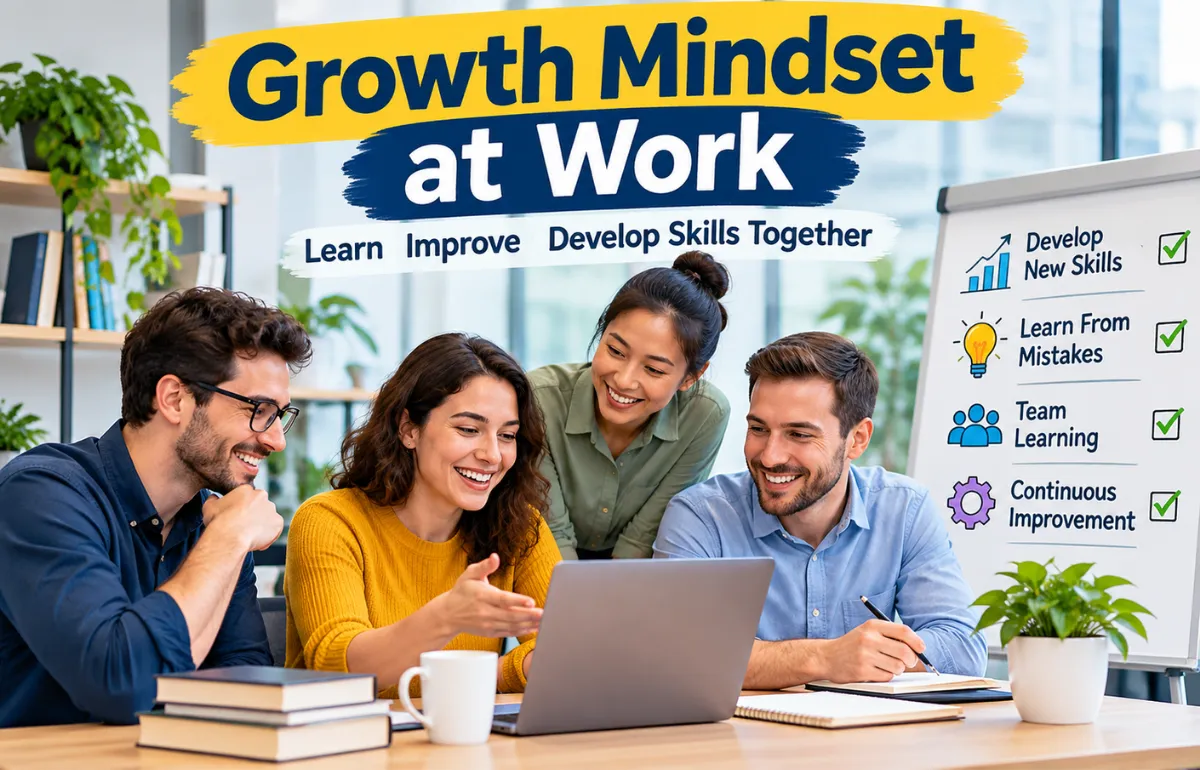
A growth mindset at work is the belief that professional abilities, knowledge, and skills can improve through consistent practice, effective learning strategies, and experience. Instead of viewing talent as something permanent, employees with a growth mindset recognize that they can develop their capabilities, learn from mistakes, and become better at their jobs over time.
This approach encourages continuous learning, adaptability, creative problem-solving, and collaboration in the workplace.
I like to think of professional growth as something that happens between everyday responsibilities. It happens when you figure out a better way to complete a task, discover why a project failed, or learn something useful from a colleague.
You don’t necessarily need another degree or an expensive training program to start growing professionally. Sometimes, the most valuable learning opportunities are already sitting on your work schedule.
What Does a Growth Mindset at Work Really Mean?
The concept of a growth mindset comes from the research of psychologist Carol Dweck, who explored how people’s beliefs about their abilities influence learning and development.
In a professional setting, having this mindset means understanding that your current skill level does not necessarily determine what you will be capable of in the future.
For example, imagine an employee who struggles with data analysis. Rather than assuming they are naturally bad with numbers, they spend time learning spreadsheet functions, understanding data patterns, and practicing with smaller datasets.
Their abilities gradually improve because they approach the difficulty as a learning opportunity.
However, a growth mindset doesn’t mean believing that everyone can master everything. People have different strengths, circumstances, resources, and learning needs.
I see it as a willingness to explore what can realistically improve rather than placing unnecessary limits on professional development.
Growth Mindset vs. Fixed Mindset in the Workplace
A fixed mindset assumes that abilities and intelligence are largely unchangeable. A growth-oriented mindset recognizes that many abilities can develop through appropriate learning and experience.
The difference becomes particularly noticeable when employees encounter unfamiliar responsibilities or workplace setbacks.
| Workplace Situation | Fixed Mindset | Growth Mindset |
|---|---|---|
| Learning new software | Avoids unfamiliar features | Explores and practices useful functions |
| Making a mistake | Tries to forget the incident | Investigates what caused the mistake |
| Facing a difficult project | Depends only on existing abilities | Develops additional skills |
| Meeting a skilled colleague | Views their abilities as natural talent | Studies their working methods |
| Experiencing change | Holds onto outdated processes | Experiments with alternative methods |
| Completing routine tasks | Repeats familiar approaches | Looks for opportunities to improve |
| Sharing knowledge | Keeps expertise to oneself | Helps colleagues develop their abilities |
These mindsets are not permanent personality categories. Someone might approach technical challenges with curiosity while resisting changes to their organizational habits.
Recognizing where fixed thinking appears is more useful than labeling yourself or your colleagues.
Why Is a Growth Mindset Important in the Workplace?
Professional environments rarely remain unchanged. New responsibilities emerge, technologies evolve, and familiar working methods eventually need improvement.
A learning-oriented approach helps employees respond to these changes without relying entirely on what they already know.
Supports Continuous Skill Development
Employees who regularly explore unfamiliar tasks create more opportunities to expand their professional abilities.
An administrative assistant might learn workflow automation. A content writer might develop research and data interpretation skills. A customer service representative might study the causes of recurring customer complaints.
Each additional capability makes existing experience more versatile.
Encourages Better Problem-Solving
When an initial solution fails, a learning mindset encourages employees to investigate alternative approaches instead of repeating the same process indefinitely.
I consider this particularly valuable when workplace problems have several possible causes.
Examining assumptions, testing solutions, and comparing results can reveal issues that were previously overlooked.
Strengthens Workplace Adaptability
Changes in technology, customer expectations, and business operations often require employees to update their knowledge.
People who view learning as an ongoing responsibility may find it easier to participate in new processes and adjust their working methods.
Adaptability becomes something they practice regularly rather than something they attempt only during major organizational changes.
Improves Team Collaboration
A 2020 study published in Personality and Social Psychology Bulletin found that employees who perceived their organizations as having growth-oriented cultures reported more positive collaboration, innovation, and organizational trust than those who perceived fixed-mindset cultures.
These findings suggest that workplace beliefs about talent can influence how employees experience their organizational environment.
When knowledge is treated as something that can be developed collectively, colleagues have more reason to share what they know.
How to Develop a Growth Mindset at Work
Developing a learning mindset requires changes in everyday behavior. Simply repeating motivational statements won’t teach you how to perform an unfamiliar task.
Here are practical approaches that connect mindset development with meaningful professional improvement.
1. Identify the Exact Skill You Need to Improve
Broad learning goals often make progress difficult to recognize.
For instance, wanting to become better at digital marketing sounds useful, but it covers several different abilities, including research, analytics, writing, advertising, and campaign planning.
I recommend identifying the specific activity that repeatedly causes difficulty.
Instead of trying to improve your entire marketing skill set, you might concentrate on interpreting campaign reports or identifying why website visitors abandon a particular page.
A narrower learning objective makes practice more manageable and progress easier to measure.
2. Turn Everyday Tasks Into Learning Opportunities
Routine responsibilities can become surprisingly effective learning exercises.
Suppose you prepare a weekly business report. Rather than producing it the same way every week, you could explore a more efficient data collection method, experiment with clearer visualizations, or improve how information is organized.
The responsibility remains the same, but the learning opportunity changes.
I would focus on improving one element at a time. Changing everything simultaneously can make it difficult to determine which adjustment produced better results.
3. Practice Skills Outside High-Pressure Situations
Learning becomes more complicated when mistakes have immediate consequences.
If you’re exploring a new software application, practicing with sample files is often more sensible than experimenting with an important client document.
Similarly, employees learning financial reporting can work with simulated figures before handling sensitive business information.
Creating a low-risk practice environment allows you to explore unfamiliar methods without unnecessarily disrupting operations.
4. Replace Repetition With Deliberate Practice
Performing a task repeatedly doesn’t automatically lead to improvement.
Someone could prepare hundreds of presentations without becoming noticeably better at organizing information if they always use the same approach.
Deliberate practice involves concentrating on a specific weakness, attempting an improved method, and examining the result.
For example, an employee might practice reducing unnecessary information in presentations while preserving the main message.
The objective is to improve how the task is performed, not simply increase how often it is performed.
5. Learn the Reason Behind a Working Method
When someone teaches you a new process, try to understand why it works rather than only memorizing the instructions.
Knowing which spreadsheet formula to use is helpful. Understanding why that formula produces the correct result makes the knowledge more transferable.
You can then apply the underlying principle when the structure of your spreadsheet changes.
I prefer this approach because professional learning becomes more valuable when it extends beyond a single assignment.
6. Build Connections Between Different Skills
Some of the most useful professional abilities emerge when separate skills are combined.
A graphic designer who understands consumer psychology may produce more effective advertising materials. A project coordinator with basic data analysis skills may recognize operational bottlenecks earlier.
Consider which abilities could strengthen your existing expertise.
You don’t always need to pursue an entirely different career direction. Developing complementary skills can make your current work more effective and interesting.
7. Measure Learning Through Practical Results
Completing an online course is an accomplishment, but it doesn’t necessarily demonstrate that you can apply what you’ve learned.
Look for measurable changes in your work, such as completing a process more efficiently, reducing recurring errors, solving unfamiliar problems independently, or explaining a complex procedure to someone else.
These outcomes provide more meaningful evidence of professional development than simply counting training hours.
How to Learn From Mistakes at Work
Mistakes can reveal weaknesses in knowledge, assumptions, communication, and working processes.
However, experiencing failure and learning from failure are two different things. A mistake becomes educational when you understand its cause and change something meaningful.
Research by psychologists Michael Frese and Nina Keith highlights the value of effective error management in organizational learning.
Separate the Mistake From Its Underlying Cause
Imagine that an employee sends a report containing incorrect figures.
The obvious mistake is submitting inaccurate information. The underlying cause might be an outdated data source, an incorrect formula, inadequate training, or insufficient time for verification.
Correcting the figures solves the immediate problem. Identifying the underlying cause helps prevent similar problems.
I recommend examining the conditions that made the error possible rather than concentrating exclusively on the final outcome.
Distinguish Between Different Types of Workplace Errors
Not every mistake requires the same response.
| Type of Mistake | Workplace Example | Learning Opportunity |
|---|---|---|
| Knowledge gap | Using an unfamiliar tool incorrectly | Develop technical knowledge |
| Process error | Missing a required approval | Improve the workflow |
| Assumption error | Misunderstanding customer requirements | Verify requirements earlier |
| Communication error | Sending incomplete instructions | Improve information sharing |
| Experimental failure | Testing an unsuccessful approach | Examine the results and revise the method |
Understanding these differences helps employees select an appropriate solution instead of treating every mistake as a personal weakness.
Create a Small Learning Record
One exercise I recommend is keeping a short record of meaningful workplace mistakes.
For each incident, record what happened, what contributed to the problem, what needs to change, and how you will know whether the change works.
This doesn’t need to become a lengthy journal. A few sentences are enough for most routine situations.
Reviewing these records occasionally can reveal patterns. You might discover that several unrelated errors actually originate from the same inefficient process.
Make Sure the Lesson Changes Something
A common weakness in workplace learning is identifying a lesson without applying it.
If a missed deadline resulted from unclear responsibilities, establish clearer task ownership for the next project.
If outdated information caused an inaccurate report, introduce a source verification check.
The value of a lesson becomes visible when it changes future behavior or prevents a similar problem.
Serious mistakes involving safety, privacy, or regulatory obligations should also be reported and handled through the appropriate organizational procedures.
Practical Examples of a Growth Mindset at Work
A growth-oriented approach can appear in almost any profession, regardless of an employee’s position or industry.
The following hypothetical examples demonstrate how it works in everyday situations.
Learning a New Digital Tool
An office employee notices that preparing monthly reports takes several hours of manual work.
They begin exploring spreadsheet automation using sample documents. Over several weeks, they develop a reusable template that reduces unnecessary manual entries.
The employee hasn’t merely completed a training exercise. They have applied new knowledge to an existing workplace problem.
Improving an Unsuccessful Marketing Campaign
A marketing team launches a campaign that generates fewer conversions than expected.
Instead of immediately abandoning the campaign strategy, the team examines audience selection, messaging, website usability, and the offer itself.
They test individual changes and document the results.
Even if the campaign remains unsuccessful, the team can carry useful knowledge into future projects.
Learning From Another Department
A customer support employee spends time observing how the product development team investigates technical issues.
They learn which information developers need to reproduce common problems and begin including those details in support requests.
This cross-functional learning improves communication while developing the employee’s understanding of the product.
How to Build a Growth Mindset Culture Within Teams
Individual learning becomes more valuable when knowledge moves between employees instead of remaining with the person who originally acquired it.
Research by Harvard professor Amy Edmondson, involving 51 manufacturing work teams, found an association between psychological safety and team learning behavior.
Creating an environment where employees can acknowledge uncertainty and discuss work-related problems supports collaborative learning.
Introduce Short Knowledge-Sharing Sessions
Teams don’t always need formal workshops to exchange useful knowledge.
A fifteen-minute weekly session can give employees an opportunity to demonstrate a helpful tool, explain a process improvement, or discuss something they recently discovered.
I would keep these sessions focused on information colleagues can realistically apply.
A small, practical lesson may be more useful than a long presentation covering several unrelated topics.
Document Solutions to Recurring Problems
When an employee solves a difficult operational problem, encourage them to document the solution in a shared resource.
The document should explain what caused the issue, how it was resolved, and when the solution should be used.
This creates organizational knowledge that remains available when employees change roles, take leave, or join another department.
It also reduces the need for multiple people to solve the same problem independently.
Create Opportunities for Cross-Training
Cross-training allows employees to understand responsibilities beyond their usual roles.
An operations employee might observe the purchasing process, while a sales representative might learn how customer onboarding works.
Understanding how different departments operate can reveal why certain delays, misunderstandings, or duplicated tasks occur.
Employees also develop practical knowledge that helps them collaborate across organizational boundaries.
Review Projects for Learning, Not Just Results
Project reviews often concentrate on deadlines, budgets, and final outcomes.
I suggest examining what the team can now do differently because of the experience.
Which process improved? Which assumption turned out to be incorrect? Which newly developed skill could help another department?
These questions help transform completed projects into resources for future organizational development.
My Practical Framework for Turning Work Into Learning
I suggest organizing workplace learning around four actions: notice, practice, apply, and transfer.
First, notice a recurring difficulty or inefficient working method. Next, practice a specific technique that could address the problem.
Apply that technique to an appropriate workplace task and examine the outcome. Finally, transfer the useful knowledge to another task or share it with a colleague.
For example, an employee struggling to organize large amounts of information could practice spreadsheet filtering, apply it to a monthly report, and later demonstrate the method to teammates.
The transfer stage matters because knowledge becomes more valuable when it can solve problems beyond the original learning situation.
This framework is a practical exercise rather than a scientifically validated assessment tool.
Common Barriers to Developing a Growth Mindset at Work
Even employees who value learning can struggle to maintain it when working conditions make professional development difficult.
Excessive Workloads
Constant deadlines leave little opportunity to explore better methods.
Learning time should be treated as a legitimate part of professional development rather than an additional responsibility employees must complete outside working hours.
Overdependence on Existing Expertise
Experienced professionals may rely on methods that worked well in the past.
Occasionally reviewing established procedures helps reveal where newer tools or approaches could improve results.
Workplace Cultures That Punish Every Mistake
Employees may avoid reasonable experimentation when every unsuccessful attempt carries negative consequences.
Organizations should distinguish responsible learning from negligence while maintaining appropriate professional standards.
Confusing Effort With Improvement
Working harder isn’t always the answer. Sometimes, changing the strategy, accessing appropriate training, or improving available resources is more effective.
A genuine learning mindset recognizes when persistence needs to be accompanied by a different approach.
A Simple 30-Day Growth Mindset Plan for Employees
During the first week, identify one professional skill that would improve your everyday work. Establish your current ability by completing a representative task.
In the second week, dedicate short, scheduled practice sessions to that skill. Use relevant examples rather than unrelated exercises.
During the third week, apply your new knowledge to an appropriate work assignment. Observe what becomes easier and what still requires improvement.
In the final week, repeat your original task and compare the results. Document one useful technique and share it with someone who could benefit.
The purpose isn’t to master an entire subject in 30 days. It’s to establish a sustainable pattern of workplace learning.
Conclusion
Developing a growth mindset at work is about improving how you learn, solve problems, and use professional experience.
I believe the most meaningful progress happens when learning becomes part of everyday responsibilities rather than an occasional activity reserved for training sessions.
Start by identifying one skill you want to develop or one recurring workplace problem you want to understand better.
Practice a different approach, examine the results, and carry what you learn into your next assignment. Small improvements can gradually build a stronger foundation for long-term professional growth.
Frequently Asked Questions
What is an example of a growth mindset at work?
An employee learning unfamiliar software, practicing its functions, and applying those skills to improve an existing workflow demonstrates a growth mindset.
How can employees develop a growth mindset?
Employees can develop one by practicing specific skills, exploring new working methods, learning from mistakes, and regularly applying new knowledge.
Why is a growth mindset important for career development?
It supports continuous learning, professional adaptability, problem-solving abilities, and the development of skills needed for changing workplace responsibilities.
How can managers encourage a growth mindset in the workplace?
Managers can provide learning opportunities, support responsible experimentation, encourage knowledge sharing, and incorporate skill development into everyday work.
Can a fixed mindset change into a growth mindset?
Yes. People can gradually develop growth-oriented thinking by recognizing limiting beliefs, practicing new learning behaviors, and experiencing meaningful skill improvement.

FOLLOW YOUR CURIOSITY
A little more to explore
Stay with the topic. Find another perspective to take into your day.
Scarcity Mindset in Relationships: 8 Signs and Fixes
By Kittisak Wattanakul
How to Overcome Scarcity Mindset: 12 Ways to Break Free
By Kittisak Wattanakul
Neuroplasticity and Growth Mindset: 6 Powerful Tips
By Kittisak Wattanakul