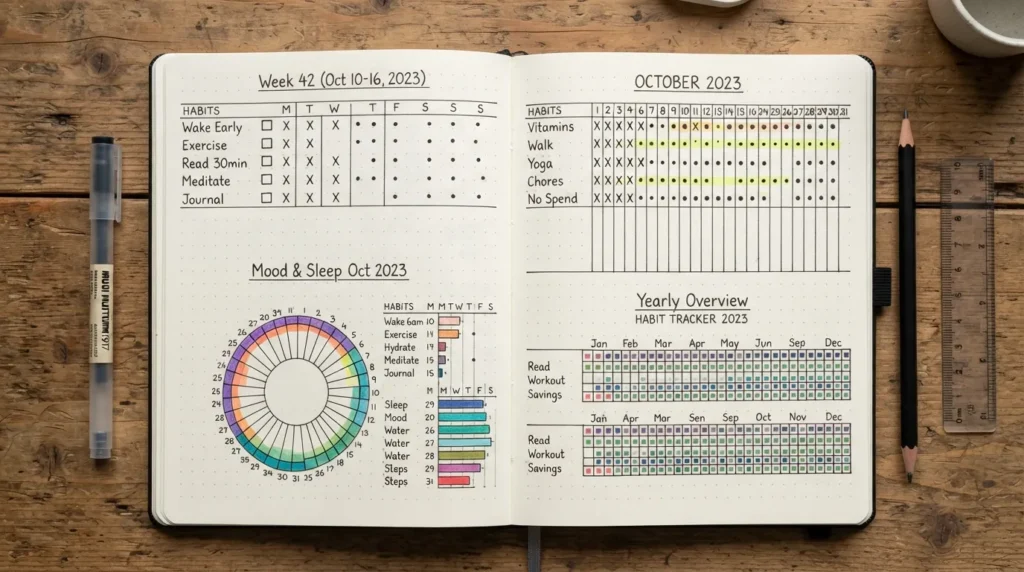
A habit tracker bullet journal can be as simple as a row of boxes you check each day or as creative as a full monthly spread. The best tracker is not necessarily the prettiest one. It is the one you can understand quickly, update consistently, and connect to habits that actually matter to you.
In this guide, I’ll show you how to choose a tracker layout, create one from scratch, connect your habits to bullet journal goals, and avoid the common problems that make habit trackers feel like another chore. You’ll also find simple, weekly, monthly, yearly, mood-tracking, template-style, and printable-friendly ideas.
What Is a Habit Tracker in a Bullet Journal?
A habit tracker is a simple visual system for recording whether you completed a habit over a chosen period. In a bullet journal, you create the tracker yourself instead of relying on a fixed planner layout.
That flexibility is one of the biggest advantages of the Bullet Journal method. You can track one habit, several habits, a weekly routine, or a longer-term goal without committing to a permanent format.
The simplest way to think about it: your goal tells you where you want to go, your habit tells you what repeated action moves you there, and your tracker shows you whether you are doing that action.
How to Choose the Right Bullet Journal Habit Tracker
Before drawing a spread, decide what you actually need to track. A monthly grid is excellent for simple daily habits, while a graph or larger spread can make more sense when you want to see patterns or combine several kinds of information.
If you want to… | Try… | Why it works |
Start as a beginner | Simple monthly grid | Fast to draw and easy to read |
Track a busy weekly routine | Weekly tracker | Keeps the tracking window short |
See a full year’s progress | Yearly tracker | Makes long-term patterns visible |
Understand how you feel alongside habits | Habit + mood tracker | Lets you compare two types of information |
Focus on one important behavior | Single-habit tracker | Removes unnecessary visual clutter |
Simple Habit Tracker Bullet Journal Ideas
If this is your first tracker, start with a layout that takes only a few minutes to create. You can always make it more decorative later.
1. Basic Monthly Grid
Write your habits down the left side of the page and the days of the month across the top. Fill one small square whenever you complete the habit.
Best for: water, reading, exercise, meditation, skincare, studying, or any habit that can be marked as done or not done.
This is one of the easiest bullet journal tracker templates to recreate because you only need a ruler, pen, and a little space.
2. Minimalist One-Page Tracker
Use a clean grid with very little decoration. Give each habit a short label and use one consistent symbol or mark when it is completed.
Why choose it: a minimalist spread is useful when the act of drawing and decorating starts taking longer than the habit itself.
3. Color-Coded Habit Tracker
Assign a simple color to different habit categories, such as health, learning, self-care, and productivity. Keep the color key small so the system remains easy to use.
Best for: people who enjoy visual patterns and want to see which parts of their routine receive the most attention.
4. Circle or Dot Tracker
Instead of squares, draw small circles or dots for each day. Fill, shade, or mark the shape when the habit is completed. It gives you the same basic tracking function while creating a softer visual style.
Weekly Habit Tracker Bullet Journal Ideas
A weekly tracker can be a better choice than a monthly tracker if you are testing a new routine or tend to lose interest when a spread becomes too large.
Create seven columns for the days of the week and list your habits down the side. You can also combine the tracker with your weekly planning spread so your habits stay visible beside your appointments and tasks.
A useful rule: choose a weekly tracker when you care more about staying engaged with the routine than seeing a long historical record.
Yearly Habit Tracker Bullet Journal Ideas
A yearly tracker gives you a bird’s-eye view. Instead of recording every detail in a large daily spread, you can dedicate a small section to each month and mark the days or weeks you completed a selected habit.
This works especially well for habits where the pattern over several months is more interesting than individual daily details, such as reading, exercise, creative practice, or a recurring personal project.
A yearly spread is best used as a high-level record. If you need detailed notes about why a habit succeeded or failed, pair it with a smaller weekly or monthly tracker.
Habit and Mood Tracker Together
A mood tracker can sit beside a habit tracker when you want to notice patterns between your routines and how you feel. For example, you might track sleep, movement, time outdoors, or journaling alongside a simple mood rating.
Keep the system simple. If you need five colors, several symbols, and a long explanation just to understand one day, the tracker may be doing too much.
Remember that a combined tracker can show patterns, but it does not automatically prove that one habit caused a particular mood or outcome.
How to Connect Habit Tracking to Bullet Journal Goals
One of the most useful ways to make a habit tracker meaningful is to connect it to a larger goal. Instead of choosing habits because they appear on a popular list, start with what you want to accomplish and work backward.
Goal | Supporting habit | Possible tracker |
Read more | Read for a set amount of time | Daily grid |
Practice a skill | Practice several times each week | Weekly tracker |
Build a creative routine | Spend regular time creating | Monthly or yearly tracker |
This goal → habit → tracker relationship prevents your bullet journal goals from becoming a list of intentions that you never revisit. The tracker gives you a small, visible action to return to.
How Many Habits Should You Track?
There is no universal number that works for everyone. A better starting point is to track only the habits you can realistically review and act on.
If you are new to habit tracking, starting with a small set can make the system easier to maintain. The official Bullet Journal approach also emphasizes intentional tracking and connecting habits with meaningful goals rather than collecting habits simply for the sake of measurement. Learn more about intentional habit tracking.
If your tracker keeps becoming crowded, that is useful information. Remove habits that no longer matter, combine related habits where sensible, or move lower-priority items into another system.
What Habits Should You Put in a Bullet Journal?
The best habits to track are the ones that answer a useful question about your life or support a goal you care about.
- Health and routine: sleep routine, movement, water, or regular meals.
- Learning: reading, studying, language practice, or skill practice.
- Productivity: focused work, planning, or completing a recurring task.
- Creative work: drawing, writing, music, crafting, or another creative practice.
- Self-care: journaling, personal routines, or time away from screens.
- Goal-specific habits: the repeated action that directly supports a current bullet journal goal.
Common Habit Tracker Mistakes
A habit tracker can fail even when the design looks perfect. Usually, the problem is the system rather than the notebook.
Tracking Too Many Habits
A huge tracker can turn a helpful routine into daily administrative work. Start with the habits that matter most and expand only when the system remains easy to maintain.
Making the Tracker More Complicated Than the Habit
If it takes several minutes to understand what each color, icon, graph, and symbol means, simplify it. A tracker should reduce friction, not add it.
Choosing Popular Habits Instead of Useful Habits
You do not need to track every habit you see online. Ask what the habit contributes to your current priorities before giving it space in your journal.
Abandoning the Tracker After a Missed Day
A missed day does not erase previous progress. Leave the space blank or use whatever mark your key defines, then continue. The point of a tracker is to help you observe your routine, not create a perfect visual record.
Prioritizing Aesthetics Over Function
An attractive spread can make journaling enjoyable, but decoration should support the system rather than make it difficult to update. A functional base with optional decoration is often the easiest balance.
What to Do When You Stop Using Your Habit Tracker
If you created a tracker and then stopped filling it in, do not assume you need a prettier layout. First, find the friction.
- Ask whether the habit still matters.
- Remove habits that are no longer priorities.
- Make the tracking mark faster.
- Switch from monthly to weekly tracking if a month feels overwhelming.
- Connect the remaining habits to a specific goal or routine.
A useful tracker should adapt when your priorities change. You do not need to finish an old spread perfectly before creating a simpler system.
Habit Tracker Bullet Journal Templates You Can Recreate
If you are looking for a habit tracker bullet journal template, you do not need a complicated printable design. These simple structures can be recreated directly in your notebook.
Simple monthly template
Habit | 1 2 3 4 5 6 7 … 31
Read | □ □ □ □ □ □ □ …
Move | □ □ □ □ □ □ □ …
Journal | □ □ □ □ □ □ □ …
Simple weekly template
Habit | Mon | Tue | Wed | Thu | Fri | Sat | Sun
Habit 1 | □ | □ | □ | □ | □ | □ | □
Habit 2 | □ | □ | □ | □ | □ | □ | □
These layouts can also serve as a starting point for a printable or PDF version. If you prefer a physical journal, simply copy the structure and adjust the number of habits and days to fit your page.
Bullet Journal Supplies for Habit Tracking
You can create a habit tracker with very basic supplies. If you enjoy decorative journaling, you can add color and artwork, but none of these extras are required for the tracking system itself.
- Notebook or bullet journal
- Pen or pencil
- Ruler for grids and straight lines
- Highlighters or markers for color coding
- Optional stickers, washi tape, or decorative elements
- Optional graphing or drawing tools for more detailed spreads
Is a Bullet Journal Good for ADHD?
A flexible bullet journal may work well for some people with ADHD because the system can be adapted to personal priorities and changing routines. However, it is not an ADHD treatment, and there is no single journaling method that works for everyone.
If you find detailed trackers distracting, a very small habit list, simple symbols, and a short weekly review may be easier to maintain than a large decorative spread.
Can a Journal Include a Habit Tracker?
Yes. A habit tracker can be a dedicated page, part of a monthly spread, part of a weekly planning page, or a small collection that runs across several pages.
The advantage of placing it inside your journal is that your habits can sit close to your goals, plans, notes, and reflections. That makes it easier to see the relationship between what you planned and what you actually did.
What Is the Best Bullet Journal for Tracking Habits?
There is no single best bullet journal notebook for everyone. The useful choice depends on how much space you need, whether you prefer plain or structured pages, and whether you carry the notebook with you regularly.
For habit tracking, prioritize a notebook that gives you enough usable page space for your preferred layout and feels comfortable enough that you will actually open it and update it.
More Habit Tracker Ideas to Try
Once you understand the basic system, you can adapt it to different types of information:
- Reading tracker
- Exercise tracker
- Water tracker
- Sleep routine tracker
- Study tracker
- Creative practice tracker
- Self-care tracker
- Mood and habit tracker
- Goal-progress tracker
- Yearly consistency tracker
Frequently Asked Questions About Habit Tracker Bullet Journals
How do you make a habit tracker in a journal?
Choose a time period, list the habits you want to monitor, create a grid or another simple layout, add a small key, and mark each habit as you complete it. Start with the simplest design that gives you the information you need.
What is an example of a habit tracker?
A basic example is a monthly grid with habits listed vertically and days of the month horizontally. Each day, you fill a box when you complete the corresponding habit. You can use the same idea with dots, circles, colors, or symbols.
What things should I put in a bullet journal?
You can include plans, goals, task lists, notes, collections, reflections, habit trackers, mood tracking, project pages, reading lists, and other information you want to organize. The useful pages are the ones that support your actual needs rather than a fixed list of required sections.
Which habit tracker format is best for beginners?
A simple monthly grid is a good starting point because it is easy to draw, easy to understand, and flexible enough for many everyday habits. If a month feels too large, switch to a weekly version.
Should I use a printable habit tracker or draw one myself?
Use whichever reduces friction. A printable can save drawing time, while a hand-drawn tracker gives you complete control over the layout and lets you integrate the tracker directly into your bullet journal. A simple hand-drawn template is often enough.
Can I make a bullet journal habit tracker PDF?
Yes. A tracker can be designed as a printable PDF using the same grid, weekly, monthly, or yearly structures described above. If you are creating one digitally, make sure the labels and writing spaces remain readable when printed at the intended page size.
Should I track habits every day?
Not necessarily. Track at the frequency that matches the behavior and the question you want to answer. Some habits make sense to record daily, while others are more useful as weekly or monthly measures.
What should I do if I miss several days?
Continue from the current day instead of restarting the entire tracker. Leave missed days blank or mark them according to your chosen key. Then review whether the habit, frequency, or tracking method needs adjustment.
A Habit Tracker Should Help You, Not Judge You
The most useful habit tracker bullet journal is not the one with the most colors, the largest number of habits, or the most elaborate artwork. It is the one that gives you useful information without creating unnecessary work.
Start small. Connect habits to meaningful bullet journal goals. Choose a layout you can update quickly, and use the patterns you see to adjust your routine rather than judging yourself for imperfect days.
Once the system becomes easy to maintain, you can experiment with weekly, monthly, yearly, mood, goal-based, aesthetic, or more detailed tracker designs. The flexibility is the point.
For more guidance on the original Bullet Journal approach to intentional habit tracking, you can also read the official Bullet Journal habit-tracking guide. For additional visual spread inspiration, Archer & Olive’s habit tracker inspiration and Zebra Pen’s habit and
Pimchanok Srisuk
Pimchanok Srisuk is the Journaling Editor at Holistic Wellbeing Living. She writes about journaling prompts, reflective writing, emotional clarity, and mindful routines. With seven years of experience creating personal-growth content, Pimchanok helps readers use simple writing practices to understand their thoughts and make calmer everyday decisions.