Jump to:
ToggleJournal vs Diary: What's the Real Difference and Which One You Actually Need
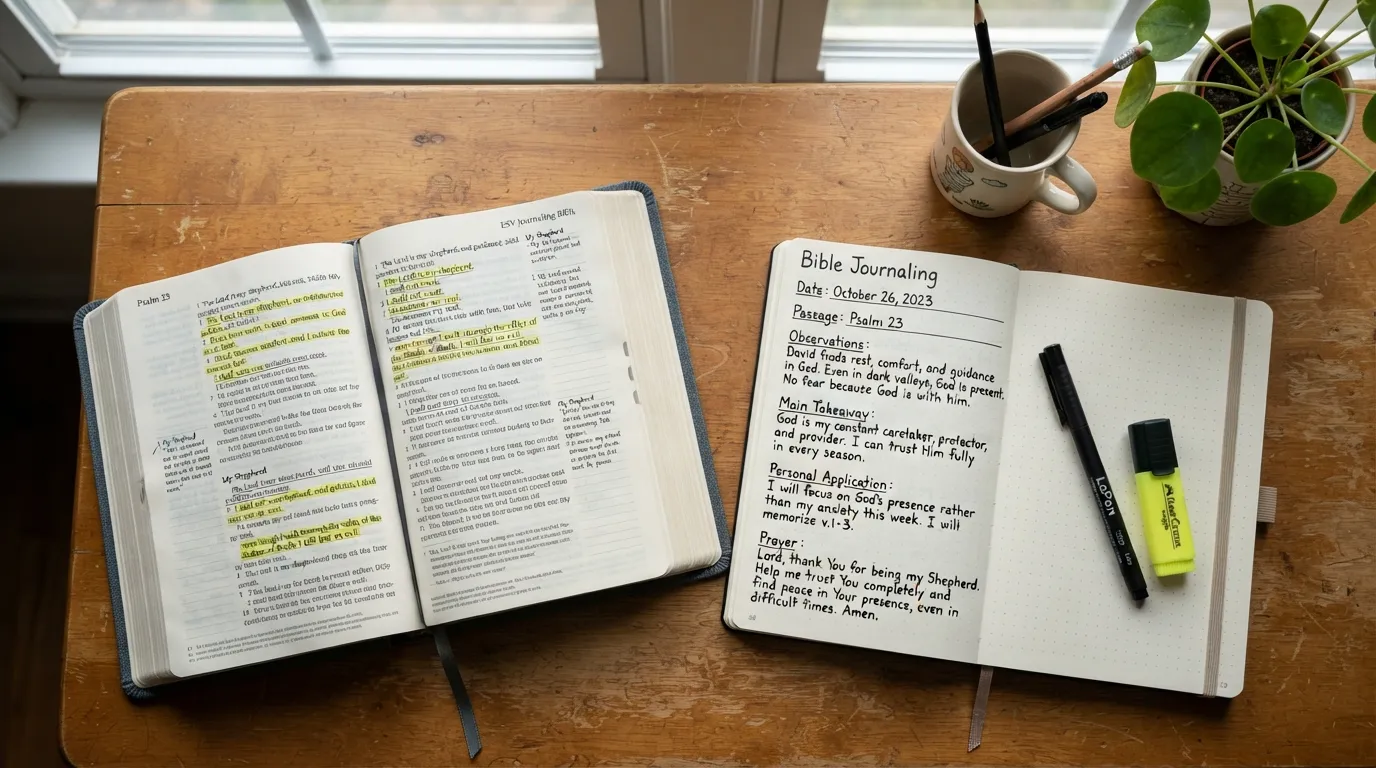
Bible journaling is simply a way to slow down while reading Scripture and record what you notice, learn, question, pray about, or want to apply. You can write directly in a wide-margin or journaling Bible, use a separate notebook, or combine written reflection with simple art. You do not need artistic skill or a large collection of supplies to begin.
If you are completely new, I recommend starting with a Bible, a pen or pencil, and one short passage. Read it carefully, write what stands out, summarize what you think the passage is communicating, note one practical response, and finish with a short prayer. That basic process is Bible journaling.
What Is Bible Journaling?
Bible journaling combines Scripture reading with written reflection. Depending on your purpose, an entry might contain observations, questions, cross-references, a paraphrase, a prayer, an action you want to take, or visual elements that help you remember the passage.
People sometimes use Bible journaling to mean decorative artwork inside a Bible. That is only one form of it. You can have an effective Bible journal containing nothing more than dates, verses, notes, prayers, and honest reflection.
Keep the purpose clear: the journal is a tool for engaging with Scripture. A beautiful page can be meaningful, but artistic perfection is not the goal.
Choose Where You Want to Bible Journal
Before buying supplies, decide where you want your notes to live. This one decision prevents a lot of beginner confusion.
Method | Best For | Main Trade-Off |
Journaling Bible | Keeping notes beside the passage | Margin space is limited |
Separate notebook | Detailed study, long prayers, organized notes | Your notes are separate from the Bible text |
Binder | Organizing by book, topic, or study | Less portable |
Digital journal | Searchable notes and easy organization | More screen time and fewer handwritten notes |
If writing over or near Scripture makes you uncomfortable, use a notebook. If you want your observations visible every time you return to a passage, a wide-margin Bible is convenient. Neither method is more “correct.” Choose the one you will actually use.
What Do You Need for Bible Journaling?
You can start with three things: a Bible, somewhere to write, and a writing tool. Everything else is optional.
Simple Setup | Optional Creative Supplies |
Bible or journaling Bible | Colored pencils |
Notebook if preferred | Bible-safe highlighters |
Pencil or fine-tip pen | Washi tape, stickers, stamps, or stencils |
Your current reading plan or passage | Watercolor pencils or other light art media |
Do not delay starting because you do not own a special journaling Bible. A regular Bible plus a notebook works perfectly well.
About Bible-safe pens: thin Bible paper varies considerably. Look for fine-tip, quick-drying, low-bleed writing tools and test them on an inconspicuous page before using them throughout your Bible. A product that works well in one Bible may still ghost or bleed in another.
How to Bible Journal Step by Step
1. Choose a Short Passage
Do not start by trying to journal several chapters at once. Choose a paragraph, a short Psalm, a few verses from a Gospel, or the passage in your current reading plan. A smaller passage gives you enough space to notice details instead of rushing.
2. Pray and Read Slowly
Begin with a simple prayer for understanding, then read the whole passage once without trying to decorate or analyze every sentence. Read it a second time more slowly.
On the second reading, notice repeated words, contrasts, commands, promises, questions, warnings, descriptions of God, and anything that seems especially important.
3. Write What You Observe
Write what is actually present in the passage before jumping immediately to what it means for you personally.
- Who is speaking or being addressed?
- What action is happening?
- Are any words or ideas repeated?
- Is there a promise, command, warning, contrast, or question?
- What does the surrounding passage add to the meaning?
- What do you not understand yet?
4. Summarize the Main Idea in Your Own Words
After observing the text, write one or two sentences explaining what you think the passage is primarily communicating. Keeping this short forces you to separate the main idea from every smaller detail.
5. Decide How You Should Respond
Application should be more specific than “I need to do better.” Ask what belief, attitude, decision, habit, relationship, or action the passage makes you reconsider.
A useful application might be something you need to remember, stop, start, confess, practice, trust, or pray about.
6. Write a Prayer
Turn the passage into a personal response. Your prayer does not need to be long. A few honest sentences often make the journal entry feel more complete because you are responding to what you have just read instead of simply recording information.
7. Date the Entry and Review It Later
Write the date and passage reference on every entry. When you return weeks or months later, you can see what you were learning, what questions were answered, and whether you followed through on an application you wrote down.
What Are You Supposed to Write in a Bible Journal?
You do not need to fill every category every day. These are useful possibilities:
- Passage: what you read.
- Key verse: the verse or idea you want to remember.
- Observation: details you noticed.
- Context: information from nearby verses that affects meaning.
- Summary: the main idea in your own words.
- Questions: anything you need to study further.
- Cross-references: related passages you discover.
- Application: what you should believe, remember, or do.
- Prayer: your response to the passage.
- Takeaway: one sentence you want to carry into the day.
A Simple Bible Journal Format You Can Copy
If you keep staring at a blank page, use the same basic structure until journaling becomes natural.
Date: ____________________
Passage: ____________________
Key verse or idea: ____________________
What I notice:
________________________________________
What I think the passage means:
________________________________________
What I need to do or remember:
________________________________________
Questions or cross-references:
________________________________________
Prayer:
________________________________________
You can copy this structure into a notebook, print the page from your browser, or shorten it to only the fields you actually use.
How to Use the SOAP Bible Journaling Method
If you want more structure, SOAP is one of the simplest Bible journaling methods for beginners.
S — Scripture: record the verse or passage you are focusing on.
O — Observation: write what you notice in the text.
A — Application: decide how the truth should affect your thinking or actions.
P — Prayer: respond to God in writing.
SOAP is useful because it stops your journal from becoming only a collection of copied verses. It moves you from reading to observing, responding, and applying.
It is not the only legitimate method. You may also encounter systems such as SOAR or different “5 P” Bible study frameworks. Those frameworks can be useful, but the phrase “5 P’s” is used for more than one method, so do not assume every teacher means the same five steps.
Bible Journaling Example Using Psalm 16
A worked example makes the process easier to understand. Suppose I am journaling through Psalm 16. Instead of trying to turn the entire Psalm into artwork immediately, I first look for its major ideas and write a simple entry.
Passage: Psalm 16
Key idea: The Psalm repeatedly expresses trust, security, guidance, and confidence in God.
Observation: The writer connects trust in God with security and direction rather than treating faith as an abstract idea.
Application: I can identify one area where I am depending more on control or worry than trust and bring that concern into prayer.
Prayer: I would write a short personal prayer asking for help to trust God’s direction in that specific situation.
If you enjoy creative journaling, you could add simple lettering, a path illustration, color coding, or another visual that helps you remember the theme. The artwork should support your reflection rather than replace it.
How to Bible Journal in a Notebook
A separate notebook is often the easiest option if you want more writing space or do not want to mark your Bible. You also have more freedom to reorganize your study system as your needs change.
Set Up the First Few Pages
Leave two or three pages at the beginning for an index. Number your journal pages if the notebook is not already numbered. Each time you create an important entry, add the topic, Bible book, or passage to your index.
Use One Repeatable Entry Layout
At minimum, record the date, passage, observations, application, and prayer. Consistency makes the notebook much easier to review later.
Choose an Organization System
There is no single required format. You can organize your notebook:
- Chronologically — one entry after another by date.
- By Bible book — Genesis notes together, Psalms together, Matthew together, and so on.
- By theme — prayer, wisdom, anxiety, relationships, leadership, promises, or another subject.
- By study — one section for each devotional, sermon series, or reading plan.
If you frequently move pages around or study several topics at once, a binder with dividers may be easier than a bound notebook.
Simple Bible Journaling Ideas
You do not have to create elaborate pages. Try one idea at a time:
- Underline repeated words.
- Use one color for promises and another for commands.
- Write a one-sentence summary beside a passage.
- Record one question you want to research.
- Write a short prayer in the margin.
- Draw a small symbol that represents the main idea.
- Add a cross-reference to another passage.
- Write what the passage teaches about God’s character.
- Record something you are grateful for.
- Write one specific action you want to take.
Pinterest and social media can provide visual inspiration, but copying someone else’s page is not the same as reflecting on the passage yourself. Use inspiration as a starting point, not as a substitute for reading and thinking.
How to Avoid Bleeding, Ghosting, and Damaged Bible Pages
Bible pages are usually thin, so your normal journaling supplies may behave differently on them.
- Test first. Try a pen or highlighter on an inconspicuous page before using it widely.
- Use light pressure. Pressing hard can leave impressions even when ink does not bleed.
- Start with dry media. Pencil and colored pencil are usually easier for beginners to control than wet paint.
- Let ink dry. Closing the Bible immediately can transfer ink to the opposite page.
- Protect the page. Put a clean sheet behind the page if you are experimenting with wetter media.
- Know the difference. Ghosting means you can see an image or writing through the page; bleeding means the ink actually passes through it.
If preserving the printed page is a major concern for you, do your artwork in a notebook, on a separate insert, or on a removable note rather than directly over the text.
Common Bible Journaling Mistakes
Trying to Make Every Page Beautiful
A useful journal will contain ordinary pages. Some entries may be only three sentences. If every entry has to look publishable, you may spend more time designing than reflecting.
Buying Too Many Supplies Before You Develop a Habit
Start with a pen or pencil. Add supplies only when you know what kind of journaling you enjoy.
Ignoring Context
Do not build an entire application from one isolated phrase without reading the surrounding passage. Reflection becomes more useful when it grows out of what the text is actually communicating.
Creating an Organization System You Cannot Maintain
Ten colors, several symbols, multiple indexes, and complicated categories can feel productive for a week and exhausting afterward. Use the simplest system that helps you find your notes again.
Leaving Every Application Vague
Instead of writing “trust more,” identify the situation in which you need to practice trust. Specific application makes the journal more useful when you review it later.
A 10-Minute Bible Journaling Routine for Beginners
If consistency is difficult, make the routine smaller instead of making it more complicated.
- 1 minute: pray and settle your attention.
- 3 minutes: read a short passage twice.
- 2 minutes: write what you observe.
- 2 minutes: write one application or takeaway.
- 2 minutes: write a short prayer.
Ten focused minutes done regularly are more useful than an elaborate system you avoid because it feels like a project.
Where Should You Start Reading?
You do not need a special Bible-reading order just because you are journaling. If you already follow a reading plan, continue with it. If you are starting from scratch, choose manageable passages rather than worrying about finding the perfect order.
A short Psalm, a section from one of the Gospels, or a passage you recently heard in a sermon can all work well because you can concentrate on a small amount of text and practice the journaling process.
What Type of Journaling Bible Is Best?
The best journaling Bible is the one that fits how you plan to use it. Before buying one, check:
- Translation: choose a translation you are comfortable reading and studying.
- Margin space: wider margins are better for substantial written notes.
- Page layout: some include lined margins, while others provide blank or interleaved pages.
- Paper: consider how it handles the pens, pencils, or art media you plan to use.
- Binding and size: a large Bible may offer more space but can be less portable.
- Your actual goal: choose writing space for study if you mainly take notes; do not pay for an art-focused format you will never use.
A journaling Bible can be worth it if you frequently want notes beside the text. If you prefer long-form study or detailed prayers, a normal Bible and notebook may serve you better.
Frequently Asked Questions
Do I Need to Be Artistic to Bible Journal?
No. A Bible journal can contain only notes, observations, questions, prayers, and application. Art is optional.
Can I Bible Journal in a Regular Notebook?
Yes. A separate notebook is one of the most flexible options because you have more writing space and do not need to worry about thin Bible paper or marking the text.
What Pens Are Best for Journaling Bibles?
Look for fine-tip, quick-drying pens with low bleed-through, but always test your specific pen and Bible together. Paper thickness and ink behavior vary, so no pen should be assumed completely bleed-proof in every Bible.
What Is the Difference Between Bible Journaling and a Bible Study Journal?
The terms overlap. Bible journaling can include anything from margin notes and prayers to artwork. A Bible study journal usually places more emphasis on observations, interpretation, cross-references, questions, and application, often in a separate notebook.
What Is a Good Bible Journal Entry for a Beginner?
Start with the date, passage, one important observation, a one-sentence summary, one practical application, and a short prayer. That is enough for a meaningful first entry.
Do I Need a Special Journaling Bible?
No. A journaling Bible is useful when you want extra writing space beside Scripture, but a regular Bible and notebook can accomplish the same basic purpose.
Pimchanok Srisuk
Pimchanok Srisuk is the Journaling Editor at Holistic Wellbeing Living. She writes about journaling prompts, reflective writing, emotional clarity, and mindful routines. With seven years of experience creating personal-growth content, Pimchanok helps readers use simple writing practices to understand their thoughts and make calmer everyday decisions.