Jump to:
ToggleHow to Date a Journal Entry (Formats, Rules & Examples)
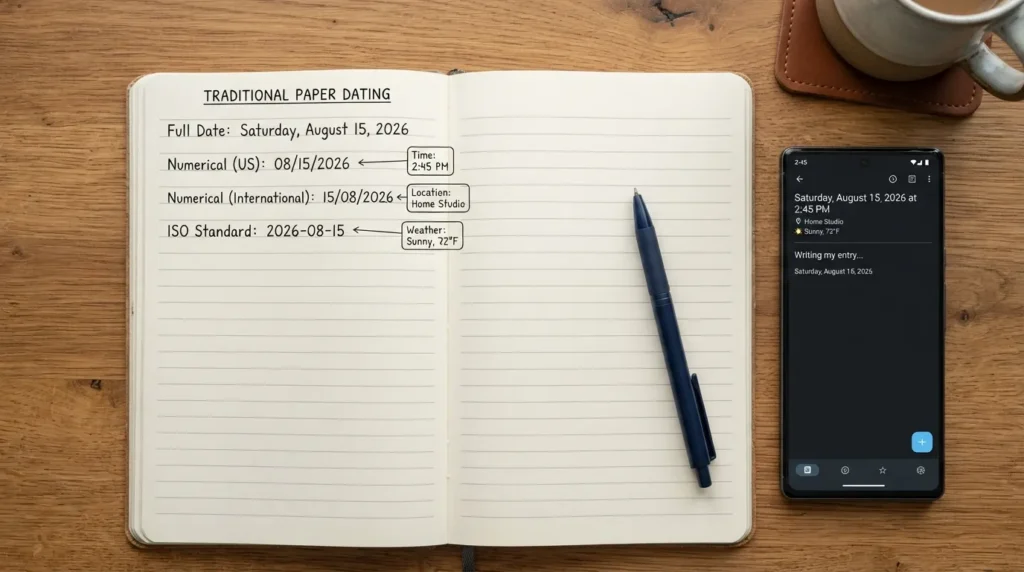
If you searched for how to date a journal entry and found yourself staring at articles about debit and credit balances, don’t worry. This guide is strictly about personal journaling, creative diaries, and mental health logs—not accounting ledgers. Below, you will find every format option, regional date rule, digital vs. paper tip, formal style rule, and extra entry detail you need to structure your personal journal, all in one place.
Why Dating Every Journal Entry Matters
Creates a reliable timeline: Slapping a date on the page anchors your thoughts to a specific moment in time. When you flip back through old notebooks years down the road, you will know precisely when a life milestone, a bad day, or a sudden breakthrough actually happened.
Makes entries searchable and sortable: If you keep a digital diary, putting dates in a standard format lets you search or sort your entries instantly. Even with paper journals, a quick glance at the top corner helps you locate a specific memory in seconds.
Helps organize multiple completed journals: Once you finish notebook after notebook, things get messy fast. Dating your pages—and writing the date range on the spine or cover—keeps your bookshelf from turning into a chaotic pile of mystery logs.
Supports personal growth tracking: You can compare how you felt on the exact same date across different years. Seeing where you were on August 15th three years ago versus today gives you incredible perspective on how much you have grown.
Useful for therapeutic, medical, or legal reference: If you are tracking physical symptoms, mental health trends, or specific life events, dates turn personal musings into an accurate record you can share with a doctor, therapist, or professional
The 3 Main Ways to Date a Journal Entry
Standard Format (Month Day, Year)
Example: August 15, 2026
This is the classic, everyday way to stamp your page. It is clean, natural, and instantly readable for anyone who grew up using written calendars. It works best for general daily entries, long-form thoughts, or when you just want a quick, timeless header before you start writing.
Detailed Format (Day of Week + Full Date + Time)
Example: Saturday, August 15, 2026 — 2:30 PM
Including the day of the week and the exact time gives your future self so much extra context. You might notice that your late-night entries sound anxious while your Saturday morning notes feel hopeful. Spotting those mood and time-of-day patterns can change how you structure your routine.
Minimalist Format (Numeric Shorthand)
Example: 8/15/26
If you prefer a clean look with minimal effort, simple numbers get the job done. This shorthand is great when space is tight, like in pre-dated planners, pocket notebooks, or rapid bullet journals.
Caution: Stay consistent within the same notebook so you do not confuse yourself later when reviewing your entries.
Numeric Date Formats — Avoiding Confusion
MM/DD/YYYY vs. DD/MM/YYYY
In the United States, most people write the month first, then the day, then the year (MM/DD/YYYY). However, most of the rest of the world writes the day first, followed by the month and year (DD/MM/YYYY).
This difference leads to major confusion with dates early in the month. For example, 04/05/2026 means April 5th to an American, but May 4th to almost everyone else. If you use shorthand, pick one order and stick to it so your timeline stays clear.
The ISO 8601 Standard (YYYY-MM-DD)
Example: 2026-08-15
The ISO 8601 standard puts the four-digit year first, followed by the month and the day, separated by hyphens. Because it goes from largest unit to smallest, there is zero ambiguity about which number represents the month or the day.
This format shines for digital journaling and computer file names. Files named with YYYY-MM-DD automatically sort in perfect chronological order on your computer, eliminating the mess of jumbled dates. You can check out the official ISO 8601 standard page for more technical details on how it works.
Does Canada Use MM/DD/YYYY or DD/MM/YYYY?
Canada is notorious for using a mixed mix of date formats. Officially, the Canadian government adopts the YYYY-MM-DD standard, but in everyday life, you will see people using MM/DD/YYYY, DD/MM/YYYY, and YYYY-MM-DD interchangeably depending on the province, language, or context.
For Canadian journalers—or anyone living in a region with mixed habits—the most practical approach is writing out the month as a word (e.g., Aug 15, 2026) or using the ISO YYYY-MM-DD layout. That simple choice eliminates all guesswork forever
What Else to Add Besides the Date
Location
Writing down where you are when you open your notebook takes only a few seconds, but it adds instant context. Whether you are at your kitchen table, sitting on a train, or squeezed into a corner booth at a local coffee shop, note it down right beside the date.
Weather or Mood
A quick word about the current weather or how you feel gives your future self an immediate snapshot of the atmosphere. Try drawing a tiny sun or cloud, or simply write a single word like rainy or anxious.
A Short Title
Giving your entry a quick headline helps you scan through old entries much faster later on. You don’t need anything poetic—just a brief label that summarizes the main focus of your writing.
Location: Shows you how your physical surroundings shaped your mindset when you look back years later.
Weather or Mood: Connects your emotions to external factors so you can spot long-term patterns in your life.
A Short Title: Makes your journal easy to search when you want to find a specific memory or thought again.
How to Date a Journal Entry — Step-by-Step
- Open to a fresh page: Start at the top left or top right corner, leaving enough white space around the margins so the page doesn't look cluttered.
- Choose your date format: Pick one standard style—like standard American, international, or all-numeric—and stick with it consistently throughout the entire notebook.
- Write the date clearly: Use your natural handwriting, but make sure the numbers and letters are easy to read at a quick glance.
- Add optional context details: Right next to or directly under the date, write down your current location, the time of day, or a quick weather symbol.
- Create a brief title: Skip one line below your date block and write a short, 3-to-5-word title that summarizes what you plan to write about.
- Write your main entry: Drop down another line and start writing out your thoughts without worrying about making the text look perfect.
- Date the front or back cover: When you start a brand new notebook, write the starting date on the inside front cover so you know exactly when that volume began.
- Label the spine when finished: Once you write on the final page, write the full date range on the outer spine before placing the notebook on your shelf.
Here's a short video walking through the process visually:
Formal & Grammatically Correct Date Writing
How to Write a Date in a Formal Letter
If you are writing a formal letter inside your journal, your choice of format usually depends on whether you follow American or British conventions.
American style puts the month first, followed by the day, a comma, and the full four-digit year (for example: May 13, 2026). British style places the day first, followed by the month and year, without any comma needed (for example: 13 May 2026).
How to Correctly Write “13th May” (and similar dates)
When you write out ordinal numbers using letters like st, nd, rd, or th, keep them inline with the numbers rather than using raised superscript text.
If the day comes before the month, you can drop the letters entirely in plain prose (write 13 May instead of 13th May). If you place the day after the month in full sentence form, use the word “of” or keep the ordinal sound natural, such as writing May 13th when reading aloud.
What Makes a Date “Grammatically Correct” or “Proper”
A date is grammatically proper as long as it uses consistent punctuation and avoids confusing structural mixes.
As a quick rule of thumb: always place a comma between the day and the year when the month comes first (January 1, 2026), but leave the comma out whenever the day stands before the month (1 January 2026).
Dating Entries in a Digital Journal
Digital journal apps take most of the work out of dating your entries. The moment you open a new page, the app grabs the current time and date from your device and tags it automatically. You don’t have to think about it at all.
If you ever need to log a past memory or fix a missed day, you can manually change the date or time. Most apps let you tap directly on the header timestamp or open an entry’s settings menu to pick a new date from a calendar pop-up. Keep in mind that exact buttons and steps vary depending on which app you use.
For instance, if you’re using Day One, you can easily adjust past entry dates using Day One’s official date-editing guide.
Digital vs. Paper Advantage: Digital dates create automatic metadata. This lets you instant-search, filter, or auto-sort your entire journal chronologically in seconds, whereas paper journals rely on manual scanning.
What Is the 3-3-3 Journaling Method?
The 3-3-3 method usually refers to one of two simple frameworks. The most common version is a mental grounding technique where you name three things you see, three sounds you hear, and move three parts of your body. Another common version is a reflective writing prompt where you write down three things you are grateful for, three goals for the day, and three quick affirmations.
No matter which variation you practice, date this entry the same way as any other. Put your preferred date format right at the top of the page before you dive into your three steps.
FAQ
What is a journal date?
A journal date is the record of the day, month, and year you write a specific entry. It anchors your thoughts to a specific moment in time so you can track your personal growth later.
Is it DD/MM/YYYY or MM/DD/YYYY?
Both formats are correct. DD/MM/YYYY is the standard in Europe and most of the world, while MM/DD/YYYY is predominantly used in the United States.
What is the correct way to write a date?
The correct way is whichever format is clearest to you and used consistently. For standard clarity, writing out the month name (like "15 August 2026") eliminates any region-based confusion.
Is it correct to write "date and time" formally?
Yes, writing both the date and time is completely standard and very helpful. Adding the time adds precise context to when your thoughts took place during the day.
What is a proper date?
A proper date includes the calendar day, the month, and the four-digit year. It gives a complete, unambiguous timestamp for any record or personal writing.
Final Thoughts
At the end of the day, there is no single “right” way to date your pages. Choose a format that feels natural, stick with it consistently, and add extras like time or weather only if they genuinely add value to your routine. The best dating system is simply the one you use without overthinking it.
Pimchanok Srisuk
Pimchanok Srisuk is the Journaling Editor at Holistic Wellbeing Living. She writes about journaling prompts, reflective writing, emotional clarity, and mindful routines. With seven years of experience creating personal-growth content, Pimchanok helps readers use simple writing practices to understand their thoughts and make calmer everyday decisions.