Jump to:
ToggleHow to Keep a Sketch Journal: A Simple Beginner’s Guide
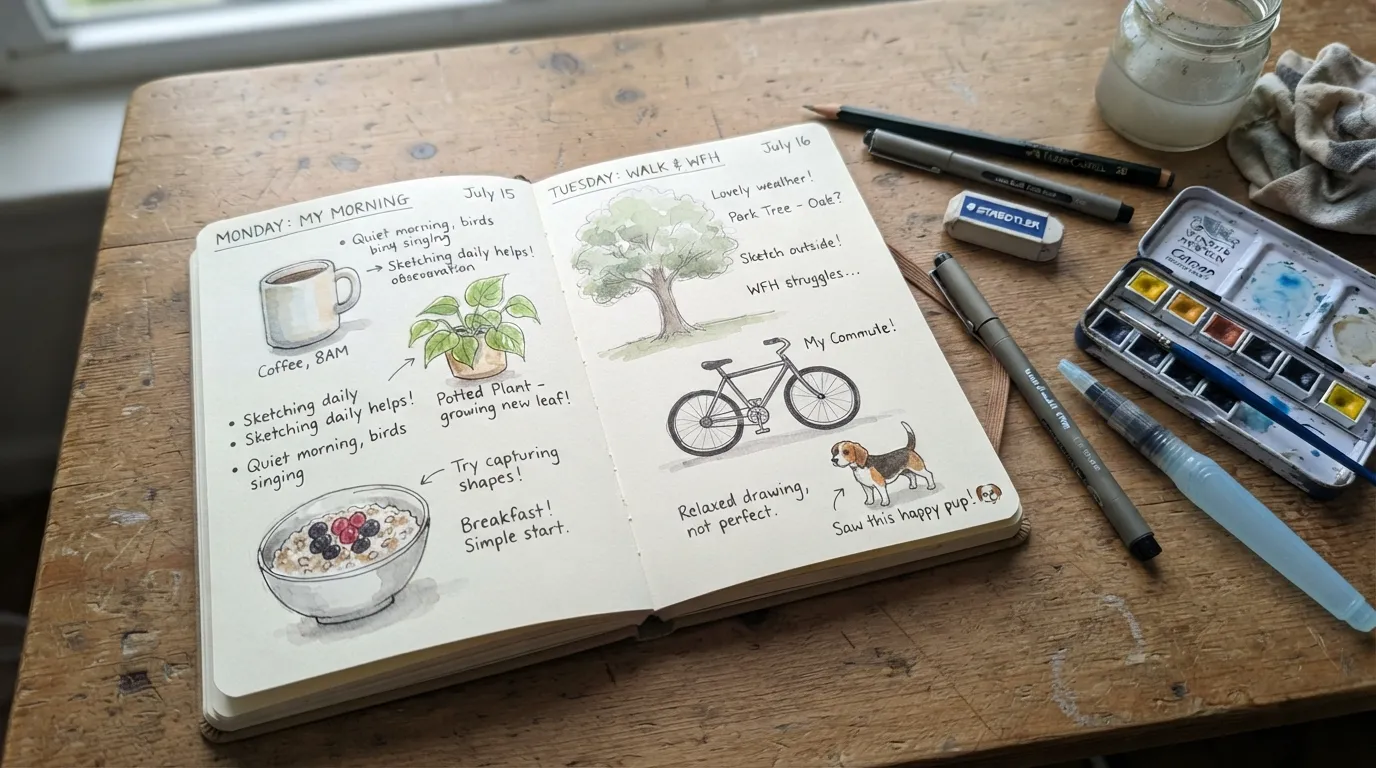
To keep a sketch journal, make it easy to start and easy to return to. Choose a portable sketchbook that suits the materials you actually use, keep your tool kit small, draw ordinary things from daily life, add a few written notes, and treat imperfect pages as part of the journal rather than mistakes you need to hide.
You do not need to create a polished illustration every day. A useful sketch journal can contain quick drawings, unfinished studies, dates, observations, color swatches, ticket stubs, scraps of paper, written memories, or a single object you noticed that day. The habit lasts much longer when the journal feels like a place to observe and experiment instead of a book you must keep beautiful.
A simple rule that works:
on a busy day, draw one thing and write one sentence about it. That is enough to keep the journal alive.
What Is a Sketch Journal?
A sketch journal is a visual record that combines drawing with written observations. You might sketch a cup of coffee and write where you drank it, paint the colors of an evening sky and add the date, or draw a building and note what caught your attention about it.
That makes it slightly different from a basic sketchbook, which may be used mainly for drawing practice. An art journal can be broader and more expressive, often mixing painting, collage, lettering, personal reflection, and other media. In practice, these categories overlap, so you do not need to worry about following a strict definition.
Type | Main Focus | Typical Content |
Sketchbook | Drawing and practice | Studies, doodles, ideas, exercises |
Sketch journal | Drawing plus observation | Sketches, dates, notes, memories, places |
Art journal | Creative expression | Painting, collage, lettering, reflection, mixed media |
How to Keep a Sketch Journal Step by Step
I would make the process deliberately simple at first. The goal is not to build the perfect art kit. It is to remove as much friction as possible between noticing something and putting it on the page.
1. Decide what you want the journal to record
A journal becomes easier to maintain when it has a loose purpose. Yours might record everyday life, travel, gardens, food, architecture, people, nature, imaginative ideas, or simply anything that catches your attention.
Do not make the theme so narrow that you cannot use the book unless a specific subject appears. “Things I notice during the week” is often easier to sustain than “one perfect architectural drawing every day.”
2. Choose a sketchbook that matches your materials
Portability matters more than prestige. A smaller sketchbook that fits in your usual bag is often more useful than a beautiful oversized book that stays at home.
Paper matters most when you use wet media. The Postman’s Knock recommends avoiding very light paper for watercolor and suggests at least about 70 lb paper for that kind of use. If watercolor will be a major part of your journal, choosing paper specifically designed for wet media is safer than relying on weight alone because paper sizing and surface also affect how it behaves.
If You Mainly Use | Simple Starter Setup | Paper Consideration |
Pencil | Pencil and eraser | Most drawing paper works; smoother pages may preserve fine detail better |
Pen or ink | One favorite pen | Test for feathering or bleed-through before filling a spread |
Watercolor | Compact palette and small brush | Choose paper made to tolerate wet media; very light paper can buckle |
Mixed media | Pen, pencil, limited color, adhesive | A sturdier mixed-media surface handles varied materials more reliably |
3. Keep the tool kit small
Too many choices can make starting harder. A pencil, a pen, and an eraser are enough for a complete sketch journal. Add watercolor, markers, pastels, collage materials, or brushes only when you actually want to use them.
Keep your journal and basic tools where you can see or reach them easily. If you have to unpack a complicated art station every time, you have created an unnecessary reason not to draw.
4. Make the first page deliberately easy
The first page causes more trouble than it deserves because a new sketchbook can feel precious. Do not make your first entry a test of your ability.
Try this first entry:
- Write today’s date and location.
- Choose one nearby object.
- Draw it for a few minutes.
- Add one sentence about why you noticed it.
- Stop. The page is finished.
This matters because you are proving that a journal entry can be small. Once the first page is no longer blank, the book usually feels less intimidating.
5. Draw from ordinary life
You do not need dramatic subjects. Observational drawing works because ordinary objects are always available. You can draw meals, shoes, plants, pets, windows, buildings, shop signs, tools, people waiting for a bus, weather, trees, your desk, or objects from your pocket.
A sketch journal becomes more personal when you record what your own day actually looked like instead of waiting for something impressive enough to draw.
6. Write beside the drawing
The writing does not need to become a diary entry. A date, location, short caption, weather note, sentence about what happened, or observation about color and shape may be enough.
Draw | Write |
Your morning drink | Where you were and one thing you were thinking about |
A plant or flower | Date, weather, colors, or a change you noticed |
A café or street scene | Sounds, atmosphere, location, or a small moment you want to remember |
A travel object or landmark | Place, date, route, meal, conversation, or memory connected to it |
7. Add mementos when they improve the story
A sketch journal can also hold ticket stubs, labels, business cards, maps, receipts, scraps of patterned paper, or other small flat items. These can turn an ordinary spread into a stronger memory record.
If you want the journal to last, think about the materials you paste into it. Acid-free or archival-quality adhesives are a better choice for long-term preservation than unknown household glues, and very bulky objects can distort the book or prevent pages from closing properly.
8. Finish when the page has done its job
A sketch does not need to become a finished artwork. Some pages can contain only line drawings. Some can have color. Some can remain incomplete. If the page helped you notice, record, practice, or remember something, it worked.
What Should You Put in a Sketch Journal?
The easiest subjects are usually the ones already around you. Instead of asking, “What should an artist draw?” ask, “What did I notice today?”
- Food, cups, plates, fruit, or cooking ingredients
- Pets, birds, insects, leaves, flowers, and trees
- Shoes, bags, tools, keys, glasses, and everyday objects
- Your desk, bedroom, kitchen, garden, or view from a window
- Buildings, doors, signs, cafés, streets, and public spaces
- Quick gesture sketches of people
- Travel scenes, maps, tickets, and route notes
- Color combinations or small watercolor studies
- Ideas for larger artworks
- Imaginary creatures, characters, or fantasy environments
A useful trick is to choose a temporary theme when you run out of ideas. For one week, you might sketch only objects from your kitchen, plants you pass on walks, or one small bird each day. A narrow temporary theme reduces the mental effort of deciding what to draw without permanently limiting your journal.
Simple Sketch Journal Page Layouts
You do not need a complicated page design. A few repeatable layouts make it easier to start because you are not designing the whole spread from scratch every time.
One sketch with a caption
Draw one main subject and place a date, location, or short note underneath it. This is one of the fastest formats for an everyday visual diary.
Several mini sketches
Divide the page informally into small areas and record several moments: breakfast, a plant, a street sign, the evening sky, or an object from your pocket.
Sketch plus written block
Use one side of the page for a drawing and the remaining space for observations. This works particularly well for travel, nature, or memory journals.
Collage plus drawing
Attach a flat memento, then draw around or beside it. A ticket plus a quick station sketch, for example, can record a trip more effectively than either item alone
How to Make Sketch Journaling a Habit
The biggest mistake is making the habit larger than your available time. You do not need to draw for 30 minutes every day for a sketch journal to count. Frequency is useful, but consistency is easier when the minimum requirement is tiny.
Time Available | A Useful Entry |
About 5 minutes | One small object + date + one sentence |
About 15 minutes | One observational sketch + short written notes |
More time available | A full spread with color, notes, collage, or several studies |
Keep the sketchbook in your normal environment. Carry it in your bag if you draw away from home, or leave it somewhere visible if you usually draw at a desk. A journal hidden in a drawer is easy to forget.
You can also attach sketching to something you already do: after breakfast, during a lunch break, while waiting for a train, or before you put your phone on charge at night.
And if you miss a day, do not turn it into a problem. Continue on the next page when you are ready. You do not have to backfill missed days unless you genuinely want to.
What to Do When You Are Afraid of Ruining the Sketchbook
This is one of the most common reasons people stop maintaining a sketchbook. A new book looks clean, expensive, and permanent, so every drawing starts to feel like a test.
The solution is not to wait until you become good enough. It is to lower the importance of each individual page.
- Use a reasonably priced book instead of one that feels too precious to touch.
- Start with small sketches instead of full-page finished drawings.
- Use some pages only for experiments or warm-ups.
- Leave unsuccessful drawings in the book.
- Write what went wrong if the mistake taught you something.
- Remember that a private sketchbook does not need to look like curated sketchbook tours online.
Artists discussing sketchbook frustration in the ArtistLounge community repeatedly make the same point: sketchbooks are practice spaces, and messy pages are normal. That is a more sustainable expectation than trying to make every spread portfolio-ready.
How to Protect Sketchbook Pages From Smudging
The right method depends on the medium. There is no single protection method that is appropriate for every sketch journal.
- Graphite: avoid excessive rubbing and consider placing a clean sheet between heavily worked pages if transfer becomes a problem.
- Charcoal or soft pastel: these materials are much more prone to transfer. Interleaving pages with suitable protective sheets can help. Artists sometimes use fixative, but you should follow the specific product’s directions because sprays vary and can alter the appearance of artwork.
- Ink: allow it to dry fully before closing the book. Test unfamiliar pens because drying time, bleed-through, and water resistance differ.
- Watercolor: allow the page to dry completely before closing the journal. Paper intended for wet media will usually handle washes better than ordinary lightweight drawing paper.
Do not spray an unknown fixative onto a finished page without testing it first.
Different media, papers, and fixatives can react differently, and aerosol products should only be used according to their safety instructions.
Common Sketch Journal Problems and What to Do
Problem | Likely Friction | Try This |
I never know what to draw | Too many choices | Pick one ordinary object or use a temporary weekly theme |
I am afraid to ruin the book | The journal feels too precious | Use a cheaper or smaller book and deliberately make a low-pressure first page |
I stop after a few days | The routine is too demanding | Reduce the minimum entry to one sketch and one sentence |
My pages look boring | Every entry uses the same visual treatment | Add captions, limited color, mini sketches, or one flat memento |
Watercolor buckles the page badly | Paper may be too light or unsuitable for wet media | Use a sketchbook specifically intended for watercolor or mixed media |
I hate an ugly page | You are treating practice like finished art | Keep it, note what you learned, or simply turn the page and continue |
Why Keep a Sketchbook or Sketch Journal?
People keep sketchbooks for different reasons, so there is no single correct purpose. A sketch journal can function as a practice tool, visual diary, idea bank, travel record, observation exercise, memory book, or private place to experiment.
Ten practical reasons someone might keep one are:
- To practice drawing regularly.
- To notice details in everyday life.
- To preserve memories visually.
- To record travel and places.
- To test materials without committing to a finished piece.
- To develop ideas for future artwork.
- To study objects, environments, plants, or people from observation.
- To combine words and pictures in one personal record.
- To see how your interests and drawing habits change over time.
- To make creativity easier to fit into ordinary days.
You do not have to use the book primarily for skill development. Claudia Nice’s work on sketchbook journaling also emphasizes recording thoughts, surroundings, travel, garden subjects, and imagination. The value of the journal depends on what you want it to remember or help you explore.
Is Drawing 30 Minutes a Day Enough?
Thirty minutes can be a useful amount of practice, but it is not a requirement for keeping a sketch journal. Ten focused minutes may be more sustainable for one person, while another may prefer longer weekend sessions. The more useful question is whether your routine is realistic enough to continue.
If 30 minutes makes you postpone drawing because you do not have enough time, shorten the session. A five-minute observational sketch that actually happens is more useful to your journal than a 30-minute plan you repeatedly avoid.
Do You Need Drawing Talent to Keep One?
No. A sketch journal does not require polished drawing ability. Sketching is a practice that develops through observation and repetition, and the journal itself can be the place where that development happens. If your purpose is memory keeping rather than technical drawing practice, accuracy may matter even less. A rough drawing with a useful note can preserve a moment perfectly well.
A Simple 7-Day Sketch Journal Starter Plan
If you want structure without committing to a rigid challenge, use one week to learn what kind of entries you actually enjoy.
- Day 1: Draw one object from your desk and add the date.
- Day 2: Sketch something you ate or drank and write one sentence about the day.
- Day 3: Draw a plant, tree, pet, or outdoor detail.
- Day 4: Make three very small sketches on one page.
- Day 5: Add limited color to a simple drawing.
- Day 6: Combine a sketch with a ticket, label, receipt, or other flat paper item if you have one worth keeping.
- Day 7: Look back through the week and write which type of entry you would actually enjoy repeating.
After seven days, keep the parts that felt natural and drop the parts that felt like homework. The journal should become more personal as you use it, not more restrictive.
Useful References and Inspiration
If you want to see how other artists approach observational sketching and visual journaling, these sources from the current search results are useful starting points:
- The Postman’s Knock guide to making a sketchbook journal includes first-hand journal examples and practical advice on choosing a sketchbook and filling pages.
- 3dtotal’s How to Keep a Sketch Journal brings together ideas, materials, techniques, and approaches from artists with different backgrounds.
- Claudia Nice’s sketchbook-journal guide explores writing, sketching, themed journals, travel, gardens, imagination, and different traditional media.
- ArtistLounge’s sketchbook discussion is useful for seeing the practical problems artists face with consistency, perfectionism, and maintaining a sketching habit.
The best sketch journal is not the one with the most polished pages. It is the one you can keep using. Choose tools you will actually carry, record things that are genuinely part of your life, let unfinished work stay unfinished, and make your minimum entry small enough that opening the book never feels like a major project.
Pimchanok Srisuk
Pimchanok Srisuk is the Journaling Editor at Holistic Wellbeing Living. She writes about journaling prompts, reflective writing, emotional clarity, and mindful routines. With seven years of experience creating personal-growth content, Pimchanok helps readers use simple writing practices to understand their thoughts and make calmer everyday decisions.