Jump to:
ToggleJournal for Overthinkers: Prompts & 5-Minute Mental Clarity Guide
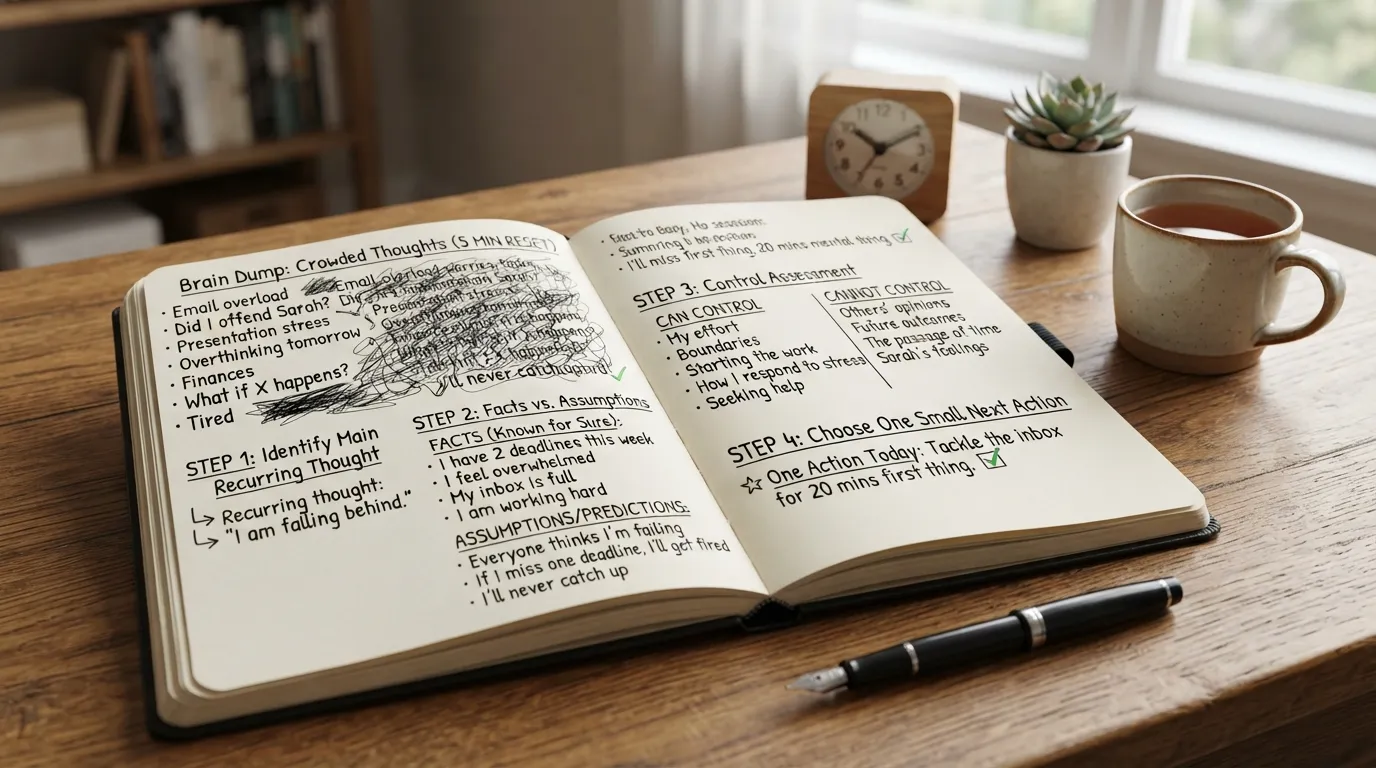
When your mind keeps replaying the same thought, jumping ahead to every possible outcome, or turning a small question into ten bigger ones, a blank journal can feel surprisingly difficult to use. You may know you want to write, but not know what to write or how to turn a page of thoughts into something clearer.
A journal for overthinkers works best when it gives your thoughts somewhere to go without turning journaling into another task to perfect. Instead of simply recording everything that is on your mind, you can use short prompts and simple structures to separate facts from guesses, sort what you can control, identify one useful next step, and leave the rest for later.
If your mind is racing right now: take five minutes, write down the thought you keep repeating, separate what you know from what you are assuming, identify what you can control today, and choose one small next step. If there is nothing useful you can do right now, give yourself permission to put the problem down for the moment.
What Is a Journal for Overthinkers?
A journal for overthinkers is not necessarily a special kind of notebook. It is a structured way of journaling that helps organize repetitive thoughts instead of simply adding more words to them.
The basic idea is simple: get the thought out, understand what is actually happening, separate what is known from what is imagined, and decide whether there is a useful action to take. This makes a guided journal or a few well-chosen prompts more practical than staring at a blank page and wondering where to begin.
You can use a normal notebook, a notes app, a printable template, or a guided journal. The format matters less than whether the writing helps you understand the thought and move forward.
Does Journaling Help With Overthinking?
Journaling can be a useful self-reflection tool, but it is better to think of it as a way to organize and examine thoughts rather than a guaranteed cure for overthinking. Research on expressive writing has produced mixed results, with benefits varying according to the person, the writing approach, the situation, and the outcome being measured.
That distinction matters. If writing helps you identify a worry, clarify what is within your control, and choose a reasonable next step, it may feel useful. But if you spend an hour writing the same fear from ten different angles without gaining any new understanding, more writing is not necessarily better.
A useful goal for overthinking journaling
Do not aim to write everything perfectly. Aim to finish with more clarity, one useful decision, one small action, or a conscious decision to let the issue rest for now.
The Best Journaling Methods for Overthinkers
Different kinds of overthinking call for different approaches. You do not need to use every method. Start with the one that matches what your mind is doing right now.
1. The Brain Dump
Best when: your head feels crowded with too many thoughts at once.
A brain dump is a short, unfiltered writing session where you put the thoughts competing for your attention onto the page. You do not need to organize them while writing.
Try this: set a short timer and write whatever is occupying your mind. Work, conversations, worries, reminders, decisions, unfinished tasks, questions, and random thoughts can all go on the same page.
Afterward, stop and sort. Circle anything that needs action. Underline anything that is simply a thought or worry. Cross out anything that does not require your attention today.
2. Control vs. Chaos
Best when: you are worrying about something you cannot completely control.
Draw two columns. Label the first What I Can Control and the second What I Cannot Control Right Now.
| What I Can Control | What I Cannot Control Right Now |
|---|---|
| What I say, prepare, ask, schedule, or do next | Another person’s reaction, an uncertain future outcome, or something that has already happened |
The purpose is not to make uncertainty disappear. It is to stop spending the same mental energy on something you cannot change while overlooking the small action that is actually available to you.
3. The 5-Minute Reset
Best when: you want to journal but feel too overwhelmed to start.
- Write the thought that is taking up the most space.
- Write what you know for certain.
- Write what you are guessing, predicting, or fearing.
- Write one thing you can influence today.
- Choose one small action—or decide that no action is needed right now.
This method keeps journaling deliberately small. You do not have to produce a beautiful page or discover a life-changing insight every time.
4. Fact vs. Prediction
Best when: your mind keeps treating a possible future outcome as though it has already happened.
Write the worry exactly as it appears in your mind. Then divide it into two parts:
- What is a fact?
- What am I predicting?
For example, “I have not received a reply yet” is different from “They must be upset with me.” The second statement may be a possibility, but it is not the same thing as a confirmed fact.
5. The One-Next-Step Journal
Best when: overthinking is preventing you from deciding what to do.
Ask yourself:
What is the smallest useful action I can take next?
Not the perfect solution.
Not the complete five-year plan. Just the next useful action.
This is particularly useful when a large problem has become mentally tangled into dozens of smaller decisions.
Journal Prompts for Overthinkers
Instead of keeping one giant list of prompts, choose a prompt based on the type of thought you are dealing with.
When Your Mind Feels Full
- What thoughts are competing for my attention right now?
- Which thought feels the loudest?
- What do I need to remember so I do not have to keep rehearsing it?
- What can I put on paper instead of keeping it in my head?
When You Keep Repeating the Same Thought
- What thought am I repeating today?
- Have I learned anything new since I first had this thought?
- Is there an unanswered question underneath this thought?
- Am I trying to solve something that cannot be solved yet?
When You Are Worried About the Future
- What am I afraid might happen?
- What do I actually know right now?
- What am I assuming about the future?
- If the situation changes, what could I do then?
When You Need Mental Clarity
- What is the real problem I am trying to solve?
- What part of this situation matters most?
- What am I making more complicated than it needs to be?
- What would “clear enough” look like here?
When You Need to Let Something Go for Tonight
- Is there anything useful I can do about this tonight?
- If not, when will I give this my attention again?
- What can I safely leave unfinished for now?
- What would help me shift my attention to the present moment?
A Simple Journal Template for Mental Clarity
If you regularly open a notebook and have no idea where to start, save this structure. You can complete it in a few minutes.
Right now, my mind is focused on:
________________________________________
The thought I keep repeating is:
________________________________________
What I know for sure:
________________________________________
What I am assuming or predicting:
________________________________________
What I can control today:
________________________________________
One small action I can take:
________________________________________
What I cannot solve right now:
________________________________________
What I want to remind myself before I close the journal:
________________________________________
Notice that the template does not ask you to solve everything. Its purpose is to move from mental noise → clearer information → one useful response.
How to Journal When You Cannot Stop Replaying a Thought
When the same thought keeps returning, writing it down repeatedly may not give you anything new. Instead, try changing the question.
- Name the loop. Write the exact thought you keep returning to.
- Check for new information. Ask whether anything has actually changed since the last time you considered it.
- Identify the unresolved part. Is there a decision, question, conversation, task, or uncertainty underneath it?
- Choose your response. Take one reasonable action if one is available.
- Close the loop for now. If no action is possible, write when or under what condition you will revisit it.
The goal is not to force yourself to stop thinking. It is to give the thought a clearer place in your mind instead of repeatedly examining the same uncertainty without new information.
Morning or Evening: When Should You Journal?
There is no universal best time. Choose the time that matches what you want journaling to do.
| Time | Useful for | Try asking |
|---|---|---|
| Morning | Sorting priorities before the day becomes busy | What deserves my attention today? |
| During the day | A quick mental reset when thoughts become tangled | What is the one thing I need to clarify? |
| Evening | Reviewing unfinished thoughts and tomorrow’s priorities | What can I leave for tomorrow? |
How Often Should You Journal?
You do not need to fill several pages every day. A short, repeatable practice may be easier to maintain than a demanding routine.
Some people prefer a brief daily check-in. Others journal only when their thoughts feel crowded or when they need to work through a particular decision. Choose a rhythm that feels useful rather than turning journaling into another obligation.
A good test is simple: after writing, do you feel that you understand the situation better, know what to do next, or have a clearer place to leave the thought? If yes, the practice is serving a purpose.
Different Journaling Styles for Mental Clarity
“Journaling” can mean several different things. You do not have to use the same style every day.
- Brain-dump journaling: useful for clearing a crowded mind.
- Prompt journaling: useful when you need a question to get started.
- Decision journaling: useful when you are weighing options and want to clarify your reasoning.
- Gratitude journaling: useful when you intentionally want to record things you appreciate.
- Reflection journaling: useful for looking back at an experience and identifying what you learned.
- Planning journaling: useful when overthinking is connected to too many unfinished tasks or decisions.
The best style is the one that matches the problem you are trying to solve. If your mind is overloaded, start with a brain dump. If you cannot decide, try a decision page. If you have no idea what to write, use a prompt.
What Not to Do When Journaling as an Overthinker
Journaling is supposed to make reflection more manageable, not become another activity you feel you have to perform perfectly.
- Do not wait for the perfect words. A journal is for thinking, not publishing.
- Do not force yourself to write for a long time. A short useful entry can be enough.
- Do not treat every prediction as a fact. Label uncertainty honestly.
- Do not turn every entry into a problem-solving marathon. Some situations cannot be resolved immediately.
- Do not repeatedly rewrite the same worry without checking for new information. If nothing has changed, change the question or move to an action step.
- Do not judge your thoughts for being “wrong.” Notice them first; then decide what deserves your attention.
One important distinction: journaling can support self-reflection, but it should not be treated as a replacement for professional mental-health care. If overthinking is causing significant distress or interfering with your daily life, sleep, relationships, work, or ability to function, consider talking with a qualified mental-health professional.
A Simple 3-Step Journal Reset
If you want one method to remember, use this three-part structure:
- Empty: What is taking up space in my mind?
- Sort: What is fact, what is uncertainty, and what can I control?
- Choose: What is one useful next step, or what can I consciously leave alone for now?
This gives you a simple path from thoughts → clarity → action without requiring a complicated journaling system.
Frequently Asked Questions
What is a good journal for overthinkers?
A good journal for an overthinker is one that makes it easy to turn thoughts into structured reflection. A simple notebook with prompts for brain dumping, fact-versus-assumption thinking, control versus uncertainty, and next steps can work just as well as a commercially guided journal.
What should I write in a journal when I am overthinking?
Start with the thought you keep repeating. Then write what you know for sure, what you are assuming or predicting, what you can control, and one small action you can take. If there is no useful action available, write what you are willing to leave unresolved for now.
Is journaling good for overthinkers?
Journaling can be a useful way to organize thoughts and reflect on worries, but it is not guaranteed to reduce overthinking for everyone. A structured approach is often more practical than repeatedly writing the same worry without examining it.
What is the 3-3-3 journaling method?
There is no single universally defined journaling method called the “3-3-3 method.” Different sources may use the name for different exercises. If you see a specific 3-3-3 technique, check how that source defines it rather than assuming every journal uses the same method.
What is the 3-2-1 journaling method?
The term “3-2-1 journaling method” is also used for more than one exercise. Because the format is not universal, the most useful approach is to follow the exact instructions attached to the version you choose rather than treating the name as one standardized technique.
What should you not do when journaling?
Avoid turning journaling into a perfectionist task or endlessly repeating the same worry without looking for new information, a practical action, or a clear stopping point. You also do not need to write a certain number of pages for a journal entry to be worthwhile.
What time of day should I journal?
Choose the time that fits your purpose. Morning journaling can help organize priorities, daytime journaling can provide a short reset, and evening journaling can help you sort unfinished thoughts before moving on to the rest of your night.
Is it healthy to journal every day?
Daily journaling is not necessary for everyone. Some people prefer a short daily practice, while others write when they need to process a particular thought or decision. The useful measure is whether the practice supports reflection rather than becoming another source of pressure.
How do I journal correctly?
There is no single correct way to journal. For overthinking, a practical starting point is to write the recurring thought, separate facts from assumptions, identify what you can control, and choose one next step. Keep the process simple enough that you can actually use it.
When Your Journal Becomes a Tool for Clarity
The most useful journal for an overthinker does not need to be complicated. It needs to help you move from an unclear mass of thoughts toward something you can understand.
Start by emptying the mental clutter. Then sort the thought: What is true? What am I predicting? What can I control? Finally, choose one small action or decide that the situation does not need more attention right now.
You do not have to solve every thought before you close the notebook. Sometimes the most useful journal entry is simply the one that helps you see what deserves your attention—and what does not.
Pimchanok Srisuk
Pimchanok Srisuk is the Journaling Editor at Holistic Wellbeing Living. She writes about journaling prompts, reflective writing, emotional clarity, and mindful routines. With seven years of experience creating personal-growth content, Pimchanok helps readers use simple writing practices to understand their thoughts and make calmer everyday decisions.