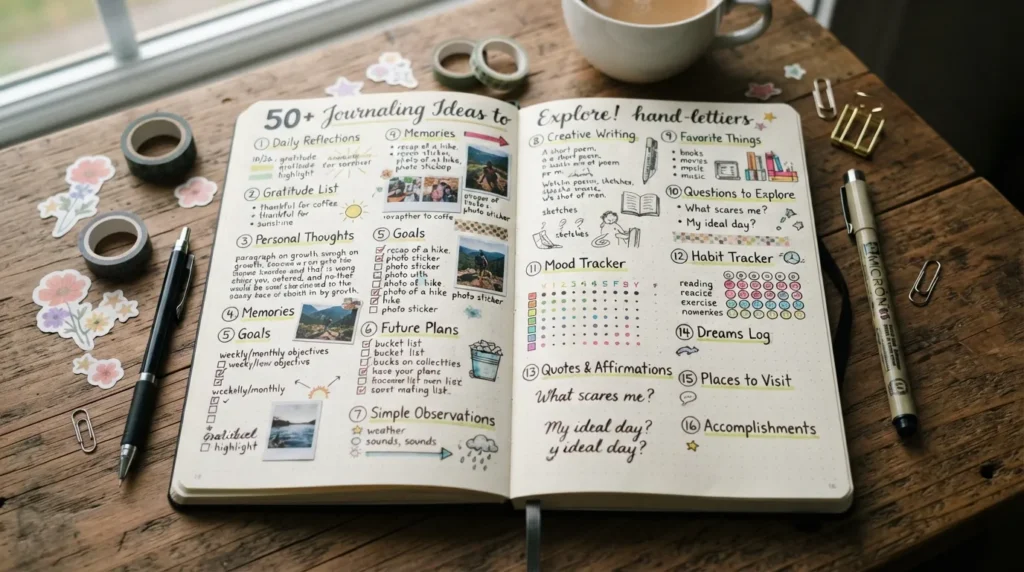
If you are staring at a blank journal page and thinking, “What am I supposed to write?”, you do not need to wait for a profound thought. You can write about your day, make a quick list, record a memory, try a creative spread, track something you enjoy, or use a simple prompt to get started.
The best journaling idea depends on what you want from the page. Some days you may want to clear your head; other days you may want to remember what happened, plan ahead, be creative, or simply fill a few quiet minutes. I have organized the ideas below by purpose so you can choose something that fits the time, energy, and kind of journaling you want to do today.
Journaling Ideas You Can Actually Start Today
You do not have to use one journaling style every day. Pick the idea that matches what you need right now.
If you cannot decide: write down three things that happened today, one thing you felt, one thing you learned, and one thing you want to remember. That is enough for a useful journal entry.
1. Do a five-minute brain dump
Write whatever is occupying your mind without trying to make it organized or polished. You can include tasks, worries, ideas, reminders, conversations, plans, or completely random thoughts.
Try this: Set a five-minute limit and keep writing until the time ends. Afterward, circle anything that needs action and leave the rest alone.
2. Write a simple daily reflection
Instead of recording every detail of your day, choose a few moments worth remembering.
- What happened today?
- What was the best part?
- What was difficult?
- What surprised me?
- What do I want to remember?
3. Make a three-item gratitude list
Write three things you appreciated today. They can be ordinary: a good meal, a funny message, comfortable weather, finishing a task, or having a quiet moment. You do not need to make every entry dramatic or deeply emotional.
4. Keep a “small joys” page
Whenever something makes you smile, add it to one running list. You might record a song you enjoyed, something funny someone said, a beautiful view, a favorite snack, or a tiny moment that made an ordinary day better.
5. Record one thing you learned
Write down something new you discovered today. It could come from a book, conversation, class, work, hobby, documentary, recipe, or simple everyday experience. Over time, this turns your journal into a record of what you have learned.
6. Make a “currently” page
Create a snapshot of your life right now:
- Currently reading
- Currently watching
- Currently listening to
- Currently learning
- Currently enjoying
- Currently working toward
7. Track books, movies, shows, or music
Your journal does not have to be a diary. Make a running list of books you finish, movies you watch, shows you complete, albums you discover, or songs you want to remember. Add a rating, favorite character, memorable quote, or short reaction if you want more detail.
8. Write a letter you do not need to send
Write to your future self, past self, a fictional character, someone you admire, or even yourself one year from now. The point is not sending the letter; it is giving yourself a different way to organize your thoughts.
What Should I Journal About Every Day?
If you want a daily journaling routine, keep it small enough that you can repeat it. You do not need to write pages every night.
| If you have… | Try journaling about… |
|---|---|
| 2–5 minutes | One good thing, one challenge, and one thing you want to remember |
| A busy mind | A brain dump followed by your three most important tasks |
| A reflective mood | What happened, how you responded, and what you learned |
| Creative energy | A collage, sketch, list, photo page, or decorative spread |
| Nothing to say | What you saw, heard, ate, watched, read, or noticed today |
A daily journal can also be as simple as one sentence. Consistency matters more than filling a certain number of pages.
Journaling Ideas for Beginners
If you are new to journaling, start with prompts that have an obvious answer. A blank page becomes much less intimidating when you only need to complete one small task.
- Write five things you can see around you.
- Describe the best part of today.
- List three things you are looking forward to.
- Write about something that made you laugh recently.
- Record what you are currently reading, watching, or listening to.
- Describe your ideal ordinary day.
- Write down one problem you are trying to solve.
- Make a list of things you want to try.
- Describe a favorite place from memory.
- Write one thing you learned this week.
Beginner tip: do not create a complicated journaling system on day one. Start with one notebook, one pen, and one repeatable idea. You can add trackers, decorations, prompts, or different sections later if they genuinely make journaling more enjoyable.
What to Write in Your Journal When You Have Nothing to Say
Sometimes the problem is not that you do not want to journal; it is that nothing feels important enough to write down. On those days, lower the standard.
Try completing one of these sentences:
- “Right now I am thinking about…”
- “Today was different because…”
- “Something I noticed today was…”
- “If I could change one thing about today…”
- “One thing I do not want to forget is…”
- “The next thing I want to do is…”
- “Lately, I have been curious about…”
- “A small thing that made today better was…”
You can also write a factual entry. Describe the weather, your surroundings, what you ate, what you listened to, where you went, or what you spent time doing. A journal can preserve ordinary life, not just major events.
Creative Journaling Ideas
If traditional diary writing feels boring, turn the page into a small creative project. You can combine words with photographs, paper, drawings, lists, tickets, stickers, or other flat keepsakes.
Memory collage
Create a page around one day, trip, event, or season. Add photographs, ticket stubs, packaging, notes, small paper pieces, or short captions. The written part can be as simple as what happened and why you want to remember it.
Sticker journal pages
Use stickers as the starting point rather than trying to decorate an entire page. Pick one sticker, build a small color or theme around it, and add a few words about your day or the idea it reminds you of.
Favorite-things lists
Make lists of favorite meals, books, songs, movies, places, drinks, quotes, outfits, recipes, weekend activities, or childhood memories. Lists are especially useful when you want to journal without writing long paragraphs.
Photo-and-caption pages
Choose one or several photographs and add short captions. Instead of only describing what is visible, record why the moment mattered, what happened before or after it, or what you want your future self to remember.
Interactive pages
If you enjoy making things with your hands, try pockets, envelopes, fold-outs, layered paper, or hidden notes. Keep interactive elements practical enough that the journal can still open and close comfortably.
What Is Junk Journaling?
Junk journaling is a creative form of journaling that uses collected or everyday paper materials as part of the page. Instead of treating a notebook as a place for writing alone, you can build pages from items such as paper scraps, tickets, labels, photographs, envelopes, receipts, decorative pieces, or other keepsakes.
The appeal is that the page can become a record of an experience without requiring a traditional diary entry. You might create a travel page from tickets and notes, a monthly collage from packaging and photographs, or a themed spread around a favorite book or season.
One limitation: collected materials can make a journal bulky. If you plan to add thicker objects, leave enough room for the book to close comfortably.
Aesthetic Journal Ideas Without Making the Page Complicated
An aesthetic journal does not have to look elaborate. You can create a cohesive page by choosing one simple visual rule.
- Use one or two colors for the page.
- Choose one theme, such as coffee, books, flowers, travel, or a season.
- Repeat one small visual element, such as a sticker or handwritten label.
- Leave some empty space instead of filling every corner.
- Combine a small amount of decoration with meaningful writing or memories.
If you enjoy Pinterest-style visual inspiration, use it to collect ideas for layouts, color combinations, or themes. You do not need to reproduce another person’s entire spread for your own journal to look good.
Journaling Ideas for Reflection and Emotional Check-Ins
If you use journaling as a way to reflect, try questions that help you notice patterns rather than forcing yourself to write something positive.
- What has been taking up most of my attention lately?
- What situation felt easier than I expected?
- What has been frustrating me?
- What do I wish I had handled differently?
- What is within my control right now?
- What do I need more of this week?
- What do I need less of?
- What boundary or decision have I been avoiding?
- What is one small action I can take next?
Journaling can be a useful reflection practice, but it does not need to replace professional support when you are dealing with a serious mental-health concern. If writing about difficult experiences consistently makes you feel worse rather than helping you reflect, changing the approach or seeking appropriate support may make more sense.
Three Simple Journaling Methods to Try
The 3-3-3 journaling method
The name “3-3-3” can refer to different journaling exercises, so it is worth checking the instructions for the specific version you are using rather than assuming there is one universal format.
For a simple personal version, you can write three things you noticed, three things you are thinking about, and three things you want to focus on next. The value is in giving a blank page a repeatable structure; you can change the categories to fit your routine.
The 3-2-1 journaling method
Like other numbered journaling methods, 3-2-1 can be adapted in several ways. A simple daily version is:
- 3: things that happened or stood out
- 2: things you learned, noticed, or appreciated
- 1: thing you want to carry into tomorrow
The exact categories are flexible. What matters is having a short framework you can repeat without deciding what to write from scratch every day.
Different Types of Journaling
There is no single official list of “the seven types of journaling.” Different writers group journaling styles differently. The useful way to think about them is by what you want the journal to help you do.
| Type | What you might do | Best when… |
|---|---|---|
| Daily journal | Record events and observations | You want a record of everyday life |
| Reflective journal | Explore experiences and lessons | You want to understand patterns or decisions |
| Gratitude journal | Record things you appreciate | You prefer short positive entries |
| Creative journal | Combine writing, drawing, collage, or decoration | You enjoy visual or hands-on projects |
| Bullet-style journal | Use short notes, lists, and trackers | You prefer structure and quick entries |
| Memory journal | Preserve photos, keepsakes, and stories | You want to document experiences |
| Topic journal | Focus on one interest or project | You want to collect ideas in one place |
Things to Do in a Notebook Besides Writing
If you are looking for things to do in a notebook, you have more choices than writing diary entries.
- Draw or sketch something you can see.
- Make a reading list or media tracker.
- Plan a trip or weekend.
- Create a list of recipes you want to try.
- Collect quotes that are meaningful to you.
- Make a page of favorite songs.
- Create a monthly highlights page.
- Write down ideas for future projects.
- Make a wish list or “things to try” list.
- Create a memory collage.
- Make a personal reference page for something you are learning.
- Keep a collection of observations from walks, trips, or everyday life.
Journaling Ideas by Mood or Goal
Choosing an idea becomes easier when you start with the reason you opened the journal.
| Your goal | Good ideas to try |
|---|---|
| Clear a crowded mind | Brain dump, task triage, stream-of-consciousness writing |
| Remember your life | Daily highlights, photos, memory pages, keepsakes |
| Be creative | Collages, stickers, sketches, themed spreads, fold-outs |
| Track your interests | Books, movies, music, recipes, hobbies, favorite things |
| Reflect on a decision | What I know, what I do not know, options, trade-offs, next step |
| Keep it quick | One-sentence entry, three-item list, or one prompt |
Unique Journaling Ideas When You Want Something Different
When the usual “How was your day?” prompt starts feeling repetitive, change the angle rather than forcing yourself to write more.
- Write a “day in objects” entry: choose three objects you used today and explain why they mattered.
- Create a sensory page: record something you saw, heard, smelled, tasted, and felt physically.
- Make a future-self snapshot: describe what your life looks like right now for yourself to read later.
- Build a personal museum page: collect small memories from one period of your life and caption each one.
- Write “things I almost forgot”: record ordinary details that might disappear from memory.
- Make a recommendation page for your future self: list books, films, meals, places, songs, or activities you currently love.
- Create a “before and after” reflection: write what you thought before an experience and what you think afterward.
- Document a normal day: record the small routine details you might otherwise never remember.
Common Journaling Mistakes That Make the Habit Harder
Trying to make every entry meaningful
Some days will be ordinary. That does not make them unworthy of recording. A short factual entry can be valuable when you read it months or years later.
Making the routine too complicated
Multiple trackers, elaborate layouts, color systems, and daily prompts can become another task to maintain. Add structure only when it makes journaling easier or more enjoyable.
Believing you must journal every day
A missed day is not a failed habit. You can simply continue with the next entry instead of spending time explaining why you stopped.
Copying aesthetic pages you do not enjoy making
Visual inspiration can be useful, but your journal does not need to look like someone else’s. If decorating takes more energy than you want to spend, keep the page simple.
Writing only when something is wrong
If every entry focuses on problems, your journal may become a record of difficult moments only. Balance reflective entries with ordinary observations, interests, memories, achievements, and small joys.
How to Choose the Right Journaling Idea
You do not need a permanent journaling style. Choose based on what would make today’s page useful.
- If your mind feels crowded, start with a brain dump.
- If you have very little time, write one sentence or three short bullets.
- If you want to remember today, record the moments you would otherwise forget.
- If you want something creative, use photographs, stickers, collage materials, sketches, or lists.
- If you want to reflect, write what happened, how you responded, and what you learned.
- If you are bored with your routine, switch from diary writing to a themed page, list, tracker, or memory spread.
The simplest rule: your journal should fit your life, not the other way around. If a particular format makes you want to stop journaling, change the format.
Frequently Asked Questions About Journaling Ideas
What are some good topics for journaling?
Good topics include your day, memories, goals, decisions, lessons, books, movies, music, hobbies, gratitude, challenges, future plans, favorite things, creative projects, and ordinary details you want to remember. The best topic is one you actually want to explore or record.
What are some easy journaling ideas?
Try a three-item gratitude list, one-sentence daily entry, “currently” list, favorite-things list, daily highlight, or one thing you learned. These take little preparation and are easy to repeat.
What can I write in a gifted journal?
You can use it as a daily journal, memory book, reading journal, creative notebook, travel journal, idea collection, gratitude journal, or personal list book. If the notebook feels too special to “waste,” start with something simple and let the journal become yours through use.
What do people usually journal about?
People journal about everyday events, thoughts, feelings, memories, goals, challenges, gratitude, creative ideas, hobbies, books, music, travel, lists, and things they want to remember. There is no requirement that a journal follow one particular subject.
What are six types of journals I could keep?
Six useful categories are a daily journal, reflective journal, gratitude journal, creative journal, memory journal, and topic-focused journal. You can keep one or combine several styles in the same notebook.
Can journaling be creative without writing much?
Yes. You can use photographs, stickers, drawings, lists, paper scraps, tickets, labels, collages, pockets, and short captions. A journal can be visual, written, or a combination of both.
Do I need a special journal or journaling supplies?
No. A basic notebook and pen are enough to start. Stickers, photographs, colored pens, decorative paper, and other supplies are optional and are most useful when they make the activity more enjoyable for you.
How long should a journal entry be?
There is no required length. One sentence can be enough on a busy day, while another entry might fill several pages. Choose a length you can comfortably maintain instead of treating page count as a measure of whether you journaled “properly.”
A Simple Journaling Routine You Can Reuse
If you want one routine rather than a long list of prompts, use this four-part entry whenever you open your journal:
- Notice: What happened or stood out today?
- Reflect: How did it affect you or what did you learn?
- Remember: What detail would you like your future self to know?
- Next: Is there anything you want to do, change, explore, or carry into tomorrow?
On a busy day, answer each question with one sentence. When you have more time, expand whichever answer feels interesting. This gives you a consistent starting point without forcing every journal entry to look the same.
The best journaling idea is the one you will actually enjoy returning to. Your notebook can be a place for thoughts, memories, lists, creative pages, observations, plans, or simply a record of ordinary life. Start with one page today, and let the journal develop its own style as you use it.
Pimchanok Srisuk
Pimchanok Srisuk is the Journaling Editor at Holistic Wellbeing Living. She writes about journaling prompts, reflective writing, emotional clarity, and mindful routines. With seven years of experience creating personal-growth content, Pimchanok helps readers use simple writing practices to understand their thoughts and make calmer everyday decisions.