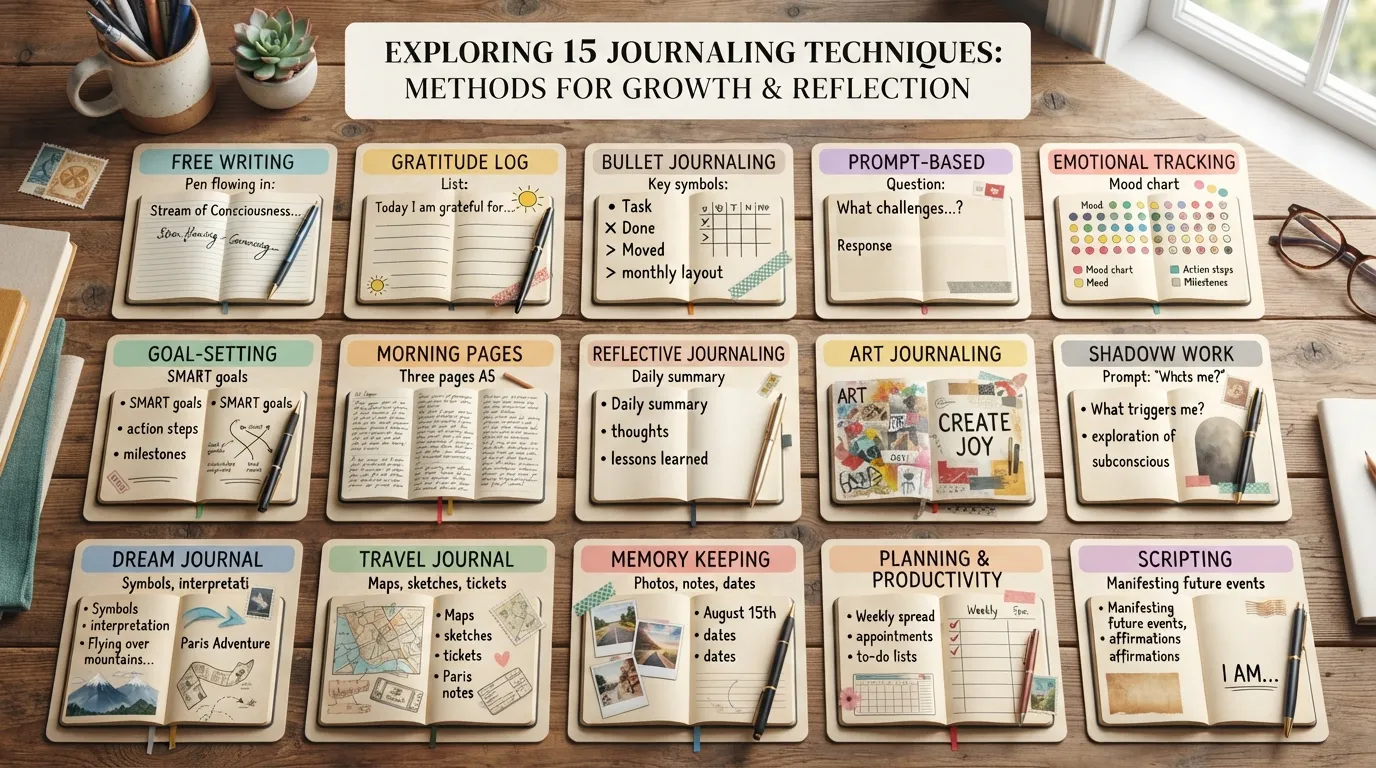
If you want to start journaling but are not sure what to write, you do not need a complicated system. Journaling techniques are simply different ways of using a journal for a particular purpose, such as clearing your thoughts, reflecting on your day, tracking emotions, exploring ideas, practicing gratitude, or organizing goals.
The best method depends on what you want from journaling. Free writing can help when your mind feels crowded, prompts can help when you stare at a blank page, gratitude journaling gives you a simple positive-reflection structure, and bullet journaling is useful when you want writing and organization in one place. Below, I’ll explain the main journaling methods, show you how each one works, and help you choose a technique that actually fits your life.
The short answer
There is no single best journaling technique for everyone. Choose based on your goal: free writing for mental clutter, prompts for getting started, gratitude for positive reflection, emotional tracking for noticing patterns, bullet journaling for organization, and goal or reflective journaling for planning and personal growth.
What Are Journaling Techniques?
A journaling technique is a particular way of writing in a journal. Instead of opening a blank notebook and wondering what to do, you use a structure that gives your writing a purpose.
For example, free writing asks you to keep writing without stopping to edit. Gratitude journaling focuses your attention on things you appreciate. Prompt journaling gives you a question to answer. Bullet journaling uses short notes and symbols to combine reflection with organization.
| Term | What it means | Example |
|---|---|---|
| Technique | A way of writing or recording information. | Free writing or gratitude journaling |
| Method | A more defined framework or process for journaling. | A structured 3-2-1 reflection |
| Journal type | The purpose or subject around which the journal is organized. | A gratitude, travel, dream, or goal journal |
| Prompt | A question or starting point that tells you what to write about. | “What is taking up most of my attention today?” |
The Best Journaling Techniques to Try
You do not need to use all of these journaling methods. Start with the one that matches your current reason for journaling. If it feels forced after several attempts, change the method rather than assuming journaling is not for you.
1. Free Writing
Free writing, sometimes called stream-of-consciousness writing, is one of the simplest journaling techniques. You write continuously for a set period without worrying about grammar, organization, or whether every sentence sounds intelligent.
How to do it: Set a short timer, such as 5 to 10 minutes, choose a starting thought, and keep your pen or keyboard moving. If you run out of ideas, write about the fact that you have run out of ideas and continue from there.
Best for: clearing mental clutter, brainstorming, processing everyday thoughts, and getting past the fear of a blank page.
Possible limitation: Free writing can become repetitive if you use it without a clear purpose for a long time. If you need to solve a specific problem or track something consistently, a more structured technique may work better.
2. Gratitude Journaling
Gratitude journaling focuses your writing on things you appreciate. You can record people, experiences, opportunities, ordinary moments, or specific things that went well.
A simple format:
- One thing I appreciated today
- Why it mattered to me
- One detail I might otherwise have overlooked
Best for: positive reflection, noticing everyday experiences, and creating a simple journaling routine.
Possible limitation: Gratitude journaling is not a requirement to feel positive every day. If you are dealing with a difficult situation, forcing yourself to find a positive angle can feel unhelpful. You can choose a different journaling technique when honest reflection is what you need.
3. Prompt Journaling
If you regularly think, “I want to journal, but I have no idea what to write,” prompt journaling is an easy place to start. Instead of creating the subject yourself, you answer a question.
Try prompts such as:
- What is taking up most of my attention today?
- What am I avoiding, and why?
- What went better than I expected?
- What do I need more of right now?
- What would I tell a friend in the same situation?
Best for: beginners, reflective writing, self-discovery, and anyone who freezes when faced with a blank page.
4. Bullet Journaling
Bullet journaling uses short notes, symbols, lists, and simple page layouts to organize information. It can combine tasks, appointments, notes, goals, habits, and personal reflections in one notebook.
Best for: people who enjoy visual organization, planning, task tracking, and keeping several types of information together.
Possible limitation: decorative layouts can become a project of their own. You do not need elaborate drawings, expensive supplies, or a perfect spread for bullet journaling to be useful.
5. Emotional or Mood Tracking
Emotional tracking means recording how you feel and looking for patterns over time. You might use a simple word, number, color, or short description rather than writing a full page every day.
A simple entry might include:
- Emotion: frustrated
- Trigger: difficult conversation
- What I noticed: I kept replaying the conversation afterward
- What might help: take a break before responding next time
Best for: noticing recurring emotional patterns and connecting feelings with situations, thoughts, or habits.
6. Daily Reflection Journaling
Daily reflection gives your journaling a repeatable structure. Instead of writing everything that happened, you focus on a few questions that help you review the day.
Try this three-part format:
- What happened today?
- What did I learn or notice?
- What do I want to do differently tomorrow?
Best for: building a simple routine, learning from experiences, and ending the day with a focused reflection.
7. Goal Journaling
Goal journaling connects writing with something you want to accomplish. Instead of simply stating a goal, you use your journal to break it into actions, record progress, and review what is or is not working.
A useful structure:
- What am I trying to achieve?
- Why does it matter?
- What is the next small action?
- What could get in the way?
- What did I learn from my last attempt?
Best for: personal projects, habits, learning goals, and situations where progress matters more than simply recording thoughts.
8. Creative Journaling
Creative journaling gives you more freedom than conventional diary writing. You can combine words with sketches, lists, collage, poetry, mind maps, observations, or short pieces of fiction.
Best for: people who think visually, want to explore ideas, or find conventional diary entries too restrictive.
9. Problem-Solving Journaling
When a problem keeps circling in your head, writing it down can make the situation easier to examine. The goal is not to write endlessly about the problem. It is to separate the facts, your interpretation, possible options, and your next step.
Try this structure:
- The situation: What actually happened?
- My interpretation: What am I assuming it means?
- What I can control: Which part is actually within my control?
- Options: What are two or three reasonable responses?
- Next step: What can I do now?
Best for: decisions, everyday problems, planning conversations, and situations where your thoughts feel tangled.
10. Morning Pages
Morning pages are a form of free-flowing writing done at the beginning of the day. The emphasis is on getting thoughts onto the page rather than producing polished writing.
Best for: people who enjoy writing early, want to clear mental clutter before the day begins, or want an unstructured creative warm-up.
11. One-Line-a-Day Journaling
One-line-a-day journaling is exactly what it sounds like: you record one meaningful sentence about the day. It is useful when you like the idea of keeping a record but do not want journaling to take much time.
Best for: busy schedules, beginners, and people who struggle to maintain long journaling sessions.
Which Journaling Technique Is Best for You?
Instead of asking which journaling method is universally “best,” start with your purpose. The right method is the one that makes it easier for you to do the kind of writing you actually need.
| If you want to… | Try first | Why it fits |
|---|---|---|
| Clear your thoughts | Free writing | You can write without planning the structure first. |
| Get started as a beginner | Prompt journaling | A question gives you an immediate starting point. |
| Reflect on positive experiences | Gratitude journaling | It gives positive reflection a simple structure. |
| Notice emotional patterns | Mood or emotional tracking | Short entries make patterns easier to review. |
| Organize tasks and notes | Bullet journaling | It combines lists, planning, notes, and tracking. |
| Work toward a goal | Goal journaling | You can connect reflection with specific next actions. |
| Solve a problem | Problem-solving journaling | It separates facts, assumptions, options, and action. |
What Are the Different Types of Journaling?
The words technique, method, style, and type are often used interchangeably online, but they can describe different things. A useful way to think about them is that a technique describes how you write, while a journal type describes what the journal is mainly for.
Common journal types include:
- Personal journal: everyday thoughts, experiences, and reflections.
- Gratitude journal: appreciation and positive experiences.
- Goal journal: goals, progress, obstacles, and next actions.
- Dream journal: recording dreams and observations after waking.
- Travel journal: places, experiences, observations, and memories from trips.
- Creative journal: ideas, sketches, writing experiments, and visual exploration.
- Bullet journal: a flexible notebook system for planning, tracking, notes, and reflection.
- Reflection journal: lessons, experiences, decisions, and personal observations.
You can also combine them. For example, a goal journal might use bullet points for tracking, prompts for reflection, and free writing when you need to think through a difficult decision.
What Is the 3-3-3 Journaling Method?
The 3-3-3 journaling method is not a single universally standardized journaling system. Different journaling resources use the name for different three-part exercises, so you should check how a particular version defines each “3.”
If you want a simple three-part version, you can use three questions such as:
- What are three things I noticed today?
- What are three things I learned or appreciated?
- What are three things I want to focus on next?
The advantage of a structure like this is not the number three itself. It is the fact that a fixed framework removes the pressure of deciding what to write next.
What Is the 3-2-1 Journaling Method?
Like 3-3-3, the phrase 3-2-1 journaling method is used for more than one journaling format online. Rather than treating one version as the only correct definition, use the numbers as a flexible framework.
For example, one practical daily reflection can be:
- 3: three things that happened or stood out.
- 2: two things you learned or appreciated.
- 1: one action or intention for tomorrow.
If you find another 3-2-1 version that uses different prompts, that does not necessarily mean one source is wrong. The label is not a single standardized psychological technique.
Journaling Techniques for Beginners
If you have never journaled consistently, start smaller than you think. Your first goal is not to create a beautiful journal or write several pages. Your first goal is to make the process easy enough to repeat.
- Choose one reason to journal. Decide whether you want reflection, organization, creativity, emotional awareness, or goal tracking.
- Pick one technique. Do not start with five systems at once.
- Keep the first session short. Five minutes is enough to begin.
- Use a prompt if you get stuck. A question is often easier than a blank page.
- Write honestly rather than perfectly. Your journal is not an essay for grading.
- Review what works. After several sessions, notice whether the technique is helping you do what you wanted it to do.
If the blank page is the problem
Do not force yourself to “write something meaningful.” Start with one concrete sentence: “Right now, the thing taking up most of my attention is…” Then follow the thought wherever it goes. A simple starting point is often more useful than waiting for inspiration.
Journaling Techniques for Mental Health and Emotional Well-Being
Journaling is sometimes used as a reflective practice alongside other approaches to mental health. Research on expressive writing has found potential benefits, but the effects are not universal and different journaling interventions vary considerably.
A 2023 meta-analysis of 31 experimental studies involving 4,012 participants found a small but statistically significant overall effect of expressive writing on depression, anxiety, and stress symptoms, with effects appearing more clearly at follow-up. Other reviews have also found potential benefits while emphasizing substantial differences between studies and limitations in the evidence. The 2023 meta-analysis is available through PubMed.
The American Psychological Association’s discussion of expressive writing also explains the research tradition around writing about difficult experiences and emphasizes that the way people write can matter.
So I would not treat journaling as a guaranteed treatment or promise that one technique will fix anxiety, depression, trauma, or another mental health condition. If writing about a painful experience makes you feel significantly worse or overwhelmed, stop the exercise and consider speaking with a qualified mental health professional.
How Often Should You Journal?
You do not have to journal every day for your journal to be useful. The right frequency depends on the technique and your purpose.
| Goal | A practical starting rhythm | What to watch |
|---|---|---|
| Daily reflection | Daily or most days | Keep entries short enough to sustain. |
| Goal tracking | As needed, with a regular review | Focus on progress and next actions rather than repetition. |
| Free writing | Whenever you need it | Stop if the exercise becomes unhelpfully repetitive or overwhelming. |
| One-line journaling | Daily if convenient | Choose one detail rather than trying to summarize everything. |
Consistency can be useful, but there is no need to turn journaling into another task you feel guilty about missing. A method that fits your schedule is usually easier to maintain than an ideal routine you cannot realistically follow.
Common Journaling Mistakes to Avoid
- Trying every technique at once: start with one method and learn whether it fits you.
- Making the journal look perfect: usefulness matters more than decoration.
- Writing only what you think you “should” feel: honest observation is more useful than performing positivity for the page.
- Forcing a daily routine: choose a realistic rhythm instead.
- Writing without a purpose when you need a decision: switch to a structured problem-solving or goal method.
- Treating every emotional entry as a diagnosis: a journal can record experiences and patterns, but it cannot replace professional assessment.
- Continuing an exercise that makes you feel increasingly distressed: pause and choose a gentler approach or seek professional support when appropriate.
Journaling Exercises You Can Start Today
The 5-Minute Mental Reset
Set a five-minute timer and write continuously about whatever is occupying your attention. When the timer ends, underline one thought that deserves your attention and stop there.
The Three-Part Daily Review
- What happened?
- What did I learn?
- What will I carry into tomorrow?
The Problem-to-Action Page
- Write the problem in one sentence.
- Separate facts from assumptions.
- List two possible responses.
- Choose the smallest useful next action.
The One-Sentence Check-In
Complete this sentence: “Today I most need…” Then write one or two sentences explaining why. This is useful when you want to journal but have very little time.
What If Journaling Makes You Feel Worse?
Not every journaling exercise is suitable for every situation. Writing in detail about a distressing event can temporarily increase emotional discomfort, and research on expressive writing does not show identical effects for everyone. The evidence also varies by intervention, population, and outcome.
If a writing exercise leaves you increasingly distressed, stuck in repetitive rumination, or unable to return to your normal activities, you do not have to push through it. Try a more present-focused technique such as describing your surroundings, writing about what you can control today, or switching to a short practical journal.
If you are dealing with significant mental health symptoms, trauma, or thoughts of harming yourself, journaling should not be treated as a replacement for professional care. A qualified mental health professional can help you choose an appropriate approach.
Frequently Asked Questions About Journaling Techniques
What are the best journaling techniques?
The best technique depends on your goal. Free writing is a good starting point for clearing thoughts, prompts are useful when you do not know what to write, gratitude journaling supports positive reflection, bullet journaling combines writing with organization, and goal or problem-solving journaling gives you more structure.
What is the best journaling method for beginners?
Prompt journaling and short free writing are both easy starting points. If a blank page makes you freeze, use one question and write for five minutes. If you already know what you want to say, free writing gives you more flexibility.
What type of journaling is best for mental health?
There is no single best method for every mental health concern. Expressive writing and other journaling interventions have been studied, with research suggesting potential benefits in some settings, but the evidence is mixed and heterogeneous. Journaling can be a useful reflective practice for some people, but it should not replace appropriate professional treatment.
How often should I journal?
There is no universal schedule you must follow. You can journal daily, several times a week, or only when a particular technique is useful. Start with a routine that feels realistic rather than making frequency another source of pressure.
What should I write in a journal if I have nothing to say?
Use a prompt. Start with “What is on my mind right now?”, “What happened today that I keep thinking about?”, or “What do I need tomorrow?” You can also describe what you see, hear, feel, or notice around you until a more meaningful thought appears.
Is bullet journaling the same as keeping a diary?
Not exactly. A diary usually emphasizes recording experiences and thoughts, while bullet journaling is a flexible organization system that can include tasks, events, notes, trackers, goals, and reflections. You can use bullet journaling as part of a personal journal if that combination works for you.
Are the 3-3-3 and 3-2-1 journaling methods standardized?
No single universal definition should be assumed for either label. Different journaling resources use the numbers for different prompts or steps. When you follow a particular version, use the instructions provided by that source rather than assuming every “3-3-3” or “3-2-1” exercise means the same thing.
How to Choose a Journaling Method You Will Actually Keep Using
The most useful journaling technique is rarely the one that looks most impressive. It is the one that fits the reason you are writing and the amount of effort you can realistically give it.
If your thoughts are scattered, start with free writing. If you need direction, use prompts. If you want to notice positive experiences, try gratitude journaling. If you want to understand recurring emotional patterns, use simple tracking. If your main need is organization, bullet journaling may be a better fit. And if you have a specific problem or goal, give yourself a structure that moves from reflection toward action.
You can also change techniques as your needs change. Journaling does not have to be one fixed system for the rest of your life. Think of these methods as tools: choose the one that fits the job in front of you, keep the process simple, and adjust when it stops being useful.
Pimchanok Srisuk
Pimchanok Srisuk is the Journaling Editor at Holistic Wellbeing Living. She writes about journaling prompts, reflective writing, emotional clarity, and mindful routines. With seven years of experience creating personal-growth content, Pimchanok helps readers use simple writing practices to understand their thoughts and make calmer everyday decisions.