Jump to:
ToggleMental Health Journal Prompts: 60+ Prompts by Category
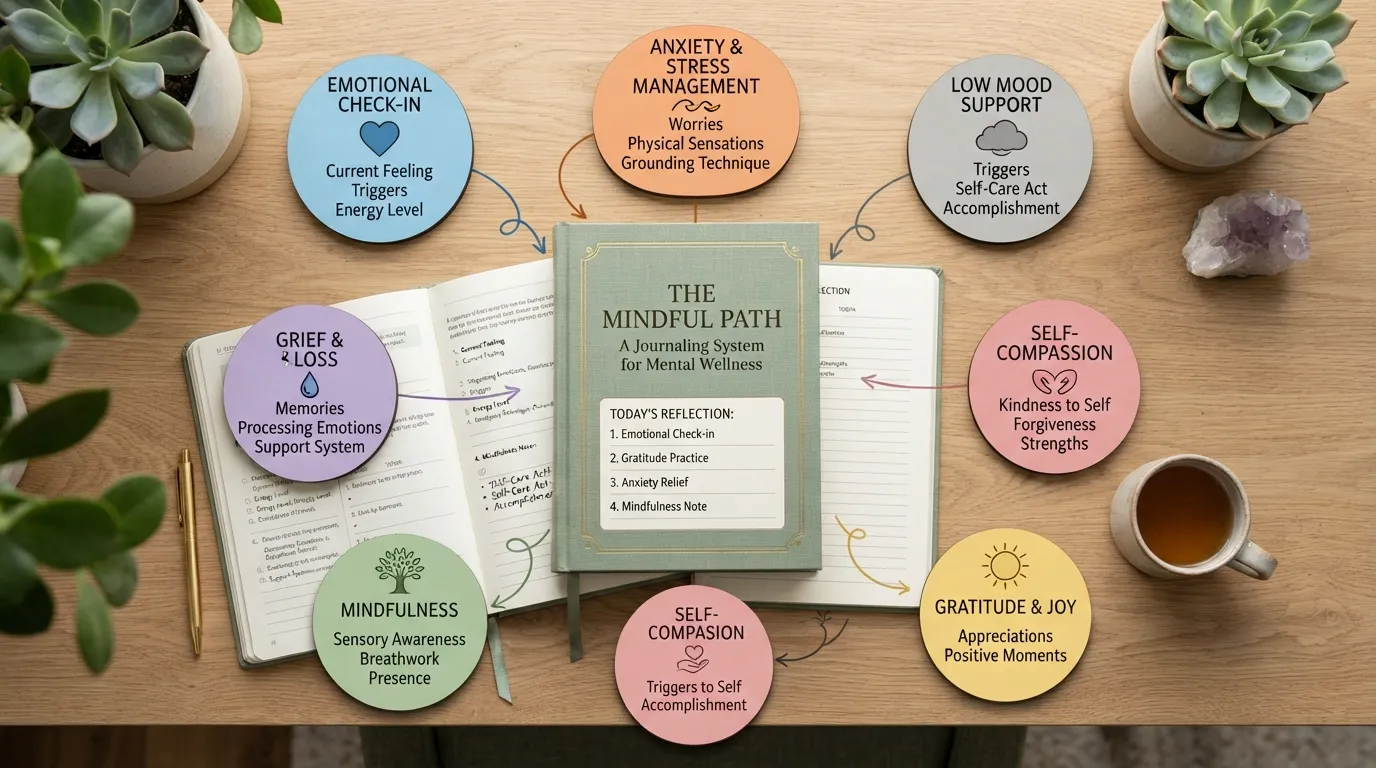
What Are Mental Health Journal Prompts?
Mental health journal prompts are curated questions or reflections designed to provide structure to your internal dialogue, helping you move past the “blank page” block often found in standard freewriting. Unlike open-ended stream-of-consciousness writing, prompts offer a specific focal point that can help you process complex emotions, identify recurring thought patterns, and build greater self-awareness.
Research indicates that expressive writing techniques, such as responding to guided prompts, can significantly reduce symptoms of psychological distress and improve emotional regulation by assisting the brain in processing and organizing stressful life experiences (PMC).
These prompts are designed specifically for adults; for younger readers, please visit our journal prompts for teens page.
Emotional Check-In Prompts
If my current emotion had a physical texture, weight, or temperature, how would I describe it right now?
Where in my physical body—such as my shoulders, jaw, chest, or stomach—am I holding the most noticeable tension today?
If the conflicting feelings currently pulling at me could speak at the exact same time, what would each of them be trying to say?
What emotion am I trying hardest to avoid or push away right now, and what might happen if I allowed myself to just sit with it for five minutes?
If my internal energy level today were a weather forecast, what would the skies look like, and is a storm brewing or finally clearing?
When I scan my body for signs of discomfort or ease, what is the loudest physical signal I’m receiving in this exact moment?
Quick Daily Check-In (5-Minute Version)
One word that captures my baseline emotional state right now is…
The single most prominent thought taking up space in my mind this morning/evening is…
One thing I can do in the next hour to protect my peace is…
Right now, my mind and body are collectively asking me for…
One small way I can show up for myself today is…
Journal Prompts for Grief and Loss
What is a specific memory of what was lost that caught me completely off guard today, and how did my body react to the sudden wave of emotion?
In what ways has this absence quietly rewritten the “script” of my daily routines, forcing me to navigate spaces that feel different than they did before?
If I could articulate the most complex, unsaid part of this loss to someone who truly understands, what would I say without fear of being judged for the depth of my sadness?
How has my internal sense of time shifted since this loss occurred—do certain days feel frozen in place while others vanish entirely?
What does “moving forward” look like to me on a day when grief feels less like a hurdle to be jumped and more like a permanent piece of my landscape?
Journal Prompts for Anxiety and Stress
When I scan my life right now, what specific situation or obligation is acting as the primary drain on my mental battery?
Looking at the tasks currently swirling in my mind, what can I definitively cross off, delegate, or intentionally let go of today without negative consequences?
What is the “worst-case scenario” my mind is whispering about this situation, and what is a more realistic, evidence-based alternative?
When my nervous system feels overloaded, what is one sensory experience—like hot water, dim lighting, or silence—that helps signal safety to my body?
Between the things I can directly influence today and the factors completely outside my control, where am I currently spending most of my emotional energy?
What physical boundary do I need to set with myself or others this week to prevent my stress from spilling over into my rest time?
If I could reclaim one hour of energy that I typically lose to worry, what specific act of recharge would I spend it on?
Journal Prompts for Low Mood and Depression
What is one microscopic victory from the past twenty-four hours that required effort, no matter how small or insignificant it might appear from the outside?
Looking back at a difficult season in my past, what specific inner resilience did I draw upon that is still quietly living inside me today?
If I were to invite a trusted, non-judgmental friend into my space right now, what kind of practical or emotional support would I actually feel comfortable asking them for?
What is one rigid expectation I am holding myself to today that I have absolute permission to drop, just for now?
On days when motivation is entirely missing, what is one gentle, low-energy way I can care for myself without demanding productivity in return?
What is a memory of a time when I felt genuinely capable, and can I identify one small aspect of that version of myself that is still here now?
Please remember: there is absolutely no pressure to write more than a single line on your harder days.
Self-Compassion Prompts
If I were to look at my current perceived shortcomings through the eyes of a deeply loving and patient mentor, what would they point out about my genuine efforts?
What is a past mistake or regret that I am still quietly punishing myself for, and what would it look like to offer that past version of myself complete forgiveness?
If a dear friend came to me experiencing the exact same struggle, self-doubt, or harsh self-judgment I am facing right now, what comforting words would I instinctively offer them?
Where does my inner critic get its loudest voice from, and how is its harshness actually trying (in a clumsy, misguided way) to protect me from failure or rejection?
When I compare my behind-the-scenes struggles to everyone else’s highlight reel, what fundamental truth about my own human limitations am I forgetting?
What kind, reassuring phrase do I desperately need to hear right now, and how can I say it to myself with genuine, unwavering conviction?
Gratitude Prompts for Mental Health
What is a comforting texture, scent, or sound I encountered today that grounded my nervous system for even a fleeting second?
Which person in my life makes me feel entirely safe, seen, and unmasked simply by being in their presence?
What is a mundane, everyday convenience—such as running clean water, a warm cup of tea, or a comfortable bed—that I often overlook until it is missing?
What is a difficult lesson, closed door, or unexpected detour from my past that I can now look back on with quiet appreciation for where it ultimately led me?
What is one physical capability of my body today, no matter how ordinary, that allows me to experience and navigate the world around me?
When I pause to look at my current space, what single item or corner brings a genuine sense of ease or calm to my mind?
Mindfulness and Present-Moment Prompts
Setting aside past regrets and future worries, what is happening right in front of me that deserves my undivided attention for the next sixty seconds?
What sounds can I hear in my immediate environment right now if I close my eyes and simply let the ambient noise wash over me without labeling it as good or bad?
How does my breath feel as it naturally enters and leaves my body, without attempting to change its rhythm, depth, or speed?
What is one detail in my current surroundings—a play of light, a shadow, a color, or a subtle movement—that I have completely failed to notice until this exact moment?
If I anchor my awareness entirely in the present second, what is one thing that is genuinely okay right now, regardless of what tomorrow holds?
3 Ways to Use These Prompts
Freewrite / Stream-of-Consciousness: Pick a prompt and write continuously for five to ten minutes without lifting your pen or editing your thoughts, allowing whatever surfaces to spill freely onto the page.
CBT-Style Reflection: Write down the distressing thought sparked by a prompt, examine the objective evidence for and against it, and then construct a balanced, grounded reframe.
Guided One-Question-at-A-Time: Take a single prompt and approach it slowly over your morning coffee or evening wind-down, letting it guide a single, focused block of reflection without rushing.
Physical paper notebooks, digital journaling apps, and voice-to-text notes all work equally well for these methods.
Download These Prompts as a Free PDF
Take Your Reflection Practice Offline
Ready to take your reflection practice offline? Click below to download our curated, printer-friendly PDF collection. You can keep this list on your desk, tuck it into your favorite notebook, or print it out to use as a bedside companion whenever you need a moment of clarity.
Download Printable PDF CollectionFrequently Asked Questions
What is the 3-3-3 journaling method?
The 3-3-3 method is a fast, low-pressure grounding technique designed to ease anxiety. You set a timer for 3 minutes, list 3 things you are grateful for, and write down 3 specific sensory details from your immediate surroundings to anchor your mind back in the present moment.
What is the 3/2-1 method of journaling?
The 3-2-1 reflective method helps organize your thoughts at the end of a busy day. Typically, it involves writing down 3 wins or positive moments, 2 things or expectations you are letting go of, and 1 core intention or priority for tomorrow.
What are 5-minute journal prompts for mental health?
Quick mental health prompts are designed to be punchy and low-barrier. Great examples include: "What emotion am I carrying right now that I need to acknowledge?", "What is one small thing within my control today?", and "What does my body need right now to feel safe?"
How should I journal for mental health?
To journal effectively for mental health, start with a raw, unfiltered brain dump to clear mental clutter, transition into gentle reflective questions, balance your emotional release with constructive processing, and close with a grounded, non-toxic gratitude note.
How often should I use these prompts?
You can use these prompts as often as feels supportive—whether that is every morning as a grounding ritual, or just a few evenings a week when stress or mental fatigue builds up. The goal is consistency without feeling burdened by a rigid schedule.
What if a prompt brings up overwhelming emotions?
If a prompt triggers heavy or intense feelings, give yourself permission to pause immediately, close your notebook, and shift your focus to physical grounding—as detailed in the next section.
When Journaling Isn't Enough
While expressive writing is a powerful tool for self-reflection and emotional processing, it is designed to support mental wellness rather than replace professional therapeutic care. If you are navigating a particularly difficult season, please remember that reaching out to a licensed professional is a profound and effective act of self-care.
If you are going through a difficult time and need immediate support, the 988 Suicide & Crisis Lifeline provides free, confidential support 24/7 by calling or texting 988.
Pimchanok Srisuk
Pimchanok Srisuk is the Journaling Editor at Holistic Wellbeing Living. She writes about journaling prompts, reflective writing, emotional clarity, and mindful routines. With seven years of experience creating personal-growth content, Pimchanok helps readers use simple writing practices to understand their thoughts and make calmer everyday decisions.