Jump to:
ToggleDay by Day Journal: The Complete Guide to Starting, Writing & Sticking With It
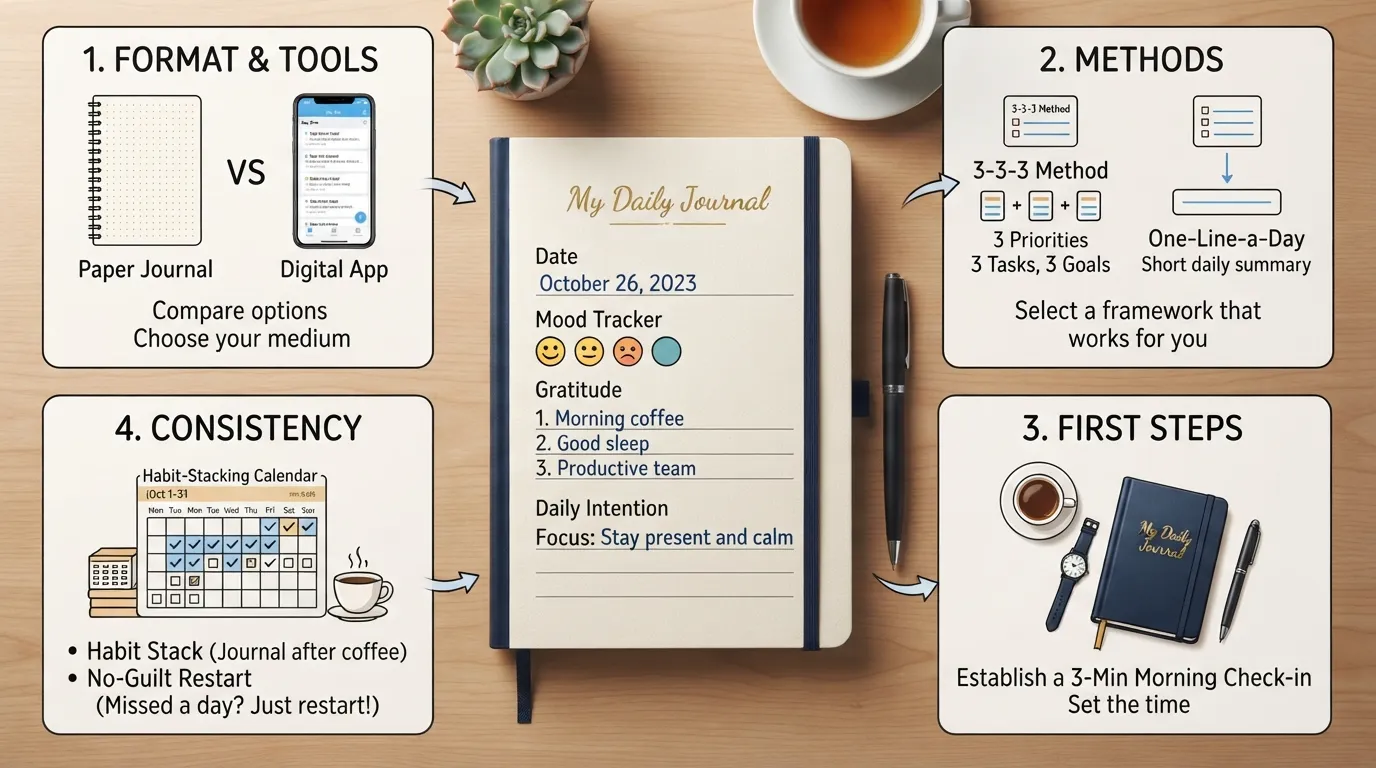
Starting a practice of putting pen to paper every single morning or evening sounds remarkably simple, yet keeping it going is where most people get stuck. A day by day journal is simply a dedicated space to record brief, daily reflections, track your personal growth, and process your thoughts one entry at a time. Whether you prefer a structured daily journal book, a minimalist notebook, or a focused blessings journal, building a sustainable habit does not require hours of writing or deep artistic talent. In this guide, you will explore practical journaling formats, proven reflection methods, beginner-friendly prompts, and realistic strategies to help you write consistently without burnout.
What Is a Day by Day Journal?
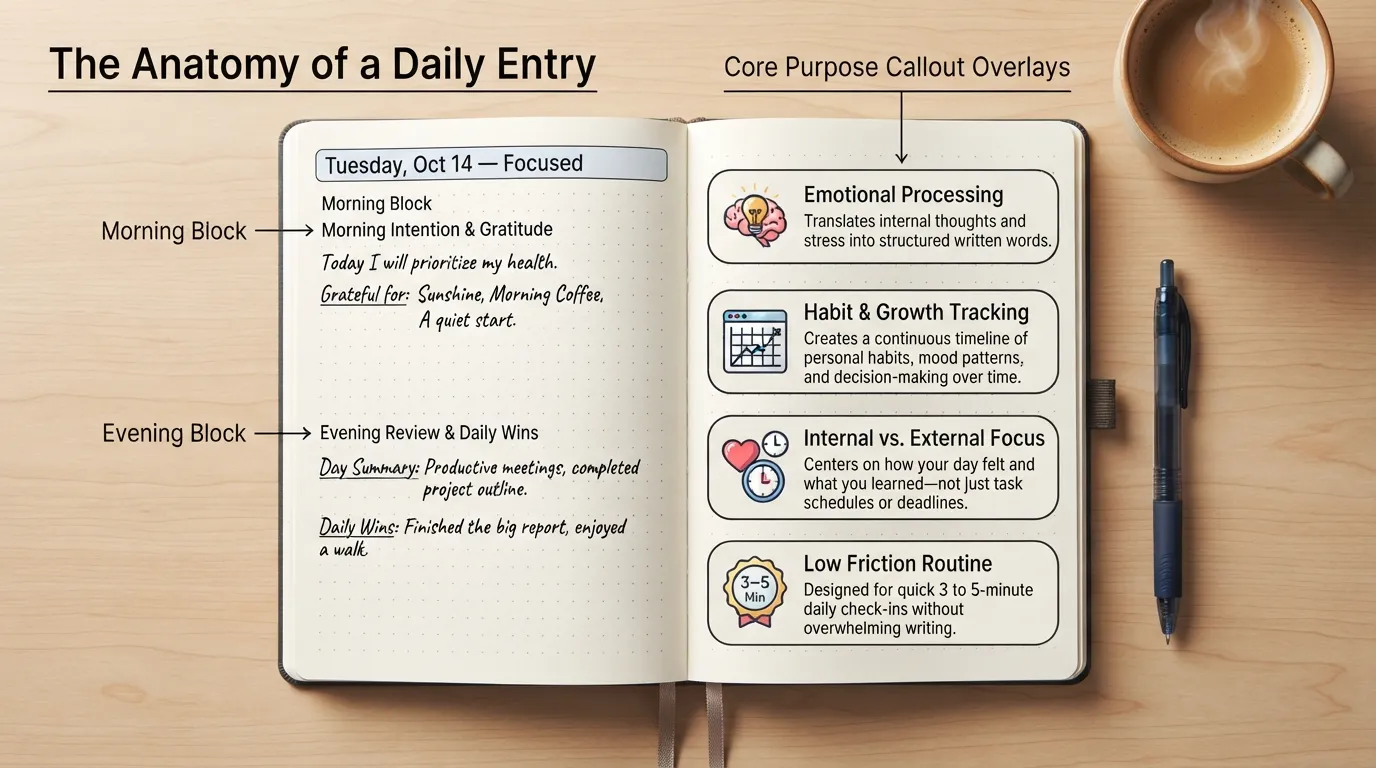
At its core, a day by day journal is a tool for self-reflection and personal tracking, meant to capture your thoughts, emotions, and experiences on a regular daily basis. Unlike tools built purely for scheduling or task execution, a daily journal book centers on your internal experience—how your day felt, what you learned, or what you are grateful for.
It serves as an ongoing record of your personal evolution. Over time, turning small moments into written entries turns scattered thoughts into clear insights, making it much easier to track long-term habits, personal growth, and emotional shifts.
Day by Day Journal vs Daily Planner vs Bullet Journal vs Diary — What’s the Difference?
While these four writing systems often overlap, each serves a distinct primary function depending on whether you are looking to manage your time, organize tasks, or process your thoughts.
| Journal Type | Primary Purpose | Best Suited For | Format Structure |
|---|---|---|---|
| Day by Day Journal | Emotional processing, habit tracking, and self-reflection | Anyone wanting a consistent mindfulness or writing practice | Structured prompts, daily blank pages, or open reflections |
| Daily Planner | Task scheduling, time-blocking, and managing deadlines | Professionals, students, and busy schedules | Time slots, checkboxes, and calendar layouts |
| Bullet Journal | Custom rapid-logging for tasks, events, and notes | People who like high customization and visual organization | Grid or dot pages with personalized key symbols |
| Diary | Unstructured chronological recording of daily events | Documenting memories, personal secrets, and life stories | Mostly open-ended lined pages without prompts |
Dated vs Undated Journals — Which One Should You Choose?
Choosing between a pre-dated journal and an undated notebook comes down to how you handle structure and perfectionism.
Dated journals come with pre-printed calendar dates on every page, offering built-in accountability that nudges you to open the book daily. The fixed sequence makes it easy to maintain momentum, though skipping a few days can leave empty pages that feel like a visible record of missed effort.
Undated journals let you write in the date yourself, allowing you to start anytime during the year without wasting pages. This format is far more forgiving if your writing routine fluctuates, eliminating the subtle guilt of blank pages that often leads people to give up on journaling entirely.
If you thrive on rigid routines, a dated option helps lock in the habit. If you want a low-pressure space that fits a fluid schedule, an undated format gives you room to pick up right where you left off.
Why Keep a Daily Journal? Benefits, Backed by Research
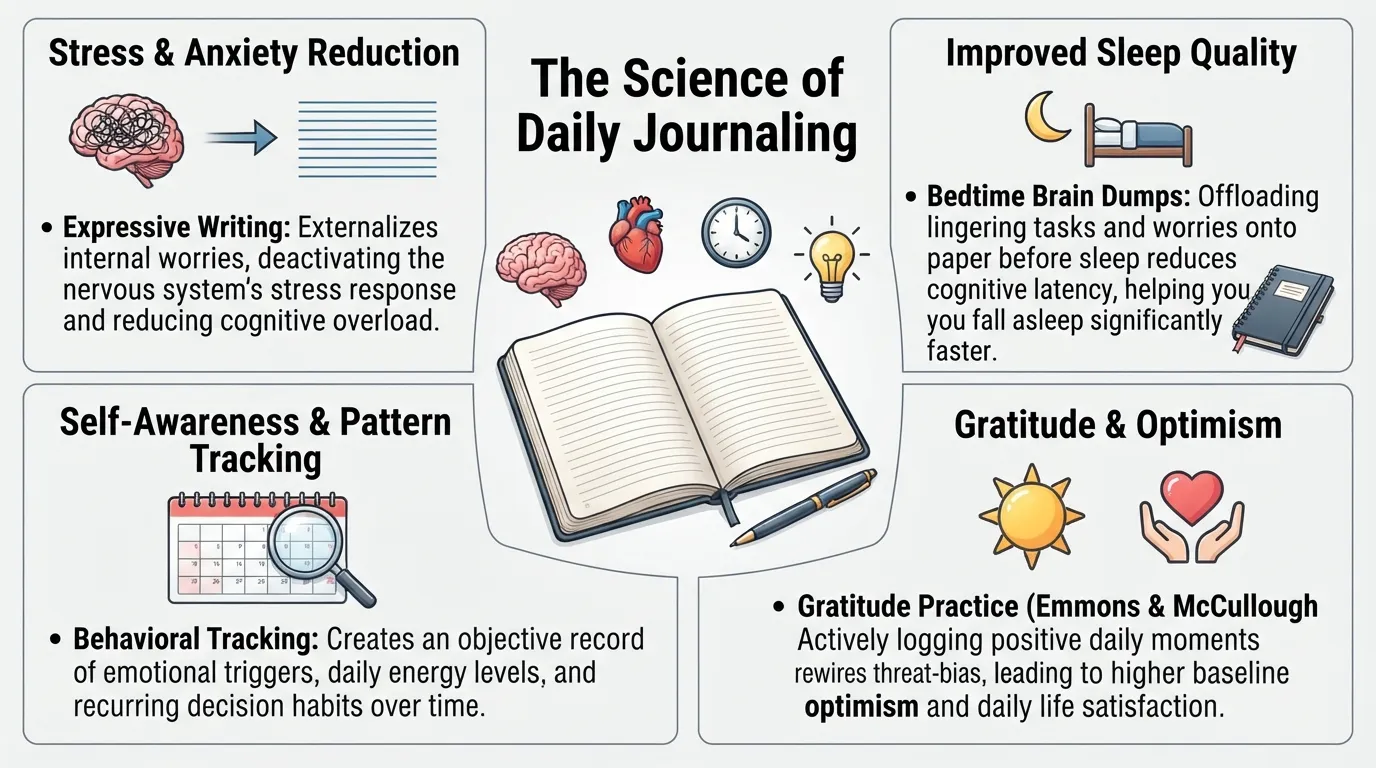
Keeping a daily journal is far more than a simple creative outlet; it functions as a low-tech, high-impact tool for mental wellness and cognitive performance. When you regularly translate internal thoughts into written words, you change how your brain processes emotions, stress, and daily demands.
Reduces Stress and Anxiety
Putting your concerns onto paper externalizes your internal monologue, a process psychologists refer to as “expressive writing.” When unaddressed worries swirl in your mind, they keep your nervous system on high alert.
Writing down specific fears or stressors helps deactivate that mental alarm system by giving structure to abstract feelings. By creating distance between yourself and your thoughts, you can evaluate challenges more logically rather than feeling overwhelmed by them.
Improves Sleep Quality
Bedtime anxiety often stems from “cognitive activation”—your brain cycling through uncompleted tasks, upcoming schedules, and lingering worries right as your head hits the pillow.
Journaling before bed acts as a mental dump that lowers cognitive load. In fact, behavioral sleep research demonstrates that offloading upcoming tasks or lingering worries onto paper right before bed helps clear mental bandwidth, allowing people to fall asleep significantly faster compared to those who internalize their thoughts.
Builds Self-Awareness and Pattern Recognition
It is difficult to spot long-term emotional or behavioral patterns while living through them day to day. A regular entry practice creates an objective archive of your habits, triggers, and decision-making processes.
As you review past entries, you begin to notice recurring themes—such as specific situations that consistently drain your energy, or routine habits that boost your mood. Recognizing these patterns empowers you to make intentional lifestyle choices rather than repeating the same subtle mistakes.
Strengthens Gratitude and Optimism
Focusing intentionally on positive experiences rewires your brain’s natural bias toward highlighting threats and problems.
Seminal psychological research on gratitude—most notably led by researchers Robert Emmons and Michael McCullough—demonstrates that individuals who regularly keep a gratitude log report higher levels of daily optimism, increased physical energy, and greater overall life satisfaction compared to those who focus on daily hassles. Consistently noting positive details shifts your baseline perspective toward constructive appreciation. [link to: Blessings Journal section]
Types of Day by Day Journals Pick What Fits You
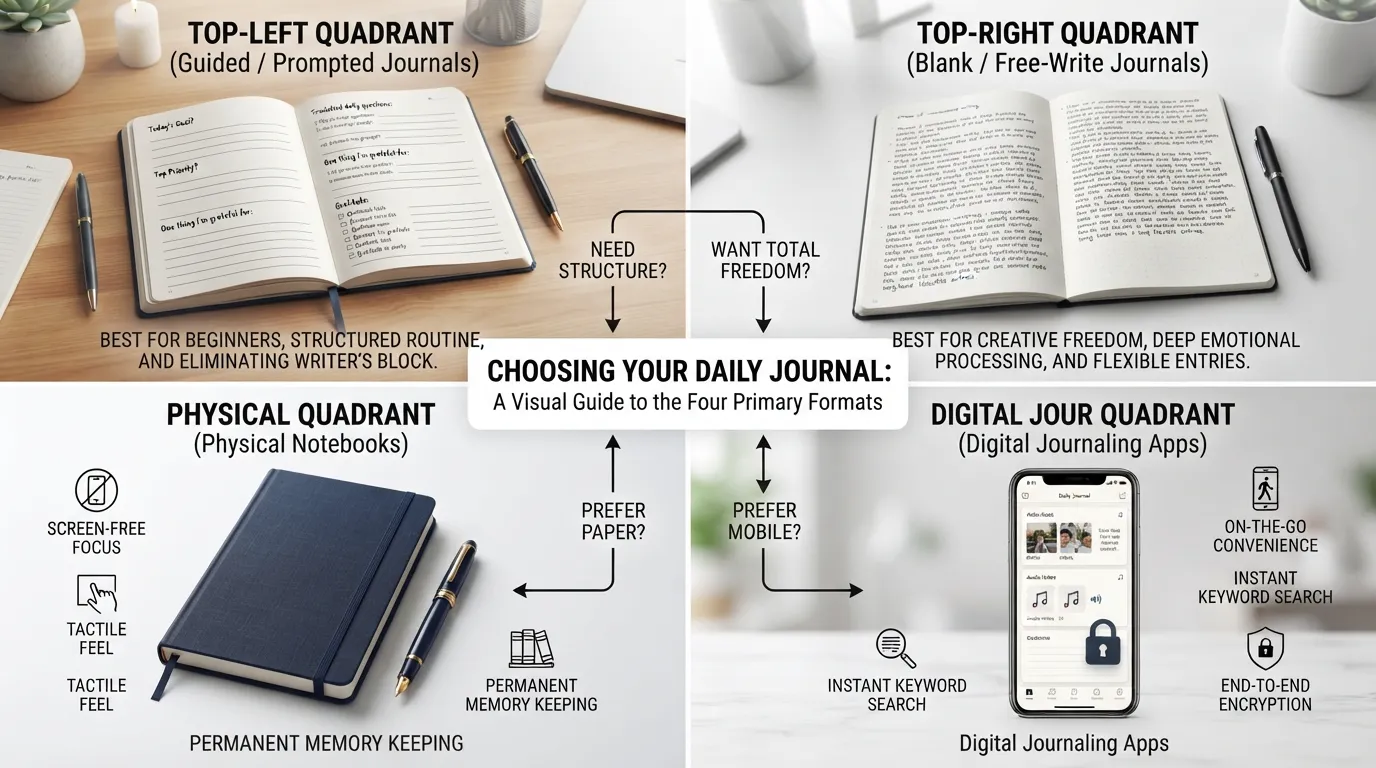
Finding the right journaling format comes down to understanding your personal style, daily schedule, and what feels most approachable. There is no single “correct” way to write—the best format is simply the one you will stick with consistently.
Guided / Prompted Journals
Guided journals provide specific questions, structured exercises, or daily themes to help direct your reflection. Instead of staring at a blank page, you can use guided journaling prompts to explore your thoughts, reflect on daily challenges, recognize small wins, or practice mindfulness with a clearer sense of direction.
This structure reduces the pressure of deciding what to write, making guided journaling especially approachable for beginners, busy individuals, or anyone who finds open-ended writing intimidating. Short, focused prompts can also make it easier to maintain a consistent daily journaling habit.
Blank Free-Write Journals
Blank free-write journals consist entirely of unprompted lined, grid, or blank pages, offering complete creative and emotional freedom. This format allows you to write as much or as little as you want without being constrained by pre-printed sections or fixed prompts.
It is particularly useful for stream-of-consciousness writing, deep emotional processing, brainstorming, or capturing detailed long-form entries. While it requires a bit more initiative to start each session, it easily adapts to whatever you need to express on any given day.
Digital Journaling Apps vs Physical Notebooks
Choosing between a digital app and a physical notebook depends on whether you prioritize convenience and searchability or sensory engagement and tactile focus.
| Feature | Physical Notebooks | Digital Journaling Apps |
|---|---|---|
| Best For | Screen-free relaxation and intentional focus | On-the-go convenience and instant access |
| Writing Experience | Tactile, deliberate, and free from digital distractions | Fast typing, dictation, and media attachments |
| Searchability | Manual flipping through pages | Instant search by keyword, tag, or date |
| Privacy & Security | Physical storage; requires hidden placement | Password, PIN, or biometric encryption |
| Portability | Requires carrying a book and pen | Always accessible on phone, tablet, or laptop |
| Flexibility | Fixed page limit and permanent ink | Unlimited space, easy editing, and re-organizing |
Popular Daily Journaling Methods Explained
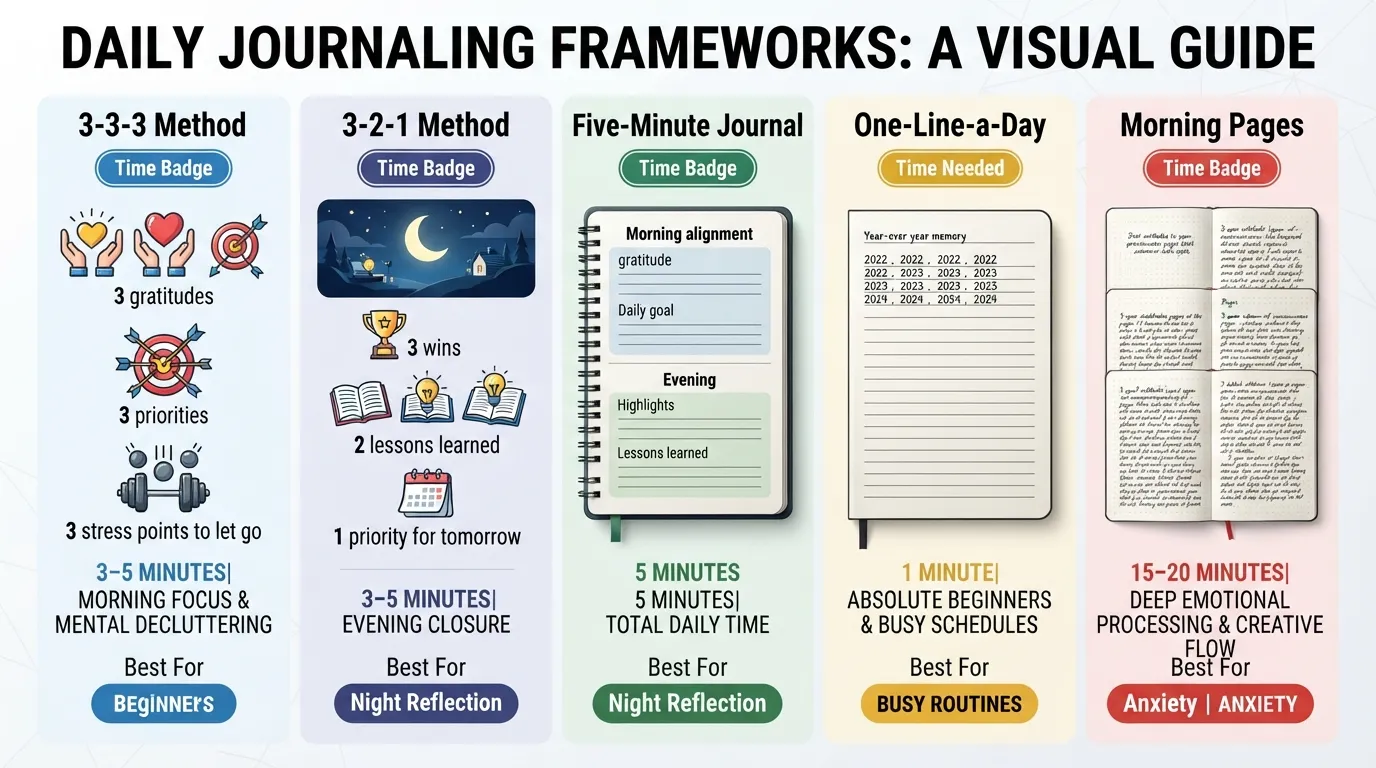
Choosing a specific structure can mean the difference between staring at blank paper and easily filling a page. The following methods range from quick micro-entries to deep stream-of-consciousness sessions, allowing you to select a process tailored to your available time and mental needs.
The 3-3-3 Journaling Method
The 3-3-3 method is a grounded approach designed to clear mental clutter and organize your day into manageable focus areas.
Each morning, you write down:
3 things you are grateful for (to ground your mindset)
3 main priorities for the day (to focus your energy)
3 things to let go of (to reduce anxiety around factors outside your control)
This structure provides immediate clarity without feeling overwhelming, making it an excellent bridge between emotional reflection and daily planning.
The 3-2-1 Journaling Method
Designed primarily for evening reflection, the 3-2-1 method helps you process the day’s events and wrap up lingering thoughts before bed.
At night, you log:
3 things that went well
2 things you learned
1 thing you will improve tomorrow
By focusing on wins and learning moments, this exercise prevents your mind from dwelling exclusively on mistakes, fostering a constructive, growth-oriented perspective right before sleep.
The One-Line-a-Day Method
If you are short on time or struggle with consistency, the One-Line-a-Day method removes almost all friction.
You simply commit to writing a single sentence every day—capturing a memorable highlight, a brief thought, or a mood check-in. Multi-year memory books use this format by stacking five years of entries for the same date on a single page, allowing you to easily look back and see how your life has evolved year over year.
The Five-Minute Journal Method
Popularized as a quick book-ended daily ritual, this method uses fixed prompts split between the morning and evening to maintain a balanced perspective.
Morning (2.5 minutes): Write 3 things you are grateful for, 3 things that would make today great, and 1 positive affirmation. [link to: Blessings Journal section]
Evening (2.5 minutes): Write 3 highlight moments from the day and 1 lesson learned.
Because the prompts remain identical every day, you never waste time figuring out what to write, making it ideal for maintaining a steady daily habit.
Morning Pages Method
Created by author Julia Cameron in The Artist’s Way, Morning Pages involves writing three pages of longhand, stream-of-consciousness thoughts immediately upon waking.
There are no rules, themes, or polished sentences required—you write down whatever pops into your mind, whether it is a list of worries, strange dreams, or mundane errands. The goal is to drain the mental noise from your brain before your inner critic wakes up, leaving you clear and focused for the rest of the day.
Comparison of Journaling Methods
| Method | Time Needed | Best Suited For | Primary Benefit |
|---|---|---|---|
| 3-3-3 Method | 3–5 minutes | Busy individuals & task-focused writers | Combines gratitude with daily planning |
| 3-2-1 Method | 3–5 minutes | Evening reflection & goal setting | Encourages continuous learning & closure |
| One-Line-a-Day | 1 minute | Absolute beginners & time-strapped writers | Low pressure; easy long-term memory archive |
| Five-Minute Journal | 5 minutes | Gratitude building & daily focus | Balanced morning alignment and evening review |
| Morning Pages | 15–20 minutes | Creative blocks, anxiety & deep processing | Clears cognitive clutter and emotional tension |
How to Write a Day-to-Day Journal Step-by-Step
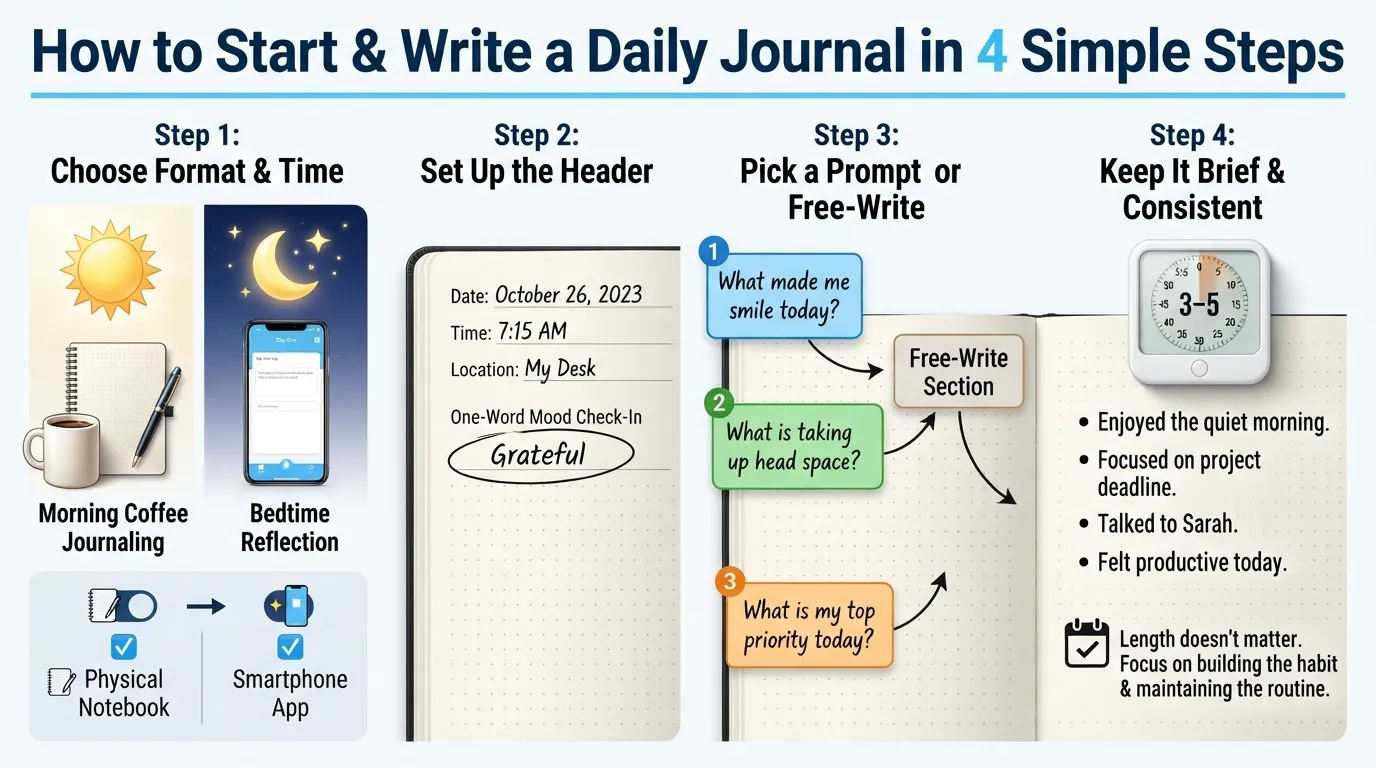
Starting a daily practice works best when you establish a low-friction routine rather than waiting for dramatic inspiration. By breaking down the process into clear, manageable decisions, you can build a system that feels natural and sustainable from day one.
Choosing Your Format and Time of Day (Morning vs Night)
First, decide whether a physical notebook or a digital setup fits best into your existing routine. Physical journals offer a screen-free break that encourages mindful pacing, while digital options make it easy to type brief notes while commuting or taking a work break.
Next, choose a consistent window of time that aligns with your natural energy levels:
Morning Journaling: Writing right after waking up helps set a deliberate tone for the day, clear morning brain fog, and prioritize tasks before daily demands kick in.
Evening Journaling: Writing before bed helps you process emotional events, celebrate small wins, and release leftover stress so your mind can wind down for sleep.
Setting Up Your First Entry
To avoid staring at a intimidating blank page, give your entry a simple, structured header. Starting with basic context builds momentum before you write your first sentence.
Write down these quick details at the top of the page:
Date and Time: (e.g., Tuesday, October 14 — 7:30 AM)
Current Location or Environment: (e.g., Kitchen table with coffee)
One-Word Mood Check: (e.g., Focused, Tired, or Hopeful)
Once your header is written, pick a single focus area—such as listing three quick thoughts, answering a single prompt, or setting an intention—and begin writing without worrying about grammar or neatness.
What to Write When You Don’t Know What to Write
When your mind goes blank, having a handful of simple prompts eliminates hesitation. Pick any single prompt below to start your momentum:
What is one small detail from today that made me smile?
What is taking up the most room in my head right now?
If I could describe my current mood as weather, what would it be?
What is one low-stakes problem I can solve today?
What does my body or mind need most in this moment?
What Should You Journal Every Morning?
A quick morning check-in does not need to take more than five minutes. Use these targeted prompts to align your mindset for the day ahead:
What are three things I am genuinely looking forward to today?
What is my single most important priority before the day ends?
How do I want to feel at the end of the day, and what step supports that?
What potential stressor might arise today, and how will I handle it calmly?
What is one uplifting statement or reminder I need to keep in mind? [link to: Blessings Journal section]
How Long Should a Daily Journal Entry Be?
A daily entry can be as brief as a single sentence or as long as three handwritten pages—there is no mandatory length. On busy days, writing two or three bullet points captures the essence of your day in under two minutes. On days when you have more time or feel emotionally overwhelmed, taking fifteen minutes to write a full page allows for deeper reflection. Consistency matters far more than entry length, so keep your entries brief enough that you never feel tempted to skip them.
Blessings Journal: How to Start a Daily Gratitude Practice
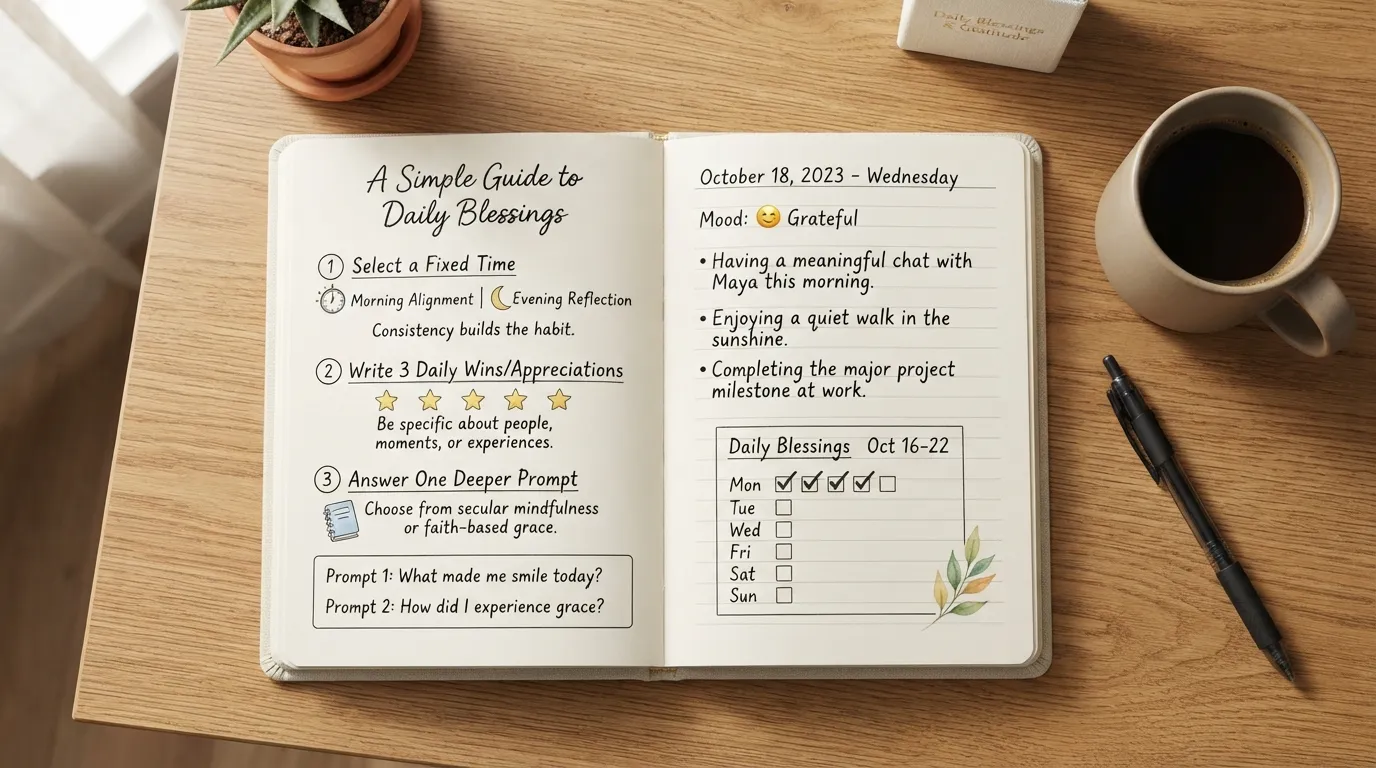
While general journaling often focuses on organizing tasks or working through complex emotions, a blessings journal intentionally directs your attention toward positive experiences, support systems, and meaningful moments. Cultivating an explicit practice of noticing daily good shifts your mental baseline away from frustration and toward grounded appreciation.
What Is a Blessings Journal?
A blessings journal is a dedicated daily log focused entirely on tracking moments of goodness, personal progress, unexpected kindness, and quiet appreciation. Rather than letting positive details slip away unrecorded, this format creates a permanent record of life’s daily wins.
It acts as a gentle counterweight to human negativity bias—our natural tendency to remember minor setbacks while ignoring quiet successes. Over time, routinely documenting these details builds emotional resilience, making it easier to maintain perspective when challenges arise.
Blessings Journal Prompts (Secular + Faith-Based)
Whether you approach gratitude from a secular mindfulness perspective or a faith-based practice, using specific prompts helps prevent your entries from becoming repetitive.
Secular Prompts
What is a physical comfort I enjoyed today that I usually take for granted?
Who made a task easier or more pleasant for me today, and how?
What is a challenge I faced recently that actually brought out a personal strength?
What is one beautiful sight, sound, or taste I paused to notice today?
What is a skill, opportunity, or resource available to me now that I lacked five years ago?
Faith-Based Prompts
What specific prayer, hope, or intention felt answered or supported today?
Where did I notice unexpected grace, peace, or divine timing in my schedule?
What scripture, verse, or uplifting reflection spoke to my current situation today?
What spiritual or community support am I thankful for this week?
How can I share the blessings I received today to encourage someone else tomorrow?
How Often Should You Write in a Gratitude Journal?
You do not need to write exhaustive daily essays for a blessings journal to be effective; consistency and genuine engagement matter far more than length or frequency.
Writing three to five specific items 3 to 5 times a week is often the sweet spot. Research on habit psychology suggests that writing every few days with deep intention—focusing on why you appreciate a specific detail—prevents emotional fatigue better than forcing quick, superficial daily lists out of obligation. Find a natural rhythm, whether that means a quick nightly check-in or a dedicated Sunday morning reflection session.
Best Daily Journals in 2026 Notebooks + Apps
Choosing the right day by day journal comes down to finding a format that seamlessly fits into your daily routine. The market offers incredible options for both paper enthusiasts and digital writers, ranging from minimalist Japanese notebooks to privacy-focused mobile applications.
What to Look For in a Journal Notebook (paper, binding, page count)
Evaluating a physical daily journal book requires looking closely at three core construction features:
- Paper Weight (GSM): Paper density is measured in grams per square meter. For everyday gel or ballpoint pens, 80 to 100 GSM prevents distracting ghosting. If you prefer fountain pens, heavy ink markers, or watercolor accents, look for 120 to 160 GSM paper.
- Binding Style: Thread-bound (smyth-sewn) lay-flat binding is essential. Notebooks that lie completely flat when opened allow you to write comfortably across the entire width of the page without constantly holding down the spine.
- Page Count and Size: Standard A5 size (5.8 x 8.3 inches) strikes the ideal balance between writing space and portability. A page count of 160 to 250 pages provides roughly three to six months of daily writing without making the book too heavy to carry in a bag.
Best Physical Daily Journal Notebooks
For writers who prefer the tactile, screen-free routine of pen and paper, these notebooks represent the gold standard for daily journaling:
- Leuchtturm1917 A5 Hardcover: The benchmark for dedicated writers, featuring 251 numbered pages, 80 GSM acid-free paper, dual ribbon bookmarks, and an expandable back pocket. Its sturdy cover and lay-flat thread binding handle daily wear exceptionally well.
- Midori MD Notebook A5: Renowned for Japanese craftsmanship, this minimalist notebook uses proprietary MD paper designed specifically to prevent ink feathering and bleed-through. It features an exposed woven spine that lies perfectly flat on any flat surface.
- Stalogy 365 Days Notebook: An exceptional choice for undated free-writing. It packs 368 thin, lightweight pages into a slim profile using subtle grid lines, letting you write daily entries or skip days without leaving empty pages.
- Paperage Lined Journal: An affordable, high-value entry option made with durable 100 GSM cream paper. It provides a sturdy hardcover and thick pages at roughly half the price of premium imported journals.
Best Daily Journal Apps + Are Journaling Apps Private and Secure?
Digital journaling apps offer fast entry, automatic date tagging, and cross-device syncing, but security remains a primary concern when storing personal reflections online.
Most top-tier daily journaling apps treat user privacy as a foundational requirement. Leading applications protect your entries using end-to-end encryption (E2EE), meaning your entries are encrypted on your device before syncing to the cloud, ensuring no one—not even the app developers—can read your private thoughts. Modern apps also support biometric security (Face ID, Touch ID, or PIN locks) to prevent physical unauthorized access.
Top digital picks include:
- Day One: The standard-bearer for digital journaling, offering rich text formatting, voice notes, photo attachments, and end-to-end encryption across mobile and desktop platforms.
- Apple Journal: A clean, built-in option for iOS users that leverages machine learning to offer personalized writing suggestions based on your photos, workouts, and locations while keeping all data stored locally on-device.
- Daylio: A fast, micro-journaling app that uses mood icons and custom activity tags instead of heavy typing, making it perfect for rapid habit tracking. [link to: Blessings Journal section]
Top 5 Daily Journals — Quick Picks
- Leuchtturm1917 A5 Hardcover — Best physical daily journal overall, featuring premium lay-flat construction, numbered pages, and reliable build quality for long-term archiving.
- Day One App — Best digital journal app, combining rich media support, location tagging, and industry-standard end-to-end encryption.
- Midori MD Notebook — Best notebook for fountain pen writers, offering bleed-resistant Japanese paper and a completely distraction-free design.
- Daylio App — Best micro-journaling app for busy schedules, allowing quick daily mood and activity tracking in under 60 seconds without typing.
- Paperage Hardcover Journal — Best budget-friendly physical notebook, offering thick 100 GSM paper and durable binding for beginner daily writers.
How to Build a Daily Journaling Habit That Actually Sticks
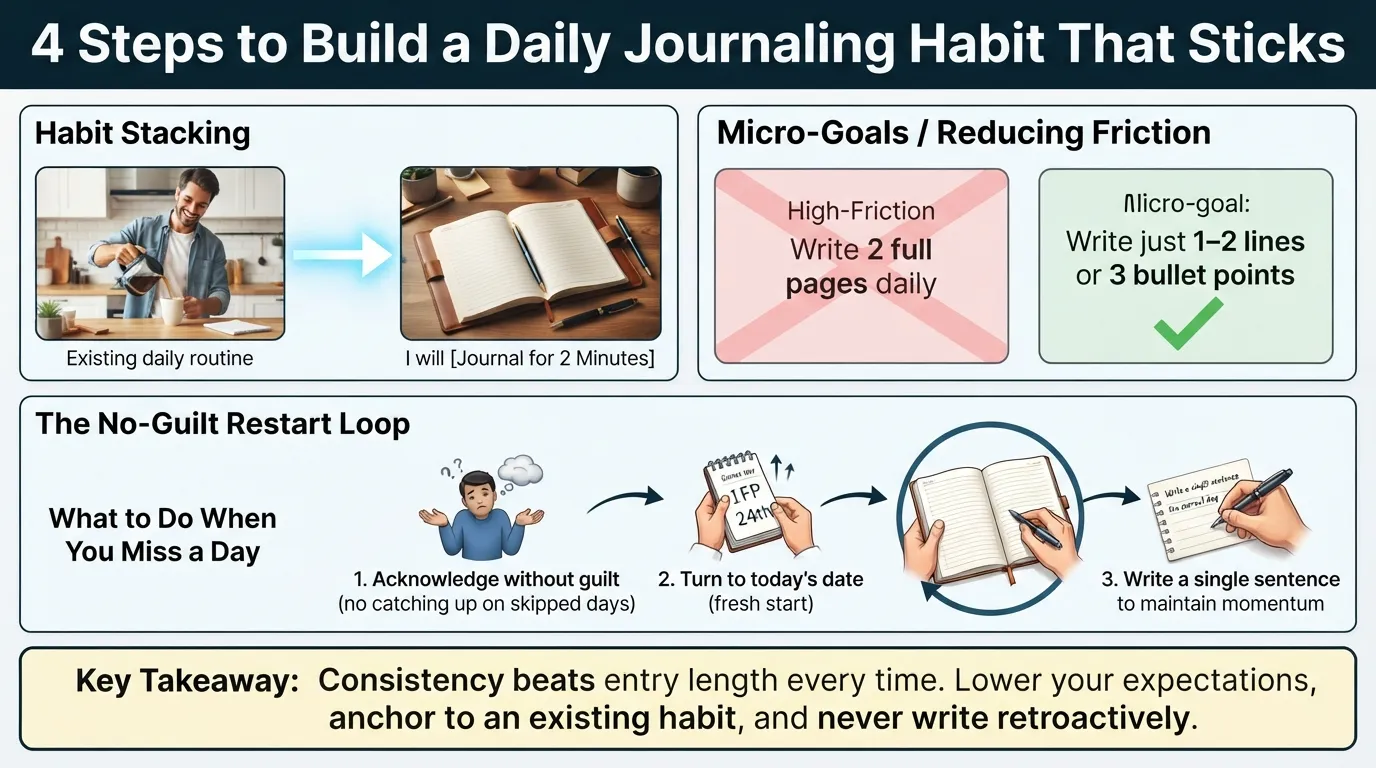
Building a consistent habit with a day by day journal has very little to do with raw willpower and almost everything to do with reducing initial friction. Most people fail not because they lack discipline, but because they set rigid, unrealistic expectations right from the start. Designing a system that easily fits into your current lifestyle creates a routine that lasts well beyond the initial burst of motivation.
How to Journal When You Miss a Day (No-Guilt Restart)
Skipping a entry—or even an entire week—is an inevitable part of building a long-term habit. The secret to staying on track isn’t maintaining an unbroken record; it’s learning how to resume your routine without falling into a spiral of guilt.
When you realize you’ve missed several days, avoid these common beginner mistakes that usually cause people to abandon journaling altogether:
Trying to “catch up”: Never force yourself to write retroactively for days you missed. Summarizing five days of missed events turns journaling into stressful homework rather than a helpful reflection tool.
All-or-nothing thinking: Assuming that a missed entry means your entire week or month is ruined leads straight to burnout. A missed day is simply an isolated event, not a failure.
Setting initial daily targets too high: Committing to writing two full pages every morning creates unnecessary pressure. When time is tight, high expectations make it far easier to skip the session completely.
Instead, reframe missed days as valuable data points rather than personal setbacks. Turn to the current date, write a single short sentence about where you are right now, and move forward. If you find yourself consistently skipping entries, shrink your daily goal to just two lines or switch to a simpler format like a daily gratitude entry. [link to: Blessings Journal section]
Habit Stacking — Pairing Journaling With an Existing Routine
Trying to remember to open your journal at a random point during the day relies heavily on active memory and motivation—both of which fluctuate. A far more reliable approach is habit stacking, a behavioral science strategy popularized by habit researcher BJ Fogg and author James Clear.
Habit stacking works by anchoring a new behavior onto an established daily routine that your brain already performs on autopilot. Because your brain has already built strong neural connections for your existing routine, the old habit acts as a natural trigger for the new one.
Use this simple formula to structure your stack:
“After I [CURRENT AUTOMATIC HABIT], I will [WRITE IN MY DAILY JOURNAL].”
Here are a few practical examples of habit stacking for daily writing:
Morning: “After I pour my morning coffee, I will write three things I am grateful for.”
Workday: “After I sit down at my desk and open my laptop, I will write my single top priority for the day.”
Evening: “After I put my phone on the charger for the night, I will write one highlight from today.”
By tying your day by day journal to an action you already do every single day, you eliminate decision fatigue and build a sustainable habit that effortlessly sticks.
Frequently Asked Questions
What is the 3-3-3 journaling method?
The 3-3-3 journaling method is a structured daily system where you write down 3 things you are grateful for, 3 core priorities for the day, and 3 anxieties or stressors you choose to let go of. It offers an easy way to combine gratitude practice with clear time management in under five minutes.
How do you write a day-to-day journal?
You write a day-to-day journal by choosing a fixed daily time (morning or night), dating your page, and capturing brief reflections using structured prompts or free-form text. Focus on building consistency with short 2 to 5 minute entries rather than attempting long-form writing every single session.
What is the 3-2-1 method of journaling?
The 3-2-1 method is a reflection framework where you log 3 things that went well, 2 lessons you learned, and 1 area of focus or improvement for tomorrow. It is particularly effective during evening reviews to wrap up your day with a balanced mindset.
What are the best daily journals?
The best daily journals combine lay-flat thread binding with thick paper (80 to 120+ GSM) to prevent ink bleed-through. Top physical options include the Leuchtturm1917 A5 Hardcover and Midori MD Notebook, while Day One and Daylio lead as the top digital options.
What are the top 5 journals?
The top 5 daily journals across physical notebooks and digital apps are:
- Leuchtturm1917 A5 Hardcover: Best overall physical daily notebook.
- Day One App: Best feature-rich digital journal app.
- Midori MD Notebook: Best minimalist paper for fountain pen users.
- Daylio App: Best micro-journaling app for fast mood tracking.
- Paperage Hardcover Journal: Best budget-friendly physical option.
What should you journal every morning?
In the morning, focus your writing on forward-looking prompts such as your primary intention for the day, three brief items of gratitude, and your single most important task. This quickly aligns your mental focus before daily distractions take over. [link to: Blessings Journal section]
How do I turn a day by day planner into a bullet journal?
You can turn a day-by-day planner into a bullet journal by using open daily calendar slots as flexible rapid-logging spaces for custom bullet symbols (tasks, notes, and events). Use blank monthly overview pages to create habit trackers and key legends without needing to draw layout grids from scratch.
Final Thoughts — Which Day by Day Journal Is Right for You?
Finding the ideal daily writing approach isn’t about choosing the most complex system or the prettiest notebook—it’s about selecting a format that seamlessly fits your actual life.
If you want structure and clear daily focus: Start with a guided prompt system like the 3-3-3 method or the Five-Minute Journal.
If you struggle with perfectionism or missing days: Go with an undated physical notebook or a simple One-Line-a-Day format so you can write without feeling guilty about empty calendar pages.
If you prefer screen-free relaxation: Invest in a sturdy, lay-flat paper notebook like the Leuchtturm1917 or Midori MD.
If you are constantly on the move: Build a habit using a secure digital application like Day One or Daylio for fast, on-the-go entries.
If you want to cultivate daily peace and appreciation: Focus exclusively on a blessings journal practice to train your mind to notice life’s small daily wins.
Remember, the most powerful journal is simply the one you open. Pick a single format or method that resonates with you today, write your first entry—even if it’s just one short sentence—and let your practice evolve naturally, one day at a time.
Pimchanok Srisuk
Pimchanok Srisuk is the Journaling Editor at Holistic Wellbeing Living. She writes about journaling prompts, reflective writing, emotional clarity, and mindful routines. With seven years of experience creating personal-growth content, Pimchanok helps readers use simple writing practices to understand their thoughts and make calmer everyday decisions.