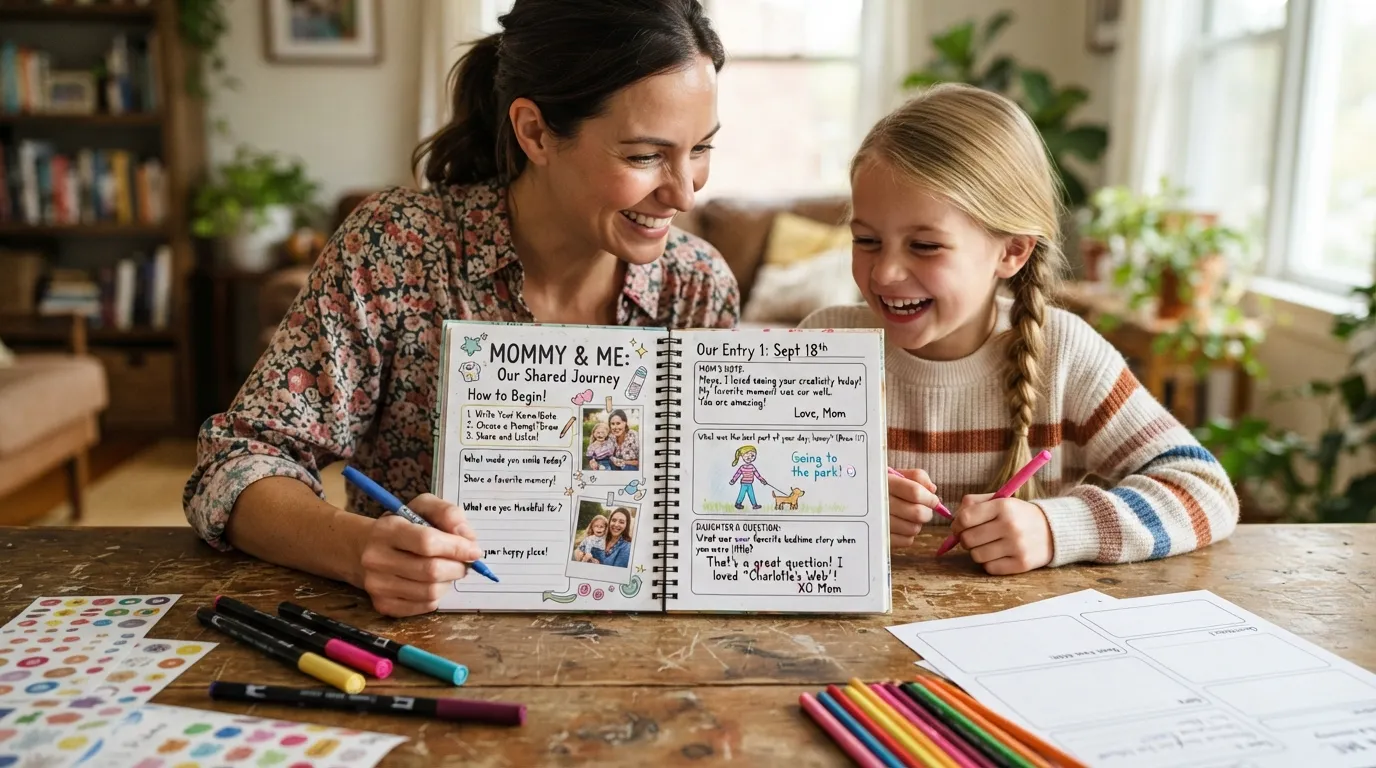
A mommy and me journal is a shared notebook that you and your child pass back and forth to write notes, answer questions, draw pictures, share memories, and talk about things that may feel harder to say face to face. It can be as simple as a blank notebook or as structured as a guided mother-daughter or mother-son journal filled with prompts.
What makes it useful is not perfect handwriting or writing every day. The goal is to create a comfortable, low-pressure way for you and your child to stay connected. Some entries may be thoughtful, while others may be jokes, doodles, favorite-food lists, questions, or little updates about the day.
A simple way to use it:
- You write a short note, question, prompt, or drawing.
- Leave the journal somewhere your child knows to look.
- Your child responds when they are ready.
- You read the response and write back without turning it into an interrogation.
- Keep repeating the process naturally rather than making it feel like homework.
What Is a Mommy and Me Journal?
A mommy and me journal is sometimes called a mom and me journal, mother-child journal, parent-child journal, shared journal, or back-and-forth journal. The basic idea is the same: two people use one notebook as an ongoing written conversation.
Unlike a child’s private diary, a shared journal is created with the understanding that both people will read and respond to what is written inside it. That distinction matters. A mommy and me journal works best when the child knows exactly what is shared, what stays private, and what the journal is for.
Although the phrase “mommy and me” is commonly used, the same idea can work for a mother and daughter, mother and son, or another parent-child pairing. The content can also change as your child gets older.
Why Start a Mom and Me Journal?
Children do not always want to answer important questions the moment an adult asks them. A child may need time to think, may feel embarrassed, or may simply communicate better through drawing or writing. A shared journal gives them another option.
You might use one to:
- share funny stories and everyday memories;
- ask open-ended questions without putting your child on the spot;
- talk about school, friendships, worries, or changes;
- write encouraging notes;
- practice gratitude and reflection together;
- learn things about each other that may not come up in normal conversation;
- create a keepsake you can look back on later.
I would not treat the journal as therapy or promise that journaling will solve emotional or behavioral problems. Think of it as one communication tool. If your child is struggling with something serious, the journal can help start a conversation, but it should not replace appropriate professional support.
What Age Is Best for a Mommy and Me Journal?
There is no single perfect age because reading ability, writing confidence, attention span, and personality matter more than a birthday. The important distinction is between co-journaling with a younger child and true independent back-and-forth writing with an older one.
| Age / Readiness | Best Style | Good Activities |
|---|---|---|
| Ages 3–5 | Parent-led shared journal | Drawing, stickers, dictated answers, simple choices |
| Ages 6–8 | Short back-and-forth entries | One-sentence answers, drawings, lists, simple prompts |
| Ages 9–12 | Independent back-and-forth journaling | Feelings, friendships, memories, goals, questions |
| Teens | Low-pressure shared journal with stronger boundaries | Reflection, relationships, confidence, future plans, difficult conversations |
If your preschooler cannot write yet, that does not mean you need to wait. Let them draw, circle an answer, choose stickers, or tell you what they want you to write. What changes with age is the format, not the opportunity to connect.
How to Start a Mommy and Me Journal
1. Choose a journal your child will actually want to use
You do not need anything expensive. A blank notebook works. If your child likes structure, a guided journal with printed questions may be easier. Younger children may enjoy a sketchbook with plenty of room to draw.
Let your child help choose the notebook if possible. Ownership matters more than how polished the journal looks.
2. Explain what the journal is for
Do not simply hand your child a notebook and say, “Write your feelings.” Give them a simple explanation.
“This is our journal. Sometimes I’ll write to you and sometimes you can write to me. You can tell me funny things, ask questions, draw pictures, or write about something you want me to understand. There is no grade and your spelling does not have to be perfect.”
3. Agree on the rules before sensitive entries appear
You and your child should know:
- who is allowed to read the shared journal;
- where it will be kept;
- whether either person can mark an entry “please talk to me”;
- whether an entry can be answered later rather than immediately;
- that a separate private diary is different from the shared journal.
4. Make the first entry easy to answer
Starting with “Tell me your biggest problem” is too intense for many children. Begin with something easy, warm, or playful.
Good first questions include:
- What made you laugh today?
- What is something you wish we did more often together?
- What are three things you are really good at?
- If we could go anywhere this weekend, where would you choose?
- What is one question you have always wanted to ask me?
5. Keep the rhythm flexible
A mommy and me journal does not need a strict daily schedule. You can begin with one or two exchanges a week and use it more often when something worth talking about comes up. If your child starts seeing it as an assignment, reduce the pressure.
Blank Notebook or Guided Mom and Me Journal?
Neither option is automatically better. Choose based on how much structure you and your child need.
| Option | Best For | Trade-Off |
|---|---|---|
| Blank notebook | Families who want freedom to write, draw, paste photos, and create their own prompts | You have to think of your own questions and structure |
| Guided journal | Families who want ready-made prompts, quizzes, lists, and conversation starters | Less flexible and some prompts may not fit your child |
For a younger child or reluctant writer, I would usually start simple. A notebook that allows short answers and drawings may feel less intimidating than a book packed with questions.
What Should I Write on the First Page?
The first page should make the journal feel safe and inviting rather than serious. You can copy and adapt this:
Dear [Child’s Name],
I made this journal for us. We can use it to write notes, ask questions, draw pictures, share jokes, talk about our days, and tell each other things we may not always remember to say out loud.
You do not have to write long answers. You can write one sentence, make a list, draw something, or ask me a question instead.
My first question for you is: What is one thing you would love for us to do together this month?
What Does a Real Back-and-Forth Entry Look Like?
Your journal does not need to sound deep or polished. A useful exchange may be very short.
Mom: What was the hardest part of school today?
Child: Lunch. My friend sat with someone else and I felt left out.
Mom: That sounds disappointing. Do you want advice, or do you just want me to listen?
Child: Just listen for now.
Notice what the parent did not do: immediately demand names, solve the friendship problem, or give a lecture. The journal stays useful when the child does not feel that every honest answer will trigger a long interrogation.
35 Mommy and Me Journal Prompts
Good mommy and me journal prompts are open enough to start a conversation but simple enough that your child knows how to answer. Mix serious questions with fun ones.
Fun and Get-to-Know-You Prompts
- What made you laugh the hardest this week?
- If you planned our perfect day together, what would we do?
- What three foods would you keep if you could only eat three foods for a week?
- What is something you think I was like when I was your age?
- What is one silly question you want me to answer honestly?
Feelings and Big-Thought Prompts
- What is something that has been on your mind lately?
- When do you feel most understood?
- What do adults sometimes misunderstand about kids your age?
- What helps you feel better when you have a bad day?
- Is there anything you wish was easier to talk to me about?
School and Friendship Prompts
- What is the best part of school right now?
- What is the hardest part?
- What makes someone a really good friend?
- Have you ever felt left out? What happened?
- What is something you wish teachers or classmates knew about you?
Confidence Prompts
- What are three things you are proud of?
- What is something difficult you learned to do?
- What is one thing you like about your personality?
- When do you feel most confident?
- What would you like to get better at this year?
Gratitude and Memory Prompts
- What are three small things that made you happy today?
- What is one family memory you never want to forget?
- What is something kind someone did for you recently?
- What is your favorite memory of us together?
- What family tradition should we always keep?
Dreams and Future Prompts
- What would you love to learn someday?
- If you could visit any place, where would you go?
- What do you hope life is like when you are older?
- What is one goal you want me to help you with?
- What kind of person do you want to become?
Prompts Your Child Can Ask You
- What were you scared of when you were my age?
- What mistake taught you an important lesson?
- What was your favorite thing to do with your mom?
- What is something you wish you had known when you were younger?
- What is one thing about me that makes you proud?
A Free Mommy and Me Journal Template You Can Copy
You do not need to buy a printable to get started. Copy the template below into a notebook, Google Doc, Word document, or design tool. If you want a mommy and me journal PDF, you can format these pages and save or print the document as a PDF.
Date: __________________
Today I want to tell you:
________________________________________
Something that made me happy:
________________________________________
Something on my mind:
________________________________________
My question for you:
________________________________________
Your reply:
________________________________________
For younger children, replace some writing spaces with “draw how you feel today,” “circle your mood,” or “draw something fun we should do together.”
Privacy Rules Matter More Than Fancy Prompts
A child is unlikely to keep writing honestly if the journal feels like surveillance. Before you begin, separate the shared mommy and me journal from any private diary your child may keep.
I would use these ground rules:
- Do not secretly read a separate private diary. A shared journal is shared because both people agreed to it.
- Do not punish honesty. If every uncomfortable answer immediately leads to anger, the honest answers will stop.
- Do not show entries to relatives or friends without permission.
- Let your child say, “I don’t want to answer this one.”
- Do not promise absolute secrecy in unsafe situations. If a child writes that they or someone else may be in danger, safety comes before the normal privacy rule.
- Use the journal to support conversation, not replace it.
What If My Child Does Not Want to Write?
They only give one-word answers
Stop asking questions that sound like schoolwork. Try choices, rankings, drawings, jokes, “would you rather” questions, or prompts about favorite things. One-word answers can still become longer conversations later.
They stop replying
Do not chase them with reminders every day. Leave a funny note or drawing and let the journal rest. The point is connection, not completion.
It starts feeling like homework
Remove the schedule. Stop correcting spelling, grammar, handwriting, or sentence length unless your child specifically asks for help.
Your teen wants more privacy
Respect that signal. A teen may prefer occasional notes rather than a formal journal exchange. You can also agree that certain pages are shared while their personal diary remains completely separate.
Common Mistakes That Make a Shared Journal Fail
- Starting too seriously. Build comfort before asking emotionally heavy questions.
- Using every entry to teach a lesson. Sometimes your child just wants to be heard.
- Asking too many questions at once. One good question is usually better than a page of prompts.
- Correcting the writing. This is a relationship tool, not an English assignment.
- Forcing a daily routine. A flexible journal often feels more natural.
- Ignoring privacy. Trust is difficult to rebuild once the journal feels unsafe.
- Making it only about problems. Include jokes, memories, drawings, gratitude, dreams, and ordinary life.
What Is the Best Mother and Daughter Journal?
There is no single best mother and daughter journal for every family. The better question is whether you want a guided book or a blank shared notebook.
If you want ready-made prompts, quizzes, drawing spaces, and structured activities, a published guided journal can save you from inventing questions every week. One well-known example is Just Between Us: Mother & Daughter, which is designed around mother-daughter conversation and shared activities.
If you are looking specifically for a mother-son option, Between Mom and Me by Katie Clemons is an example of a guided keepsake journal designed for mothers and sons.
But you do not need a branded journal. A blank notebook may actually be better if your child dislikes structured prompts or you want the freedom to add photos, drawings, private jokes, ticket stubs, or your own questions.
Mommy and Me Journal Ideas Beyond Writing
If writing is not your child’s favorite activity, the journal can still work. Try adding:
- photos with a one-sentence memory underneath;
- stickers that represent the day’s mood;
- a “top five” list;
- doodles or comic strips;
- ticket stubs or small keepsakes;
- a monthly “what we’re loving right now” page;
- questions the child writes for Mom;
- gratitude pages;
- dream or goal pages;
- a page for planning the next mommy-and-me day together.
How Often Should You Use It?
There is no required schedule. If you are unsure where to begin, try one or two exchanges a week. Some weeks you may write more; other weeks the journal may sit untouched. That is fine. Consistency can help, but pressure defeats the purpose.
Questions Parents Often Have
What are good prompts for a mother and daughter journal?
Start with open-ended questions about everyday life, memories, feelings, friendships, confidence, gratitude, and future goals. Mix deeper questions with playful ones so the journal does not become emotionally heavy every time it is opened.
Does a mommy and me journal have to be mother-daughter?
No. A mother-son journal can use exactly the same back-and-forth idea. The prompts should match the child’s interests, age, personality, and comfort level rather than being chosen only by gender.
Can I make a mommy and me journal for free?
Yes. Use a notebook you already own or copy the free template above into a document. You can print individual prompt pages or save your document as a PDF if you prefer a printable format.
Should I read everything my child writes?
In a shared journal, both people should understand that entries are meant to be read. That does not give you permission to secretly read a separate private diary. Make the boundary clear before you begin.
What if my child writes something worrying?
Respond calmly first. Ask what they need and whether they want to talk. If the entry suggests that your child or someone else may be unsafe, take the concern seriously and get appropriate help rather than treating the entry as something that must remain secret.
Making the Journal Worth Keeping
The best mommy and me journal is not the one with the prettiest cover or the largest number of prompts. It is the one your child feels comfortable opening.
Start small. Write something easy to answer. Let your child be silly. Give them room not to respond. Respect the difference between a shared journal and a private diary. And when a serious topic does appear, focus first on understanding rather than fixing everything immediately.
Over time, the pages may become a record of ordinary days, hard conversations, inside jokes, changing interests, questions, drawings, and memories that neither of you would have remembered otherwise. That is what turns a simple shared notebook into a meaningful keepsake.
Pimchanok Srisuk
Pimchanok Srisuk is the Journaling Editor at Holistic Wellbeing Living. She writes about journaling prompts, reflective writing, emotional clarity, and mindful routines. With seven years of experience creating personal-growth content, Pimchanok helps readers use simple writing practices to understand their thoughts and make calmer everyday decisions.