Jump to:
ToggleDeep Writing Prompts: 100+ Thought-Provoking Questions for Deep Self-Reflection
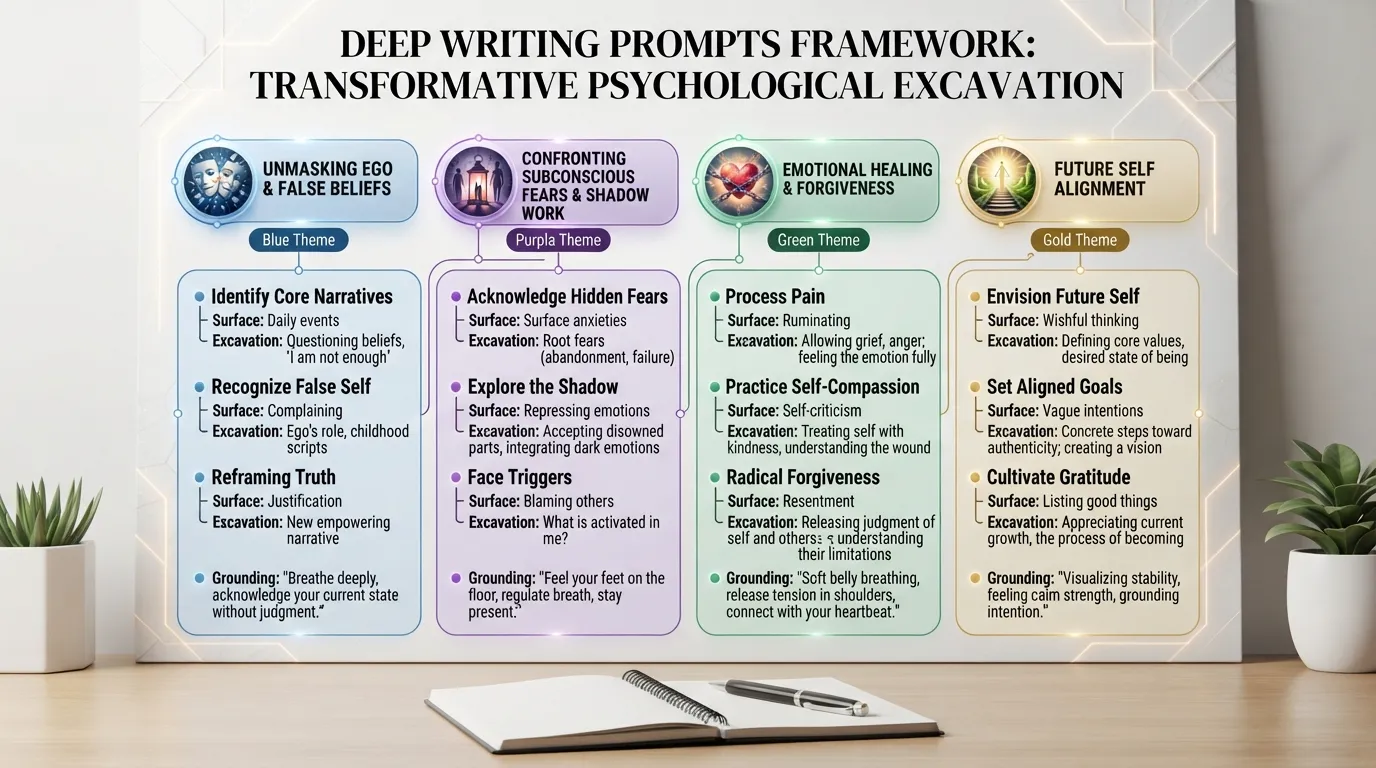
Surface-level journaling records the events of your life; deep writing excavates your truth. If your daily pages read like a logistical log of what you ate, who you emailed, and where you felt tired, you are storing data, not transforming your state. True self-reflection requires bypassing the polite narratives you tell yourself to get through the day.
What Makes a Writing Prompt "Deep"? (The Psychology of Self-Reflection)
A shallow prompt asks you to describe an external circumstance (“What made you smile today?”). A deep prompt forces you to confront an internal contradiction (“When was the last time you betrayed your own boundaries to keep someone else comfortable, and what were you afraid would happen if you didn’t?”).
Depth is measured by resistance. If a question makes you hesitate, shift uncomfortably in your seat, or immediately want to write a socially acceptable answer, you have found the right entry point. Deep writing prompts act as a psychological scalpel. They target the unexamined grief, the quiet compromises, and the protective armor you spent decades constructing.
The Science of Expressive Writing and Nervous System Regulation
Writing by hand is fundamentally different from typing on a screen. When your fingers move across a keyboard, your brain stays in a state of rapid-fire processing, primed for editing, curation, and performance. Pen and paper force a structural slowdown that changes your neurology.
The physical act of forming letters activates the brain’s reticular activating system (RAS), filtering out external static and forcing your consciousness down the narrow bottleneck of your hand.
Research pioneered by social psychologists into expressive writing demonstrates that putting raw, unfiltered emotional experiences onto paper measurably reduces physiological stress. When you name an unformated fear, structure it into sentences, and look at it on a physical page, you shift cognitive processing from the limbic system—the emotional threat center—to the prefrontal cortex. You take an amorphous, paralyzing anxiety and turn it into an object you can observe, evaluate, and eventually integrate, lowering baseline cortisol and grounding your nervous system.
How Deep Prompts Differ from Standard Gratitude or Daily Logs
Routine habit tracking and standard gratitude lists have their place in wellness routines, but they serve a maintenance function. They stabilize your baseline; they do not alter your architecture.
Daily Logs record what happened. They focus on external chronology, tasks completed, and minor grievances. They keep you anchored in the present moment’s surface noise.
Gratitude Lists focus on appreciation. They train the brain to look for safety, abundance, and comfort, which is vital for emotional regulation but can sometimes act as a spiritual bypass for unresolved pain.
Deep Writing Prompts initiate cognitive restructuring. They ask you to interrogate your core beliefs, dismantle inherited family patterns, and examine the gap between who you pretend to be and who you actually are. They do not seek to make you feel immediately better; they seek to make you profoundly honest.
Category 1: Unmasking Ego, Identity, and False Beliefs

Questioning Inherited Narratives and Social Conditioning
What opinion or belief do you hold strictly to fit in with a family or social group, and who originally taught you to believe it?
What is the single biggest lie you currently tell yourself to get through the work week without burning out?
When was the last time you betrayed your own core values to keep someone else comfortable, and what did it cost your self-respect?
Deconstructing Your Public Persona vs. Private Reality
If people closest to you described your character with brutal honesty, what uncomfortable truth would they point out first?
What part of your personality is an emotional armor built to protect a childhood insecurity?
Category 2: Confronting Subconscious Fears and Shadow Work

Unlocking Hidden Anxieties and Avoidance Patterns
What past failure or mistake are you still secretly punishing yourself for because letting it go feels like losing your edge?
What difficult conversation are you actively avoiding, and what are you most afraid will happen if you finally initiate it?
What human trait do you judge most harshly in others that secretly mirrors a shadow aspect within yourself?
Somatic Awareness: Mapping Stress in the Body
Close your eyes, think of your primary current stressor, and pinpoint where you physically feel it in your body. What is that physical sensation trying to communicate?
Category 3: Emotional Healing, Forgiveness, and Release

Radical Self-Forgiveness and Letting Go
Write an unfiltered letter of total forgiveness to someone who deeply hurt you—not to excuse their actions, but to remove their hook from your life.
What regret from your past have you forgiven everyone else for, except yourself? What would change if you granted yourself grace?
Inner Child Integration
What did your 10-year-old self desperately need to hear from an adult that you never received? Write that exact message down now.
Category 4: Ambition, Purpose, and Future Self Alignment
Stripping Away Societal Definitions of Success
If failure, societal judgment, and financial constraints were completely impossible, what exact life path would you pursue starting tomorrow?
What does a genuinely fulfilling life look like when stripped of social media validation and external status symbols?
Legacy and Mortality Framing
If your life up to this exact second were a published book, what is the title of the chapter you are currently writing?
What do you want people to honestly say about your character at a dinner table fifty years from now when you are no longer in the room?
Expert Frameworks and Guided Visualizations
Watch: Advanced Techniques for Processing Deep Emotional Writing
Unfiltered Expression: Allow thoughts to flow freely onto the paper without internal editing or self-judgment.
Naming the Core Emotion: Shift focus from a vague sense of stress to identifying the precise emotion driving the reaction.
Pacing and Boundaries: Honor emotional safety by taking breaks if a memory or prompt becomes overwhelmingly intense.
Clinical Guidelines on Journaling for Mental Wellness
To ensure your self-reflection practices remain grounded, safe, and psychologically constructive, consult structured resources like the Verywell Mind Mental Health Guide for professional frameworks on emotional self-care, recognizing signs of cognitive rumination, and balancing expressive writing with practical, actionable wellness habits.
How To Journal *aka HOW TO IMPROVE YOUR MENTAL HEALTH
This video provides practical strategies for using journaling as a medium to communicate with yourself and improve your mental health.
How to Build a Safe, Sustainable Deep Writing Practice
The 3-Step Container Method
Deep emotional excavation requires more than just raw honesty; it demands a secure container. Without proper boundaries, unearthing buried truths can leave your nervous system ungrounded and overwhelmed. Use the 3-Step Container Method to establish psychological safety before, during, and after your session.
Step 1: Environmental Safety Choose a private, quiet physical space where you will not be interrupted. Put your phone in another room or turn off all digital notifications to eliminate external static. Set a timer for 15 to 20 minutes so you can completely surrender to the writing without watching the clock.
Step 2: Stream-of-Consciousness Writing Never edit, censor, or fix grammar while answering deep prompts. The moment you start worrying about how a sentence sounds or whether your handwriting is neat, you hand control back to your defensive ego. Let the pen move continuously; if you get stuck, write the last word repeatedly until a new thought breaks through.
Step 3: Grounding and Closing Never slam the notebook shut and immediately jump back into high-stress tasks or emails. When your timer goes off, close the book and spend two minutes intentionally shifting back to your physical surroundings. Drink a glass of cold water, stretch your shoulders, or press your palms against a textured object to signal to your nervous system that the excavation is complete and you are entirely safe in the present moment.
Frequently Asked Questions About Deep Writing Prompts
What is the best time of day to work through deep writing prompts?
The ideal time to engage in deep writing is either early in the morning—before digital inputs, emails, and external demands flood your conscious mind—or late in the evening during your intentional wind-down routine. Morning sessions catch your psyche while the ego defenses are still soft from sleep, whereas evening sessions allow you to process the residual friction of the day. Avoid tackling heavy shadow work when you are already severely depleted or rushed, as true emotional excavation requires uninterrupted mental space.
What should I do if a writing prompt triggers intense emotional overwhelm?
If a prompt unearths memories or emotional responses that feel too intense, stop writing immediately. Do not force yourself to finish the entry. Pivot away from the cognitive mind and engage your nervous system directly through somatic grounding, such as the 5-4-3-2-1 sensory method:
- Acknowledge 5 things you can see around you.
- Touch 4 physical objects and notice their textures.
- Listen for 3 distinct sounds in your environment.
- Identify 2 things you can smell.
- Taste 1 thing (like a sip of fresh water).
This anchors your consciousness back into the physical present moment and signals to your brain that the perceived threat has passed.
How often should I use deep prompts instead of regular journaling?
Deep prompts should be integrated as a specialized, high-impact practice rather than an everyday chore. Aim for 1 to 2 deep shadow-work or self-reflection sessions per week. Balance these intensive practices with standard daily logs or gratitude tracking on the other days. Because deep writing rewires cognitive patterns and expends significant emotional energy, giving your nervous system time to integrate between sessions prevents burnout and ensures lasting personal growth.
Pimchanok Srisuk
Pimchanok Srisuk is the Journaling Editor at Holistic Wellbeing Living. She writes about journaling prompts, reflective writing, emotional clarity, and mindful routines. With seven years of experience creating personal-growth content, Pimchanok helps readers use simple writing practices to understand their thoughts and make calmer everyday decisions.