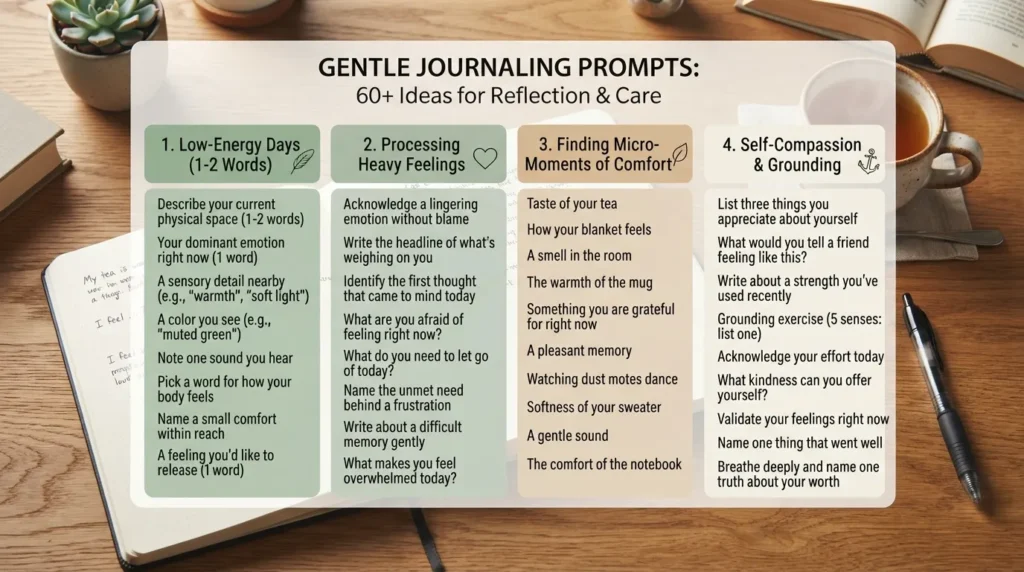
When you’re dealing with depression, even pulling off the cap of a pen can feel like trying to lift a sack of concrete. Your mind feels noisy, fogged up, or entirely blank—and the idea of sitting down with a crisp, empty notebook sounds exhausting instead of therapeutic.
You don’t need to write pages of deep revelations right now. Journaling during a low period isn’t about being productive or fixing yourself. It’s simply about giving the stuff heavy on your heart a safe place to land, so you don’t have to carry every single ounce of it in your head.
Below, you’ll find gentle, low-pressure prompts designed for real life, low energy, and hard days. Write one line, answer in bullet points, or just read through them until something clicks. There are no rules here.
How to Journal When You Have Depression
Keep it impossibly small: Aim for one sentence, three words, or a bulleted list. You don’t need full paragraphs.
Pick low-energy prompts: Focus on what you see, feel, or need right in this exact minute rather than trying to figure out your whole life.
Ditch the perfectionism: Spelling doesn’t matter, and bad handwriting is fine. Scribbling out a page counts just as much as writing poetry.
Treat it as a safe space: Write without judging yourself for feeling down, angry, or numb.
Why Journal Prompts Help With Depression
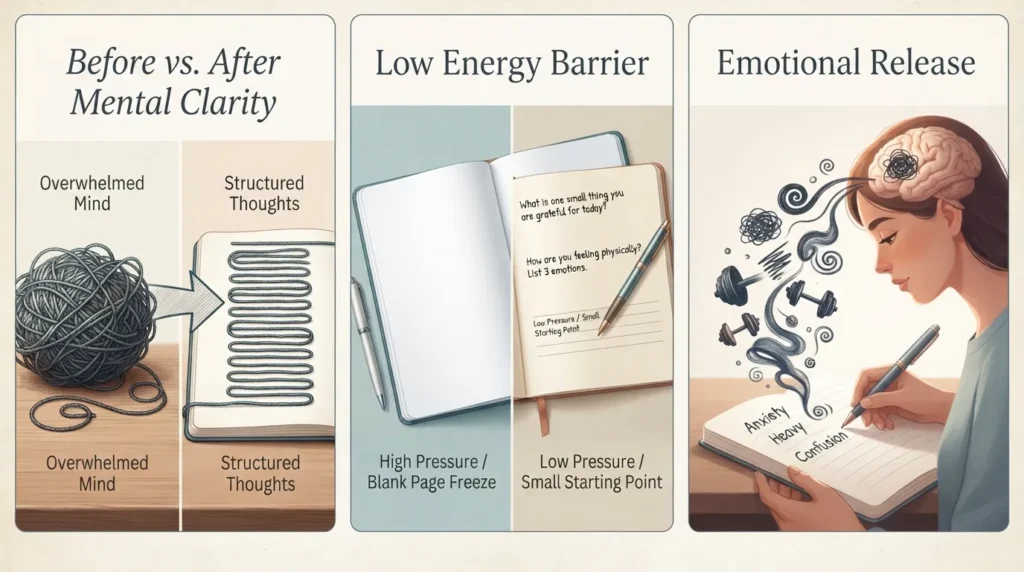
When you are dealing with depression, your own mind can feel like a noisy, crowded room. Thoughts loop continuously, and heavy feelings blend together until everything feels like one big, confusing weight.
Journaling gives those thoughts a physical place to go so they stop spinning in your head. Prompts make this even easier because they take away the pressure of facing a blank page. Instead of figuring out where to start, you just respond to a single question.
Putting feelings into words
When emotions stay trapped inside your mind, they tend to grow bigger and more overwhelming. The simple act of putting your feelings into written words helps your brain organize and process what you are experiencing.
Studies on expressive writing show that translating emotional stress into language can actually help calm the brain’s stress response, making hard feelings easier to carry. You don’t need to write anything poetic or organized. Just getting the words out onto paper helps create a little breathing room between you and your thoughts.
A tool, not a replacement for treatment
It is helpful to view journaling as a gentle daily support system rather than a quick fix or a cure. Writing can help you track your mood, recognize patterns, and express emotions you might otherwise keep bottled up inside.
However, journaling is meant to work alongside professional support, not replace it. If you are struggling, therapy, medical care, and trusted loved ones are essential parts of getting through a low period. Think of your notebook as a safe, quiet place to check in with yourself while you receive the broader support you deserve.
How to Journal When You're Depressed (Simple, No-Pressure Tips)
When you’re dealing with depression, even small tasks can feel like climbing a mountain. Looking at a blank page or a long list of questions can easily feel overwhelming.
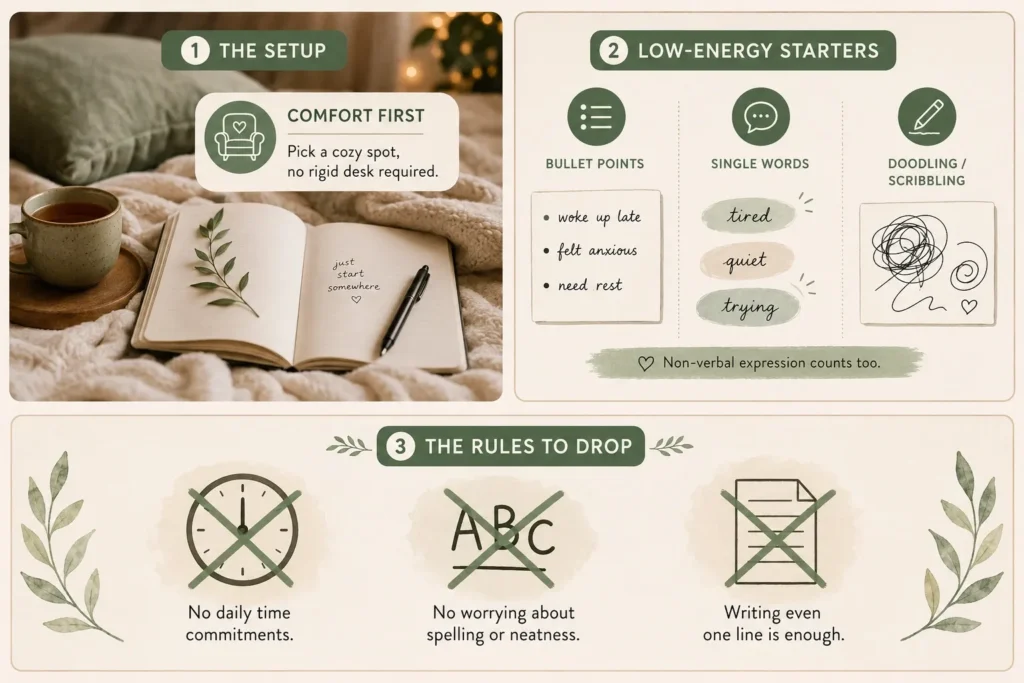
Journaling shouldn’t feel like homework, and it definitely shouldn’t add to your stress. Here are a few simple, low-effort ways to make it work for you right now:
Pick one prompt at a time: You don’t need to answer every question you see. Look through a list, pick the single prompt that feels easiest or most interesting, and ignore the rest for today.
A few sentences are enough: You don’t need to fill an entire page. Writing three words or two short sentences counts just as much as writing a long entry.
Skip anything that feels too heavy: If a prompt brings up painful thoughts or makes you feel worse, step away from it. Journaling is meant to support you, not push you into a emotional corner.
Choose whatever format is easiest: You don’t have to use a fancy notebook. Type a quick note on your phone, open a blank document on your computer, or speak into a voice recorder app while lying in bed.
Pair it with an existing daily habit: Connect journaling to something you already do without thinking. Jot down a quick thought while your morning coffee brews or right after you brush your teeth at night.
Use a simple checklist on tough days: On days when open writing feels impossible, ditch the full sentences. Write down three basic things, like “drank water,” “sat in the sun,” or “fed the cat.”
[Video embed here]
Journal Prompts for Low-Energy, Hard Days
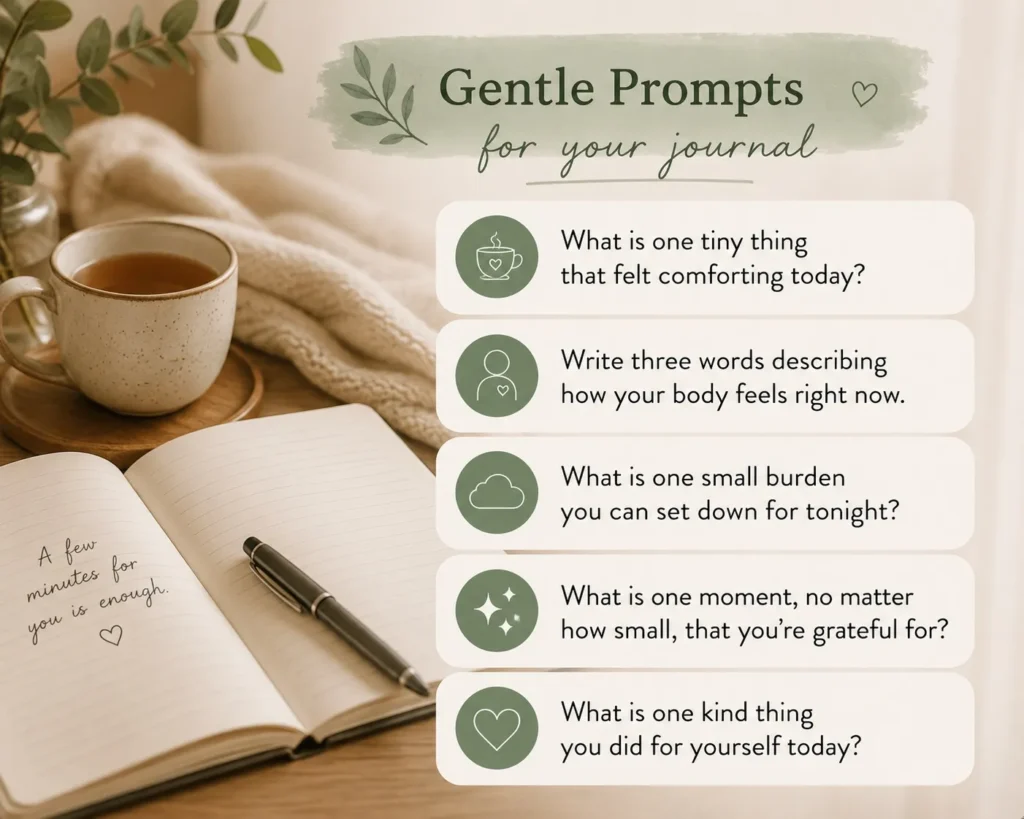
When you’re dealing with depression, even opening a notebook can feel like running a marathon. On days when your brain feels foggy and your body feels heavy, you don’t need deep, complicated inner work. You just need a low-pressure way to check in with yourself.
You don’t have to write full pages or complete sentences. A few words, a bulleted list, or a messy scribbled sentence is more than enough. Here are 10 gentle prompts designed for the days when you have very little energy to give:
What is one small thing that brought a tiny moment of comfort today? (It could be warm tea, a soft blanket, or the room being quiet.)
If your body could speak right now without any judgment, what would it ask you for?
What is one expectation or task you can give yourself permission to drop today?
Look around the room. What are three physical items near you that feel calm or neutral?
If a close friend felt as exhausted as you do right now, what would you tell them?
What is one tiny thing you did today that took real effort? (Getting out of bed, opening a window, or drinking water all count.)
What does gentle self-care look like for you today, in this exact moment?
What is one heavy thought lingering in your mind that you can write down just to get it out of your head?
What is something simple and low-effort that makes your space feel a little safer?
If you can’t write full sentences right now, what five words describe your current mood?
Prompts to Understand What You're Feeling
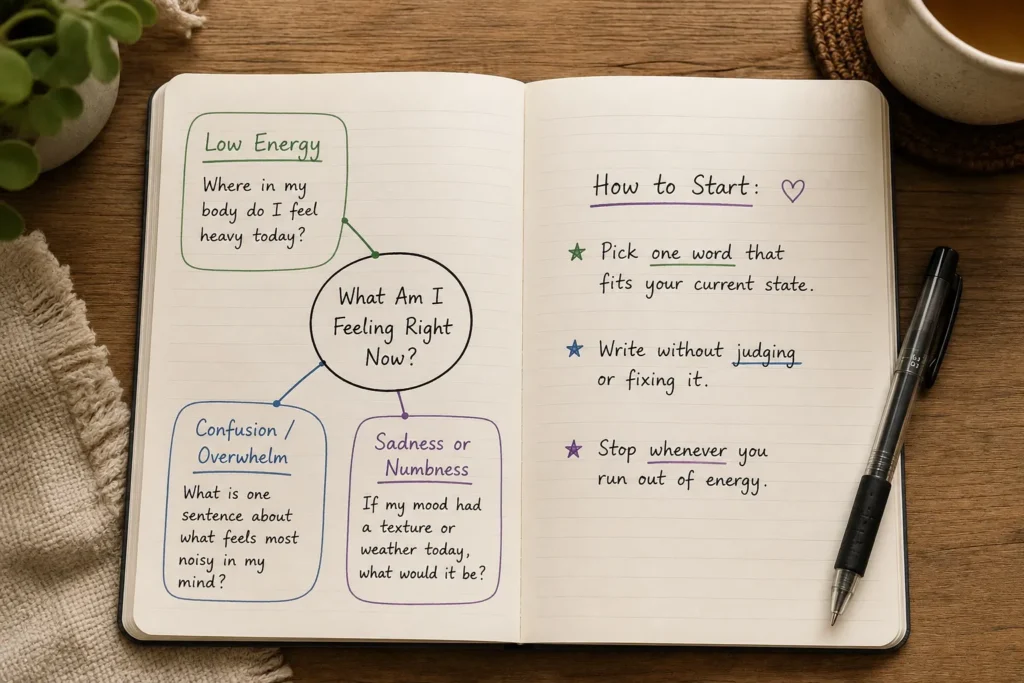
Depression often shows up in your body long before your mind can make sense of it. You might notice a heavy tightness in your chest, a dull fog behind your eyes, or a deep fatigue that sleep just doesn’t seem to fix.
These prompts focus on what your body is experiencing right now. You don’t need to fix or analyze anything—just notice what’s there and write it down.
Where in your body are you carrying tension right now, and how would you describe the feeling? (For example: a tight knot, a dull ache, or a cold emptiness.)
If your physical tiredness had a voice, what is the main thing it would ask you for today?
Scan your body from your shoulders to your feet. Which spot feels the heaviest, and which spot feels the most neutral?
What physical sensation did you notice in your body the moment you woke up this morning?
How does your chest or stomach react when you think about your daily tasks today?
If your body could ask for one small comfort right this second—like soft clothes, fresh air, or quiet—what would it choose?
When you take a slow breath in, where does the air seem to flow easily, and where does it feel tight or restricted?
Check in with your jaw, neck, and shoulders. What changes if you consciously let them drop down half an inch?
If you had to describe your energy level right now using a physical texture or object, what would it be? (Like lead weights, dry sand, or thin paper.)
What is one simple thing your body did to keep you going today, even while feeling low?
Self-Compassion Journal Prompts
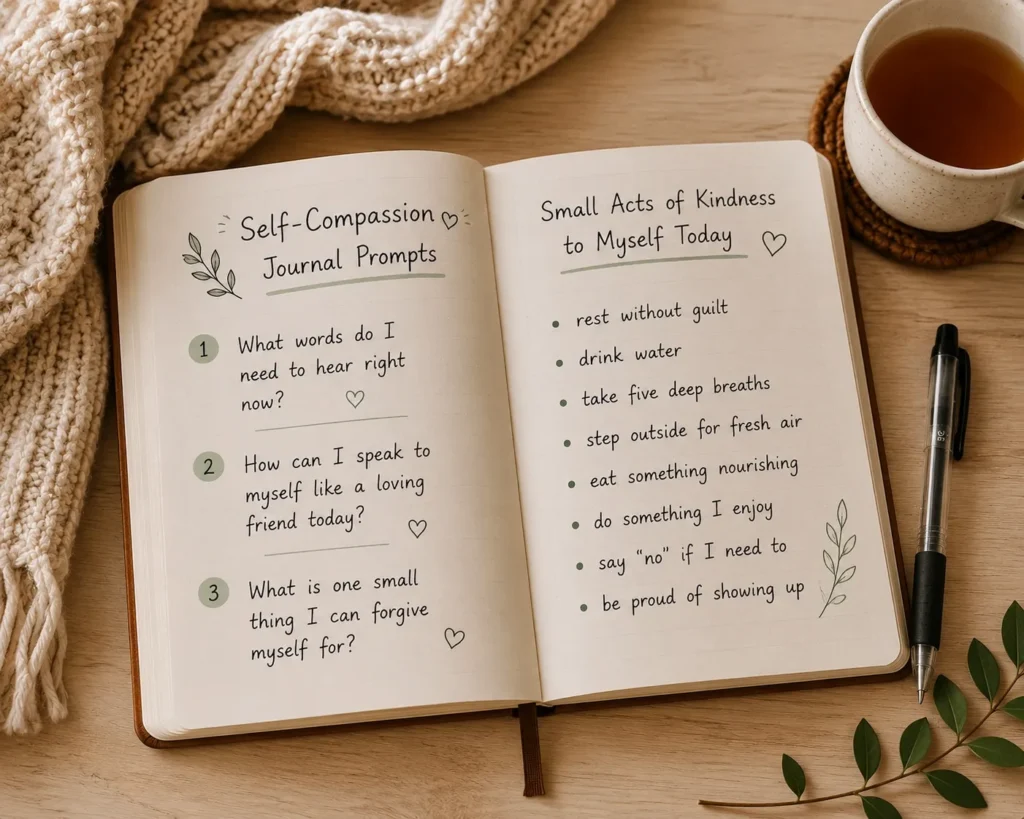
When you are dealing with depression, your inner voice can get pretty mean. You might catch yourself beating yourself up for taking a nap, not texting someone back, or just struggling to get through the day. These prompts are designed to help you soften that voice and treat yourself with a little more grace.
What is something you are blaming yourself for right now, and what would you tell a close friend who was in the exact same spot?
If your low energy could speak today, what is it trying to ask you for?
Write down one small thing you accomplished today—even if it was just drinking a glass of water or brushing your teeth.
What is a standard or expectation you are holding yourself to that might be too heavy for right now?
In what ways have you been tough on your body lately, and how can you offer it a moment of rest instead?
What is one kind thing someone has said to you recently that you found hard to believe? What makes it hard to accept?
If you gave yourself full permission to feel low today without trying to fix it immediately, what would change about your afternoon?
Finish this sentence: “Even though I feel overwhelmed right now, I am still allowed to…”
Journal Prompts for Depression and Anxiety Together
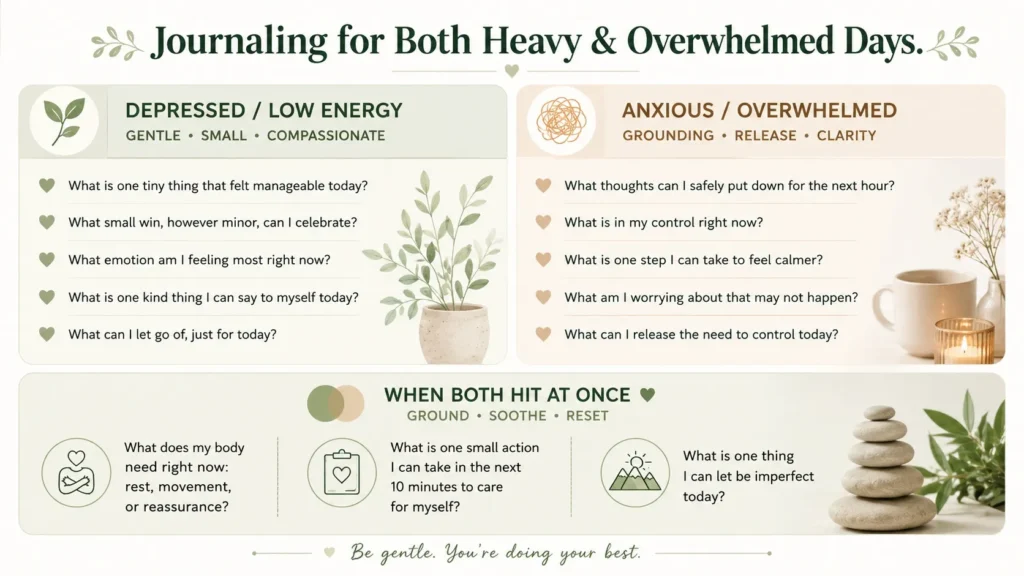
When depression and anxiety hit at the same time, it can feel like your brain is running a fever while your body feels like heavy stone. Anxiety fills your mind with racing thoughts, while depression strips away the energy you need to handle them.
Journaling isn’t about fixing everything in one sitting. It is simply a safe place to untangle the knot in your mind, one line at a time.
Here are 10 gentle prompts designed to help you process both feelings together:
What is one thought making my heart race right now, and what is one soft truth I can offer myself in response?
If my anxiety and my depression were two different voices, what are they currently arguing about?
What is something small that feels completely overwhelming today, and how can I break it down so it only takes two minutes?
Write down three things in your physical room that are quiet, still, and safe right now.
What is a expectation I am holding myself to today that I would instantly forgive a friend for dropping?
When my mind feels noisy and my body feels exhausted, what is the single kindest thing I can do for myself in the next hour?
What is one worst-case scenario my brain keeps repeating, and what is one realistic, quiet outcome that is actually more likely to happen?
What does my body need most right now: movement, rest, water, or just a deep breath?
What is a small boundary I need to set today to protect my limited energy?
Finish this sentence without overthinking it: “Right now, it is completely okay if all I accomplish today is…”
Prompts to Notice Small Wins and Moments of Comfort

When you are feeling down, your brain tends to play a trick on you: it highlights everything that went wrong and completely ignores the small good things. Recognizing tiny moments of comfort or low-effort victories isn’t about forced positivity. It is simply a way to remind yourself that good moments can still exist alongside the heavy ones.
Here are eight prompts to help you spot those small, gentle moments:
What is one physical feeling that brought you a second of comfort today? (Think of simple things, like a warm drink, clean sheets, or soft socks.)
Did you complete a task today that felt huge before you started it? Write about it, even if it was just opening the blinds, brushing your teeth, or replying to one message.
What is a small detail in your environment that felt peaceful recently? It could be the way sunlight hit the floor, the sound of rain against the window, or a quiet room.
Name one thing you did today to treat yourself with grace. Did you let yourself rest, say no to an exhausting plan, or step away from work when you felt overwhelmed?
Is there a song, video, show, or animal that made you feel even five percent lighter this week? What was it, and how did it feel to pause and enjoy it?
What is a physical spot in your home that feels safe to you right now? Describe why sitting there gives your body a chance to relax.
What is one thing you survived today that felt hard to face when you woke up? Acknowledge the energy it took to get through it.
If a close friend was having a rough day and accomplished just one basic task, what would you say to them? Try writing those exact words to yourself.
Prompts to Understand Your Patterns and Triggers
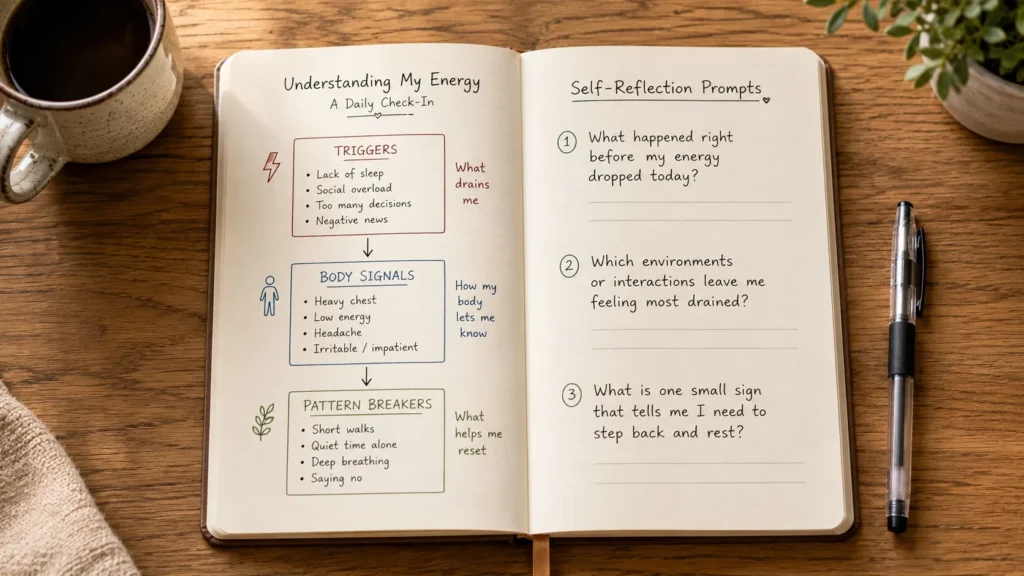
Depression has a way of blurring everything together into one heavy cloud. When every day feels identical, it is hard to figure out what is actually making things worse and what might be helping, even a tiny bit.
These prompts are designed to act like a gentle flashlight. They help you notice subtle shifts in your mood, energy, and thoughts without judging yourself for them.
What was one moment today when your chest felt a little less tight or your mind felt a little quieter? What were you doing, and who were you with?
Look back at the last few days. Was there a specific time your energy completely crashed? Try to write down what happened right before that happened.
What is a story your brain keeps repeating to you this week? (For example: “You’re failing,” or “Nobody cares.”) Is that story entirely true, or is depression doing the talking?
Which daily tasks or places felt like they drained almost all your battery today? * When you feel a sudden shift toward feeling worse, what physically happens in your body first? Do your shoulders tense up, does your stomach drop, or do you just feel exhausted?
What is one thing you find yourself avoiding right now? What feels like the scariest or hardest part of facing it?
Think of a recent time you felt overwhelmed. Were your basic physical needs met in that moment? (Have you eaten, drank water, or slept enough?)
What is one piece of advice or criticism you recently received that you are still carrying around? Why do you think it hit you so hard?
Get These as a Free Printable
If you prefer holding a pen on paper without staring at a screen, you can save or print a clean version of all these prompts for free. Keep it on your nightstand or tuck it inside your notebook so you always have a gentle place to start, even on heavy days.
- No sign-up required: Save the page directly to your device with one click.
- Printer-friendly design: Uses minimal ink with a soft, clean layout that is easy on the eyes.
- Organized by energy level: Quickly find a prompt that matches how much mental energy you have right now.
When Journaling Isn't Enough — When to Reach Out
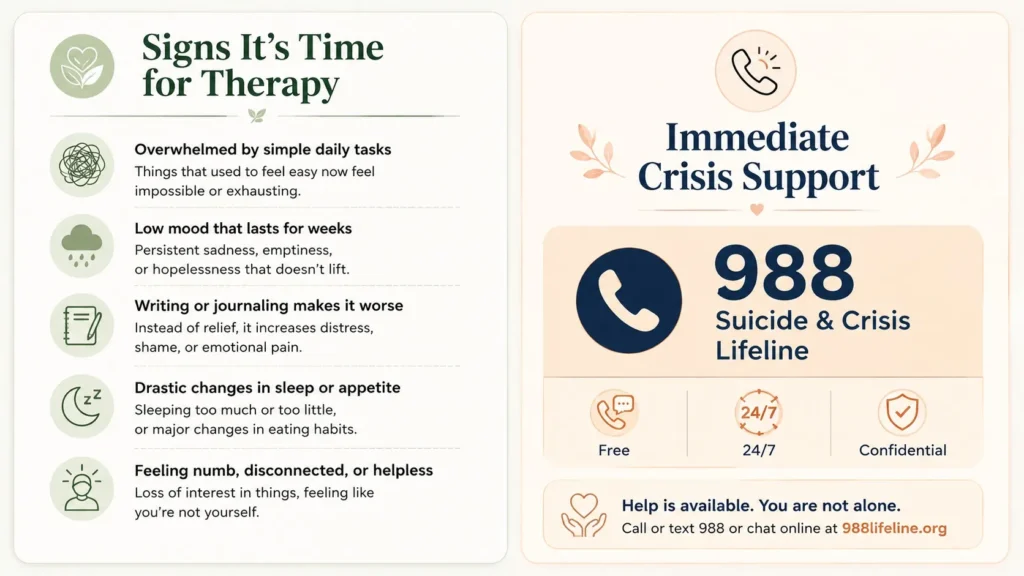
Writing can be a helpful, quiet place to process your thoughts, but it isn’t a fix-all. It is a supportive tool, not a replacement for professional care. There are times when putting pen to paper simply isn’t enough to carry the weight of what you are feeling, and recognizing that is a brave step.
Signs It Might Be Time to Talk to a Therapist
If you notice that your low moods are making daily life feel impossible, reaching out to a mental health professional can give you support that a notebook can’t. You might want to consider professional support if:
Your low mood lasts for weeks: The heavy feeling hasn’t lifted, no matter what coping tools you try.
Basic tasks feel overwhelming: Getting out of bed, showering, making a meal, or replying to a text takes more energy than you have.
You’ve lost interest in everything: Things that usually bring you a little comfort or joy feel completely flat.
Journaling makes you feel worse: If writing leaves you feeling more overwhelmed, stuck in negative thought loops, or spiraling, it is okay to close the notebook and step back.
Your sleep or appetite has drastically changed: You are barely sleeping, sleeping all day, or struggling to eat.
Finding Immediate Support
If you are feeling completely hopeless, having thoughts of self-harm, or feel like you can’t keep yourself safe, please don’t wait. You do not have to navigate this alone, and help is available right now.
You can call or text the 988 Suicide & Crisis Lifeline at 988 (available 24/7, free, and confidential in the US and Canada). If you are outside the US, please reach out to your local emergency services or a national helpline. Reaching out for help is not a sign of failure—it is a sign that you deserve support.
Frequently Asked Questions
What should I write in a journal when I'm depressed?
Keep it as low-pressure as possible. You don't need to craft deep essays or make sense. You can write about how heavy your body feels, list three tiny things you noticed today, stream-of-consciousness vent your frustration, or answer a single gentle prompt. Even writing "I don't want to write today" counts.
How often should I journal for depression?
Only as often as it feels helpful. Forcing a rigid daily rule can turn journaling into another task on your to-do list, which causes unnecessary guilt. Some people write once a day, while others open their notebook twice a week. Pick up your journal when you feel the need to unload your mind, not because you feel obligated.
Can journaling replace therapy?
No, journaling is a self-care tool, not a replacement for professional clinical care. While writing can help you sort through tangled thoughts and lower stress, it cannot diagnose or treat depression. Think of journaling as a quiet companion to support your healing, ideally alongside professional therapy or medical care if you need it.
What if I don't know what to write?
That is completely normal, especially on low-energy days. You can start by picking a low-energy prompt, drawing how you feel, or writing single words instead of full sentences. If words won't come, just holding the pen and writing whatever pops into your head—even random thoughts—is enough to start breaking the freeze.
Are these prompts okay for teens to use?
Yes, these prompts are gentle, safe, and suited for anyone navigating low moods, including teenagers. They focus on self-compassion, small daily moments, and low-stress self-reflection without pushing into heavy or clinical territory.
Pimchanok Srisuk
Pimchanok Srisuk is the Journaling Editor at Holistic Wellbeing Living. She writes about journaling prompts, reflective writing, emotional clarity, and mindful routines. With seven years of experience creating personal-growth content, Pimchanok helps readers use simple writing practices to understand their thoughts and make calmer everyday decisions.