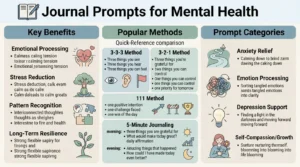
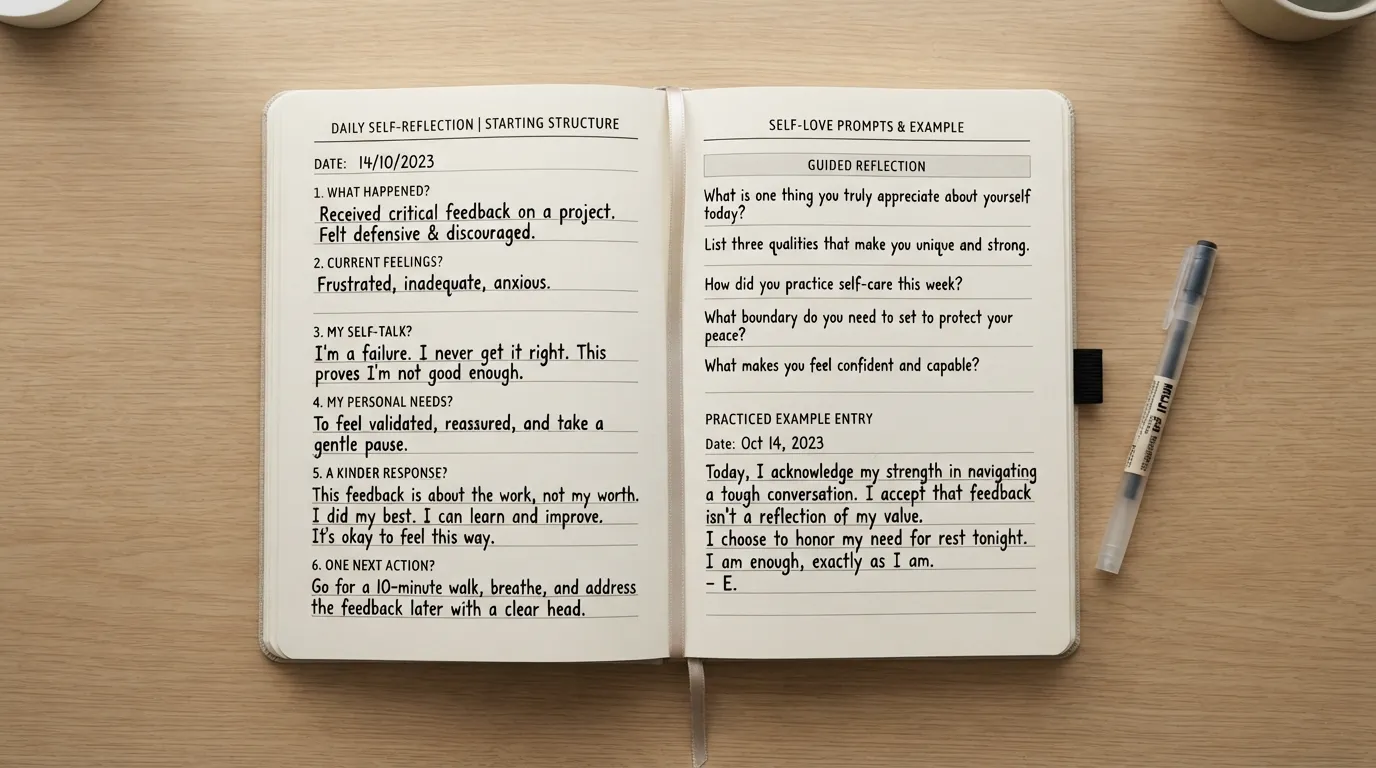
 A self love journal is a personal space where you examine how you think about yourself, respond to mistakes, recognize your needs, challenge harsh self-talk, and practice treating yourself with more understanding and respect. It can be a blank notebook, a guided journal, or a digital document. What matters most is not the format but what you do with the reflection.
If you are new to this, you do not need 100 prompts, perfect handwriting, or an expensive journal. I would start much more simply: notice one real experience, write down what you told yourself about it, respond to yourself as fairly as you would respond to someone you care about, and choose one small action that supports you. That turns journaling from a collection of nice thoughts into a practical self-reflection habit.
A simple way to begin today: write about one moment when you were hard on yourself. Ask, “What happened? What did I say to myself? What am I actually feeling or needing? What would a fairer and kinder response sound like? What is one useful thing I can do next?”
What Is a Self-Love Journal?
A self-love journal is a type of self-help journal focused specifically on your relationship with yourself. Instead of merely recording what happened during the day, you use the page to notice self-criticism, understand emotions, acknowledge strengths and needs, examine boundaries, practice self-acceptance, and decide how you want to care for yourself in real life.
“Self-love” can sound vague, so I find it more useful to break it into concrete behaviors. In a journal, self-love might mean admitting that something hurt rather than pretending it did not, recognizing that a mistake does not define your entire worth, saying no when a boundary is repeatedly crossed, asking for help, resting without having to earn it, or changing a habit that is harming you.
One useful psychological concept closely related to this practice is self-compassion. Researcher Kristin Neff describes self-compassion in terms of self-kindness, common humanity, and mindful awareness rather than harsh self-judgment and over-identification with painful thoughts. You can read her foundational explanation of self-compassion if you want the research-based concept behind many self-love exercises.
Self-Love, Self-Esteem, Self-Compassion, and Self-Reflection Are Not the Same Thing
These ideas overlap, but treating them as exact synonyms makes journaling less useful. Knowing the difference helps you choose better questions.
| Concept | Main focus | What you might journal about |
| Self-love | Your overall relationship with yourself | Needs, values, boundaries, care, self-talk and choices |
| Self-esteem | How you evaluate your worth or competence | Strengths, achievements, comparison and confidence |
| Self-compassion | How you respond when you struggle or fail | Pain, mistakes, kinder responses and balanced perspective |
| Self-reflection | Understanding your experiences and patterns | What happened, why you reacted, what you learned and what you may change |
A self esteem journal therefore tends to focus more narrowly on confidence, competence, strengths and perceived worth. A self-love journal can include those topics, but it also asks how you treat yourself when you are not feeling confident or successful. That distinction matters because real life includes failure as well as achievement.
Why Do People Struggle With Self-Love?
There is rarely one reason. A person can understand intellectually that they should treat themselves well and still fall into harsh patterns automatically. Common influences include:
- Perfectionism: believing mistakes reduce your value rather than simply showing where something went wrong.
- Comparison: constantly measuring your appearance, progress, relationships or achievements against other people.
- Conditional approval: learning that you are acceptable only when you perform, please others or meet certain expectations.
- A strong inner critic: using harsh language as a way to control, motivate or protect yourself from future failure.
- Shame about needs or emotions: believing you should not feel hurt, tired, jealous, lonely, angry or afraid.
- Painful relationships or experiences: repeated criticism, rejection or disrespect can influence how you learn to speak to yourself.
- Appearance and social pressure: unrealistic standards can turn self-worth into an endless evaluation.
A journal cannot erase those influences simply because you write about them. What it can do is make a pattern visible. Once you can see the pattern in words, you have a better chance of deciding whether you still want to follow it.
How to Start a Self-Love Journal
You do not have to journal “correctly.” There is no required number of pages or special time of day. A useful practice is simply one that helps you notice yourself more clearly and respond in a way that supports your values and well-being.
- Choose a format you will actually use.
Use a blank notebook if you enjoy open writing, a guided journal if prompts help you begin, or a private digital note if convenience matters more than paper. - Start with a real moment, not a vague idea.
“I need more self-love” is difficult to explore. “I criticized myself for making a mistake during today’s meeting” gives you something concrete to examine. - Separate what happened from the story you told yourself.
Write the event first. Then write your interpretation. This helps you notice when one mistake turns into a sweeping conclusion such as “I always fail.” - Name the emotion and need underneath it.
You may discover that anger is covering embarrassment, or that self-criticism is hiding a need for reassurance, rest, respect or clearer boundaries. - Respond to yourself fairly.
Fairness is more useful than forced positivity. You do not need to write “I am amazing” when you do not believe it. Try something believable: “I handled part of this badly, but one mistake does not make me incapable.” - Choose one next action.
Reflection becomes more useful when it changes something: apologize, rest, ask a question, set a boundary, practice a skill, reach out to someone or stop repeating an unfair judgment. - Review patterns occasionally.
Do not obsessively reread every entry. Instead, periodically look for repeated triggers, repeated language and needs that keep showing up.
A Simple Self-Love Journaling Method You Can Repeat
When you do not know what to write, use this five-part loop. I prefer it to randomly answering prompt after prompt because each entry ends with interpretation and action.
- Event: What actually happened?
- Inner voice: What did I immediately tell myself?
- Underneath: What am I feeling, fearing or needing?
- Fair response: What would a truthful but kinder response sound like?
- Next step: What is one action that respects both reality and my well-being?
You do not need to complete all five parts every day. The value is in learning to move from reaction to awareness and then from awareness to a useful response.
What a Useful Self-Love Journal Entry Can Look Like
Here is the difference between recording a self-critical thought and actually working with it.
A surface-level entry:
“I made another mistake at work. I need to stop being so stupid and learn to love myself more.”
A more reflective entry:
What happened? I sent a report before checking one number, and my manager asked me to correct it.
What did I tell myself? “You always mess things up. Everyone probably thinks you are incompetent.”
What is underneath that? I am embarrassed and afraid that one mistake will change how people see me.
A fairer response: I did make an avoidable error, so I need a better checking process. That is different from being incompetent.
My next step: Correct the report, own the mistake without over-explaining, and create a two-minute final check before future submissions.
The second entry does not excuse the mistake. It removes the unnecessary attack on your whole identity and replaces it with responsibility plus a constructive response. That is a more useful form of self-love than simply writing positive statements you do not believe.
What Should You Write in a Self-Love Journal?
Good prompts are not there to produce beautiful answers. They help you notice something specific. Rather than collecting hundreds of questions, choose a small number that match what you are dealing with now.
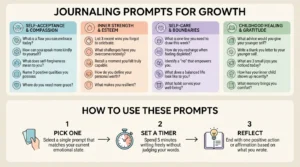
For self-acceptance
- What part of myself am I constantly trying to prove is acceptable?
- What mistake am I using as evidence against my entire worth?
- What would change if I accepted that I can be imperfect and still deserve respect?
For your inner critic
- What do I repeatedly say to myself that I would never say to someone I care about?
- What is my inner critic trying to prevent or protect me from?
- What would be a more accurate sentence than the harsh one I am repeating?
For confidence and self-esteem
- What have I handled recently that I once thought I could not handle?
- Which qualities do I respect in myself even when no one praises them?
- Where am I comparing my beginning with someone else’s visible result?
For boundaries and relationships
- Where am I saying yes while feeling resentment?
- What behavior from another person am I repeatedly excusing even though it hurts me?
- What would respecting my own needs look like in this relationship?
For body image
- When do I become most critical of my appearance, and what usually triggers it?
- What does my body allow me to experience or do that has nothing to do with appearance?
- Which appearance standard am I treating as a requirement rather than a preference or social message?
For everyday self-care
- What do I need more of this week: rest, support, structure, fun, movement, quiet or connection?
- What is one small thing I can do today that my future self will appreciate?
- Where am I waiting to “deserve” care instead of responding to a real need?
A One-Page Self-Love Journal Template
If you came looking for a self-love journal PDF, you can use this simple template without downloading anything. Copy it into a notebook, notes app, or document and reuse it whenever you need it.
Today I noticed:
What happened or what is on my mind?
My automatic thought was:
What did I immediately tell myself?
I am feeling:
Name the emotion as specifically as you can.
What I may need is:
Support, rest, clarity, reassurance, a boundary, repair, practice, space or something else?
A fair and compassionate response is:
What is true without being unnecessarily cruel?
One thing I appreciate about myself today:
Choose something specific rather than generic.
My next small action:
What can I actually do after closing the journal?
Blank, Guided, or Digital: Which Self-Love Journal Is Best?
There is no single best journal for everyone. The right choice is the format that removes the biggest obstacle between you and consistent, honest reflection.
| Format | Best if… | Possible drawback |
| Blank notebook | You like freedom and already know what you want to explore | A blank page can make starting harder |
| Guided journal | You get stuck, like structure, or want prompts to lead the practice | Some prompts may not fit what you need that day |
| Digital journal | You value convenience, typing speed, search or password protection | Devices can bring distractions and privacy depends on your setup |
If you are a beginner who keeps staring at an empty page, I would choose a guided format first. If prompts make you feel boxed in, use a blank journal and keep the five-part method above as your only structure.
You also do not need a journal marketed specifically “for women” or “for men” unless its prompts genuinely match your experiences. The basic practice of self-awareness, self-compassion, boundaries and constructive action is not gender-specific.
What Time of Day Should You Journal?
There is no universally best time. Choose the time that matches what you want the journal to do.
- Morning: useful when you want to notice how you are starting the day, identify what you need and set an intention.
- Evening: useful when you want to reflect on triggers, relationships, successes, mistakes and patterns from the day.
- After a difficult moment: useful when a specific event has activated strong self-criticism and you want to understand it while the details are still clear.
Consistency is useful, but rigidity is not. If daily journaling becomes another standard you use to criticize yourself, it is defeating the purpose. A shorter practice you return to willingly is more sensible than forcing yourself to fill pages because you missed yesterday.
How to Make Journaling Lead to Real Change
One weakness in many journaling routines is that reflection stops on the page. You recognize the same issue repeatedly but do nothing differently. To prevent that, review your journal for patterns, decisions and experiments, not just feelings.
Look for repeated triggers
If five entries mention feeling inadequate after scrolling social media, that repeated context matters more than any single entry. You now have something specific you can test, such as changing who you follow or taking a break from an account that repeatedly triggers comparison.
Look for repeated needs
You may keep writing that you are exhausted, overcommitted or resentful. The useful question then is not “What new prompt should I answer?” It is “What boundary or routine keeps being postponed?”
Turn one insight into one experiment
If you notice that you become harsh with yourself when receiving feedback, your experiment might be to wait ten minutes before reacting and then write down the factual feedback separately from the meaning you automatically attach to it. Small experiments make a journal practical.
What Not to Do When Journaling
Journaling is flexible, but some habits can make it less useful.
- Do not use the journal as a courtroom against yourself. Writing five pages of accusations is not automatically reflection.
- Do not force positivity. “Everything is perfect” is not self-love when something genuinely hurts. Start with what is true.
- Do not treat every thought as a fact. Writing “Everyone hates me” records a thought; it does not prove the thought.
- Do not chase perfect wording. Your private journal does not need polished grammar, beautiful handwriting or profound insights.
- Do not answer prompts mechanically. Ten shallow answers are often less useful than one question that helps you notice a meaningful pattern.
- Do not reread compulsively when it makes you spiral. Review with a purpose: patterns, progress, triggers or decisions.
- Do not ignore privacy. If fear that someone will read your journal stops you being honest, choose a more secure physical or digital system.
- Do not treat journaling as a replacement for professional care. It can be a self-reflection or coping tool, but it is not the same thing as diagnosis or treatment.
Can a Self-Love Journal Help You Feel More Loved?
A journal cannot manufacture the feeling of being loved on command. What it can do is help you identify what care, respect and support actually mean to you. Sometimes the next step is internal, such as changing your self-talk. Sometimes it is behavioral, such as resting. Sometimes it is relational, such as asking for support or stopping a pattern of accepting disrespect.
If I were using a journal for this purpose, I would ask: “When do I feel most cared for, what do I keep expecting other people to give me, and which part of that can I reasonably provide or ask for more directly?” The goal is not to pretend you never need other people. Healthy relationships and social connection matter. The journal simply helps you become more deliberate about how you relate to yourself as well.
What Does Research Say About Self-Compassion Writing?
Research gives a more useful answer than saying journaling “works” or “doesn’t work.” Studies on expressive and self-compassionate writing suggest that certain structured writing exercises can influence how people respond to difficult experiences, but results vary by population, instructions, outcome and study design.
For example, a 2025 experimental study indexed by PubMed found increases in self-compassion after a single self-compassion writing exercise in its writing groups, while anxiety outcomes differed across conditions. A separate 2026 randomized controlled trial found some effects on stress-related behavior patterns but did not find broad direct improvements across all measured stress and health-behavior outcomes.
That mixed picture matters. A self-love journal can be a practical tool for reflection and self-compassion, but it should not be sold as a guaranteed way to fix anxiety, depression, relationships, body image or every problem with self-worth.
If you are dealing with depression or significant emotional distress: journaling may be one coping or reflection tool, but depression is a health condition with established treatment options. The National Institute of Mental Health describes psychotherapy, medication and other treatments depending on a person’s needs. Persistent or severe symptoms deserve professional attention rather than relying on a journal alone.
Is Journaling a Coping Strategy?
It can be. Writing may help you slow down, label what you are experiencing, organize thoughts and decide what to do next. But coping is not the same as solving every underlying problem. If an entry shows that you repeatedly need support, safety, medical care, a boundary or professional help, the useful response may be action outside the journal.
How Do You Know Whether Your Self-Love Journal Is Helping?
Do not judge the practice by whether every session makes you feel better immediately. A more useful test is whether, over time, the journal helps you notice and respond differently.
Look for changes such as:
- you catch harsh self-talk earlier;
- you can distinguish a mistake from a judgment about your whole identity;
- you recognize repeated triggers or needs;
- you make clearer decisions about boundaries;
- you recover from setbacks without spending as long attacking yourself;
- you turn reflections into realistic actions;
- your journal contains more nuance and less all-or-nothing language.
If you have been writing the same painful story for weeks without new understanding or action, change the method. Use more specific questions, reduce how often you reread, talk with someone you trust, or seek professional support when the issue is beyond what self-guided writing can reasonably address.
Questions People Often Have About Self-Love Journaling
Do I have to journal every day?
No. Daily journaling works for some people, but frequency is not a test of commitment. Write often enough to notice patterns and maintain the habit without turning it into another source of guilt.
What if I do not know what to write?
Start with the most concrete sentence possible: “The thing I keep thinking about is…” Then use the five-part method: event, inner voice, emotion or need, fair response and next step. You do not need inspiration before you begin.
Should I use affirmations in a self-love journal?
You can, but believable affirmations are usually more useful than exaggerated ones. If “I love everything about myself” feels false, try “I can treat myself with respect while I am still working on things I want to change.”
Which type of journaling is best for self-love?
For this goal, reflective and self-compassionate writing are especially relevant because they help you examine experiences and how you respond to yourself. Gratitude writing can also fit when it includes appreciation for your own effort, values or support systems. There is no need to choose only one journaling style.
Is there a correct way to journal?
There is no universal correct format. A useful journal is honest enough to reveal something, structured enough to help you understand it, and practical enough to influence what you do next. If a method makes you more confused, distressed or self-critical every time, change the method rather than assuming you are bad at journaling.
Can I use a normal notebook instead of buying a self-love journal?
Yes. A branded guided journal can provide useful structure, but the practice does not depend on owning a specific product. A blank notebook plus a few well-chosen questions is enough to begin.
Start With One Honest Page
The point of a self-love journal is not to convince yourself that you are flawless. It is to build a more honest, supportive and useful relationship with yourself—especially when life gives you reasons to become critical, ashamed or discouraged.
If you want to begin now, skip the hunt for the perfect prompt. Pick one real situation from today and write five things: what happened, what you told yourself, what you are feeling or needing, what a fairer response would be, and what you will do next.
That one page can tell you more about your relationship with yourself than filling a notebook with positive phrases you do not yet believe.
Related Posts