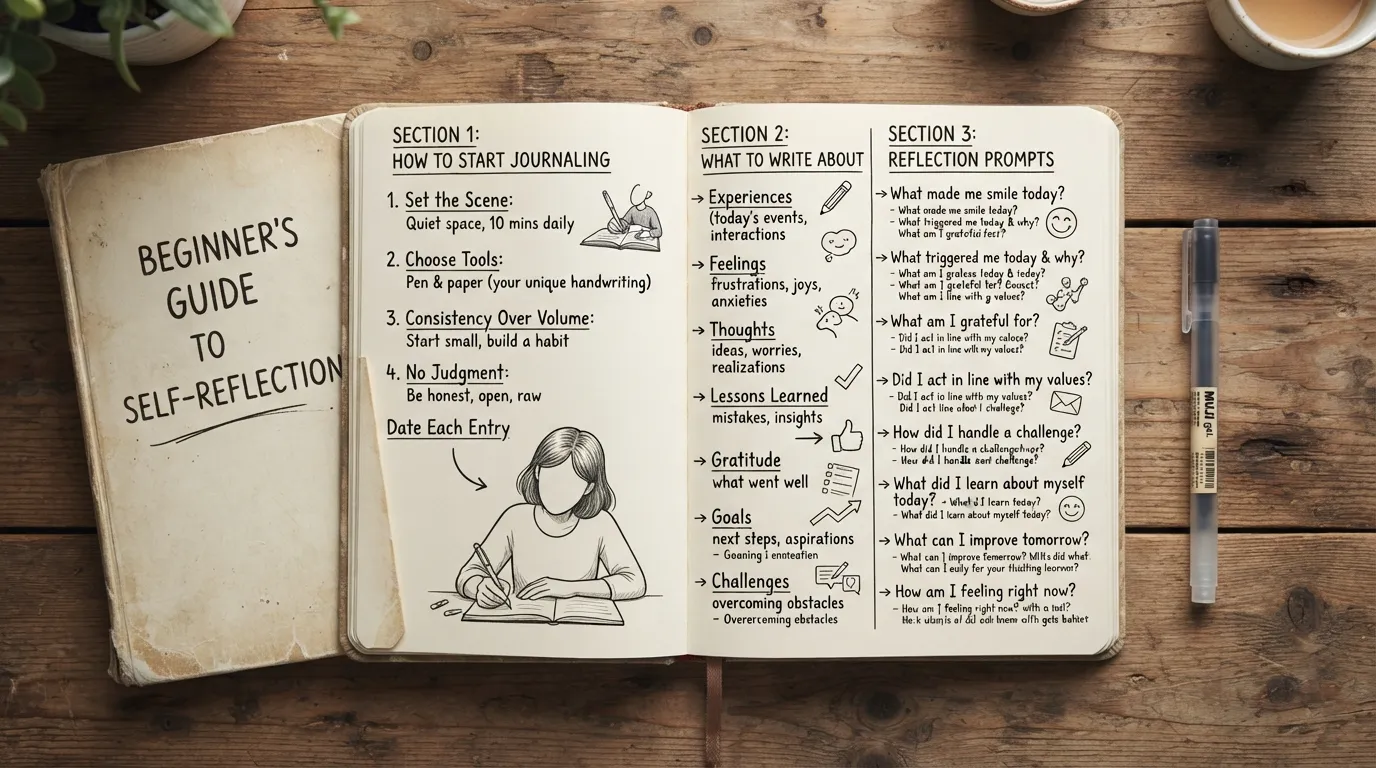
A self reflection journal is a place where you do more than record what happened. You slow down, examine your thoughts and feelings, notice patterns, decide what an experience means to you, and work out what you want to do next. That last part matters: a journal becomes genuinely reflective when your writing helps you understand yourself or make a more intentional choice.
You do not need a special notebook, a perfect routine, or pages of writing every day. A blank reflection notebook, a guided journal, a notes-to-self journal, or a digital document can all work. What matters most is the quality of the questions you ask and whether you move from what happened to what can I learn from it?
A simple reflection loop:
Event → Feeling → Meaning → Lesson → Next action
What Is a Self-Reflection Journal?
A self-reflection journal is a written record you use to examine your experiences, reactions, thoughts, emotions, values, habits, relationships, goals, and decisions. Instead of simply documenting your day, you ask why something affected you, what it reveals about you, what you learned, and whether anything should change.
That is the main difference between ordinary diary writing and reflective journal writing. A diary entry might say, “I had an argument with my friend today.” Reflection goes further: “Why did that conversation affect me so strongly? What was I expecting? Did I react to what was actually said, or to an assumption I made? What could I do differently next time?”
Your journal does not have to produce a dramatic insight every time. Sometimes the useful result is simply naming a feeling, recognizing that you need rest, noticing the same problem for the third time, or deciding to have a conversation you have been avoiding.
How to Write a Self-Reflection Journal
If you are staring at a blank page and wondering what you are supposed to write, use the five-part process below. It keeps reflection focused without making your journal feel like homework.
- Describe what happened.
Start with the facts. What experience, conversation, decision, success, mistake, or concern are you reflecting on? Keep this part short enough that you still have room to examine it. - Name what you felt.
Try to be more specific than “good” or “bad.” Were you disappointed, relieved, embarrassed, resentful, excited, uncertain, proud, jealous, anxious, frustrated, or hopeful? - Ask what you made the experience mean.
This is where reflection gets deeper. What assumptions did you make? What expectation, belief, value, fear, or need influenced your reaction? - Look for the lesson or pattern.
Ask whether this is an isolated event or something you have seen before. What did the experience teach you about yourself, another person, or the situation? - Choose a next action when one is useful.
Reflection does not always require action, but when something can be improved, decide on one realistic next step instead of ending with a vague promise to “do better.”
The purpose is not to force every experience into a five-step formula. The structure is there for the days when you need help moving beyond a description of what happened.
A Self-Reflection Journal Example
Here is what the process can look like in an actual entry.
What happened?
My manager pointed out an unfinished part of my project during our team meeting.
What did I feel?
I felt embarrassed and immediately became defensive.
What meaning did I attach to it?
I interpreted one piece of criticism as proof that my manager thought I was bad at my job, even though that was not actually said.
What do I notice?
I sometimes turn feedback about one task into a judgment about my overall ability. That makes it harder for me to hear useful criticism.
What will I do next?
Tomorrow I will ask which two changes matter most, complete them, and judge the feedback by what was actually said rather than by my first emotional reaction.
Notice that the useful part of this entry is not its length. The writer moves from an event to an emotion, identifies an interpretation, spots a possible pattern, and ends with a specific response.
7 Self-Reflection Questions to Ask Yourself
You do not need dozens of prompts each time you journal. These seven questions cover most of the work a useful reflection needs to do:
- What happened, without exaggerating or minimizing it?
- What am I feeling, and what may be underneath that feeling?
- What was I expecting or needing in this situation?
- What assumptions am I making?
- Have I noticed a similar reaction or pattern before?
- What can I learn from this experience?
- What is one thing I want to accept, change, continue, or do next?
You can answer all seven after a significant experience or choose just one for a short daily reflection.
Self-Reflection Journal Prompts for Different Areas of Life
Prompts are most useful when they match what you actually need to explore. Instead of working through a huge list in order, choose a category that fits your situation today.
For self-awareness
- When do I feel most like myself?
- What am I pretending does not bother me?
- What have my recent choices been showing me about my priorities?
For emotions
- What emotion has appeared most often this week?
- What happened immediately before I felt it?
- What might this emotion be asking me to notice?
For habits and behavior
- Which habit is helping me most right now?
- Where do I keep making the same choice despite wanting a different result?
- What usually happens just before I fall back into that pattern?
For relationships
- Where do I feel understood, and where do I feel I have to perform?
- Is there a boundary I need to communicate more clearly?
- Am I reacting to this person, or to something this situation reminds me of?
For values and decisions
- What matters most to me in this decision?
- Am I choosing from my values, fear, habit, or someone else’s expectations?
- Which option would I respect myself for choosing even if it were uncomfortable?
For goals and personal growth
- What progress have I made that I have not acknowledged?
- What obstacle keeps slowing me down?
- What is one small action that would make the next week better?
A Simple Daily Reflection Journal Template
If you want a reusable self-reflection journal template, copy the structure below into a notebook, notes app, document, or printable page.
Date: __________________________
What stands out from today?
__________________________________________________
What am I feeling?
__________________________________________________
What am I telling myself about it?
__________________________________________________
What pattern, value, assumption, or need do I notice?
__________________________________________________
What did I learn?
__________________________________________________
What will I accept, continue, change, or do next?
__________________________________________________
If you are looking for a self-reflection journal PDF, this same structure can be copied into a document and saved or printed as a PDF. You do not need a complicated worksheet for the process to be useful.
How Often Should You Reflect?
There is no rule that says meaningful journaling has to happen every day. The better schedule is the one you can sustain without turning reflection into another obligation.
| Routine | Good for | What to focus on |
|---|---|---|
| Daily | Building awareness | One event, feeling, lesson, or intention |
| Weekly | Spotting patterns | Wins, difficulties, recurring emotions, lessons, priorities |
| Monthly | Seeing bigger changes | Habits, relationships, goals, energy, recurring themes |
A five-minute daily reflection journal can be enough for routine awareness. A longer weekly review may be more useful if you prefer to write only when you have something meaningful to examine.
What Time of Day Is Best for Journaling?
There is no universally best time. Choose the time that matches the kind of reflection you want to do.
- Morning: useful for checking in with yourself, clarifying priorities, and setting intentions before the day begins.
- Evening: useful for reviewing what happened, processing reactions, and identifying lessons while the day is still fresh.
- After an important event: useful when a conversation, decision, mistake, success, or emotional reaction deserves closer attention.
If evening writing makes you replay upsetting events just before sleep, move deeper reflection earlier in the day. Your routine should help you understand your experience, not leave you unnecessarily wound up.
What Is the Best Journal for Self-Reflection?
The best journal is not automatically the most expensive or the one with the most prompts. Choose a format based on how much structure you need and how you naturally like to write.
| Format | Best when | Possible drawback |
|---|---|---|
| Blank notebook | You enjoy free writing | A blank page can feel too open-ended |
| Guided journal | You often do not know what to write | Prompts may not always match what you need |
| Digital journal | You value search, tags, portability, or fast typing | Devices can create distractions |
| Printable template | You want repeatable structure without buying a guided book | The same template can eventually feel repetitive |
If you already own a plain notebook, start there before assuming you need a dedicated product. A reflection notebook becomes useful because of what you do inside it, not because “self-reflection” appears on the cover.
How to Review Your Journal and Actually Learn From It
Writing an entry can help in the moment, but reviewing several entries is where patterns often become easier to see. Once a week or once a month, skim your recent pages and look for repetition.
Ask yourself:
- Which emotions appeared repeatedly?
- Which situations or people repeatedly triggered strong reactions?
- What problems keep returning?
- What consistently gives me energy?
- What consistently drains me?
- What promises to myself do I repeatedly keep or break?
- What am I handling better than I was a month ago?
- What is one pattern I want to respond to differently?
Do not turn the review into a hunt for everything that is wrong with you. Look for progress and useful patterns as well as problems. Reflection is more productive when it increases understanding rather than simply increasing self-criticism.
Self-Reflection vs. Rumination: Know the Difference
One of the easiest journaling traps is believing that repeatedly thinking about a problem automatically means you are reflecting deeply. It does not.
| Useful reflection | Rumination |
|---|---|
| “What actually happened?” | “Why does this always happen to me?” |
| Looks for meaning and perspective | Replays the same distress without new perspective |
| Separates facts from assumptions | Treats fearful assumptions as facts |
| Can end in acceptance, learning, or action | Often ends at the same unresolved thought |
If you notice yourself writing the same painful conclusion over and over, change the question. Instead of “Why am I like this?” try “What facts do I know?”, “What am I assuming?”, “What is within my control?”, or “What would help me move one step forward?”
You also do not have to reread every difficult entry. If revisiting certain writing consistently leaves you more distressed without giving you useful perspective, you can leave it alone and focus on what you need now.
How to Journal to Process Emotions
When you are emotional, begin by describing rather than judging. “I feel angry” gives you something to examine. “I am ridiculous for being angry” adds another layer of judgment before you have understood the first feeling.
A useful sequence is:
- Name the emotion as specifically as you can.
- Identify what happened before it appeared.
- Separate observable facts from your interpretation.
- Ask what need, fear, value, expectation, or memory may be involved.
- Decide whether you need action, acceptance, more information, a conversation, rest, or support.
You do not have to solve an emotion for your entry to be worthwhile. Sometimes accurately naming what you are experiencing is enough for that day.
Popular Reflection Techniques You Can Try
There is no single correct journaling method. Different structures work for different people, and you can switch methods depending on what you are trying to understand.
What? So what? Now what?
This compact reflective structure asks three questions: What happened? Why does it matter? What happens next? It is useful when you want enough structure to learn from an experience without completing a long journal exercise.
Gibbs’ Reflective Cycle
For more structured reflective writing, Gibbs’ Reflective Cycle moves through description, feelings, evaluation, analysis, conclusion, and an action plan. It is commonly used in formal reflective practice, but you can borrow its basic logic for personal journaling without turning your entry into an academic assignment. Southern New Hampshire University’s library provides a concise explanation of reflective writing and Gibbs’ Reflective Cycle.
The 3-3-3 journaling method
Be careful when you see the term “3-3-3 journaling method.” It is used online for different exercises rather than one universally standardized reflection method. If you like the idea of a simple three-part structure, you can create a consistent version for yourself—for example, three things you noticed, three feelings or needs you want to understand, and three possible next actions.
The 3-2-1 journaling method
“3-2-1 journaling” is also used for more than one prompt structure, so do not worry about finding one official version. A practical reflection version could be three things you noticed, two lessons you want to remember, and one action you will take. The value comes from using a structure that helps you think—not from following a particular number system.
What Not to Do When Journaling
There is plenty of freedom in journaling, but a few habits can make self-reflection less useful.
- Do not turn every entry into self-criticism. Reflection should help you understand behavior, not build a case against yourself.
- Do not confuse assumptions with facts. Write down what you know separately from what you fear, predict, or imagine.
- Do not force an insight. “I still do not know how I feel about this” can be an honest conclusion.
- Do not use prompts mechanically. Skip a prompt that has nothing to do with what you need today.
- Do not judge your writing quality. This is reflection, not a writing competition.
- Do not mistake longer entries for better reflection. Three thoughtful sentences can be more useful than three pages of repetition.
- Do not expect a journal to handle every problem. Writing can be one tool among many; some situations need conversation, practical action, or professional support.
Does Self-Reflection Journaling Help Your Well-Being?
Journaling can support self-awareness because writing makes thoughts, interpretations, and recurring themes easier to examine. Some research has also studied expressive writing—writing about emotionally significant experiences—and found potential psychological benefits. That research should not be treated as proof that every journaling style produces the same outcome for every person.
For context, the American Psychological Association discusses James Pennebaker’s research on expressive writing, while a meta-analysis indexed by PubMed found that effects on depression, anxiety, and stress were modest on average and varied across studies.
That distinction matters. A journal can be a useful coping or reflection tool, but it is not a guaranteed treatment for depression, anxiety, trauma, or another mental-health condition. If writing repeatedly leaves you overwhelmed, intensifies distress, or brings up experiences that feel difficult to manage alone, it is reasonable to stop and seek appropriate support rather than forcing yourself to keep journaling.
Do You Have to Journal “Correctly”?
No. There is no single correct way to journal. The more useful question is whether your method helps you notice, understand, remember, decide, or act.
A reflection practice is probably doing its job if it helps you:
- put an experience into clearer words;
- recognize emotions without immediately judging them;
- spot recurring thoughts or behavior patterns;
- separate facts from assumptions;
- clarify your values or priorities;
- notice progress as well as problems; or
- make a more intentional next decision.
Handwriting versus typing, morning versus evening, blank notebook versus guided prompts, and short versus long entries are secondary choices. Start with the version you are most likely to use consistently.
A Weekly Review That Turns Reflection Into Action
If daily entries start feeling disconnected, add a ten-minute weekly review. Read enough of the week’s writing to identify themes, then complete these four sentences:
I noticed…
I learned…
I want to continue…
Next week I will…
This keeps your journal from becoming a storage place for thoughts you never revisit. You are turning observations into patterns, patterns into learning, and learning into a deliberate response.
Frequently Asked Questions
What are the main types of journaling?
There is no universally fixed list, but common forms include self-reflection journaling, expressive or emotional writing, gratitude journaling, guided journaling, goal or progress journaling, bullet journaling, and free-writing or stream-of-consciousness journaling. They overlap, so you do not need to choose only one. A daily reflection journal can include gratitude, goals, emotions, and free writing whenever those approaches are useful.
Which type of journaling is best?
It depends on your goal. Choose self-reflection if you want to understand experiences and patterns, gratitude journaling if you want to intentionally notice things you appreciate, goal journaling if you want to track progress, and free writing if you need space to think without a rigid structure. You can combine them in one notebook.
Is journaling a coping strategy?
It can be. Writing may help you organize thoughts, express emotions, create distance from an immediate reaction, or identify what you can do next. But coping strategies work differently for different people, and journaling does not have to be your only one.
Can journaling help with depression?
Some research on expressive writing has found modest improvements in depression, anxiety, and stress symptoms on average, but results vary and expressive writing is not identical to every form of journaling. A journal should not be presented as a replacement for evidence-based treatment or professional care when those are needed.
What if I never know what to write?
Do not start with “What should I write about?” Start with something smaller: “What is taking up the most space in my mind right now?” Then ask what you feel about it and why it matters. If blank pages regularly stop you, a guided journal or reusable prompt template may suit you better than a completely blank notebook.
How do I make my own reflection journal?
Choose any notebook or digital document and create a repeatable page with a date, an event or topic, your feelings, your interpretation, what you learned, and a possible next action. Add weekly or monthly review pages if you want to track patterns over time. You do not need to design an elaborate journal before you start writing.
Should I keep separate journals for different parts of my life?
Only if separation makes reflection easier. One journal is simpler and often reveals connections between work, relationships, habits, and emotions that you might otherwise miss. Separate notebooks can make sense when privacy, organization, or a specific practice matters more to you.
Start With One Experience, Not a Perfect Journal
You do not need 100 prompts or a beautifully designed notebook to begin. Pick one experience from today and write five lines: what happened, what you felt, what meaning you gave it, what you learned, and what you want to do next.
Over time, your entries can show you something that memory alone often hides: which feelings keep returning, which situations trigger the same reactions, which values actually guide your decisions, where you are changing, and where you keep getting stuck. That is where a reflection journal becomes more than a record of your days—it becomes a practical way to understand them.
Pimchanok Srisuk
Pimchanok Srisuk is the Journaling Editor at Holistic Wellbeing Living. She writes about journaling prompts, reflective writing, emotional clarity, and mindful routines. With seven years of experience creating personal-growth content, Pimchanok helps readers use simple writing practices to understand their thoughts and make calmer everyday decisions.