Jump to:
ToggleWhat Are Some Journal Prompts for Anxiety? 30 Prompts to Calm an Anxious Mind
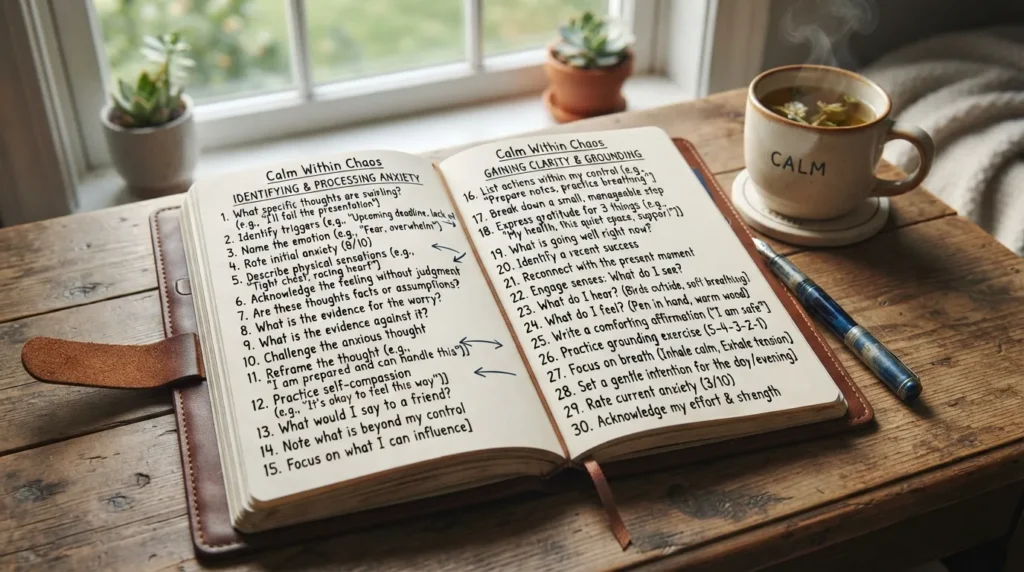
If anxiety has been making your thoughts feel loud, repetitive, or difficult to organize, journaling can give those thoughts somewhere to go. The most useful journal prompts for anxiety are not about writing perfectly—they help you notice what you are feeling, separate facts from fears, reconnect with the present moment, and identify one manageable next step.
Below, I’ve grouped practical prompts by what you may actually need in the moment: calming your body, understanding the worry, challenging anxious thoughts, dealing with overthinking, processing difficult emotions, and deciding what you can do next.
A simple place to start: If you are anxious right now, don’t try to answer 20 prompts. Pick one: “What am I afraid will happen right now, and what do I actually know to be true?” Then write whatever comes up for 5–10 minutes.
Journal Prompts for Anxiety You Can Use Right Now
When anxiety is high, open-ended journaling can sometimes feel like another task. Short, specific questions are easier to answer. Try the section that matches what you are experiencing.
1. Grounding prompts for anxious moments
Use these when your mind is racing or you feel disconnected from what is happening around you.
- What do I notice in my body right now?
- Where do I feel the anxiety most strongly—my chest, stomach, shoulders, jaw, or somewhere else?
- What can I see, hear, touch, smell, or taste around me right now?
- What does my breathing feel like without trying to change it?
- What is happening around me that tells me I am here, in this moment?
- What is one thing I can physically do to make the next five minutes feel easier?
- What do I need right now: quiet, movement, water, rest, connection, or space?
2. Prompts to understand what is triggering your anxiety
Sometimes the hardest part is figuring out what is actually bothering you. These questions help you move from a vague feeling of “something is wrong” toward a more specific concern.
- What happened just before I started feeling anxious?
- What thought keeps coming back?
- What am I afraid might happen?
- Is there a particular person, situation, decision, memory, or uncertainty connected to this feeling?
- What part of this situation feels outside my control?
- What am I trying to predict or prevent?
- Have I felt this type of anxiety before? What was happening then?
- Is today’s anxiety connected to something happening today, or is an older experience influencing how I feel now?
3. Prompts for separating facts from fears
An anxious thought can feel convincing even when you do not have evidence that it will happen. Writing the thought down gives you a chance to examine it instead of automatically accepting it.
- What am I telling myself will happen?
- What evidence supports this thought?
- What evidence does not support it?
- What do I know as a fact, and what am I assuming?
- Am I treating a possibility as if it were a certainty?
- What is the most likely outcome—not just the worst possible outcome?
- If a friend had this exact thought, what would I say to them?
- Is there another explanation for what happened?
Try this two-column exercise
Fear: “I’m going to mess everything up.”
What I actually know: “I made one mistake, but I have handled difficult situations before and I can decide what to do next.”
4. Journal prompts for overthinking
Overthinking often keeps asking the same question without producing a useful decision. These prompts can help you turn repetitive thinking into something more concrete.
- What question am I repeatedly trying to answer?
- Do I actually need more information, or am I looking for certainty that may not be possible?
- What is within my control today?
- What is outside my control?
- What decision am I avoiding?
- What is the smallest useful action I could take?
- If I could not solve this problem tonight, what would help me put it down temporarily?
- What would “good enough” look like here?
5. Prompts for anxiety about the future
- What future situation am I worried about?
- What part of the future is genuinely uncertain?
- What can I prepare for without trying to control everything?
- What is one practical thing I can do today that supports the future I want?
- What would I want to remember if this situation turns out differently than I expect?
- What have I survived or handled before that once felt uncertain?
- What would I do if the outcome I fear actually happened?
6. Prompts for anxiety and self-doubt
- What am I criticizing myself for?
- Would I judge someone I love as harshly for the same thing?
- What did I handle better than I realize?
- What is one quality I have used to get through difficult situations?
- What do I need to hear from someone I trust right now?
- What would treating myself with patience look like today?
- What mistake am I turning into a judgment about my entire character?
7. Prompts for identifying what you can control
A useful anxiety-journaling exercise is to divide the problem into what you can influence and what you cannot.
- What part of this situation can I influence?
- What part is completely outside my control?
- What is one action I can take in the next 10 minutes?
- What can wait until tomorrow?
- What am I trying to control because uncertainty feels uncomfortable?
- What would it look like to accept what I cannot change while still taking useful action?
8. Prompts for difficult emotions
- What emotion am I feeling besides anxiety?
- Where do I notice that emotion in my body?
- What does this emotion seem to be telling me?
- What happened that made this emotion stronger?
- What do I wish someone understood about how I feel?
- What do I need but have not asked for?
- What would help me process this emotion without judging myself for having it?
Journal Prompts for Anxiety and Depression
Anxiety and low mood can overlap, but they are not exactly the same experience. If you are dealing with both, your journal can explore worry while also making room for energy, motivation, connection, and self-compassion.
- What feels hardest today?
- What am I worried about, and what am I feeling sad or discouraged about?
- What did I need today that I did not receive?
- What is one small task that would make today slightly easier?
- Who could I safely reach out to?
- What is one thing I usually enjoy, even if I do not feel like doing it right now?
- What would a gentle version of today look like?
- What is one thing I accomplished, tolerated, or got through today?
If anxiety or low mood is persistent, severe, interfering with daily life, or becoming difficult to manage, journaling should be treated as a self-reflection tool rather than a replacement for professional care.
A 5-Minute Anxiety Journaling Exercise
You do not need a complicated journaling system. When you have only a few minutes, use this sequence:
- Name it: What am I feeling right now?
- Locate it: Where do I notice the feeling in my body?
- Identify it: What thought or situation seems connected to it?
- Reality-check it: What do I know as fact, and what am I predicting?
- Choose one step: What is one small thing I can do next?
Example
Feeling: “I feel nervous and overwhelmed.”
Thought: “I won’t be able to handle tomorrow.”
Fact: “Tomorrow has some uncertain parts, but I have not failed yet.”
Next step: “I’ll prepare the one thing I can control tonight, then stop planning
What Is the 3-3-3 Rule for Anxiety?
The 3-3-3 rule is commonly described as a grounding exercise that brings your attention away from anxious thoughts and toward your immediate surroundings. Versions vary, so there is not one universally standardized journaling version of the rule.
A simple version is to notice:
- Three things you can see.
- Three things you can hear.
- Three things you can physically move or notice with your body.
You can turn this into a journal entry by writing the three items under each category and then answering: “What do I notice about my anxiety after bringing my attention back to the present?”
What Is the 3-3-3 Journaling Method?
There is no single universally recognized “3-3-3 journaling method” for anxiety. Different journaling resources use the numbers differently, so it is better to focus on the purpose of the exercise rather than assuming one fixed formula.
If you want a simple structure, you can create your own 3-3-3 format: write three things you are feeling, three thoughts that are occupying your mind, and three actions or supports that could help. The structure is useful because it turns an overwhelming page into three small categories.
What Is the 3/2-1 Journaling Method?
“3/2-1 journaling” is not a single standardized clinical method, and different creators may use the name for different exercises. If you see this phrase online, check how that particular source defines it rather than assuming every version is the same.
For anxiety journaling, you can use the general idea of a short structured reflection: identify a few things you notice, narrow down the most important concern, and finish with one practical next step. The value comes from making your thoughts more manageable, not from the numbers themselves.
What Is the Best Journal for Anxiety?
The best journal for anxiety is usually the one you will actually use. You do not need an expensive notebook, a special cover, or a complicated guided journal.
If you need… | Try… |
Quick emotional check-ins | A small notebook with one-page daily prompts. |
Understanding recurring anxiety | A journal where you can record triggers, thoughts, feelings, and patterns over time. |
Structured guidance | A guided journal with prompts that reduce the pressure of deciding what to write. |
Private reflection | Any private paper or digital format that feels comfortable and secure. |
How Often Should You Journal for Anxiety?
There is no single schedule that everyone needs to follow. Some people prefer a few minutes each day, while others find it more useful to journal when a particular worry appears.
If daily journaling feels helpful rather than burdensome, try a short session at a consistent time. If writing every day makes you focus more intensely on anxious thoughts, use shorter check-ins or journal when you have a specific question to work through.
A useful rule: You do not need to fill a page. One honest paragraph can be more useful than several pages of repetitive worry.
Can Journaling Get Rid of Anxiety?
Journaling can be a useful self-reflection and coping practice, but it should not be treated as a guaranteed way to eliminate anxiety. It may help you organize thoughts, identify triggers, notice patterns, express emotions, and think through practical next steps.
For some people, repeatedly writing about the same fear without moving toward understanding or action can instead become another form of rumination. If you notice that journaling consistently leaves you more distressed, try shorter sessions, grounding prompts, or discussing the experience with a qualified mental health professional.
For general mental-health journaling ideas, resources such as Mental Health First Aid and Crisis Text Line provide additional prompt-based exercises.
When Journaling Starts Making Anxiety Worse
Pay attention to how you feel during and after writing. Consider changing your approach if you notice that you are:
- repeating the same worry without reaching a new understanding;
- spending a long time trying to achieve complete certainty;
- using the journal to repeatedly check whether something bad will happen;
- becoming more distressed every time you reread old entries; or
- avoiding everyday activities because journaling has become another anxiety ritual.
In that situation, switch from “Why is this happening?” prompts to present-focused questions such as “What do I need in the next 10 minutes?” or “What is one thing I can do without solving the entire problem?”
How to Start an Anxiety Journal Tonight
- Choose a simple format. Use paper, a notes app, or a private digital journal—whatever feels easiest.
- Set a small limit. Start with five to ten minutes rather than trying to write everything.
- Name the main concern. Write one sentence describing what is worrying you.
- Separate the thought from the fact. Ask what you actually know and what you are predicting.
- Choose one useful action. It can be tiny. The goal is not to solve your entire life in one entry.
- Close the entry. Write one sentence such as, “I have given this thought some attention, and I can return to it later if I need to.”
Frequently Asked Questions
What are some good prompts for journaling about anxiety?
Start with prompts that help you identify the worry, distinguish facts from predictions, notice what is happening in your body, and choose something within your control. For example: “What am I afraid will happen?”, “What evidence do I have?”, and “What is one small step I can take now?”
What are some journal prompts for anxiety and overthinking?
Ask: “What question am I repeatedly trying to answer?”, “Do I need more information or more certainty?”, “What is within my control?”, and “What would be good enough for today?” These questions can help turn repetitive thinking into a more specific problem-solving exercise.
What are some journal prompts for anxiety and panic?
During an intense moment, keep prompts simple and present-focused: “What do I notice around me?”, “Where do I feel this in my body?”, “What is happening right now?”, and “What do I need for the next few minutes?” Journaling is not a substitute for urgent medical or mental-health support when symptoms are severe or feel unsafe.
Can I use these prompts for anxiety every day?
Yes, if regular journaling feels helpful. Keep sessions short and vary the prompts so you are not repeatedly analyzing the same fear. A simple daily check-in about emotions, triggers, needs, and one manageable action can be enough.
Should I write about my anxiety before bed?
You can, but choose the type of prompt carefully. If detailed problem-solving makes your mind more active at night, try a brief “brain dump” followed by a calming closing question such as “What can wait until tomorrow?” The goal is to put the concern down rather than continue analyzing it.
What if I don’t know what to write?
Start with one sentence: “Right now, I feel ___ because ___.” Then ask, “What do I need?” You do not have to produce an insightful entry. Honest, simple writing is enough.
Pimchanok Srisuk
Pimchanok Srisuk is the Journaling Editor at Holistic Wellbeing Living. She writes about journaling prompts, reflective writing, emotional clarity, and mindful routines. With seven years of experience creating personal-growth content, Pimchanok helps readers use simple writing practices to understand their thoughts and make calmer everyday decisions.