Jump to:
ToggleWhat Is a Daily Journal? Meaning, Benefits, and How to Start One
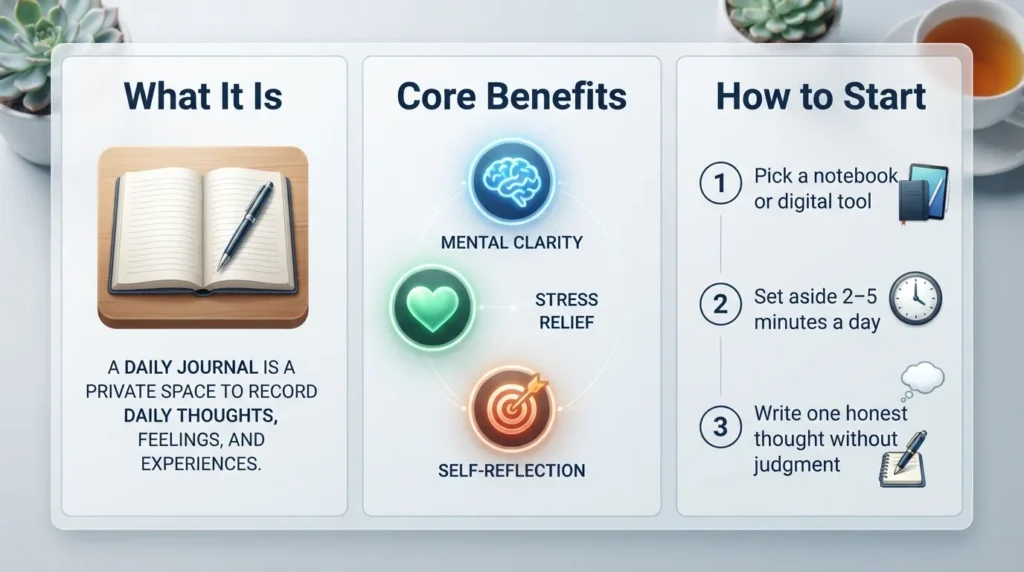
A daily journal is a personal written record where you note down your thoughts, feelings, goals, and daily experiences on a regular basis. Far more than just a place to log what happened today, it serves as a simple tool for mental clarity, stress relief, and personal growth. Taking just a few minutes each day to write helps you process complex emotions, clear away mental clutter, and track how you evolve over time.
In this guide, you’ll learn exactly what a daily journal is, how it differs from a diary, what to write, proven methods like 3-3-3 and 3/2-1, and how to start today.
What Is a Daily Journal?

A daily journal is a private space where you regularly write down your thoughts, feelings, and experiences to process your life and gain mental clarity. At its core, it is a personal tool for reflection rather than a strict log of events.
Making it “daily” is all about consistency, not perfection. You do not need to write every single day at the exact same time for hours on end to keep a daily journal. It simply means creating a flexible routine where you turn to your notebook regularly—whether that is five minutes every morning, a few lines before bed, or a quick check-in a few times a week. The goal is to build a steady habits of checking in with yourself without feeling guilty if you skip a day.
Journal vs. Diary — What’s the Real Difference?
People often use the terms “journal” and “diary” interchangeably, but they actually serve two different purposes.
A diary is mainly a chronological record of what happened during your day. It focuses on external events—the meetings you had, the people you saw, or the places you went. It acts like a personal history book to help you log memories.
A journal, on the other hand, digs into how you felt about those events and what they mean to you. Instead of just listing what you did, a journal gives you room to process your emotions, explore ideas, and understand your internal world.
| Aspect | Diary | Journal |
| Focus | Daily events | Thoughts & feelings |
| Structure | Chronological log | Reflective, freeform |
| Purpose | Record memories | Process emotions, gain clarity |
Why Do People Keep a Daily Journal?
Ask ten people why they journal and you'll probably get ten different answers. But when you dig a little deeper, most of them come back to the same few reasons — and once you see them laid out, it's easy to understand why this simple habit has stuck around for so long.
The first one is a clearer mind. Your head can only hold so much before things start to feel crowded. The moment you write a thought down, even a messy, half-formed one, you're giving your brain permission to stop holding onto it. A lot of people notice they feel calmer, or even sleep better, within just a few days of starting.
It also gives you something most people never get to see — real proof of your own growth. Go back and read an entry from six months ago and you'll probably notice things you'd never catch otherwise. Maybe something that used to stress you out doesn't bother you anymore. Maybe a goal you quietly wrote down actually happened. That kind of perspective is hard to get any other way.
Journaling is also a surprisingly good problem-solving tool. There's something about putting a tangled decision into actual words on a page that makes it feel less overwhelming. You start to see the situation more clearly, almost like you're looking at someone else's problem instead of your own.
Goals tend to stick better when they're written down too. Instead of getting buried in your memory next to a hundred other things, they stay somewhere you'll actually see again — and that alone makes you more likely to follow through.
And then there's the emotional side of it. Writing regularly helps you process what you're feeling instead of just carrying it around all day. We'll get into what psychologists actually say about this a bit later, but even without the research, most people who journal will tell you it simply makes them feel a little more steady.
What Should You Write in a Daily Journal?
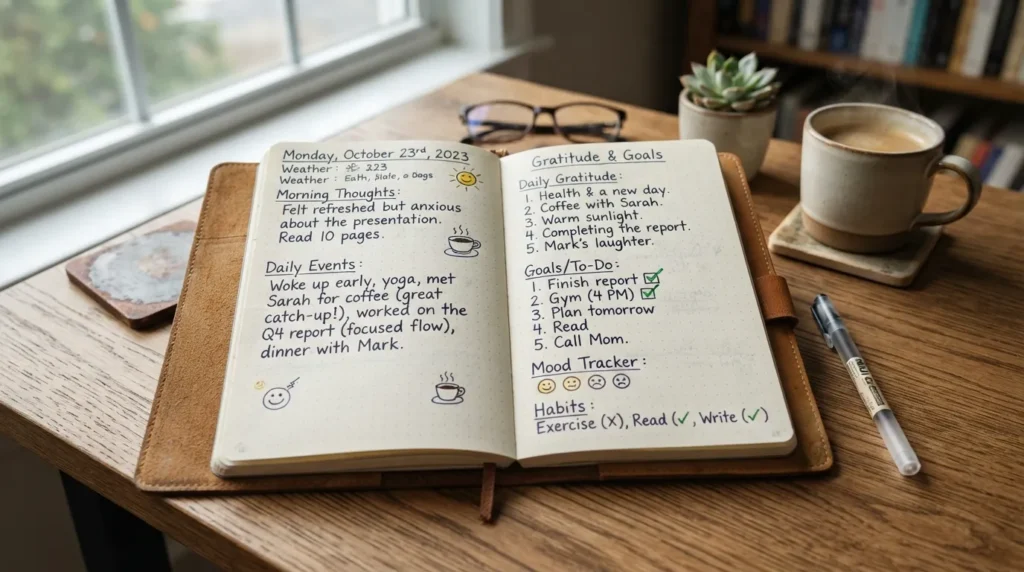
If you open a blank notebook and feel completely stuck, you are not alone. The beauty of keeping a daily journal is that there are no strict rules or required topics. Your page is simply a private space to unpack whatever is on your mind.
If you need a little inspiration to get going, here are a few simple things you can focus on.
Your Feelings & Emotions
Writing down how you feel is one of the most effective ways to process your day. When you get heavy emotions out of your head and onto paper, they often feel much easier to manage. You don’t need to analyze everything deeply—just naming what you feel (like stress, joy, or frustration) can bring a lot of relief.
Daily Events & Highlights
You don’t need an action-packed day to write about what happened. Documenting simple moments—a good cup of coffee, a pleasant conversation, or a small win at work—helps you build a record of your life. Over time, reading back through these daily entries gives you a clear picture of how much you’ve grown.
Gratitude
Taking a minute to list a few things you appreciate can shift your entire mindset. Gratitude journaling does not have to be dramatic; you can be thankful for good weather, a comfortable chair, or a quiet morning. Noticing the good parts of your day trains your brain to spot positive moments more easily.
Goals & Plans
A journal is a great place to map out your next steps. You can write down your big long-term dreams, or simply outline what you need to finish before dinner. Writing down your daily goals keeps you grounded and helps you focus on what actually matters to you.
Ideas, Dreams & Random Thoughts
Inspiration strikes at unpredictable times. Your journal can act as a landing pad for creative ideas, strange dreams you had last night, or random thoughts you want to explore later. Getting these thoughts down on paper keeps your brain uncluttered so you can focus on the present moment.
Remember: There is no single “right” way to fill your pages. Whether you write freeform stream-of-consciousness sentences, use guided prompts, or stick to bulleted lists, the best journal setup is simply the one that feels effortless to you.
Popular Daily Journaling Methods
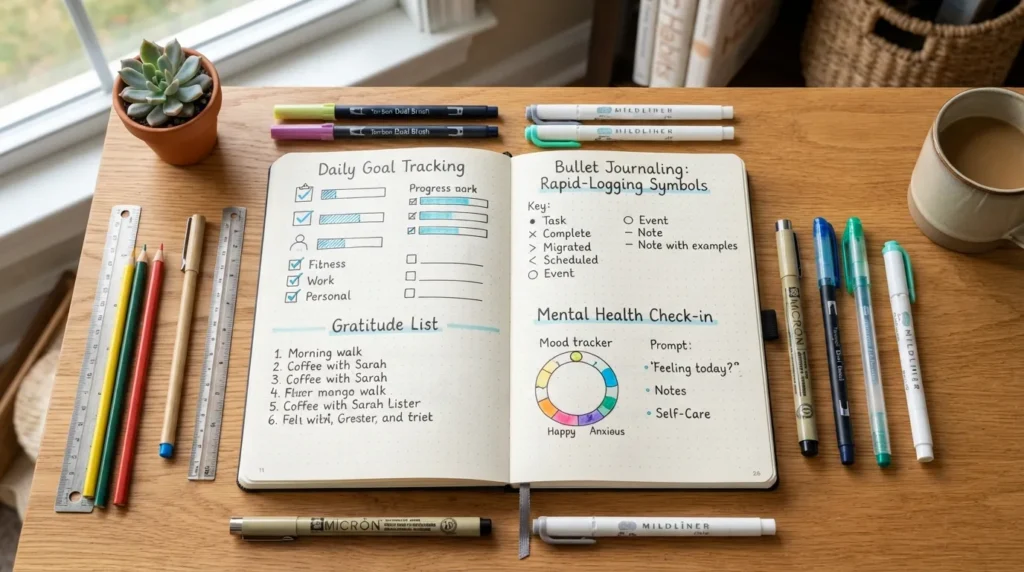
The 3-3-3 Journaling Method
If you want a quick routine that takes less than five minutes, the 3-3-3 method is a great place to start. It helps you focus on positivity, recognize your progress, and set your direction for the next day without feeling overwhelmed.
To use this approach, write down:
3 things you are grateful for: These can be big milestones or simple pleasures, like a warm cup of coffee or a good conversation.
3 things you accomplished today: Acknowledge what you got done, whether it was finishing a major work project or simply making time to stretch.
3 goals for tomorrow: Pick three realistic tasks you want to tackle next so you wake up with a clear focus.
The 3/2/1 Journaling Method
The 3/2/1 method offers another structured way to reflect on your day. It gives you a balanced framework to celebrate the good moments, learn from your daily experiences, and keep moving forward.
Here is how to set it up:
3 highlights: Write down three positive things that happened during your day.
2 lessons: Note two insights or practical lessons you learned, even from small setbacks or mistakes.
1 goal: Choose one primary goal to focus on tomorrow to keep your momentum steady.
How to Start a Daily Journal (Step-by-Step for Beginners)
Starting a journal sounds simple until you actually sit down to do it — then suddenly the blank page feels bigger than it should. The good news is you don't need a system, a fancy notebook, or a perfect plan. You just need a few small decisions to get going.
Step 1: Pick your format — paper or digital
Some people love the feel of pen on paper. Others would rather type on their phone or laptop because it's faster and always with them. Neither one is better — the right format is simply the one you'll actually stick with. If you're not sure, try both for a week and see which one feels easier.
Step 2: Choose a consistent time
Journaling works best when it's tied to something you already do every day. Some people write first thing in the morning with their coffee, before the day gets busy. Others prefer winding down at night, going over what happened. Pick whichever time fits your routine, not someone else's.
Step 3: Start small — even 2–3 lines count
You don't have to fill a whole page to make it "count." Some of the most consistent journalers write just two or three lines a day. The goal isn't length, it's showing up. Once it becomes a habit, you can always write more if you feel like it.
Step 4: Use prompts if you're stuck
Staring at a blank page with no idea what to write is one of the biggest reasons people quit early. If that happens, don't force it — just answer a simple question instead. Something like "What's on my mind right now?" or "What's one thing that went well today?" is usually enough to get you writing again.
Step 5: Don't self-edit — write freely
This is your journal, not an essay. Nobody is grading your grammar or your sentence structure. Let the thoughts come out messy if they need to. The second you start worrying about how it sounds, you'll stop writing what you actually feel.
Step 6: Review your entries weekly or monthly
Every so often, go back and read what you've written. This is where journaling really pays off — you'll start noticing patterns, spotting what's been stressing you out, and seeing how far you've come. A quick Sunday-night read-through or a monthly flip-back works well for most people.
What Does a Daily Journal Entry Look Like? (Example)
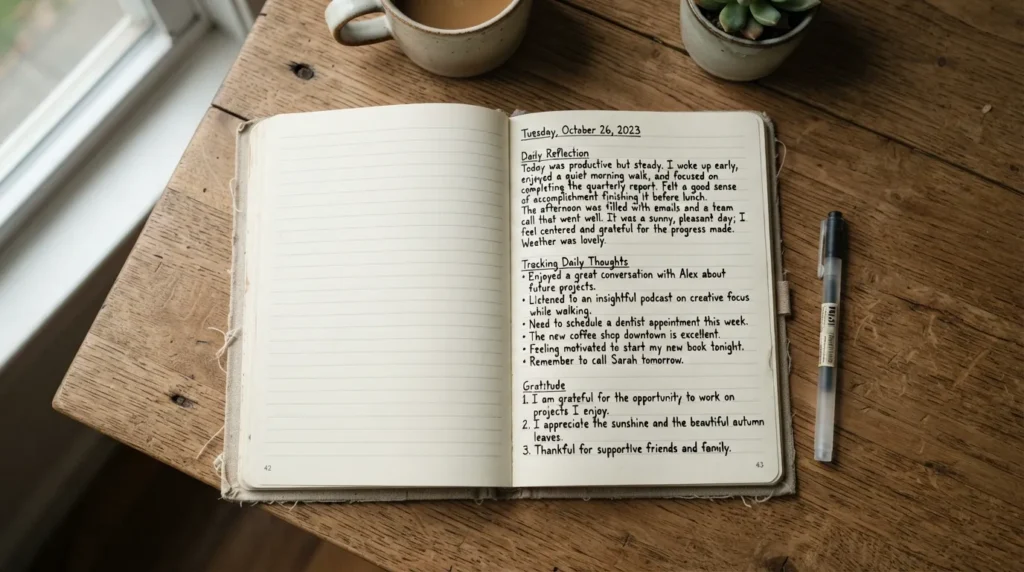
Here is a quick look at how a realistic daily journal entry might come together in just a few lines:
“Work felt pretty overwhelming this afternoon because of the tight deadline, and I noticed my shoulders tensing up during our team meeting. I took a quick ten-minute walk outside around 3 PM, which helped clear my head enough to finish my main tasks. I’m really grateful for my coworker Sam, who offered to review my report before I turned it in.”
What Do Psychologists Say About Journaling?

Psychologists often view journaling as a practical tool for emotional processing and mental clarity. When you write about your daily experiences, you give your brain a structured space to make sense of complex feelings instead of letting them pile up in your head.
Research on expressive writing consistently shows that putting your thoughts into words can lower stress levels and help manage anxiety. Experts highlighted by the American Psychological Association note that regular journaling helps interrupt the pattern of rumination—that frustrating mental loop where you replay worries repeatedly. Getting those thoughts out on paper gives you some distance from them, which makes your problems feel much easier to handle.
Is There a Dark Side to Journaling?

Journaling is widely praised for its mental health benefits, but it is not completely foolproof. Like any self-reflection tool, how you use it determines whether it actually helps you or leaves you feeling stuck.
One common trap is rumination—the habit of dwelling on negative thoughts and repeating them over and over on the page. When you simply dump your heaviest emotions into a notebook without guiding those thoughts toward a resolution, you end up reliving the stress rather than releasing it. Instead of bringing relief, your journal becomes a magnifying glass for your bad mood.
This often leads to overanalyzing rather than truly processing your emotions. Processing means acknowledging a feeling, understanding why it is there, and letting it move through you. Overanalyzing happens when you dissect every detail, look for hidden meanings in every thought, and get caught up in endless “why” questions that don’t have clear answers.
To keep your daily journal habit healthy and beneficial, try adopting a balanced approach:
Time-box your entries: Set a timer for 5 or 10 minutes. Giving yourself a soft limit stops you from spiraling into excessive overthinking.
Pair venting with gratitude or action: If you spend half your time writing about something that went wrong, use the remaining time to write down one thing you are grateful for, or one small step you can take to address the issue.
Know when to close the notebook: Once you have put your thoughts down, step away. Close the journal, take a deep breath, and transition into another activity like going for a walk, making tea, or starting your workday.
Why Do Some People Avoid Journaling?
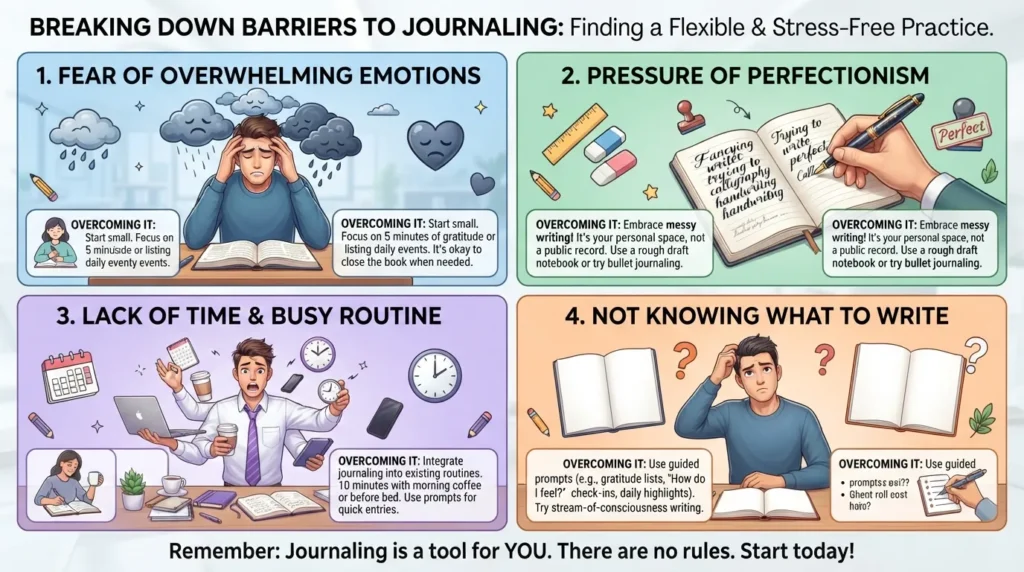
Despite all its benefits, plenty of people hesitate to pick up a pen. Most of the time, this avoidance comes down to a few common worries—all of which are much easier to overcome than you might think.
“I don’t know what to write”
Staring at a blank, white page can feel intimidating. When you sit down without a clear idea, your mind often goes blank, making the exercise feel frustrating.
The Fix: Use simple journaling prompts. Asking yourself basic questions like “What made me smile today?” or “What is one thing on my mind right now?” gives your brain an easy place to start.
Fear of being read by someone else
It is tough to be completely honest on paper if you are constantly worried a roommate, partner, or family member might stumble across your private thoughts. This fear forces you to filter yourself, which defeats the purpose of the practice.
The Fix: Build solid privacy practices. Keep a password-protected digital journal, lock your physical notebook in a desk drawer, or explicitly establish boundaries with the people you live with regarding your personal space.
It feels like a chore or a source of pressure
Many people abandon journaling because they think they have to write long, deep entries every single night. When life gets busy, meeting that standard feels like adding another exhausting task to an already long to-do list.
The Fix: Give yourself permission to write just one line. On busy days, writing “Today was exhausting, but I finished my project” counts as a complete entry. Consistency matters far more than length.
Perfectionism about writing quality
If you catch yourself worrying about bad handwriting, awkward grammar, or sloppy sentence structure, perfectionism is getting in your way. You might feel like your notebook needs to look neat and aesthetic, like the ones you see on social media.
The Fix: Remind yourself that a daily journal is a private workspace, not a published manuscript. It does not need to look pretty or sound eloquent. It is simply a safe place to unpack your mind, exactly as it is.
Is Keeping a Daily Journal Actually Good for You?
Yes, keeping a daily journal is genuinely good for you—provided you approach it with a healthy, balanced mindset. Research on expressive writing shows that putting your thoughts onto paper can lower stress, clear mental clutter, and help you process complex emotions. However, it works best when it feels like a supportive habit rather than an exhausting chore. If journaling starts to feel like a performance or a space where you fixate solely on negative thoughts, it can lose its benefits. Used intentionally, it remains one of the simplest, most effective tools for personal growth and emotional balance.
Frequently Asked Questions
How do I write a daily journal?
To write a daily journal, pick a quiet moment and write down whatever is on your mind. You can describe your day, list things you are grateful for, or explore how you feel. There are no strict rules, so focus on being honest rather than worrying about perfect grammar or neat handwriting.
How do beginners start journaling?
Beginners can start journaling by keeping it simple and setting low expectations. Choose a basic notebook or a digital app, and commit to writing for just two to three minutes a day. Using simple daily prompts or writing three things you are grateful for makes building the habit easy and stress-free.
What is the dark side of journaling?
The main drawback of journaling occurs when it turns into rumination, where you endlessly replay negative experiences without moving toward resolution. It can also become harmful if you use it to judge yourself harshly or if it replaces real-world problem solving and talking with trusted friends or professionals.
Is having a daily journal good?
Yes, having a daily journal is very good for your mental and emotional well-being. It helps you manage stress, gain clarity on your goals, track personal growth, and process difficult feelings. Regular writing creates a safe, private space to clear your head and check in with yourself.
Why do people avoid journaling?
People often avoid journaling because they fear they lack the time or do not know what to write. Others worry about privacy, fear facing uncomfortable emotions, or fall into perfectionism, believing their entries must be beautiful or profound. Overcoming these mindsets makes starting much easier.
What is the 3-3-3 journaling method?
The 3-3-3 journaling method is a quick daily exercise designed to build focus and gratitude. Every day, you write down three things you are grateful for, three things you want to accomplish, and three things you want to let go of. It takes under five minutes and provides immediate mental clarity.
What do psychologists say about journaling?
Psychologists frequently recommend journaling as an effective tool for emotional regulation and stress reduction. Expressive writing allows your brain to organize unstructured thoughts, making problems feel more manageable. Mental health experts emphasize that consistent, unfiltered writing helps process difficult life events safely.
What is the 3-2-1 method of journaling?
The 3-2-1 method is a simple framework to guide your daily reflection. To use it, you write down three things you noticed today, two things you learned, and one thing you are looking forward to tomorrow. It helps balance reflection with positive forward momentum.
What is a daily journal example?
A daily journal entry can be as simple as writing: “August 14: Feeling a bit overwhelmed by work today, but drinking coffee on the porch this morning was peaceful. My goal for tonight is to disconnect early, read a chapter of my book, and get a good night’s sleep.”
Pimchanok Srisuk
Pimchanok Srisuk is the Journaling Editor at Holistic Wellbeing Living. She writes about journaling prompts, reflective writing, emotional clarity, and mindful routines. With seven years of experience creating personal-growth content, Pimchanok helps readers use simple writing practices to understand their thoughts and make calmer everyday decisions.