Jump to:
ToggleWhat is a Reflective Journal? The Ultimate Guide to Reflective Writing & Self-Growth
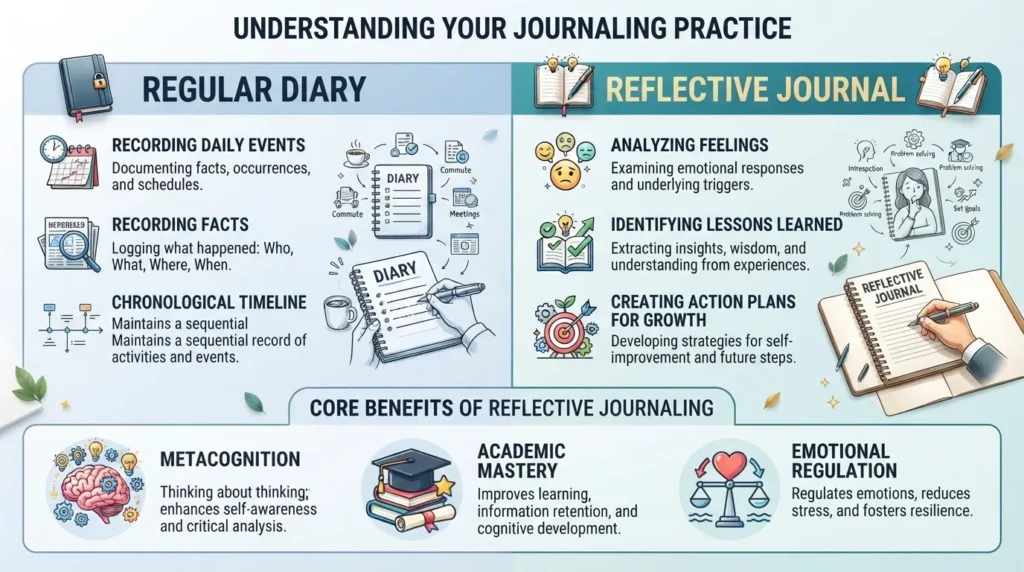
A reflective journal is a structured personal document where individuals record their experiences, evaluate their reactions, and extract practical insights to foster ongoing personal, academic, or professional development. Unlike a standard daily log or diary, reflective journaling shifts the focus away from simply recounting what happened to deeply analyzing why it happened, how it made you feel, and what you can do differently in the future.
Understanding Reflective Journaling
To truly understand what a reflective journal is, you must look at how human learning works. Reflective journaling bridges the gap between raw, real-world experiences and meaningful learning. It acts as an internal mirror, encouraging critical thinking and self-awareness.
Reflective Journal vs. Traditional Diary
Many people confuse reflective journals with standard personal diaries. While both involve writing about daily life, their goals and structures are completely different.
Standard Diary: Focuses on chronological event recaps (e.g., “I attended a workshop today and then met a friend for lunch”).
Reflective Journal: Focuses on analytical self-assessment (e.g., “During today’s workshop, I felt defensive during the feedback session. Why did I react that way, and how can I handle criticism more constructively next time?”).
Primary Purpose & Goals of a Reflective Journal
Fostering Critical Thinking: It helps you question assumptions, evaluate actions, and examine different perspectives.
Tracking Growth Over Time: By looking back at past journal entries, you can visually trace how your mindset, behavior, and problem-solving skills have matured over months or years.
Identifying Hidden Emotional Triggers: It allows you to uncover subtle habits, stressors, and emotional patterns that affect your daily choices.
Improving Decision-Making: Unpacking past mistakes and successes helps you make more deliberate, evidence-based choices in future scenarios.
Key Features of an Effective Reflective Journal
A high-quality reflective entry contains specific characteristics that set it apart from basic freewriting.
Subjective Insights: It captures your personal interpretations, feelings, and internal monologues alongside external events.
Process-Oriented Focus: It centers on the mechanisms of growth—emphasizing why a situation unfolded a certain way rather than just describing the static outcome.
Ongoing Continuity: It forms a continuous timeline of learning, where each entry builds upon previous reflections.
Self-Assessment & Evaluation: It acts as a private evaluation tool where you critically grade your own actions, strengths, and areas needing improvement.
Core Frameworks: The 5 R’s & Gibbs’ Reflective Cycle
To write a deep reflective journal entry without getting stuck in superficial summaries, experts use established educational frameworks.
The 5 R’s of Reflective Writing
The 5 R’s framework guides you step-by-step through the reflection process:
Reporting: Briefly describe the situation, event, or task. Keep this brief and factual.
Responding: Detail your immediate thoughts, emotional reactions, and initial feelings regarding the event.
Relating: Connect the current experience to your prior knowledge, personal background, or past encounters.
Reasoning: Analyze why things happened the way they did. Examine underlying theories, core principles, or external contributing factors.
Reconstructing: Formulate a concrete future action plan based on what you have learned from this analysis.
Gibbs’ Reflective Cycle
Gibbs’ model breaks down reflection into a smooth 6-step loop:
Description: What happened?
Feelings: What were you thinking and feeling?
Evaluation: What was good and bad about the experience?
Analysis: What sense can you make of the situation?
Conclusion: What else could you have done?
Action Plan: If it arose again, what would you do?
Reflective Journals Across Different Domains
Reflective writing changes its tone depending on where and why it is applied.
A. In Education & Academic Settings
In university courses, schools, and online programs, educators assign reflective journals (often called learning logs) to evaluate student comprehension.
Formative Assessment: Teachers use student journals to identify learning gaps without relying solely on exams.
Active Engagement: Writing requires students to process lectures, scholarly readings, and assignments actively rather than passively memorizing information.
B. In Professional Practice (Healthcare & Teaching)
Professionals in fields like nursing, counseling, and teaching use reflective logs to maintain high standards of service.
Clinical Reflections in Nursing: Healthcare professionals record daily patient encounters to refine clinical judgment and improve patient care.
Educator Logs: Teachers analyze classroom interactions, lesson plan delivery, and student engagement to continuously update their instruction strategies.
C. In Personal Life & Mental Wellbeing
Outside academic and clinical settings, reflective journaling plays a major role in personal growth and stress management.
Emotional Regulation: Writing down complex emotional reactions creates distance between you and your stress, reducing anxiety.
Mindfulness Alignment: It helps align daily actions with personal core values and holistic wellness goals.
How to Start a Reflective Journal: A Step-by-Step Guide
Starting a reflective writing habit is straightforward when you follow a structured routine.
Step 1: Choose Your Preferred Medium
Decide whether you write best using a classic paper notebook or digital tools like Notion, Google Docs, or specialized journaling apps.
Step 2: Establish a Regular Writing Schedule
Set aside 10 to 15 minutes daily or at the end of every week. Consistency matters far more than writing long entries.
Step 3: Use Prompts to Trigger Deep Thought
Instead of staring at a blank page, start writing using focused questions:
What went particularly well today, and why?
What situation made me feel stressed or uncomfortable, and what caused that reaction?
What specific action can I take tomorrow to handle similar situations better?
Step 4: Write Unfiltered and Honestly
Do not worry about perfect grammar, flowery vocabulary, or aesthetic handwriting. Focus on total honesty regarding your thoughts and feelings.
Step 5: Periodically Review Past Entries
Set aside time every month to reread previous entries. Look for recurring patterns, progress, and areas where your mindset has evolved.
To get a clearer visual understanding of how reflective journals function as educational tools, watch this breakdown of the core principles:
Key Video Highlights:
- Reflection as a Mirror: Just as a physical mirror shows your outer appearance, a reflective journal mirrors your thoughts, actions, and internal experiences.
- Focusing on "How" and "Why": Effective logs move past basic descriptions to analyze underlying motives and learning processes.
- Communication Channel: In academic setups, reflective journals serve as an ongoing, indirect dialogue between students and educators to track overall progress.
Practical Reflective Journal Examples
Example 1: Academic Student Reflection
Situation: “I received a low grade on my history research paper today.”
Reflection: “My initial reaction was frustration, and I wanted to blame the grading criteria. However, when looking closely at the feedback, I realized I rushed through the source verification step during the last two days before the deadline. My poor time management directly caused this outcome. Next time, I will create a project timeline with set milestones two weeks in advance.”
Example 2: Professional Workplace Reflection
Situation: “A team meeting got heated while discussing the new project timeline.”
Reflection: “I noticed that I interrupted my teammate twice when they questioned my proposed schedule. My reaction stemmed from feeling defensive about my planning abilities. Interrupting prevented us from hearing a valid point about workload constraints. In future meetings, I will practice active listening by pausing for 5 seconds before responding to objections.”
Frequently Asked Questions
What is a reflective journal example?
A reflective journal example is an entry where a writer documents an event (such as a difficult team meeting), describes their emotional response (feeling anxious or defensive), analyzes why they felt that way using personal or external factors, and outlines an action plan to manage similar meetings better in the future.
What are the 5 R's of reflective writing?
The 5 R's of reflective writing are Reporting (describing the event), Responding (recording immediate feelings), Relating (connecting to past knowledge or experiences), Reasoning (analyzing the underlying causes), and Reconstructing (creating a future action plan).
What is the main goal of a reflective journal?
The primary goal of a reflective journal is to promote self-awareness, critical thinking, and continuous self-improvement by helping individuals convert daily experiences into actionable lessons.
How long should a reflective journal entry be?
A typical reflective journal entry ranges from 250 to 500 words. However, depth of reflection and honest analysis are far more important than reaching a specific word count.
Pimchanok Srisuk
Pimchanok Srisuk is the Journaling Editor at Holistic Wellbeing Living. She writes about journaling prompts, reflective writing, emotional clarity, and mindful routines. With seven years of experience creating personal-growth content, Pimchanok helps readers use simple writing practices to understand their thoughts and make calmer everyday decisions.