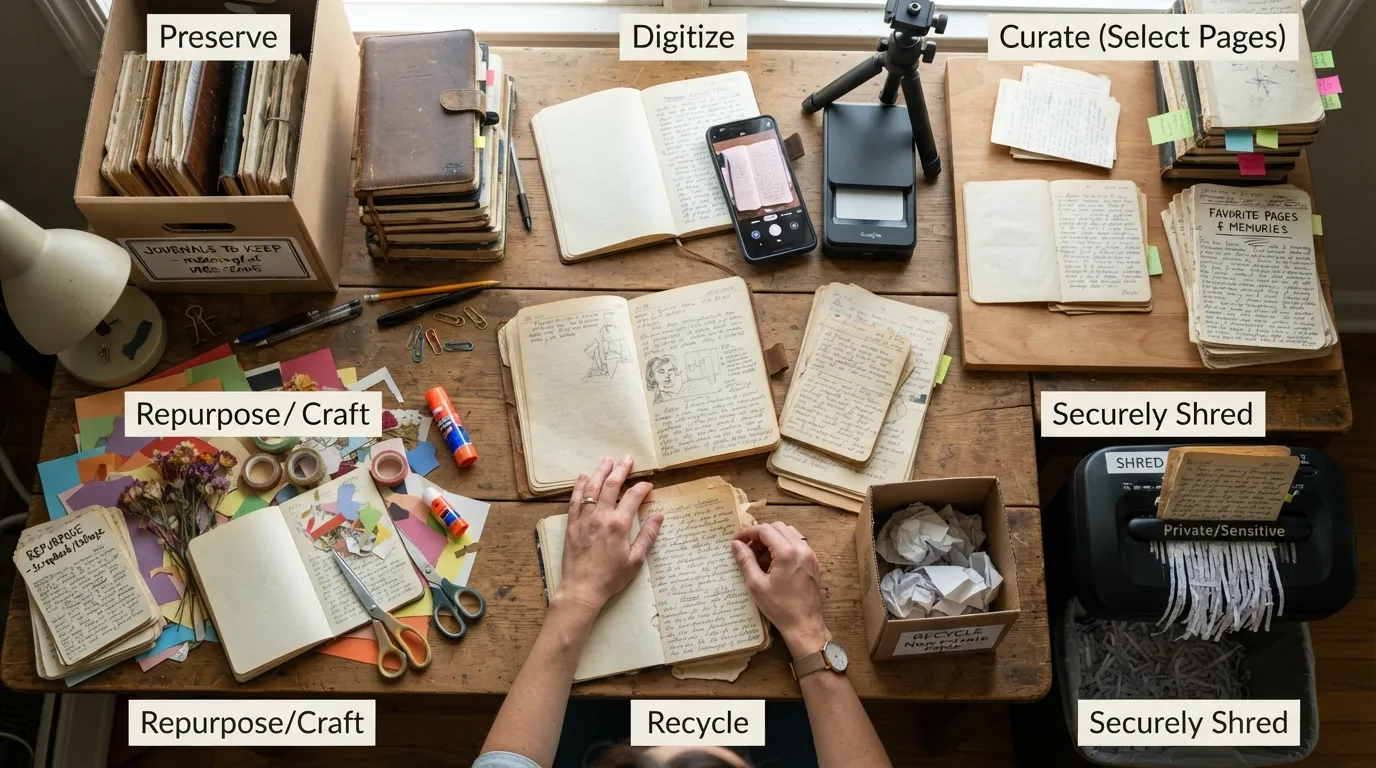
If you have a box, drawer, or shelf full of old journals, you do not have to make one big decision about all of them. Some may be worth keeping, some may be better digitized, and others may be ready to let go.
The best approach is to decide what each journal means to you, how private its contents are, how much physical space you want to give it, and whether you would actually want the memories later. From there, you can keep, curate, digitize, repurpose, recycle, or securely destroy your old journals.
A simple rule: You do not have to keep every page to keep the memories that matter. You can preserve the meaningful parts and let go of the rest.
What Should You Do With Old Journals?
Start by choosing one of six options:
- Keep them if they contain memories, writing, artwork, or experiences you genuinely want to preserve.
- Curate them by keeping only your favorite or most meaningful pages.
- Digitize them if you want the information or memories without keeping every physical book.
- Repurpose them for collages, scrapbooks, bookmarks, or other paper crafts.
- Recycle them when the contents are not private and you no longer need the paper.
- Securely destroy them when privacy is more important than preservation.
You can also use different options for different journals. A diary from an important period of your life may deserve careful preservation, while an old notebook filled with ordinary daily notes may be much easier to release.
Should You Keep Your Old Journals?
There is no rule saying you should keep every journal you have ever written. Keep an old journal when its value to you outweighs the space, privacy concerns, or emotional weight that comes with storing it.
Keep it if it contains something you may value later
- Important life events or milestones
- Memories from a period you want to remember
- Creative writing, drawings, poems, or ideas
- Family stories or information that may become meaningful over time
- Reflections that show how you changed or grew
Consider letting it go if keeping it no longer serves you
- You are keeping it only because you feel guilty throwing it away.
- You have no interest in reading it again.
- It takes up space you genuinely need.
- It contains private material you no longer want to preserve.
- You have already preserved the few pages or memories that matter most.
If you are unsure, you do not have to make an irreversible decision immediately. Put the journals aside for a short period and decide later. Sometimes the easiest way to declutter is to separate the decision to keep the memory from the decision to keep the entire object.
Read Your Old Journals Before Getting Rid of Them?
You can, but you do not have to. Reading an old journal can be fascinating because it shows you what you cared about, worried about, or dreamed about at another point in your life. It can also bring back memories you would rather leave alone.
If you are curious but overwhelmed by a full journal, try skimming a few pages rather than reading everything from beginning to end.
You are allowed to destroy a journal without rereading it. If privacy or emotional comfort is your priority, you do not owe the old pages another reading before you let them go.
What If Your Old Journals Are Embarrassing or Very Private?
This is one of the biggest reasons people hesitate to get rid of old diaries. You may have written things as a teenager or during a difficult period that you would never want another person to read.
If privacy is a concern, treat the journal differently from ordinary recyclable paper. Before donating, passing it to someone else, or putting it into a recycling bin, consider whether the pages contain names, addresses, passwords, financial information, intimate thoughts, or other identifying details.
For highly private material, secure destruction is usually more appropriate than donation. If you want to preserve some memories, remove or digitize only the pages you actually want to keep.
10 Practical Things You Can Do With Old Journals
1. Keep the journals that still matter to you
If a journal represents an important chapter of your life, there is nothing wrong with keeping it. Choose a dedicated shelf, box, or cabinet rather than allowing old notebooks to spread throughout your home.
2. Create a collection of your favorite pages
You do not necessarily need the entire journal. If only a handful of entries matter, keep those pages and let go of the rest. Meaningful entries, favorite quotes, drawings, poems, and important memories are good candidates.
3. Digitize the pages you want to preserve
Scanning or photographing journal pages can reduce physical clutter while allowing you to preserve important memories.
- Choose the pages you genuinely want to keep.
- Scan them or photograph them in good lighting.
- Organize the files by journal, year, or life period.
- Back up important files in more than one location.
- Password-protect sensitive digital material when appropriate.
- Decide separately whether the physical journal still needs to be kept.
4. Turn meaningful pages into a scrapbook
If you enjoy memory keeping, combine selected journal pages with photographs, ticket stubs, drawings, letters, or other keepsakes. This can turn several bulky journals into one smaller collection that is easier to revisit.
5. Make collages or mixed-media artwork
Pages that no longer need to be preserved can become part of a collage or mixed-media project. You can paint over sections, cut out interesting phrases, or combine handwritten pieces with photographs and other materials.
6. Make bookmarks, gift tags, or other paper crafts
Old journal paper can be reused for small craft projects such as bookmarks, gift tags, decorative paper, or scrapbook elements. Avoid using private entries where another person could read them.
7. Store them properly for the long term
If you decide to preserve your physical journals, protect them from conditions that can accelerate deterioration.
- Keep them in a dry environment.
- Avoid prolonged direct sunlight.
- Avoid damp basements and excessively hot storage areas.
- Use archival-quality storage materials when long-term preservation is important.
- Do not cram journals into a box so tightly that they become difficult to remove.
8. Recycle them when privacy is not an issue
If the journal contains nothing sensitive and you have decided you no longer need it, recycling may be an option depending on your local recycling rules. Remove anything that should not go into the recycling stream and check your local guidance for accepted paper materials.
9. Shred highly private journals
For diaries containing sensitive information, a cross-cut shredder provides a more privacy-focused approach than simply putting intact pages in the recycling or trash. If there are too many journals to handle at home, look for a reputable document-destruction service that accepts personal paper.
10. Create a personal “closing chapter” ritual
Sometimes an old journal represents a version of yourself that you are ready to leave behind. You might select a few pages to preserve, write a short reflection about what you learned, and then securely dispose of the remaining material. The important part is choosing a process that feels meaningful to you rather than keeping something solely because it is old.
How to Declutter a Collection of Old Journals
If you have dozens of journals, going through every page at once can make the process harder. Instead, sort the collection in stages.
- Gather everything together. This gives you a realistic view of how much you actually have.
- Separate obvious keepers. Put aside journals you immediately know are important.
- Create a “decide later” group. Do not force yourself to make every emotional decision immediately.
- Curate meaningful pages. Save important memories, artwork, or writing.
- Digitize what makes sense. A digital copy may be enough for some material.
- Separate private material. Anything sensitive should be handled differently from ordinary paper.
- Choose the final destination. Store, digitize, repurpose, recycle, or securely destroy.
What Is the Best Way to Store Old Journals?
For journals you want to preserve for years, think about both the paper and the information inside it. A dry, stable environment away from prolonged direct sunlight is preferable to places that experience significant heat or moisture.
If the journals have strong sentimental, historical, or archival value, consider archival-quality storage materials. Keep private journals somewhere secure if you do not want visitors or other household members casually accessing them.
You can also make a simple inventory of the collection so you know what each box or group contains without repeatedly opening every journal.
What Should You Do With a Diary From 10 Years Ago?
Treat it as a personal decision rather than assuming its age makes it valuable or worthless. A ten-year-old diary may contain important memories, creative work, or a record of a period you have completely forgotten. It may also contain writing that no longer represents who you are.
If you are unsure, skim it, identify the pages you would regret losing, and preserve those first. You can then decide whether the entire diary deserves a permanent place in your collection.
Frequently Asked Questions
Should I throw away my old journals?
You can if you no longer want them. Before doing so, check for private information and decide whether there are pages you would regret losing. If there are, keep or digitize those pages first.
Is it okay to get rid of old diaries?
Yes. A journal is a personal record, not an obligation. If keeping it no longer feels useful or meaningful, you can choose to let it go.
How can I declutter my old journals?
Sort them into keep, curate, digitize, repurpose, recycle, and secure-destruction groups. Start with the easiest decisions and leave emotionally difficult journals until you have more clarity.
How should I store old journals?
Keep them in a dry, stable environment away from prolonged direct sunlight, excessive heat, and moisture. For journals with significant long-term value, consider archival-quality storage materials.
What should I do with embarrassing old diaries?
You do not have to keep or reread them. If you want some memories, preserve selected pages or create digital copies. If privacy is more important, securely destroy the pages rather than donating or disposing of them intact.
Can I use old journal pages for crafts?
Yes. Non-sensitive pages can be used for collages, scrapbooks, bookmarks, gift tags, and other paper crafts. Avoid repurposing pages that contain information you would not want someone else to read.
Should I digitize my old journals?
Digitization is useful when you want to preserve selected memories without storing every physical journal. Focus on meaningful pages rather than automatically scanning everything, and protect sensitive digital files with appropriate security and backups.
Pimchanok Srisuk
Pimchanok Srisuk is the Journaling Editor at Holistic Wellbeing Living. She writes about journaling prompts, reflective writing, emotional clarity, and mindful routines. With seven years of experience creating personal-growth content, Pimchanok helps readers use simple writing practices to understand their thoughts and make calmer everyday decisions.