Jump to:
ToggleWhat to Write in a Journal: Ideas, Prompts, and Methods for Every Mood
There's No Wrong Way to Journal
Your journal is a private space — no rules on grammar, neatness, or topic. It doesn’t matter if your sentences are fragments or your handwriting is shaky; this is for your eyes only, so leave the perfectionism at the door.
You have full permission to write messy, short, or unfinished thoughts. If you only have energy for one word or a scribbled shape, that counts as a successful entry.
Starting anywhere beats waiting for the “right” thing to write, and your first entries don’t need to be deep or polished. Often, the best way to break the ice is to just start describing the room you’re sitting in or how tired you feel right now. You aren’t writing a memoir; you are just clearing out the clutter in your head.
What to Write About: 3 Simple Categories
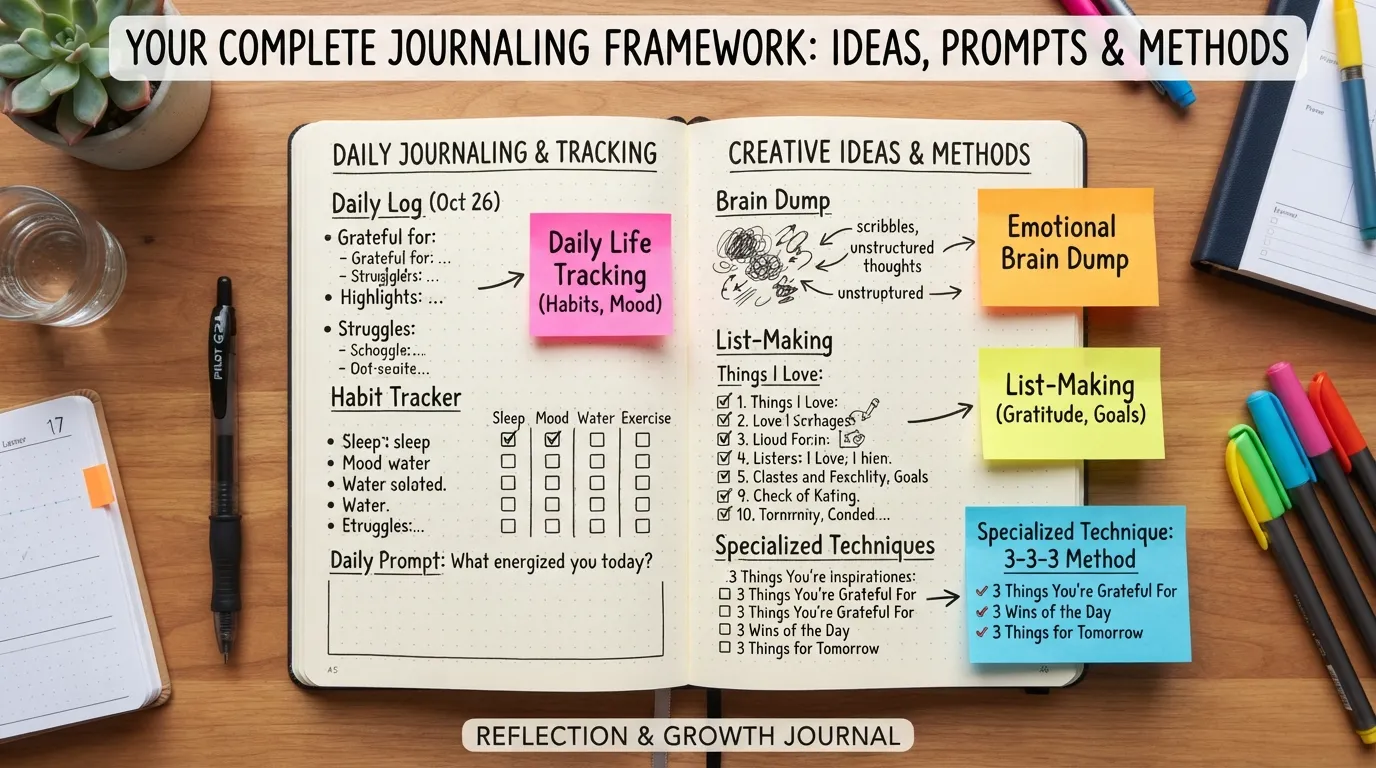
Daily Life and Events
Focus on the tangible details of your day. This isn’t just about recording what you did; it’s about noticing the small, funny, or interesting things that usually fade by dinner time. Did you see a dog wearing a sweater? Did a specific song on the radio catch your attention? Capture the details worth remembering so your life doesn’t feel like a blur of routine.
Thoughts and Feelings
This is your dedicated “brain dump” space. When your mind is racing, use this section to name exactly why you feel a certain way. You can vent about a frustrating email, celebrate a tiny personal victory, or simply acknowledge that you feel “off” today. By putting these feelings on paper, you take them out of your head, where they tend to loop, and trap them on the page.
Lists and Quick Notes
When paragraphs feel like too much, switch to lists. This can include gratitude lists, your weekly goals, or simple action plans for the weekend. You can also use this space to save interesting quotes you heard, lines from a book you’re reading, or even a grocery list that felt particularly satisfying to write.
Real Journal Entry Examples
A Daily-Life Entry Example
I spent way too long at the coffee shop today just watching the rain hit the window. The barista kept playing this weird 80s synth-pop playlist that actually grew on me after the third song. I think I finally finished that report, but now I’m kind of dreading the follow-up meeting on Tuesday.
A Thoughts-and-Feelings Entry Example
I feel really jittery today for no good reason. It’s like my brain has too many tabs open and none of them will close. I’m annoyed with myself for feeling this way when there’s nothing actually “wrong,” but I guess I just need to sit here for a minute and breathe before I start cleaning the kitchen.
A Gratitude/List Entry Example
Three things that made today better: 1) Finding a ten-dollar bill in my old winter coat, 2) That specific golden light right before sunset, and 3) Getting my inbox down to zero. Honestly, that’s about it, but it’s enough.
What to Write in a Journal for Mental Health
Use your journal to name and track emotional patterns over time. When you write regularly, you begin to see the “weather patterns” of your moods—you might notice you always feel anxious on Sunday nights or energized after a workout. Journaling provides a low-pressure way to process these feelings instead of ruminating on them, allowing you to move through your emotions rather than getting stuck in them.
What to Write in a Journal for Students
For students, a journal is a vital tool for reflection. Spend a few minutes recording what you learned that day, even if it’s just one new concept or a realization about a lecture. Use the pages to process exam stress or academic pressure by listing out what’s left to do, which helps calm the “I’m going to forget something” panic. Tracking your goals, deadlines, and small wins through a term keeps you grounded. A simple end-of-day study log format works best: list one thing you mastered, one thing you found difficult, and the main goal for tomorrow.
What to Write in a Journal When You're Just Starting Out
Overcoming the Blank Page
If you are staring at a blank page, try these simple starters: write down three things you can see, two things you can hear, and one thing you are looking forward to. This grounds you in the present moment immediately.
If you are a visual learner, take a look at this short video walkthrough for beginners to help you get moving:
What to Write in a Journal Every Day
The secret to daily journaling is to keep it manageable. Use small, repeatable prompts like “The best part of today was…” or “Something I’m curious about right now is…” One line is enough to build the habit without it feeling like a chore.
Aesthetic and Creative Things to Write in Your Journal
Don’t be afraid to make your journal look as interesting as it feels. Include doodles, sketches, or abstract shapes alongside your text to break up the lines. Paste in ticket stubs, photos, or even pressed flowers to turn the pages into a scrapbook. You can also fill empty spaces with your favorite song lyrics, movie quotes, or lines from poetry that resonate with you.
Popular Journaling Methods Worth Trying
What Is the 3-3-3 Journaling Method?
The 3-3-3 method is a technique where you write down three things you are grateful for, three things you are looking forward to, and three tasks you want to accomplish that day. It is designed to start your day with intention and finish it with a sense of perspective.
What Are the 7 Types of Journals?
The seven most common types include: (1) Gratitude journals (focusing on positives), (2) Bullet journals (organizing tasks), (3) Dream journals (recording sleep), (4) Morning pages (stream-of-consciousness writing), (5) Travel journals (documenting trips), (6) Art journals (visual expression), and (7) Reflective/thought journals (processing life events).
What Are the 3 C’s of Writing?
The 3 C’s of writing stand for Clear, Concise, and Consistent. In the context of journaling, this means keeping your thoughts understandable (Clear), not over-explaining simple emotions (Concise), and showing up for the page regularly (Consistent).
What Is the 2/3-1 Rule in Writing?
The 2/3-1 rule is a productivity framework where you spend 2/3 of your entry time on the “problem” or “event” and 1/3 of your time on the “resolution” or “action plan.” It forces you to move past just complaining and toward a constructive mindset.
Cool and Unexpected Things to Write About When You're Stuck
If nothing “important” happened, write a letter to your future self five years from now, or make a list of your “all-time” favorites: favorite songs, favorite meals, or favorite places you’ve ever visited. You could also try hypothetical prompts like, “If I could change one thing about my daily routine, what would it be?” or “What would I do today if I had no responsibilities?”
Why Journaling Is Worth Doing
Journaling is essentially a workout for your emotional wellbeing. It provides a reliable outlet for stress relief, helps sharpen your self-awareness by revealing your subconscious triggers, and acts as a time capsule for your personal growth and memories. Don’t overthink the “purpose”—just grab a pen and start with today’s entry.
FAQ
What's good, the best, and the most popular thing to write in a journal?
The "best" thing to write is whatever you actually find yourself doing consistently, as there is no single superior format. The most popular and effective entries for most people are "gratitude lists" (for perspective) and "stream-of-consciousness brain dumps" (for anxiety reduction).
Ultimately, the most "good" thing you can write is whatever helps you clear your head at that exact moment—whether that is a list of chores, a venting session, or a doodle of a leaf. The goal is utility, not literary greatness, so prioritize whatever format helps you feel a little lighter after you close the book.
What should I write in the salutation for my diary entry?
Traditional diaries often open with "Dear Diary" or a name you've given your journal (Anne Frank famously addressed hers to "Kitty"), but plenty of modern journalers skip a salutation entirely and just start writing.
Neither is more "correct" — it comes down to whether that little ritual helps you get into the headspace to write or if you prefer jumping straight into your thoughts.
What is the best time of day to write in your journal?
The ideal time to journal depends entirely on your personal goals and daily schedule. Morning journaling is fantastic for setting daily intentions, clearing out early-morning mental fog, and mapping out your priorities before distractions kick in.
On the other hand, evening or nighttime journaling works wonders for processing the events of the day, reflecting on lessons learned, and "brain-dumping" lingering worries so you can sleep with a clear, peaceful mind.
How can I stop worrying about making my handwriting or layout look messy?
Perfectionism is one of the biggest mental blocks when starting a journal. Remember that your journal is a private workspace, not a museum piece or an Instagram showcase. Messy handwriting, scratched-out words, and uneven margins are proof of genuine, raw thought in action.
If it helps, try using a plain notebook with no lines or give yourself permission to write the first sentence as poorly as possible just to break the spell of the blank page.
Pimchanok Srisuk
Pimchanok Srisuk is the Journaling Editor at Holistic Wellbeing Living. She writes about journaling prompts, reflective writing, emotional clarity, and mindful routines. With seven years of experience creating personal-growth content, Pimchanok helps readers use simple writing practices to understand their thoughts and make calmer everyday decisions.