Types of Habits in Psychology With Real-Life Examples
What Is a Habit?
In psychology, habits are commonly divided into 5 main types: motor (physical), intellectual, social, emotional, and productivity/lifestyle habits — plus 3 tracking types (binary, count, duration).
At its core, a habit is a repeated, automatic behavior triggered by a familiar environmental cue, operating smoothly below the threshold of conscious thought. When you repeat an action enough times in the same context, the basal ganglia takes over the heavy lifting, saving your brain precious energy for novel decisions.
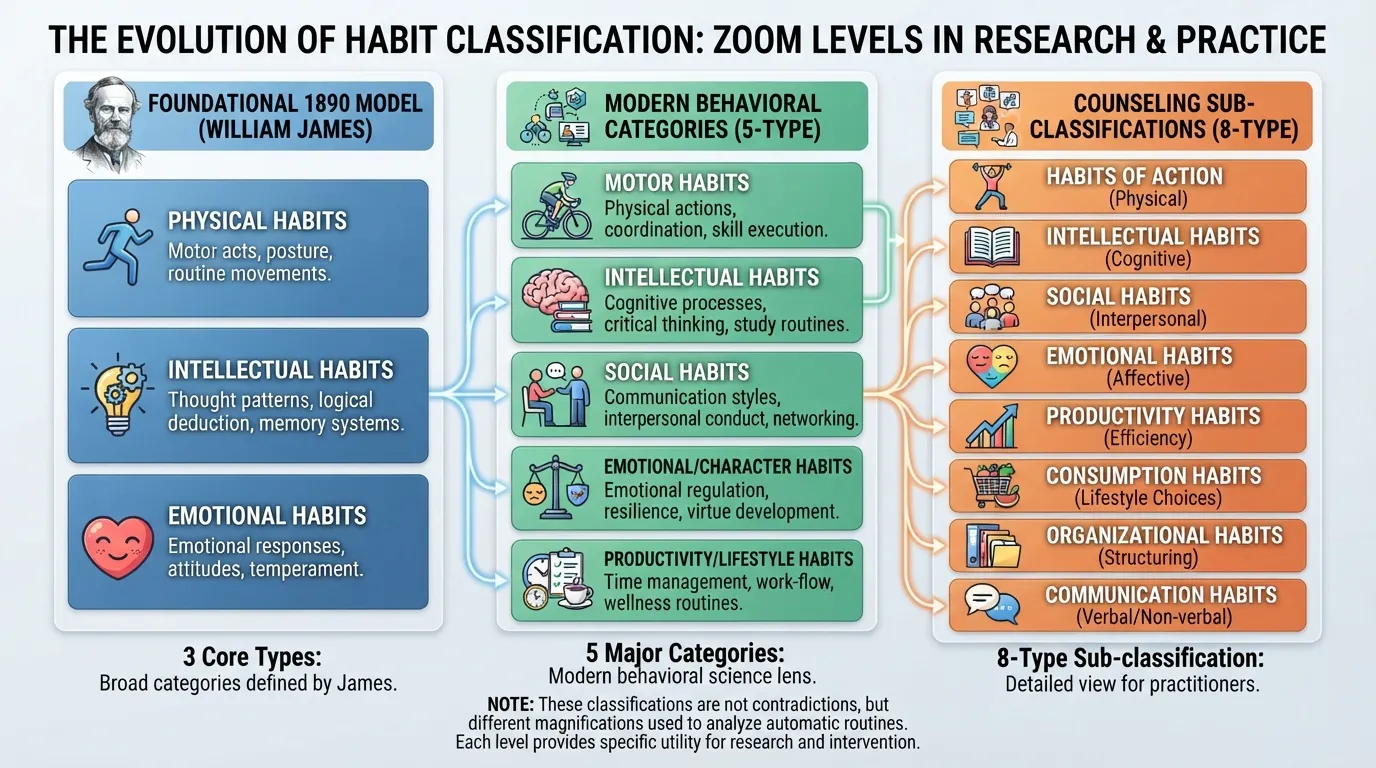
People often get confused about how many types of habits actually exist because different sources throw around numbers like three, five, or eight. The truth is, these aren’t competing theories; they’re just different zoom levels of the same human machinery. Back in 1890, William James laid the groundwork in his Principles of Psychology, describing habits as physical pathways carved out by repetition. Since then, behavioral science has simply expanded on his foundation, grouping automatic routines into practical categories to help us make sense of why we do what we do on autopilot.
How Many Types of Habits Are There? Why the Number Changes
The Confusion — 3, 4, 5, or 8 Types?
Different frameworks count differently, leaving anyone searching for a straight answer scratching their head. If you look at historical texts, William James’s 3 core types rule the foundation. Jump over to a modern search engine’s AI overview, and you’ll usually find 5 major categories. Dig into specialized counselling resources, and you might stumble across 8-type sub-classifications that split hairs between mental and behavioral nuances.
It’s easy to assume someone must be wrong, but these numbers just reflect different lenses rather than contradictions. A clinical researcher studying neuroplasticity needs a different grouping than a productivity coach tracking daily routines. This page focuses on the two frameworks people actually search for: the 5 major behavioral categories recognized in modern overviews and the 3 practical tracking types used to measure them.
The 5 Major Types of Habits in Psychology
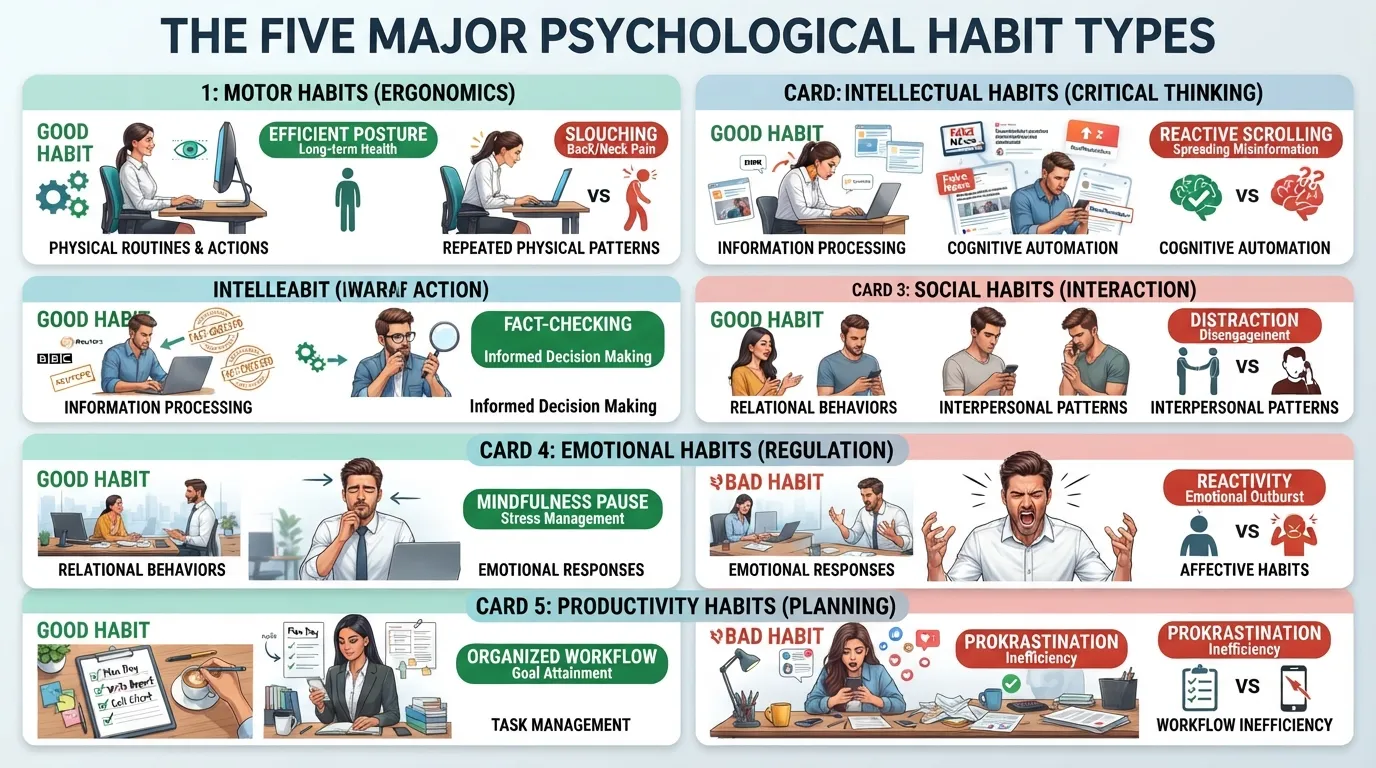
1. Motor (Physical) Habits — definition + example (posture, walking pace, exercise)
Motor habits are physical movements ingrained so deeply into your muscle memory that you execute them without directing your attention to every single muscle twitch. Typing on a keyboard without looking down at the keys is a classic example of this autopilot physical programming. Once these motor pathways are established in the nervous system, your body carries them out seamlessly while your conscious mind drifts elsewhere.
2. Intellectual (Cognitive) Habits — definition + example (reasoning, overthinking, critical reading) + short first-person EEAT observation line
Intellectual habits govern how your mind processes information, solves problems, and reacts to incoming data. A great example is the automatic reflex of vetting a news headline for bias rather than blindly accepting it at face value. What’s fascinating is that most people label their chronic “mental loops” as personality flaws, when psychologically, chronic overthinking is just an intellectual habit running on a persistent feedback loop.
3. Social Habits — definition + example (eye contact, greeting style, communication tone)
Social habits shape your default patterns of interpersonal interaction and communication. An example is the automatic way you modulate your tone of voice and offer a firm handshake when meeting someone new in a professional setting. These behavioral scripts help you navigate group dynamics smoothly without having to overanalyze every handshake or conversational pause.
4. Emotional / Character Habits — definition + example (empathy, honesty, nervous reactions)
Emotional and character habits dictate your baseline affective and moral responses to stress, joy, and everyday triggers. An everyday example is the knee-jerk habit of taking a deep breath and grounding yourself when frustration flares up, rather than instantly snapping back. These patterns form the emotional backbone of how your character shows up under pressure.
5. Productivity & Lifestyle Habits — definition + example (sleep schedule, prioritization, diet)
Productivity and lifestyle habits organize your daily energy, health maintenance, and output management. An example is the automated sequence of setting out your workout clothes the night before and tackling your hardest task first thing in the morning. According to insights from Harvard Health Publishing health.harvard.edu, structuring these lifestyle routines reliably reduces decision fatigue and preserves your mental bandwidth for the rest of the day.
Habit-Tracking Types Binary vs Count vs Duration
Binary Habits — yes/no actions (e.g., did I work out today?)
Binary habits are the simplest form of behavioral tracking because they operate on a strict pass-fail basis. You either completed the action or you didn’t, leaving no room for gray areas or half-measures. Checking off whether you took your morning vitamins or ran a mile falls squarely into this bucket. It’s an effective way to remove mental negotiation from your daily routine.
Count Habits — tracked by number (e.g., glasses of water)
Count habits introduce a quantitative metric, focusing on volume, frequency, or repetition rather than a simple yes-or-no state. Keeping a tally of how many glasses of water you drink or how many pages of a book you read each day are classic examples. This approach gives you granular feedback on your progress without demanding rigid perfection.
Duration Habits — tracked by time (e.g., minutes meditated)
Duration habits measure your consistency through the lens of elapsed time rather than discrete repetitions. Committing to twenty minutes of deep meditation or half an hour of stretching before bed relies entirely on a clock-based framework. Tracking time helps prevent you from rushing through a routine just to check a box, keeping your focus anchored on sustained presence.
Conscious Habits vs Hidden Unconscious Habits
Conscious Habits — examples (smoking after meals, morning alarm)
Conscious habits are routines you are fully aware of performing, even if they have become automatic over years of repetition. Lighting a cigarette right after finishing dinner or waking up to your blaring morning alarm and immediately reaching for your phone are textbook examples. You know the cue, you recognize the routine, and you understand the reward, making these behaviors easier to identify when you decide to change them.
Hidden Habits — examples + 2-3 original self-check questions
Hidden habits operate entirely below the surface, quietly steering your daily actions without your conscious permission. Fidgeting with a pen during stressful phone calls, sighing deeply when faced with a minor inconvenience, or automatically checking your notifications every time there’s a lull in conversation are classic invisible routines. Because your brain runs these on deep autopilot, you rarely notice them until someone points them out or you catch yourself in a mirror.
You can unearth these blind spots by asking yourself a few pointed self-check questions during your downtime:
What physical micro-movement do I default to when I feel slightly anxious or bored?
When I hit a mental roadblock at work, what is the very first tab or app I open without thinking?
What phrase or filler word do I rely on automatically when I’m caught off guard in a conversation?
How Habits Actually Form The Cue–Routine–Reward Loop
Every automatic routine you run operates through a neurological three-part loop: a cue, a routine, and a reward. The cue acts as a trigger that tells your brain to go on autopilot and let a specific behavior unfold. Next comes the routine itself, which is the physical, mental, or emotional action you perform. Finally, the reward delivers the payoff, teaching your brain that this particular sequence is worth remembering for the future.
This entire machinery is anchored deep inside the basal ganglia, a structure in your brain that shifts behaviors from conscious thought to permanent efficiency. When researchers look at how long this rewiring actually takes, studies show it can range anywhere from 18 to 254 days depending on the complexity of the behavior and the individual.
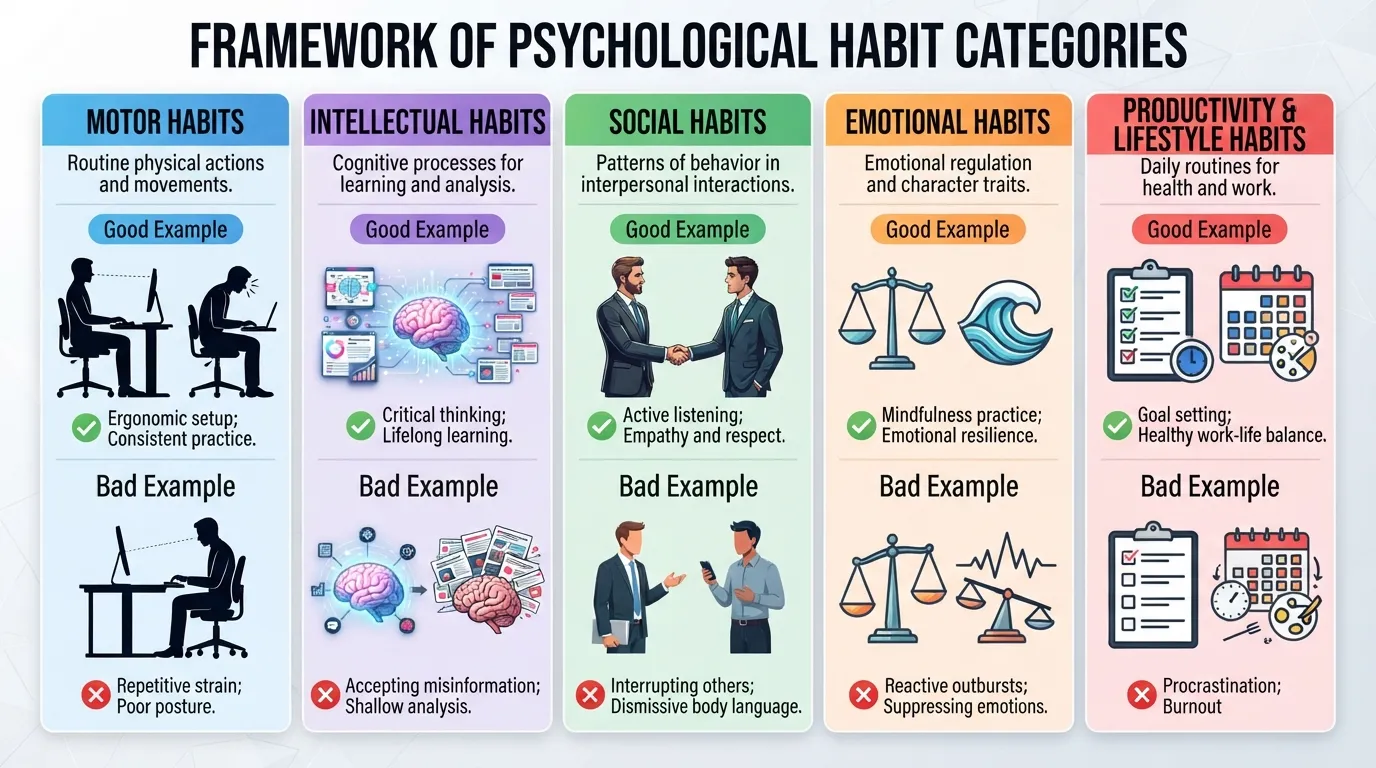
Good Habits vs Bad Habits With Examples by Type
Whether a behavior gets labeled as “good” or “bad” isn’t a separate category of habit; it’s simply a quality label stamped onto any of the five major types depending on its long-term impact on your life.