How to Stop Anxious Habits: Break the Trigger–Habit–Relief Loop Step by Step
How to Stop Anxious Habits: Break the Trigger–Habit–Relief Loop Step by Step
Anxious habits are repetitive physical actions, mental patterns, or escape behaviors your brain automatically uses to soothe uncomfortable feelings of anxiety or tension.
To stop an anxious habit for good, you need to map your personal loop, interrupt the automatic urge, replace the action with a competing response, and stay curious about the feeling underneath.
What Are Anxious Habits?
Anxious habits are repetitive routines your mind or body performs automatically to deal with stress, doubt, or physical tension. To understand how to stop anxious habits, you first need to identify which category your specific behavior falls into.
Most anxious habits fall into three distinct types:
Physical habits: Repetitive body-focused behaviors used to discharge nervous energy or physical restlessness, such as nail biting, skin picking, hair twirling, leg shaking, or jaw clenching.
Mental habits: Internal cognitive patterns meant to regain certainty or head off hypothetical problems, including overthinking, endless “what-if” loops, compulsively seeking reassurance from others, or repeatedly checking things (like locked doors or sent emails).
Escape habits: Distraction behaviors designed to numb uncomfortable feelings or avoid a stressful task, such as endless doomscrolling on your phone, habitual snacking when you are not hungry, or outright procrastination and avoidance.
— SOURCES USED —
Anxiety and Depression Association of America (ADAA) – Body-Focused Repetitive Behaviors: https://adaa.org/understanding-anxiety/co-occurring-conditions/body-focused-repetitive-behaviors
Mayo Clinic (Anxiety disorders symptoms and coping): https://www.mayoclinic.org/diseases-conditions/anxiety/symptoms-causes/syc-20350961
Why Anxious Habits Form and Keep Coming Back
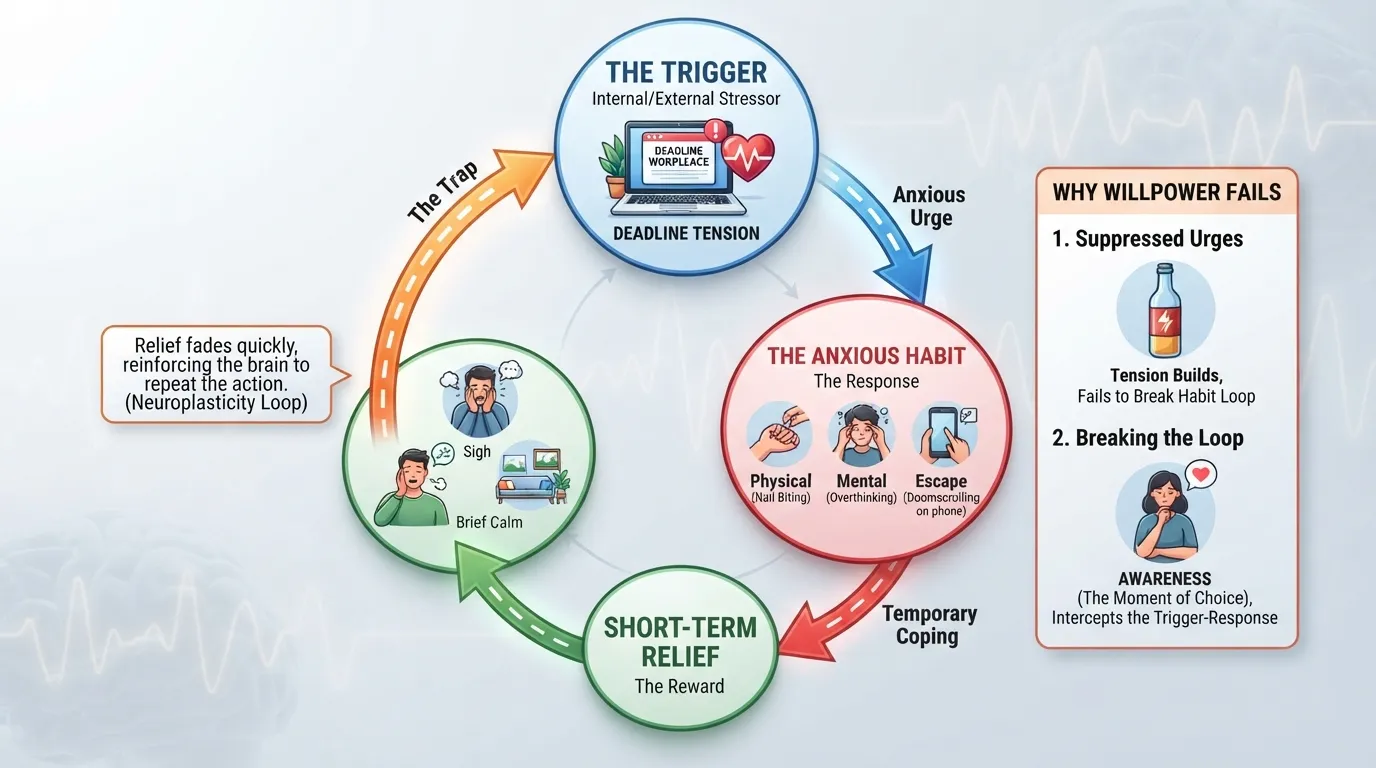
Anxious habits persist because they offer your brain immediate relief from uncomfortable internal feelings. Every time you perform an anxious routine, your brain registers a temporary drop in tension, which reinforces the habit loop and makes you far more likely to repeat the action next time anxiety strikes.
The Trigger–Habit–Relief Loop
Your brain builds habits around a simple three-part cycle: a trigger creates internal discomfort, the habit offers an immediate reaction, and the relief reinforces the behavior.
| Habit Type | Trigger (Feeling or Situation) | Anxious Habit | Short-Term Relief |
|---|---|---|---|
| Habit Type Nail Biting | Trigger (Feeling or Situation) Restlessness or physical tension while reading an email | Anxious Habit Biting or picking at cuticles | Short-Term Relief A brief sense of physical release or focus |
| Habit Type Doomscrolling | Trigger (Feeling or Situation) Dreading a difficult work assignment or feeling isolated | Anxious Habit Swiping endlessly through news feeds | Short-Term Relief Sudden distraction from the stressful task |
| Habit Type Overthinking | Trigger (Feeling or Situation) Unpredictable situation or fear of making a mistake | Anxious Habit Replaying "what-if" scenarios in your head | Short-Term Relief A false feeling that you are actively solving the problem |
Because the relief you get is brief and fleeting, the underlying trigger remains completely unaddressed. The moment the short-term soothing wears off, the urge returns, keeping the loop alive.
Trying to break this loop through pure willpower or suppression rarely works because force does not stop the urge. Suppressing an automatic impulse only builds up internal tension until your resistance breaks and the habit takes over again.
Why Worry Feels Like Control
For mental habits like overthinking or reassurance seeking, the loop is especially tricky because your brain misinterprets worrying as a form of constructive work. When faced with uncertainty, replaying worst-case scenarios tricks your mind into believing you are staying safe, preparing for danger, or keeping control—even though it actually just prolongs your anxiety.
How to Map Your Anxious Habit Loop
Before you can break an anxious habit, you must make the automatic routine conscious. Mapping your loop helps you identify the precise moment your body shifts from experiencing a trigger to performing the habit, giving you a clear window to step in and interrupt it.
4 Questions to Map Your Loop
To discover how to stop anxious habits, start by asking yourself four targeted questions immediately after you notice the behavior occurring:
When does it happen? Identify the exact time of day, transition point, or specific task (for example, while sitting in traffic or right before writing a report).
Where are you? Note your physical setting and environment (for example, at your office desk, lying in bed, or waiting in line).
What are you feeling right before the urge? Pinpoint the emotional or physical sensation that triggered the response (for example, a tight chest, bored restlessness, or fear of making a mistake).
What short-term relief do you get? Notice what the habit gives you in that exact second (for example, a temporary distraction, physical release, or a feeling of control).
Catch It and Name It
Once you identify your pattern, practice catching the urge in real time and naming it without judgment. Assigning a simple, neutral label to the experience—such as “Ah, that is my overthinking loop starting” or “I am feeling skin-picking tension”—shifts your brain out of automatic reaction mode and into quiet observation. Naming the urge creates a psychological gap between feeling the impulse and acting on it.
7-Day Tracker Worksheet
Track your patterns for one week using this simple mapping layout. Keeping a log for seven days reveals hidden environmental triggers and emotional patterns you might otherwise miss.
| Day & Time | Where / Context | Triggering Feeling / Urge | Anxious Habit Performed | Relief or Outcome Felt |
|---|---|---|---|---|
| Day & Time Mon 9:15 AM | Where / Context At work desk | Triggering Feeling / Urge Dreading long email draft | Anxious Habit Performed Doomscrolling news app | Relief or Outcome Felt Brief distraction from work |
| Day & Time Mon 3:30 PM | Where / Context In team meeting | Triggering Feeling / Urge Restless, anxious energy | Anxious Habit Performed Picking skin near nails | Relief or Outcome Felt Slight release of tension |
How to Stop Anxious Habits: 7 Steps
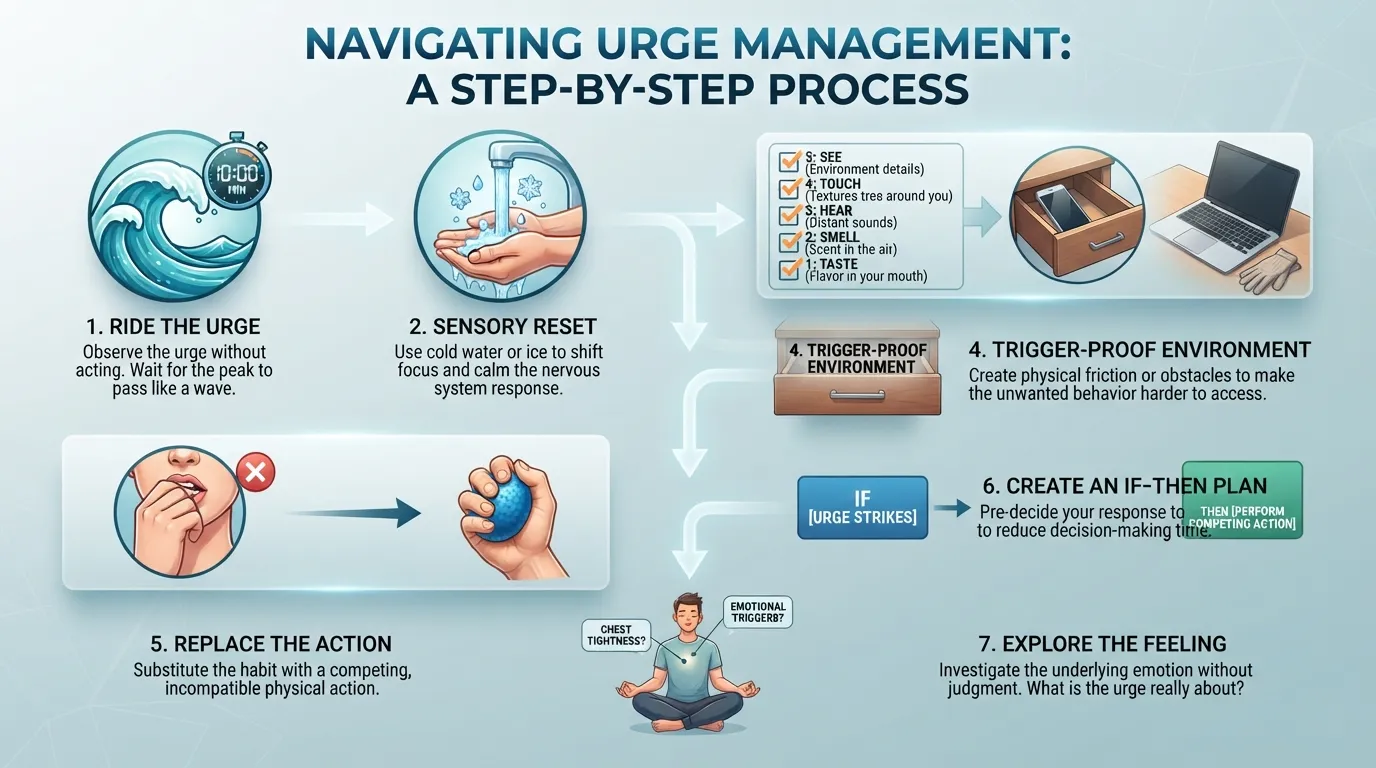
To break an automatic nervous routine, you need strategies that directly interrupt the impulse in real time. Combining physiological resets with targeted behavioral shifts allows you to handle the underlying tension without falling back on your usual habits.
1. Ride the Urge
Urge surfing teaches you to experience an uncomfortable impulse without automatically acting on it. Instead of fighting the sensation, imagine the urge as a wave in the ocean that naturally rises, peaks, and subsides over a short window. A practical way to practice this is the 10-minute rule: when you feel a strong impulse to perform an anxious habit, commit to waiting just ten minutes before deciding whether to give in. By the time those ten minutes pass, the peak intensity of the urge has usually faded.
2. Sensory Reset
A sudden physical stimulus interrupts the neural loop driving your habit by forcing your nervous system to reorient. Running cold water over your hands, splashing your face, or holding a brief cold ice pack on your wrist triggers a mild mammalian dive reflex, slowing your heart rate and pulling immediate focus away from the anxious impulse.
3. Grounding: 5-4-3-2-1
When anxiety draws your focus inward toward a repetitive habit, the 5-4-3-2-1 technique anchors your attention in your immediate surroundings. Look around your space and name out loud or in your head:
5 things you can see around you
4 physical textures you can feel (like your chair or clothing)
3 distinct sounds you can hear
2 things you can smell
1 taste you can notice
4. Trigger-Proof Your Environment
Removing friction from healthy choices—and adding friction to unhealthy ones—prevents automatic execution. For example, if you pick your skin at your computer desk, you might remove desktop mirrors and keep cotton gloves near your keyboard. If you compulsively check your phone, moving it to another room while working stops the physical habit before it starts.
5. Replace It
Simply trying to stop a habit creates a physical vacuum that often leads to relapse. Instead, substitute the habit with a competing response—an physical action using the same muscles that makes the original habit impossible to perform. For the replacement to work, match the physical sensation: if nail biting provides oral and tactile stimulation, chewing a crunchier option or squeezing a firm worry stone offers a direct physical substitute.
6. If–Then Plan
An if–then plan automates your healthier response ahead of time so you do not rely on impulse control while stressed. Frame your plan using clear, positive language focusing on what you will do rather than what you want to avoid: “If I feel the urge to twirl my hair while studying, then I will immediately pick up my grip squeeze ball with that hand.”
7. Get Curious About the Feeling
Replacing a habit alone often fails over time because a physical swap does not address the emotional urge underneath. When a habit impulse hits, pause and examine the feeling neutrally: Where am I holding tightness? What specific worry is driving this urge right now? Approaching your emotional state with interest rather than frustration diffuses the tension that feeds the habit loop.
— SOURCES USED —
UT Southwestern Medical Center (Breaking Bad Habits): https://utswmed.org/medblog/breaking-bad-habits/
Mayo Clinic (Stress Relief and Grounding): https://www.mayoclinic.org/healthy-lifestyle/stress-management/in-depth/stress-relievers/art-20047257
How to Stop Your Specific Anxious Habit
While foundational strategies help manage general tension, targeting the unique mechanics of your specific behavior provides the fastest path to relief. Here are direct, habit-specific fixes for the most common anxious routines.
Nail Biting, Skin Picking, and Hair Twirling
Body-focused repetitive behaviors rely heavily on immediate physical access and tactile stimulation.
Physical barriers: Apply bitter-tasting polish to your nails, wear thin cotton gloves during high-risk times (like watching TV or reading), or cover active picking areas with small adhesive bandages.
Competing physical response: Keep your hands busy with objects that offer similar tactile feedback, such as a textured worry stone, a fidget ring, or a rubber stress ball.
Moisturize immediately: Apply heavy hand cream or cuticle oil the moment you feel the urge; slippery skin makes picking and biting significantly harder to execute.
Overthinking and What-If Loops
Mental loops persist because replaying scenarios feels like active problem-solving. To break the cycle, separate real problems from hypothetical anxieties using the Worry → Write → Decide → Act framework.
Classify: Ask yourself if the worry represents a real, solvable issue right now or a hypothetical “what-if” scenario.
Write: If it is solvable, write down the specific problem on paper to externalize it from your mind.
Decide: List one single concrete action step you can take today to address it.
Act: Execute that single step immediately, or schedule a specific time to do it. If the worry is unsolvable or hypothetical, gently return your focus to your physical environment.
Reassurance Seeking and Checking
Repeatedly asking others “Is everything okay?” or checking locked doors and sent emails lowers uncertainty for a brief second, but reinforces anxiety over time.
Delay the response: When you feel the urge to check or ask for reassurance, set a timer for 15 minutes before acting. Increasing the delay proves to your brain that you can tolerate temporary uncertainty.
Limit checking count: Establish a hard numerical cap—for example, allow yourself to check the stove or lock twice, then step away immediately.
Resist asking: Reframe reassurance as a habit that feeds doubt rather than solving it, and practice stating out loud: “I can sit with this uncertainty for now.”
Doomscrolling and Phone Checking
Compulsive phone use offers a constant, low-effort distraction from underlying uncomfortable feelings or boring tasks.
Grayscale mode: Switch your phone display to grayscale in your accessibility settings. Removing vibrant colors makes apps significantly less stimulating to your brain.
App friction: Log out of social media accounts after every session and delete news apps from your home screen so accessing them requires deliberate effort.
Physical distance: Keep your phone out of reach—such as in another room or inside a closed drawer—during deep work hours and bedtime.
Avoidance
Avoidance and procrastination occur when your brain misinterprets a stressful task as a threat, driving you to escape into easier activities.
The 2-minute rule: Commit to working on the avoided task for just two minutes; once you cross the initial threshold of starting, momentum usually carries you forward.
Everyday Habits That Feed Anxiety and What to Do Instead
Certain routine daily choices can quietly heighten physical tension and keep your nervous system on high alert. Swapping these everyday habits for calmer alternatives helps lower your baseline anxiety, making automatic urges far easier to manage.
| Everyday Habit | How It Feeds Anxiety | What to Do Instead (Healthy Swap) |
| High Caffeine & Energy Drinks | Stimulates adrenaline release, artificially spiking your heart rate and triggering jitters that your brain misinterprets as anxiety or panic. | Switch to green tea, herbal options like chamomile, or warm lemon water, especially after midday. |
| Alcohol Consumption | Disrupts neurotransmitter balance and REM sleep, causing a rebound spike in physical anxiety (often called “hangxiety”) as it wears off. | Swap for sparkling water with a splash of fruit juice, herbal teas, or non-alcoholic alternatives. |
| Poor or Irregular Sleep | Deprives your brain of emotional regulation time, lowering your threshold for stress and making anxious habit urges significantly harder to resist. | Keep a strict wake-up time, turn off bright screens 60 minutes before bed, and build a restful nighttime routine. |
| Physical Inactivity | Traps excess stress hormones like cortisol in your body, allowing restless physical energy to build up and feed nervous habits. | Take a brisk 15-minute daily walk, practice light stretching, or use short movement breaks to release physical tension. |
Slips Happen: Relapse Plan and Self-Compassion
Slipping back into an anxious habit does not mean you have failed or erased your progress. Rebuilding neural pathways takes consistent practice, and occasional slip-ups are a completely normal part of breaking automatic routines. Treating a slip as useful feedback rather than a personal defeat prevents a brief mistake from turning into a full relapse.
The 3-Step Reset After a Slip
When you notice you have fallen back into an anxious habit, execute this quick reset to regain control immediately:
Pause and drop your shoulders: Stop the behavior without judgment, take one deep breath, and physically release tension in your body.
Identify the immediate trigger: Ask yourself neutrally, “What was happening right before this?” pinpointing the exact situation or feeling that sparked the urge.
Execute your competing action: Pivot straight into your replacement behavior (such as holding a worry stone or drinking cold water) to signal to your brain that the habit is over.
Avoid All-Or-Nothing Thinking
A single slip only becomes a total relapse if you fall into all-or-nothing thinking—believing that because you bit your nails or doomscrolled for ten minutes, your entire effort is ruined. This “what the heck” mindset leads to spiraling back into old routines. Remind yourself that one slip is simply a single data point, not a failure, and gently refocus on your next choice.
When to Seek Professional Help
Self-help strategies and habit-mapping tools are effective for mild to moderate anxiety routines. However, if an anxious habit begins to interfere with your ability to function normally, seeking guidance from a qualified mental health professional is an important next step.
Consider reaching out for professional support if you notice any of these signs:
Daily disruption: Your habits consume significant amounts of time each day or impair your performance at work, school, or home.
Physical injury or distress: Body-focused habits cause physical damage (such as bleeding skin, severe nail damage, or hair thinning) or leave you feeling overwhelmed by shame and frustration.
Sleep and health impact: Unmanageable worry or escape routines routinely prevent you from getting restful sleep or lead to severe emotional exhaustion.
Feeling out of control: You feel completely unable to stop the behavior despite using structured self-help strategies consistently over several weeks.
Evidence-based therapeutic options include Cognitive Behavioral Therapy (CBT), which helps restructure the thought patterns driving your urges, and Habit Reversal Training (HRT), a specialized form of therapy designed specifically to address repetitive physical behaviors. If underlying anxiety or mood symptoms are severe, consulting a psychiatrist can help evaluate whether medical treatments alongside therapy might be beneficial.
Persistent patterns like severe skin picking (excoriation) or hair pulling (trichotillomania), as well as rigid checking routines, often share features with obsessive-compulsive spectrum disorders. These patterns deserve targeted care from a clinician who can offer proper guidance without jump to conclusions or formal diagnoses without a complete assessment.
Disclaimer: This content is for informational and educational purposes only and is not a substitute for professional medical advice, diagnosis, or treatment. If you are experiencing severe distress or feeling unsafe, please contact your local emergency services or a national mental health crisis helpline immediately.
FAQ
Chronic avoidance is widely considered one of the worst habits for anxiety because fleeing from perceived threats provides short-term relief but reinforces fear long-term. This behavior trains your brain to view harmless situations as dangerous, progressively shrinking your comfort zone.
How long does it take to break anxious habits?
Breaking an anxious habit and building a healthier response typically takes anywhere from 18 to 254 days, depending on consistency and complexity. While simple behavioral adjustments can shift within a few weeks, deeply ingrained neural pathways require patient, repeated reinforcement.
Mark Steve
Mark Steve is a tech, business, and lifestyle writer with over 5 years of experience analyzing digital trends, startups, and online business models. He publishes well-researched, fact-checked content focused on clarity, credibility, and real-world value.