Cue, Craving, Response, Reward: The Atomic Habits Loop Explained With Examples
What Is the Habit Loop?
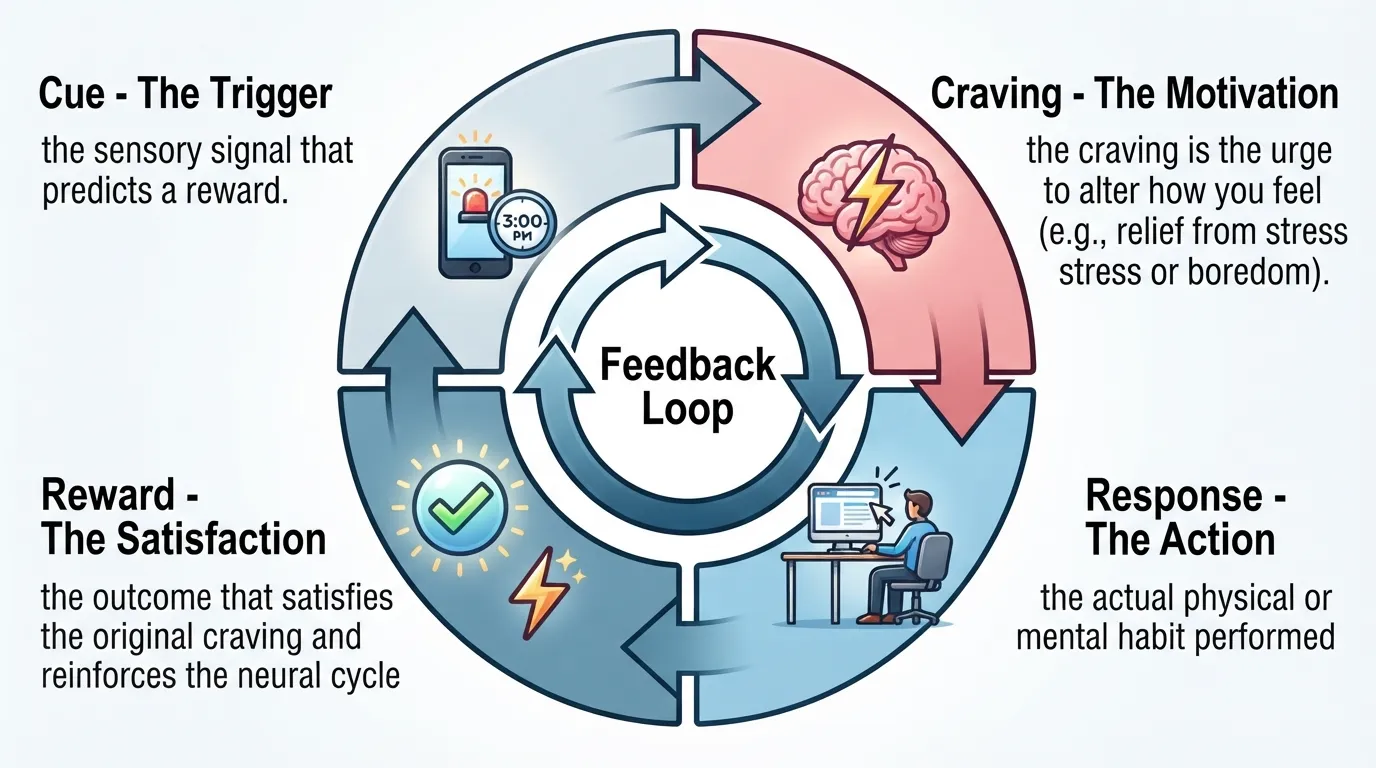
The habit loop is a four-step neurological feedback loop—comprising cue, craving, response, and reward—that governs every human behavior and transforms conscious actions into automatic routines over time.
Cue → Triggers a prediction in your brain by noticing a physical, temporal, or emotional bit of information.
Craving → The motivational force or internal state change desired to alter how you currently feel.
Response → The actual habit or action you execute, which can be a thought, a physical movement, or a behavior.
Reward → The ultimate goal that satisfies the craving and teaches your brain whether to repeat the action in the future.
(Back to Cue) → The reward reinforces the original trigger, locking the loop into an automatic cycle.
The 4 Steps of the Habit Loop Explained
1. Cue — The Trigger
The cue is a bit of information that predicts a reward. It is the sensory or mental spark that notices a possibility for a change in your environment or internal state, prompting your brain to initiate a behavior.
- Time: Specific hours or moments in your daily timeline (e.g., the clock hitting 3:00 PM or waking up at 6:30 AM).
- Location: Physical environments or distinct settings (e.g., sitting at your desk, walking into the kitchen, or standing in a waiting room).
- Emotional State: Internal feelings or mood shifts (e.g., feeling stressed, experiencing boredom, or sensing anxiety before a presentation).
- People: The presence of specific individuals or groups (e.g., a colleague who always chats about gossip, or a friend who orders drinks).
- Preceding Action: An event or behavior that naturally finishes right before the next one starts (e.g., pouring a cup of coffee, closing your laptop at 5:00 PM, or finishing a meal).
Real-World Examples:
- Work Domain: You open your laptop to write a report, but the immediate visual cue of 14 unread notification badges on your browser icon draws your eyes away from your draft.
- Health Domain: You step out of the shower in the morning and immediately see your running shoes placed right beside the bedroom door.
- Study Domain: You sit down in a quiet library room, and the silence serves as the signal to open your notebook and study.
2. Craving — The Motivation
A craving is the internal desire to change your current state, not a desire for the action itself. You do not crave chewing gum; you crave the clean taste in your mouth. You do not crave opening a social media application; you crave relief from an uncomfortable feeling of isolation or boredom.
- Relief from Friction: Seeking to remove an unpleasant sensation like physical tightness, mental fatigue, or deep uncertainty.
- Social Connection: The urge to feel included, recognized, or valued by peers in a community.
- Status and Power: The drive to gain respect, mastery, or a sense of personal achievement over a difficult task.
- Sensory Pleasure: The desire for a sudden change in taste, comfort, or visual stimulation.
3. Response — The Action
The response is the actual habit you perform, which can manifest as either a physical action (stepping onto a treadmill, opening a tab) or a mental one (ruminating over a problem, counting to ten). Whether a response occurs depends heavily on your capacity and the friction involved.
- Ability: Whether you possess the physical skill, mental focus, or resources required to carry out the action at that exact moment.
- Motivation: The strength of the craving driving you; if the desire is weak, the effort required will feel too high.
- Friction: The number of hurdles, decisions, or physical steps standing between the cue and the execution of the response.
4. Reward — The Satisfaction
The reward is the final outcome of every habit loop. It serves a dual purpose: first, it satisfies the craving by delivering the state-change you sought; second, it teaches your brain which actions are worth remembering and repeating when the cue appears again.
- Immediate Rewards: A sudden hit of dopamine, a burst of flavor, the immediate relief of closing a stressful work tab, or a warm feeling of comfort.
- Long-Term Rewards: Improved cardiovascular fitness over months, a completed manuscript, financial savings, or strong personal relationships built over years.
Habit Loop Examples
| Domain | Cue (Trigger) | Craving (Motivation) | Response (Action) | Reward (Satisfaction) |
|---|---|---|---|---|
| Phone Scrolling | A 3-second pause in your work focus while sitting at your desk. | Desire to escape a moment of mental fatigue or boredom. | Pick up phone and open a social media app. | A quick burst of novel stimulation and distraction. |
| Fitness / Gym | Your morning alarm goes off and your workout clothes are laid out. | Desire to feel energized and build long-term strength. | Put on your shoes and drive to the gym for a 45-minute workout. | A feeling of accomplishment and a physical endorphin boost. |
| Smoking | Stepping outside a high-pressure meeting or feeling a sudden spike in stress. | Desire to relieve nervous tension and change your physiological state. | Light and smoke a cigarette. | Temporary relaxation and a brief physical break from work. |
| Studying | Opening a complex textbook chapter and feeling confused. | Desire to avoid cognitive strain and feeling inadequate. | Open a browser tab to watch unrelated online videos. | Immediate relief from mental discomfort and confusion. |
| Work Focus | Closing out your final project task of the day at 5:00 PM. | Desire to transition out of work mode and unwind. | Clear your desk, close all browser tabs, and log off. | Mental clarity and a clear boundary for leisure time. |
Quick Reference Cheat Sheet
| Step | Definition | Real-World Example | Matching Law |
|---|---|---|---|
| 1. Cue | A bit of information predicting a potential reward. | Phone notification buzzes on your desk. | 1st Law: Make it obvious (or Invisible) |
| 2. Craving | The internal drive to alter your current emotional or physical state. | Desire to know who messaged and feel connected. | 2nd Law: Make it attractive (or Unattractive) |
| 3. Response | The actual physical action or mental thought performed. | Reaching out, unlocking the phone, and reading the message. | 3rd Law: Make it easy (or Difficult) |
| 4. Reward | The outcome that satisfies the craving and reinforces the loop. | Relief from curiosity and a quick hit of social connection. | 4th Law: Make it satisfying (or Unsatisfying) |
How the 4 Laws of Behavior Change Connect to the Loop
Make it Obvious → Cue: To form a habit, design your environment so the triggers for good choices are prominent and unmistakable. To break a bad habit, make the cue invisible.
Make it Attractive → Craving: Reframe your mindset and bundle habits with enjoyable activities so the urge to act is irresistible. To break a bad habit, highlight its drawbacks to make it unattractive.
Make it Easy → Response: Reduce friction, simplify the required action, and lower the effort needed to get started. To break a bad habit, increase the friction to make the response difficult.
Make it Satisfying → Reward: Attach an immediate, pleasurable outcome or sense of progress so your brain wants to repeat the behavior. To break a bad habit, create an immediate penalty to make it unsatisfying.
Common Confusions in the Habit Loop
Craving vs. Response Mix-Up
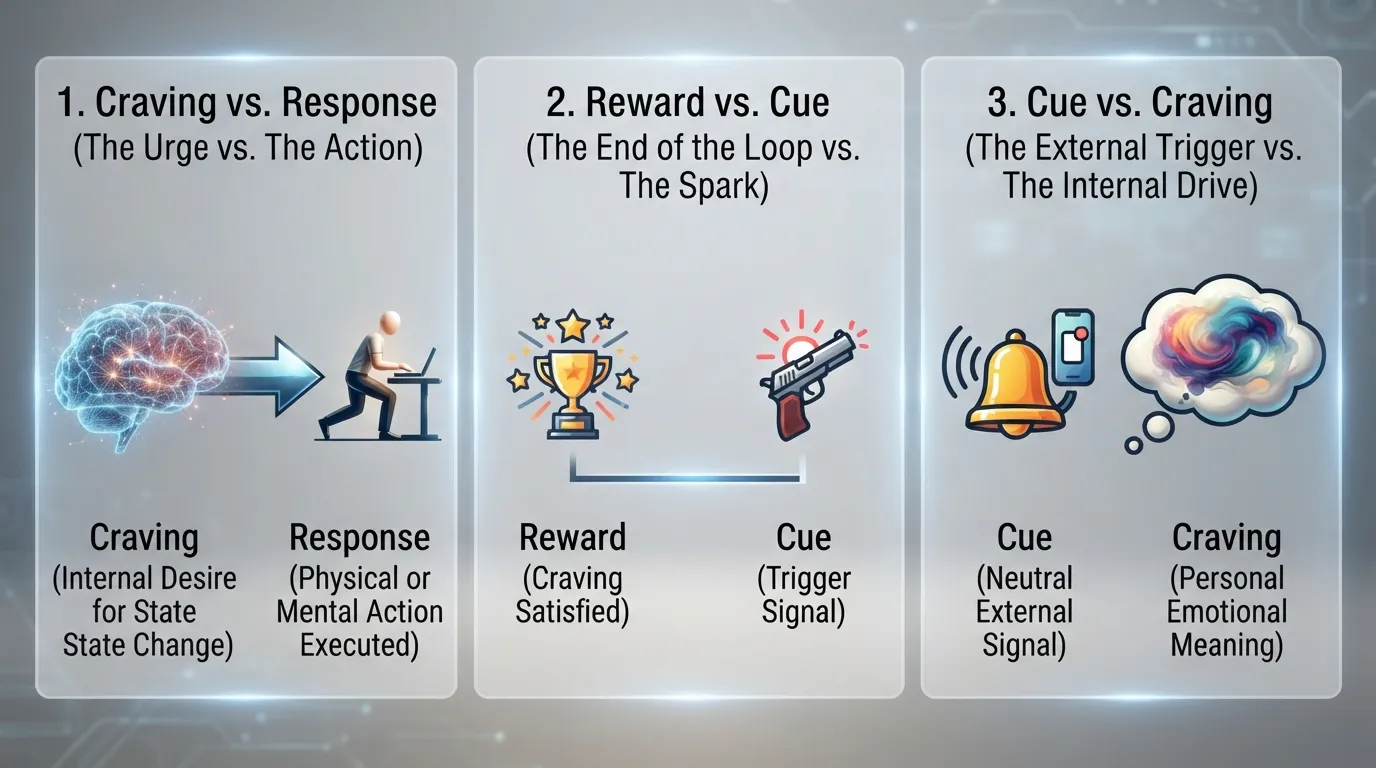
People frequently conflate the internal urge with the action itself. The craving is the motivational shift—an urge to alter your current state—while the response is the physical or mental execution that follows. For instance, feeling an itch to check your phone is the craving; picking up the device and opening an app is the response. Confusing these two makes it hard to intervene, as breaking a habit requires targeting the urge before the action occurs.
mistaking the Reward for the Cue
It is easy to confuse the end of one cycle with the start of another because rewards often generate new triggers. Eating a sugary snack acts as a reward that satisfies an afternoon energy slump, but the resulting sugar crash an hour later becomes a fresh physical cue for fatigue. The reward resolves the immediate craving, whereas the cue merely signals the possibility of obtaining that reward in the first place.
Treating the Cue and Craving as the Same Thing
Many assume the environmental trigger and the craving are identical, but they operate on entirely different levels. A cue is an objective, neutral signal in your surroundings—like a clock hitting 5:00 PM or a notification light flashing. A craving is your brain’s subjective interpretation of that signal based on your past experiences, driving an emotional or physiological desire to act. Without the interpretation of the craving, a cue remains entirely neutral and prompts no behavior.
My Experience Applying the Habit Loop
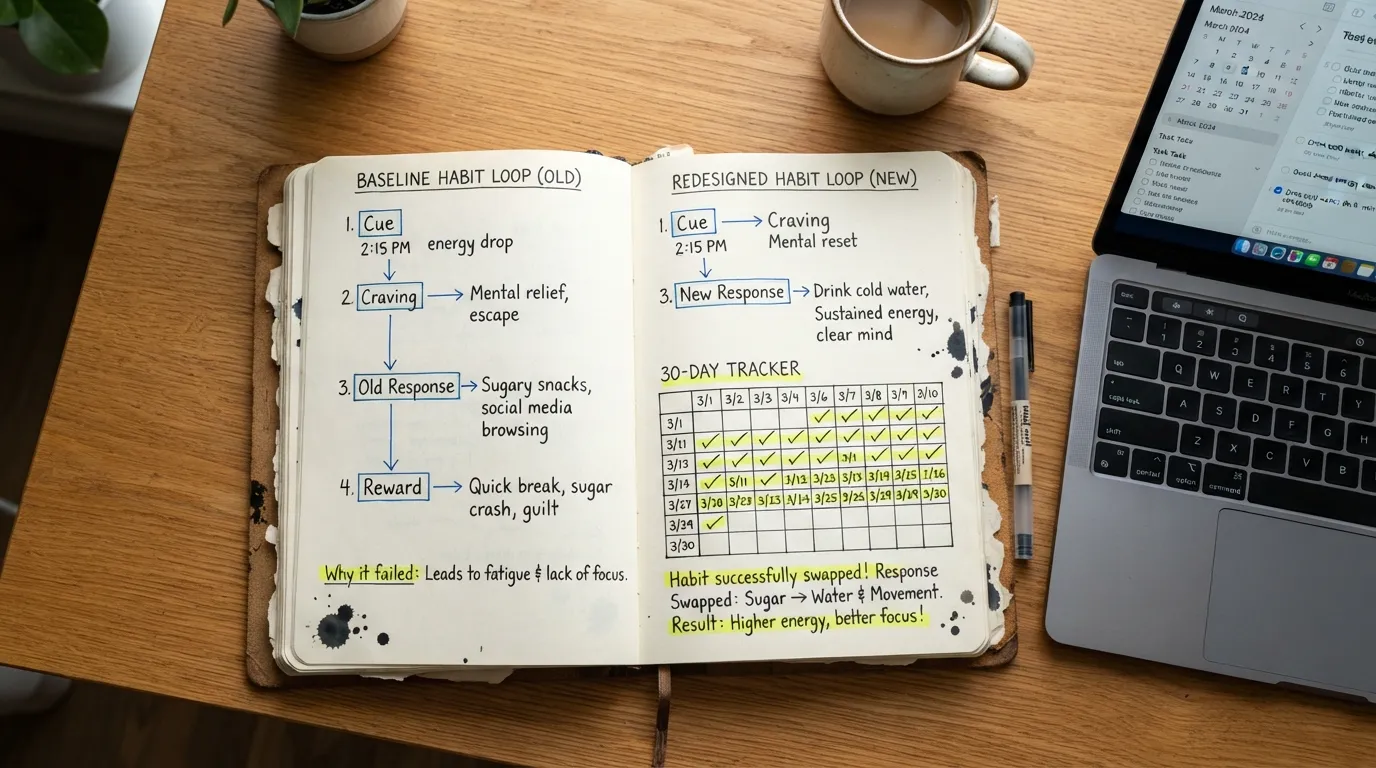
I spent 30 days testing the four-step feedback loop to address a persistent mid-afternoon slump that routinely derailed my deep work between 2:00 PM and 4:00 PM. Instead of trying to force raw willpower, I audited the precise mechanics of the cycle driving my behavior.
Tracking the Baseline (Days 1–7): By logging my actions, I discovered my Cue was a distinct drop in physical energy at 2:15 PM after sitting continuously for three hours. The true Craving was not food or social media, but mental relief from dense cognitive effort. My default Response had been mindlessly opening news tabs and eating sugary snacks at my desk, which yielded an immediate Reward of temporary dopamine and a quick break, followed by a heavy sugar crash by 3:00 PM.
Redesigning the Loop (Days 8–21): I kept the original cue and underlying craving intact but swapped the middle stages. When 2:15 PM arrived, I changed the Response: I stepped away from the screen, walked down the hall, drank a full glass of cold water, and stretched for five minutes. The new Reward delivered the exact mental reset I needed without the physical slump.
The 30-Day Result: By isolating the craving from the action, I eliminated the sugary desk snacks entirely over the final nine days. My productive output during the late afternoon increased noticeably, proving that changing a habit isn’t about fighting the urge—it’s about giving the underlying craving a better route to satisfaction.