How to Break OCD Habits: A Step-by-Step Guide to Stopping Compulsions
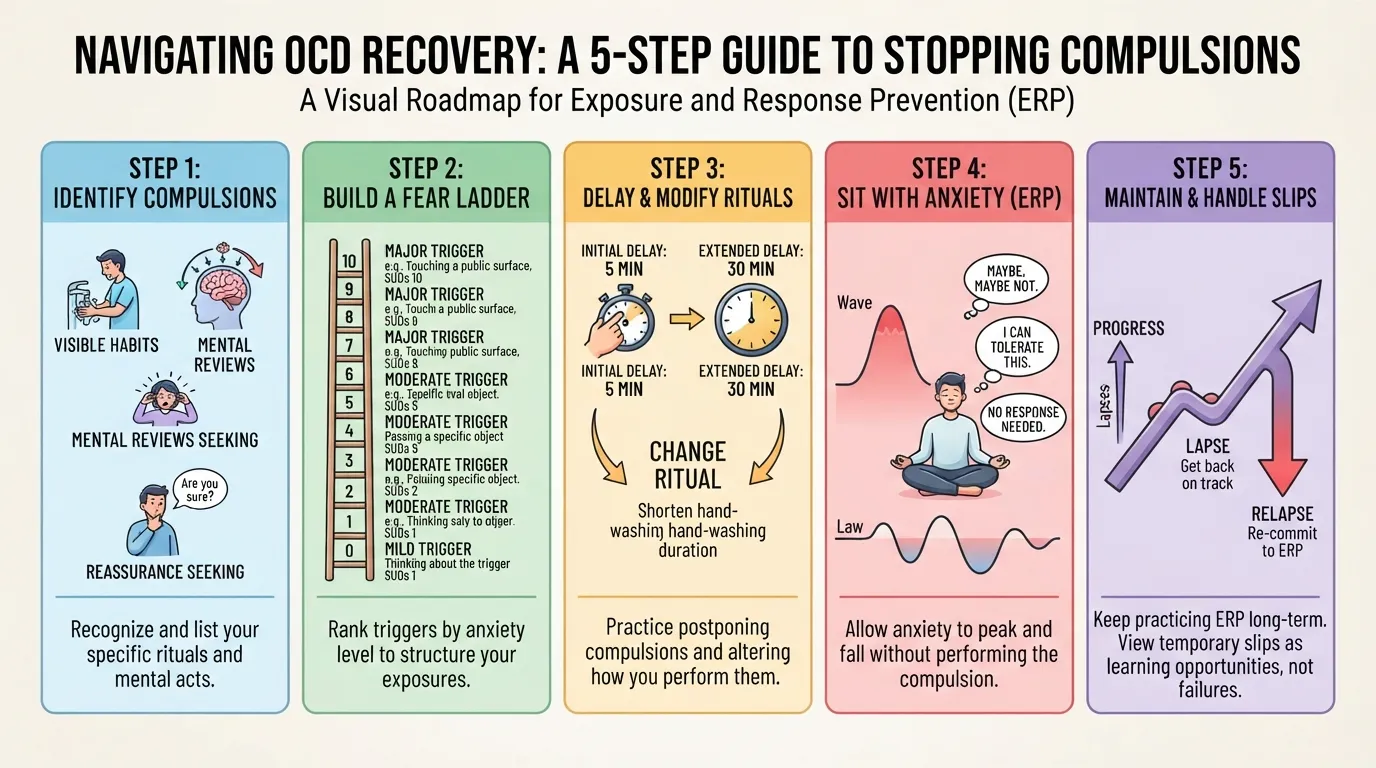
Recognizing and breaking free from OCD compulsions requires intentional practice and patience. Compulsions often feel like immediate, non-negotiable urges, but learning to pause creates the space needed to regain control. By delaying your response, making gradual shifts, and allowing uncomfortable feelings to sit without acting on them, you actively retrain your brain’s fear response over time. The most effective framework for mastering this approach is Exposure and Response Prevention (ERP) therapy.
To break compulsions, first identify your triggers and rituals. When an urge arises, intentionally delay performing the compulsion, then gradually alter or reduce it. Crucially, allow yourself to sit with the anxiety until it naturally fades, letting ERP therapy guide this structured recovery process.
Are They Really "OCD Habits"? Habit vs Compulsion
People frequently mix up routine habits with clinical compulsions, but the driving force behind them is fundamentally different. While a habit is an automatic behavior designed for convenience or comfort, a compulsion is a rigid, repetitive behavior performed to neutralize intense distress or prevent a feared outcome. Understanding this distinction is crucial for recognizing when a routine crosses the line into obsessive-compulsive territory.
Habit vs Compulsion
| Aspect | Habit | Compulsion |
| Trigger | Environmental cue or daily routine (e.g., walking through the door) | Intrusive thought, urge, or spike in anxiety (e.g., “What if I left the stove on?”) |
| Feeling | Neutral, comfortable, or automatic | High anxiety, dread, guilt, or intense urge |
| Relief | Low-level satisfaction or standard completion | Temporary relief from severe distress or temporary feeling of safety |
| Need to Repeat | Done out of repetition; easy to stop once complete | Compulsive urge to repeat until it feels “just right” or safe |
| Distress When Stopped | Mild inconvenience or frustration | Severe distress, panic, or overwhelming anxiety |
Everyday “So OCD” vs Clinical OCD
It is common in casual conversation to hear someone say they are “so OCD” because they like an organized desk, double-check a locked door, or prefer color-coded notebooks. However, casual preferences for neatness or routine do not constitute a clinical disorder.
Clinical Obsessive-Compulsive Disorder (OCD) is defined by persistent, unwanted intrusive thoughts (obsessions) and distressing repetitive behaviors (compulsions) that consume significant time (often over an hour a day) and cause severe impairment in daily life, work, or relationships.
Disclaimer: This content is for informational and educational purposes only and does not constitute medical advice. If you suspect that your anxiety or repetitive behaviors are interfering with your daily functioning, please consult a licensed mental health professional or psychiatrist for a proper clinical evaluation.
Why OCD Habits Are So Hard to Break
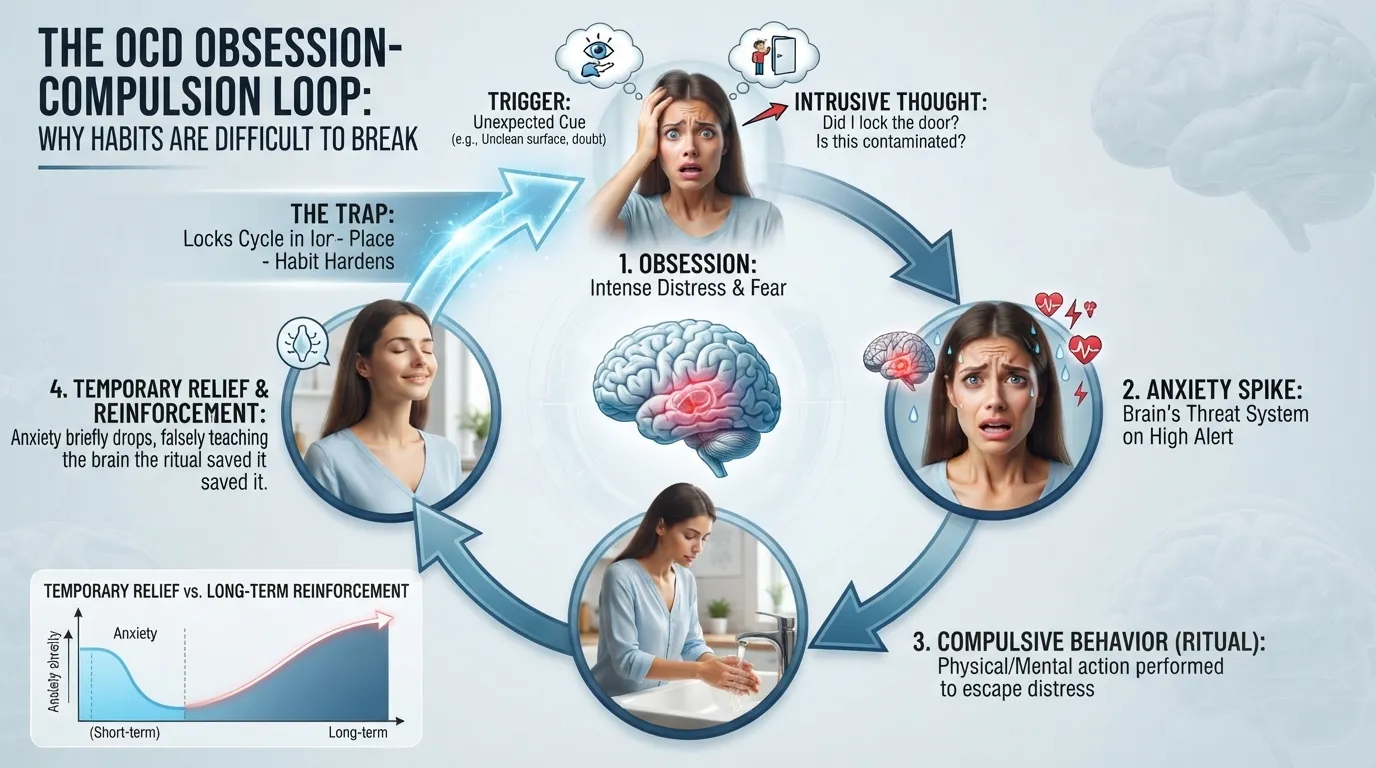
Understanding why OCD compulsions are so persistent requires examining the complex psychological and neurological mechanisms that reinforce them. It’s not simply a lack of willpower; it is a powerful cycle of anxiety and relief that fundamentally alters how the brain processes fear and safety.
The Obsession–Compulsion Loop
At the core of OCD is a self-perpetuating cycle known as the obsession-compulsion loop. This cycle begins when an intrusive thought (the obsession) is interpreted as catastrophic, triggering intense distress.
The Loop in Action:
Trigger (External or Internal): A random thought, doubt, object, or sensation.
Intrusive Thought (Obsession): An unwanted, distressing thought/image that is interpreted as dangerous or meaningful.
Anxiety/Distress: The intense spike in fear, dread, or uncertainty.
Ritual (Compulsion): A repetitive behavior (physical or mental) performed to neutralize the distress or prevent the feared event.
Temporary Relief: A short-lived reduction in anxiety after the compulsion is completed.
Loop Strengthened: This brief relief reinforces the brain’s belief that the obsession was dangerous and that the compulsion is necessary for safety.
Why Relief Backfires
While performing the compulsion provides immediate relief from distress, this relief is the trap that keeps the loop turning. By completing the ritual, you teach your brain—specifically the amygdala (the brain’s fear center)—a false lesson.
The brain interprets the sequence like this: “The intrusive thought appeared, I felt intense danger, I performed the ritual, and now I am safe. Therefore, the ritual must have saved me from the danger of that thought.”
This reinforcement solidifies the link between the thought and the threat, making the thought more likely to reappear with greater intensity. The relief validates the fear.
Why “Bas Rok Do” and Thought Suppression Don’t Work
When faced with a compulsion, the intuitive response is often to “just stop it” (“bas rok do”) or to forcefully suppress the intrusive thought. However, these methods almost universally fail with OCD due to two primary reasons:
Rebound Effect: Forcefully trying not to think about something actually makes the brain focus on it more. If you try not to think about a “blue elephant,” your brain must first identify the blue elephant to ensure it is not thinking about it, keeping the thought active.
Increased Urgency: Simply stopping a compulsion without addressing the underlying anxiety spike doesn’t solve the issue. The distress builds and becomes overwhelming, leading to a point where the urge to perform the ritual is nearly irresistible. Effective recovery requires learning to tolerate the anxiety without the ritual, rather than trying to suppress the thought that triggered it.
Step 1: Identify Every Compulsion, Including Hidden Ones
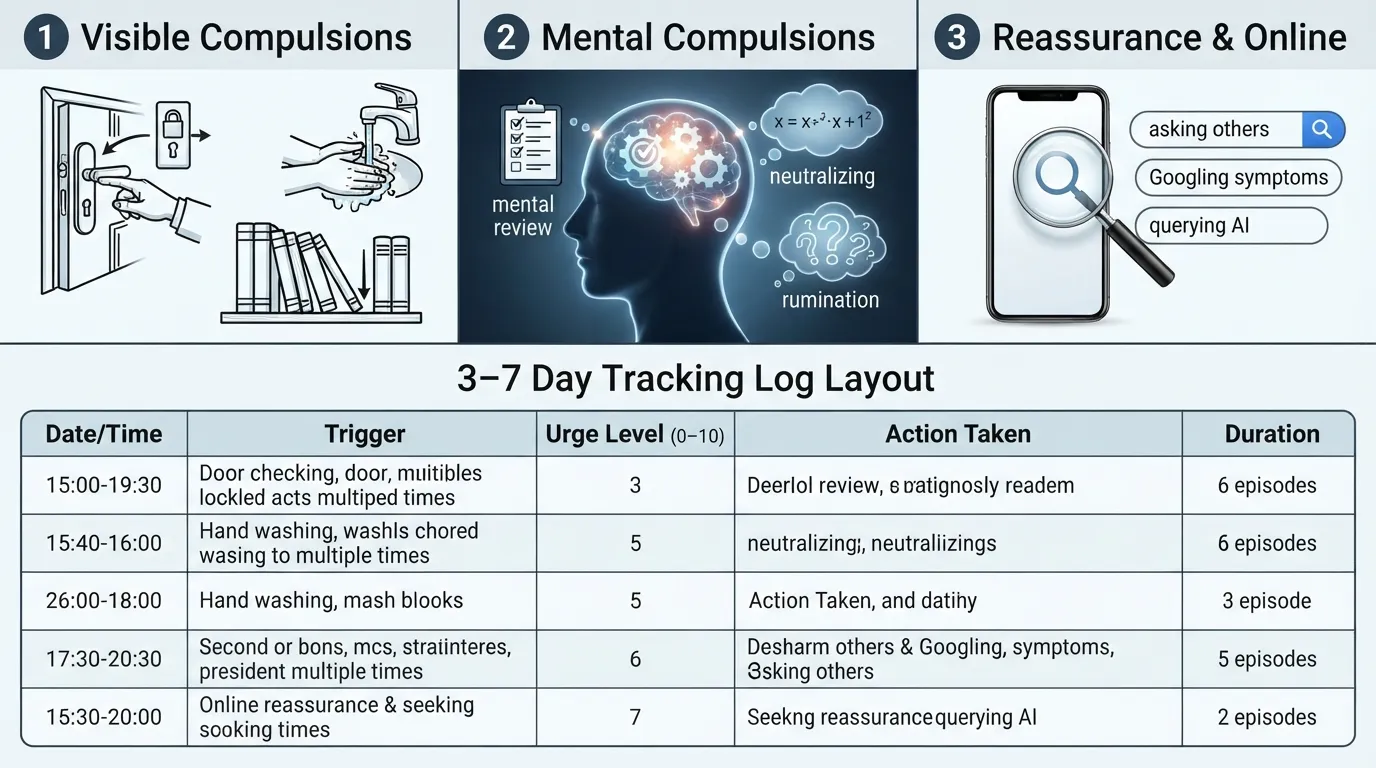
Before you can break compulsions, you must bring awareness to every form they take. OCD compulsions are not limited to obvious physical acts; they often lurk invisibly in your thoughts, internet searches, and interactions with others. Spotting these patterns is the foundational step toward recovery.
Visible Compulsions
Visible or overt compulsions are physical actions that can be observed by someone else. These are performed to eliminate distress or prevent a perceived disaster.
Checking: Repeatedly verifying locks, stoves, light switches, alarms, or appliances.
Washing & Cleaning: Excessive handwashing, prolonged showering, or scrubbing household objects to eliminate contamination.
Counting: Performing physical actions a specific “safe” number of times (e.g., tapping a table four times).
Arranging & Ordering: Moving items until they align perfectly or feel “just right.”
Mental Compulsions
Mental compulsions occur entirely inside your head. Because they are invisible to others, they are frequently misidentified as “just thinking,” but they are active, repetitive behaviors used to manage anxiety.
Mental Review: Replaying past events, conversations, or memories step-by-step to check if you made a mistake or caused harm.
Neutralizing: Replacing a “bad” thought with a “good” thought, special word, or prayer to undo perceived danger.
Rumination: Endless, analytical problem-solving in response to an intrusive “what if?” question.
Reassurance & Online Compulsions
Seeking certainty from outside sources is one of the most common ways OCD maintains its grip.
Asking Others: Frequently asking friends, family, or partners questions like “Are you sure I locked it?”, “Is everything going to be okay?”, or “Did I say something offensive?”
Googling & Researching: Spending hours reading forums, medical articles, or diagnostic criteria to get absolute clarity on a worry.
Querying AI: Asking AI assistants or chatbots repetitive questions to test scenarios, seek validation, or reassure yourself that a feared event won’t happen.
3–7 Day Tracking Log
To gain an accurate picture of your compulsions, keep a simple tracking log for 3 to 7 days. Record each instance as close to real-time as possible.
| Date & Time | Trigger / Intrusive Thought | Urge Intensity (0–10) | What You Did (Physical/Mental/Reassurance) | Time Spent |
|---|---|---|---|---|
| Date & Time Mon 8:30 AM | Trigger / Intrusive Thought Left house, thought "Is stove on?" | Urge Intensity (0–10) 8/10 | What You Did (Physical/Mental/Reassurance) Checked knob 5 times, took photo of stove | Time Spent 5 minutes |
| Date & Time Mon 2:15 PM | Trigger / Intrusive Thought Thought about a past conversation | Urge Intensity (0–10) 7/10 | What You Did (Physical/Mental/Reassurance) Mental review of every word said | Time Spent 20 minutes |
Step 2: Build Your Ladder
Trying to stop every compulsion at once is usually overwhelming and unsustainable. Instead, you can structure your recovery by creating an Exposure and Response Prevention (ERP) hierarchy—often called an Anxiety Ladder. This allows you to systematically face your fears and reduce compulsions from the least distressing to the most intense.
Ranking Compulsions on a 0–10 Scale
List your identified compulsions and assign each a Subjective Units of Distress (SUDs) rating from 0 to 10 based on how much anxiety you feel when you don’t perform the ritual.
0–2: Minimal distress; easy to resist.
3–4: Low to moderate distress; uncomfortable, but manageable.
5–6: Moderate to high distress; strong urge to perform the ritual.
7–8: Severe distress; intense urge, feels very difficult to resist.
9–10: Peak panic; extreme urge, feels nearly impossible to resist without guidance.
Example Anxiety Ladder
| Step / Level | Situation or Compulsion Trigger | Distress Rating (0–10) | Target Response Prevention |
|---|---|---|---|
| Step / Level Step 1 (Easy) | Situation or Compulsion Trigger Leaving the bedroom door unlocked before going to sleep | Distress Rating (0–10) 3/10 | Target Response Prevention Do not check the door handle after closing it. |
| Step / Level Step 2 (Moderate) | Situation or Compulsion Trigger Touching a light switch without wiping hands with a tissue | Distress Rating (0–10) 5/10 | Target Response Prevention Resist washing hands immediately; wait at least 30 minutes. |
| Step / Level Step 3 (Challenging) | Situation or Compulsion Trigger Seeing a vague concern online and wanting to search forums | Distress Rating (0–10) 7/10 | Target Response Prevention Refrain from Googling or asking an AI assistant for reassurance. |
| Step / Level Step 4 (Hard) | Situation or Compulsion Trigger Leaving the house after checking the stove burner only once | Distress Rating (0–10) 9/10 | Target Response Prevention Turn off the stove, walk out, and do not re-enter to double-check. |
Start with the Easy Items (Distress Level 3–4)
Begin your practice at the bottom of your ladder with items rated between 3 and 4. Facing lower-distress triggers builds your confidence and teaches your brain the core principle of response prevention: anxiety rises, peaks, and naturally falls on its own, even without performing the compulsion.
Starting with 9s or 10s often leads to intense panic, which can force you to perform the compulsion and unintentionally reinforce the loop. Small, consistent wins on easier items build the resilience needed to tackle higher levels later.
Focus on One Item at a Time
Avoid tackling multiple ladder levels simultaneously. Choose one target item from your ladder and focus on resisting or delaying that specific compulsion until it consistently produces little to no anxiety (a rating of 0–2).
Master the current step: Practice resisting the chosen target across multiple exposures over several days.
Move up gradually: Once the item no longer triggers significant distress, move up to the next item on your ladder (level 5 or 6).
Maintain progress: Keep resisting earlier items as you move up; do not let old compulsions slip back in.
Step 3: Delay, Reduce, Change
Once you have identified your compulsions and built your ladder, you don’t always have to stop a ritual cold turkey. Instead, you can weaken its power using three core response-prevention techniques: delaying, reducing, and deliberately altering how you perform it.
Delay: Active Waiting
Delaying breaks the automatic link between the surge of anxiety and the immediate compulsion. The goal is not just “holding your breath,” but practicing active waiting.
Time Escalation: Start small. When an urge hits, delay performing the compulsion for 5 minutes. Once that becomes manageable, increase the delay to 10 minutes, then 15, and eventually 30 minutes.
Label the Urge: Acknowledge what is happening without judgment (e.g., “This is an OCD urge to check the lock. I am feeling anxiety, but I can wait 10 minutes.”).
Engage in another Task: Shift your attention to an absorbing physical or mental activity during the delay period.
Re-evaluate: When the time is up, re-check your urge level. Often, the anxiety spike will have naturally peaked and begun to drop, making the urge easier to resist entirely.
Reduce: Gradual Decreases
If an absolute stop feels too overwhelming, systematically scale down the frequency, duration, or thoroughness of the compulsion.
Fewer Repetitions: If you usually check the door lock 10 times, reduce it to 7, then 5, then 2.
Shorter Duration: If you scrub your hands for 3 minutes, set a timer and cut it down to 2 minutes, then 1 minute.
Less “Satisfying”: Deliberately refrain from waiting for the “just right” feeling before stopping the ritual.
The 20% Weekly Rule: Aim to cut down the total frequency or duration of a targeted compulsion by approximately 20% each week.
Change: Do It Imperfectly
Compulsions thrive on perfectionism, symmetry, and strict rules. By intentionally introducing imperfection into the ritual, you disrupt its automatic quality and teach your brain that the “rules” don’t keep you safe—you are safe anyway.
Non-Dominant Hand: Perform physical compulsions using your non-dominant hand (e.g., turning off the light switch with your left hand instead of your right).
Skip a Step: Omit a specific element of your ritual (e.g., skip wiping down the faucet after washing your hands).
Change the Pattern: If you always touch an object in a clockwise pattern, touch it counter-clockwise, or change the order of your routine.
The Compulsion Swap Trap
A common pitfall during this step is the Compulsion Swap Trap. As you resist or modify a physical compulsion, your brain may try to sneak in a replacement to maintain safety.
Ritual Replacement: Stopping physical checking, but replacing it with mental checking (e.g., replaying the memory of locking the door in your head).
Avoidance: Avoiding the trigger altogether (e.g., refusing to turn on the stove so you don’t have to face the checking urge).
New Reassurance: Stopping Googling, but starting to ask a partner for validation instead.
Key Rule: Avoidance and mental rituals are just hidden compulsions. True progress requires facing the trigger without using any replacement coping mechanism.
Sample 2-Week Practice Plan
Here is an example of how to structure gradual delay, reduction, and alteration over two weeks for a targeted checking compulsion:
| Week & Day | Targeted Trigger & Ritual | Strategy Applied | Goal / Target |
|---|---|---|---|
| Week & Day Week 1 (Mon–Wed) | Targeted Trigger & Ritual Leaving home (checking front door knob 6 times) | Strategy Applied Delay + Imperfect | Goal / Target Wait 5 minutes before performing ritual; check with non-dominant hand. |
| Week & Day Week 1 (Thu–Sun) | Targeted Trigger & Ritual Leaving home (checking front door knob 6 times) | Strategy Applied Reduce (20% rule) | Goal / Target Reduce checks from 6 times to 4 times max. No waiting for "just right" feeling. |
| Week & Day Week 2 (Mon–Wed) | Targeted Trigger & Ritual Leaving home (checking front door knob) | Strategy Applied Increase Delay | Goal / Target Wait 15 minutes before any checking urge. Skip checking entirely if anxiety drops. |
| Week & Day Week 2 (Thu–Sun) | Targeted Trigger & Ritual Leaving home (checking front door knob) | Strategy Applied Full ERP Step | Goal / Target Turn key once, walk away immediately. Do not perform mental checking or ask housemates. |
Step 4: Sit With the Urge in the Moment
The ultimate goal of Exposure and Response Prevention (ERP) is not to eliminate anxiety immediately, but to build your capacity to tolerate distress without engaging in compulsions. When an urge hits, sitting through the discomfort teaches your brain that uncertainty is manageable and that anxiety naturally dissipates over time.
Relabel the Experience
When an intrusive thought triggers a powerful urge, step back and label what is actually happening rather than treating the thought as an emergency.
Acknowledge the mechanism: Say to yourself, “This is an OCD urge,” or “My brain is sending a false alarm right now.”
Separate thought from reality: Remind yourself, “I just had a thought; having a thought does not mean it’s an action, a threat, or a reality.”
Observe without judgment: View the urge as a physical sensation or a passing mental cloud rather than a command that requires an immediate response.
Respond with Uncertainty (“Maybe, Maybe Not”)
OCD thrives on demanding absolute certainty (“Are you 100% sure the door is locked?”, “Are you sure you didn’t do something wrong?”). Feeding this demand keeps the loop alive. Instead, lean into uncertainty using non-engagement responses:
Accept the possibility: Answer intrusive “what-if” questions with phrases like, “Maybe I locked it, maybe I didn’t,” or “It’s possible, but I am choosing to leave it uncertain.”
Refuse to argue: Avoid trying to prove the thought wrong or analyzing why it happened. Giving an intrusive thought a logical argument only invites further OCD counter-arguments.
Embrace the risk: Acknowledge that life involves inherent risk, and agree to live with that slight possibility of uncertainty in the present moment.
Use Calming Techniques to Endure, Not Escape
Relaxation and grounding tools can be helpful, but their purpose in ERP must be carefully managed.
The Intent Matters: Use techniques like slow diaphragmatic breathing, ground-focused sensory awareness, or light stretching to stay present with the discomfort, not to force the anxiety to disappear.
Avoid Emotional Avoidance: If you use deep breathing or mindfulness as a compulsion to “make the bad feeling go away right now,” it becomes just another ritual.
Focus on Willingness: Use grounding to keep your mind steady while allowing the underlying anxiety spike to rise and fall naturally in the background.
What NOT to Do
To ensure response prevention remains effective during an anxiety spike, actively avoid these common traps:
Do Not Debate the Thought: Never try to reason with, analyze, or figure out the meaning behind an intrusive thought.
Do Not Seek Reassurance: Resist asking others, searching online, or checking with AI tools to confirm that everything is fine.
Do Not Suppress or Push Away: Trying to force a thought out of your head creates a rebound effect, making the thought return stronger. Let the thought exist without engaging with it.
How ERP Works and What You Can Safely Do on Your Own
Exposure and Response Prevention (ERP) is considered the gold standard treatment for OCD because it directly targets the cycle that keeps compulsions alive. Understanding how ERP works empowers you to take structured, safe steps toward breaking rituals and regaining control over your daily life.
ERP Explained
ERP consists of two main components working together: Exposure and Response Prevention.
Exposure: Deliberately facing thoughts, images, objects, or situations that trigger anxiety or intrusive worries.
Response Prevention: Choosing not to perform the compulsive ritual or avoidance behavior in response to that trigger.
When you practice ERP, you stop demanding 100% certainty or absolute safety. Instead, you train your brain to adopt a realistic mindset: “Feared outcome chahe ho ya na ho, main anxiety aur uncertainty ko handle kar sakta hoon.” Over time, through a process called habituation, your brain realizes that the feared catastrophe doesn’t occur, and the anxiety naturally decreases on its own without needing a ritual.
Self-Directed vs. Therapist-Guided ERP
While many people can implement mild-to-moderate ERP strategies independently, it is important to know when self-help is sufficient and when professional guidance is necessary.
Self-Directed ERP: Suitable for low-to-moderate distress levels, simple checking or ordering habits, and individuals who are highly motivated to follow a structured hierarchy. It requires strong self-discipline and awareness to avoid falling into hidden mental rituals.
Therapist-Guided ERP: Strongly recommended when compulsions consume multiple hours a day, cause severe distress, or involve complex mental rumination. A specialized cognitive-behavioral therapist (CBT/ERP) helps design a safe hierarchy, prevents covert compulsions, and provides essential accountability.
Severe Cases and Medication
For individuals experiencing severe OCD symptoms, practicing exposure exercises can feel overwhelming or nearly impossible due to extreme baseline anxiety.
In such cases, combining ERP with evidence-based psychiatric medication—such as Selective Serotonin Reuptake Inhibitors (SSRIs)—under the strict supervision of a medical doctor or psychiatrist can significantly lower the intensity of anxiety spikes. Medication acts as a stabilizing foundation, making it easier to engage in and benefit from ERP exercises safely.
Lifestyle Support
While therapy and response prevention are the primary treatments for OCD, your daily lifestyle habits play a crucial role in regulating your nervous system. Maintaining healthy physical and mental routines creates a solid foundation, making it significantly easier to resist compulsions and manage spikes in anxiety.
Prioritize Consistent Sleep: Lack of sleep directly impacts the brain’s prefrontal cortex—the region responsible for executive function and impulse control. Aim for 7–9 hours of quality sleep each night to help keep your brain resilient against intrusive thoughts.
Identify Stress Triggers: High stress levels lower your tolerance for uncertainty, causing OCD symptoms to flare up. Track periods of elevated stress (such as tight work deadlines or personal conflicts) so you can proactively apply your response-prevention strategies.
Incorporate Daily Movement: Regular physical exercise—such as brisk walking, strength training, or yoga—helps burn off excess cortisol and adrenaline. Exercise boosts mood-regulating neurotransmitters like serotonin, helping to reduce overall baseline anxiety.
Moderate Caffeine Intake: Caffeine is a central nervous system stimulant that mimics the physical symptoms of anxiety (racing heart, jitteriness, shallow breathing). Reducing or eliminating caffeine can prevent these physical cues from triggering false alarms in your brain.
Set Online Time Limits: Excessive screen time—especially late-night browsing or doomscrolling—can fuel reassurance-seeking behavior and mental overstimulation. Set strict daily limits on social media, search engines, and forums to give your mind space to rest.
Slips, Setbacks, and Bad Days
Recovery from OCD is rarely a straight line. Having days where anxiety spikes or where you fall back into old habits does not mean you have failed; it simply means your brain is navigating a complex learning process. Anticipating setbacks and knowing how to respond to them keeps temporary slips from turning into long-term relapses.
Lapse vs. Relapse
Understanding the difference between a lapse and a relapse is essential for maintaining momentum:
Lapse (A Slip): A single, temporary moment where you perform a compulsion or give in to an intrusive thought (e.g., double-checking the stove or asking for reassurance once after weeks of progress). A lapse is a minor misstep, not a complete breakdown of your recovery.
Relapse: A sustained pattern where you give up response-prevention strategies and return to daily compulsive loops over several days or weeks.
Key Mindset: A slip only becomes a relapse if you treat it as proof that ERP “didn’t work” and abandon your tools altogether.
What to Do If You Perform a Compulsion
If you give in to an urge and carry out a compulsion, react with curiosity and self-compassion rather than guilt or frustration:
Label it immediately: Acknowledge what happened without judgment (e.g., “That was a compulsion. I gave in to the urge, and that’s okay.”).
Note the trigger: Record the slip in your tracking log. Identify what triggered the spike and what made resisting difficult at that moment.
Adjust for next time: Commit to extending your delay or applying response prevention during the next exposure (e.g., “Next time this trigger happens, I will wait 10 minutes before responding.”).
Do not perform “undoing” rituals: Resist the urge to perform additional compulsions or mental checks to “fix” the slip.
When Self-Care Becomes Compulsive
A subtle trap in recovery is when self-care and coping strategies turn into disguised compulsions. If a health habit becomes rigid, rule-bound, or driven by a demand for safety, it has slipped into OCD territory.
Compulsive Exercise: Working out strictly to “wash away” intrusive thoughts or relieve anxiety rather than for fitness and health.
Compulsive Healthy Eating/Cleanliness: Sticking to extreme diet or hygiene rules to feel “pure” or avoid vague health fears.
Compulsive Mindfulness: Using deep breathing, meditation, or positive affirmations forcefully to make anxiety disappear immediately.
Rule of Thumb: If you feel intense panic or guilt when you skip a self-care routine, evaluate whether that routine has become an OCD compulsion.
Bad-Day Checklist
When facing a high-anxiety day, use this practical checklist to keep yourself grounded and on track:
[ ] Acknowledge the baseline: Remind yourself, “Today is a high-anxiety day, and that is completely normal.”
[ ] Lower the daily demand: Focus on maintaining basic routines; avoid taking on unnecessary stressors.
[ ] Stick to the ladder: Do not attempt high-level exposure exercises on a bad day; focus on holding your ground on easier items.
[ ] Avoid the research trap: Keep off search engines, forums, and AI assistants for reassurance.
[ ] Focus on physical needs: Ensure you have eaten a balanced meal, stayed hydrated, and moved your body gently.
[ ] Practice acceptance: Allow uncomfortable feelings to exist in the background while continuing your scheduled daily activities.
How Long Does It Take? Can OCD Habits Be "Cured"?
Setting realistic expectations is essential when understanding the journey of OCD recovery. Knowing what progress actually looks like protects you from unnecessary frustration, burnout, and premature disappointment.
Can OCD Be “Cured”?
In clinical terms, OCD is not typically framed as something that is “cured,” but rather as a condition that can be effectively managed.
Management vs. Cure: Through structured Exposure and Response Prevention (ERP) and the right cognitive mindset, you can reduce your symptoms so significantly that they no longer disrupt your daily life, work, or relationships. You regain control over your choices, even though having random intrusive thoughts remains a normal part of human brain function.
Retraining the Brain’s Fear Response: Recovery does not mean that intrusive thoughts will completely disappear forever. Instead, it means that when an intrusive thought occurs, your brain no longer misinterprets it as an immediate danger, allowing you to dismiss the urge without engaging in compulsions.
What Is the Timeline?
There is no guaranteed universal timeline for breaking OCD habits or reducing compulsions. Everyone’s recovery timeline varies based on several factors:
Severity and Duration: How long the compulsive patterns have been ingrained and how intensely they impact your routine.
Consistency with ERP: How regularly and actively you practice exposure exercises and response prevention in daily life.
Level of Support: Whether you are practicing self-directed ERP or working alongside a specialized therapist.
When working on lower-level distress triggers (3–4 on your anxiety ladder), many people begin noticing meaningful improvements within a few weeks (4 to 8 weeks). However, unlearning deeply rooted, high-distress compulsions can take several months of steady practice.
Progress Is Not a Straight Line
Recovery is rarely a linear, smooth process. It naturally comes with peaks, plateaus, and temporary dips:
Good Days and Tough Days: On some days, resisting compulsions will feel manageable and empowering. On other days—especially during periods of high stress or fatigue—the urge to perform rituals will feel significantly stronger.
Avoiding the Frustration Trap: A temporary spike in anxiety or a minor slip does not mean your hard work has been erased. Setbacks are an expected and normal part of the learning process.
Bottom Line: The goal of recovery is not to achieve zero anxiety or zero intrusive thoughts. The true goal is to build tolerance for uncertainty and discomfort, ensuring that compulsions no longer dictate your life.
When to Get Professional Help
When to Get Professional Help
While self-directed strategies can be helpful for mild OCD habits, professional support becomes essential when compulsions begin to overwhelm your daily life. Knowing when to seek expert help ensures you receive the structured care needed for long-term recovery.
Key Red Flags
Consider reaching out to a mental health professional if you experience any of the following:
Significant Time Loss: Compulsions, mental reviews, or research consume a substantial portion of your day (often more than an hour daily).
Impact on Work and Relationships: Intrusive thoughts or repetitive rituals interfere with your job performance, academic progress, personal life, or relationships with family and friends.
Inability to Resist: You feel completely unable to delay or modify compulsions on your own, and resisting them causes overwhelming panic or distress.
Expanding Rituals: Your compulsions are multiplying or becoming increasingly complex over time.
How to Find an ERP Therapist and What to Ask
Not all therapy is effective for OCD. Traditional talk therapy or general cognitive therapy can sometimes inadvertently worsen OCD by encouraging you to analyze intrusive thoughts. You need a professional specifically trained in Exposure and Response Prevention (ERP).
How to Find One
Look for licensed clinical psychologists, psychiatrists, or counselors certified in Cognitive Behavioral Therapy (CBT) with a specialization in OCD and ERP.
Use reputable directories like the International OCD Foundation (IOCDF) or local mental health professional registries to locate vetted providers.
Questions to Ask Potential Therapists
When evaluating a therapist during an initial consultation, ask these key questions:
“Do you specialize in treating OCD, and do you specifically use Exposure and Response Prevention (ERP)?”
“How much of your current practice is dedicated to treating clients with OCD?”
“How do you handle mental compulsions and reassurance seeking during sessions?”
“Will we be creating a structured exposure hierarchy together for my exposures?”
Crisis Support and Emergency Help
Immediate Warning: If intrusive thoughts turn into thoughts of self-harm, suicide, or if you feel unsafe and unable to keep yourself secure, do not wait for a therapy appointment.
Please reach out immediately to your local emergency service, visit the nearest hospital emergency room, or call/text a national crisis hotline (such as 988 in the US/Canada, 111 in the UK, or your local emergency number) for immediate support.
FAQs
Can I break OCD habits without therapy?
While self-help strategies like response prevention and journaling can help manage mild patterns, professional treatment through Exposure and Response Prevention (ERP) is typically necessary for lasting recovery. Therapy provides structured guidance to safely navigate severe triggers without reinforcing the cycle.
How do I stop OCD thoughts immediately?
Trying to forcefully suppress intrusive thoughts usually backfires and makes them stronger. Instead of fighting the thought, acknowledge its presence without judgment, accept the uncertainty, and allow the anxiety to pass naturally over time.
What to do on bad OCD days?
On difficult days, lower your expectations and focus entirely on basic self-care and radical acceptance. Avoid adding extra pressure, reduce major triggers where possible, and practice grounding exercises to anchor yourself in the present moment.
How do I calm an OCD brain?
Calming an overactive brain involves breaking the loop of physical and mental compulsions. Slow down your breathing, step away from reassurance-seeking behaviors, and give your nervous system time to regulate without engaging in safety rituals.
How do I stop OCD from getting worse?
Preventing OCD from worsening requires catching avoidance and reassurance loops early. Refrain from checking, googling, or seeking comfort from others, as every avoided trigger teaches your brain that the fear was legitimate.
Why is OCD so hard to overcome?
OCD is exceptionally difficult because compulsions provide immediate, addictive relief that tricks the brain into feeling safe. This powerful feedback loop reinforces the obsession, making the urge to perform rituals feel like a matter of survival.
Mark Steve
Mark Steve is a tech, business, and lifestyle writer with over 5 years of experience analyzing digital trends, startups, and online business models. He publishes well-researched, fact-checked content focused on clarity, credibility, and real-world value.