Jump to:
ToggleSelf-Discipline: How to Build Lasting Habits, Master Your Mind, and Achieve Your Goals
What Is Discipline, Really?
Discipline functions as the foundational framework governing how individuals regulate behavior, establish personal boundaries, and execute consistent routines to achieve long-term objectives. Far from being a rigid punitive measure, authentic discipline represents a deliberate mechanism for self-control and sustained personal growth.
What Does “Discipline” Actually Mean?
At its core, discipline is the capacity to override immediate impulses in favor of enduring principles and delayed gratification. It relies heavily on established behavioral patterns rather than fleeting bursts of motivation.
Behavioral Regulation: The active management of daily actions to align with overarching goals.
Consistent Routines: Predictable structures that reduce decision fatigue and automate productivity.
Internalized Virtue: A character strength that transforms external rules into self-directed choices.
Self-Discipline vs. Child Discipline: Which One Do You Need?
While search engines often group behavioral management and personal mastery under the same umbrella, they serve entirely different psychological domains. If your goal centers on personal productivity, habit formation, and emotional regulation, the primary focus belongs on self-discipline.
Self-Discipline: Focuses inward on personal agency, intrinsic motivation, and self-directed behavioral modification.
Child Discipline: Focuses outward on establishing healthy boundaries, guidance, and developmental structure for youth.
Is Discipline a Skill or a Trait?
Discipline is fundamentally a malleable skill rather than an immutable genetic trait. Contemporary psychological research confirms that self-control operates like a muscle; it strengthens through progressive overload, deliberate practice, and the cultivation of supportive environments.
Neuroplasticity: The brain physically rewires neural pathways when repeating structured behaviors consistently.
Environmental Design: Reducing friction for desired outcomes matters more than raw willpower.
Incremental Growth: Small, daily applications of boundaries build long-term behavioral endurance over time.
Why Self-Discipline Matters (The Science-Backed Case)
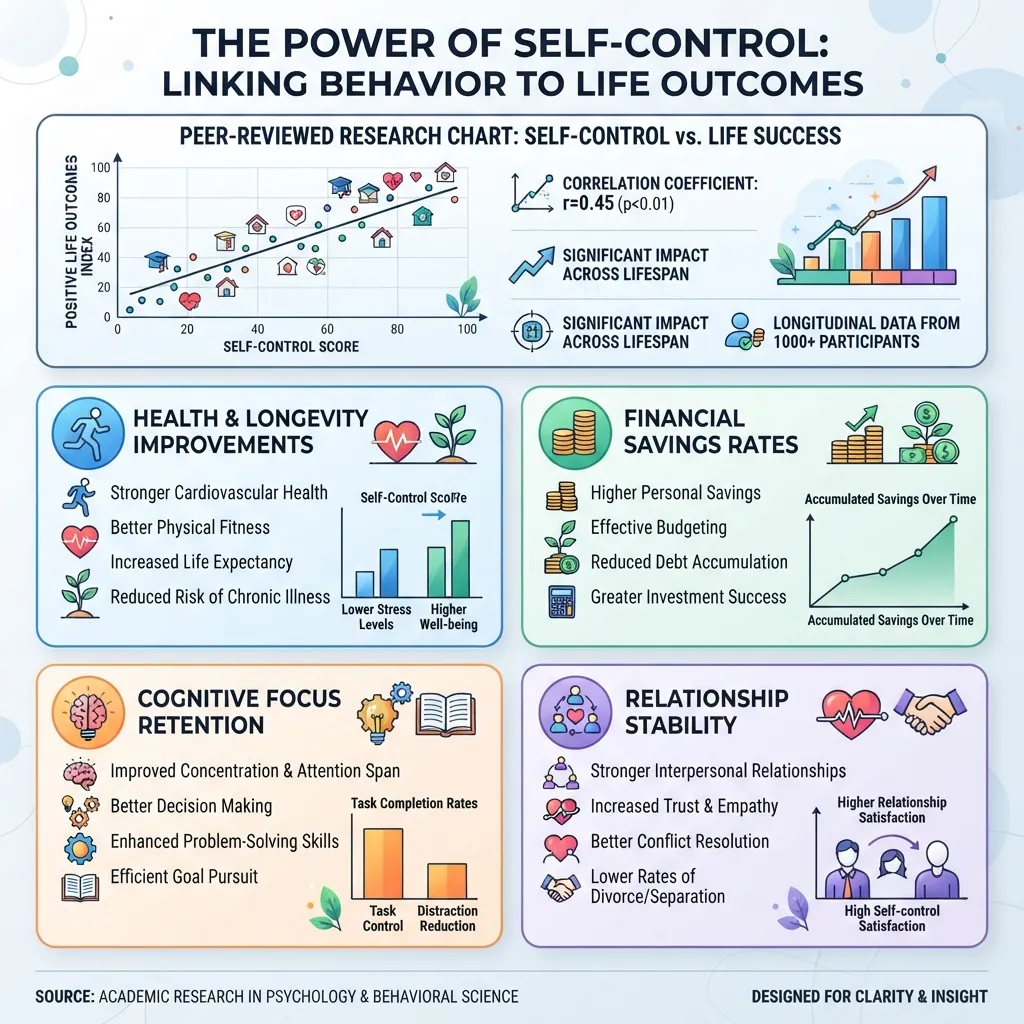
Self-discipline serves as the primary psychological engine driving long-term success, surpassing raw intelligence or talent in predicting academic, financial, and personal achievements. Peer-reviewed research, including studies documented by the National Institutes of Health, demonstrates that individuals with high self-control consistently exhibit better health outcomes, higher financial stability, and stronger interpersonal relationships throughout their lifespan.
The Real Benefits of Self-Discipline
Cultivating daily self-control rewires behavioral patterns to optimize performance across multiple life domains simultaneously. Rather than relying on fleeting motivation, disciplined routines compound minor daily wins into monumental long-term advantages.
Health and Longevity: Higher self-discipline correlates directly with lower body mass indexes, regular exercise habits, and healthier dietary choices.
Financial Stability: Individuals with strong self-control excel at prioritizing delayed gratification, leading to superior savings rates and minimal impulse debt.
Cognitive Focus: Consistent boundary-setting eliminates distractions, expanding attention spans and accelerating deep work capacity.
Relationship Quality: Emotional regulation prevents reactive outbursts, fostering trust, stability, and healthier conflict resolution.
What Happens When Discipline Is Missing
An absence of structured self-control frequently traps individuals in cycles of chronic stress, reactive decision-making, and unfulfilled potential. Without boundaries, daily life becomes dictated by immediate environmental impulses rather than intentional goals.
Chronic Procrastination: Important tasks are repeatedly delayed, triggering acute anxiety and poor performance output.
Decision Fatigue: Relying solely on real-time choices exhausts mental energy, leading to poor judgment by midday.
Stagnation: Personal and professional growth plateaus because effort stops the moment discomfort arises.
What Causes Poor Self-Discipline?
Struggling with self-control does not indicate a character flaw; it typically stems from biological, psychological, or environmental stressors. Recognizing these root causes allows for targeted behavioral interventions instead of harsh self-criticism.
Ego Depletion: Constantly resisting temptations drains the brain’s finite metabolic and psychological energy reserves.
Unclear Boundaries: A lack of explicit daily routines forces the brain to constantly negotiate what tasks to do next.
Environmental Friction: High-distraction settings—such as chaotic workspaces or constant smartphone notifications—overwhelm executive function.
The Psychology & Neuroscience of Discipline
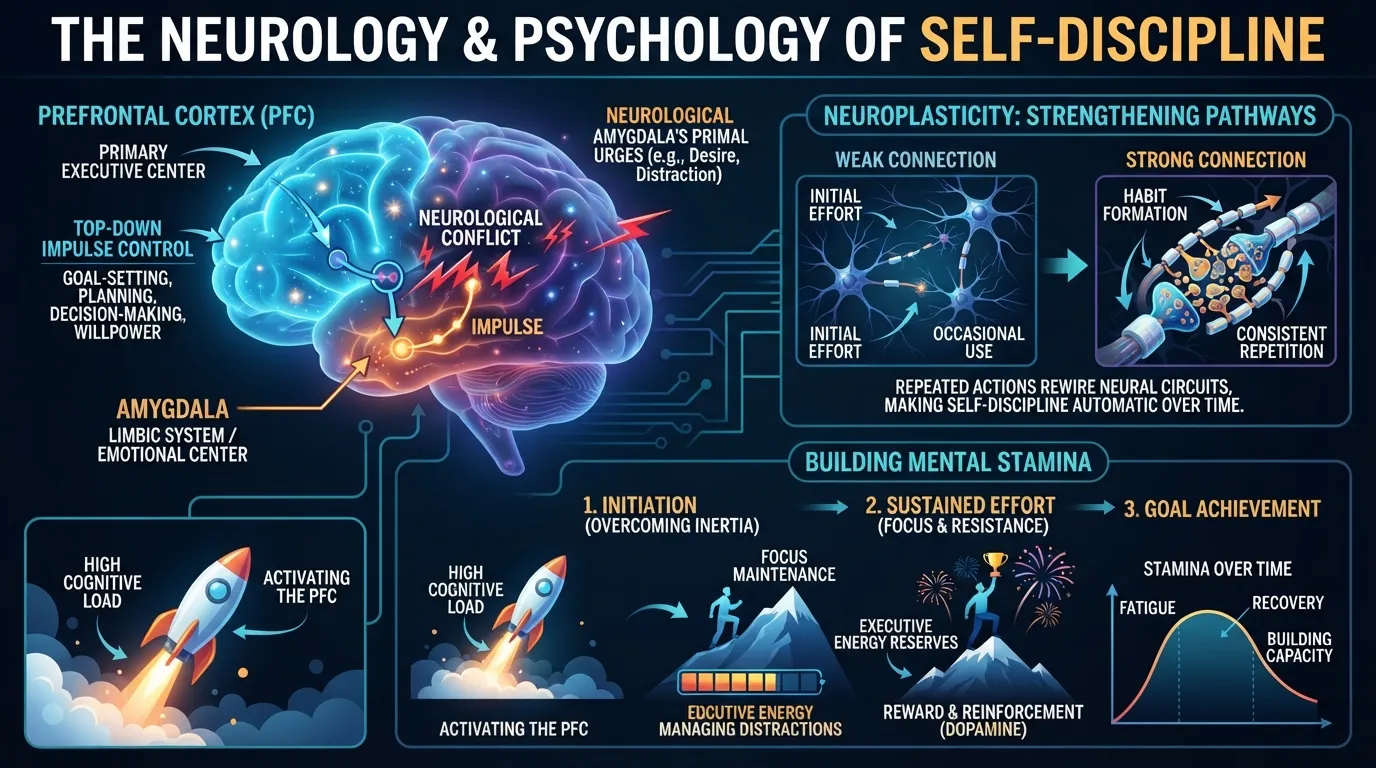
Mastering discipline requires understanding the biological mechanisms and cognitive frameworks that govern human behavior, bridging the gap between conscious intention and physical execution. By examining the brain’s executive control systems and the ongoing debates surrounding mental stamina, you can leverage neuroscience to build lasting self-regulation.
Which Part of the Brain Controls Discipline?
Discipline is managed primarily by the prefrontal cortex (PFC), the region responsible for executive functions, impulse control, and long-term planning. The PFC constantly engages in a biological tug-of-war with the amygdala, the primitive emotional center that demands immediate gratification and stress relief.
Executive Oversight: The prefrontal cortex evaluates future consequences, allowing you to bypass short-term comfort for overarching goals.
Neural Conflict: When you experience a strong temptation, your PFC must exert top-down inhibition to override the impulses generated by subcortical reward pathways.
Energy Consumption: Operating the prefrontal cortex requires significant metabolic resources, which explains why mental fatigue rapidly erodes your ability to stay focused.
The “Ego Depletion” Debate: Is Willpower Really Limited?
For years, psychologists believed in ego depletion—the idea that willpower acts like a muscle that fatigues completely with use throughout the day. Modern behavioral science and replication studies now present a more nuanced picture of mental stamina.
The Belief Effect: Research shows that people who view willpower as a limitless resource experience far less daily fatigue when tackling demanding tasks.
Motivational Framing: Perceived exhaustion is often a subconscious prioritization shift rather than an absolute depletion of biological energy.
Strategic Rest: While cognitive energy fluctuates, reframing fatigue and taking short strategic pauses can rapidly restore self-regulatory capacity.
How to Train Your Brain for Discipline
You can physically alter your brain’s structure through neuroplasticity, strengthening the neural circuits connecting the prefrontal cortex to lower emotional centers. Training discipline does not require sudden perfection; it requires progressive behavioral overload.
Micro-Habits: Start with tiny, friction-free commitments that require minimal initial activation energy to build neural momentum.
Friction Optimization: Rearrange your immediate environment to physically block distractions, reducing the load on your prefrontal cortex.
Consistent Repetition: Performing challenging tasks at the exact same time daily automates the process, turning deliberate effort into an ingrained subconscious routine.
How Long Does It Actually Take to Build Discipline?
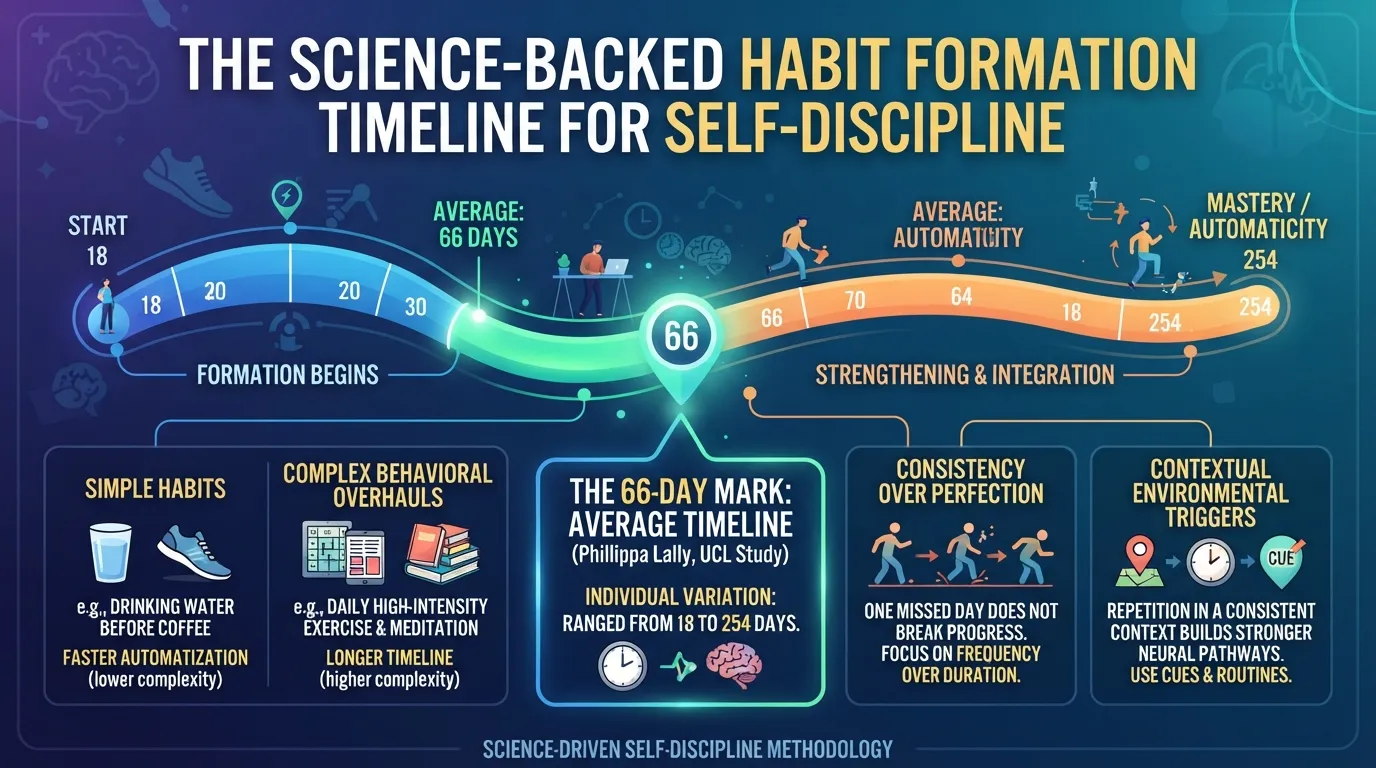
Building authentic self-discipline is a dynamic, non-linear process that defies simplistic formulas. While popular self-help myths frequently cite a flat 21-day window, contemporary habit science reveals a significantly broader and more realistic developmental timeline.
The Truth About Habit-Formation Timelines
Groundbreaking research conducted by Dr. Phillippa Lally at University College London established that forming a new, automated behavior actually takes an average of 66 days, with actual timelines ranging drastically from 18 to 254 days depending on individual variables.
The 66-Day Average: Most people require slightly over two months of consistent execution before a conscious action transitions into an automatic routine.
Complexity Variance: Simple habits—like drinking a glass of water immediately upon waking—solidify rapidly, whereas complex behavioral overhauls demand extended neural adaptation.
Consistency Over Perfection: Missing a single day of practice does not reset your cumulative progress, debunking the myth that perfection is required to build lasting neural pathways.
Why Discipline Isn’t a Fixed Number of Days
Treating habit formation as a rigid countdown timer sets individuals up for failure because human neuroplasticity and daily friction levels fluctuate constantly. Discipline functions less like a binary switch and more like a sliding scale of increasing cognitive efficiency.
Contextual Triggers: The speed at which discipline solidifies depends heavily on environmental stability rather than elapsed time alone.
Variable Baseline Resistance: Personal stress, baseline energy levels, and the inherent difficulty of the target behavior dictate how quickly the prefrontal cortex automates the task.
Identity Shift: True discipline stabilizes permanently only when the target behavior evolves from an external chore into an internal reflection of your core personal identity.
How to Build Self-Discipline — The Complete Step-by-Step System
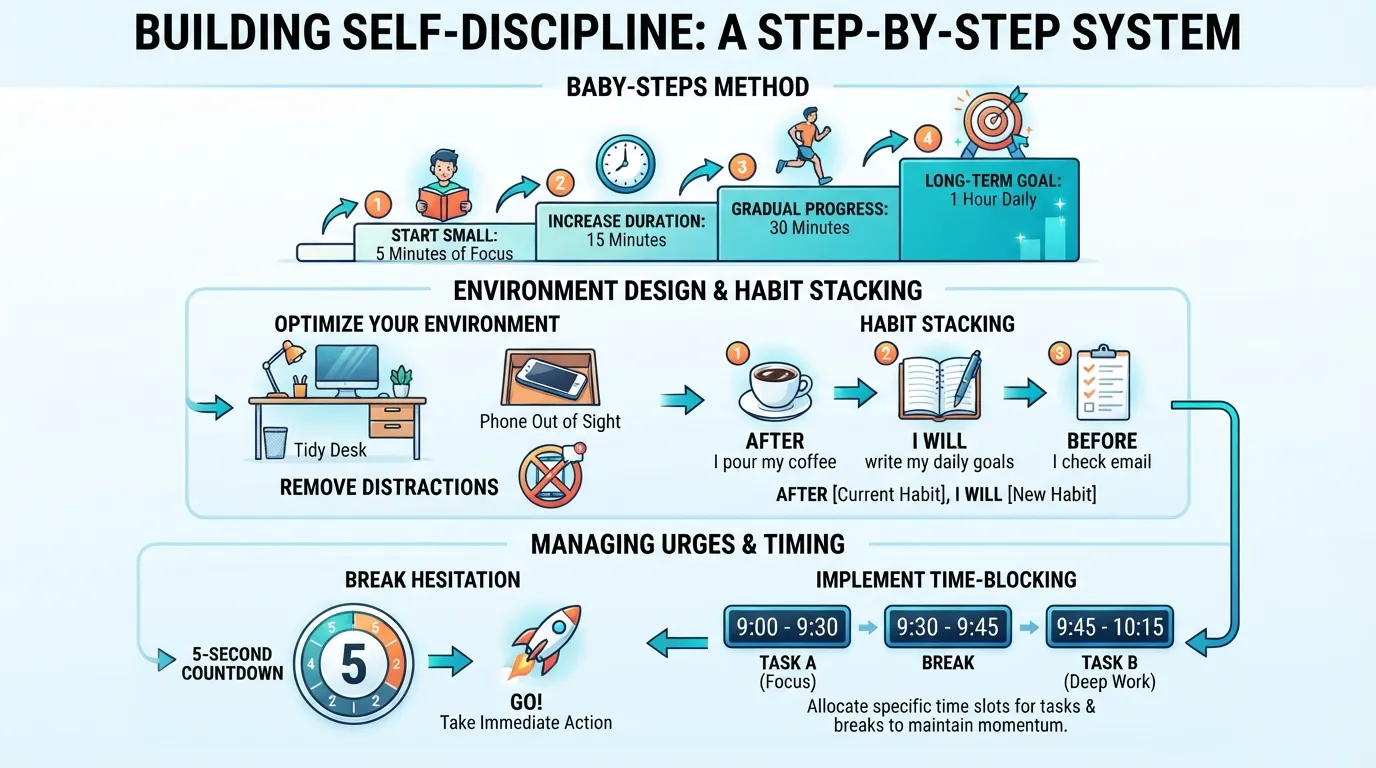
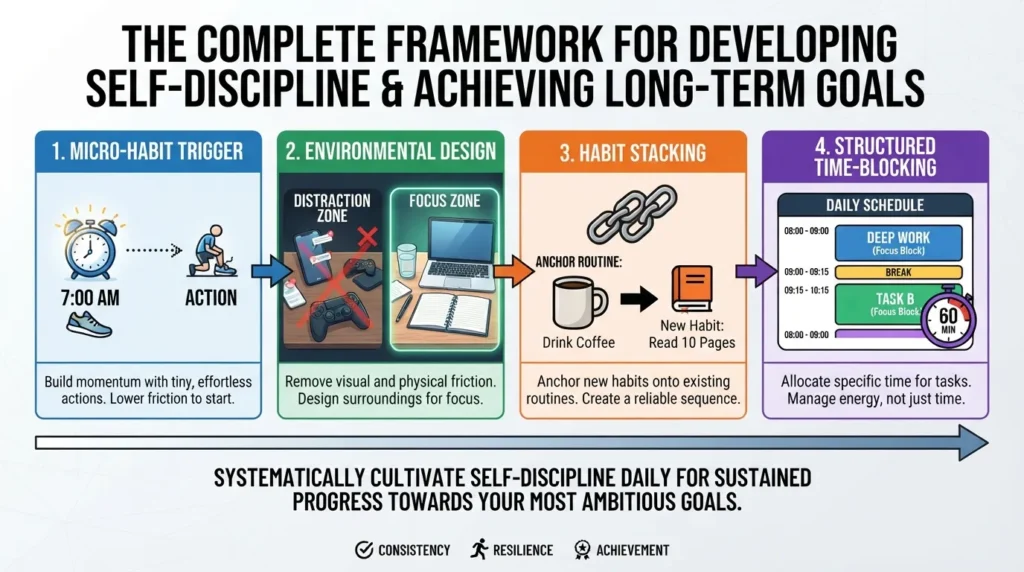
Developing unshakeable self-discipline is not a matter of waiting for motivation to strike or possessing superhuman willpower. Building sustainable self-control requires a systematic, repeatable framework that lowers cognitive friction and rewires your daily behaviors.
Start Small: The Baby-Steps Method
Attempting a massive lifestyle overhaul all at once exhausts your prefrontal cortex and triggers burnout. The baby-steps method relies on micro-commitments so small that your brain experiences zero resistance in executing them.
Lower the Bar: Reduce your goal to a trivial level, such as writing a single sentence or reading one page, to bypass initial psychological hesitation.
Build Momentum: Once you cross the starting threshold, action itself generates the motivation needed to continue.
Compound Small Wins: Consistent minor victories gradually expand your baseline capacity for greater challenges.
Design Your Environment for Success
Relying entirely on willpower within a high-distraction environment is a recipe for failure. Environmental design removes temptation before it ever reaches your conscious awareness.
Increase Friction for Bad Habits: Physically hide distractions, such as placing your phone in another room or locking distracting applications.
Decrease Friction for Good Habits: Prep your workspace the night before so your tools are immediately accessible when you wake up.
Automate Choices: Reduce daily decision fatigue by establishing fixed protocols for routine tasks.
Use Anchor Routines (Habit Stacking)
Habit stacking leverages established daily behaviors to anchor new, unfamiliar routines into your schedule without requiring extra mental effort.
Identify Existing Anchors: Anchor new habits to automatic behaviors like brushing your teeth, pouring your morning coffee, or sitting at your desk.
Establish Clear Sequences: Follow the formula: “After I [Current Habit], I will [New Habit].”
Reduce Activation Energy: Piggybacking on existing neural pathways makes new routines feel natural rather than forced.
Time-Block Your Focus (10–15 Minute Intervals)
Staring at an open-ended block of work triggers avoidance and procrastination. Time-blocking creates structured boundaries that make intense focus feel manageable.
Micro-Intervals: Commit to just 10 to 15 minutes of uninterrupted focus using a visible timer.
Eliminate Multitasking: Dedicate the entire interval to a single, hyper-specific task while ignoring all incoming notifications.
Take Structured Breaks: Step away briefly after each block to reset cognitive energy before diving into the next cycle.
The Countdown Method: Stop Hesitating, Start Moving
When facing a task you want to avoid, your brain begins rationalizing procrastination within seconds. The countdown technique interrupts active hesitation by engaging the prefrontal cortex immediately.
Count Backwards: Silently count down from five to one (5-4-3-2-1) to cut off internal negotiations.
Immediate Physical Action: Commit to moving your body as soon as you hit one, shifting focus from thoughts to physical motion.
Override Hesitation: This simple mental circuit-breaker prevents emotional resistance from talking you out of important actions.
Discomfort Training: Building Tolerance for Hard Things
Discipline grows precisely at the edge of your comfort zone. Discomfort training systematically exposes your mind and body to controlled friction to raise your stress tolerance.
Embrace Small Agonies: Voluntarily choose minor discomforts, such as taking a cold shower, working without background noise, or finishing a difficult task before checking messages.
Desensitize the Brain: Training your nervous system to tolerate discomfort reduces the urge to flee toward immediate gratification.
Expand Your Capacity: As you practice enduring manageable friction, major challenges begin to feel routine and achievable.
Mindfulness With Urges (How to Notice and Resist Impulses)
Impulses lose their power the moment you stop reacting to them automatically and begin observing them with detached awareness. Mindfulness transforms intense cravings from commands into temporary sensations.
Observe the Urge: Notice the physical sensation of an impulse without judging yourself for feeling it.
Surf the Wave: Understand that psychological urges follow a bell curve; they peak in intensity and naturally subside if you refuse to feed them.
Create Space: Insert a deliberate pause between the stimulus and your response to regain complete control over your behavior.
How to Fix a Lack of Discipline (Diagnostic Section)
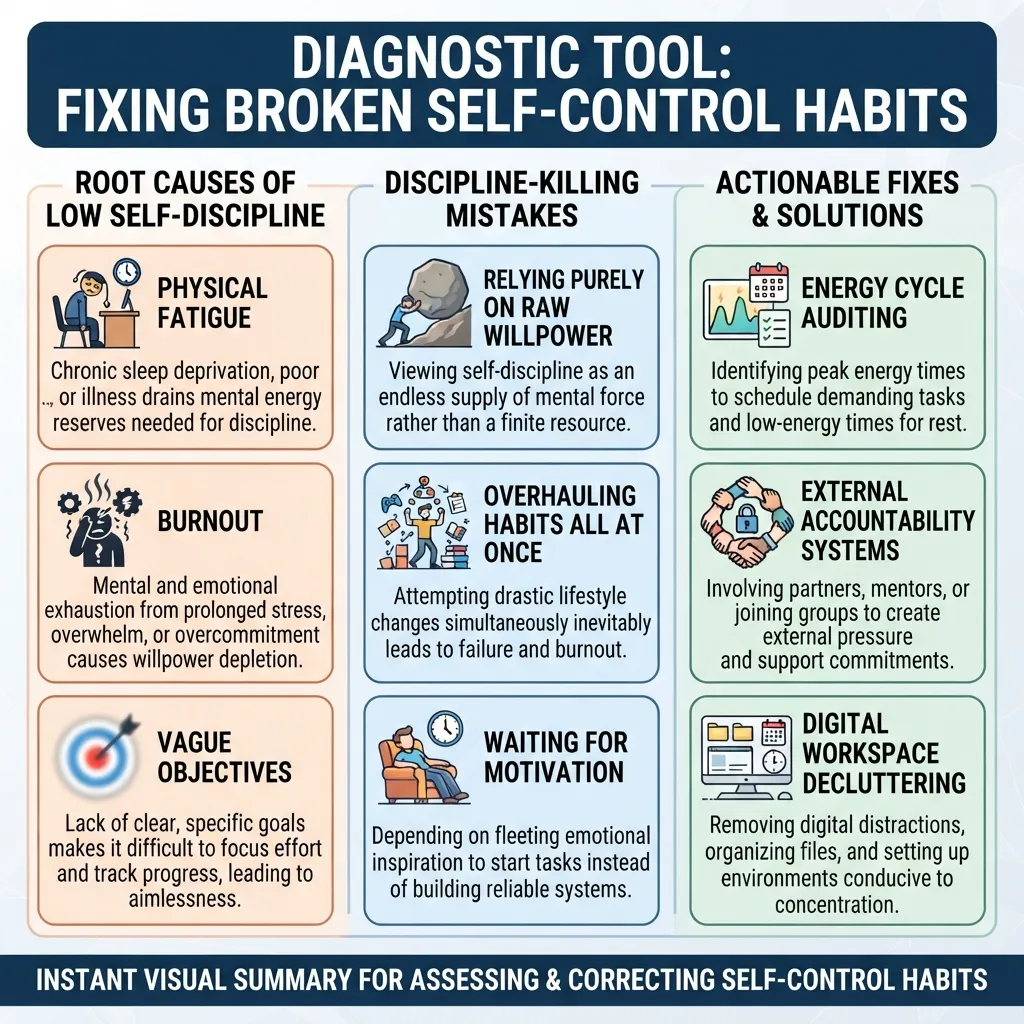
Experiencing a chronic lack of discipline rarely stems from personal laziness or a permanent character flaw. Instead, low self-regulation acts as a diagnostic signal indicating that your current systems, biological energy levels, or environment are actively working against your objectives.
Why Am I So Undisciplined?
Uncovering the root cause of your struggle requires looking beyond surface-level procrastination to examine the systemic barriers draining your cognitive resources. Identifying these hidden drivers shifts your approach from self-blame to strategic adjustment.
Burnout and Fatigue: Chronic physical exhaustion or mental overload chemically impairs the prefrontal cortex, stripping away your ability to regulate impulses.
Vague Objectives: Setting broad, undefined goals leaves your brain without a clear execution path, triggering immediate cognitive avoidance.
Fear of Failure: Subconscious perfectionism often masks itself as a lack of discipline, preventing you from starting tasks to protect your self-image.
Common Discipline-Killing Mistakes People Make
Most attempts to fix poor discipline fail because they rely on flawed tactics that drain mental energy rather than preserving it. Avoiding these common traps is essential for sustainable progress.
Relying on Raw Willpower: Treating discipline as an infinite resource guarantees burnout when high-stress situations deplete your mental stamina.
Overhauling Everything at Once: Trying to change your diet, workout routine, and work habits simultaneously spreads your focus too thin to succeed.
Waiting for Motivation: Equipping yourself with the expectation that you must feel like working before you start ensures continuous stagnation.
How to Fix Your Lack of Discipline
Resetting broken discipline requires targeted behavioral interventions designed to rebuild cognitive momentum and repair damaged daily routines.
Audit Your Energy Cycles: Map your peak biological hours and reserve your most demanding tasks for times when your prefrontal cortex is fully charged.
Implement External Accountability: Partner with a colleague or mentor, or utilize public tracking systems to introduce healthy social friction for missed targets.
Perform a Digital and Physical De-Clutter: Purge high-dopamine distractions from your immediate workspace to eliminate the temptation of quick, easy escapes.
Self-Discipline With ADHD
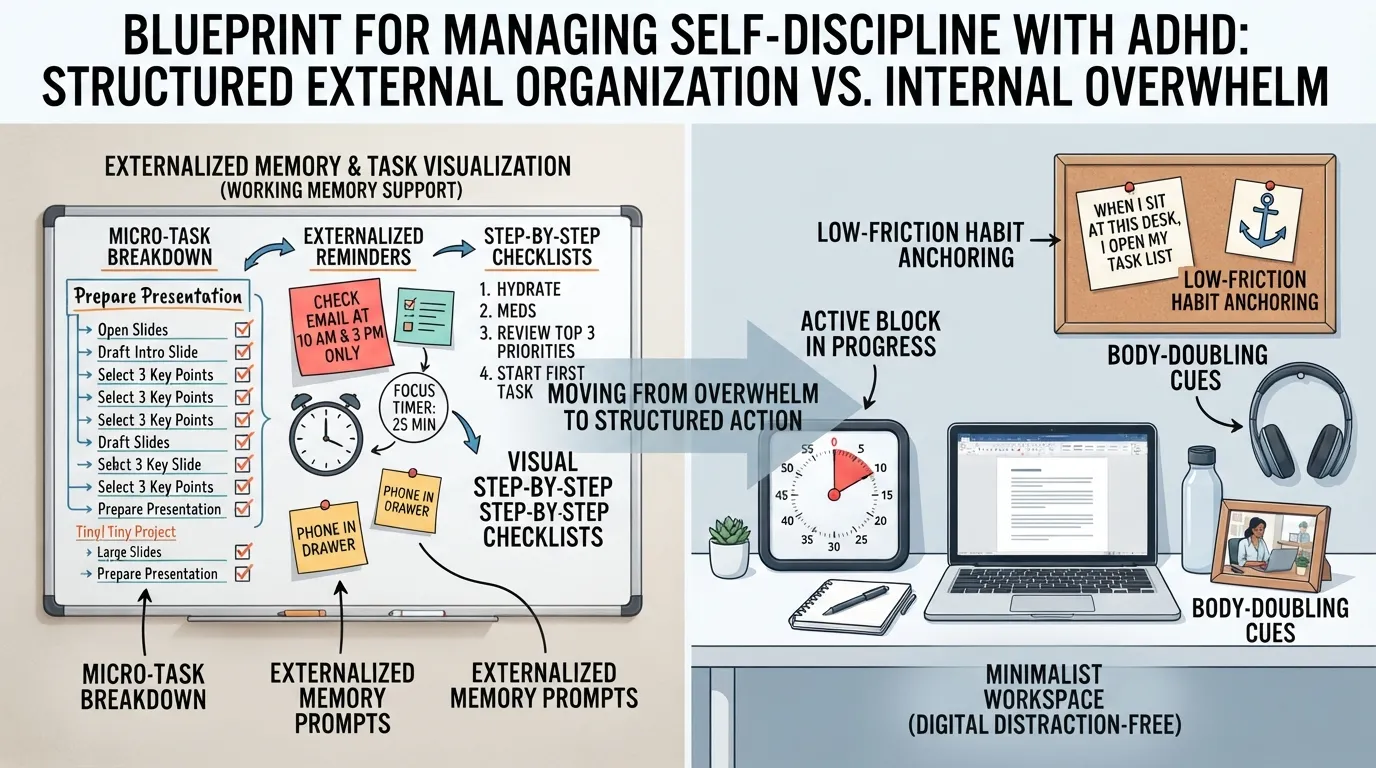
Traditional self-discipline frameworks frequently fail neurodivergent individuals because standard advice assumes a neurotypical baseline of executive function and dopamine regulation. Managing self-control with ADHD requires tailoring strategies to bypass working memory deficits and harness natural motivation loops.
Why Standard Discipline Advice Often Fails With ADHD
Standard discipline systems rely heavily on internal delayed gratification and long-term planning, both of which are regulated by dopamine pathways that function differently in ADHD brains. When advice tells you to “just push through” or “rely on willpower,” it ignores the neurological reality of executive dysfunction.
Dopamine Starvation: The ADHD brain craves immediate stimulation; tasks lacking novelty or urgency cause physical discomfort and mental paralysis.
Working Memory Bottlenecks: Out-of-sight tasks vanish from awareness entirely, making long-term timelines difficult to track mentally.
Shame Cycles: Repeatedly failing at neurotypical productivity advice builds chronic self-criticism, which further depletes the energy required to start tasks.
Practical Discipline Strategies Adapted for ADHD Brains
Effective discipline for ADHD relies on externalizing structure, shrinking task sizes, and introducing artificial urgency to stimulate the brain’s reward centers.
Externalize Your Working Memory: Move to-do lists, schedules, and reminders out of your head and onto physical whiteboards or visible desktop widgets where they cannot be ignored.
Gamify Your Workflow: Introduce timers, background instrumental music, or friendly challenges to inject immediate novelty and dopamine into mundane chores.
Buddy Systems and Body Doubling: Work alongside someone else or use virtual co-working platforms to create external social accountability that naturally drives focus.
Hyper-Focus Channelling: Instead of forcing rigid routines, recognize your natural hyper-focus windows and leverage them aggressively when high-energy inspiration strikes.
Self-Discipline in Specific Areas of Life

Applying self-discipline across different domains requires tailoring core behavioral principles to meet the unique demands of professional execution and physical training. While the underlying neuroscience of self-control remains constant, translating intention into results depends heavily on context-specific strategies and robust accountability systems.
Discipline in Business and Leadership
In a professional setting, self-discipline dictates strategic consistency, emotional regulation under pressure, and the ability to steer organizations through market volatility. Leaders who master personal discipline set a reliable operational tone that prevents teams from drifting into reactive chaos.
Strategic Focus: Protecting deep work blocks for high-leverage tasks prevents urgent operational noise from derailing long-term company goals.
Calm Executive Presence: Managing emotional responses during high-stakes crises maintains team morale and stabilizes corporate decision-making.
Accountability Structures: Establishing transparent metrics and regular performance reviews ensures that professional execution matches stated intentions.
Discipline in Sports and Physical Training
Athletic and physical discipline tests the absolute limits of delayed gratification, demanding rigorous adherence to training protocols regardless of external weather, mood, or motivation. Physical discipline serves as a proving ground because results correlate mathematically with consistency.
Process-Driven Training: Prioritizing daily movement quality and recovery routines over immediate performance milestones ensures sustainable athletic growth.
Friction Elimination: Preparing workout gear and scheduling training sessions the night prior minimizes morning decision fatigue.
Mental Toughness Protocols: Using controlled physical discomfort during training builds psychological resilience that translates directly into high-pressure professional environments.
Self-Assessment — Are You Actually Disciplined?
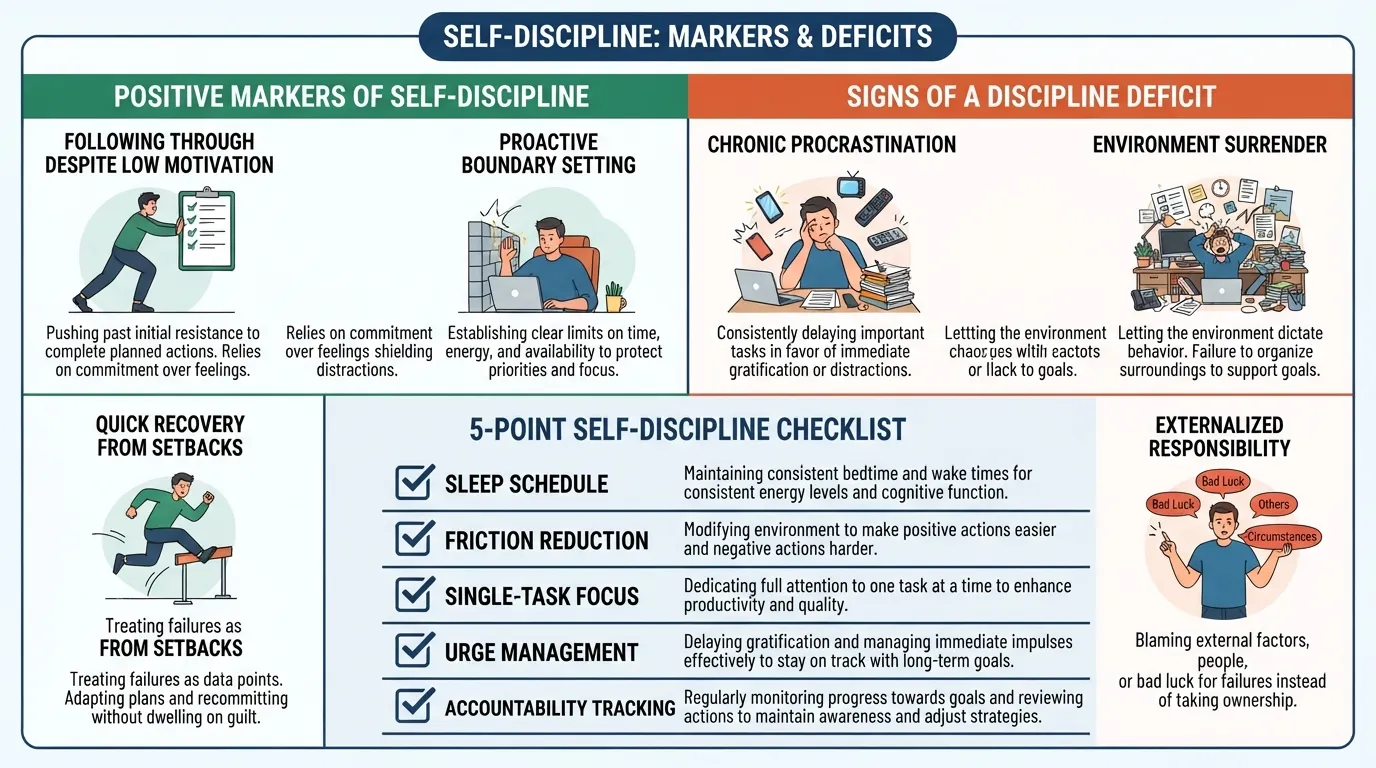
Evaluating your true level of discipline requires cutting through self-criticism and examining your actual behavioral patterns under pressure. Most people drastically underestimate their discipline because they measure it by how they feel rather than what they consistently execute.
Signs You’re More Disciplined Than You Think
True discipline rarely feels like a heroic battle of ironclad willpower; more often, it looks like quiet consistency and efficient system maintenance. If you possess these subtle behavioral markers, your self-regulation is far stronger than you realize.
Following Through Despite Low Motivation: You complete essential daily tasks even when you feel tired, bored, or uninspired.
Proactive Boundary Setting: You routinely decline short-term distractions to protect your long-term energy and focus.
Recovering Quickly From Setbacks: Missing a workout or a deadline prompts immediate recalibration rather than a multi-week spiral of guilt.
What a Lack of Discipline Looks Like
A genuine deficit in self-discipline manifests as chronic reactivity, externalized blame, and a total reliance on immediate environmental prompts to dictate actions. Recognizing these patterns highlights precisely where your structural systems are breaking down.
Chronic Intention-Behavior Gap: You endlessly plan, research, and talk about goals without ever executing the initial steps.
Impulsive Environment Surrender: You immediately give in to digital notifications, snacks, or entertainment the moment work becomes slightly uncomfortable.
Externalizing Responsibility: You frequently blame bad luck, lack of time, or other people for stalled personal progress.
Quick Self-Discipline Checklist
Assess your daily operating standards by checking off the behaviors you consistently demonstrate during a typical week.
[ ] Consistent Wake-Up Time: You maintain a stable sleep and wake schedule, even on weekends.
[ ] Friction Reduction: You prepare your workspace or training gear the night before to eliminate morning decision fatigue.
[ ] Single-Task Focus: You can work on a single demanding task for at least 20 minutes without checking your phone.
[ ] Urge Management: You pause and observe cravings or distractions rather than reacting instantly to them.
[ ] Accountability Tracking: You regularly review your progress against concrete goals rather than hoping things work out.
The Pillars, Principles, and Rules of Self-Discipline
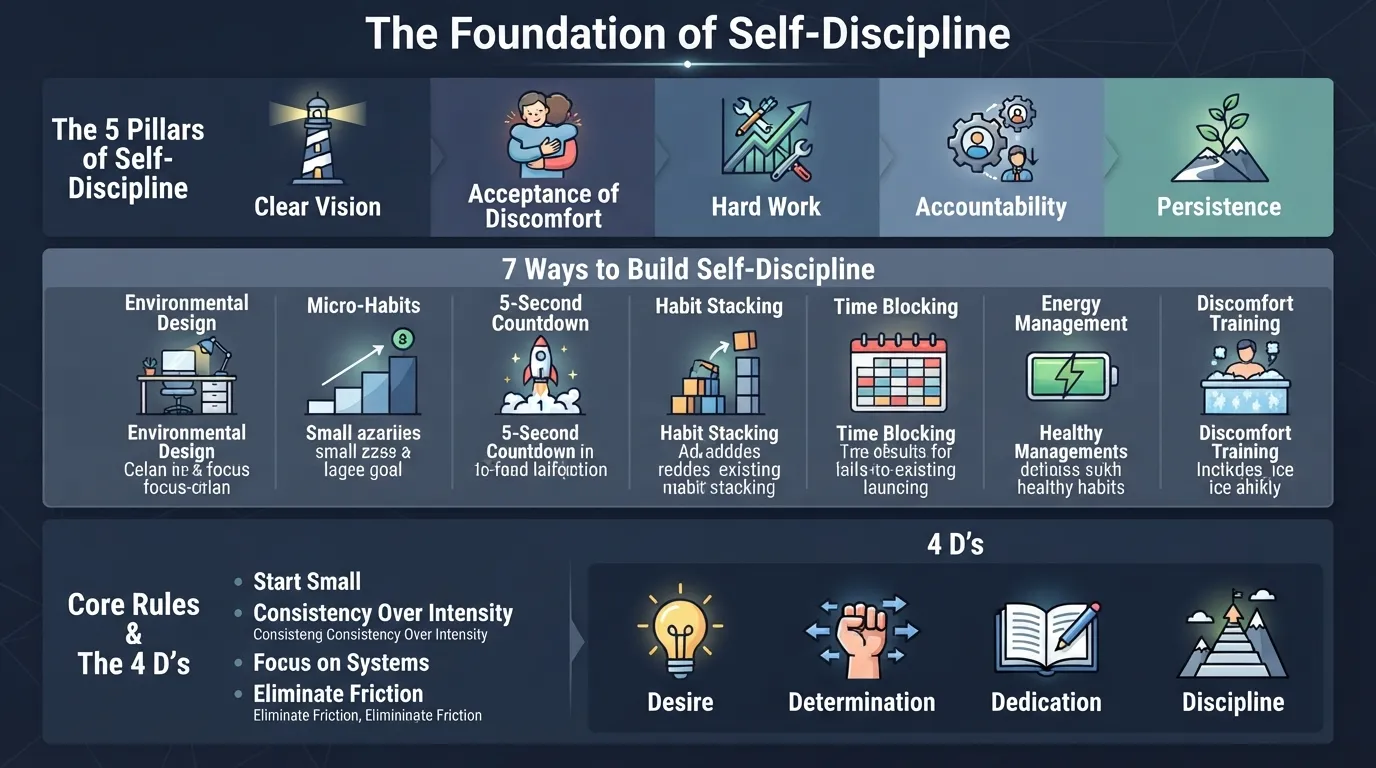
Mastering self-discipline requires a structured framework built on timeless principles rather than temporary motivation. By codifying your approach into explicit pillars, rules, and actionable systems, you eliminate ambiguity and establish a reliable foundation for lifelong personal control.
The 5 Pillars of Self-Discipline
Sustainable self-control rests upon five foundational pillars that support every aspect of personal growth, habit formation, and emotional regulation.
Clear Vision: Establishing hyper-specific objectives that give your prefrontal cortex a concrete target to work toward.
Acceptance of Discomfort: Recognizing that physical and mental friction is not a sign to stop, but the exact mechanism where growth occurs.
Hard Work and Diligence: Committing to consistent, unglamorous execution day after day without waiting for inspiration.
Reliable Accountability: Implementing internal metrics or external tracking systems to measure progress and maintain honesty.
Unyielding Persistence: Bouncing back immediately from setbacks, view missteps as data points rather than catastrophic failures.
7 Ways to Gain Self-Discipline
Implementing practical behavioral techniques accelerates the transition from conscious effort to automated habit, turning self-control into an effortless default.
Design your environment to physically hide temptations and reduce friction for desired actions.
Start with micro-habits so small that your brain experiences zero resistance in initiating them.
Use the 5-second rule to interrupt hesitation and force immediate physical movement.
Practice habit stacking by anchoring new routines directly onto existing daily behaviors.
Time-block your schedule into manageable 10 to 15 minute bursts of intense, single-minded focus.
Manage your biological energy by scheduling demanding tasks during your peak cognitive hours.
Train your tolerance for discomfort by voluntarily tackling minor daily challenges.
The 10 Rules of Self-Discipline
Adhering to strict operating rules safeguards your mental stamina against burnout, distraction, and the erosion of your daily boundaries.
Never negotiate with your core habits once the decision is locked in.
Prioritize long-term compounding value over immediate emotional comfort.
Eliminate digital and physical distractions before starting deep work.
Treat failure as a feedback mechanism rather than an excuse to quit.
Automate repetitive daily decisions to conserve mental bandwidth.
Protect your sleep schedule to keep your prefrontal cortex fully charged.
Hold yourself strictly accountable for your results, regardless of circumstances.
Say no to good opportunities so you can say yes to exceptional priorities.
Focus entirely on the process rather than obsessing over the final outcome.
Acknowledge and celebrate small consistency wins to reinforce positive neural pathways.
The 4 D’s of Discipline
When facing overwhelming workloads, sudden impulses, or procrastination traps, rely on the four fundamental D’s to regain immediate cognitive control.
Desire: Cultivate a burning internal motivation anchored to a crystal-clear personal vision.
Determination: Summon the willpower required to push past initial resistance and start the task.
Dedication: Commit to the long-term process, maintaining consistency even when novelty fades.
Discipline: Execute the necessary actions daily, independent of your current emotional state or mood.
What the Bible Says About Self-Discipline

Spiritual texts place immense value on self-control, framing personal discipline not merely as a productivity tool, but as a vital spiritual virtue and a fruit of inner character transformation. Across biblical literature, mastering one’s impulses is presented as essential for living a purposeful, resilient, and faithful life.
Bible Verses on Self-Discipline
Scripture frequently emphasizes the necessity of guarding one’s mind, actions, and speech through deliberate self-restraint and spiritual vigilance.
2 Timothy 1:7: For the Spirit God gave us does not make us timid, but gives us power, love and self-discipline.
Proverbs 25:28: Like a city whose walls are broken through is a person who lacks self-control.
1 Corinthians 9:25: Everyone who competes in the games goes into strict training. They do it to get a crown that will not last, but we do it to get a crown that will last forever.
Galatians 5:22-23: But the fruit of the Spirit is love, joy, peace, forbearance, kindness, goodness, faithfulness, gentleness and self-control. Against such things there is no law.
What These Verses Teach About Self-Control
Examining biblical teachings reveals that self-discipline requires active daily engagement, emotional guarding, and an internal fortitude grounded in spiritual principles.
Protection Against Vulnerability: Lacking self-control leaves a person defenseless against external temptations and internal chaos, much like an ancient city with broken walls.
The Parallel of Athletic Training: Spiritual and personal growth requires the same rigorous, intentional discipline that an athlete applies to physical conditioning.
A Manifestation of Inner Strength: True self-discipline is viewed as an outward expression of inner spiritual power rather than a purely mechanical human effort.
Positive Child Discipline (For Parents Who Landed Here)
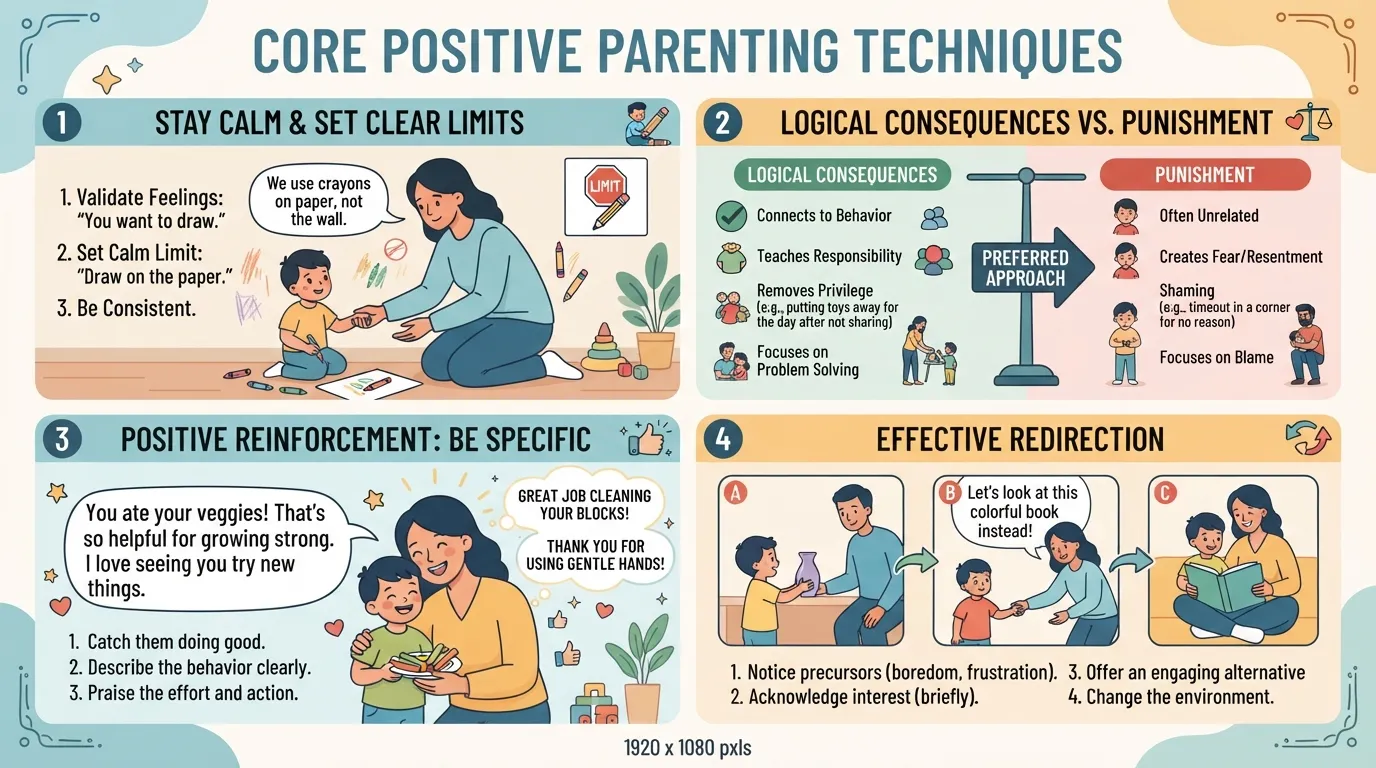
Positive child discipline shifts the focus away from punitive measures and toward teaching emotional regulation, problem-solving, and healthy behavioral boundaries. By coaching rather than punishing children, parents foster long-term self-discipline and secure emotional development.
How to Discipline a Toddler the Right Way
Toddler discipline requires managing immature brain development and intense emotional outbursts with calm, predictable boundaries. Because the prefrontal cortex is still in its earliest stages of formation, young children rely heavily on adult co-regulation to manage distress.
Stay Calm and Grounded: Your regulated nervous system acts as an external anchor, helping to de-escalate your child’s emotional storm.
Set Clear, Loving Limits: Use brief, simple statements to explain what behavior is expected without resorting to yelling or harsh tones.
Acknowledge Feelings Before Limits: Validate the emotion (“I know you are angry we have to leave”) while maintaining the boundary (“and it is time to go”).
Logical Consequences vs. Punishment
Punishment relies on fear and arbitrary penalties, whereas logical consequences directly connect a child’s action to a natural outcome, teaching responsibility rather than resentment.
Direct Relevance: Ensure the consequence is naturally tied to the behavior, such as having to help clean up a mess that was intentionally made.
Empathetic Delivery: Deliver consequences calmly and without lecturing, allowing the situation itself to teach the lesson.
Focus on Problem-Solving: Involve the child in brainstorming how to fix the mistake next time, building critical thinking skills.
Praising the Underlying Skill (Positive Reinforcement)
Effective positive reinforcement looks beyond generic praise to highlight specific character traits, effort, and self-regulatory skills.
Name the Behavior: Instead of saying “good job,” specify what they did right, such as “I noticed how patiently you waited your turn.”
Reinforce Agency: Highlight their internal control by pointing out how their choices led to a positive outcome.
Build Self-Efficacy: Recognizing incremental progress encourages children to take pride in their growing emotional maturity.
Redirect and Distract: Discipline for Younger Kids
For infants and young toddlers, redirection is often the most effective behavioral tool because their attention spans are fleeting and impulse control is virtually non-existent.
Shift the Environment: Physically move the child to a new area or introduce an engaging, alternative activity before a meltdown escalates.
Use Novelty: Capture their curiosity with a new object or game to gently break the loop of challenging behavior.
Pre-empt Triggers: Anticipate fatigue, hunger, or overstimulation and adjust your plans before behavioral issues surface.
Staying Disciplined Long-Term (Motivation & Consistency)
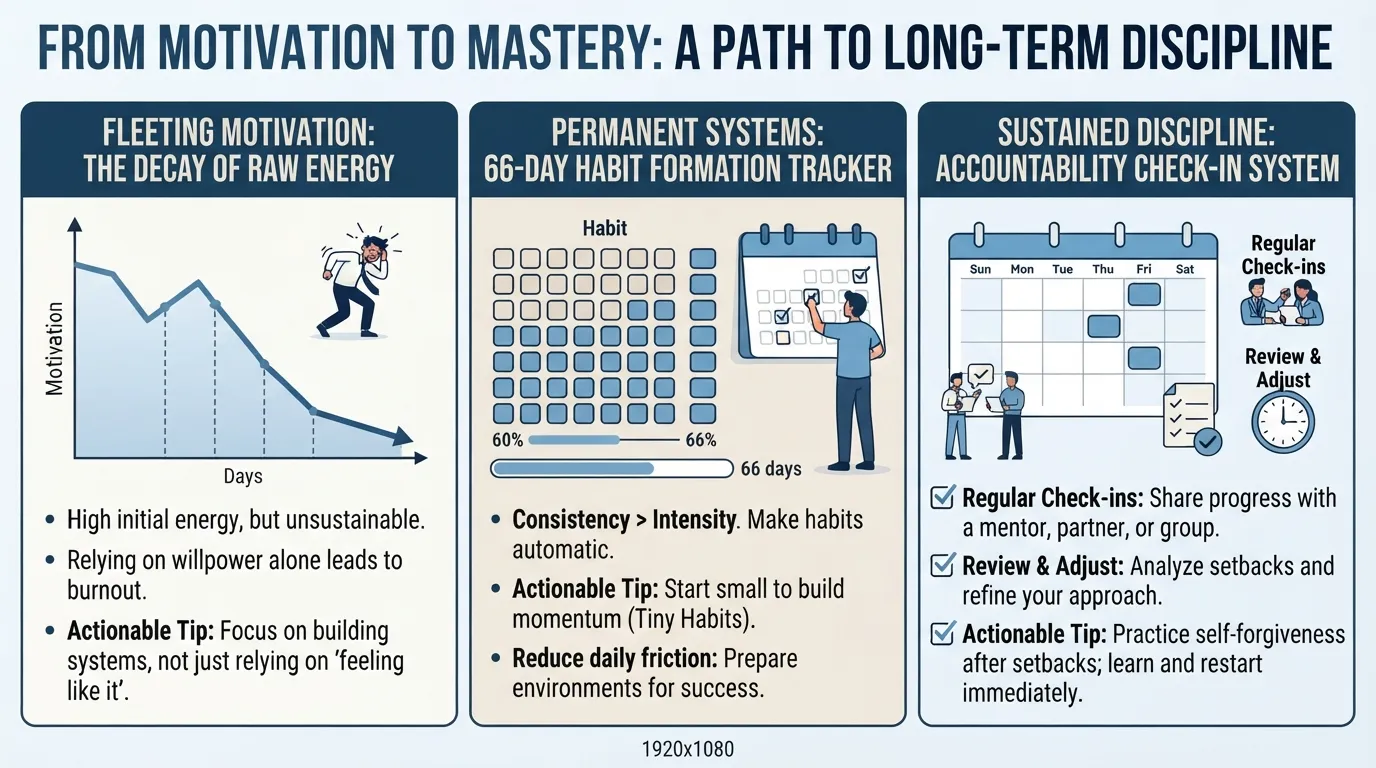
Sustaining long-term discipline requires recognizing that motivation is an unreliable, fluctuating emotional state while systems and habits are permanent. Maintaining high performance over years depends heavily on environmental stability, built-in accountability, and self-compassion when execution falters.
How to Stay Disciplined When Motivation Fades
Every long-term endeavor inevitably hits a phase where initial excitement wears off and daily execution feels burdensome. When inspiration vanishes, relying on structured routines keeps momentum alive.
Lower the Bar Temporarily: On low-energy days, commit to doing just 5 minutes of the task to maintain the neural habit loop without triggering burnout.
Focus on the Process: Detach your daily satisfaction from immediate results and judge success solely on whether you completed your scheduled actions.
Rely on Environmental Triggers: Let your automated workspace and visible schedules drive your behavior when your internal drive is empty.
Getting Support and Accountability
Attempting to build and maintain lifelong discipline entirely in isolation drastically increases the likelihood of relapse. External support systems introduce healthy social friction that deters procrastination.
Partner with an Accountability Ally: Share specific, time-bound goals with a colleague or mentor who will check in on your progress regularly.
Join Public Tracking Communities: Leverage online groups or masterminds where members openly report daily wins and failures.
Hire a Professional Coach: Engage an expert who can objectively audit your systems and hold you strictly to your commitments.
Forgiving Setbacks and Getting Back on Track
Treating a single missed day or broken streak as a total failure triggers a destructive cycle of guilt and abandonment. True long-term discipline normalizes friction and prioritizes immediate recovery.
The Two-Day Rule: Never allow yourself to miss the same habit two days in a row; a single lapse is an anomaly, while missing twice starts a new negative pattern.
Practice Self-Compassion: Research shows that forgiving yourself for past procrastination reduces stress and accelerates your return to productive execution.
Analyze the Slip: Treat unexpected setbacks as valuable diagnostic data to see which environmental or mental triggers caused the breakdown.
Frequently Asked Questions
How Do I Give Myself Discipline?
Building self-discipline requires replacing raw willpower with systematic environmental design and micro-habits. Start by removing physical distractions from your workspace and committing to tiny, friction-free daily actions that gradually rewire your prefrontal cortex.
What Are the 5 Steps of Discipline?
Developing reliable self-control involves establishing a clear vision, accepting inevitable discomfort, executing consistent daily work, tracking your performance through accountability systems, and practicing unyielding persistence after setbacks. These five foundational pillars create an unshakeable framework for personal growth.
How Do I Know If I Am Disciplined?
True discipline manifests as quiet consistency rather than a heroic daily battle of motivation. You are more disciplined than you realize if you routinely complete essential tasks despite feeling uninspired, recover quickly from missed goals, and proactively set boundaries against distractions.
How to Be Extremely Disciplined?
Achieving elite levels of self-discipline requires automating your daily choices, optimizing your biological energy cycles, and relentlessly protecting your schedule from low-value distractions. Master the art of delayed gratification by treating long-term compounding outcomes as more valuable than immediate comfort.
What Are Some Self-Discipline Exercises?
You can train your brain for self-control by practicing discomfort, such as taking cold showers or finishing complex tasks before checking your phone. Additional exercises include using the 5-second countdown method to bypass hesitation and time-blocking your schedule into strict 10-minute focus intervals.
Why Is Discipline So Difficult?
Discipline feels hard because the brain’s primitive emotional center constantly competes with the prefrontal cortex for metabolic energy and immediate comfort. When your environment is cluttered with high-dopamine distractions, your brain naturally defaults to the path of least resistance.
Conclusion — Your Discipline Action Plan
Transforming self-discipline from an elusive concept into a daily reality requires abandoning the myth of raw willpower in favor of proven behavioral systems. By designing your environment, mastering micro-habits, and treating self-control as a trainable skill, you establish a permanent foundation for long-term achievement.
Key Takeaways
Discipline is a Skill: Self-control functions like a muscle that strengthens progressively through neuroplasticity and consistent behavioral repetition.
Systems Over Willpower: Environmental design and friction reduction eliminate the need to constantly fight against procrastination and immediate impulses.
Consistency Beats Perfection: Missing a single day does not ruin your progress; the 66-day habit formation timeline rewards steady persistence over flawless execution.
Your Next Step Today
Stop trying to overhaul your entire life overnight and pick a single, high-leverage micro-habit to implement immediately. Prep your workspace tonight, set a 15-minute timer tomorrow morning, and let your first small win build the momentum you need for lasting change.
Kittisak Wattanakul
Kittisak Wattanakul is the Discipline Editor at Holistic Wellbeing Living. He writes about routines, focus, consistency, and practical follow-through. With nine years of experience creating personal-growth content, Kittisak helps readers build realistic systems for steady progress without extreme productivity pressure.