Habit Loop Explained: The Cue-Routine-Reward Cycle
What Is the Habit Loop?
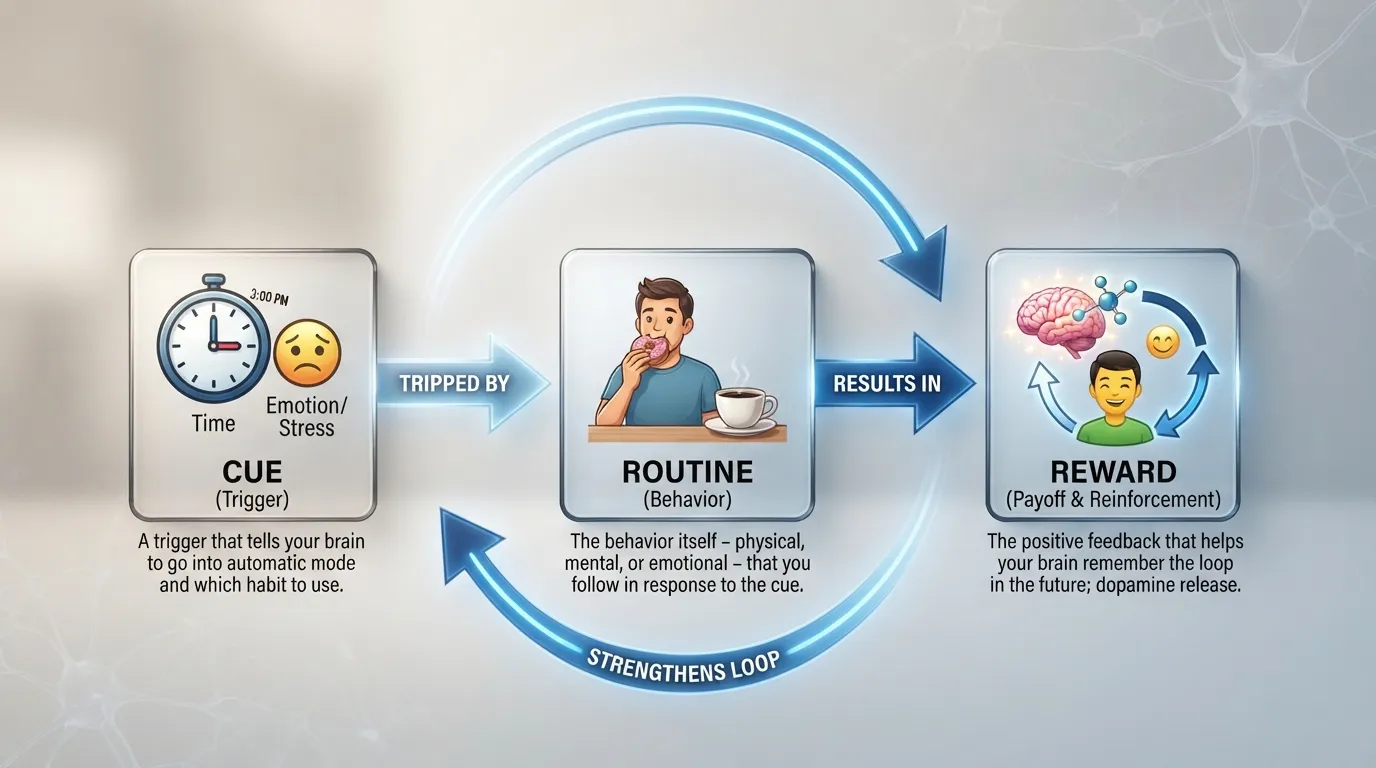
Definition and neuroscience: The habit loop is a self-reinforcing neurological cycle consisting of a cue, a routine, and a reward that automates repeated behaviors by encoding them into the basal ganglia and driving them through dopamine release. When you repeat this sequence, your brain stops actively making decisions and instead chunks the behavior into an efficient neural pathway, conserving mental energy for other tasks.
Origin and framework: Originally popularized by Charles Duhigg in The Power of Habit and later expanded into a four-stage model by James Clear in Atomic Habits, this framework explains how external triggers and internal motivations lock everyday actions into autopilot.
The 3 Parts of the Habit Loop
Cue (Trigger)
Every automatic behavior starts with a spark that tells your brain to drop into autopilot. This trigger can manifest in a few distinct ways depending on your environment and internal state:
Time: Looking at the clock and seeing 3:00 PM signals your afternoon slump, which prompts a trip to the breakroom.
Location: Walking through your front door immediately prompts you to drop your keys on the counter and toss your bag on the couch.
Emotion: Feeling a sudden wave of boredom or stress while looking at a complex work project triggers the automatic reflex to open a new browser tab and check social media.
Preceding event: Finishing your last bite of dinner serves as the definitive cue to stand up and walk over to the kitchen sink to wash the plate.
Routine (Behavior)
The routine is the actual action you perform, which can take physical, mental, or emotional forms. This is the heavy lifting of the loop that your brain eventually compresses into a single, effortless script. A physical routine looks like lacing up your running shoes and stepping out the door for a morning jog. A mental routine might involve automatically opening a budgeting spreadsheet the moment you sit down at your desk on a Monday morning. An emotional routine surfaces when you instinctively snap back with a defensive remark the second you feel criticized during a conversation.
Reward
The reward is the ultimate payoff that teaches your brain whether this entire sequence is worth remembering for the future. When you execute the routine, your brain releases a hit of dopamine that validates the action, satisfying a craving or solving a problem. If you feel stressed (cue), scroll your phone for ten minutes (routine), and experience immediate mental relief (reward), your brain logs that connection. That chemical reinforcement is precisely why the loop hardens into a permanent fixture of your daily routine.
The 3 R's of Habit Formation Reminder, Routine, Reward
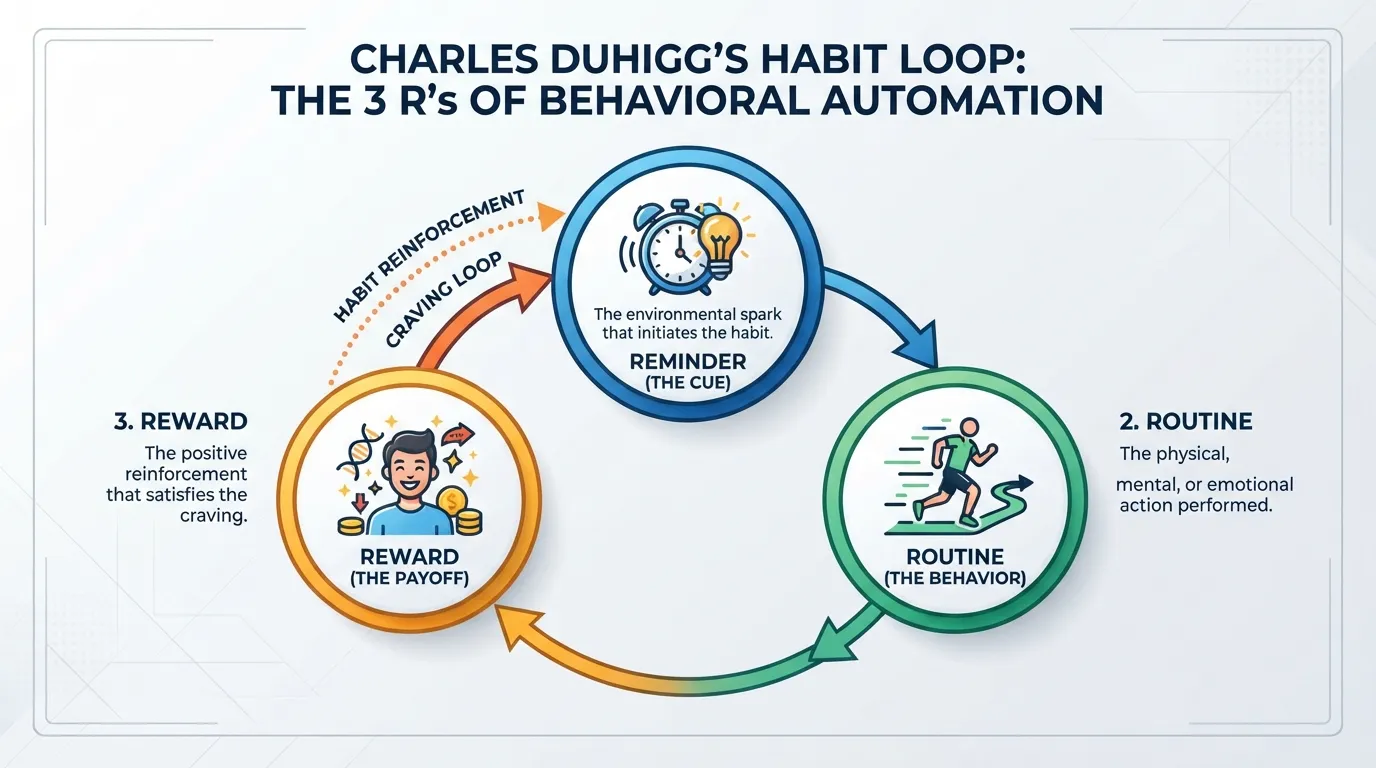
The 3 R’s framework utilizes alternate terminology coined by Charles Duhigg—Reminder, Routine, and Reward—to describe the exact same underlying neurological mechanism as the classic Cue-Routine-Reward loop.
The 4 Stages of Habit Formation Atomic Habits Model
Cue → Craving → Response → Reward
Cue: Same as above.
Craving: The motivational engine and internal desire that bridges the gap between noticing a cue and taking action.
Response: The actual habit performed, which replaces “routine” and broadens the definition to include not just physical actions, but also the choice not to act.
While Duhigg’s 3-part loop focuses on the mechanical anatomy of behavior, Clear’s 4-stage model shifts the lens to psychological motivation by explicitly separating the internal desire (Craving) from the physical action (Response).
Real-Life Habit Loop Examples
Good habit loop: Placing your gym bag directly in front of your bedroom door serves as a physical cue, walking to the local fitness center and completing a 45-minute strength session is the routine, and experiencing a surge of post-workout endorphins and mental clarity provides the reward.
Bad-habit-to-good-habit case study: When a stressful workday acts as a cue, an automated bad-habit loop might drive you to eat a bag of chips for an instant hit of sugar-induced comfort (routine and reward). To rewrite this loop while keeping the original cue and reward intact, you swap out the behavior: instead of reaching for junk food, you step outside for a brisk 10-minute walk around the block (new routine), which still burns off tension and delivers a genuine sense of mental relaxation (reward).
How to Change or Break a Habit Loop
Step 1 — Identify the Cue
You cannot change a behavior you do not understand, and habits always begin with an invisible trigger. To catch your cue in action, pay attention to the exact moment an unwanted urge hits and immediately note four environmental data points: the time of day, your current location, who you are with, and your immediate emotional state. Doing this for a few consecutive days will reveal a repeating pattern, showing you precisely what sparks your autopilot.
Step 2 — Experiment With the Reward (find the real craving)
The reward is what your brain is actually chasing, but the superficial payoff is often masking a deeper psychological need. When you feel the urge to execute a bad habit, force yourself to try different, temporary rewards during that moment—such as walking away to chat with a colleague instead of hitting the vending machine, or doing five deep breathing exercises instead of checking your phone. If you return to your desk and still feel the restless craving, that wasn’t the true reward; if the craving vanishes, you have successfully isolated what your brain was actually looking for (like social connection or a mental break).
Step 3 — Replace Just the Routine/Response (keep cue + reward same)
Trying to overhaul a habit by changing every single variable usually fails because the original trigger and underlying craving remain unaddressed. Instead, keep your familiar cue and your ultimate reward intact, but consciously swap out the middle routine for a healthier alternative. If your 3:00 PM afternoon slump (cue) normally triggers a trip to get sugary office donuts for a burst of energy and a chance to chat (reward), substitute the donut run with stepping outside to drink a glass of ice-cold water and chat with a coworker for three minutes. You satisfy the exact same underlying craving with a new, productive response.
How to Build a New Habit Using the Loop
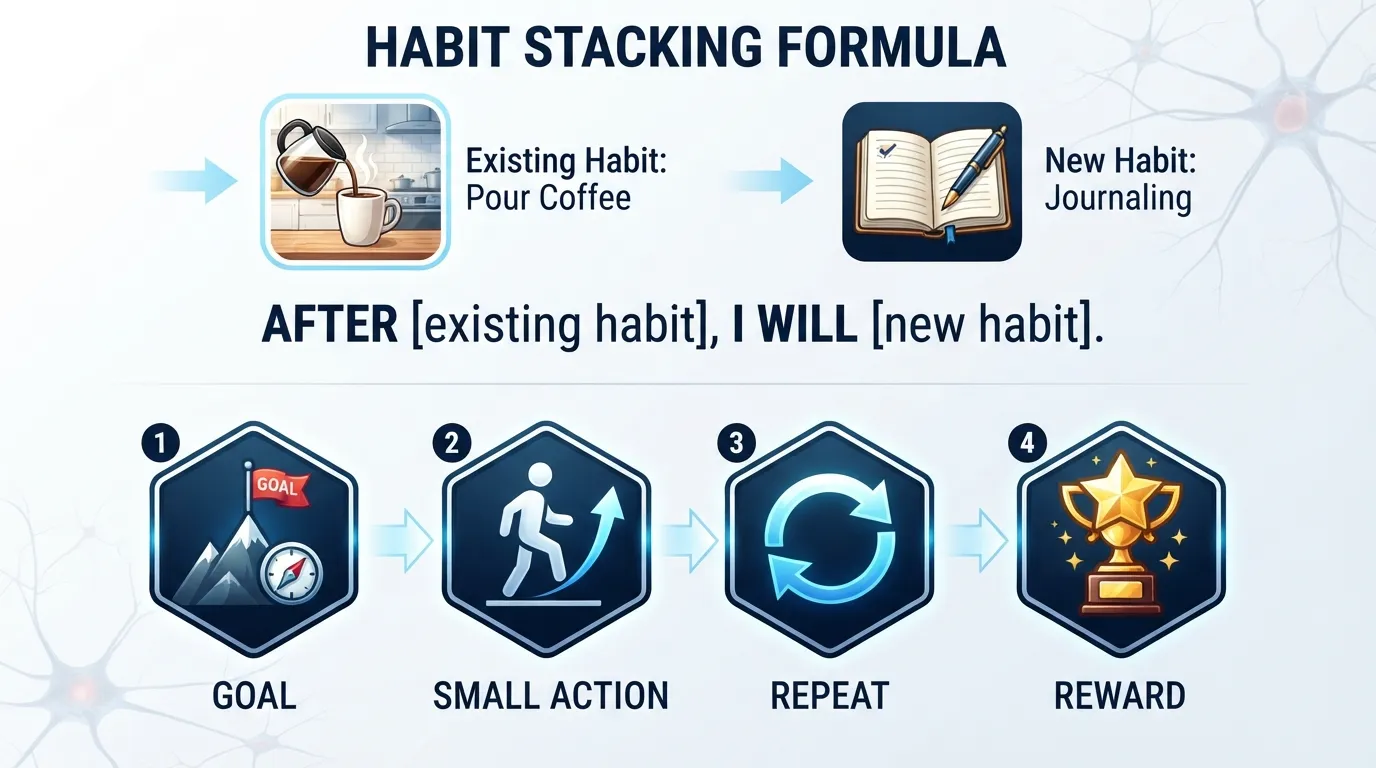
Habit Stacking — attach new habit to an existing one, with formula example
You do not need to build a new habit completely from scratch in an empty schedule; instead, anchor it to an automated behavior you already perform every single day. This technique, known as habit stacking, leverages your brain’s existing neural pathways to serve as the built-in cue for your new goal. By stacking a desired action onto an established routine, you eliminate the friction of figuring out when to start. Use the following clear formula to map it out: “After [existing habit], I will [new habit].” For example, “After I pour my morning cup of coffee, I will immediately open my journal and write down three daily priorities.”
Goal → Action → Repeat → Reward Formula
Building a lasting behavior requires translating abstract ambitions into a structured mechanical sequence that your brain can easily process and automate. Start with a clear Goal, then break that ambition down into an achievable Small Action step that eliminates friction and gets you moving without mental resistance. Repeat that micro-action consistently within the same environment so it hardens into a reliable script, and cap off the sequence with an immediate Reward that releases dopamine and locks the new neural pathway into place.
Habit Loop Worksheet (Quick Template)
Current Cue (The Trigger): [Write down the exact time, location, emotional state, or preceding event that sparks the automatic urge]
Current Routine (The Behavior): [Describe the physical, mental, or emotional action you currently perform automatically when triggered]
Current Reward (The Payoff): [Identify what immediate benefit, relief, or feeling you get from completing the routine]
New Replacement Routine (What I Want to Change It To): [Choose a healthier behavior that keeps the original cue and reward intact while breaking the old cycle]
Tools to Track Your Habit Loop
Habit-tracking apps: Digital habit trackers leverage streaks, data visualization, and push notifications to provide immediate digital rewards and visual reinforcement every time you complete a routine.
Journal-based tracking: Pen-and-paper habit logs require intentional manual logging, forcing active mindfulness that prevents you from mindlessly repeating a negative loop on autopilot.
Accountability-partner apps: Shared tracking platforms and social habit apps introduce external social pressure and shared streaks, turning individual consistency into a collaborative commitment.
FAQs
The four stages are the Cue (trigger), Craving (the motivational force), Response (the actual habit performance), and Reward (the benefit gained).
The 3-3-3 rule involves focusing on 3 core habits for 3 consecutive weeks, or dividing your daily routine into 3 specific time blocks for better consistency.
Identify the cue and the reward driving the habit, replace the old routine with a healthier alternative that provides a similar reward, and modify your environment to remove triggers.
It varies widely depending on the individual and the strength of the neural pathways, often taking anywhere from several weeks to a few months of conscious effort.
The three R's are Reminder (the cue that initiates the behavior), Routine (the action performed), and Reward (the positive reinforcement received).
No, the 21-day timeline is a popular myth. Psychological research shows it takes an average of 66 days for a new behavior to become automatic.
A framework suggesting it takes 7 days to commit to a change, 21 days to build it as a routine, and 90 days to cement it as a permanent lifestyle habit.
You can pause or interrupt a routine for 3 days, but deeply entrenched neural pathways require consistent, long-term behavior modification to truly break.