How to Build Good Habits and Break Bad Ones Science-Backed Guide
What Are Habits and Why They're Hard to Change
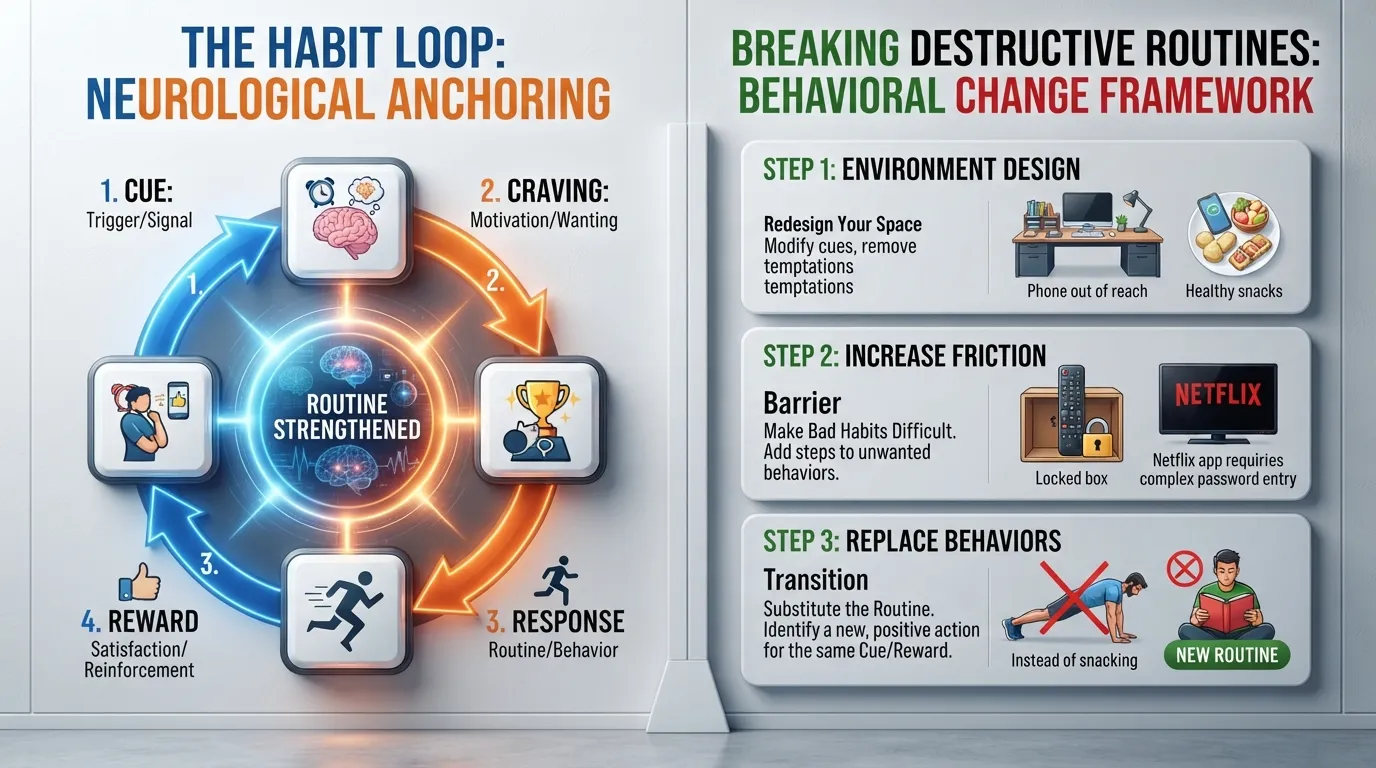
The habit loop — cue, craving, response, reward
Every deep habit runs on a tight four-part biological loop: cue, craving, response, and reward. If you want to sit down for two uninterrupted hours of deep work, your brain needs a reliable trigger to kick things off. The cue might be your desk lamp turning on at 7:00 AM or your phone going into airplane mode. That cue sparks a craving—the desire for the dopamine hit of accomplishment or the relief of clearing a heavy task off your plate.
The response is the actual work you put in, and the reward is the chemical satisfaction of finishing. When you struggle to maintain a deep work routine, it is usually because one of these links is broken. If your cue is too vague (“I’ll write sometime today”), your brain never receives the clean signal it needs to bypass friction and enter focus mode.
Why willpower alone doesn’t work
Relying on raw grit to force yourself into hours of intense concentration fails because willpower is a finite metabolic and cognitive resource, not a character trait. By mid-afternoon, decision fatigue drains your mental reserves, leaving you defenseless against distractions.
Trying to push through a complex task purely on discipline is like driving cross-country with your foot jammed hard on the gas pedal while ignoring the fuel gauge—eventually, the engine sputters out. When you try to sustain a deep habit without automated triggers, you burn out within a week. Sustainable focus requires designing an environment and a tracking system that reduces friction, bypassing the need for constant, exhausting acts of self-control.
How to Build Good Habits
Start small
Massive overhauls often lead to quick burnout because your cognitive and physical energy cannot sustain abrupt, radical shifts. By shrinking your new behavior down to a micro-habit—such as reading just one page or doing a single push-up—you bypass initial psychological resistance and make consistency feel effortless.
Make cues obvious
Out of sight often means out of mind when it comes to behavioral triggers. Redesigning your immediate surroundings to feature prominent visual cues—like leaving a book directly on your pillow or setting out workout gear the night before—ensures that your environment actively prompts the right choices before friction can set in.
Reduce friction
Human beings naturally gravitate toward the path of least resistance. To build lasting routines, systematically eliminate the hidden obstacles and barriers that make positive behaviors inconvenient, while intentionally adding friction to unwanted habits by keeping distractions out of reach.
Anchor new habits (habit stacking)
Instead of trying to force a brand-new routine into a chaotic schedule, anchor it directly onto an existing automatic behavior. By using an established daily cue—such as reviewing your goals immediately after pouring your morning coffee—you piggyback off neural pathways already hardwired into your day.
Reward yourself immediately
The brain repeats behaviors that offer immediate positive reinforcement and instant gratification. Pairing a challenging habit with an immediate reward or celebrating a tiny win right after completion triggers a healthy dopamine response that locks the new neural pathway in place.
Build identity-based habits
True behavioral transformation relies less on what you want to achieve and more on who you believe you are. When you shift your focus from outcome-driven goals to anchoring your actions in your core self-identity, every repeated small action becomes a vote for the person you aspire to become.
Use accountability
Willpower alone can easily fluctuate, but social expectations and shared commitments provide a steady anchor. Partnering with someone who tracks your progress or openly sharing your milestones introduces a healthy external structure that minimizes procrastination and keeps you honest.
How to Break Bad Habits
Identify triggers
Unwanted routines like mindless phone checking or mid-afternoon procrastination persist because you are fighting them blindly. To dismantle a destructive pattern, you have to intercept the autopilot loop by pinpointing its exact spark—whether it is a specific time of day, an emotional state like boredom, or a physical environment like your desk setup. Keep a brief log for 48 hours to catch the exact moment the urge hits.
Make cues invisible
Out of sight truly means out of mind when it comes to breaking bad patterns. If visual triggers remain scattered across your field of vision, your brain will constantly expend energy resisting temptation. Hide your phone in a drawer when you need to focus, clear distracting bookmarks off your browser bar, or keep junk food out of the house so that executing the bad habit requires a deliberate, inconvenient effort.
Increase friction
Make bad habits physically painful or annoying to access. If you tend to waste hours on social media during deep work blocks, log out of every account and move the apps into a deeply nested folder. Adding structural barriers gives your logical prefrontal cortex time to step in and override the impulsive craving before the routine takes over.
Replace, don't remove
Eliminating a bad habit cold turkey leaves a vacuum that your brain will rush to fill, especially if that habit served as a coping mechanism for stress or fatigue. Instead of trying to delete the behavior entirely, substitute a constructive routine that satisfies the same underlying craving. If you habitually check your phone when you hit a mental wall, replace that impulse with a 60-second stretch or a glass of water.
Build resilience after slip-ups
Falling into the all-or-nothing trap is the quickest way to turn a single missed day into a total abandonment of your goals. Perfectionism tells you that if you break your streak, the whole effort is ruined. Real resilience means treating a slip-up as objective data rather than a moral failure, acknowledging the lapse, and immediately returning to your baseline on the very next rep.
When a "bad habit" might be more than a habit
Sometimes, persistent compulsive behaviors stem from underlying psychological drivers or dependencies that go far beyond standard habit loops. If a routine feels entirely compulsive, causes distress, or heavily interferes with your daily functioning despite your best efforts to change it, it may require specialized care. Reaching out to a licensed mental health professional or counselor can provide structured, clinical support tailored to deeper patterns.
How Long Does It Actually Take to Build a Habit?
Debunking the “21 days” myth (66-day research)
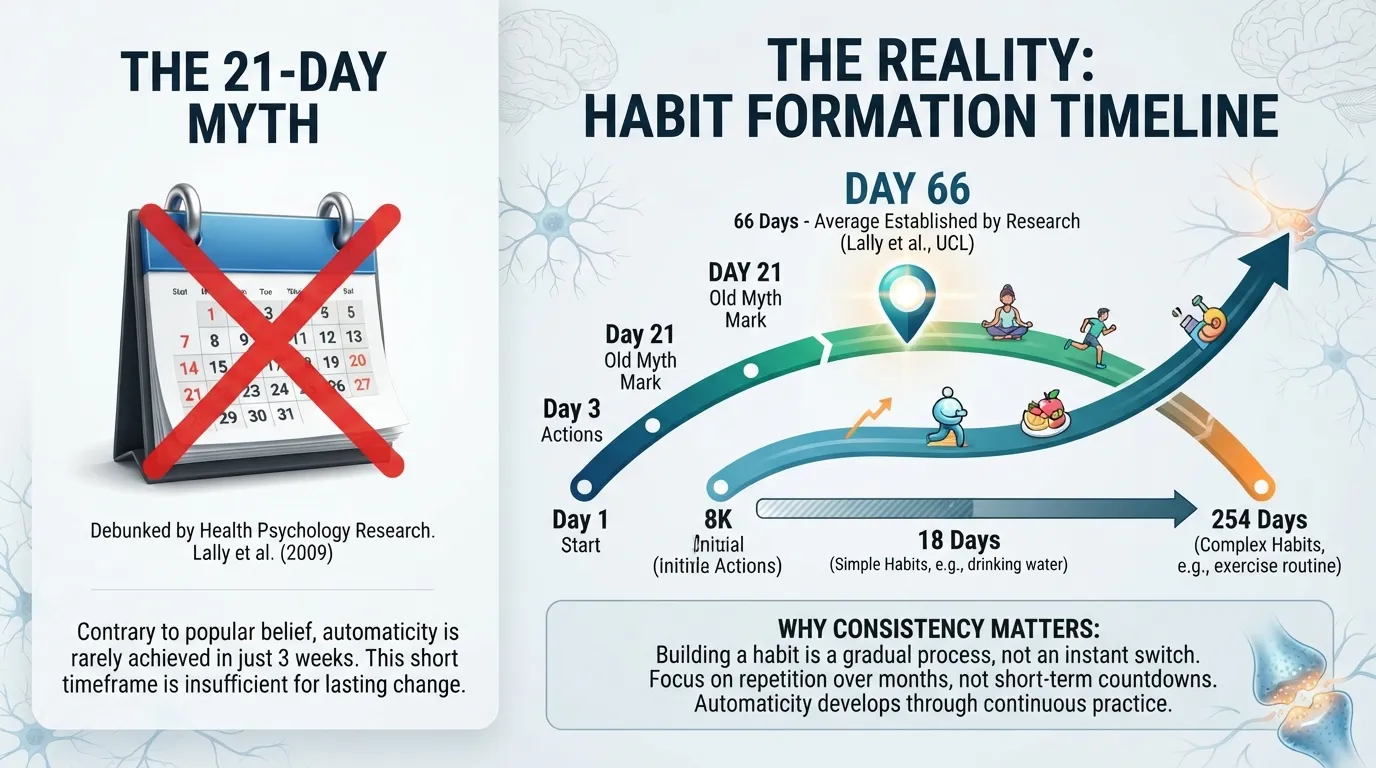
The persistent idea that it takes exactly 21 days to form a new habit is one of the most widespread myths in personal development, originating from a misinterpretation of plastic surgeon Maxwell Maltz’s 1960s observations on amputees adjusting to their bodies. Real psychological research paints a very different picture. A landmark study published in the European Journal of Social Psychology by health psychology researcher Dr. Phillippa Lally tracked individuals forming new daily health and focus behaviors and found that it actually takes an average of 66 days for a new behavior to become automatic.
More importantly, that timeline is not a universal rule; the research showed a massive variation, ranging anywhere from 18 to 254 days depending on the complexity of the habit, individual differences, and environmental consistency.
When you are trying to anchor a cognitively demanding deep work routine—like writing or coding for an hour straight—expecting it to feel effortless in three weeks will only lead to frustration when it doesn’t. Understanding that true neural automaticity takes months rather than weeks helps you drop the premature guilt, shift away from short-term countdowns, and commit to the long-term consistency required to lock the behavior in for good.
Examples — Good Habits to Start & Bad Habits to Break
Common good habits list
Building a high-performance routine requires replacing vague aspirations with concrete, daily behaviors that drive real cognitive and professional leverage. Instead of saying “I want to be more productive,” anchor your day with specific good habits tailored for deep execution:
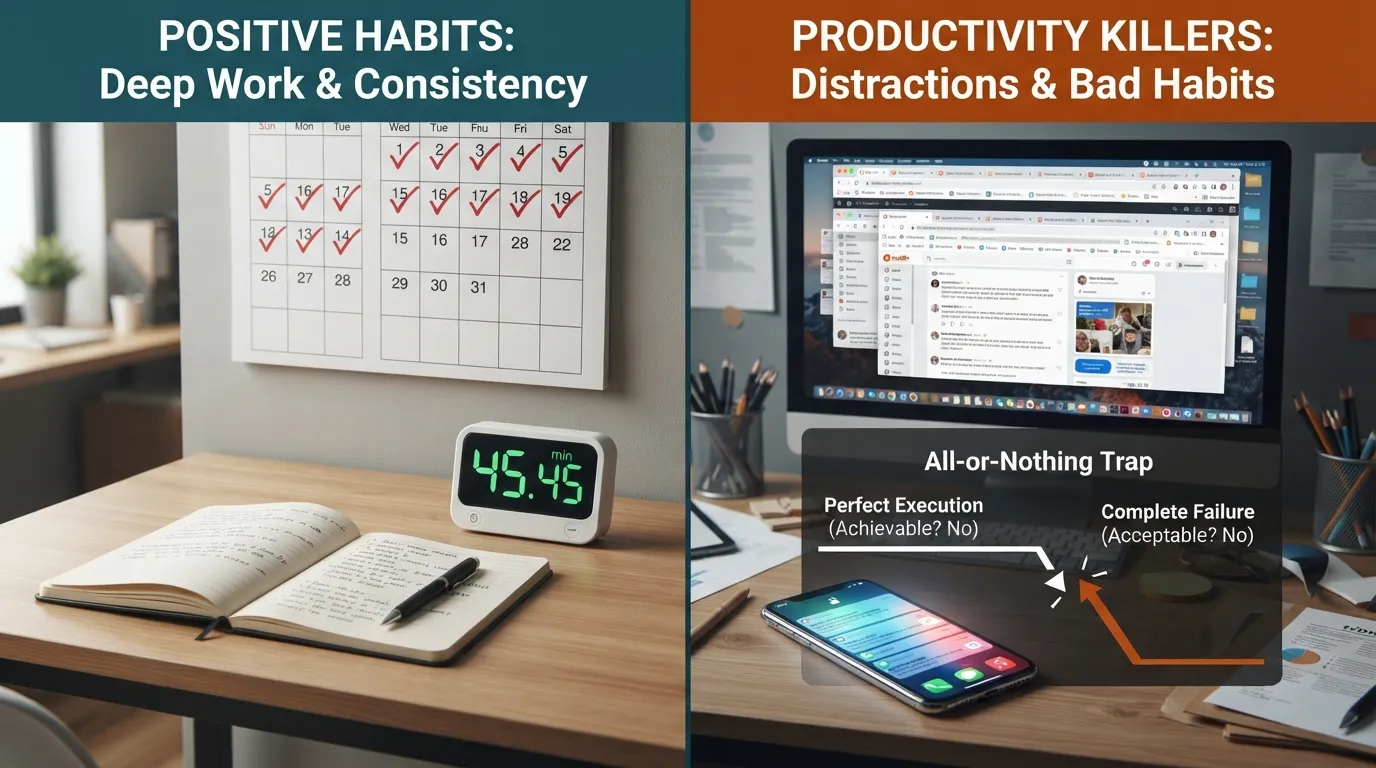
The 45-minute deep focus block: Committing to a single uninterrupted work session first thing in the morning before opening email or messaging apps.
The evening workspace shutdown: Clearing your desk, organizing your primary document, and writing down your top three output milestones for the next day before logging off.
Single-tasking compartmentalization: Closing all background browser tabs and locking your phone in a drawer for a set window to eliminate split-attention fatigue.
Active reading and synthesis: Taking 20 minutes daily to read non-fiction material and immediately writing a three-bullet summary in your own words to force retention.
The strategic movement break: Stepping away for a brisk 10-minute walk halfway through your workday to reset mental stamina without picking up a screen.
Common bad habits list
Unwanted routines often look harmless on the surface, but they quietly drain your cognitive reserve and fracture your ability to sustain deep focus. Keep an eye out for these common productivity traps:
The phantom check: Automatically unlocking your phone to check notifications every time you hit a minor mental roadblock or a moment of difficult thinking.
Task-switching camouflage: Bouncing between open browser tabs, light administrative updates, and minor inbox sorting under the illusion that you are working hard.
Over-planning without execution: Spending hours organizing project boards, tweaking color-coded to-do lists, and researching tools instead of actually doing the hard work.
Revenge bedtime procrastination: Sacrificing sleep to scroll through feeds or watch videos to claw back a sense of personal control after a draining day.
The all-or-nothing trap: Abandoning a positive routine entirely for the rest of the week just because you missed a single daily session or fell short of a target.
How to Track Your Habits
Simple tracking methods (journal, streak, app)
Choosing the right tracking mechanism is the difference between a system you maintain effortlessly and an administrative chore you abandon within a week. When dealing with deep work and cognitive habits, your tracking method needs to match your chosen metric—whether that is logging hours or marking off binary output milestones.
The physical habit journal: A simple notebook grid or bullet journal where you physically check off your daily session or milestone. The tactile act of crossing off a square provides a satisfying physical anchor that reinforces consistency.
The streak calendar (The Seinfeld Method): Marking a big red “X” across a wall calendar for every day you successfully complete your habit. Seeing an unbroken chain build visual momentum makes your brain desperate not to break the chain, though it works best for consistency-based hour tracking.
Minimalist habit-tracking apps: Digital tools like Streaks or Habitica that send gentle reminders and log your completion rates automatically. Apps work well if you travel frequently or prefer having your progress data instantly accessible on your phone, provided you don’t use the app opening as an excuse to fall into a social media rabbit hole.
The golden rule of tracking is friction reduction: pick the absolute simplest method that gives you honest feedback without turning into a second job. If tracking your habit takes more than 60 seconds a day, your system is too complex.
Real Questions People Ask
When you dive into online discussions about productivity, a very specific type of frustration echoes across threads on Reddit and Quora. People aren’t asking how to become superhuman; they are venting about feeling stuck. You see professionals and students asking why they can log three solid hours at their desk every single day yet still end the week feeling like they produced nothing of actual value.
Another common dilemma pops up when people try to scale their efforts: they ask how to stop treating habit tracking like a rigid prison sentence where missing a single day makes them want to quit entirely. These communities are full of people who track every minute religiously but burn out because their metric rewards staring blankly at a screen just as much as it rewards deep, hard thought.
The underlying anxiety in all these discussions is the fear of confusing mere motion with actual progress. People want a practical framework that tells them precisely when to stop counting hours and start measuring real output, without letting perfectionism destroy their long-term consistency.
Thanawat Rattanakul
Thanawat Rattanakul is the Habits Editor at Holistic Wellbeing Living. He writes about daily routines, habit systems, small behavior changes, and sustainable progress. With eight years of experience creating personal-growth content, Thanawat helps readers build practical routines that fit real life.