Mini Habits by Stephen Guise: Book Summary, Key Ideas & Honest Review
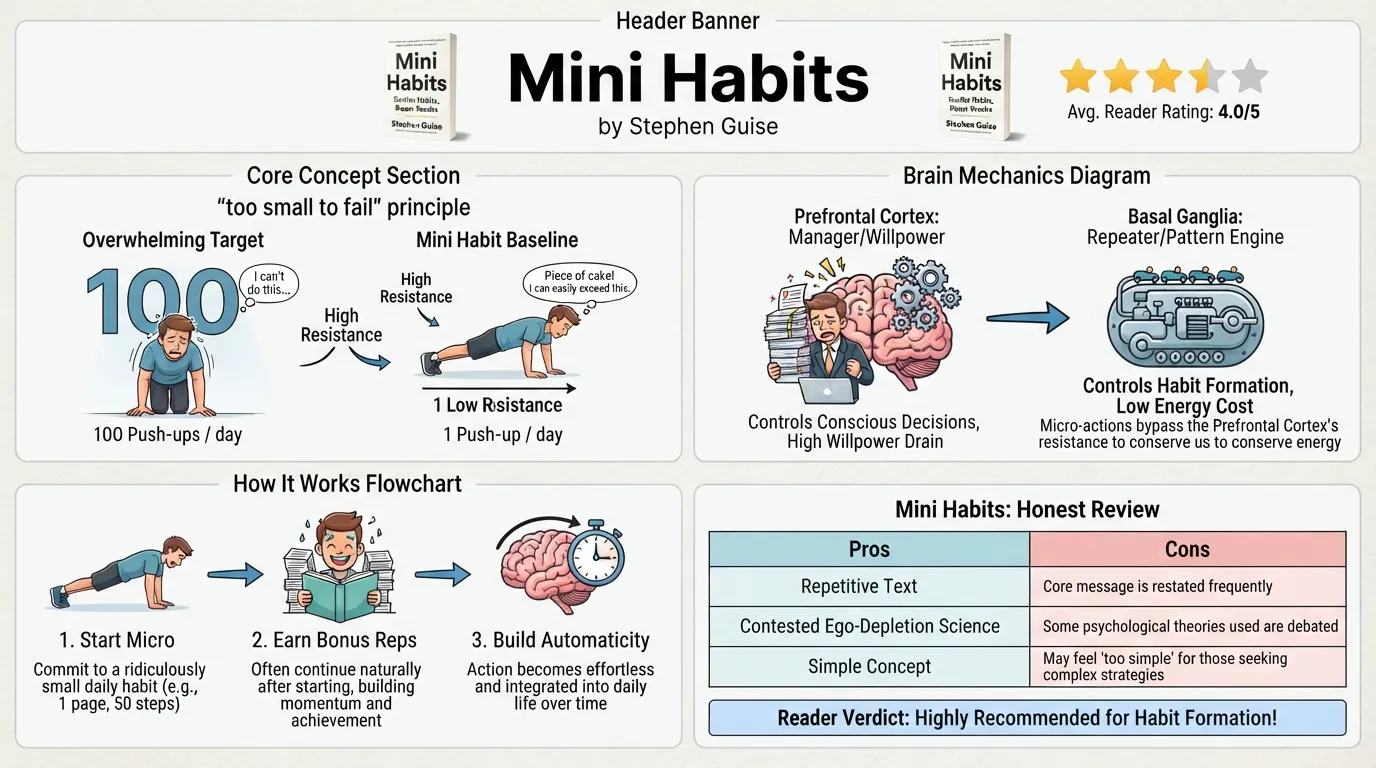
Mini Habits by Stephen Guise is an insightful self-help book first published in December 2013. Written by author Stephen Guise, it is designed for anyone looking to build lasting positive habits without feeling overwhelmed. By breaking down goals into ridiculously small daily actions, the book offers a practical, stress-free path to consistent personal growth.
| Quick Facts | Details |
| Author | Stephen Guise |
| First Published | December 2013 |
| Goodreads Rating | 4.00 / 5 stars (8,012 ratings, as of September 2026) |
| Sales & Translations | 400,000+ copies sold across 18 languages (author reported) |
| Core Target Audience | Anyone wanting to build good daily habits easily |
Key Takeaways in 60 Seconds
Mini habits are microscopic daily actions: A mini habit is a tiny positive behavior—such as doing one push-up, writing 50 words, or reading two pages—designed to be too small to fail.
Designed for good habits, not addiction: The framework focuses on adding positive daily routines and is not meant for quitting severe chemical dependencies or addictions.
Willpower over motivation: The book prioritizes small amounts of willpower over unpredictable motivation, though the underlying ego depletion theory remains scientifically contested.
Bonus reps are strictly optional: You are free to do extra work if inspired, but completing just your bare minimum requirement counts as a total success.
Habit formation time varies: How long it takes to automate a habit depends entirely on the specific individual and the complexity of the behavior.
What Is Mini Habits by Stephen Guise About?
The Core Idea and What a Mini Habit Is
The book centers on forcing yourself to take "stupidly small" positive actions every single day—targets so minimal that failure becomes practically impossible. Instead of attempting intimidating goals like 100 push-ups or drafting 3,000 words, Stephen Guise advocates setting a daily baseline of just one push-up or writing 50 words. By lowering the barrier to entry, you bypass the mental resistance that usually stops people before they start.
This animated summary breaks down how micro-commitments disable brain resistance to make daily consistency effortless.
Is It for Breaking Bad Habits?
Mini Habits is designed specifically for building positive routines rather than stopping severe addictions like smoking or gambling, which often require professional support. However, by consistently adding constructive mini habits to your day, you gradually displace passive bad habits like laziness, fear, and time-wasting over the long term.
What's Inside the Book
Mini Habits is structured into seven distinct parts that guide the reader from the core psychology of habit formation to practical, daily execution. The table below outlines each section and shows where its main concepts are covered in depth across this review.
| Part | Focus | Location on This Page |
| Part 1: Introduction | The author’s origin story and the one push-up challenge | Covered in Who Is Stephen Guise? |
| Part 2: How Your Brain Works | Neural mechanics involving the prefrontal cortex and basal ganglia | Covered in Key Ideas |
| Part 3: Willpower vs. Motivation | Why relying on willpower works better than waiting for motivation | Covered in Key Ideas |
| Part 4: The Strategy | Bypassing mental resistance with minimal daily effort | Covered in Key Ideas |
| Part 5: What Makes Mini Habits Different | Managing expectations and building consistency | Covered in Key Ideas |
| Part 6: Eight Steps | A practical step-by-step framework to launch new habits | Covered in How to Start: The Book’s 8 Steps |
| Part 7: Eight Rules | Key operational rules to protect progress and avoid burnout | Covered in The 8 Mini Habit Rules |
Who Is Stephen Guise?
How It Started and What He Reports
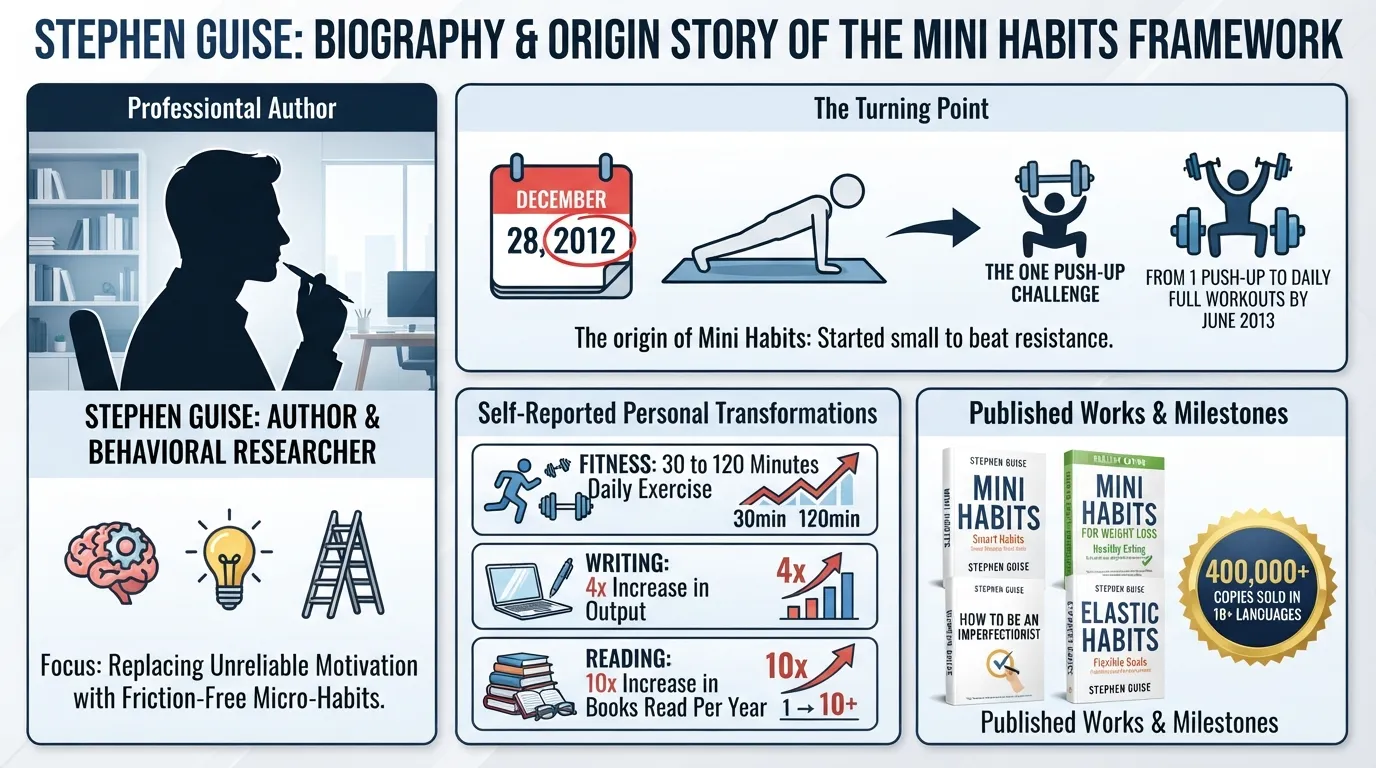
Stephen Guise is an author and self-development researcher who created the micro-habit methodology after repeatedly failing to stick to traditional self-improvement plans. On December 28, 2012, feeling completely unmotivated for a standard 30-minute workout, he decided to do just a single push-up. That micro-action removed his mental resistance, leading to a full workout session and sparking the concept behind his book.
Guise maintained his single push-up requirement throughout 2013 before transitioning to standard gym sessions around late June 2013. In his self-reported results, he notes that this simple framework quadrupled his writing output, roughly tenfold increased his reading volume, and grew his daily exercise routine to between 30 and 120 minutes.
Other Books by Stephen Guise: In addition to his original habit guide, Guise has authored Mini Habits for Weight Loss, How to Be an Imperfectionist, and Elastic Habits, alongside his 4+ hour video course, Mini Habit Mastery.
Key Ideas From Mini Habits
Willpower Over Motivation
Stephen Guise asserts that relying on motivation is a fundamentally flawed strategy because motivation depends on unpredictable feelings, energy levels, and stress. The author argues that small amounts of willpower provide a far more reliable driver for daily action. By keeping required tasks microscopic, you draw down minimal willpower reserves, allowing you to maintain consistency even on tired or stressful days.
However, the scientific theory of “ego depletion”—the idea that willpower is a limited resource that drains like a battery—is heavily contested in modern psychology. The book was published in 2013, prior to major replication efforts. A massive 23-lab replication study (Hagger et al., 2016, N=2,141) found an effect size near zero, while a later 36-lab study (Vohs et al., 2021) yielded inconclusive results. While the book’s specific theory on limited willpower energy is contested, the practical benefit of lowering starting friction remains sound.
The Brain: Repeater vs Manager
In Part 2, the book explains habit formation through the interaction of two distinct neural structures: the conscious prefrontal cortex and the subconscious basal ganglia.
Prefrontal Cortex (The Manager): Handles logical decision-making and long-term planning. It processes conscious choices but fatigues quickly under stress or cognitive effort.
Basal Ganglia (The Repeater): Functions as the brain’s automated habit engine. It executes repetitive routines efficiently without consuming heavy mental energy.
When you attempt a drastic lifestyle change, the conscious manager faces immediate friction from the repeater, which resists unfamiliar patterns. Micro-actions bypass this neural alarm system, repeating smoothly until the basal ganglia converts the behavior into an automatic loop.
Bonus Reps
The “bonus rep” concept is the psychological engine that allows microscopic habits to yield major results over time. Once you fulfill your mandatory micro-target—such as writing one sentence—you overcome the initial mental inertia. You are then free to write several pages if you feel inspired.
Stopping immediately after hitting your minimum target is entirely acceptable and counts as a total daily success. Treating extra work strictly as an optional bonus ensures that your official daily requirement stays low, preventing future overwhelm while giving you space to capitalize on spontaneous momentum.
How to Start: The Book's 8 Steps
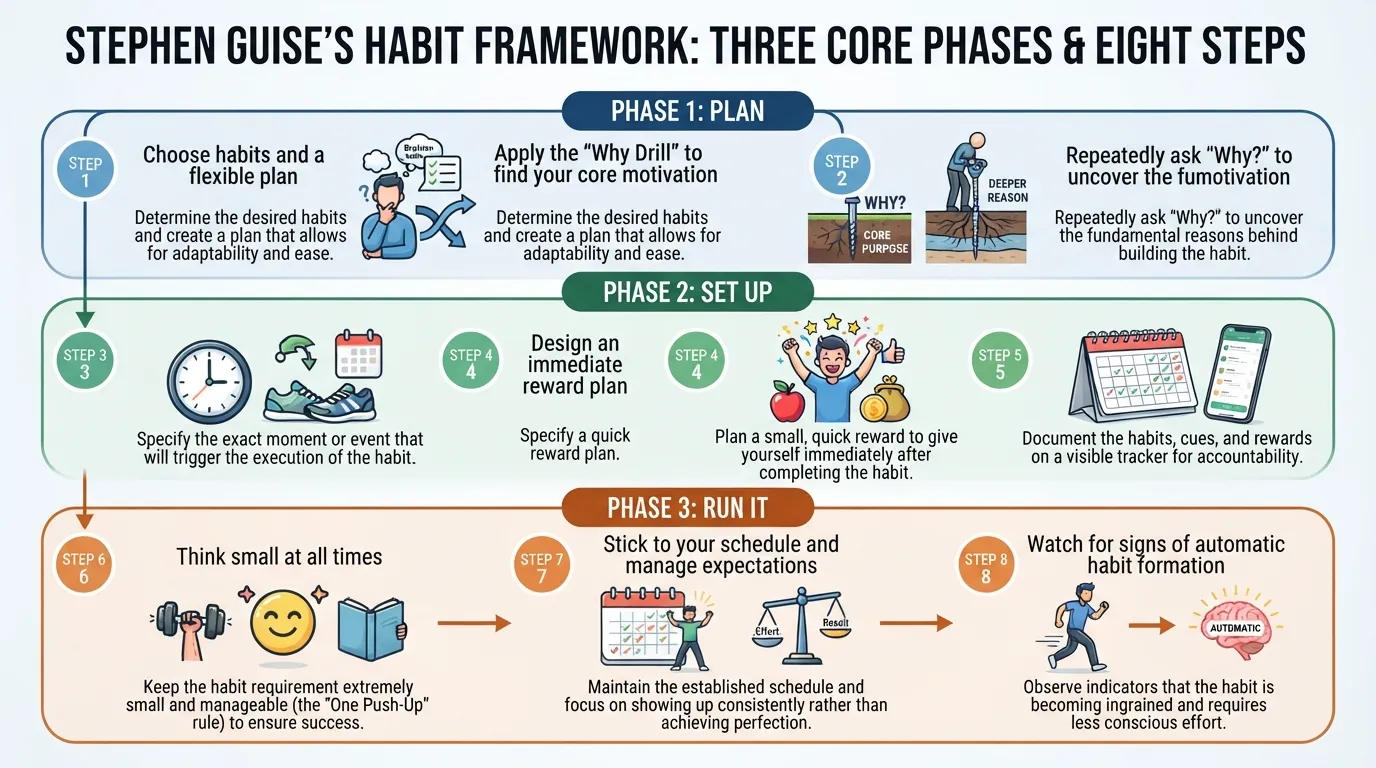
Plan
To build a sustainable mini habit foundation, begin by choosing a manageable plan and clarifying your core motivations:
Choose your habits and a flexible strategy: Select a small handful of habits—the author recommends keeping the total low and typically runs two to three himself—and define a microscopic daily baseline for each.
Use the “why drill”: Ask yourself why you want to build each habit repeatedly until you uncover the deep, underlying emotional motivation behind your goal.
Set Up
Before executing your new routine, set up clear anchors, positive feedback loops, and tracking mechanisms:
Define your cues: Decide whether your daily mini habits will be tied to a specific time of day or triggered by an existing habit in your routine.
Make a reward plan: Design immediate small rewards following each completion to satisfy your brain’s habit loop.
Write everything down: Document your mini habits on a physical wall calendar or a digital tracking app to make your daily commitments clear and visible.
Run It
Maintain daily momentum by keeping your targets minimal and monitoring signs of automatic behavior:
Think small at all times: Keep your daily requirements ridiculously tiny to stop mental resistance from building up on hard days.
Keep to your schedule and manage expectations: Focus strictly on hitting your baseline requirement every day without expecting massive performance output.
Watch for signs the habit has formed: Track your consistency until the behavior feels natural, automatic, and requires minimal conscious effort.
If you miss a single day while running your routine, do not panic; as covered in the habit timing section below, research shows a single missed day will not derail long-term habit formation.
The 8 Mini Habit Rules
Stephen Guise outlines eight essential guidelines to keep your daily system friction-free and sustainable over the long term:
Never cheat the system: Do not secretly expect 50 push-ups while setting an official daily baseline of just one.
Celebrate all progress: Acknowledge every completed micro-step as a genuine victory to reinforce positive mental momentum.
Reward yourself frequently: Build quick, pleasing rewards into your routine after every habit completion to satisfy your brain’s feedback loop.
Stay level-headed: Keep your emotions steady after early wins instead of overconfidently raising your permanent baseline.
Go smaller when resistance hits: Shrink your target to an even more microscopic step if a task feels surprisingly hard on a bad day.
Remind yourself how easy it is: Focus on how trivial your mini action is to neutralize any rising mental friction.
Never view a step as too small: Remember that a tiny effort maintains your neural habit loop, while doing zero breaks it.
Channel extra energy into bonus reps: Direct spontaneous bursts of enthusiasm into extra repetitions rather than increasing your official daily requirement.
Mini Habit Examples
Applying the mini habit strategy involves converting standard self-improvement targets into microscopic daily actions that carry virtually zero friction. The table below lists concrete examples drawn directly from the author’s own experience and real reader reports on Goodreads.
| Area | Mini Version Baseline | Potential Bonus Outcome |
| Fitness & Exercise | Complete 1 push-up | Finish a full set or a complete 30-minute workout session |
| Writing & Content | Draft 50 words daily | Write an entire article or complete a full book chapter |
| Reading & Learning | Read 2 pages per day | Read a full chapter or finish several book sections |
| Outdoor Activity | Go for a 5-minute walk | Walk for 30 minutes or complete an entire outdoor loop |
| Home Organization | Declutter 1 single item | Clear off a full desk surface or organize an entire closet |
| Mindfulness | Think 2 positive thoughts | Practice a full session of positive reflection or journaling |
How Long Does It Take to Form a Habit?
Forming a new habit takes anywhere from 18 to 254 days, with an average time of 66 days, depending on the behavior’s complexity and the individual’s personality. The popular belief that habits take exactly 21 days is a widespread myth derived from misinterpretations of early plastic surgery observations, not controlled behavioral science.
The foundational research on habit formation comes from a landmark study by Lally et al. (2010) published in the European Journal of Social Psychology. Researchers tracked 96 volunteers who chose a single health-related daily behavior to perform over an 84-day period.
Key findings summarized by the BPS Research Digest include:
Average duration: The median time required for a behavior to become automatic was 66 days.
Observed range: Individual times ranged from 18 days for simple actions (like drinking a glass of water) up to a projected 254 days for complex habits (like 50 sit-ups before breakfast).
Model projections: The upper limit of 254 days was a statistical model projection based on participant trajectories, not a directly observed individual completion date during the study window.
Resilience: Missing a single day here or there did not materially impact the long-term process of habit formation, proving that consistency over time matters far more than perfect compliance.
Does It Really Work? Reader Results
Reader feedback demonstrates that Stephen Guise’s approach works exceptionally well for overcoming starting friction, though experiences vary based on expectations. On the Goodreads book page, the book maintains an average score of 4.00 out of 5 stars across more than 8,000 ratings.
The breakdown of reader ratings shows strong overall satisfaction:
5-Star: 36% (2,955 ratings)
4-Star: 36% (2,932 ratings)
3-Star: 18% (1,488 ratings)
2-Star: 5% (438 ratings)
1-Star: 2% (199 ratings)
Common Praise
Readers frequently report that setting microscopic goals removes the anxiety and dread of starting a new routine. Many highlight successful real-world applications, such as taking a brief 5-minute daily walk, completing a single crunch, reading one page before sleeping, sorting through one item of clutter, drafting a single sentence in a journal, or drinking one glass of water before morning coffee.
Common Criticisms
Critical readers often note that the book feels padded and overly repetitive across its chapters, arguing that the central message could be summarized in a short article. Others express disappointment with the lack of diverse case studies, pointing out that the author relies heavily on his own personal experiences rather than broad population studies.
Pros, Cons and Verdict
Pros and Cons
The main strength of Mini Habits lies in lowering the psychological barrier to starting new behaviors, making action practically effortless even on low-energy days. Stephen Guise supports his framework with references to behavioral psychology research and offers a free chapter so readers can test the core strategy before purchasing the full text.
However, many readers note that the book feels padded and repetitive, arguing that its core thesis could easily fit into a concise blog post. The content relies heavily on the author’s personal anecdotes rather than a wide variety of third-party case studies, and its reliance on 2013-era willpower concepts (like ego depletion) does not fully align with modern psychological replications.
Mini Habits vs Elastic Habits
While Mini Habits focuses on sticking to a single, fixed microscopic baseline every day, Stephen Guise later expanded his methodology in his 2019 book, Elastic Habits. The author states that while small habits remain effective, flexible, adjustable habits represent a better path for long-term adaptiveness.
On his Elastic Habits Amazon listing, Guise explains that offering multi-tiered targets (Mini, Plus, Elite) allows habits to flex around changing energy levels without breaking momentum.
Who Should Read It, Who Should Skip
Who Should Read It: Procrastinators who struggle to get started, people recovering from burnout, or anyone intimidated by traditional “all-or-nothing” goal-setting advice.
Who Should Skip It: Individuals seeking guidance for breaking severe addictions (like smoking or gambling), or readers who prefer a flexible, multi-option routine (who should check out Elastic Habits instead).
Where to Get It + Free Chapter
Mini Habits by Stephen Guise is widely available through major booksellers in paperback, Kindle eBook, and audiobook formats. You can find official retail listings and community discussions on the Goodreads book page or browse editions directly on the Amazon listing.
If you are looking for a legitimate free sample or PDF version to test the strategy before buying, avoid unauthorized file-sharing sites. The author provides a free download of Part 1 via his official Free Chapter PDF, which covers his background story and the origin of the method without paywalls.
Mini Habit Mastery Video Course: For readers who prefer video content, Guise also offers an official 4+ hour video course that walks through the practical setup and long-term execution of the mini habits framework in detail.
Mark Steve
Mark Steve is a tech, business, and lifestyle writer with over 5 years of experience analyzing digital trends, startups, and online business models. He publishes well-researched, fact-checked content focused on clarity, credibility, and real-world value.