The Brain Science Behind Habit Formation: How Your Brain Builds and Breaks Habits
What Habit Formation Actually Means in the Brain
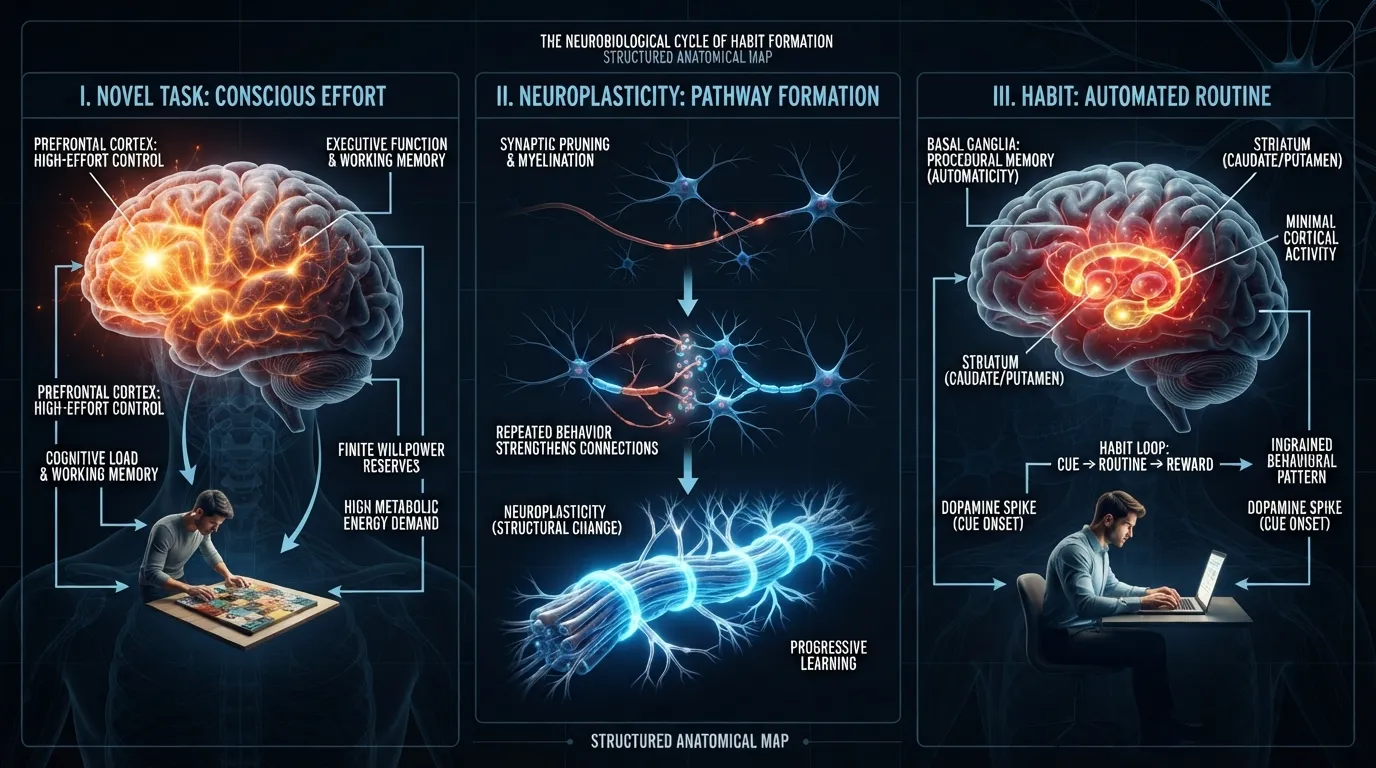
Habit formation is the neurological process by which a behavior, through consistent repetition, transitions from a goal-directed action requiring conscious cognitive effort into an automatic routine executed with minimal mental overhead. When you repeat an action within a stable context, the brain optimizes its energy consumption by hardwiring the underlying neural pathways, effectively shifting the behavior from the deliberate decision-making centers of the mind to the procedural memory systems.
This exploration breaks down the biological mechanics driving that mental transition. Ahead, we cover:
The Habit Loop: The foundational three-part framework—cue, routine, and reward—that triggers, drives, and reinforces automatic behaviors.
Key Brain Regions: The specific neural structures, including the shift of control from the prefrontal cortex to the basal ganglia, that orchestrate automatic execution.
The Role of Dopamine: How the brain’s primary anticipation and reward neurotransmitter spikes motivation and cements behavioral loops into place.
The Habit Loop — Your Brain's 3-Step Cycle
Cue — the trigger that starts the loop
The cue is the external or internal stimulus that instructs your brain to initiate a specific behavior. It acts as an environmental trigger, signaling which automated routine to deploy. Cues can take several forms:
Time of day: Waking up at 6:00 AM.
Location: Walking into your office workspace.
Emotional state: Feeling stressed, anxious, or bored.
Preceding action: Sitting down at the dining table and finishing your last bite of food.
Routine — the behavior itself
The routine is the physical, mental, or emotional action performed in response to the cue. This is the core habit itself, which can range from a simple action like opening an app to a complex sequence like following a multi-step evening wind-down protocol.
Reward — the payoff that reinforces the loop
The reward is the ultimate benefit or relief your brain experiences, teaching it whether this specific habit loop is worth remembering for the future. Rewards satisfy a craving, release dopamine, and reinforce the neural connection between the cue and the routine, completing the feedback cycle.
Real-Life Example: The Phone-Checking Habit
Cue: A buzzing vibration or a screen lighting up with a notification banner.
Routine: Reaching for your pocket, unlocking the phone, and swiping through social media or email feeds.
Reward: A quick hit of mental stimulation, satisfying curiosity, or temporarily escaping boredom.
Your Brain Builds Highways, Not Just Habits
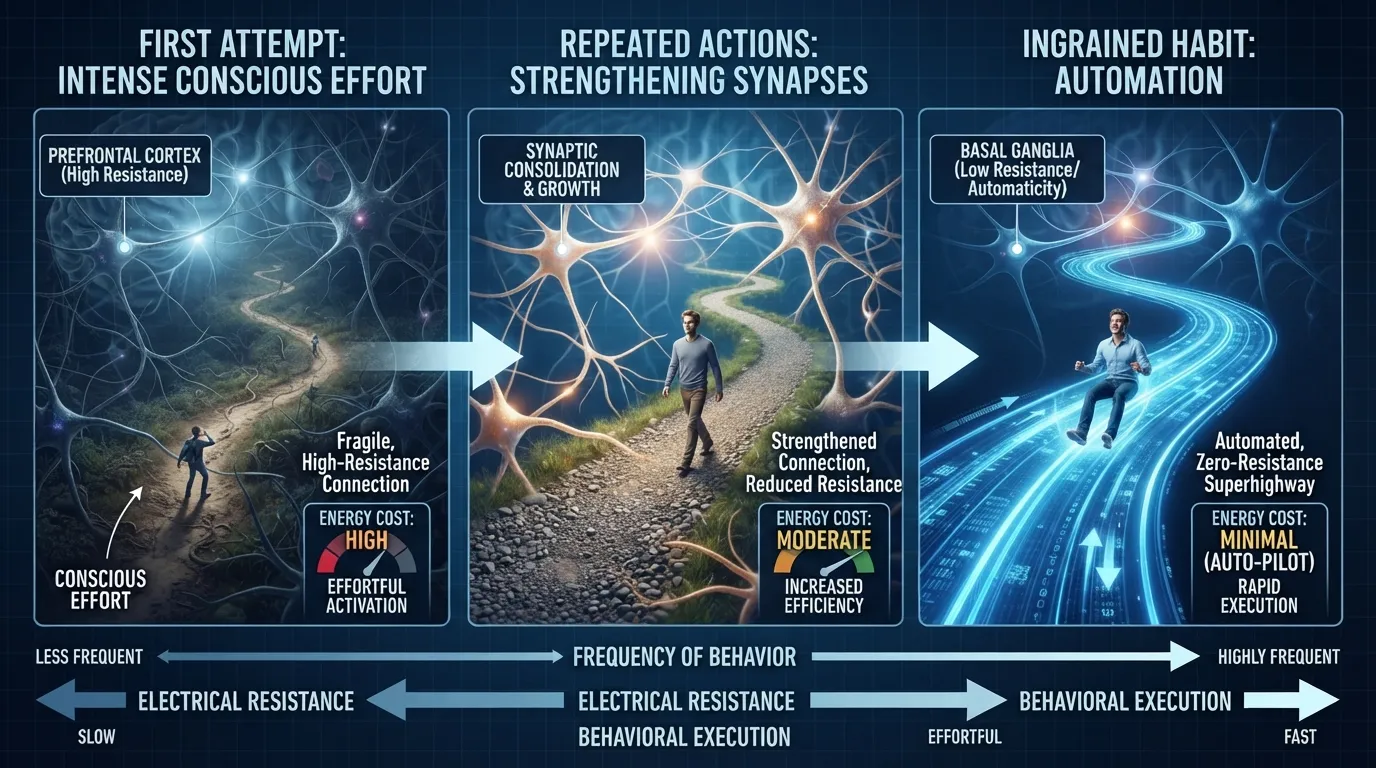
When you perform an action for the very first time, your brain has to clear a path through dense mental terrain, much like walking through an overgrown forest. Every time you repeat that behavior, you clear away more brush, lay down gravel, and eventually pave a smooth, multi-lane highway. This process of structural remodeling is known in neuroscience as neuroplasticity—the brain’s ability to reorganize itself by forming new neural connections based on experience.
First attempt: The initial effort creates a faint, fragile neural pathway that requires intense concentration and active navigation to cross.
Repeated action: Subsequent repetitions reinforce the synapse connections between neurons, turning the faint trail into a well-trodden path.
Frequent repetition: Consistent practice widens the connection, significantly lowering the electrical resistance and making information transfer faster and more efficient.
Eventually: The pathway becomes an automated superhighway where impulses travel instantaneously, allowing the behavior to execute with zero conscious input.
The Brain Regions Behind Habit Formation
Prefrontal Cortex — conscious control (new/unfamiliar actions)
The prefrontal cortex acts as the command center for executive function, logical reasoning, and decision-making. When you encounter a novel task or try to learn a brand-new behavior, this region works overtime. It evaluates options, weighs consequences, directs focus, and forces your body to execute unfamiliar movements step-by-step. Because every micro-action requires deliberate thought, utilizing the prefrontal cortex burns through mental energy rapidly.
Basal Ganglia & Striatum — automatic control (repeated actions)
As a behavior is repeated over time, the neural control center shifts backward from the prefrontal cortex to the basal ganglia—specifically the striatum. The basal ganglia are deep-seated structures specialized in procedural memory, motor control, and the generation of automated routines. Once this region takes over a behavioral sequence, it groups individual actions into a single chunk, allowing you to run the entire loop smoothly without needing active oversight.
Dopamine — the chemical that reinforces the loop
Dopamine acts as the brain’s primary currency for motivation, learning, and reinforcement. When you perform an action that results in an unexpected reward, dopamine neurons fire a burst of electrical signals, acting as a chemical neon sign that tells the brain: Pay attention, remember what just happened, and do it again. Over time, as the habit solidifies, the dopamine spike shifts from the moment of the reward to the very beginning of the loop—triggering anticipation and desire the instant the cue appears.
Why the shift happens — the brain’s energy-saving system
The human brain makes up roughly 2% of body weight but consumes around 20% of its energy. To survive and operate efficiently, it constantly looks for ways to offload heavy processing loads.
Conscious processing is mentally expensive: Actively analyzing, problem-solving, and managing unfamiliar tasks requires significant metabolic resources and glucose consumption in the prefrontal cortex.
Automating repeated behavior conserves brain energy: By shifting routine tasks to the basal ganglia, the brain frees up precious cognitive bandwidth, allowing you to focus on new challenges while autopilot handles the familiar.
Example — learning to drive: On your very first day behind the wheel, every movement—checking mirrors, adjusting the seat, feathering the gas, and signaling—requires intense, exhausting concentration from your prefrontal cortex. Years later, you can drive an entirely familiar route home while lost in thought, because the basal ganglia has fully automated the mechanics of driving.
Why Motivation Fails But Systems Work
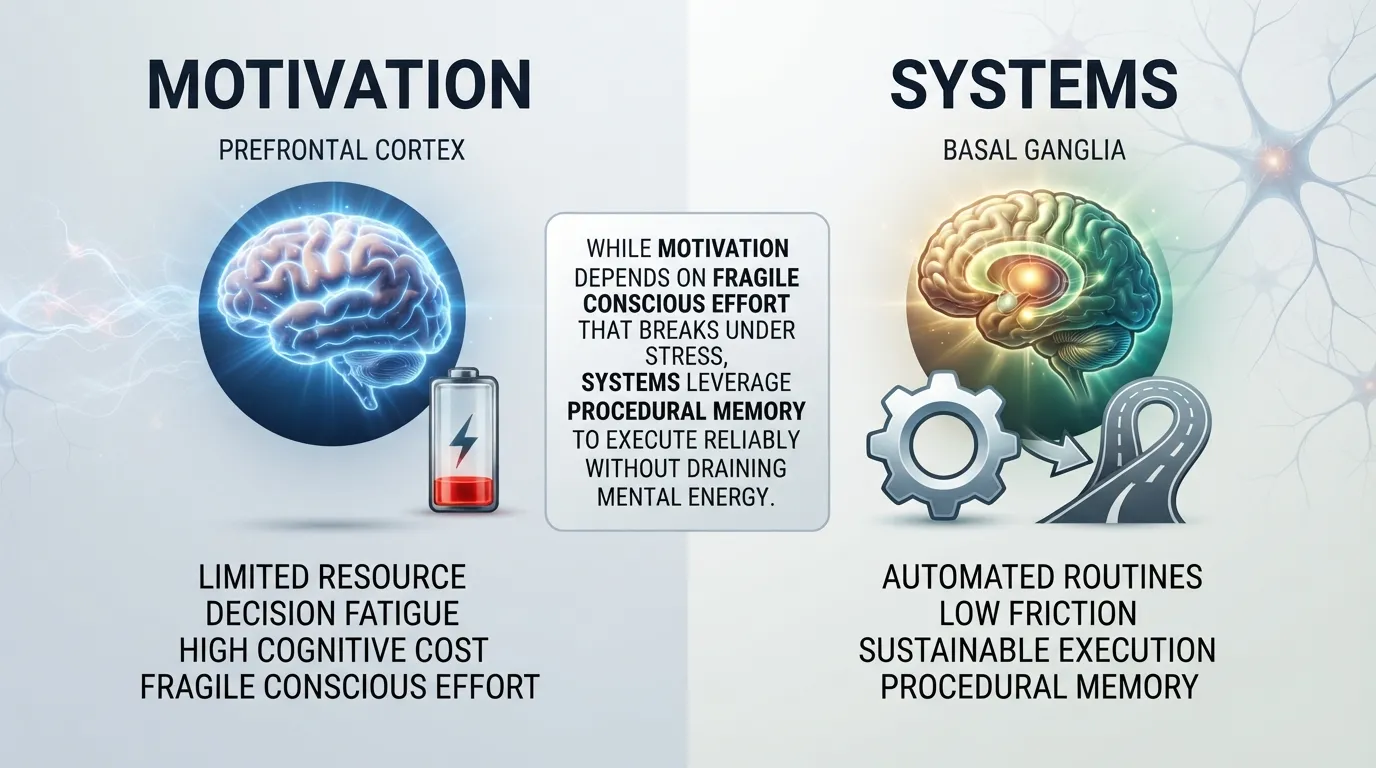
Relying purely on motivation to change your behavior is a losing battle because motivation is governed by the prefrontal cortex, a finite resource that fatigues quickly under stress, fatigue, and distraction. Systems and automated habits, by contrast, are anchored in the basal ganglia, operating largely independent of conscious willpower. When you build a system, you stop fighting your biology and start working with it.
Early stage: The beginning of any change depends heavily on active willpower and effortful decisions, requiring your prefrontal cortex to manually override old neural pathways.
Later stage: Once the habit loop is established, the brain seamlessly follows the established pattern automatically, removing the daily friction of choice.
Identity Is the Final Stage of Habit Formation
True long-term behavior change is not just about what you achieve, but who you believe you are. When habits align with your core self-image, you stop trying to force changes from the outside in. Instead of viewing a behavior as a chore you have to complete, it becomes a natural reflection of your identity. The deepest layer of habit change follows a clear developmental progression: focusing first on outcomes, then on performance routines, and finally on the internal story you tell yourself.
Stage 1 (Outcome): Focuses on what you want to get—e.g., “I want to lose ten pounds” or “I want to run a 5K.”
Stage 2 (Process/Routine): Focuses on what you do—e.g., “I exercise every morning at 7:00 AM.”
Stage 3 (Identity): Focuses on who you believe you are—e.g., “I am a healthy, active person who values fitness.”
Why Old Habits Feel Stronger Than New Ones
Old habits feel almost impossible to break because they are backed by decades of biological reinforcement, whereas new habits are fragile experiments struggling for survival in your neural network. When you face stress, fatigue, or distraction, your brain naturally seeks the path of least resistance—and in the neural landscape, an old habit is a massive, multi-lane superhighway compared to a faint, unpaved footpath of a new behavior.
Old habits: Built on thousands of repetitions, reinforced pathways, and deep emotional links, making them fire instantly with minimal metabolic cost.
New habits: Composed of fragile, newly sprouted synaptic connections that require constant conscious attention and active prefrontal cortex oversight to maintain.
This neurological imbalance explains why relapse into old patterns happens so easily. Under pressure, the prefrontal cortex—the seat of willpower and self-control—depletes its energy quickly and goes offline. The moment conscious oversight lapses, the basal ganglia steps in and default-drives you straight back down the strongest, oldest, and most well-worn neural highway available.
Does It Really Take 21, 30, or 90 Days to Build a Habit? The Myth, Debunked
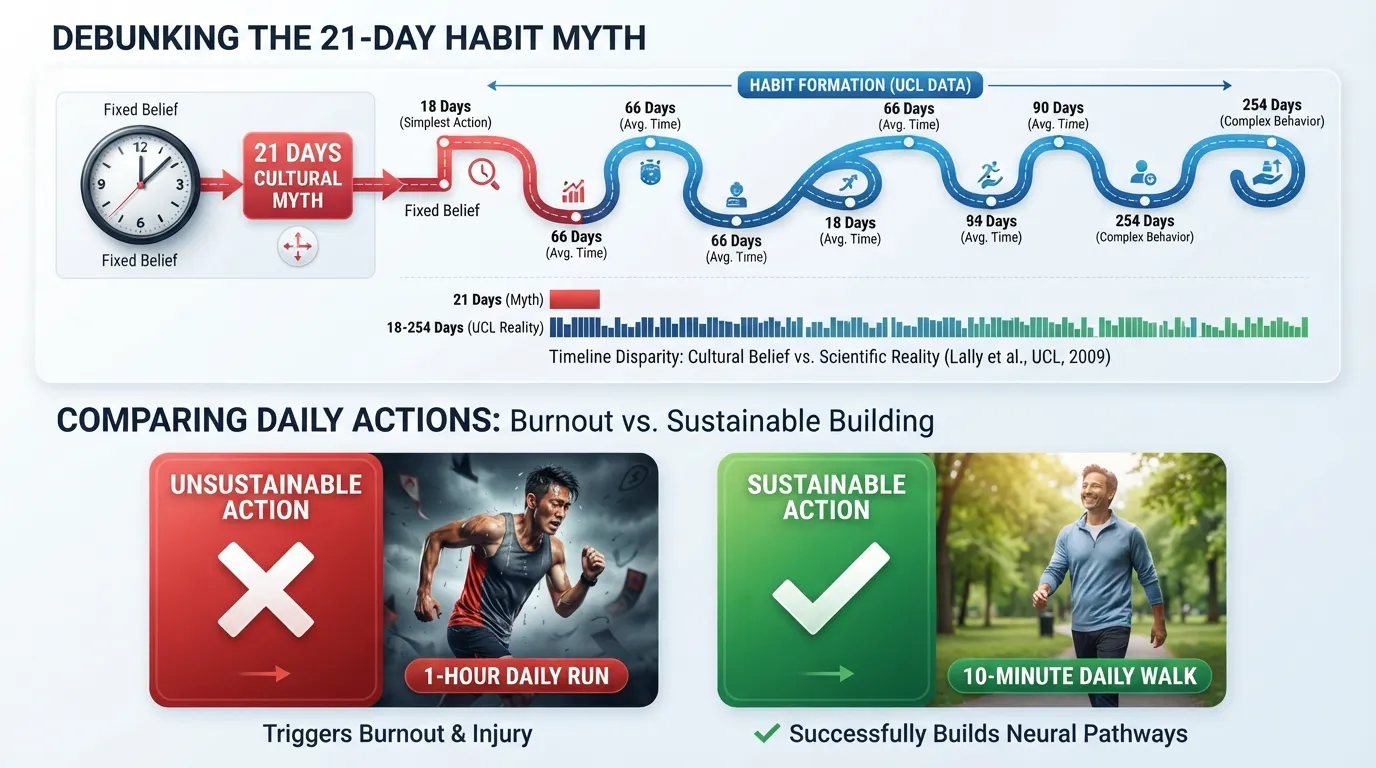
The popular belief that it takes exactly 21 days to form a habit is a persistent cultural myth born from a misinterpretation of plastic surgeon Maxwell Maltz’s 1960 observations on how long patients took to adjust to facial changes. Modern psychological research has completely dismantled this rigid timeline. A landmark study by health psychology researcher Dr. Phillippa Lally at University College London found that the actual time it takes for a new behavior to become automatic ranges anywhere from 18 to 254 days, with an average of about 66 days.
There is no universal magic number because habit formation is not dictated by a calendar; it is dictated by repetition consistency and behavior complexity. Drinking a glass of water after breakfast automates much faster than trying to complete a complex 45-foot-work-out routine.
❌ Run 1 hour daily: An overly ambitious, complex, and high-friction target that quickly drains mental energy, leading to frustration, burnout, and high dropout rates.
✅ Walk 10 minutes: A low-friction, highly sustainable micro-action that reliably builds the neural pathway without overwhelming your prefrontal cortex.
How This Shows Up: Common Habit & Behavior Examples
Habit loops govern almost every aspect of our daily routines, quietly running in the background until a cue triggers the automated sequence. Recognizing these loops in everyday life is the first step toward consciously directing them.
The Phone-Checking Loop: A buzzing notification (cue) triggers reaching for the phone and unlocking the screen (routine), delivering a quick hit of social curiosity or mental escape (reward).
The Nail-Biting Reflex: A moment of boredom, stress, or deep focus (cue) leads to bringing fingers to the mouth (routine), offering a tactile release of nervous energy (reward).
The Morning Coffee Ritual: Walking into the kitchen or smelling freshly brewed grounds (cue) prompts turning on the machine and pouring a mug (routine), providing a warm energy boost and comforting sensory anchor to start the day (reward).
The Exercise Routine: Slipping into running shoes immediately after waking up and lacing them tight (cue) sparks heading out the door for a jog (routine), ending with a rush of endorphins and a sense of accomplishment (reward).
The Skipping Breakfast Habit: Rushing out the door late for work or an early appointment (cue) results in bypassing the kitchen entirely and grabbing nothing to eat (routine), avoiding immediate time crunch stress at the expense of morning focus and stable blood sugar (reward).
For a deeper category breakdown of how different types of behaviors operate and branch out across various areas of life, explore our full Types of Habits guide.
The Habit Replacement Formula
Trying to completely erase an unwanted habit often fails because the underlying neural circuit remains active and intact. The cue is still there, and the brain still craves the reward. Instead of trying to suppress a bad habit through brute-force willpower, neuroscientists and behavioral psychologists recommend the Habit Replacement Formula.
The secret lies in keeping the existing cue and the anticipated reward, but consciously swapping out the middle step—the routine. By redirecting the energy into a new response that satisfies the same underlying craving, you rewire the neural pathway without fighting your brain’s natural tendencies.
Framework: Trigger → Old Response → New Response → New Reward
Worked example — Stress → phone scrolling, replaced with Stress → 5-minute walk → relaxation
The Cue (Trigger): A surge of work-related stress or mental fatigue while sitting at your desk.
The Old Response (Routine): Reaching for your smartphone and mindlessly scrolling through social media feeds for 20 minutes.
The Old Reward: A temporary mental distraction and dopamine escape from immediate pressure.
The New Response (Replacement Routine): Standing up, stepping away from the desk, and taking a brisk 5-minute walk outside or around the hallway.
The New Reward: Physical tension release, a clearing of the mind, and genuine stress reduction that satisfies the brain’s original craving in a much healthier, more productive way.
Try It Yourself — Habit Formation Self-Check
Use this interactive checklist to audit an unwanted habit you want to change or a new habit you want to build.