How to Build Good Habits That Last
Starting a new habit feels effortless on day one, fueled by pure adrenaline and midnight motivation. By day fourteen, that energy vanishes, the alarm goes off, and you are right back where you started. If you have abandoned a habit tracker before the month ended, the fault does not lie with your willpower. Relying on motivation to how to build good habits that last is a losing battle because motivation is an emotion, and emotions fluctuate daily.
Lasting change requires building a reliable system rather than crossing your fingers and hoping for discipline. When you learn how to form a habit through structural design rather than brute-force effort, consistency stops feeling like an exhausting chore. Let’s look at the exact mechanics of how to develop good habits that survive past the second week and finally stick for good.
Why Habits Are Hard to Build (The Loop + The Science)
Building consistency often feels like an uphill battle because our brains are naturally wired to conserve energy. Understanding the hidden psychological mechanics behind how routines form is the first step toward lasting behavioral transformation.
The Habit Loop — Cue → Craving → Response → Reward
Every routine that becomes automatic follows a neurological feedback loop discovered by behavioral researchers. This cycle dictates how actions become hardwired into daily life:
1. Cue: The trigger that initiates the behavior, such as a specific time of day, an emotional state, or a physical location.
2. Craving: The motivational force and underlying desire behind the habit (e.g., wanting relief, energy, or comfort).
3. Response: The actual habit or physical action you perform.
4. Reward: The ultimate benefit gained, which satisfies your craving and teaches your brain that this loop is worth remembering for the future.
Why willpower alone fails (dopamine, neural pathway reasoning)
Many people rely exclusively on motivation to drive change, hoping that inspiration will strike them on demand. However, dopamine acts as a prediction molecule rather than just a pleasure molecule; it spikes when anticipating a reward. When you rely solely on willpower, you force your prefrontal cortex to constantly fight deeply entrenched neural pathways. Because decision fatigue sets in quickly, raw discipline collapses under stress, leading back to older, more energy-efficient patterns.
Real-World Habit Loop Example
Cue: Your morning alarm sounds at 6:00 AM.
Craving: The desire to shake off grogginess and wake up.
Response: Stepping out of bed and going for a brisk morning walk.
Reward: A powerful surge of natural physical energy and mental clarity.
Expert Explainer on Habit Science
Watch this video breakdown detailing how small planning tricks and implementation intentions help bypass cognitive friction to build habits that stick:
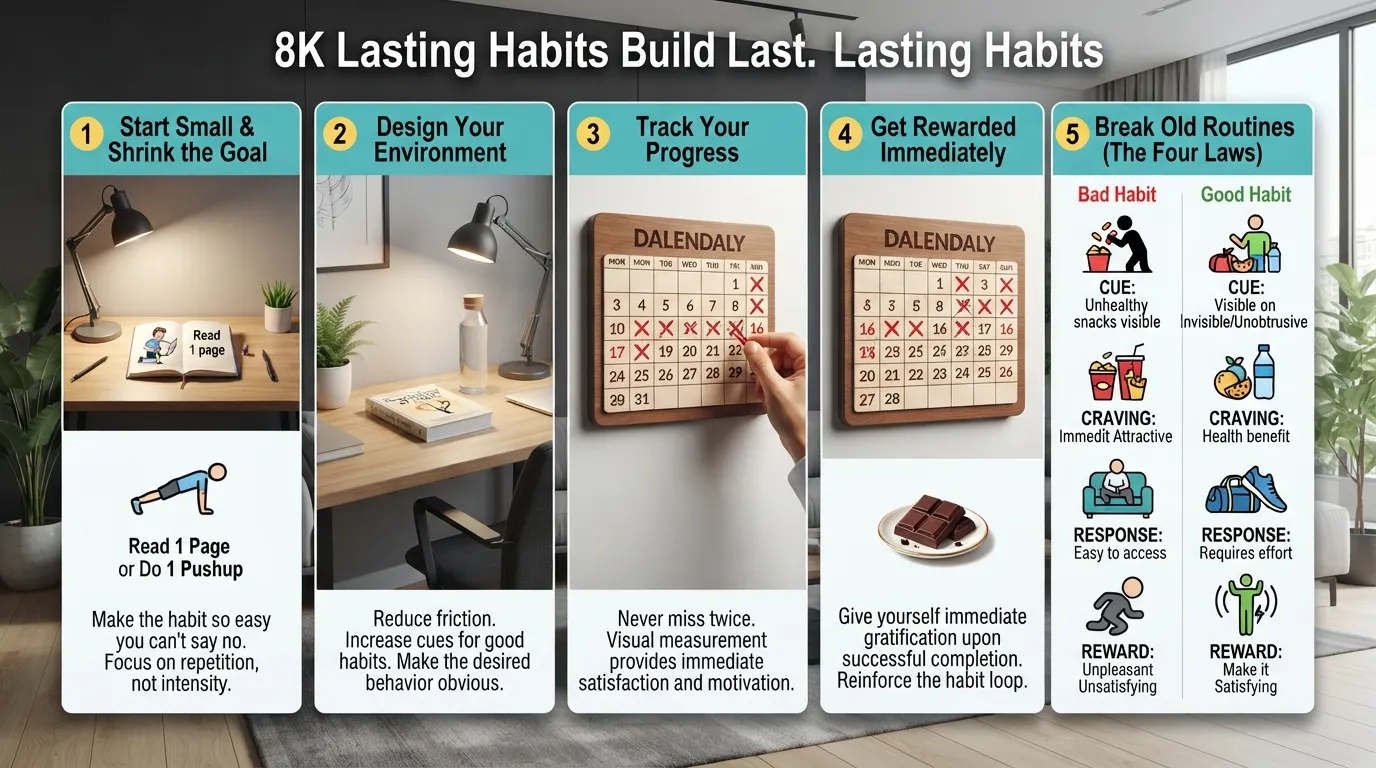
Step 1 — Start Small Enough That You Can't Say No
When excitement is high, it is easy to commit to working out for an hour every single day or reading fifty pages nightly. That initial burst feels productive, but it sets an unsustainable trap. The moment a stressful workday or a late night hits, that massive goal becomes the first thing you drop. True how to build a habit success starts by shrinking the target until failure is practically impossible.
The Two-Minute Rule
The secret to lasting momentum is making your new behavior take two minutes or less to perform. If you want to build a daily journaling habit, your two-minute rule is simply to write one single sentence. If you want to start exercising, your goal is to put on your running shoes and step out the front door. You are not trying to complete the full workout yet; you are simply mastering the art of showing up. By lowering the barrier to entry, you bypass the mental friction that makes you want to procrastinate.
Master consistency before intensity
Most people focus entirely on optimizing how hard they work out or how much they read, completely ignoring the sheer frequency of showing up. Intensity feels impressive in the short term, but consistency is what actually rewires your brain. Once you lock in the daily rhythm of the tiny action, scaling up happens naturally over time.
1 pushup: Drop to the floor and complete a single repetition to protect your daily fitness chain on exhausting days.
1 page: Read just one page of a book before bed to keep your reading routine alive without feeling overwhelmed.
1 glass of water: Drink one glass immediately upon waking up to anchor your hydration habit before your morning coffee.
Step 2 — Design Your Environment
Relying purely on self-control to how to create a habit is like swimming upstream against a strong current. Your surroundings quietly dictate your daily actions much more than your intentions do. If your running shoes are buried at the bottom of a closet or your phone is resting right beside your pillow, your environment is actively sabotaging your goals. Shifting how to develop good habits starts with reshaping your physical space so the right choice requires zero mental effort.
Make good cues visible
If you want a behavior to happen, put the cue right in your line of sight. Place your book squarely on top of your pillow in the morning so you see it before sleeping. Leave your water bottle on the kitchen counter the night before. When a positive trigger is obvious, your brain doesn’t have to hunt for motivation to get started.
Hide bad triggers
Out of sight truly means out of mind when you are trying to eliminate friction or break old patterns. Move your phone to another room an hour before bed instead of keeping it on your nightstand. Hide the snack drawer behind pantry doors or swap junk food for fresh fruit sitting on the counter. Reducing exposure to negative cues cuts off the automatic loop before it even begins.
One space per habit
Your brain naturally associates specific physical locations with specific actions. If you work, scroll social media, and try to meditate all while sitting in the exact same spot on your couch, your mind gets confused. Dedicate distinct zones for specific behaviors—like reading strictly in the armchair or journaling at the desk—so your environment works for you rather than against you.
Step 3 — Stack Habits Onto Existing Routines
One of the most effective ways to introduce a new behavior without relying on raw willpower is to anchor it to something you already do every single day. This leverages the brain's existing neural pathways to create seamless behavioral momentum.
The "After/Then" formula
Habit stacking relies on pairing an immediate cue from an established behavior with a new routine you want to introduce. By clearly specifying the trigger sequence, you remove ambiguity and tell your brain exactly when and where to act.
The Implementation Formula
"After [CURRENT HABIT], I will [NEW HABIT]."
For example: After I pour my morning cup of coffee, I will drink a full glass of water.
Real-World Habit Stacking Examples
- After I close my laptop at 5:00 PM, then I will change into my running shoes and step outside.
- After I brush my teeth at night, then I will floss just one tooth to initiate my dental care routine.
- After I sit down on the train for my morning commute, then I will open my reading app and read one page.
- After I pour my first cup of coffee, then I will write down my top three daily priorities for work.
Practical Stacking Demonstration
Watch this neuroscience-based breakdown explaining how implementation planning and contextual cues integrate habits smoothly into your daily routine:
Step 4 — Track It So Your Brain Sees Progress
Starting a new routine feels rewarding at first, but the initial excitement fades long before the behavior becomes automatic. Without a clear record of your daily actions, it is easy to trick yourself into thinking you are making progress when you are actually skipping days. Visual proof keeps your momentum alive during those sluggish weeks when motivation hits zero. When you can physically see a growing chain of successful days, your brain receives an immediate hit of satisfaction that reinforces the loop.
Simple tracker methods (calendar X, app, journal)
You do not need an elaborate, color-coded spreadsheet or an expensive subscription to monitor your growth. A simple wall calendar where you cross off each completed day with a red X works remarkably well because the visual cue stares you right in the face. If you prefer digital formats, a straightforward habit-tracking app on your phone can send gentle reminders and log your streaks automatically. Alternatively, a dedicated page in your daily journal where you check off completed tasks gives you a tactile way to review your consistency over time.
Consistent trackers and unbroken streaks noticeably improve stick-rate past month one because they turn maintaining your routine into a game you refuse to lose. As the visual chain grows longer, protecting your progress becomes a powerful motivator in its own right, helping you push through the dips when you least feel like showing up.
Step 5 — Make It Satisfying + Breaking Bad Habits, short contrast
A behavior repeats when the immediate experience feels rewarding, whereas a behavior stops when it feels frustrating or dull. When you are figuring out how to build a habit, waiting weeks or months to see physical changes or big milestones is a recipe for quitting early. You have to engineer immediate satisfaction into the process so your brain registers a win right away.
Reward tied to habit + identity reinforcement
Pair your new behavior with something you already genuinely enjoy doing, or give yourself a small, instant acknowledgement the moment you finish. If you only allow yourself to listen to your favorite podcast while walking or enjoy a specialized cup of tea immediately after journaling, your brain learns to associate the routine with immediate pleasure. More importantly, celebrate the small wins because they reinforce your new self-image. Every time you cross off your tiny daily action, you are casting a concrete vote for the kind of person you want to become.
To break a bad habit at the same time, you simply invert these four psychological levers: make the cue invisible, the craving unattractive, the action difficult, and the reward entirely unsatisfying.
10 Simple Habits Worth Starting Today
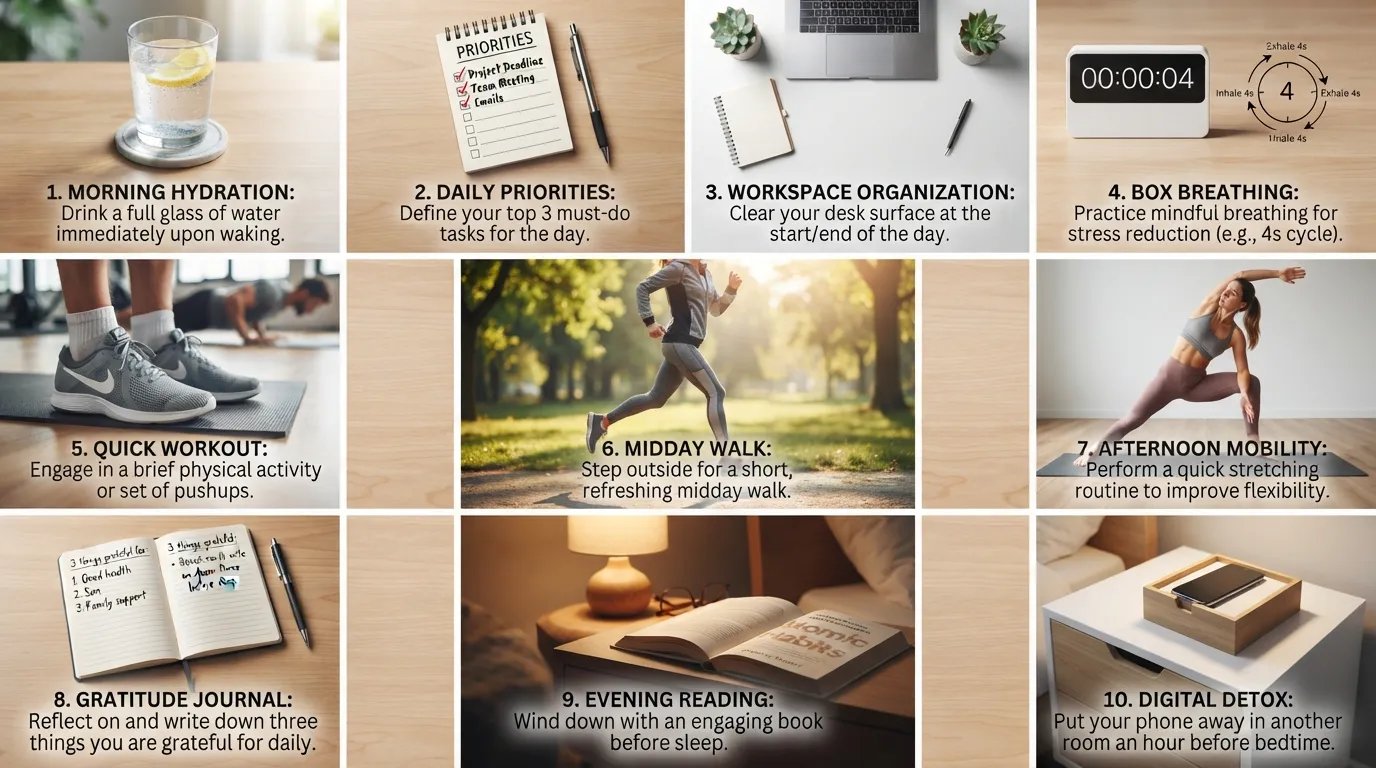
Building lasting change does not require an entirely overhauled lifestyle or a complete daily disruption. Pick one or two micro-behaviors from this list, tie them to an existing routine like your morning coffee or evening wind-down, and watch how small adjustments compound over time.
Drink a full glass of water upon waking: Jumpstarts your metabolism and rehydrates your brain immediately—stack it right beside your bed the night before so it is the first thing you see.
Write down a daily priority list of three items: Keeps busy students and remote professionals focused on high-impact tasks instead of drowning in endless to-dos—stack it during your first morning stretch or coffee brew.
Take a ten-minute outdoor walk after lunch: Clears mental fog, boosts afternoon energy, and regulates your circadian rhythm—stack it immediately after finishing your midday meal.
Read ten pages of a physical book before bed: Replaces mindless phone scrolling with quiet mental stimulation—stack it the moment your head hits the pillow.
Practice five minutes of box breathing: Lowers acute cortisol and centers your nervous system—stack it right before opening your work laptop or starting a stressful study session.
Clear your desk or workspace before logging off: Eliminates visual clutter so you start the next day with zero friction—stack it as the final step of your evening shutdown routine.
Do a single mobility stretch break every afternoon: Prevents physical stiffness and back pain from prolonged sitting—stack it when your afternoon reminder alarm goes off.
Write down one thing you are genuinely grateful for: Shifts your psychological baseline toward positive reinforcement—stack it right inside your daily journal or planner.
Put your phone in another room an hour before sleep: Protects deep sleep quality by cutting off blue light and late-night notifications—stack it right after brushing your teeth.
Do one micro-workout or pushup set: Maintains baseline physical fitness without requiring a massive gym commitment—stack it immediately after changing out of your work clothes.
The 5 Mistakes That Quietly Kill New Habits
- 1. Too much change at once Fix: Start small by focusing on just one micro-habit at a time.
- 2. Unrealistic expectations Fix: Focus on consistency and showing up rather than immediate big results.
- 3. No tracking system Fix: Use a habit tracker or calendar to visually log your daily progress.
- 4. Relying only on motivation Fix: Build automated systems and routines that work even when you don't feel like it.
- 5. No environment design Fix: Make positive cues obvious and remove friction or temptations from your surroundings.
🎥 Video Recommendation
How Long Does It Actually Take to Build a Habit?
The 3-3-3 Rule (direct PAA answer)
If you are looking for a quick mental framework to structure your daily routine, the popular 3-3-3 rule provides a helpful baseline for managing your focus. While it is not a biological law, many practitioners use it to organize their approach: pick 3 core habits to target, commit to them for 3 consecutive weeks to build initial familiarity, and evaluate your progress over a 3-month window. This prevents you from trying to overhaul your entire lifestyle overnight while keeping your attention locked on a manageable set of priorities.
21 Days vs 66 Days — What’s the Real Answer?
We have all heard the famous claim that it takes exactly 21 days to form a new habit. It is a neat, comforting idea that makes self-improvement feel like a short sprint. But if you have ever reached day 22 of a new routine only to watch it collapse the moment life got stressful, you already know the truth: that timeline is a myth.
The 21-day notion stems from a mid-century plastic surgery observation rather than behavioral science. Modern psychological research tracking real-world habit formation reveals a different reality. Data from landmark behavioral studies, supported by ongoing reviews published through institutions like the National Institutes of Health, show that the median time it takes for a new behavior to become truly automatic is actually 66 days. Furthermore, individual timelines range anywhere from 18 to upwards of 254 days depending on how complex the behavior is and how deeply ingrained your previous routines were.
If you are currently sitting at week four or five wondering why your routine still requires conscious mental effort, take a deep breath. You are not failing; you are simply moving through the normal middle phase of neural rewiring. Recognizing that true automaticity takes closer to two to three months removes the crushing pressure of arbitrary short-term deadlines and gives you permission to stay patient with yourself.
FAQs
The 3-3-3 rule typically involves focusing on 3 habits for 3 weeks, or devoting 3 blocks of your day to specific routines to build consistency without feeling overwhelmed.
Simple daily wins include drinking a glass of water upon waking, reading 10 pages daily, meditating for 5 minutes, daily journaling, walking 10,000 steps, making your bed, planning your day ahead, practicing gratitude, eating whole foods, and stretching.
Identify the trigger or cue driving the bad habit, replace the routine with a healthier alternative that gives a similar reward, and modify your environment to remove temptations.
Use habit stacking by attaching your new desired behavior to an existing daily routine (e.g., "After I brew my coffee, I will meditate for 2 minutes"), and keep the initial action extremely small.
Common pitfalls include changing too much at once, relying solely on motivation rather than automated routines and environmental design, and having unrealistic expectations.