Why Most Time Management Advice Fails Against Procrastination
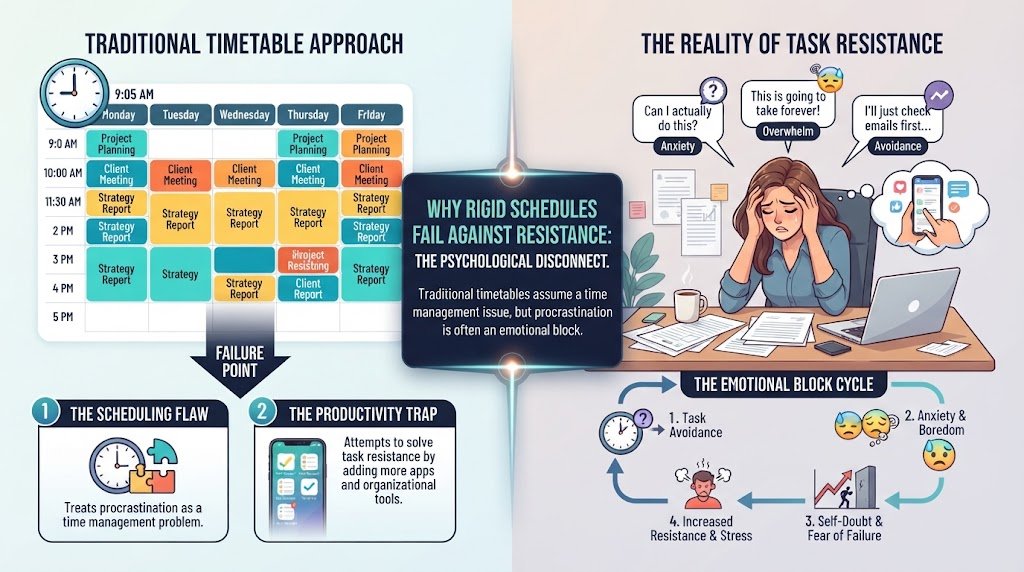
Most time management advice fails because it treats procrastination as a scheduling error when it is actually an emotional regulation problem. When a task triggers anxiety, boredom, or self-doubt, the brain seeks immediate relief through avoidance behavior, rendering color-coded calendars and strict timetables completely useless against the underlying psychological block.
Overcoming chronic delay requires shifting the focus away from optimizing your hours and toward managing your emotional state. Productivity systems only work once you recognize that putting things off is not a failure of organization, but a coping mechanism for stress.
The Emotional Root: Procrastination is driven by negative feelings associated with a task, not a lack of time-management skills.
The Avoidance Cycle: High-stress triggers cause the brain to prioritize short-term mood repair over long-term goals.
The Productivity Illusion: Adding more apps and planners to a routine only masks the emotional friction keeping you stuck.
Treating procrastination as a time management issue is like trying to fix a flat tire by replacing the steering wheel. True progress begins the moment you stop blaming your calendar and start addressing the discomfort of the task itself.
The Real Reason You Procrastinate (It's Not a Time Problem)
The Guilt-Avoidance Cycle Explained
Procrastination initiates a toxic emotional feedback loop where feeling guilty about delaying a task generates acute stress, which the brain then tries to escape through further avoidance. Rather than motivating action, self-reproach increases mental fatigue and depletes the emotional bandwidth required to begin working.
The Trigger: An upcoming obligation sparks uncomfortable feelings like inadequacy or overwhelming anxiety.
The Escape: Turning to mindless distractions delivers an immediate dopamine spike that temporarily numbs the distress.
The Toll: The resulting guilt deepens the emotional deficit, making the original task feel even more threatening next time.
How Your Brain Perceives Tasks as Threats
The limbic system—the brain’s emotional core—evaluates challenging or ambiguous tasks as direct psychological threats, triggering an automated fight-or-flight response. Because the prefrontal cortex struggles to override this emotional alarm when stress is high, the brain chooses short-term mood repair over long-term productivity.
Amygdala Hijack: High-stakes projects register in the brain similarly to physical danger, inspiring flight through distraction.
Cognitive Avoidance: Shifting focus away from the project provides instant relief from the immediate threat of failure.
Misguided Self-Protection: The brain mistakenly views delay as a successful defense mechanism against potential embarrassment or imperfection.
Why Self-Criticism Makes Procrastination Worse
Harsh self-criticism exacerbates chronic delay by compounding the exact emotional friction that triggered the avoidance in the first place. Grounded research highlights that practicing self-compassion significantly buffers against stress and helps break the cycle of self-blame, a principle supported by wellness frameworks like
The Shame Trap: Beating yourself up over missed deadlines deepens feelings of inadequacy and increases the urge to hide.
Emotional Regulation: Accepting past delays without judgment reduces the anxiety spike that fuels future procrastination.
Resilient Execution: Replacing inner criticism with tactical self-kindness restores the cognitive clarity needed to re-engage with difficult work.
This short video provides a useful overview of how self-compassion directly impacts the emotional triggers behind procrastination.
Proven Time Management Techniques for Procrastination
The 2-Minute Rule (Start Small to Beat Resistance)
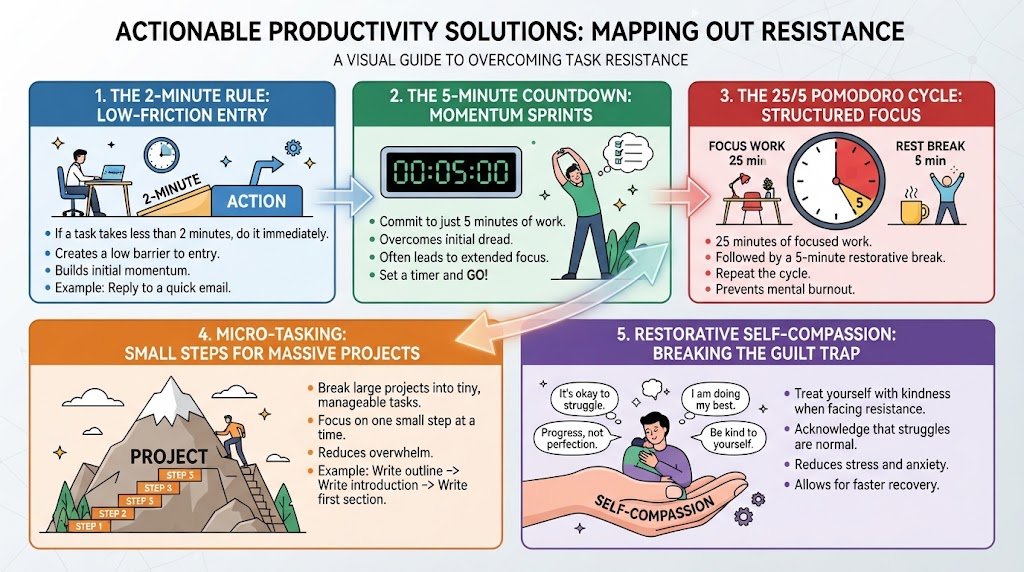
The 2-Minute Rule eliminates initial friction by requiring you to spend just two minutes on any dreaded task. By lowering the entry barrier, this strategy bypasses the brain’s threat response and makes it remarkably easy to cross the starting line.
Immediate Action: Commit to working on the project for only 120 seconds without worrying about finishing it.
Overcoming Inertia: The psychological weight of starting is always heavier than the work itself; once you begin, momentum takes over.
Natural Extension: Most people find it easier to keep going once the initial barrier has been broken.
The 5-Minute Rule (Build Momentum with a Timer)
Setting a physical timer for five minutes creates a firm boundary that tricks the brain into accepting a manageable dose of discomfort. This approach shifts focus away from the intimidating scope of the entire project and funnels all energy into a brief, low-pressure sprint.
Low-Risk Commitment: Agreeing to work for five minutes feels safe to a stressed nervous system.
The Power of Sprints: Short, focused intervals build immediate cognitive momentum and reduce overwhelm.
The Choice Point: When the timer rings, you have full permission to stop, though you will usually choose to continue.
The Pomodoro Technique (25/5 Focus Cycles)
The Pomodoro Technique structures your workday into rigid, highly focused twenty-five-minute intervals followed by a mandatory five-minute break. This rhythm protects against mental fatigue by ensuring you never push past your brain’s natural attention limits without a recovery window.
Unbroken Attention: Dedicate twenty-five minutes strictly to a single task with all digital notifications disabled.
Guilt-Free Rest: Use the five-minute break to step away, stretch, or clear your head without checking work apps.
Sustainable Output: Alternating between focused sprints and rest prevents the burnout that triggers avoidance behavior.
Breaking Down Large Tasks into Micro-Steps
Monolithic projects overwhelm the prefrontal cortex, causing the brain to freeze and seek comfort in distraction. Chunking massive assignments into microscopic, highly specific actions transforms an intimidating mountain into a series of achievable molehills.
Granular Clarity: Replace vague to-do list items like “write essay” with exact physical actions like “open document and write one sentence.”
Reduced Cognitive Load: Smaller steps require significantly less emotional bandwidth to initiate and complete.
Continuous Win State: Checking off micro-tasks delivers steady dopamine boosts that fuel ongoing productivity.
Practicing Self-Compassion Instead of Self-Criticism
Counterintuitively, replacing harsh self-blame with tactical self-compassion is one of the most effective ways to break a procrastination loop. Acknowledging past delays without judgment reduces the anxiety spike that typically drives further avoidance behavior.
Shame Reduction: Treating yourself with kindness short-circuits the emotional feedback loop of guilt and hiding.
Stress Regulation: Lowering emotional distress helps calm the limbic system so logical thinking can resume.
Resilient Recovery: Forgiving yesterday’s delay allows you to immediately re-engage with your work today.
Lesser-Known Time Management Rules Everyone Is Searching For
What Is the 3-3-3 Rule for Time Management?
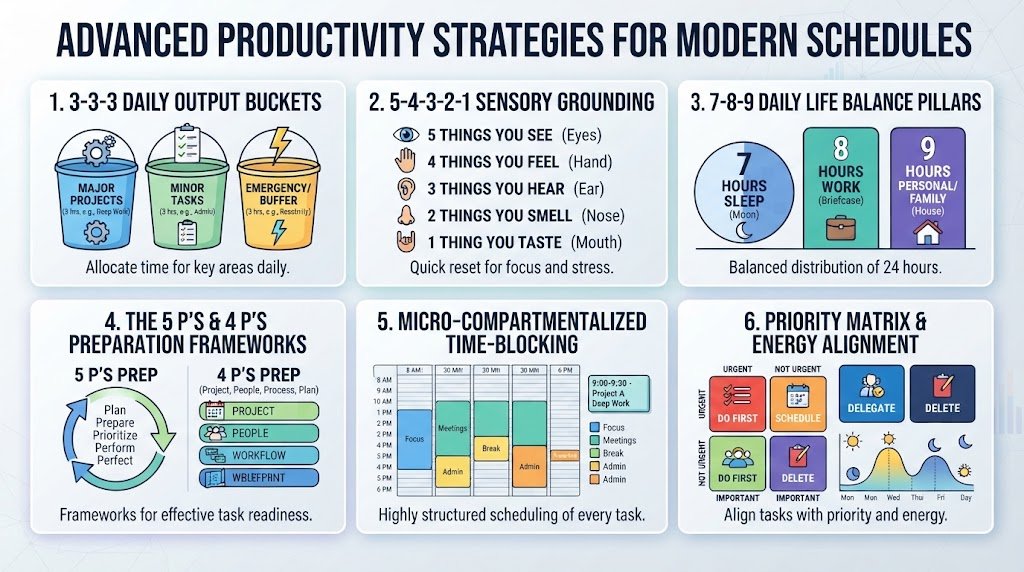
The 3-3-3 rule is a modern productivity framework designed to prevent overwhelm by capping daily output into three distinct, manageable buckets. It requires you to dedicate your core energy to one major project, three urgent supporting tasks, and three short-term maintenance chores.
The Main Focus: Spend 3 hours on your primary, high-impact goal or most critical professional project.
The Secondary Push: Complete 3 pressing tasks or mid-level deliverables that keep operations moving forward.
The Maintenance Block: Handle 3 routine administrative items like clearing emails, organizing files, or updating logs.
What Is the 5-4-3-2-1 Rule for Procrastination?
Adapted from neuroscience-backed grounding practices, the 5-4-3-2-1 method uses a rapid sensory countdown to snap the brain out of avoidance loops and force executive functioning back online. Counting down backward interrupts the emotional anxiety cycle by instantly redirecting focus back to your immediate physical environment.
Sensory Reset: Acknowledge 5 things you can see around your desk, 4 things you can physically feel, 3 sounds you can hear, 2 smells, and 1 taste.
Circuit Breaker: The rapid cognitive shift halts the limbic system’s threat response before it triggers active task avoidance.
Immediate Execution: Once grounded, transition straight into a two-minute version of the task you were putting off.
What Is the 7-8-9 Rule of Time Management?
The 7-8-9 rule provides a macro-level structural blueprint for achieving daily life balance by dividing your 24 hours into three equal-feeling pillars. It anchors productivity to health and lifestyle guardrails to ensure that career execution never completely crowds out rest and personal well-being.
7 Hours of Work: Restrict structured professional tasks, deep work, and side hustles to a concentrated seven-hour window.
8 Hours of Sleep: Protect an uncompromised block for restorative physical rest to optimize next-day cognitive function.
9 Hours of Personal Life: Allocate the remaining hours to family, nutrition, hobbies, physical fitness, and mental downtime.
The 5 P’s of Time Management Explained
The classic 5 P’s framework emphasizes that high performance is an indirect result of deep preparation rather than frantic execution. This rule reminds planners that rushing straight into work without laying proper structural groundwork guarantees widespread inefficiency.
Prioritize: Isolate the top tasks that align directly with your core outcomes and long-term goals.
Plan: Structure your daily roadmap by assigning specific calendar slots for focused execution.
Prepare: Clear friction by gathering all required tools, files, and resources before starting the clock.
Pace: Alternate intense focus sprints with deliberate rest breaks to protect against mental burnout.
Persist: Regularly audit your tracking systems and celebrate small momentum milestones to sustain long-term motivation.
The 4 P’s of Time Management Explained
The 4 P’s offer a streamlined mental model focused on maximizing efficiency while keeping behavioral friction low. By fusing task organization with positive psychology, this method targets both operational output and emotional resilience.
Prioritizing: Rank your daily responsibilities based on true impact rather than superficial urgency.
Planning: Build clean schedules that map out your upcoming objectives step by step.
Productivity: Execute high-value tasks efficiently during your biological peak energy hours.
Positivity: Maintain a resilient mindset and use regular restorative pauses to keep motivation high.
Elon Musk’s Time-Blocking Method (And How to Apply It)
Elon Musk relies on extreme time-blocking, dividing his entire schedule into rigid five-minute or ten-minute micro-compartments. This ultra-granular approach eliminates dead air, leaves zero room for indecision, and forces absolute accountability onto every hour of the day.
Micro-Granular Sprints: Break every project into strict time blocks rather than leaving open-ended hours on your calendar.
Context-Switching Discipline: Treat every calendar block as a non-negotiable contract to prevent task-bleeding and casual distractions.
Ruthless Elimination: Question the necessity of every recurring meeting or task to continuously compress your schedule.
How To Choose the Right Technique for Your Situation
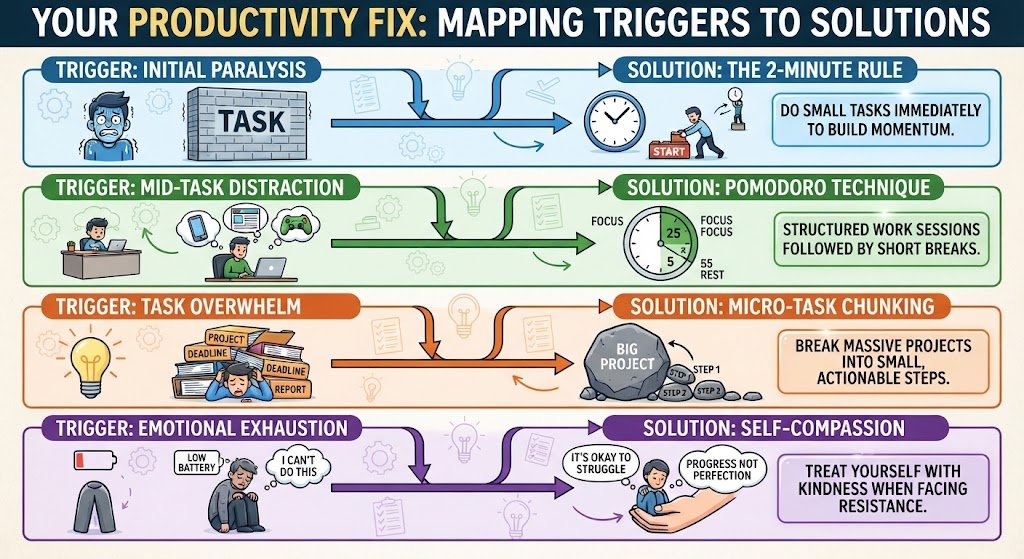
If You Freeze Before Starting -> Use the 2-Minute Rule
When the sheer thought of opening a document or facing a project causes total paralysis, you are experiencing the initial wall of resistance. The 2-Minute Rule solves this exact task avoidance trigger by shrinking the entry barrier down to an effortless commitment, bypassing your brain’s threat response entirely.
Low-Friction Entry: Agreeing to work for just 120 seconds removes the heavy psychological weight of a looming deadline.
Inertia Bypass: Once you cross the starting line, the physical momentum of doing the work naturally overrides your hesitation.
Actionable Execution: Use this method whenever you find yourself staring blankly at a screen, unable to take the first step.
If You Get Distracted Mid-Task -> Use the Pomodoro Technique
If your attention drifts to social media, random tabs, or minor chores halfway through an assignment, your focus stability is breaking down. The Pomodoro Technique tackles mid-task drift by enforcing rigid work-rest intervals that protect your attention span from mental fatigue.
Structured Boundaries: Twenty-five minutes of unbroken concentration keeps your mind locked onto a single objective.
Built-In Recovery: The mandatory five-minute break satisfies your brain’s craving for a dopamine hit without derailing your workflow.
Consistent Rhythm: Apply this strategy when you struggle to maintain sustained focus over long, open-ended stretches of time.
If the Task Feels Overwhelming -> Break It Down First
When a project looks like an insurmountable mountain of work, your prefrontal cortex gets overwhelmed and signals your body to seek comfort in distraction. Chunking the assignment transforms a massive, intimidating workload into a series of microscopic, manageable steps.
Granular Clarity: Replace vague, scary goals with specific physical actions that take less than five minutes to execute.
Reduced Cognitive Load: Smaller pieces require minimal emotional bandwidth to process and initiate.
Steady Momentum: Checking off micro-tasks delivers continuous dopamine boosts that keep self-doubt from creeping back in.
If You’re Emotionally Drained -> Lead with Self-Compassion
When emotional exhaustion, chronic stress, or harsh self-criticism leaves you completely depleted, standard productivity hacks will only make you feel worse. Practicing self-compassion addresses the emotional exhaustion directly, breaking the toxic guilt cycle that fuels long-term avoidance.
Shame Reduction: Forgiving yourself for past delays short-circuits the anxiety loop that makes you want to hide from your work.
Nervous System Regulation: Lowering emotional distress helps calm the limbic system so logical, execution-focused thinking can resume.
Gentle Recovery: Use this approach when you are running on empty and need to restore your mental baseline before attempting complex tasks.
Time Management Techniques for Students
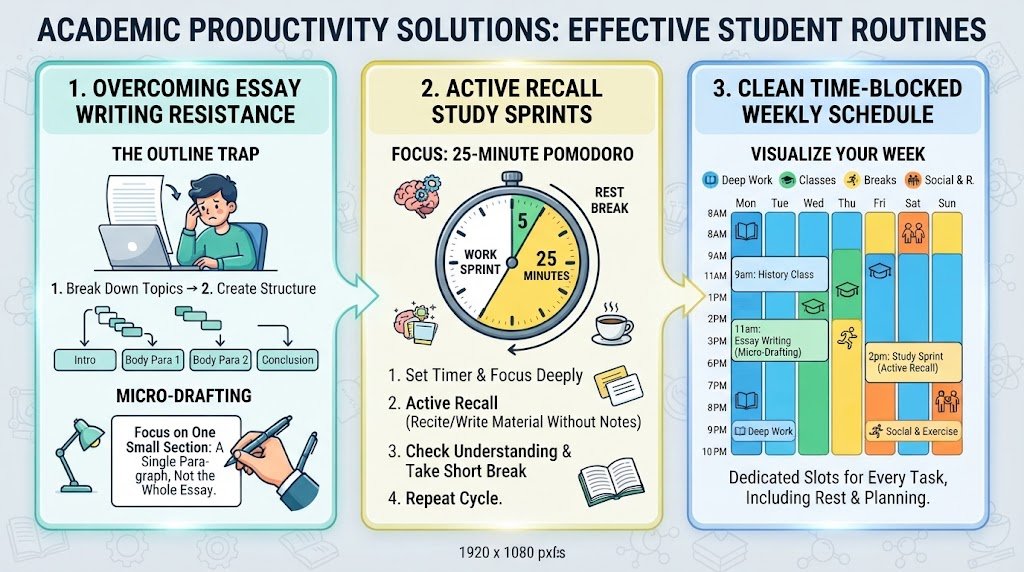
Beating Procrastination on Assignments and Essays
Academic procrastination typically stems from the overwhelming scope of writing prompts and the anxiety of meeting strict grading criteria. Overcoming academic avoidance requires shrinking major research papers and essay assignments down into microscopic, zero-pressure starting tasks.
The Outline Trap: Break down an intimidating essay prompt by writing a bulleted skeleton before touching a formal paragraph.
Micro-Drafting: Commit to typing just three messy sentences without editing to conquer the psychological weight of a blank page.
Deadline Chunking: Set internal submission targets three days ahead of actual school deadlines to eliminate panic-driven all-nighters.
Using the Pomodoro Technique for Study Sessions
Long hours of passive textbook reading quickly breed mental fatigue and cognitive boredom, leading straight to smartphone distraction. Alternating between twenty-five minutes of intense academic focus and five minutes of deliberate rest keeps attention sharp during long study blocks.
Active Recall Sprints: Dedicate your focus blocks exclusively to active study methods like flashcards, practice questions, or summarizing notes from memory.
Distraction Quarantine: Place your phone in another room or use a strict website blocker during every twenty-five-minute study interval.
Mental Recovery: Use the five-minute break to stretch, drink water, or walk away from your desk so your brain stays energized for the next cycle.
Building a Simple Weekly Study Schedule
Scattered study habits create constant anxiety about forgotten tests and uncompleted homework assignments. Constructing a predictable, time-blocked weekly framework ensures that schoolwork, test preparation, and personal rest receive dedicated space without constant decision fatigue.
Class-Block Mapping: Assign fixed afternoon slots for specific subjects rather than trying to study everything at once.
Weekly Review: Spend ten minutes on Sunday evening mapping out upcoming quizzes, reading chapters, and major project milestones.
Rest Integration: Schedule non-negotiable downtime and social breaks into your calendar to prevent academic burnout before exam season hits.
Time Management Techniques for the Workplace
Navigating professional environments requires distinct strategies because task avoidance at work is often masked behind busywork, endless meetings, and constant digital notifications. Overcoming professional deadline pressure depends on restructuring your day to protect deep focus time and eliminate administrative bottlenecks.
Overcoming Procrastination on High-Pressure Projects
High-stakes workplace projects frequently trigger performance anxiety, causing professionals to delay vital tasks by spending hours on low-impact emails or unnecessary organizing. Breaking massive deliverables down into rigid, scheduled milestones eliminates the intimidation factor and builds steady momentum.
Milestone Chunking: Divide major quarterly deliverables into daily sub-tasks that take under an hour to complete.
The First-Hour Rule: Tackle your most dreaded, high-value project during your peak morning energy window before checking incoming communications.
Accountability Anchors: Share specific daily progress targets with a colleague or manager to create external structure.
Time Blocking for a Distraction-Heavy Office Day
Open offices and relentless digital messaging destroy professional focus, turning short work intervals into fragmented chaos. Time blocking creates non-negotiable professional boundaries that shield your cognitive bandwidth from constant interruptions.
Protected Deep Work Slots: Reserve specific multi-hour blocks on your calendar strictly for high-concentration tasks without communication apps open.
Batching Communications: Group email checking and team messaging responses into designated two-to-three-times-a-day windows.
Context-Shielding: Turn off non-essential desktop notifications to prevent reactive task-switching during focus intervals.
How to Stop Procrastinating on Emails and Admin Tasks
Low-friction administrative tasks and routine correspondence often cause deep procrastination because they feel tedious and unrewarding. Establishing strict time limits transforms these minor chores from all-day distractions into quick, controlled operations.
The Ten-Minute Sprint: Set a timer for ten minutes and clear as many quick administrative items as possible before the alarm sounds.
Batch Processing: Group routine tasks like expense reporting or scheduling into a single weekly operational block.
Friction Reduction: Keep templates ready for standard responses to cut down the mental energy required for routine communication.
Watch this quick technique in action
Quick Summary Table — All Techniques at a Glance
| Technique | Best For | How Long It Takes |
| The 2-Minute Rule | Overcoming initial paralysis and starting dreaded tasks | 2 minutes |
| The 5-Minute Rule | Building immediate momentum with low-risk commitment | 5 minutes |
| The Pomodoro Technique | Maintaining focus and avoiding burnout during long work blocks | 25 minutes (plus 5-minute break) |
| Task Breakdown / Chunking | Tackling massive, overwhelming projects that cause avoidance | Varies (micro-steps under 5 minutes) |
| Self-Compassion Practice | Reversing the shame-avoidance cycle after missing deadlines | Ongoing mindset shift |
| The 3-3-3 Rule | Capping daily output into manageable focus, support, and maintenance buckets | Whole day structure |
| The 5-4-3-2-1 Rule | Rapidly snapping the brain out of acute anxiety and distraction loops | Under 1 minute |
| The 7-8-9 Rule | Balancing work, sleep, and personal life at a macro level | 24-hour daily structure |
| The 5 P’s Framework | Laying proper preparation and structural groundwork before executing | Preparation phase |
| The 4 P’s Framework | Streamlining priorities and energy management for daily tasks | Ongoing planning |
| Elon Musk’s Time-Blocking | Eliminating open-ended schedules with rigorous micro-compartments | Granular schedule blocks |
Frequently Asked Questions
What are 7 ways to overcome procrastination?
Overcoming procrastination relies on managing emotional friction and breaking down mental resistance rather than just organizing your schedule. Implementing targeted behavioral strategies can quickly restore your momentum.
The 2-Minute Rule: Commit to working on any dreaded task for just 120 seconds to bypass initial paralysis.
The 5-Minute Rule: Set a physical timer for a brief sprint to trick your brain into a low-risk start.
The Pomodoro Technique: Alternate twenty-five minutes of focused work with five minutes of rest to prevent mental fatigue.
Micro-Tasking: Break massive, intimidating projects down into tiny, manageable steps that take under five minutes.
Self-Compassion: Replace harsh self-criticism with tactical kindness to break the toxic guilt-avoidance cycle.
The 5-4-3-2-1 Rule: Use a rapid sensory countdown to snap your brain out of acute anxiety and distraction loops.
Time Blocking: Assign strict, non-negotiable compartments on your calendar to eliminate open-ended decision fatigue.
How to solve poor time management?
Solving poor time management requires shifting away from chaotic multitasking and adopting structured frameworks that protect your focus and energy. Fixing your schedule starts with establishing clear boundaries and systematic planning habits.
Prioritize Ruthlessly: Isolate your core objectives using frameworks like the 3-3-3 rule to focus on high-impact deliverables first.
Batch Administrative Tasks: Group low-friction chores like emails and messaging into designated daily windows.
Eliminate Distractions: Turn off non-essential notifications and isolate your workspace to protect your cognitive bandwidth.
Audit Your Time: Track how your hours are actually spent to identify hidden leaks and emotional avoidance triggers.
What is the most powerful time management technique?
The most powerful time management technique is the one that directly targets your specific productivity bottleneck, whether that is starting a task, maintaining focus, or avoiding burnout. Because procrastination is fundamentally an emotional regulation problem, strategies that lower psychological friction—such as the 2-Minute Rule and structured time blocking—tend to yield the highest long-term results.
For Initial Paralysis: The 2-Minute Rule delivers the fastest results by shrinking the entry barrier to an effortless commitment.
For Sustained Focus: The Pomodoro Technique provides the best balance of output and recovery to protect against mental exhaustion.
For Complex Planning: Time blocking offers total operational clarity by leaving zero open-ended room for indecision.
How does procrastination affect your time management?
Procrastination destroys time management by introducing acute stress, erratic schedule compression, and chronic decision fatigue into your daily routine. When avoidance behaviors push important tasks to the last minute, your carefully planned schedule collapses into panic-driven execution.
The Scramble Effect: Pushing work off creates artificial crunches that force rushed, low-quality output.
The Guilt Feedback Loop: Missing self-imposed deadlines generates emotional baggage that makes the next task feel even harder to start.
Cognitive Depletion: Constantly thinking about unfinished obligations drains the mental energy required for strategic planning.