Why "Laziness" Is the Wrong Word
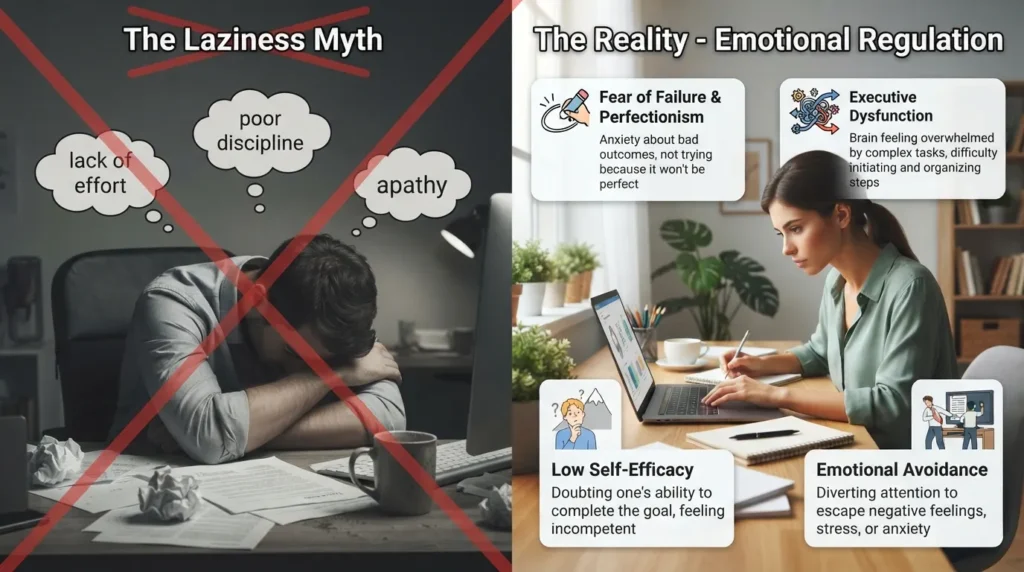
Feeling completely stuck on a task isn’t a character flaw or a sign of poor discipline. What most people diagnose as laziness is actually a predictable psychological response to overwhelm, unclear goals, or friction in your environment.
When you struggle to start, your brain isn’t refusing to work—it is actively trying to protect you from perceived complexity, failure, or discomfort. By replacing the label of “laziness” with an understanding of momentum and friction, you can break the loop of task avoidance and consistently take action without relying on willpower.
What This Article Will Help You Do Today
This guide provides a practical, science-backed framework to bypass resistance and build instant momentum. Instead of waiting for motivation to strike, you will learn how to set up immediate triggers that make taking action easier than standing still.
Here is what you will accomplish by following this framework:
Deconstruct Task Avoidance: Identify the real psychological triggers—like low task clarity or high effort perception—that stop you before you start.
Lower Friction Instantly: Use actionable micro-steps to reduce cognitive load and bypass the brain’s natural resistance to effort.
Build Lasting Momentum: Shift your focus from waiting for emotional readiness to taking small, repeatable actions that generate real progress.
Quick Answer Box: The 5-Minute Rule
The 5-Minute Rule: Commit to working on your target task for just five minutes with absolute permission to stop when the timer ends.
This technique works because the hardest part of any activity is crossing the initial friction threshold. Once you begin, the psychological barrier drops, and natural momentum carries you forward over 80% of the time.
How to Execute It Right Now:
Define the Micro-Action: Pick the absolute smallest starting step (e.g., open a blank document, clean one dish, write one sentence).
Remove Secondary Friction: Close irrelevant browser tabs, put your phone out of sight, and isolate the single task in front of you.
Set a Timer for 5 Minutes: Focus exclusively on making progress until the alarm rings.
Evaluate at the Mark: When time is up, assess your state. If momentum has taken over, keep going; if resistance persists, step away guilt-free knowing you broke the paralysis.
Laziness vs. Procrastination — Why They Are Not the Same Thing
Feeling completely stuck on a task isn’t a character flaw or a sign of poor discipline. What most people diagnose as laziness is actually a predictable psychological response to overwhelm, unclear goals, or friction in your environment.
When you struggle to start, your brain isn’t refusing to work—it is actively trying to protect you from perceived complexity, failure, or discomfort. By replacing the label of “laziness” with an understanding of momentum and friction, you can break the loop of task avoidance and consistently take action without relying on willpower.
What This Article Will Help You Do Today
This guide provides a practical, science-backed framework to bypass resistance and build instant momentum. Instead of waiting for motivation to strike, you will learn how to set up immediate triggers that make taking action easier than standing still.
Here is what you will accomplish by following this framework:
Deconstruct Task Avoidance: Identify the real psychological triggers—like low task clarity or high effort perception—that stop you before you start.
Lower Friction Instantly: Use actionable micro-steps to reduce cognitive load and bypass the brain’s natural resistance to effort.
Build Lasting Momentum: Shift your focus from waiting for emotional readiness to taking small, repeatable actions that generate real progress.
Quick Answer Box: The 5-Minute Rule
The 5-Minute Rule: Commit to working on your target task for just five minutes with absolute permission to stop when the timer ends.
This technique works because the hardest part of any activity is crossing the initial friction threshold. Once you begin, the psychological barrier drops, and natural momentum carries you forward over 80% of the time.
How to Execute It Right Now:
Define the Micro-Action: Pick the absolute smallest starting step (e.g., open a blank document, clean one dish, write one sentence).
Remove Secondary Friction: Close irrelevant browser tabs, put your phone out of sight, and isolate the single task in front of you.
Set a Timer for 5 Minutes: Focus exclusively on making progress until the alarm rings.
Evaluate at the Mark: When time is up, assess your state. If momentum has taken over, keep going; if resistance persists, step away guilt-free knowing you broke the paralysis.
Laziness vs. Procrastination — Why They Are Not the Same Thing
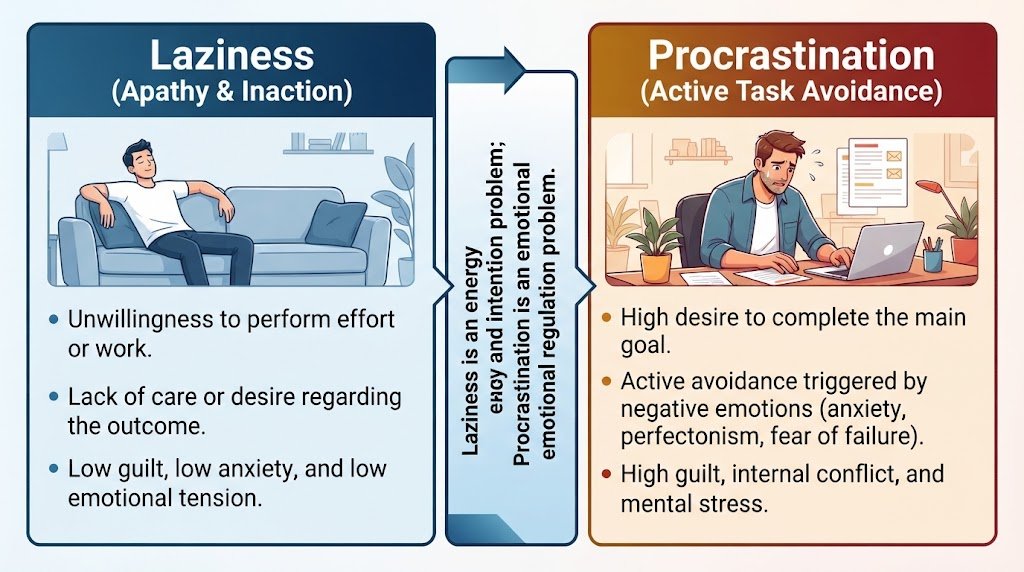
Lumping laziness and procrastination into the same category is the primary reason most productivity advice fails. While both result in unfinished tasks, their underlying psychological mechanisms, emotional states, and physiological triggers are fundamentally different.
Conflating the two leads people to apply willpower solutions to emotional regulation problems, which only deepens paralysis and task avoidance.
What Laziness Actually Means (A Trait vs. A State)
Laziness is defined by an absolute lack of desire or intention to take action. When someone is in a lazy state, there is no internal conflict, guilt, or cognitive tension regarding the undone task—they simply do not care to expend the required energy.
True laziness stems from a low motivation baseline or deliberate disinterest, rather than an underlying psychological block.
Absence of Intent: There is no active goal setting or intention to perform the task.
Zero Psychological Distress: A person experiencing laziness feels comfortable with inaction and experiences no anxiety or guilt about the outcome.
Low Cognitive Friction: The individual is not fighting an internal battle; they have made a passive choice to conserve effort.
What Procrastination Actually Means (An Emotional Regulation Problem)
Procrastination is the active, voluntary delay of an intended task despite knowing that the delay will lead to negative consequences. Contrary to popular belief, procrastination is not a time-management flaw; it is a primary emotional regulation issue.
When you procrastinate, you possess the intent to work, but your brain prioritizes short-term mood repair over long-term goals to avoid uncomfortable emotions associated with the task.
The Procrastination Cycle:
1. Perceived Task Trigger
(Anxiety, Confusion, Perfectionism)
↓
2. Short-Term Mood Repair
(Brain seeks immediate relief)
↓
3. Avoidance Behavior
(Organizing, Scrolling, Displaced Tasks)
↓
4. Guilt & Heightened Anxiety Cycle
Procrastination is driven by specific emotional avoidance triggers:
Fear of Failure or Perfectionism: Delaying the task protects your self-esteem from potential judgment or sub-par output.
Task Aversion: The assignment evokes immediate feelings of boredom, confusion, or overwhelming complexity.
Low Self-Efficacy: A temporary lack of confidence in your ability to execute the task effectively.
Why This Distinction Changes How You Fix It
Treating procrastination as laziness causes people to rely on aggressive discipline, self-criticism, or forced time-blocking. Because procrastination is fueled by negative emotions like anxiety and self-doubt, adding self-directed anger only increases the emotional threat, guaranteeing further avoidance.
Fixing procrastination requires shifting from forced willpower to emotional and operational friction reduction.
| Diagnostic Factor | Laziness | Procrastination |
| Primary Root Cause | Lack of interest or motivation | Emotional dysregulation & anxiety |
| Internal Experience | Unbothered, relaxed | Stress, guilt, cognitive overload |
| Intent to Act | Absent | Present, but blocked |
| Effective Solution | Incentivization & value alignment | Micro-stepping & lowering task friction |
When you accept that procrastination is an avoidance behavior driven by uncomfortable feelings rather than poor character, you can stop fighting yourself. You move away from forcing effort and begin systematically dismantling the emotional and cognitive friction holding you back.
Why Do We Actually Procrastinate? (The Root Causes)
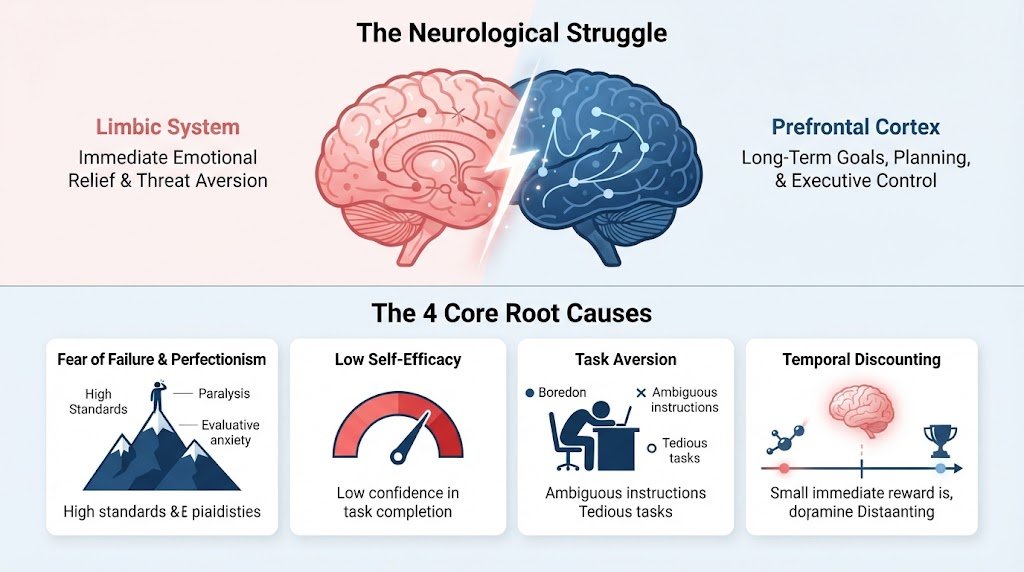
Procrastination is rarely a sign of laziness or poor time management. At its core, procrastination is a physiological and psychological defense mechanism designed to protect your brain from negative emotions, cognitive overload, or perceived social threats.
When a task triggers feelings of anxiety, uncertainty, or dread, your brain treats that task as an emotional threat and automatically triggers avoidance behavior to preserve your immediate well-being.
The Fear-Based Root: Perfectionism, Failure, and Judgment
The most pervasive driver of task avoidance is fear. High achievers frequently suffer from severe procrastination because their self-worth is tightly coupled with the quality of their output.
When the standards you set for a project are unrealistically high, starting the task exposes you to the risk of coming up short.
Perfectionism and High Standards: Expecting flawless results creates immense cognitive friction, making the act of starting feel impossibly high-stakes.
Fear of Judgment: Delaying a project protects your ego. If you produce poor work under tight deadline pressure, you can blame the time constraint rather than your innate competence.
Fear of Failure: When the outcome of a task feels uncertain, your brain defaults to avoidance to prevent potential disappointment.
Is Procrastination a Form of ADHD?
While procrastination itself is a universal human behavior, chronic and debilitating task paralysis is one of the core symptoms of Attention-Deficit/Hyperactivity Disorder (ADHD). However, procrastination alone does not mean you have ADHD.
The distinction lies in the underlying neurological cause: standard procrastination is primarily an emotional regulation issue, whereas ADHD-related procrastination stems from executive dysfunction and lower baseline dopamine regulation.
Diagnostic Distinction: Standard Procrastination vs. ADHD Paralysis
Chronic Task Avoidance Trigger
├── Standard Procrastination
• Driven by emotional avoidance and anxiety
• Rooted in fear of failure and perfectionism
• Temporary mood repair mechanism
└── ADHD-Based Paralysis
• Caused by executive dysfunction
• Linked to low baseline dopamine levels
• Accompanied by severe working memory deficits and task initiation friction
For individuals with ADHD, starting a task requires overcoming a severe shortage of executive function capacity. According to clinical guidance from the National Institute of Mental Health, ADHD involves persistent patterns of inattention and impulsivity linked to executive function deficits that make task initiation, organization, and sustained effort significantly more difficult than average.
The Dopamine and Instant Gratification Trap
Your brain is hardwired to seek immediate rewards and minimize short-term effort. Activities like checking social media, organizing a desk, or clearing easy emails provide a quick hit of dopamine, offering immediate relief from task-induced anxiety.
This dynamic creates a destructive feedback loop:
Task Presentation: You face a complex, high-effort task with delayed rewards.
Emotional Discomfort: Your prefrontal cortex perceives the required cognitive load as uncomfortable.
Displaced Reward Seeking: You switch to a low-effort, high-dopamine alternative (e.g., scrolling or cleaning).
Behavior Reinforcement: Your brain registers the displacement activity as a successful relief strategy, reinforcing the procrastination loop for future tasks.
What Carl Jung Said About Procrastination
While psychoanalyst Carl Jung did not use the modern psychiatric term “procrastination,” his psychological framework provides profound insight into task avoidance. Jung attributed chronic hesitation and avoidance to the Shadow—the repressed, unacknowledged parts of our psyche—and resistance to the process of individuation.
Jung noted that when individuals avoid taking necessary action, they are often resisting the psychological growth and discomfort required to achieve full maturity. In Jungian psychology, avoiding a task represents a conflict between the conscious desire to achieve and an unconscious fear of confronting one’s own limitations, responsibility, or potential.
Self-Check: Which of These Causes Applies to You?
To break the cycle of task avoidance, you must first identify the exact trigger driving your paralysis. Use this rapid diagnostic checklist to evaluate your current state:
[ ] The Perfectionist: You refuse to start until you have the exact right conditions, perfect clarity, or an uninterrupted block of time.
[ ] The Overwhelmed: You want to do the work, but the project is so large or vague that you do not know the immediate first step.
[ ] The Dopamine Seeker: You continuously delay work in favor of low-effort, high-reward activities like social media, messaging, or checking news feeds.
[ ] The Fearful: You feel a heavy knot of anxiety when thinking about the task because you are worried about criticism, bad grades, or failure.
The Science — How Procrastination Rewires Your Brain
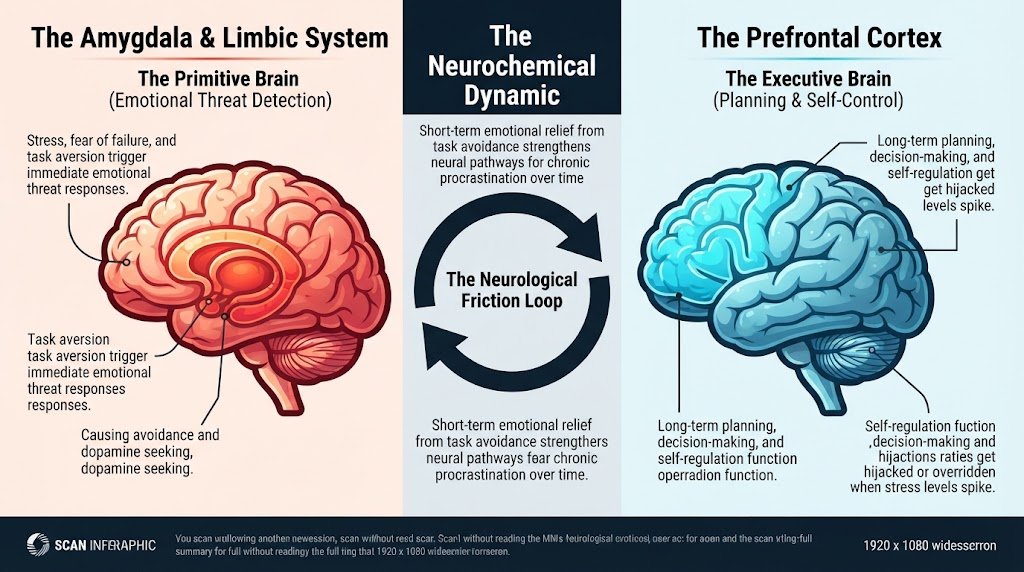
Chronic task avoidance is not an ideological failure or a flaw in character—it is a deeply ingrained neurobiological response. Every time you delay a difficult task in favor of immediate relief, you reinforce neural pathways that make future avoidance automatic.
Understanding how your brain perceives stress and forms habits is the key to interrupting the cycle and systematically retraining your mind for action.
The Brain’s Fight, Flight, or Freeze Response to Hard Tasks
When you encounter a complex project, a tight deadline, or an intimidating goal, your brain performs an immediate threat assessment. This assessment is managed by a direct tug-of-war between two main neurological systems:
The Amygdala (Emotional Alarm System): Detects perceived danger, uncertainty, or emotional discomfort. It treats cognitive load, potential failure, or boredom as a physical threat, triggering a subtle fight-or-flight stress response.
The Prefrontal Cortex (Executive Control Center): Responsible for long-term planning, decision-making, emotional regulation, and logical reasoning.
Neurological Battle in Procrastination:
Intimidating Task Trigger
├── Amygdala Activation (Threat Response)
• Detects emotional threat and uncertainty
• Triggers fear, stress, and discomfort
• Seeks immediate mood repair and relief
└── Prefrontal Cortex Resistance (Executive Function)
• Tries to enforce logical reasoning
• Manages long-term goals and planning
• Struggles against high emotional friction
└── Outcome: High Friction & Task Avoidance (Freeze State)
When emotional discomfort overwhelms your executive system, the amygdala hijacks decision-making. The brain enters a “freeze” state regarding the task, prompting you to seek immediate relief through lower-threat activities like scrolling, cleaning, or checking notifications.
Why Physical Movement Resets Your Mental State
Attempting to think your way out of a mental freeze state rarely works because executive control is already compromised by the stress response. Changing your physical state is the fastest mechanism to signal safety to your nervous system and re-engage the prefrontal cortex.
Physical movement disrupts the physiological stress loop through immediate neurochemical shifts:
Lowers Stress Hormones: Brief physical movement reduces circulating cortisol and adrenaline produced by task-related anxiety.
Increases Cerebral Blood Flow: Standing up, stretching, or walking briskly increases oxygen and glucose delivery to the brain, restoring prefrontal cortex capacity.
Breaks the Motor Paralysis: Action precedes emotion. Completing a simple physical movement breaks the motor freeze state and prepares your nervous system for task initiation.
How to Rewire Your Brain to Stop Procrastinating
Brain plasticity—the ability of your central nervous system to alter its structure and functional organization—means that chronic procrastination is not permanent. You can rewire your neural pathways by hacking the classic habit loop: Cue → Routine → Reward.
When you procrastinate, the habitual loop operates on avoidance:
Old Habit Loop: Cue (Task Anxiety) → Routine (Displaced Distraction) → Reward (Temporary Relief).
To train the brain to stop avoiding effort, you must reconstruct this loop around micro-execution:
The New Neural Habit Loop:
Task Trigger (Cue): Experiencing initial anxiety, friction, or uncertainty.
Micro-Action (Routine): Taking an immediate, 2-minute initiation step to break resistance.
Dopamine Reward (Reward): Feeling internal validation and tracking visible progress.
The 3-Step Neural Rewiring Protocol:
Isolate the Cue: Identify the exact moment feelings of friction or hesitation arise when facing a task.
Substitute the Routine: Immediately replace the avoidance behavior with an absurdly small micro-action (e.g., opening a document or writing a single title).
Deliver the Reward: Give yourself immediate internal recognition or mark progress visually on a tracker. This releases dopamine upon starting rather than upon escaping, strengthening the neural pathway for task initiation over time.
The Proven Rules and Frameworks (Complete Breakdown)
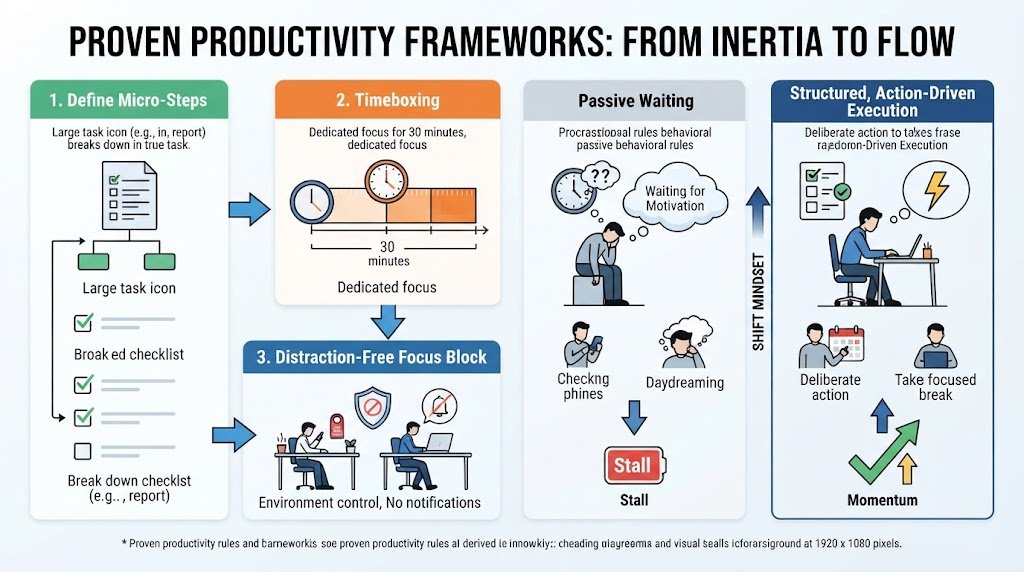
Overcoming task avoidance requires moving from passive intent to structural execution. Rather than relying on unpredictable spikes of motivation, top performers rely on clear, repeatable behavioral rules that drastically reduce starting friction.
The following science-backed frameworks systematically eliminate cognitive load, bypass emotional hesitation, and trigger immediate action.
The 5-Minute Rule
The 5-Minute Rule operates on the principle that task initiation is the single highest energy barrier in productivity. By making a psychological agreement with yourself to work on a task for just five minutes, you eliminate the threat of a massive, overwhelming project.
Once you cross the initial threshold of five minutes, the brain’s natural task-completion drive takes over, allowing momentum to sustain your focus.
Step-by-Step Execution Example:
The Scenario: You have been delaying a 2,000-word strategy document for three days due to overwhelm.
The Micro-Commitment: Tell yourself, “I only have to open the document and write for 5 minutes. If I want to stop when the timer rings, I am completely allowed to stop.”
The Execution: Set a kitchen or phone timer for 300 seconds and focus on writing anything, even rough bullet points.
The Result: In 80% of cases, the cognitive inertia disappears, and you continue working long after the timer expires.
The 5-4-3-2-1 Rule for Procrastination
Popularized by author Mel Robbins, the 5-4-3-2-1 Rule is a metacognitive tool designed to interrupt the brain’s instinct to hesitate, overthink, and avoid action.
When you feel an impulse to act on a goal or necessary task, your brain has a 5-second window before the prefrontal cortex creates excuses, fear, and rationalizations to keep you comfortable.
How to Apply It:
Recognize the Hesitation: The moment you catch yourself delaying a task (like getting out of bed, starting a draft, or sending an email).
Count Down Out Loud or Silently: Count 5 – 4 – 3 – 2 – 1.
Launch Physical Action: On “1”, move your body immediately toward the task. The physical action disrupts the habit loop of overthinking and forces brain engagement before hesitation takes root.
The 3-2-1 Rule for Procrastination
While the 5-second countdown interrupts overthinking, the 3-2-1 Rule is a rapid-fire variation specifically tailored for high-friction micro-decisions and physical inertia.
It works exceptionally well for clearing immediate micro-tasks that accumulate and create mental clutter throughout the workday.
How to Apply It:
Identify a quick, single-action task you are avoiding (e.g., making a phone call, standing up to stretch, closing distraction tabs).
Count down rapidly: 3… 2… 1…
Immediately execute the physical motion on “1” without evaluating how you feel about it.
The 70% Rule for Procrastination
The 70% Rule directly combats perfectionism—one of the primary emotional drivers of chronic delay. Originating from strategic decision-making models, this rule states that you should take action when you have roughly 70% of the information, clarity, or confidence you think you need.
Waiting for 90% or 100% certainty is simply perfectionism in disguise, leading to analysis paralysis and missed opportunities.
Key Decision-Making Zones:
0% to 69% (Inaction Zone): Insufficient clarity; gather minimal essential details to begin.
70% to 89% (Optimal Action Zone): High-momentum execution window; take action and course-correct as you progress.
90% to 100% (Perfectionism Trap): Diminishing returns; results in paralysis, loss of speed, and lost opportunities.
Why It Works:
Eliminates Analysis Paralysis: Reduces the cognitive strain of needing every variable mapped out before starting.
Prioritizes Execution Speed: Emphasizes course-correction through active feedback rather than passive planning.
Lowers Standards for Starting: Gives you permission to launch a rough draft or v1.0, knowing that refinement happens during the process, not before.
7 Japanese Techniques to Overcome Laziness
Japanese organizational and personal philosophy provides time-tested methods for dismantling resistance through gradual improvement, purposeful living, and environmental order.
Kaizen (Continuous Micro-Improvement): Focuses on making tiny, 1-minute improvements every day rather than demanding drastic change, eliminating the fear of overwhelming effort.
Ikigai (Discover Your Purpose): Aligning daily actions with your core values, skills, and contribution to ensure intrinsic motivation replaces forced effort.
Hansei (Self-Reflection Without Guilt): Conducting honest, non-judgmental reviews of past mistakes or missed deadlines to learn and optimize future execution.
Shoshin (Beginner’s Mind): Approaching tasks without rigid expectations or baggage, freeing yourself from the pressure of having to perform perfectly.
Hara Hachi Bu (Energy Conservation): Derived from the practice of eating until 80% full, this mindset encourages working at 80% capacity to prevent burnout and maintain steady, daily consistency.
Mottainai (Eliminating Waste): Reducing wasted time, fragmented attention, and physical clutter that drain cognitive energy.
Kanban (Visual Task Management): Organising work visually into clear stages (To Do, In Progress, Done) to reduce decision fatigue and clarify immediate priorities.
The 7 Steps to Cure Procrastination (A Complete Framework)
To systematically eliminate chronic task avoidance, follow this end-to-end operational framework:
Clarify the Outcome: Define precisely what “done” looks like in a single, concrete sentence to eliminate ambiguity.
Deconstruct to the Absolute First Step: Break the task down until the initial action takes less than two minutes to complete.
Remove Environmental Friction: Eliminate digital and physical distractions (e.g., put your phone in another room, close unnecessary tabs).
Set a Timebox: Allocate a fixed, uninterrupted 25-to-45-minute window dedicated exclusively to the task.
Use an Initiation Trigger: Execute the 5-4-3-2-1 countdown to bridge the gap between thinking and moving.
Focus on Process, Not Quality: Give yourself full permission to write messy code, draft bad sentences, or produce a rough outline on your first pass.
Track Progress Visually: Mark completion on a visual calendar or checklist to trigger a dopamine reward and reinforce the habit loop.
A Practical Daily System to Stop Procrastinating
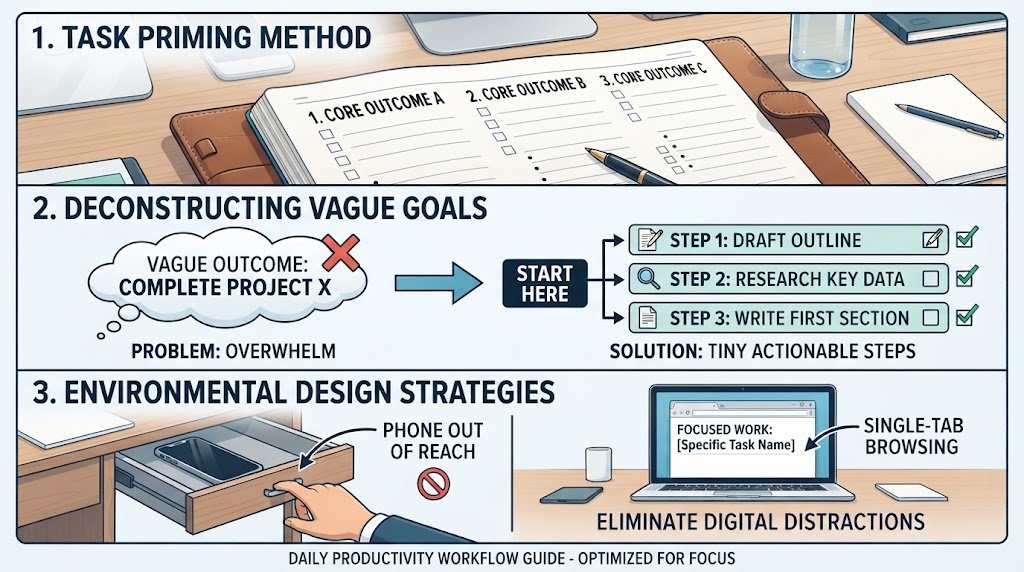
Moving from psychological theory to consistent output requires a repeatable, low-friction daily protocol. Relying on real-time decisions when energy is low creates immediate vulnerability to task avoidance and cognitive fatigue.
By structuring your environment and defining your actions in advance, you eliminate decision fatigue and build a self-sustaining system for daily momentum.
Plan the Night Before (The Task-Priming Method)
The human brain experiences severe decision fatigue in the early hours of the day if it faces a blank slate. Deciding what to work on requires heavy executive processing, which immediately triggers task avoidance before actual labor even begins.
Night-before planning leverages cognitive priming—a process where your subconscious mind organizes and processes upcoming tasks while you sleep.
Select Exactly 3 Core Outcomes: Limit your daily focus to three non-negotiable tasks. Anything more creates artificial overwhelm.
Isolate the Primary Task: Identify the single most important task (your “Frog”) that must be initiated first.
Prepare the Digital and Physical Assets: Open the required documents, lay out physical materials, and leave the target file active on your desktop before shutting down your computer.
Break Down Big Tasks Into Tiny Steps
A primary reason projects trigger paralysis is vagueness. Phrases like “write strategy document” or “prepare taxes” are not actionable steps; they are complex outcomes that overwhelm the prefrontal cortex.
To bypass resistance, deconstruct every outcome into a micro-action that requires zero emotional effort to initiate.
Example of Task Deconstruction:
Vague Outcome: “Write Quarterly Financial Report”
Concrete Step 1: Open a blank document and save it with the correct title.
Concrete Step 2: Paste the standard template headers into the document.
Concrete Step 3: Fill in the single Q3 revenue metric from the dashboard.
The Two-Minute Granularity Rule:
Never list an outcome as a task. Convert every item on your list into a direct verb (e.g., “Draft,” “Call,” “Export,” “Outline”).
Make the initial step ridiculously small. If you feel a wave of hesitation, break the step down further until resistance disappears completely.
Remove Distractions Before You Start
Distraction management is not a willpower exercise; it is an environmental design strategy. Trying to resist checking notifications while your phone sits next to your keyboard burns precious cognitive energy that should be directed toward high-value work.
Systematically eliminate friction triggers before you start your timebox:
Out of Sight, Out of Reach: Place your smartphone in another room or inside a drawer. Research demonstrates that the physical presence of a phone drains working memory even when turned upside down.
Enforce Digital Isolation: Use website and app blockers to temporarily restrict access to news, social media, and communication channels during focus sessions.
Single-Tab Protocol: Close all browser tabs unrelated to the immediate task. Every open tab represents an active cue for displaced attention.
A Real Example: How I Applied This to a Real Task
To demonstrate how this system functions under real-world conditions, consider how I tackled a severe case of task avoidance when drafting a complex, 4,000-word technical content strategy for a enterprise client.
For four consecutive days, I delayed starting the project because the sheer scope triggered perfectionism and cognitive paralysis. Here is how I deployed this exact protocol to break the deadlock:
Step 1: Night-Before Priming: At 6:00 PM the previous evening, I created a blank file named
Strategy_Draft_v1.docx, pasted the client’s brief directly into page one, and closed all other software.Step 2: Micro-Step Deconstruction: Instead of attempting to “write the strategy,” I set my initial target to simply “List 5 sub-headers based on the competitor research.”
Step 3: Pre-Emptive Friction Removal: I put my phone inside a physical lockbox in the living room and launched a website blocker for 45 minutes.
Step 4: The 5-Minute Trigger: I set a timer for five minutes with zero expectation of producing polished prose.
The Result: By lowering the starting bar to five simple sub-headers, the initial paralysis disappeared within two minutes. Once the structural outline was in place, natural momentum took over, and I completed over 1,200 words of the rough draft before taking my first break.
How to Stop Procrastinating While Studying (For Students)

Academic task avoidance operates differently than workplace procrastination. Students face an environment with distant deadlines, high evaluative anxiety, and continuous cognitive strain, making academic work uniquely susceptible to severe delay.
Overcoming study paralysis requires replacing passive, marathon study sessions with active, high-intensity focus blocks that reduce exam anxiety and cognitive fatigue.
Why Students Procrastinate Differently
Unlike structured office environments with daily deliverables, academic environments require students to self-regulate across weeks or months. This structural ambiguity creates specific psychological pressures that drive task avoidance:
Evaluative Anxiety and Exam Pressure: Academic output is directly graded and tied to self-worth, future career prospects, and parental expectations. When the perceived stakes are high, avoiding studying becomes a defense mechanism against confronting potential failure.
The Illusion of Distant Deadlines: Semesters are structured around major milestones weeks away. The human brain struggles to register distant consequences, prioritizing immediate comfort over long-term preparation until panic sets in.
Vague Learning Goals: Assignments like “study for biology” lack concrete endpoints, causing severe cognitive friction when deciding where or how to begin.
The Pomodoro Method for Study Sessions
The Pomodoro Technique is one of the most effective tools for students because it shifts focus from the daunting outcome of mastering an entire syllabus to simply managing time intervals.
By breaking work into short, timeboxed intervals, you eliminate the cognitive dread of endless study hours.
The 4-Step Pomodoro Cycle:
Set a Single Study Goal: Choose one specific micro-task (e.g., read 3 textbook pages or solve 2 past paper questions).
Work for 25 Minutes: Maintain 100% focus until the timer goes off.
Take a Mandatory 5-Minute Break: Step away from your workspace and screens to let your mind rest.
Repeat and Rest: Complete 4 cycles, then take a longer 15-to-30-minute break.
Why It Works for Academic Tasks:
Lowers Initiation Friction: Committing to 25 minutes feels manageable, even when facing an intimidating textbook chapter.
Prevents Cognitive Fatigue: Short, regular breaks prevent mental burnout and help maintain consistent retention across long sessions.
Encourages Active Recall: Use each 25-minute block to test yourself or summarize key concepts rather than passively highlighting text.
Creating a Distraction-Free Study Environment
Willpower is a finite resource that deteriorates rapidly during intense study sessions. Relying on self-control while sitting next to high-dopamine distractions guarantees eventual study paralysis.
Designing a dedicated physical and digital study space automates focus and removes friction:
Separate Study and Relaxation Zones: Never study in bed or in areas associated with leisure. Establishing a dedicated study desk trains your brain to associate that specific physical space with immediate focus.
Enforce Out-of-Sight Phone Storage: Place your smartphone in a separate room or inside your backpack during study blocks. Simply having a phone on your desk—even turned face down—drains working memory capacity.
Pre-Load All Required Materials: Before starting your timer, gather all necessary textbooks, notebooks, lecture slides, and pens. Searching for missing notes mid-session breaks state and invites distraction.
Use Ambient Instrumental Audio: Eliminate background noise using white noise, brown noise, or instrumental music without lyrics to maintain stable attention.
Shifting Your Mindset for Long-Term Change

Tactical strategies and productivity frameworks provide the initial momentum, but long-term freedom from chronic task avoidance requires a fundamental mindset shift. Relying exclusively on rigid rules without addressing your underlying self-talk creates internal resistance, making relapse into avoidance inevitable.
Building a sustainable, highly productive workflow depends on rewiring how you define success, cultivate discipline, and treat yourself when hesitation strikes.
Progress Over Perfection: Finish Badly, Not Never
Perfectionism is a primary driver of paralysis because it frames any output below an impossible standard as an outright failure. This binary mindset—believing a draft must be brilliant or not exist at all—creates immense cognitive friction that stops action before it begins.
Adopting a “progress mindset” means giving yourself explicit psychological permission to produce lower-quality v1.0 drafts.
Lower the Initial Quality Bar: Embrace the concept of a “rough first pass.” A bad draft can be edited, revised, and polished; a blank page offers zero material to improve.
Separate Production from Editing: Never attempt to generate content and critique it simultaneously. Write or execute first with full momentum, then return later with a critical lens.
Measure Velocity, Not Polish: Shift your definition of daily success from how perfect the work is to how quickly you bridged the gap between thinking and initiating.
Discipline vs. Motivation — Why Waiting to “Feel Like It” Fails
One of the most dangerous productivity myths is the belief that action must be preceded by emotional readiness or a surge of inspiration. Waiting until you “feel like” tackling a hard, complex task guarantees inconsistent output because baseline motivation fluctuates naturally based on sleep, stress, and mood.
True discipline is not the suppression of hesitation; it is the capacity to act alongside uncomfortable feelings.
The Difference Between Passive and Active Execution:
The Passive Trait Loop (Fails): Waiting for Motivation → Hesitation & Delay → Guilt & Inaction
The Active Discipline Loop (Succeeds): Physical Action → Visible Progress → Generated Motivation
Key Implementation Principles:
Action Precedes Emotion: Motivation is a byproduct of progress, not a prerequisite. Taking an initial 2-minute physical action generates the momentum that produces emotional readiness.
Decouple Feeling from Execution: Acknowledge task aversion without obeying it. You can feel bored, anxious, or unmotivated and still execute the required action.
Build Repeatable Systems: Rely on daily routines, timeboxing, and environmental triggers rather than emotional desire to dictate when high-value work begins.
Self-Compassion: Why Being Kind to Yourself Actually Works Better
When people fall into task avoidance, their default response is often harsh self-criticism, shame, or forced self-punishment. However, psychological research demonstrates that self-flagellation increases anxiety and shame, which directly triggers the brain’s emotional threat system and drives further avoidance.
Self-compassion is not self-indulgence or making excuses; it is an active emotional regulation strategy that removes the paralyzing weight of shame.
Break the Shame-Procrastination Loop: Forgiving yourself for past delays lowers emotional stress, making it significantly easier to re-engage with the task at hand.
Normalize Human Resistance: Recognize that feeling resistance to difficult, complex, or tedious work is a natural human reaction—not a character flaw or a sign of weakness.
Shift to Constructive Self-Talk: Replace critical statements like “I am so lazy and behind” with objective, action-oriented prompts like “I feel overwhelmed right now, so what is the absolute smallest step I can take in the next 5 minutes?”
Frequently Asked Questions (FAQ)
Consolidated answers to common questions regarding task avoidance, cognitive momentum, and academic focus.
What Is Procrastination?
Procrastination is the voluntary delay of an intended task despite knowing that the delay will result in negative consequences. It is primarily an emotional regulation issue rather than a time management problem, where the brain avoids the uncomfortable emotions—such as anxiety, boredom, or self-doubt—associated with a specific task.
How to Remove Laziness From Body and Mind?
Removing physical and mental lethargy requires optimizing both physiological state and environmental cues:
- Optimize Physical Fundamentals: Prioritize 7 to 8 hours of quality sleep, maintain adequate hydration, and engage in brief physical movement to raise heart rate and alertness before beginning work.
- Lower the Activation Energy: Reduce task friction by committing to work for just two minutes. Physical action triggers dopamine release, which quickly clears mental fog and builds momentum.
- Eliminate Cognitive Overload: Clear physical clutter and reduce choices by deciding on your primary focus task the night before.
How to Train Your Brain to Stop Procrastinating?
Brain training for consistent action relies on rewiring neural pathways through deliberate, repeatable habits:
- Practice Micro-Commencing: Regularly practice starting tasks for tiny intervals (e.g., 5 minutes) without forcing completion. This desensitizes the limbic system to task threat.
- Implement Implementation Intentions: Use explicit "If-Then" planning (e.g., "If it is 9:00 AM, then I sit at my desk and open my study notes"). This automates task initiation.
- Strengthen the Prefrontal Cortex: Engage in structured focus intervals like timeboxing or the Pomodoro technique to gradually build your mental focus span over time.
What's the Best Way to Overcome Laziness on Studies?
Overcoming study avoidance requires shifting from passive reading to structured, low-friction learning methods:
- Use the Pomodoro Technique: Break study sessions into manageable 25-minute focus intervals followed by 5-minute restorative breaks to avoid cognitive burnout.
- Deconstruct the Syllabus: Replace vague targets like "study physics" with concrete, verb-driven actions like "solve 3 practice problems from Chapter 1."
- Design a Friction-Free Environment: Keep your phone out of sight in another room and prepare all study materials on your desk before starting your session.
Mark Steve
Mark Steve is a tech, business, and lifestyle writer with over 5 years of experience analyzing digital trends, startups, and online business models. He publishes well-researched, fact-checked content focused on clarity, credibility, and real-world value.