What Causes Procrastination in Kids? (It's Not Laziness)
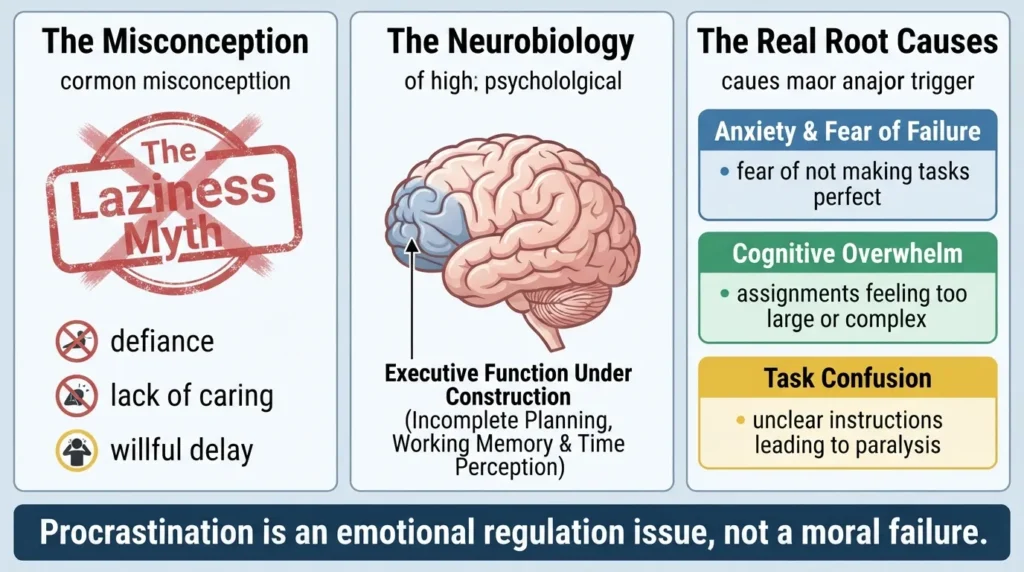
Procrastination in children is almost never a character flaw or a deliberate refusal to work. It is a protective coping mechanism triggered when a task exceeds a child’s current capacity for emotional regulation, executive processing, or stress management.
When a child repeatedly delays starting their homework, cleaning their room, or studying for a test, they are not choosing to be rebellious. They are escaping negative emotions associated with the task, such as fear of failure, confusion about where to begin, or feeling overwhelmed by the sheer scope of the assignment.
Why “Just Lazy” Is the Wrong Diagnosis
Labeling a child as “lazy” misdiagnoses a cognitive and emotional challenge as a moral failure. “Laziness” implies an absence of motivation and a lack of care about the outcome, whereas children who procrastinate often care deeply—sometimes to a fault.
The Perfectionism Trap: Many children delay starting a project because they are terrified of not doing it perfectly. The anxiety of potentially failing outweighs the motivation to complete the task.
The Misinterpretation of Avoidance: Parents often perceive task avoidance as defiance, but the child is actually attempting to regulate an overwhelming internal state.
The Energy Burnout: School demands constant focus, social navigation, and sensory processing. What looks like laziness after school is frequently legitimate mental and emotional exhaustion.
By framing procrastination as a skill deficit rather than a behavioral issue, you shift the approach from punishment to targeted skill-building.
The Real Root Causes — Anxiety, Overwhelm, and Confusion
Procrastination is an emotional regulation problem, not a time management failure. When a child looks at a task and experiences negative emotions, their brain instinctively pushes the task away to secure immediate relief.
Anxiety and Fear of Failure: High-stakes tasks or difficult subjects trigger a threat response in the brain. Postponing the task temporarily removes the uncomfortable anxiety.
Cognitive Overwhelm: When an assignment feels too complex, a child’s brain struggles to break it down. An instruction like “write a report” can feel like an impossible mountain to climb.
Lack of Clarity and Confusion: If a child does not fully understand the instructions or feels uncertain about the expected outcome, starting becomes intimidating. Delaying the task avoids facing that confusion.
Low Frustration Tolerance: Younger children and young adolescents are still developing the ability to sit through discomfort or boredom, leading them to prioritize immediate rewards over long-term goals.
How Kids’ Brains Process Tasks Differently Than Adults’
The key to understanding childhood task avoidance lies in executive function development. Executive functions are the brain-based cognitive skills managed by the prefrontal cortex—the region responsible for planning, organizing, prioritizing, initiating tasks, and managing time.
The prefrontal cortex is the last area of the human brain to fully mature, continuing its development well into a person’s mid-twenties. Expecting a child to manage complex tasks with adult-level efficiency ignores basic neurobiology.
Adults use established neural pathways to estimate time, break projects into steps, and self-regulate through boredom. In contrast, a child’s brain processes these demands with several distinct developmental limitations:
Weak Working Memory: Children struggle to keep multi-step directions in mind simultaneously, leading to quick overwhelm.
Impaired Time Perception (Time Blindness): Children live primarily in the present. Abstract concepts like “due next Friday” hold little psychological weight until the deadline becomes immediate.
Underdeveloped Impulse Control: The emotional brain (limbic system) matures faster than the logical brain (prefrontal cortex), making immediate distractions exponentially harder to resist.
Is It Normal Procrastination or a Sign of Something Else?
While occasional task avoidance is a universal part of growing up, chronic procrastination can sometimes indicate underlying neurodivergence or a formal mental health condition.
Use this decision guide to evaluate whether your child’s behavior falls within typical developmental boundaries or warrants further support:
Typical Childhood Procrastination:
Occurs mainly with non-preferred or notoriously boring tasks (e.g., chores, studying for a tough subject).
The child can complete the work once an adult provides structural support, a deadline, or an incentive.
Does not cause severe emotional meltdowns, chronic school failure, or pervasive low self-esteem.
Task initiation improves noticeably when tasks are broken into tiny, manageable steps.
Potential Indicator of ADHD or Chronic Anxiety:
ADHD (Executive Dysfunction): The child genuinely wants to start the task but experiences severe “paralysis.” They display chronic struggles across multiple domains (school, home, routines), persistent forgetfulness, high distractibility, and extreme difficulty with self-starting even on activities they enjoy.
Clinical Anxiety: Procrastination is accompanied by physical symptoms (headaches, stomachaches before school), intense tearfulness, extreme perfectionism, or severe fear of making mistakes.
Learned Helplessness: The child has completely given up trying because past efforts consistently resulted in failure or criticism, leaving them feeling powerless.
If task avoidance is persistent, pervasive, and causing significant distress or academic decline, consult with a pediatrician, school counselor, or educational psychologist to explore potential executive function deficits or learning differences.
Age-by-Age Guide — What Actually Works at Each Stage
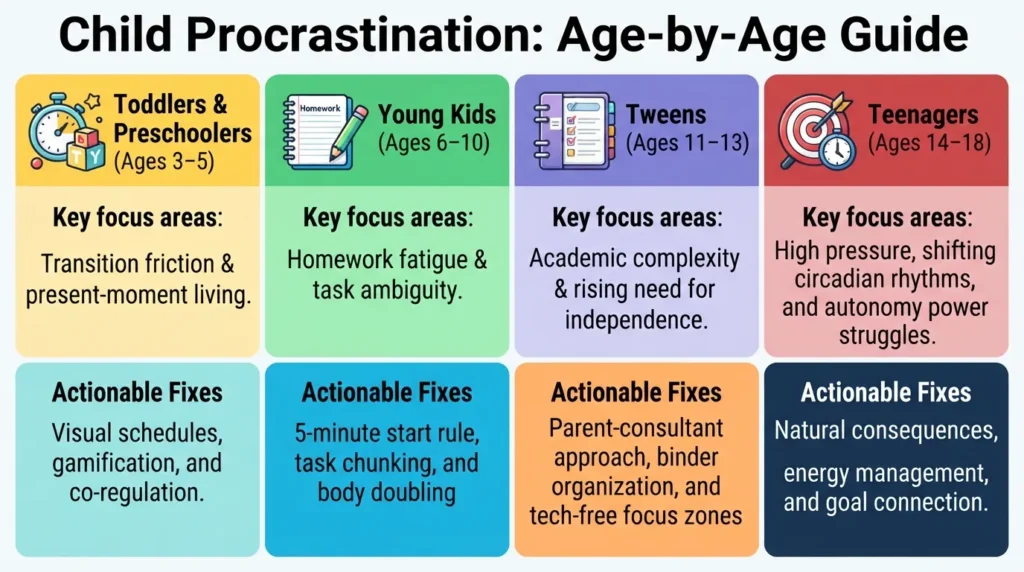
Children’s brains undergo massive shifts in executive function, self-regulation, and need for autonomy as they grow. Strategies that help a 5-year-old tidy up their toys will completely backfire on a 15-year-old struggling with research papers.
To effectively address task avoidance, interventions must match your child’s specific developmental stage. Framing expectations around what their brain can realistically process builds cooperation while reducing household friction.
Toddlers & Preschoolers (Ages 3–5): Why They Delay and What to Do
At this developmental stage, 4 year old procrastination or general toddler task resistance is almost never about work avoidance. Preschoolers live entirely in the present moment, meaning transition friction—switching from a high-dopamine activity like playing to a low-dopamine one like putting on shoes—feels physically painful to them.
Because their prefrontal cortex is just beginning to develop, young children lack time perception and struggle to self-initiate actions without external prompts.
Gamify Transitions: Turn mundane tasks into races or imaginary play (“Can we put all the red blocks away before the timer rings?”).
Use Visual Schedules: Replace verbal nagging with simple picture charts showing the step-by-step morning or bedtime routine.
Offer Choice Within Limits: Give them control over how a task gets done, not if it gets done (“Do you want to put on your jacket first, or your shoes?”).
Co-Regulate First: Instead of shouting instructions across the room, get down to their eye level, gently touch their shoulder, and perform the first step of the task together.
Young Kids (Ages 6–10): Homework and Chore Resistance
As children enter elementary school, structured demands increase dramatically. Homework procrastination and chore resistance peak during these years because schoolwork requires sustained cognitive effort after a long day of behavioral self-control.
At this age, procrastination usually stems from task ambiguity or feeling isolated during work time.
Implement the “5-Minute Start” Rule: Lower the barrier to entry by asking for just five minutes of effort. Once momentum is established, children usually continue.
Chunk the Assignments: Break a full worksheet into micro-steps. Cover the bottom half of the page with a sheet of paper so they only see two problems at a time.
Create Body Doubling Workspaces: Young kids often procrastinate because working alone feels like a punishment. Have them do homework at the kitchen counter while you prepare dinner.
Externalize Time: Use visual timers (like a Time Timer) so they can physically watch time pass, making deadlines tangible rather than abstract.
Tweens (Ages 11–13): Rising Independence and Pushback
Middle school introduces a sharp rise in academic complexity alongside a strong emotional shift toward peer connection and tween independence. Tweens experience higher levels of overwhelm due to managing multiple teachers, lockers, and long-term projects for the first time.
When adults micromanage at this stage, procrastination turns into a defensive shield to assert personal control.
Shift from Supervisor to Consultant: Offer guidance rather than direct orders (“What’s your game plan for finishing that history presentation by Thursday?”).
Separate Organization from Execution: Spend 10 minutes helping them organize their binder and plan the steps before they attempt to start writing or studying.
Establish Tech-Free Focus Zones: Social media and gaming apps are explicitly engineered to hijack developing reward pathways. Keep phones outside the study space during homework hours.
Validate the Frustration: Acknowledge their desire for freedom while holding boundaries (“I know it sucks to spend your afternoon studying, but getting it done now means your weekend is wide open.”).
Teenagers (Ages 14–18): Autonomy, Motivation, and Power Struggles
Teen procrastination is driven by high-stakes pressure, shifting sleep cycles, and a strong push for personal autonomy. High schoolers frequently face severe overwhelm from balancing academics, extracurriculars, and social dynamics.
Direct power struggles over teen motivation almost always fail. Teenagers need systems that help them internalize ownership of their obligations.
Focus on Natural Consequences: Stop playing the role of the safety net. Allowing a teenager to experience a low grade or a missed deadline often teaches time management far faster than parental nagging.
Respect Their Biological Rhythms: Circadian rhythms shift naturally during adolescence, making teens alert later at night. Allow them flexibility in when they study, provided the work gets completed.
Teach Energy Management, Not Just Time Management: Help them identify their peak focus windows (e.g., right after school versus after dinner) and schedule complex tasks for those periods.
Connect Tasks to Long-Term Goals: When teens understand how completing a current obligation connects directly to their personal choices—like getting into a desired college or securing a job—their internal drive increases significantly.
Practical, Step-by-Step Strategies That Reduce Procrastination
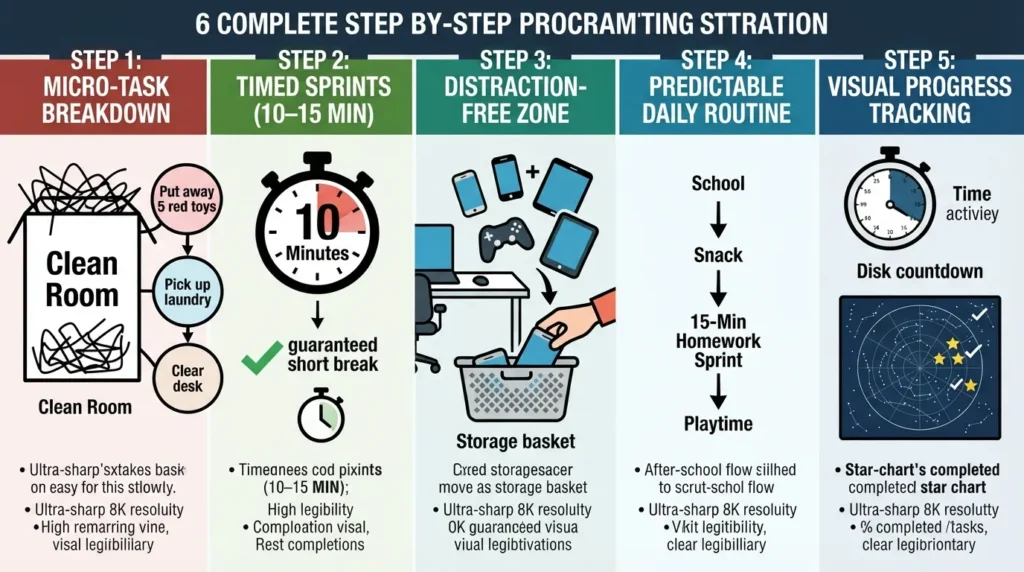
Overcoming childhood procrastination requires replacing vague expectations with low-friction, structured systems. When parents move away from broad commands and implement actionable frameworks, kids build the momentum needed to initiate and complete difficult tasks independently.
Implementing targeted interventions reduces friction at the starting line, allowing children to bypass initial resistance and develop sustainable habits over time.
Break Big Tasks Into Tiny, Specific Steps
The single primary trigger for task avoidance is cognitive overload. When a child hears a massive, multi-step command, their brain registers it as an insurmountable hurdle, causing them to freeze or pivot to an easier activity.
To fix this, implement micro-steps by converting broad goals into ultra-specific, physical actions:
Vague Command: “Clean your room.”
Micro-Step Breakdown:
Pick up 5 red toys off the floor and drop them in the bin.
Put all dirty clothes into the hamper.
Clear off the top of the desk.
Applying this task breakdown to schoolwork follows the exact same logic. Instead of telling a middle schooler to “study for science,” direct them to “read page 42 and answer question number one.”
Use Timed Sprints (10–15 Minute Rule for Kids)
Asking a child to focus indefinitely creates mental resistance. Timed sprints leverage the power of finite constraints, convincing the brain that the effort required is brief and manageable.
The 10-to-15-minute rule sets a clear end point that lowers anxiety and makes starting significantly easier:
Set the Rules: Agree on a short, uninterrupted focus window (10 minutes for ages 5–9; 15 minutes for ages 10+).
Give Complete Permission to Stop: Inform the child that once the timer rings, they have unconditional permission to stop working and take a break.
Capitalize on Momentum: Over 80% of the time, once a child pushes past the initial 5-minute threshold of task initiation, they choose to keep working past the timer because momentum has replaced their initial anxiety.
Remove Distractions Before Work Begins
Executive functioning limitations make it nearly impossible for kids to ignore high-dopamine triggers like tablets, gaming consoles, or smartphones when trying to complete low-dopamine obligations. Expecting willpower alone to overcome these temptations is unrealistic.
Proactive distraction removal creates an environment engineered for focus:
Establish a Clean Workstation: Keep study spaces clear of irrelevant toys, extra devices, and chaotic clutter before the task begins.
Centralize Digital Devices: Collect all phones, tablets, and gaming controllers during work windows, storing them in a separate room.
Utilize App Blockers: For older children who require a laptop for research, use strict website blockers to limit access to social platforms, media channels, and online games.
Build a Predictable Daily Routine
Inconsistency breeds negotiation, power struggles, and delay tactics. When children do not know when work is expected of them, they treat every assignment as an unexpected interruption to their free time.
A predictable daily routine anchors habits into their natural rhythm:
Designate a Fixed Homework Routine: Establish a consistent study window every day—such as 30 minutes after arriving home from school—so the transition becomes automatic.
Schedule a Daily Reading Routine: Set aside a non-negotiable 15-minute reading slot right before bedtime, linking literacy habits to their nightly wind-down schedule.
Pair Work with Existing Anchors: Connect responsibilities directly to daily events (e.g., “After afternoon snack, we complete math worksheets”).
Use a Visual Timer or Progress Tracker
Children naturally experience time as an abstract concept, often leading to time blindness where deadlines feel distant right up until they cause panic. Transforming time into a visible, physical reality gives children a clear sense of pacing and progress.
In practical tests with visual tools, replacing standard clocks with disk-based visual timers (where a red slice slowly disappears as time elapses) drastically improves task adherence:
Visual Timers: A visual timer allows kids to physically see how much focus time remains without needing to perform mental calculations or track digital numbers.
Visual Progress Trackers: Use simple check-off charts or sticker boards where kids physically mark completed steps, giving their brain a immediate sense of achievement and encouraging them to keep going.
The "Rules" Everyone's Asking About — Do Adult Productivity Hacks Work on Kids?
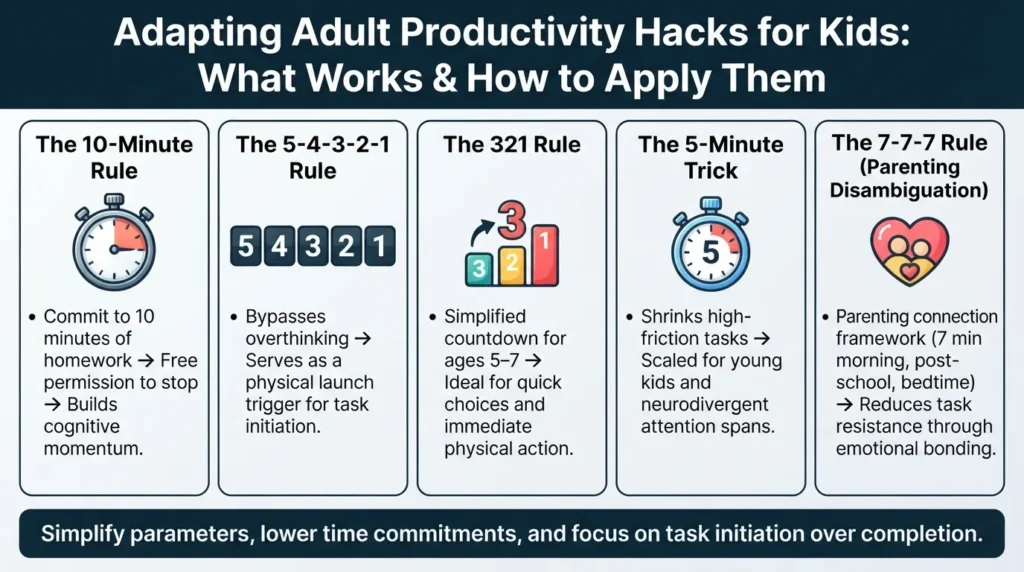
Popular productivity trends frequently spill over into parenting forums, leading parents to wonder if popular time-management formulas can solve childhood task avoidance. While adult productivity hacks are built for fully developed brains, many can be adapted effectively for children when simplified to match their developmental capacity.
Adapting these viral strategies into concrete, kid-friendly frameworks helps bridge the gap between abstract adult concepts and a child’s day-to-day routines.
What Is the 10-Minute Rule — and Does It Work for Kids?
The 10-minute rule is a cognitive momentum strategy designed to overcome initial task friction. It asks an individual to commit to working on a low-motivation task for just 10 minutes, with complete permission to stop once the timer elapses.
This rule works exceptionally well for children aged 8 and older because it removes the threat of endless effort:
Lowers Emotional Resistance: The child knows the discomfort is strictly time-limited, which reduces initial anxiety and overwhelm.
Leverages Cognitive Momentum: In practice, once a child passes the 3-to-5-minute mark, the brain gets past the initial friction, and they routinely choose to continue working until the assignment is done.
How to Apply It: Set a visible timer for 10 minutes and say, “Give this your full attention for 10 minutes. If you still want to stop when the bell rings, you can take a break—no arguments.”
The 5-4-3-2-1 Rule, Explained for Parents
Originating as a grounding technique for anxiety, Mel Robbins popularized the 5-4-3-2-1 countdown as a mechanism for initiating action. The rule directs you to count backward from 5 to 1 and physically move the moment you hit 1, interrupting the brain’s tendency to overthink or make excuses.
For kids, this serves as an effective physical trigger for task initiation, especially during challenging routine transitions:
Bypasses Hesitation: Counting backward requires focus from the prefrontal cortex, effectively cutting off the emotional brain’s impulse to delay.
Kid-Friendly Application: Use it as a fun, physical countdown for immediate actions like getting out of bed, closing a laptop, or picking up a backpack (“We count down 5-4-3-2-1, and on 1, we launch!”).
What Is the 321 Rule for Procrastination?
The 321 rule is a simplified variation of the countdown method, streamlined specifically for quick, low-complexity decisions. It instructs a person to identify a needed action, count “3, 2, 1,” and immediately start the physical movement required to execute it.
While similar to the 5-4-3-2-1 rule, the 321 rule is easier for younger children (ages 5 to 7) to grasp because the shorter count fits their rapid processing speed:
Identify the Micro-Action: Isolate the very first physical step (e.g., opening the math workbook, standing up to put away a plate).
Count Out Loud Together: Say “3, 2, 1” aloud with your child to create shared energy and momentum.
Launch the Action: Treat “1” like a starting gun, turning task initiation into an energetic, physical game rather than a battle of wills.
The 5-Minute Procrastination Trick (Kid-Friendly Version)
The 5-minute procrastination trick is a scaled-down version of the 10-minute rule, specifically calibrated for younger children (ages 4 to 7) or neurodivergent kids with shorter attention spans and low frustration tolerance.
Because 10 minutes can still feel like an eternity to a young child, 5 minutes represents a psychological threshold that feels instantly achievable:
Shrinks the Task: A 5-minute commitment feels completely non-threatening, making it almost impossible for the child to justify refusing.
Establishes Entry Points: It is particularly effective for high-friction chores like tidying up toys or sitting down to practice writing letters.
Builds Self-Efficacy: Successfully finishing a 5-minute block gives young children a quick win, building their confidence to tackle longer work windows in the future.
What Is the 7-7-7 Rule for Parenting? (Clarify: A Parenting Connection Rule)
Search results often mix up productivity algorithms with the 7-7-7 rule for parenting. To be clear, the 7-7-7 rule is not a task-management hack or procrastination fix—it is a relationship-building framework designed to maintain emotional connection between parents and children.
The rule suggests dedicating specific time intervals to nurture family bonds:
7 Minutes in the Morning: Spend the first 7 minutes of the day connecting warmly with your child before jumping into demands or logistics.
7 Minutes After School: Dedicate 7 uninterrupted minutes to listening to their day when they return home, without bringing up homework or chores.
7 Minutes Before Bed: Use the final 7 minutes of the night for calm reflection, reading, or quiet conversation.
Why it matters for procrastination: Children are significantly more cooperative and less defensive when they feel emotionally connected to their parents. Implementing the 7-7-7 rule fills your child’s emotional tank, which indirectly reduces task resistance caused by power struggles or emotional disconnection.
7 Steps to Cure Procrastination — Simplified for Children
While adult systems involve complex habit trackers and priority matrices, children need a clear, linear roadmap to move from stuck to finished.
Here is a 7-step blueprint simplified specifically for a child’s cognitive capacity:
Name the Feeling: Help your child identify why they are delaying (e.g., “This feels hard,” “I’m confused,” or “I’m bored”).
Pick ONE Micro-Step: Shrink the assignment down until it feels ridiculously easy (e.g., write just your name and the date on the paper).
Clear the Workspace: Move phones, toys, and extra visual clutter completely out of sight.
Set a Visual Timer: Select a 5-, 10-, or 15-minute window so the end point is clear and visible.
Start Together (Body Doubling): Sit nearby for the first 2 minutes to help them cross the starting line without taking over the work.
Take a Brain Break: When the timer rings, step away for a 5-minute physical reset (movement, water, or stretching).
Celebrate the Start: Validate their effort for initiating the task, reinforcing that starting is the hardest part of any job.
What to Say (and What to Avoid) When Talking to a Procrastinating Child
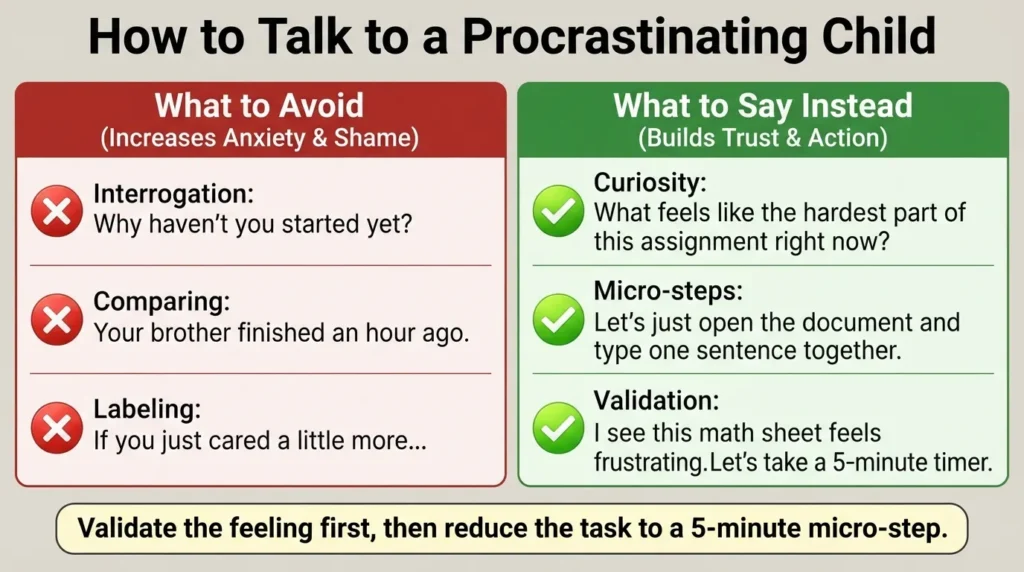
The language parents use when a child delays working can either lower their defensive walls or trigger immediate fight-or-flight responses. Switching from confrontational interrogation to constructive, anxiety-informed parenting calms the emotional brain, helping children transition from resistance to active cooperation.
Using actionable communication scripts helps parents de-escalate tension, validate underlying emotions, and maintain clear expectations without relying on shame or threats.
Questions to Ask Instead of “Why Won’t You Just Start?”
Asking a child “Why haven’t you started yet?” forces them to defend themselves, usually resulting in “I don’t know” or a defensive outburst. Children rarely possess the real-time self-awareness to explain executive dysfunction or task-related anxiety under pressure.
Shift to questions focused on curiosity, active listening, and identifying specific roadblocks:
| Instead of Interrogating… | Ask Curiosity-Driven Questions… | What It Accomplishes |
| “Why haven’t you touched your homework?” | “What feels like the hardest part of this assignment right now?” | Pins down the exact cognitive or emotional bottleneck. |
| “Why does it take you two hours to clean your room?” | “What’s the very first thing that needs to happen to clear this floor?” | Prompts the brain to identify a manageable micro-step. |
| “Are you ever going to start this project?” | “On a scale of 1 to 10, how clear are the instructions to you?” | Separates task confusion from refusal or defiance. |
| “Why are you being so lazy today?” | “Do you need a quick brain break, or do you need me to help you start?” | Identifies whether the issue is fatigue or initiation failure. |
Real Example Conversations (Script Format)
These scenario-based scripts show how calm talk, empathetic validation, and steady boundaries look in day-to-day parenting.
Scenario 1: The Homework Stand off
Child: “I hate history! This essay is stupid and I’m not doing it!” (Slams laptop shut)
Parent (Avoid): “You are doing it right now or no screens for a week! Stop complaining!”
Parent (Script): “I hear you. Staring at an empty page when you’re exhausted is miserable. You don’t have to write the whole essay right now. Let’s just open the document, write the title, and type one single sentence. If you still want to stop after that, we’ll take a 10-minute break. I’ll sit right here while you open it.”
Scenario 2: The Messy Bedroom Resistance
Child: “My room is fine! I’ll clean it later!” (Continues playing video games)
Parent (Avoid): “Your room is a biohazard! How can you live like a pig? Get up right now!”
Parent (Script): “Looking at this whole floor right now feels overwhelming—I get it. But playing games before responsibilities are handled makes it harder to relax later. Let’s set a timer for 5 minutes. You pick up all the clothes, and I’ll pick up the trash. When the bell rings, we stop.”
Scenario 3: Morning Routine Delay Tactics
Child: “I can’t find my shoes! I don’t want to go to school anyway!” (Sits on floor, unmoving)
Parent (Avoid): “We are going to be late because of you again! Move your feet!”
Parent (Script): “Mornings feel rushed, and feeling unprepared is stressful. Take a deep breath. We aren’t going to worry about the whole day right now. Let’s count 3-2-1, stand up together, and check under the couch for your shoes.”
Phrases That Unintentionally Increase Shame or Anxiety
When parents express frustration, they often default to phrases that trigger shame. Shame reinforces procrastination because it convinces children that they are fundamentally incapable, fueling a negative cycle of task avoidance.
“You’re so smart, why are you struggling with this?”
Why it backfires: Links intelligence to ease of work. When the task inevitably feels hard, the child assumes they aren’t actually smart, raising their fear of failure.
“Your brother had this done an hour ago.”
Why it backfires: Fosters resentment and deepens feelings of inadequacy without teaching executive functioning skills.
“If you just cared a little more, you’d be finished by now.”
Why it backfires: Misinterprets cognitive overload or anxiety as a lack of caring, leading the child to shut down emotionally.
“This is so easy, there’s no reason to cry.”
Why it backfires: Invalidates their internal experience. What feels simple to an adult can feel genuinely insurmountable to a child’s brain.
How to Validate Feelings Without Excusing Avoidance
Validating feelings does not mean dropping expectations or excusing avoidant behavior. It simply means acknowledging a child’s emotional state before holding them accountable to the task.
Empathy builds the emotional bridge that allows accountability to stick.
Acknowledge the Emotion First: Name the discomfort clearly (“I see that this math worksheet is making you feel frustrated and overwhelmed”).
Separate the Feeling from the Action: Normalize having negative feelings while holding the boundary on execution (“It is completely okay to feel annoyed about doing chores, but it’s still time to clear the table”).
Offer Collaborative Support: Position yourself as a partner working alongside them rather than an opponent enforcing compliance (“I can’t do the work for you, but I am right here to help you get past this first hard part”).
When Procrastination Might Signal ADHD, Anxiety, or a Learning Difference
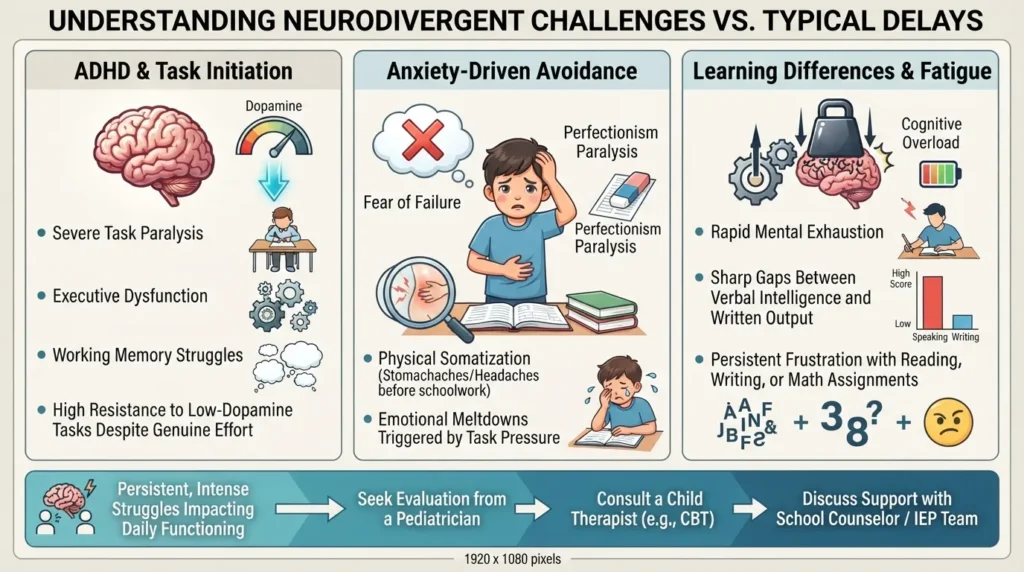
When routine strategies and environmental adjustments fail to reduce task avoidance, chronic delay is often more than a behavioral habit. Procrastination in children frequently serves as a secondary symptom of underlying neurodivergent conditions or mental health challenges.
According to research highlighted by the Child Mind Institute, children dealing with learning disabilities, ADHD, or anxiety disorders are significantly more prone to persistent task avoidance because their past experiences with academic and daily tasks are often paired with intense stress and negative reinforcement.
Signs Procrastination Might Be More Than a Habit
While occasional delay is a normal part of child development, chronic avoidance often signals that a child’s internal distress exceeds their ability to cope. Recognizing the difference between routine hesitation and clinical difficulty prevents parents from treating a medical or cognitive issue as a lack of effort.
Pervasive Task Paralysis: The child sits in front of a simple assignment for hours without making progress, despite having an empty schedule and zero digital distractions.
Extreme Emotional Reactions: Attempts to start a task consistently trigger severe meltdowns, panic reactions, intense tearfulness, or aggressive outbursts.
Physical Somatization: The child regularly complains of stomachaches, nausea, or headaches specifically when it is time to sit down for schoolwork or chores.
Widespread Impact: Task initiation failures occur across every domain of life, including non-academic activities, personal hobbies, and social events they genuinely enjoy.
Significant Discrepancy: A sharp disconnect exists between the child’s spoken intelligence or ideas and their ability to produce written or organized output on paper.
ADHD and Task Initiation — Why It’s Different
In children with Attention-Deficit/Hyperactivity Disorder (ADHD), procrastination is not an intentional choice to put off work. It is an involuntary cognitive blockage rooted in executive dysfunction and irregular dopamine regulation.
The ADHD brain processes task initiation through specific biological differences:
Dopamine Deficiency: The ADHD brain has lower baseline levels of available dopamine, the primary neurotransmitter responsible for motivation and reward processing. Low-dopamine tasks (like routine worksheets or folding laundry) feel physically painful for an ADHD brain to initiate.
Impaired Prefrontal Cortex Activity: Executive functioning skills—such as working memory, planning, time estimation, and impulse control—develop up to 30% slower in kids with ADHD compared to neurotypical peers.
The “Interest-Based” Nervous System: Children with ADHD struggle to direct focus based on priority or importance. Instead, their brain initiates action based on interest, novelty, urgency, or competition.
Anxiety-Driven Avoidance vs. Ordinary Procrastination
While ADHD-driven procrastination stems from a lack of cognitive activation, anxiety-driven avoidance is powered by an overactive threat response. When a child associates a task with potential failure, judgment, or discomfort, the brain’s amygdala interprets the assignment as an actual threat.
Understanding the underlying driver helps tailor the right supportive response:
Ordinary Procrastination: Driven by a desire to pursue immediate pleasure or avoid temporary boredom. The child can usually be persuaded to complete the work with a basic reward, clear boundary, or firm deadline.
Anxiety-Driven Avoidance: Driven by a need to escape internal pain, self-doubt, or perfectionism. The child delays starting because complete avoidance is the only way to protect themselves from feeling incompetent or failing.
Learning Differences (Dyslexia, Dysgraphia, Dyscalculia): Driven by rapid cognitive exhaustion. When reading or writing requires triple the mental effort of a neurotypical child, task avoidance becomes a natural defense mechanism against cognitive overload.
When to Talk to a Pediatrician, Therapist, or School Counselor
If task avoidance consistently creates severe household conflict, damages your child’s self-esteem, or leads to persistent academic decline, seeking a professional evaluation is the most effective next step.
Your Pediatrician: Serves as the primary starting point to evaluate medical factors, rule out sleep disorders or vision issues, and provide referrals to specialists.
A Licensed Child Therapist or Psychologist: Conducts comprehensive clinical evaluations for ADHD, clinical anxiety, or mood disorders, while offering Cognitive Behavioral Therapy (CBT) to build emotional regulation strategies.
The School Counselor or IEP/504 Team: Evaluates academic performance inside the classroom and can implement formal accommodations—such as reduced homework loads, extended testing time, visual checklists, and movement breaks.
Watch: ADHD Motivation & Task Initiation
This video by Dr. Roseann Capanna-Hodge is relevant because it directly addresses the neurodevelopmental factors behind ADHD task initiation struggles and offers actionable ways to help kids start tasks without escalating emotional battles.
Dr. Roseann Capanna-Hodge: ADHD Motivation Strategy
Why Punishment Backfires (Addressing the Spanking Question)
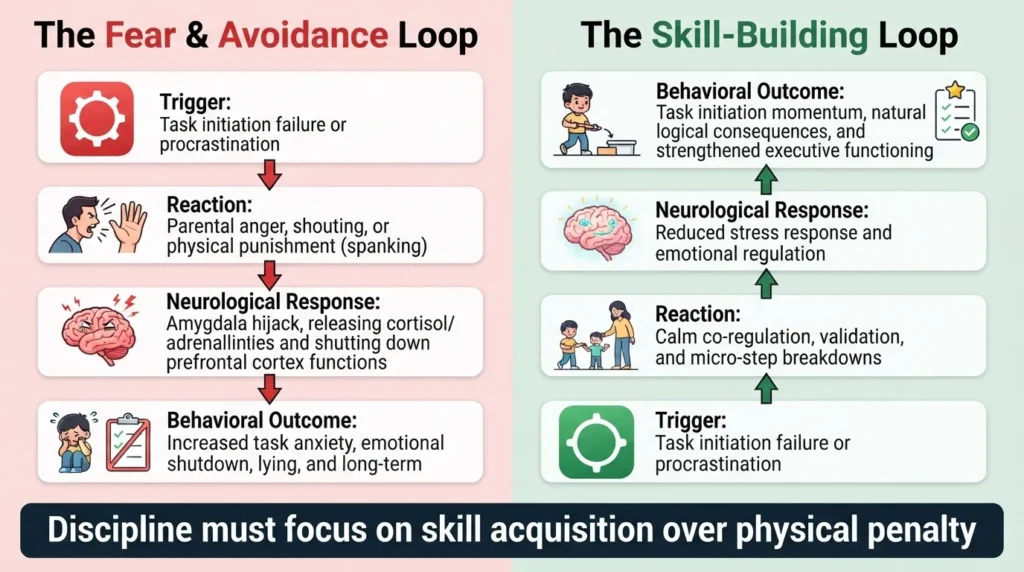
When faced with persistent task avoidance, parents often experience immense frustration and may consider resorting to harsh discipline or physical punishment to force compliance. However, physical discipline and punitive measures do not cure procrastination; instead, they significantly worsen the underlying cognitive and emotional drivers of task avoidance.
Addressing task delay through fear creates a toxic cycle that damages a child’s confidence, impairs their executive function development, and destroys the parent-child bond.
Why Punishment Doesn’t Fix Procrastination
Procrastination is an emotional regulation and executive functioning issue, not a symptom of willful rebellion or defiance. Punishing a child for failing to start or complete a task fails to address why the delay happened in the first place.
Does Not Teach Skills: Punishing a child does not magically teach them how to break down complex tasks, manage time, reduce anxiety, or improve focus.
Ignores the Root Cause: If a child delays because they are confused by an assignment or terrified of failing, taking away privileges or using physical punishment does nothing to resolve that confusion or fear.
Treats the Symptom, Not the Science: Penalty-driven compliance focuses strictly on immediate behavioral control while completely overlooking the neurological bottlenecks in the prefrontal cortex that prevent task initiation.
How Fear-Based Discipline Increases Avoidance Long-Term
Relying on fear-based parenting or physical punishment triggers a severe stress response that actively undermines the brain’s ability to learn, focus, and self-regulate.
When a child fears punishment, their brain shifts into a fight-or-flight state, releasing stress hormones like cortisol and adrenaline:
Shuts Down Executive Functioning: High stress levels inhibit the prefrontal cortex—the exact region required for planning, working memory, and initiation—making it even harder for the child to think logically or tackle difficult work.
Feeds the Avoidance Cycle: The child begins to associate homework, chores, and academic challenges with fear, threat, and shame. This heighten anxiety causes them to avoid the task even more intensely in the future to protect themselves from emotional pain.
Encourages Deception: Fear-based discipline teaches children to become better at hiding their unfinished work, lying about deadlines, or fabricating excuses rather than asking for help when they are stuck.
What to Do Instead of Punishing
Effective behavioral change requires moving away from punitive measures and toward positive reinforcement, skill-building, and predictable boundaries.
Enforce Natural and Logical Consequences: Allow the natural outcomes of their choices to teach the lesson. If a teen delays studying for an exam, receiving a low grade provides a direct, logical reflection of their preparation without parental anger.
Implement “When / Then” Routines: Frame expectations neutrally to avoid power struggles (“When your math worksheet is completed, then you can play video games”).
Reward Task Initiation, Not Just Completion: Praise the physical effort of starting a task rather than focusing solely on the final outcome (“I noticed how quickly you sat down and opened your book today—that was awesome”).
Scaffold Difficult Tasks: When task paralysis strikes, lower the barrier to entry by working through the first micro-step together rather than issuing threats from across the room.
For Teachers — Helping Students Who Procrastinate at School
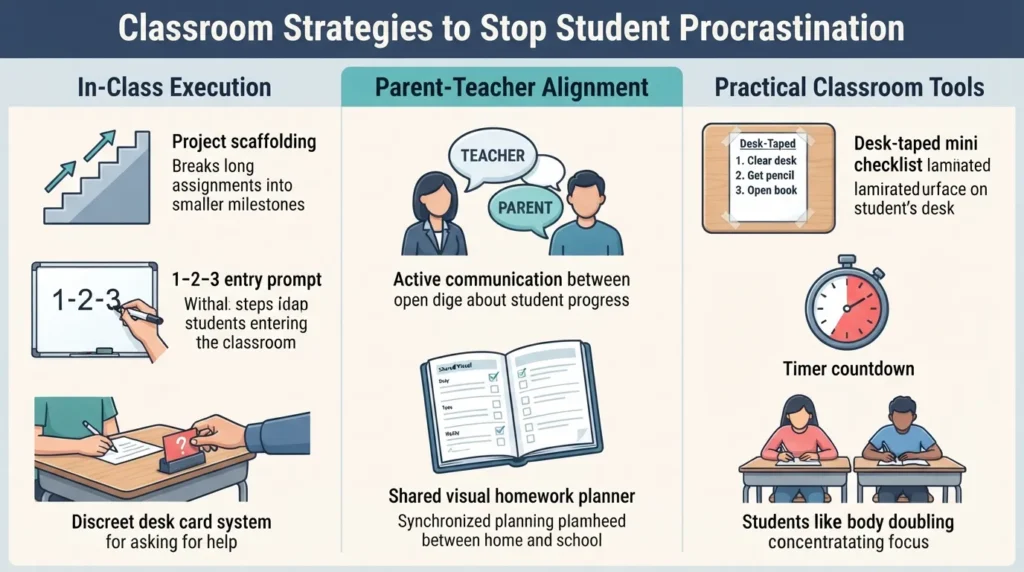
While parental support at home is vital, childhood task avoidance frequently manifests in the classroom as incomplete assignments, off-task behavior, or passive resistance during independent work. Teachers who treat procrastination as an executive functioning skill gap rather than a behavioral distraction can implement classroom strategies that build student independence and lower academic stress.
Structuring classroom environments to support task initiation helps students cross the starting line without constant individual intervention.
Classroom Strategies for Procrastinating Students
Managing a classroom full of diverse learning needs requires proactive systems that reduce task friction for all students, particularly those prone to paralysis or overwhelm.
Provide Scaffolding for Long-Term Projects: Never assign a multi-week project with only a single final due date. Break the assignment into mandatory, graded checkpoints (e.g., Topic Selection due Tuesday, Outline due Friday, First Draft due next Wednesday).
Establish Clear Task Initiation Prompts: When shifting activities, give students an explicit, physical first step rather than a general command. Instead of saying “get to work on your history assignment,” say “everyone open your notebook to page 12 and write the title on line one.”
Offer Low-Stakes Entry Points: Begin complex or intimidating lessons with a quick, 2-minute “warm-up” exercise where there are no wrong answers, building initial momentum before introducing difficult concepts.
Normalize Asking for Help: Create a discreet mechanism—such as a red/green flip card on their desk—where students can signal that they are stuck without needing to raise their hand or draw attention from peers.
How Teachers Can Coordinate with Parents
In-class progress is significantly higher when educators and families align their approaches and maintain clear parent-teacher coordination.
Share Real-Time Roadblocks: When contacting parents about delayed work, share specific observations rather than general complaints (e.g., “Noah struggles specifically with initiating written responses, though he understands the reading material well”).
Standardize Daily Systems: Align on consistent tools across home and school, such as using the same visual timer app or physical homework planner format.
Focus on Process Over Outcome: Encourage parents to praise their child’s task initiation efforts at home, reinforcing the same skill-building language used in the classroom.
Simple In-Class Tools
Integrating lightweight, tangible tools into daily instruction provides neurodivergent and overwhelmed students with the executive function support they need to stay organized.
Visual Schedules: Display a clean, step-by-step visual agenda on the whiteboard for every class period so students always know what activity is coming next and how much time remains.
Desk Checklists: Provide students with laminated micro-checklists taped to their desks that outline the basic steps for common transitions (e.g., “1. Clear desk, 2. Get out pencil, 3. Open workbook”).
Peer Accountability (Body Doubling): Pair students up to work alongside one another during independent practice. Working in proximity to a focused peer leverages social modeling to help procrastinating students stay on track.
Real Parent Story — What Actually Worked (Case Example)
When dealing with chronic task avoidance, theoretical advice often sounds great on paper but falls apart during a chaotic Tuesday evening. Real-life examples highlight the messy trial-and-error process that most families navigate before finding a routine that actually sticks.
Examining a true-to-life parent experience illustrates how shifting from high-pressure demands to anxiety-informed systems creates sustainable, long-term behavior change.
The Situation — A Relatable Everyday Scenario
Mark and Sarah were at their wit’s end with their 9-year-old son, Leo. Every afternoon following school, the same exhausting battle played out over a single 15-minute math worksheet and reading log.
Leo would walk through the front door, drop his backpack in the hallway, and immediately melt down or vanish into his bedroom when asked to complete his homework:
The Delay Tactics: He would spend 45 minutes asking for snacks, needing the bathroom, sharpening pencils, or complaining about how “unfair” his teacher was.
The Emotional Escalation: By 6:00 PM, simple reminders evolved into full-blown shouting matches, ending with Leo in tears, claiming he was “stupid,” and Mark yelling in frustration.
The Academic Impact: Despite Leo being a bright child who scored well on exams, his report card reflected failing homework grades due to missing or late assignments.
What We Tried That Didn’t Work
Like many frustrated parents, Mark and Sarah initially assumed Leo’s task avoidance was driven by laziness and a lack of discipline. They tried traditional control-focused strategies, which only amplified the household tension.
Taking Away Privileges: They banned video games, TV, and weekend playdates until all homework was finished. Instead of motivating Leo, it caused him to shut down completely and hide in his room for hours doing nothing.
Nagging and Standing Over Him: Mark sat right next to Leo, constantly correcting his posture and demanding he write faster. This micro-management made Leo feel hyper-critiqued, triggering intense task anxiety and freezing his ability to write.
Lecturing About the Future: They tried explaining how important 4th-grade math was for middle school and his future career. To a 9-year-old brain living entirely in the present moment, long-term lectures felt abstract, irrelevant, and overwhelming.
What Finally Worked (and Why)
Recognizing that their current approach was destroying their relationship with Leo without fixing his grades, Mark and Sarah consulted a school counselor who reframed the issue as executive function overload and task initiation paralysis.
They completely revamped their afternoon routine using a few targeted, low-friction strategies:
A 30-Minute “Brain Reset” Buffer: Instead of demanding homework happen immediately after school, they implemented a non-negotiable 30-minute grace period where Leo could eat a protein snack, run around outside, and decompress from the sensory demands of school.
The “Body Doubling” Kitchen Counter Setup: Instead of sending Leo to his quiet bedroom (where isolation increased his anxiety), he worked at the kitchen counter while Sarah prepped dinner. Her calm, passive presence provided unspoken co-regulation.
The 10-Minute Timed Sprint with a Visual Timer: They introduced a visual countdown clock. They agreed that Leo only had to work for 10 minutes. If he focused for that block, he earned a guaranteed 5-minute movement break.
Micro-Step Breakdowns: Sarah helped him convert vague assignments into micro-steps. Instead of “do your math worksheet,” his checklist read: “1. Write name on paper. 2. Solve problem #1. 3. Take a sip of water.”
The Results: Within three weeks, the afternoon shouting matches vanished completely. Leo realized that starting a task didn’t mean committing to hours of endless misery. By reducing the initial barrier to entry, his confidence returned, and he began initiating his homework independently over 80% of the time.
Frequently Asked Questions
What is the best solution for procrastination in kids?
The best solution for childhood procrastination is breaking tasks into micro-steps while lowering emotional anxiety through structured routines and visual timers. Rather than using punishment or nagging, adults should address the executive function gap by helping the child initiate the very first physical step of an assignment in a calm, distraction-free environment.
What is the number one cause of procrastination in children?
The primary cause of procrastination in children is an inability to regulate negative emotions—such as anxiety, fear of failure, confusion, or overwhelm—triggered by a task. Task avoidance is a protective coping mechanism, not a sign of laziness or deliberate rebellion.
What are 5 ways to avoid procrastination for kids?
To help kids avoid procrastination, implement these five evidence-based techniques:
- Break tasks into micro-steps: Convert vague commands like "clean your room" into tiny actions like "pick up 5 red toys."
- Use the 10-minute rule: Commit to working for just 10 minutes with guaranteed permission to take a break when the timer rings.
- Remove digital distractions: Store phones, tablets, and gaming consoles outside the study area during focus windows.
- Establish a fixed homework routine: Set a predictable daily window for schoolwork anchored to existing habits like afternoon snack time.
- Use visual timers: Replace traditional clocks with visual countdown timers so children can physically see time pass.
What are three cures for procrastination?
Three proven cures for procrastination are:
- Body Doubling: Sit calmly near the child while they work to provide silent emotional co-regulation and accountability.
- The 5-4-3-2-1 Countdown: Count backward from five to one out loud and launch the first physical action immediately on "one."
- Task Chunking: Cover everything on a worksheet except the single problem currently being solved to prevent cognitive overload.
Why do kids procrastinate more than adults?
Kids procrastinate more than adults because their prefrontal cortex—the area of the brain responsible for executive functions like planning, impulse control, working memory, and time perception—is still developing and will not fully mature until their mid-twenties. Adults possess more developed neural pathways to self-regulate through boredom and estimate time accurately.
How do I stop my teenager from procrastinating?
To help a teenager overcome procrastination, shift from a supervisory role to a consulting role by offering guidance rather than direct orders. Encourage autonomy by establishing clear "when/then" boundaries, letting them experience natural consequences when appropriate, maintaining tech-free study zones, and helping them manage their peak energy hours.
Mark Steve
Mark Steve is a tech, business, and lifestyle writer with over 5 years of experience analyzing digital trends, startups, and online business models. He publishes well-researched, fact-checked content focused on clarity, credibility, and real-world value.