Reframing Procrastination: From Character Flaw to Emotional Strategy
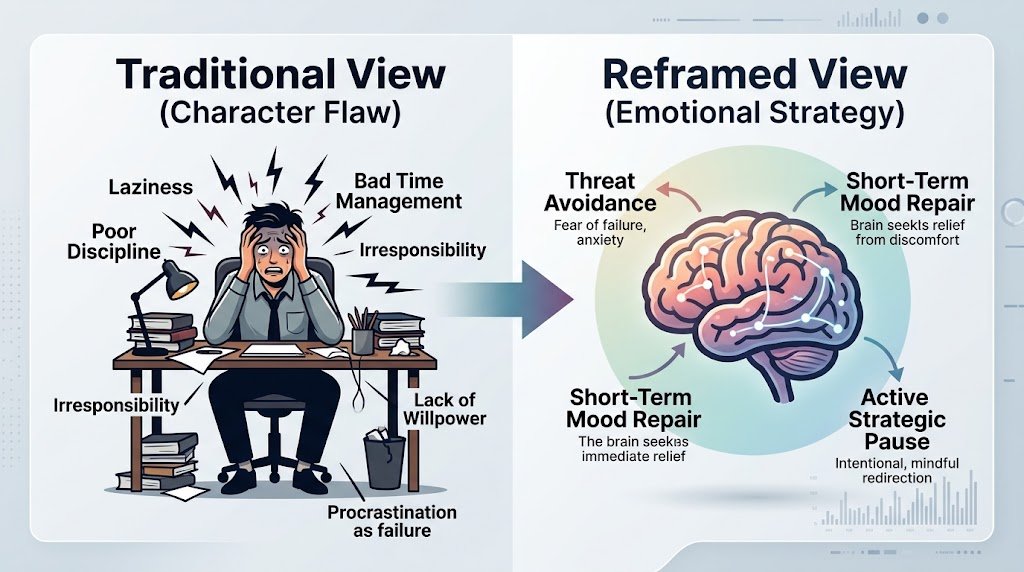
Procrastination is rarely a failure of willpower or time management. At its core, chronic delay is an emotional regulation issue where the brain prioritizes short-term mood repair over long-term objectives. Stepping away from a task that triggers anxiety, self-doubt, or boredom functions as an immediate coping strategy to temporarily soothe the nervous system.
Viewing procrastination through a psychological lens changes how we address it:
Emotional Defense Mechanism: The brain treats overwhelming tasks as threats, making avoidance a instinctual response to protect your immediate emotional state.
The Power of Active Delay: Strategic, intentional delay allows cognitive load to settle, giving you time to gather critical information and process complex decisions.
Reframing as a Positive Coping Mechanism: Differentiating between unconscious avoidance and deliberate pausing turns a guilt-inducing habit into a functional tool for sustainable productivity.
What Is Procrastination as a Coping Mechanism?
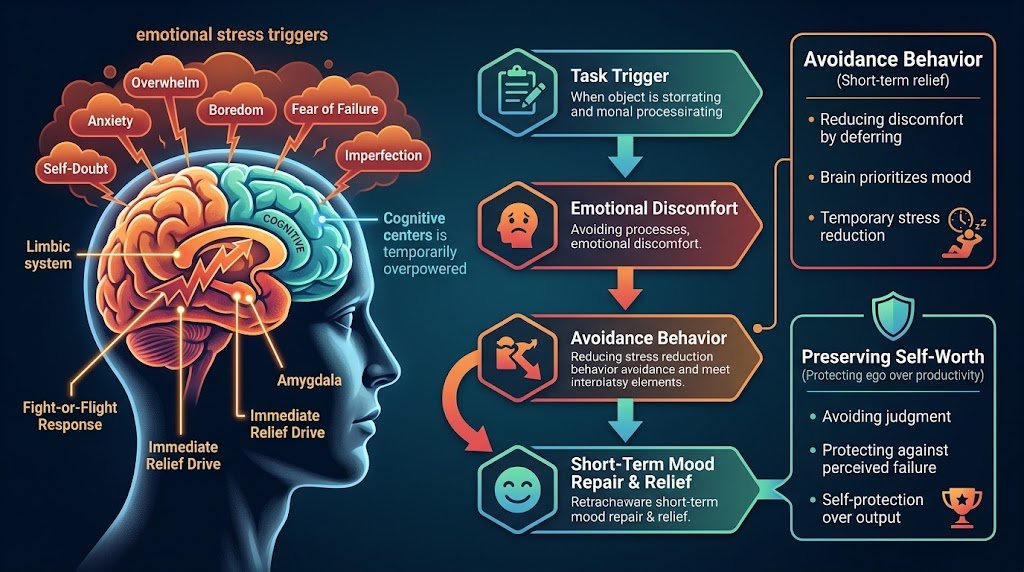
Procrastination operates as an automatic defense response designed to shield you from uncomfortable feelings. Rather than a flaw in discipline, using delay as a coping mechanism is a subconscious attempt to manage negative emotions—such as anxiety, fear of failure, or task aversion—triggered by a specific demand.
Definition of Procrastination in Psychology
In the psychology of procrastination, this behavior is defined as the voluntary delay of an intended action despite expecting to be worse off for the delay. Psychological research classifies it primarily as an emotional regulation problem rather than a failure of time management.
Avoidance Behavior: The immediate withdrawal from a stress-inducing task to avoid short-term emotional discomfort.
Mood Repair Focus: The brain prioritizes immediate relief over long-term achievements, treating the task as a threat to your current emotional well-being.
Irrationally Driven: Even when you possess the skills, resources, and desire to complete a project, emotional resistance halts action.
Why the Brain Uses Delay as a Coping Tool
When you encounter a task that feels overwhelming or ambiguous, your brain triggers a fight-or-flight stress response. The amygdala perceives the task’s negative emotions as an immediate threat, driving you toward avoidance to restore immediate calm.
Ameliorating the Stress Response: Shifting attention away from a difficult project immediately drops cortisol levels and reduces physical anxiety.
Short-Term Reward Loop: Engaging in easier, low-stakes activities provides a quick hit of dopamine, reinforcing the habit of delay.
Preserving Self-Worth: Pushing back a deadline creates a psychological buffer; if the performance is sub-par, you can blame a lack of time rather than a lack of ability.
Active vs. Passive Procrastination — The Critical Distinction
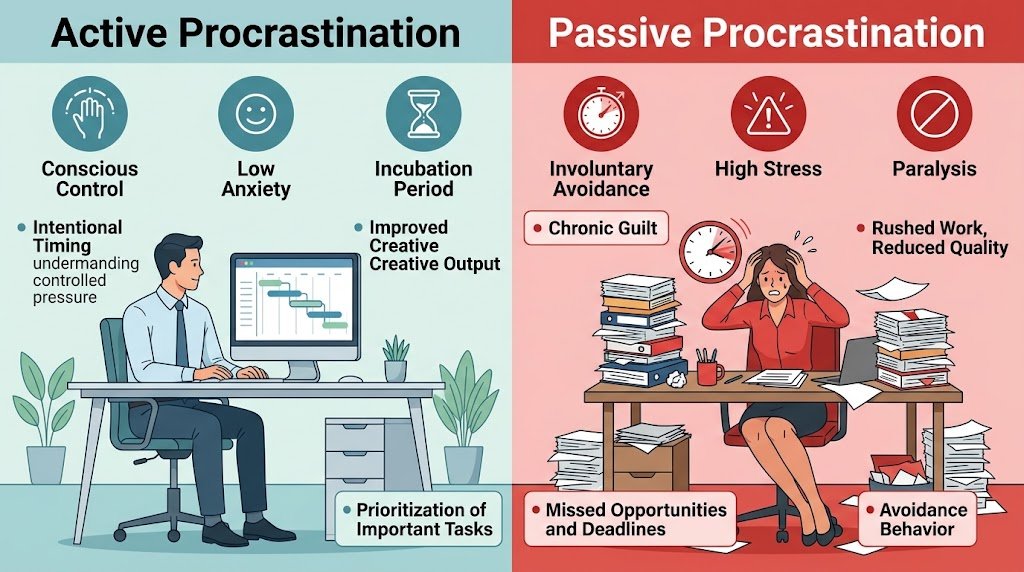
Understanding the difference between active and passive procrastination is the cornerstone of converting unproductive delay into a deliberate workflow strategy. While both involve postponing tasks, their underlying psychology, level of personal control, and ultimate outcomes are fundamentally opposite.
Active (Intentional) Procrastination Explained
Active procrastination is a conscious, strategic decision to postpone a task in order to leverage short-term pressure for improved focus and creative problem-solving. Individuals practicing active procrastination retain full control over their time and outcomes.
Intentional Delay: You deliberately choose to pause work to allow ideas to incubate, gather additional data, or manage energy levels.
High Performance Under Pressure: The controlled stress of an approaching deadline acts as a stimulant, driving high engagement and efficient execution.
Minimal Guilt or Anxiety: Because the delay is planned, it does not trigger the destructive cycle of shame or self-doubt.
Passive (Harmful) Procrastination Explained
Passive procrastination is an involuntary form of harmful avoidance driven by emotional paralysis, self-doubt, or task aversion. It represents a loss of behavioral control where time slips away without intentional choice.
Paralyzing Avoidance: You want to begin working but find yourself unable to act due to overwhelming feelings of anxiety or perfectionism.
Chronic Stress and Guilt: Postponing the task exacerbates negative emotions, leading to prolonged stress, burnout, and diminished self-esteem.
Suboptimal Outcomes: Rushed, panic-driven work often results in lower quality outputs, missed opportunities, and severe deadline friction.
How to Know Which One You’re Practicing
Developing self-awareness around your daily habits allows you to quickly identify whether your delay is serving your productivity or sabotaging it.
| Evaluation Metric | Active Procrastination | Passive Procrastination |
| Control & Choice | Deliberate decision with a scheduled start time. | Involuntary distraction; feeling helpless to start. |
| Emotional State | Calm, confident, and purposeful. | Anxious, guilty, and overwhelmed. |
| Outcome Quality | Meets or exceeds standards on time. | Subpar results, last-minute panic, or missed deadlines. |
To self-assess in real time, ask yourself one question: “Am I holding off on this task to optimize my cognitive focus, or am I running away from an uncomfortable emotion?” If it’s the latter, you are engaging in passive avoidance.
5 Ways Procrastination Acts as a Positive Coping Mechanism
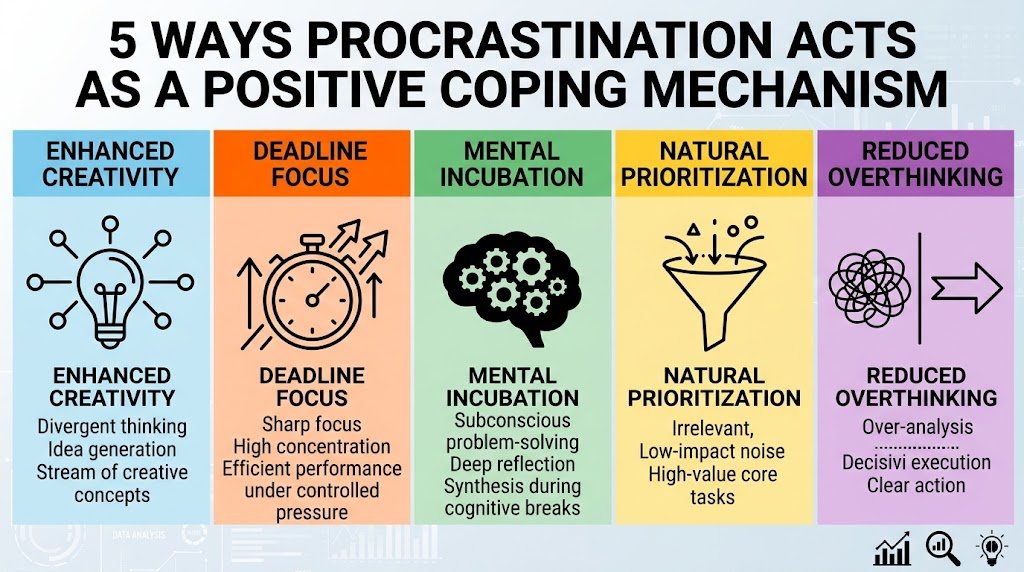
When channeled intentionally, deliberate delay transforms from a habit of avoidance into an effective productivity asset. By treating time away from a project as an active phase of work, you can leverage natural cognitive processes to improve creative output, prioritize tasks, and execute under pressure.
1. Enhanced Creativity Through Divergent Thinking
Stepping away from an immediate problem prevents premature cognitive closure—the urge to settle on the first obvious solution. Allowing time between receiving a task and completing it fosters divergent thinking, enabling your brain to connect non-obvious ideas and build unique solutions.
Broadened Mental Scope: Pausing initial execution breaks linear thinking patterns, allowing you to view problems through multiple distinct perspectives.
Idea Cross-Pollination: While engaged in secondary tasks, your mind continues drawing connections from unrelated daily experiences and information.
Higher Quality Innovations: Delaying final execution often leads to more original, thoroughly considered creative problem-solving.
2. Motivation Under Pressure (The Deadline Effect)
For many individuals, an open-ended timeframe breeds sluggishness and lack of focus. Strategic delay leverages time constraints to trigger an adrenaline focus that sharpens concentration and eliminates trivial distractions.
Clarity of Goal: An impending deadline forces immediate absolute clarity on what must be delivered versus what is secondary.
Increased Working Pace: The natural spike in physiological arousal converts passive contemplation into hyper-focused, efficient action.
Overcoming Task Inertia: The psychological pressure neutralizes initial friction, making it significantly easier to enter a state of deep work.
3. Subconscious Processing & Mental Incubation
Your brain continues working on complex problems even when you are not actively focusing on them. The incubation effect allows the subconscious mind to organize information, synthesize complex data, and resolve structural roadblocks without conscious cognitive strain.
Background Information Synthesis: Unconscious cognitive networks process tricky details while you engage in routine daily activities.
Spontaneous Insights: Sudden “aha!” moments frequently occur during periods of intentional delay when your working memory is relaxed.
Reduced Mental Fatigue: Taking structured breaks prevents burnout, ensuring that when you return to active work, your focus is sharp.
4. Natural Task Prioritization
Deliberate delay functions as a natural filter for low-value tasks. By postponing non-essential items, you often discover that certain demands resolve themselves, become irrelevant, or can be easily delegated, leaving only high-impact work.
Elimination of Superfluous Work: Postponing minor tasks prevents you from spending valuable energy on activities that contribute little to your core goals.
Self-Sorting Urgency: Critical responsibilities naturally rise to the top of your mental queue, establishing a clear hierarchy of needs.
Energy Preservation: Reserving peak energy for high-priority tasks prevents cognitive depletion on low-impact operational noise.
5. Reduced Overthinking and Overanalysis
Perfectionism frequently leads to analysis paralysis—a state where endless tweaking prevents execution. Setting a tight window to complete a project by delaying its start reduces overthinking and enforces pragmatic decision-making.
Enforced Perfectionism Boundaries: Shortened execution windows force you to focus on core functionality rather than micro-details.
Decisive Execution: Limited time demands swift, decisive choices, relying on your established expertise rather than second-guessing.
Faster Project Completion: Minimizing time spent on excessive revisions leads to quicker turnarounds and faster practical iteration.
The Neuroscience — What Happens in the Brain During Procrastination
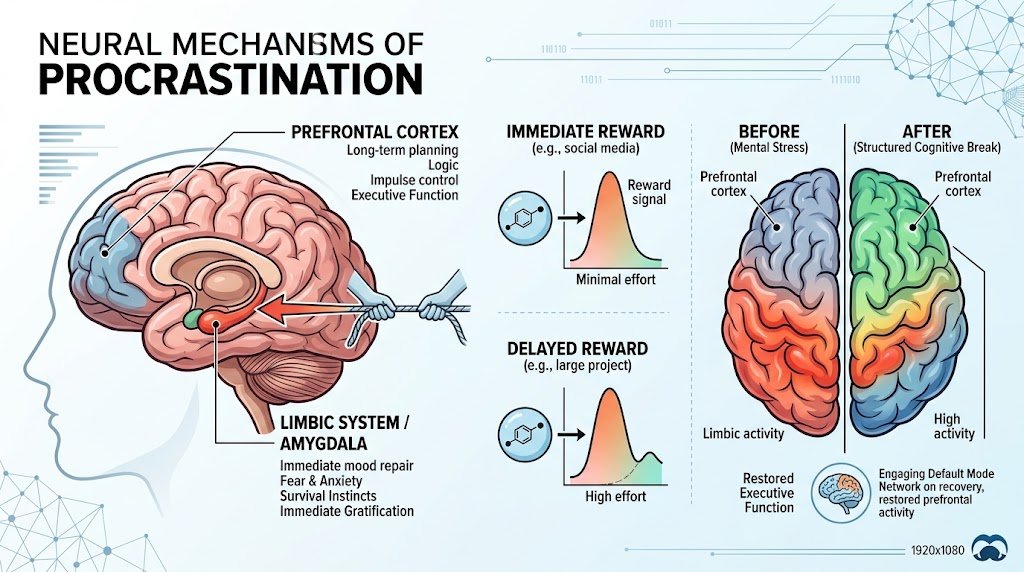
Procrastination is a direct battle between two distinct regions of the brain competing for control over your behavior. Understanding the brain science behind this process reveals why emotional regulation often overrides logical planning—and how structured breaks allow your neural architecture to reset.
The Prefrontal Cortex vs. the Limbic System
The urge to delay stems from an internal tug-of-war between the conscious, analytical brain and the automatic, emotional brain.
The Prefrontal Cortex (The Executive): Located behind your forehead, this region handles long-term planning, decision-making, and impulse control. It understands that finishing a task now yields future rewards.
The Limbic System (The Survival Center): A much older evolutionary structure that seeks immediate pleasure and avoids threat or discomfort. It prioritizes mood repair in the present moment over future results.
The Emotional Hijack: When a project triggers negative emotions, the limbic system treats those feelings as a threat, overpowering the prefrontal cortex and driving immediate avoidance behavior.
Dopamine, Reward-Seeking, and Delay
Dopamine is not merely the pleasure chemical; it drives motivation and reward-seeking behavior. The brain constantly evaluates the “cost versus reward” of any activity to determine where to allocate energy.
Immediate Reward Bias: The limbic system prefers quick dopamine hits obtained through easy distractions over the delayed reward of completing a complex task.
Dopamine Depletion: Sustained mental effort exhausts neural resources, making difficult tasks feel increasingly costly to attempt.
Neural Rewiring Potential: By using intentional delay strategically, you can train your brain to associate task completion under time-constrained conditions with positive dopamine reinforcement, aiding long-term habit formation.
How the Brain Benefits from Mental Breaks
Forcing continuous focus without respite overburdens the prefrontal cortex, leading to decision fatigue and sharp drops in productivity. Taking a strategic cognitive break allows the brain’s Default Mode Network (DMN) to engage.
Research published in Psychology Today{rel=”nofollow”} highlights how temporary disengagement from focused tasks refreshes the prefrontal cortex and restores executive functioning. When you give your brain structured space away from intense focus, it consolidates memories, restores cognitive stamina, and processes complex problems in the background.
Carl Jung's Perspective on Procrastination
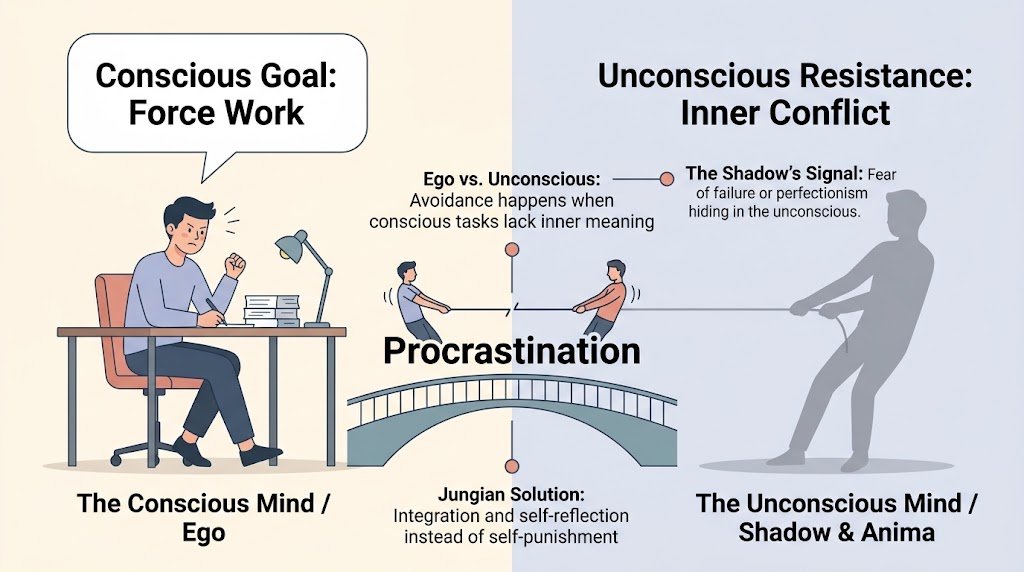
While Carl Jung never wrote a single explicit manual on modern procrastination, his theories on analytical psychology offer profound insight into why we resist specific tasks. From a Jungian perspective, persistent delay is not mere laziness—it is a meaningful signal from the unconscious mind revealing an internal conflict that demands attention.
Jung’s View on Resistance and the Unconscious
Jung famously posited that “What you resist, persists.” In Jungian psychology, procrastination serves as a physical expression of psychological resistance, indicating that your conscious goals are out of alignment with your unconscious drives.
Signals of Inauthenticity: Pushing back a task often signals that the goal is driven by external expectations rather than your authentic values.
The Unconscious Brake: The unconscious mind uses avoidance to halt action when it senses that a project violates personal boundaries or emotional readiness.
Psychological Energy (Libido) Shifts: When conscious motivation dries up, psychological energy retreats inward, manifesting outwardly as behavioral paralysis.
Procrastination as “Shadow Work”
Jung introduced the concept of the shadow self—the hidden, disowned, or repressed aspects of our personality. Procrastination frequently acts as a mirror for shadow dynamics, bringing unacknowledged fears and self-doubts to the surface.
Confronting the Fear of Failure: Delaying a project protects the ego from facing potential inadequacy, keeping the fear of judgment safely buried in the shadow.
Exposing Perfectionism: The belief that work must be flawless is often a shadow construct that prevents you from initiating real-world action.
Integrating the Shadow: Acknowledging the feelings of fear, boredom, or resentment behind your delay allows you to integrate these emotional realities rather than suppressing them.
How Jungian Psychology Supports Active Delay
Jung viewed personal growth as a process of individuation—the integration of the conscious and unconscious self into a cohesive whole. Active delay aligns with this principle by transforming passive resistance into conscious self-reflection.
Honoring the Pause: Rather than forcing productivity, taking a deliberate step back gives space to ask what your resistance is trying to teach you.
Dialogue with the Unconscious: Pausing allows you to evaluate whether a goal truly serves your long-term psychological maturity or merely satisfies ego-driven desires.
Harmonizing Action with Intuition: Strategic delay ensures that when you finally act, your effort is backed by unified conscious intention and unconscious alignment.
Personality Types and Procrastination
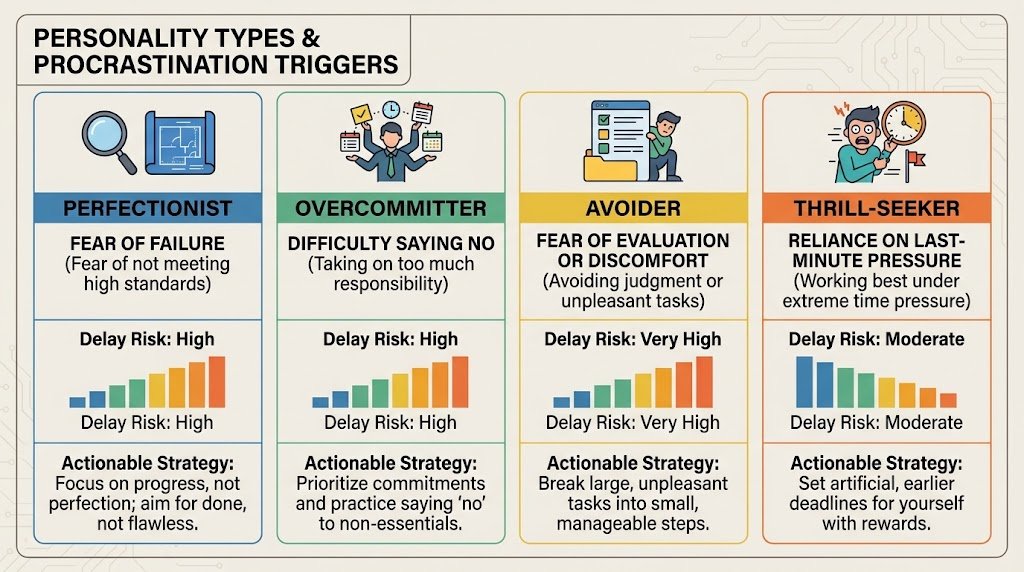
Your unique personality structure heavily dictates why, when, and how you delay tasks. While anyone can fall victim to avoidance, underlying behavioral traits—specifically within the Big Five personality framework—shape whether your procrastination stems from a fear of failure, low impulse control, or a need for emotional regulation.
Which Personality Types Procrastinate More
Certain Big Five personality traits show a strong correlation with chronic delay. Recognizing your natural tendencies helps you spot triggers before they result in paralysis.
Low Conscientiousness: Conscientiousness reflects organization, discipline, and goal-directed behavior. Individuals scoring lower in this trait naturally struggle with self-regulation and task initiation.
High Neuroticism: Those with high neuroticism experience elevated levels of anxiety and emotional reactivity. They frequently use delay as a coping mechanism to escape negative emotions associated with high-stakes tasks.
High Openness (The Divergent Thinker): Extremely creative individuals often delay final execution because their minds continuously generate alternative ideas, making task completion feel restrictive.
Perfectionists vs. Impulsive Procrastinators
Not all delay looks the same. The root drivers generally divide procrastinators into two primary behavioral patterns:
The Perfectionist Procrastinator: Driven by high standards and a fear of failure, perfectionists delay starting a project because they fear the final result will not meet their internal expectations.
Core Driver: Emotional protection against perceived inadequacy.
Manifestation: Endlessly research, plan, or re-organize without producing actual work.
The Impulsive Procrastinator: Driven by a desire for immediate gratification, impulsive individuals struggle to resist short-term distractions when faced with low-reward tasks.
Core Driver: High susceptibility to short-term temptation and low distress tolerance.
Manifestation: Abandoning priority projects for quick dopamine hits like social media, cleaning, or administrative noise.
Intrinsic vs. Extrinsic Motivation and Procrastination
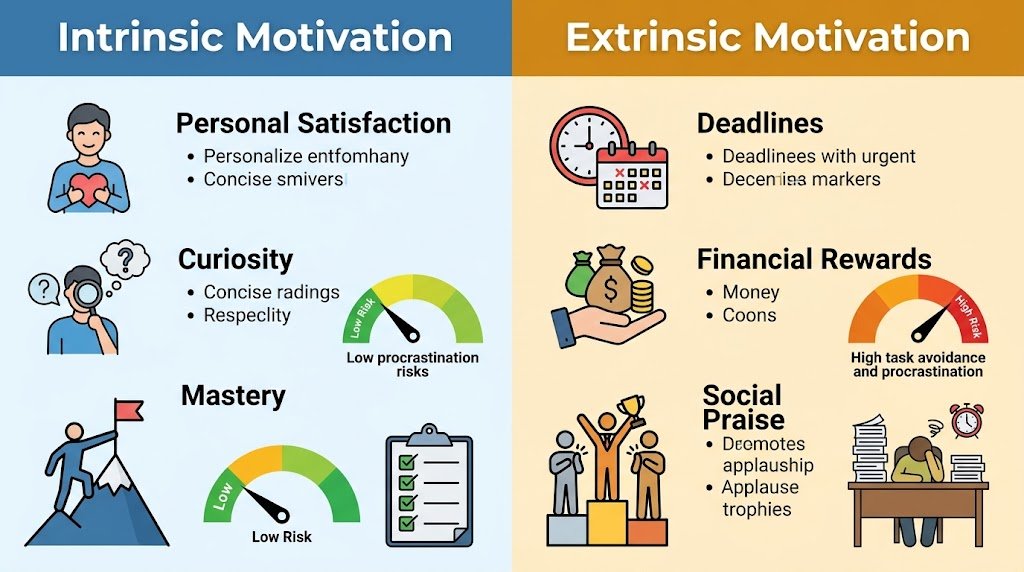
The underlying driver of your behavior determines how delay impacts your work quality and stress levels. Grounded in self-determination theory, motivation psychology shows that whether an action is driven by internal passion or external reward changes how procrastination manifests—and whether it helps or hurts your performance.
Intrinsic Motivation and Its Link to Delay
Intrinsic motivation occurs when you engage in an activity for its inherent satisfaction, curiosity, or personal enjoyment rather than an external reward.
Incubation Over Avoidance: When intrinsically motivated, delaying a task is rarely about running away from negative emotions. Instead, it serves as an incubation phase where you process creative ideas subconsciously.
Deeper Engagement: Because you care about the craft or outcome, time spent away from the work often leads to higher quality, more innovative solutions once you return.
Reduced Anxiety: Intrinsic interest buffers against the fear and self-doubt that typically trigger harmful, panic-driven procrastination.
Extrinsic Motivation and Deadline Pressure
Extrinsic motivation relies on external factors such as financial compensation, grades, recognition, or the avoidance of negative consequences.
Susceptibility to Delay: Tasks driven purely by external demands lack immediate personal value, making the brain far more likely to delay them in favor of engaging activities.
The Role of Deadline Pressure: As the cutoff approaches, the threat of negative consequences creates a surge of acute focus that overcomes initial task friction.
Risk of Burnout: Depending exclusively on external pressure to initiate action leads to chronic stress, rushed execution, and diminished overall work quality.
Which Motivation Type Makes Procrastination More Productive
Combining intrinsic motivation with deliberate, active delay creates the optimal environment for high-level productivity and creative problem-solving.
| Metric | Intrinsic Motivation | Extrinsic Motivation |
| Primary Goal | Personal mastery, curiosity, or enjoyment. | Compliance, reward acquisition, or penalty avoidance. |
| Nature of Delay | Active, reflective, and creative incubation. | Passive, defensive, and task-averse postponement. |
| Final Result | High-quality, creative, and fulfilling output. | Adequate, compliance-focused, or stress-rushed output. |
When a project is intrinsically rewarding, pausing execution allows your brain to refine ideas without generating destructive guilt. Conversely, when dealing with purely extrinsic tasks, structuring clear micro-deadlines is necessary to prevent passive avoidance from derailing your progress.
Positive vs. Negative Procrastination — Where's the Line?
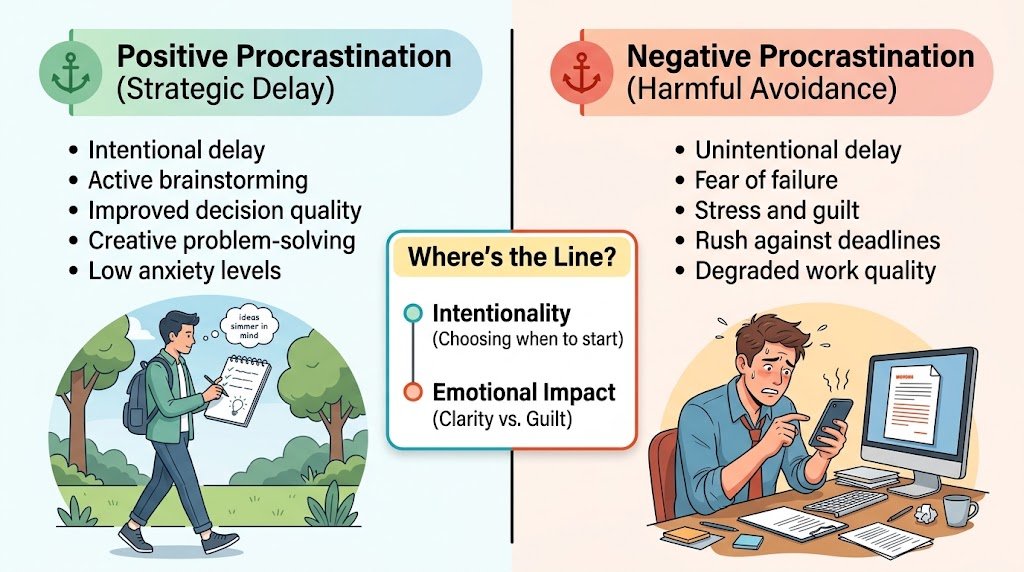
Procrastination becomes a double-edged sword depending on whether it is used as a conscious strategy or a unconscious escape mechanism. Recognizing when delay shifts from a tool for mental incubation into a pattern of harmful avoidance is essential for maintaining both performance and emotional well-being.
Signs Procrastination Has Become Harmful
When postponement is driven by overwhelming anxiety rather than deliberate choice, it turns into a maladaptive behavior. Recognizing these key warning signs helps identify when chronic procrastination is undermining your health and goals.
Pervasive Guilt and Anxiety: You experience constant emotional distress, guilt, or shame while delaying the task, preventing true rest or recovery.
Compounded Stress and Missed Deadlines: Postponing action leads to frequent panic-driven rushes, degraded work quality, or outright failure to meet obligations.
Escaping via Low-Value Distractions: You repeatedly engage in mindless tasks or low-priority activities purely to numb the discomfort of an impending responsibility.
Impact on Relationships and Health: The ripple effects of continuous delay result in friction with team members, sleep deprivation, or chronic physical stress.
Comparison Table: Positive vs. Negative Coping Through Procrastination
Evaluating the core differences between functional delay and negative coping highlights where to set personal boundaries.
| Metric | Positive Coping (Strategic Delay) | Negative Coping (Harmful Avoidance) |
| Primary Intent | Strategic pacing, mental incubation, and energy optimization. | Emotional escape, fear neutralization, and task avoidance. |
| Mindset During Delay | Calm, deliberate, and confident in the process. | Anxious, guilty, and preoccupied with self-doubt. |
| Task Execution | High-focus execution within a planned timeframe. | Rushed, reactive work performed under extreme friction. |
| Long-Term Impact | Enhanced creativity, better prioritization, and high quality. | Chronic stress, decreased self-esteem, and burnout. |
How to Reframe Procrastination to Build Resilience
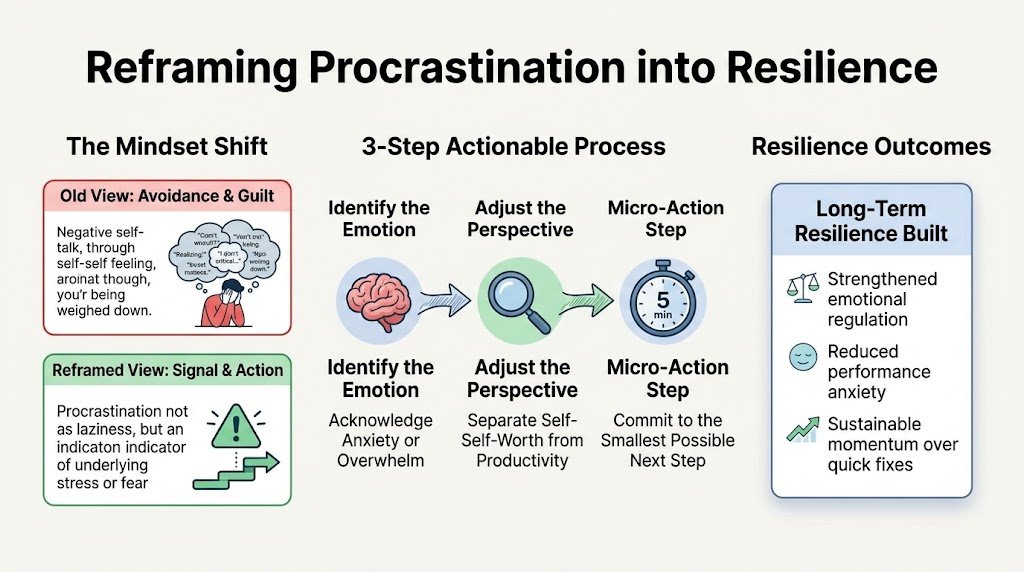
Transforming procrastination into a constructive force requires changing how you interpret the initial resistance to act. By practicing adaptive reframing, you shift from a cycle of self-criticism to a mindset of cognitive agility, using task friction as a signal for personal growth and psychological resilience.
Adaptive Reframing Techniques
Adaptive reframing involves consciously challenging negative thought patterns about delay and replacing them with functional, growth-oriented perspectives.
Practice Cognitive Reframing: Instead of viewing initial reluctance as laziness, reframe it as a signal that the task needs clearer structure, further reflection, or emotional processing.
Leverage Self-Compassion: Research consistently shows that forgiving yourself for past delay reduces anxiety, lowers cortisol, and makes initiating action easier moving forward.
Adopt a Growth Mindset: View the friction experienced during task initiation not as a limit on your ability, but as an opportunity to build distress tolerance and executive control.
Turning Delay Into a Resilience-Building Habit
Building true resilience means establishing structured boundaries so that intentional pauses actively support long-term productivity rather than devolving into avoidance.
Acknowledge the Signal: When resistance strikes, pause to identify the root emotional driver—whether it is fear, perfectionism, or ambiguity—before deciding on your next move.
Define the Active Pause: Set a clear, fixed duration for your break, explicitly defining what cognitive process (such as mental incubation or rest) will occur during the delay.
Execute Micro-Initiations: Break the task into immediate, low-effort entry points to lower the emotional activation energy required to start.
Reflect and Calibrate: After completing a project following an active pause, evaluate what worked well and refine your pacing strategies for future challenges.
Practical Techniques to Use Procrastination Productively
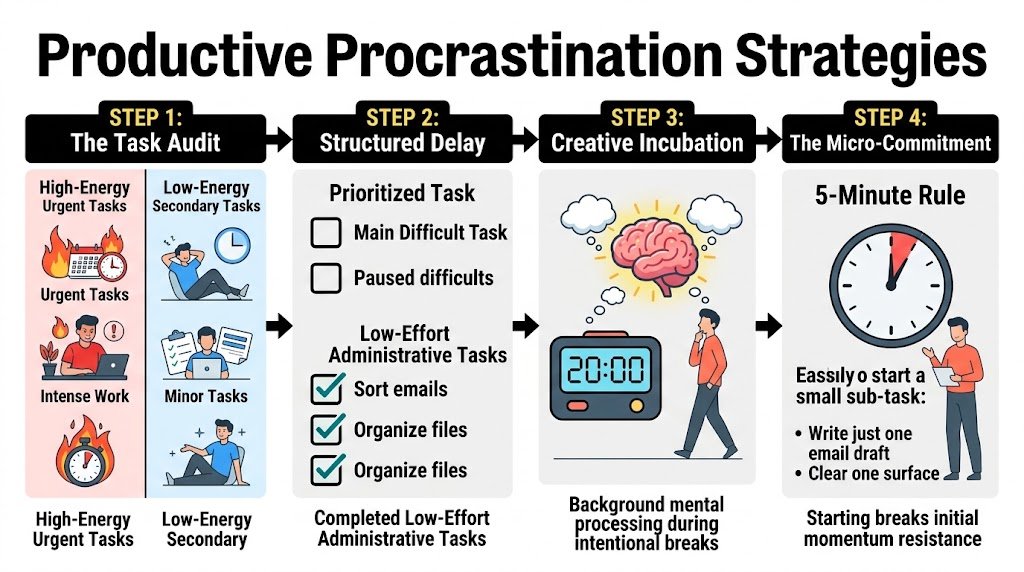
Converting procrastination into an intentional asset requires structured framework boundaries. By applying target behavioral techniques, you can channel natural delay into focused execution while eliminating the emotional paralysis associated with passive avoidance.
The 5-4-3-2-1 Rule Explained
Popularized by Mel Robbins, the 5-4-3-2-1 rule is a simple neuroscience-backed technique that interrupts the brain’s instinct to hesitate, overthink, and avoid discomfort.
Disrupts the Limbic System: Counting backward forces the prefrontal cortex to engage, bypassing the emotional brain’s impulse to seek immediate comfort.
Neutralizes Friction: The 5-second window prevents your mind from creating excuses or rationalizing reasons to postpone the action.
Launches Immediate Motion: When you reach “1,” you immediately initiate a physical movement toward the task, establishing momentum before resistance sets in.
Time-Boxing Your “Productive Delay”
Time-boxing sets hard boundaries around your active delay, ensuring that mental breaks remain restorative and do not degrade into uncontrolled avoidance.
Schedule the Incubation Period: Explicitly assign a fixed block of time (e.g., 30 to 60 minutes) dedicated solely to stepping away from the project to gather ideas or rest.
Define the Resume Trigger: Establish an unambiguous condition or time for returning to active work, such as a set alarm or completing a specific secondary task.
Protect the Window from Distractions: Use the allocated delay for low-cognitive or restorative activities rather than high-dopamine distractions like social media.
Setting Self-Imposed Deadlines the Right Way
Artificial deadlines often fail because the brain recognizes them as arbitrary. Setting effective self-imposed deadlines requires introducing accountability structures to create genuine urgency.
Leverage Public Commitments: Inform a peer, manager, or client of your scheduled completion time to introduce social accountability.
Attach Micro-Consequences: Pair internal deadlines with tangible outcomes, such as scheduling a follow-up review meeting immediately following your targeted finish time.
Break Down Major Milestones: Set strict interim deadlines for individual project phases rather than one distant target, triggering steady, manageable bursts of deadline pressure.
Section 12: FAQs (People Also Ask)
What are 7 ways to overcome procrastination?
Overcoming chronic delay requires a mix of emotional regulation strategies and practical time-management frameworks. The seven most effective approaches include:
- Break tasks into micro-steps: Lower activation energy by starting with a 2-minute version of the task.
- Use the 5-4-3-2-1 rule: Count down backward to interrupt overthinking and force immediate physical action.
- Practice self-compassion: Forgive yourself for past delay to reduce anxiety and lower friction for future work.
- Time-box your tasks: Schedule dedicated, fixed time blocks for focused execution and structured breaks.
- Eliminate digital friction: Block high-dopamine distractions during focus windows to maintain attention.
- Pair tasks (Temptation Bundling): Combine a low-reward requirement with an enjoyable sensory activity.
- Establish external accountability: Share deadlines with a partner or colleague to create social commitment.
What is a positive coping method?
A positive coping method is an intentional, constructive behavior that helps manage negative emotions and stress without causing long-term harm. Unlike maladaptive avoidance strategies, positive coping mechanisms—such as active delay, structured breaks, or mindfulness—allow your nervous system to regulate while preserving overall productivity and emotional wellbeing.
What is the best cure for procrastination?
There is no single "cure" because procrastination is an emotional regulation issue rather than a simple failure of discipline. The most sustainable solution is developing emotional self-awareness combined with structured action triggers. Identifying the specific emotion driving your avoidance—such as fear, ambiguity, or perfectionism—allows you to apply targeted strategies like micro-stepping or active reframing to overcome initial task friction.
How do I train my brain to stop procrastinating?
Brain training relies on neural rewiring through consistent, repeated behavioral cues that reward action over delay:
- Lower activation thresholds: Commit to working on a project for just 5 minutes to bypass limbic system resistance.
- Reward immediate initiation: Deliver a small, immediate positive reward right after completing a challenging initiation phase.
- Build distress tolerance: Practice sitting with brief moments of boredom or anxiety without immediately reaching for quick dopamine distractions.
What is your most productive form of procrastination?
The most productive form of procrastination is structured or active delay, where you postpone a high-cognitive task to execute lower-priority, essential administrative work. Examples include clearing your inbox, organizing your workspace, or conducting background research. This allows your brain to engage in mental incubation on the primary project while still generating meaningful momentum across secondary responsibilities.
Why does procrastinating make me feel depressed?
Procrastination creates a psychological feedback loop that directly impacts emotional wellbeing. When you delay a task, the initial mood repair is brief, followed quickly by guilt, shame, and self-criticism. Over time, chronic avoidance reinforces a sense of helplessness and low self-efficacy, making you feel trapped in an endless cycle of panic, incomplete goals, and emotional exhaustion.
Mark Steve
Mark Steve is a tech, business, and lifestyle writer with over 5 years of experience analyzing digital trends, startups, and online business models. He publishes well-researched, fact-checked content focused on clarity, credibility, and real-world value.