Is Procrastination a Sign of ADHD? The Real Truth Explained
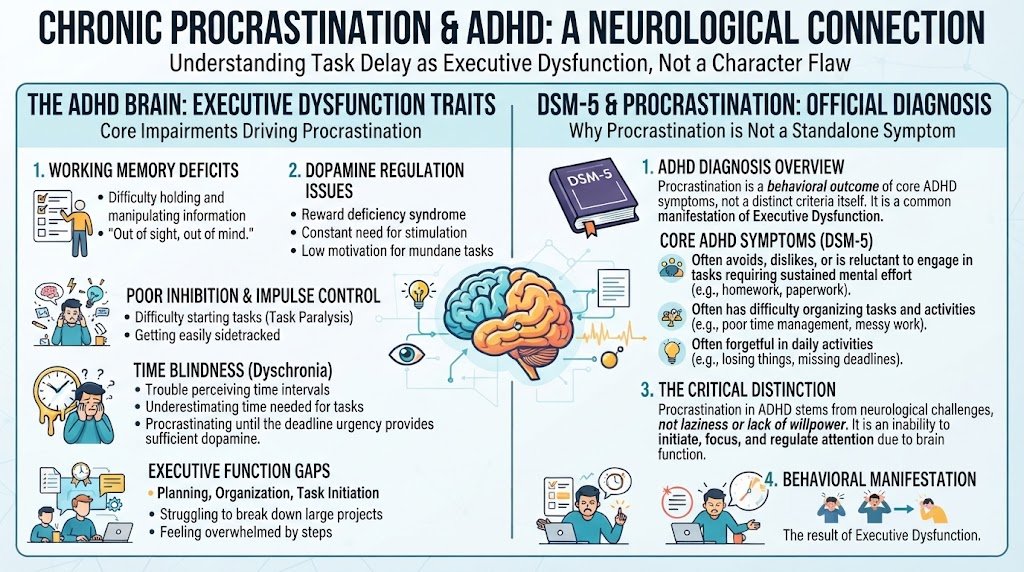
Chronic procrastination is a frequent, hallmark behavioral challenge associated with ADHD, though it is not officially listed as a standalone diagnostic symptom in the DSM-5. For individuals with ADHD, delaying tasks is rarely a matter of poor time management or laziness; rather, it is a direct result of executive dysfunction, working memory deficits, and dopamine regulation issues that make task initiation uniquely difficult.
The Answer
While procrastination affects everyone occasionally, in ADHD it manifests as a persistent, debilitating pattern rooted in brain chemistry. The ADHD brain struggles significantly with intrinsic motivation, making it exceptionally hard to start tasks that lack immediate urgency or high stimulation.
Procrastination functions as a downstream consequence of executive dysfunction rather than a character flaw.
Tasks are frequently delayed until the pressure of an impending deadline creates enough adrenaline and dopamine to force action.
This pattern often leads to chronic stress, shame, and a cycle of underachievement despite high intellectual capability.
Why It’s Not an Official DSM-5 Symptom (But Still Matters)
The Diagnostic and Statistical Manual of Mental Disorders (DSM-5) outlines specific diagnostic criteria for ADHD, focusing on core traits like inattention, hyperactivity, and impulsivity. Procrastination is excluded as a formal criterion because it is too broad and common in other conditions, such as anxiety, depression, and general executive burnout.
The clinical criteria focus on root cognitive impairments, while procrastination is viewed as a behavioral outcome of those impairments.
Clinicians look for underlying traits—such as poor working memory, distractibility, and disorganization—that naturally produce chronic task delay.
Recognizing procrastination as a sign rather than a formal diagnostic requirement helps individuals target the root executive dysfunction rather than just treating the symptom.
Why Does ADHD Cause Procrastination? The Real Brain Mechanisms (H2)
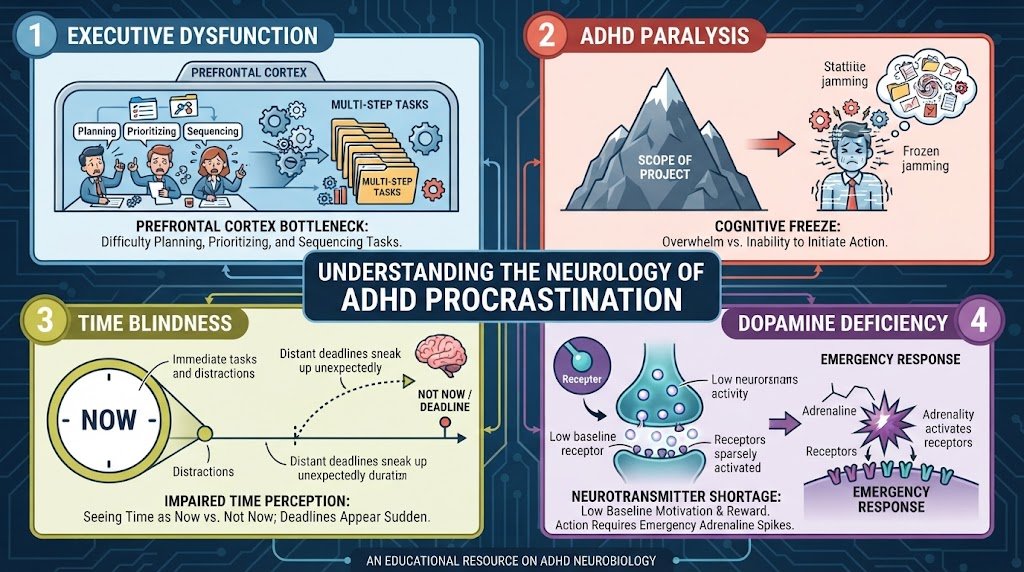
Procrastination in attention deficit hyperactivity disorder is not a behavioral choice or a failure of willpower; it is the physical manifestation of neurological differences in how the brain processes motivation, time, and stimuli. Structural and chemical variations in the prefrontal cortex disrupt the mechanics of task execution, making simple transitions feel like monumental barriers.
Executive Dysfunction (Planning & Prioritizing Breakdown)
Executive dysfunction sits at the core of ADHD-related procrastination, impairing the brain’s command center located in the prefrontal cortex. This region is responsible for organizing multi-step projects, sequencing tasks, and deciding what deserves immediate attention.
The brain struggles to sequence actions logically, meaning a simple task like filing taxes feels like navigating an unmapped labyrinth.
Working memory deficits make it difficult to hold instructions or goals in mind long enough to formulate a step-by-step strategy.
Because the pathway from thought to structured execution is fragmented, the brain retreats from the overwhelming planning phase entirely.
ADHD Paralysis (When a Task Feels Too Big to Start)
ADHD paralysis is a state of cognitive lock where an individual feels completely frozen, desperately wanting to begin a task yet utterly incapable of making a physical movement. It occurs when incoming choices, sensory stimuli, or task scopes overwhelm a brain already struggling with regulation.
Tasks with ambiguous starting points trigger intense psychological friction, leading to absolute inertia.
The perceived mountain of effort required triggers an acute stress response, shifting the brain into a freeze state.
Rather than resting, the mind spins in circles of guilt while remaining completely unable to bridge the gap between intention and action.
Time Blindness (Why Deadlines Sneak Up)
Time blindness is a profound neurological inability to intuitively sense the passage of time or accurately project how long an activity will take. For a neurodivergent brain, time exists almost exclusively in two zones: “Now” and “Not Now.”
Future consequences lack emotional or mental weight, causing deadlines weeks away to feel completely unreal until they are hours away.
Underestimating project durations leads to chronic overcommitment and last-minute panic states.
Because hours evaporate unnoticed, individuals are trapped in a reactive loop of emergency management.
Dopamine Deficiency (The Missing Motivation Reward)
Dopamine is the neurotransmitter of anticipation, reinforcement, and reward-driven behavior, and the ADHD brain operates with an impaired dopamine reward pathway. Without a steady baseline of this chemical messenger, mundane tasks fail to trigger the internal reward signals required to spark action.
Low baseline dopamine makes routine responsibilities feel intensely boring, dull, or even physically painful to initiate.
The brain craves high-stimulation activities or instant gratification to self-medicate its chemical deficit, pushing critical work aside.
Action is frequently delayed until an impending crisis injects enough adrenaline and emergency cortisol to artificially force dopamine release.
Learn more about this mechanism from the visual breakdown in .
ADHD Procrastination vs. Regular Procrastination: What's the Real Difference? (H2)
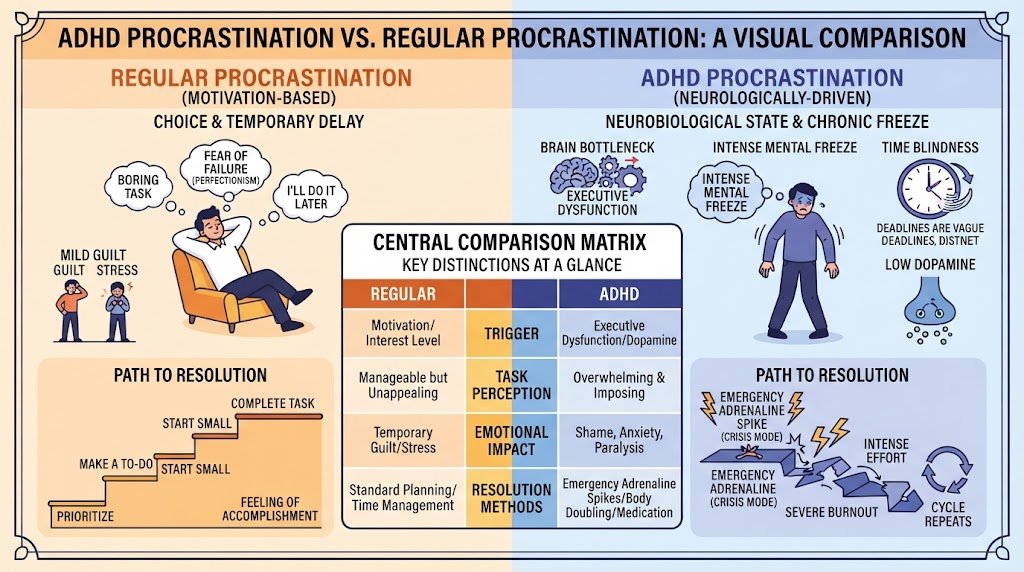
Distinguishing between standard procrastination and ADHD-driven delay is essential for understanding how to break the cycle. While everyone occasionally puts off unpleasant duties, classic procrastination stems from temporary motivation loss or poor planning, whereas ADHD procrastination is a neurologically hardwired response to executive dysfunction and dopamine deficits.
Regular Procrastination (Motivation-Based)
Classic procrastination is typically driven by temporary emotional avoidance, low motivation, or poor short-term decision-making regarding priorities. Individuals with traditional procrastination habits understand the steps required and can usually execute them once they overcome temporary friction.
Classic procrastination is often linked to perfectionism, fear of failure, or a simple lack of interest in a specific assignment.
Once the individual decides to start, the physical transition from rest to work happens relatively smoothly without intense cognitive lock.
Temporary stress or a brief motivational push is usually enough to realign focus and complete the task on schedule.
ADHD Procrastination (Neurologically-Driven)
ADHD procrastination is an involuntary freeze state rooted in brain chemistry and structural deficits within the prefrontal cortex. It occurs regardless of how important, urgent, or deeply desired the outcome is, driven by an inability to regulate attention and bridge the gap between thought and action.
Task avoidance is heavily tied to emotional dysregulation, time blindness, and an absolute deficit in intrinsic reward processing.
Even when someone desperately wants to finish a project, executive dysfunction physically blocks the initiation phase, resulting in agonizing paralysis.
Action is rarely triggered by conscious choice; instead, it typically requires the emergency chemical spike of a looming crisis to force momentum.
Comparison Table — Triggers, Duration, Emotional Impact, Resolution
| Feature | Regular Procrastination | ADHD Procrastination |
| Primary Triggers | Boredom, perfectionism, fear of failure, or poor prioritization. | Executive dysfunction, task overload, time blindness, and low dopamine. |
| Task Perception | Viewed as tedious, difficult, or unappealing, but manageable. | Viewed as an insurmountable wall, physically painful, or utterly confusing. |
| Emotional Impact | Mild guilt or fleeting anxiety that resolves quickly once work begins. | Severe chronic shame, deep feelings of inadequacy, and mental exhaustion. |
| Resolution Method | Better planning, breaking tasks down, or simply waiting out low motivation. | Emergency adrenaline spikes, external body doubling, or breaking the freeze state with novel rewards. |
Is It ADHD — Or Something Else? (Comparison Hub)
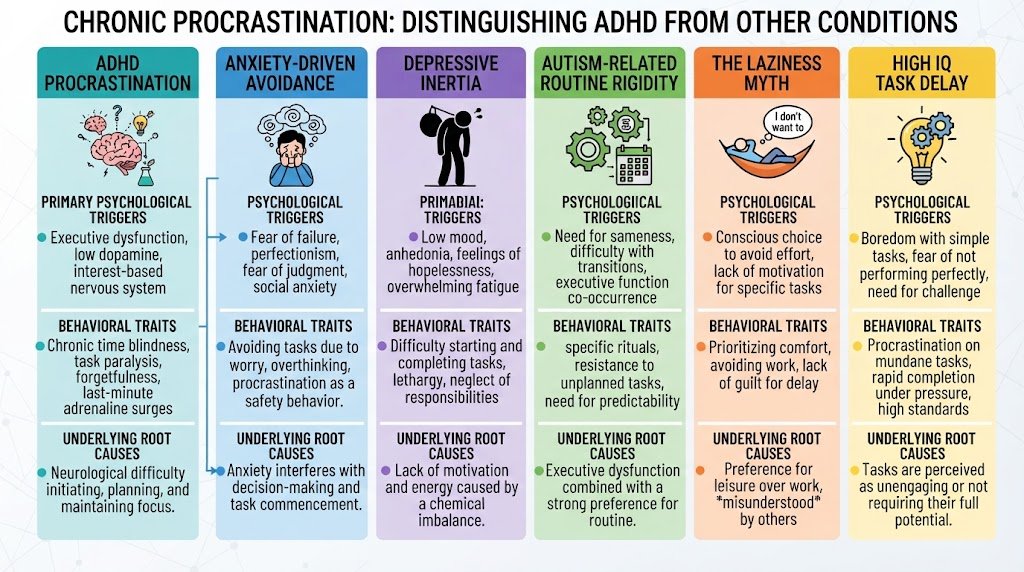
Pinpointing the root cause of chronic task delay requires looking beyond the surface behavior to understand what drives the avoidance. Because procrastination is a common downstream symptom of multiple psychological and neurological conditions, misdiagnosing the underlying trigger can lead to ineffective coping strategies.
Procrastination and Anxiety
Anxiety-driven procrastination stems from an intense fear of failure, perfectionism, or catastrophic thinking about the quality of the final output. The task itself feels threatening rather than merely boring, triggering a fight-or-flight response that results in avoidance.
The anxiety cycle feeds on high expectations, causing individuals to delay starting because they fear the work will not meet their rigid standards.
Unlike ADHD, which is fueled by a lack of dopamine and stimulus, anxiety procrastination is fueled by hyper-arousal and fear of negative evaluation.
Relief only comes temporarily when the task is avoided, which unfortunately reinforces the avoidance loop over time.
Procrastination and Depression
Depressive inertia creates a heavy, pervasive lack of energy and anhedonia that makes even basic daily activities feel impossible to initiate. When emotional and physical reserves are entirely depleted, motivation flatlines completely.
Depression-related delay is characterized by pervasive exhaustion, feelings of worthlessness, and a generalized loss of pleasure in life.
The brain lacks the emotional and physical bandwidth to care about future consequences or deadlines.
Unlike the active mental racing of ADHD paralysis, depressive inertia feels like moving through wet concrete with a heavy, numb mind.
Procrastination and Autism
Autism-related procrastination is frequently tied to executive function challenges combined with intense resistance to unstructured tasks or sudden transitions. When instructions are vague or the expected routine is disrupted, the autistic brain experiences severe friction.
Autistic individuals may delay starting projects that lack clear guidelines, explicit expectations, or a predictable framework.
Sensory overload can also induce a shutdown state, making productive work physically and mentally inaccessible.
Managing this form of delay requires establishing rigid predictability, clear visual schedules, and sensory-friendly work environments.
Procrastination and Laziness (Why It’s Not the Same Thing)
The laziness myth assumes that individuals who procrastinate simply lack work ethic or desire to succeed. In clinical reality, laziness does not exist as a psychological diagnosis; it is almost always a label misapplied to executive dysfunction, burnout, or despair.
True laziness involves choosing not to do something and feeling completely comfortable, relaxed, or indifferent about that choice.
Procrastinators suffer intensely from guilt, anxiety, and a deep desire to complete the task while being mentally locked out of action.
Labeling the behavior as laziness ignores the actual neurological roadblocks preventing task initiation.
Procrastination and High IQ (Does Intelligence Play a Role?)
High intellectual capacity can inadvertently fuel chronic procrastination by masking early warning signs and enabling last-minute success. Gifted individuals can often coast through early academic or professional environments using raw intellect alone.
Because they are accustomed to succeeding with minimal effort, they never develop robust systems for planning, studying, or sustaining long-term focus.
When they finally encounter complex challenges that require sustained effort, the lack of foundational execution skills triggers intense avoidance.
High intelligence creates a false sense of security, reinforcing a dangerous cycle of relying on adrenaline-fueled crunches.
ADHD or Autism? Overlapping Traits Explained
ADHD and autism frequently co-occur (often referred to as AuDHD), sharing overlapping symptoms like executive dysfunction and difficulty with emotional regulation. However, their underlying relationship with procrastination exhibits distinct differences.
While ADHD procrastination stems from dopamine deficiency and a chaotic internal search for stimulation, autistic procrastination stems from a need for order and predictable structure.
An AuDHD brain may simultaneously crave novelty and high-intensity input while being paralyzed by unstructured demands.
Unraveling these overlapping traits requires assessing whether the primary barrier is boredom and disorganization or sensory overload and a lack of clear rules.
Self-Check — Does Your Procrastination Look Like ADHD? (H2)
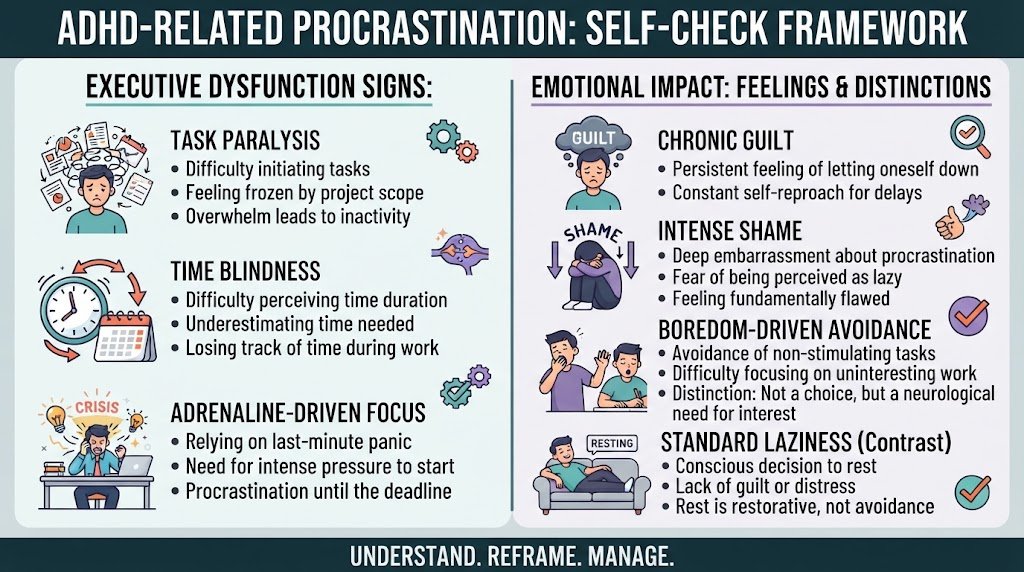
Evaluating whether your task avoidance stems from neurodivergence requires looking at recurring behavioral patterns rather than occasional bad habits. This self-assessment framework helps you identify whether your struggles align with classic executive dysfunction or standard motivational hurdles.
6 Signs Your Procrastination May Be ADHD-Related (checklist format)
Paralysis over simple tasks: You experience an overwhelming mental freeze when faced with easy or multi-step assignments, feeling entirely incapable of making the first move.
Reliance on panic to perform: You consistently find yourself unable to work until the stress of an immediate deadline triggers an intense surge of adrenaline.
Time blindness during projects: You routinely miscalculate how long a task will take, frequently believing something requires ten minutes when it demands two hours.
Intense emotional distress: Your procrastination is accompanied by disproportionate shame, deep self-criticism, and a persistent cycle of chronic guilt.
Boredom-driven avoidance: You can hyperfocus effortlessly on engaging or high-reward activities while finding mundane duties physically painful to initiate.
Scattered execution: Even when you successfully start a project, you struggle to sustain linear focus, often getting distracted or jumping between unrelated sub-tasks.
What This Checklist Can (and Can’t) Tell You
While this self-assessment helps highlight patterns consistent with executive dysfunction, it functions solely as an informational guide rather than a clinical evaluation. Recognizing these traits provides valuable clarity for understanding your brain’s unique wiring, but true validation requires professional insight.
This checklist cannot provide a formal medical diagnosis or replace a comprehensive psychiatric evaluation.
Use these insights as a starting point to reflect on your daily habits and prepare for meaningful discussions with a healthcare professional.
Identifying these patterns opens the door to adopting brain-friendly strategies tailored to your actual neurological needs rather than relying on generic productivity tips.
Practical, ADHD-Specific Ways to Stop Procrastinating (H2)
Standard productivity advice—like writing simple to-do lists or trying harder to focus—frequently fails neurodivergent minds because it ignores the underlying executive dysfunction. Breaking the cycle requires implementing actionable, brain-friendly strategies specifically designed to bypass dopamine deficits, lower initiation friction, and create external scaffolding.
Body Doubling (Working Alongside Someone Else)
Body doubling leverages the presence of another person to anchor attention and quiet the restless mind, making it one of the most powerful tools for task initiation. Knowing someone else is quietly working nearby provides a subtle external anchor that reduces the isolation of the task.
The physical or virtual presence of a colleague, friend, or body doubling platform creates silent accountability without pressure.
This technique helps regulate the nervous system, turning an intimidating solo chore into a shared, manageable experience.
It bypasses internal motivation struggles by substituting shared social energy for missing internal drive.
The 5-Minute Rule (Lowering the Barrier to Start)
The 5-minute rule combats ADHD paralysis by lowering the psychological commitment required to begin a dreaded assignment. Instead of facing an entire project, you grant yourself permission to quit after five minutes of effort.
Committing to just a brief window reduces the catastrophic mental weight that triggers the brain’s freeze response.
Once the initial friction of starting is bypassed, the brain often generates enough momentum to continue past the initial time limit.
If you truly stop after five minutes, you have still successfully broken the inertia and made tangible progress.
Micro-Steps & Task Chunking
Task chunking involves stripping away large, ambiguous project scopes and breaking them down into microscopic, hyper-specific physical actions. Traditional lists fail when a line item reads “work on report,” because the brain does not know what physical movement to execute first.
Transform vague goals into concrete actions, such as “open a blank document” instead of “write article.”
Keep chunking individual steps until each one feels ridiculously small and effortless to accomplish.
This strategy prevents working memory overload by keeping only one microscopic objective active at a time.
The Pomodoro Technique (Adapted for ADHD Brains)
The standard 25-minute work interval can feel either too restrictive or too long for a hyperactive mind, requiring flexible adaptation. Tailoring the Pomodoro technique to your unique attention span helps prevent burnout and harnesses natural focus rhythms.
Experiment with ultra-short intervals, such as 10 minutes of work followed by a 2-minute break, for high-resistance days.
Use visual timers to make the passage of time concrete, combating time blindness during focus blocks.
Keep breaks active but controlled—such as stretching or getting water—so the brain does not get sucked into a distraction rabbit hole.
External Structure — Timers, Reminders, Accountability Partners
Because the internal management system of an ADHD brain is unreliable, building a robust external scaffolding is essential for maintaining consistency. Offloading memory and organization onto external cues reduces mental fatigue.
Set frequent visual and auditory alarms on your phone or smart speaker to transition between tasks throughout the day.
Establish formal check-ins with an accountability partner or coach to review completed milestones and maintain forward momentum.
Keep tools, notes, and materials visible in your immediate workspace to minimize the invisible friction of out-of-sight, out-of-mind habits.
Explore more practical demonstrations of these methods in
ADHD Procrastination Across Life Stages
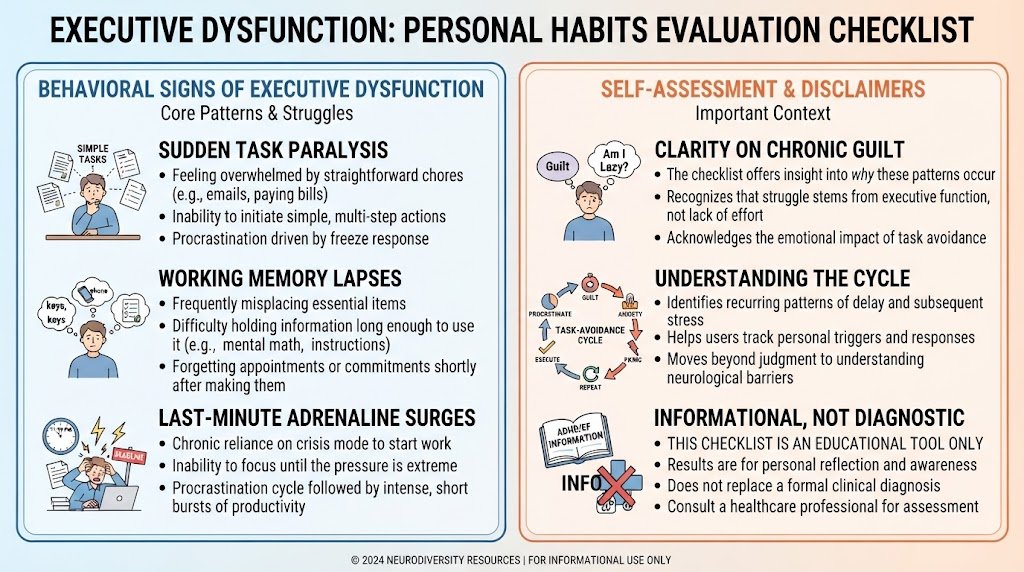
Procrastination manifests differently as individuals navigate various developmental milestones, shifting from externalized academic hurdles in youth to complex internal demands in adulthood. Understanding how task avoidance evolves across the lifespan helps clarify why certain strategies work at specific ages while failing at others.
Procrastination in ADHD Kids and Teens vs. Adults
In younger years, task avoidance is heavily mediated and managed by external scaffolding provided by parents, teachers, and rigid school schedules. When children and teenagers experience ADHD procrastination, it usually presents as missing homework, messy backpacks, or emotional meltdowns over seemingly simple assignments.
Children rely on external authority figures to break down tasks, set deadlines, and push them past initial inertia.
Adults face a sharp rise in autonomous responsibilities, such as managing finances, career planning, and maintaining households without direct supervision.
As adult life demands independent executive control, procrastination shifts from a minor school annoyance into a severe threat to career stability and personal relationships.
When ADHD Symptoms (and Procrastination) Peak
While ADHD is a lifelong neurodevelopmental condition, the severity of its behavioral impact fluctuates significantly across developmental transitions. Symptoms and associated procrastination often peak during periods of major life upheaval where structural support abruptly disappears.
The transition from structured high school environments to unstructured university life or the workforce represents a massive vulnerability window.
During early adulthood (ages 18 to 25), the sudden lack of daily oversight causes executive dysfunction to spike dramatically.
Conversely, as individuals find careers aligned with their unique strengths or develop robust coping mechanisms, chronic procrastination can become more manageable later in life.
What Happens If ADHD-Related Procrastination Goes Untreated
Ignoring chronic executive dysfunction and treating task avoidance as a simple bad habit creates a cumulative toll on mental health and long-term achievement. The consequences extend far beyond missed deadlines, deeply impacting self-worth.
Persistent task delay breeds chronic stress, anxiety, and a debilitating cycle of shame and self-blame.
Individuals may underachieve professionally or academically despite possessing exceptional intelligence and creative capability.
Over years and decades, unmanaged ADHD procrastination frequently contributes to burnout, depression, and long-term demoralization.
What It Actually Feels Like — Real Experiences
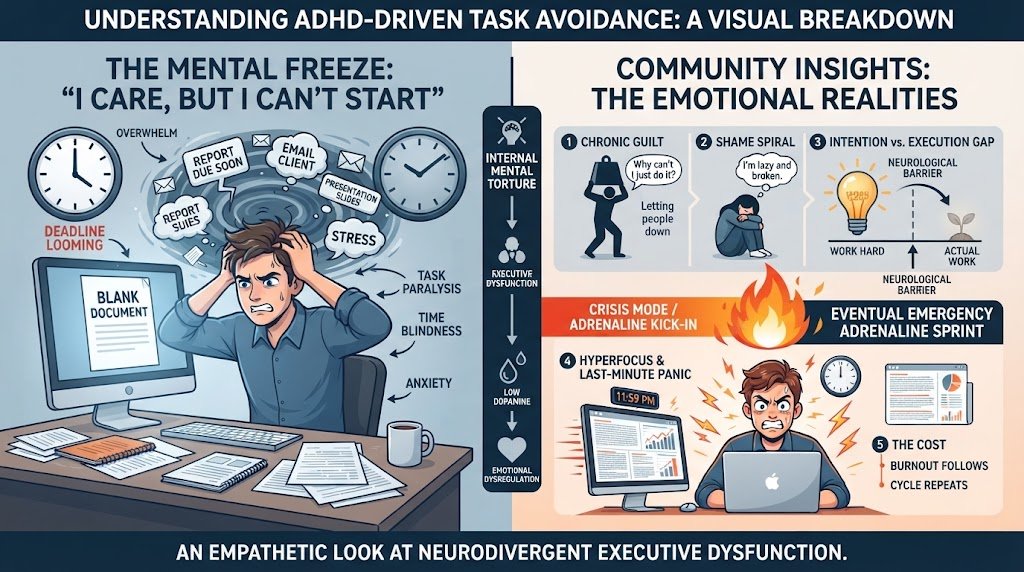
Understanding ADHD procrastination requires looking beyond clinical definitions to examine the daily emotional and psychological reality of living with executive dysfunction. The lived experience of task avoidance is deeply frustrating, often misunderstood by outsiders, and wrapped in a heavy blanket of internal conflict.
The “I Care, But I Can’t Start” Pattern (relatable scenario writing)
Imagine sitting in front of a computer screen for six hours, staring at a single open document while watching the cursor blink rhythmically. You desperately want to finish the report, your job depends on it, and you deeply care about the outcome, yet a brick wall in your mind prevents you from typing a single word.
Every minute that ticks by intensifies the panic, making the impending deadline feel like an approaching freight train.
Instead of relaxing, you spend those hours trapped in agonizing mental torture, unable to enjoy leisure activities because the unfinished task looms overhead.
When the midnight panic finally hits and emergency adrenaline forces you to finish the work in a breathless two-hour sprint, it reinforces the exhausting cycle for the next project.
What the ADHD Community Says (paraphrased Reddit/community insight)
Discussions across neurodivergent online spaces frequently center on the emotional exhaustion of being perceived as lazy when experiencing profound internal paralysis. Community members consistently describe task avoidance not as a lack of discipline, but as a total disconnect between intention and physical execution.
Individuals share that their brains treat washing a single dish or filing a tax form with the same neural alarm bells as facing immediate physical danger.
Many express relief upon discovering they are not broken or morally flawed, but rather experiencing a common neurological bottleneck related to dopamine and working memory.
The overwhelming consensus highlights that community support, non-judgmental accountability, and self-compassion are vital stepping stones for breaking free from chronic shame.
When to See a Professional About ADHD and Procrastination
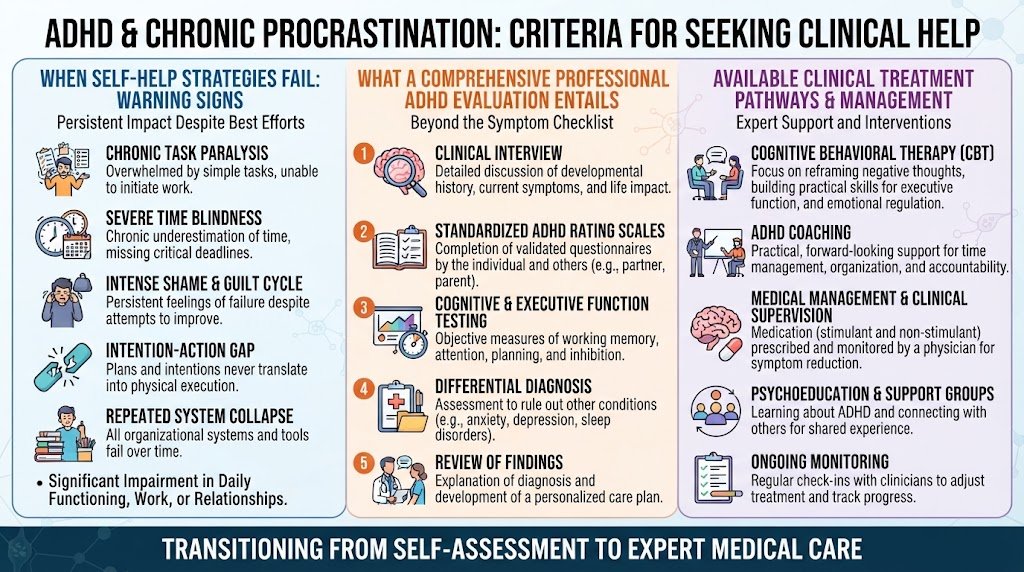
Recognizing executive dysfunction patterns is a powerful first step, but lasting change often requires professional guidance. When chronic task avoidance severely impacts your career, academic standing, or emotional well-being, consulting a qualified clinician provides the clarity and support needed to break the cycle.
Signs It’s Time for a Professional Evaluation
Self-help strategies and productivity hacks have limits when facing an underlying neurodevelopmental condition. Seeking a formal clinical evaluation becomes essential when coping mechanisms consistently fail to prevent ongoing distress.
Procrastination and disorganization create chronic crises, leading to job loss, academic failure, or severe relationship strain.
Feelings of shame, anxiety, and inadequacy become a constant baseline rather than temporary reactions to a busy week.
Standard time-management tools feel completely useless because the barrier is an invisible, physical inability to initiate tasks.
What an ADHD Assessment Involves
An official ADHD evaluation conducted by a licensed mental health professional is a comprehensive, multi-step process. Clinicians look far beyond simple self-reports to evaluate lifelong cognitive and behavioral patterns.
Clinical interviews explore developmental history, symptom onset during childhood, and current daily functioning across work and home settings.
Standardized behavior rating scales and objective screening tools are completed by the individual and often close family members.
The clinician reviews alternative explanations—such as anxiety, sleep disorders, or mood changes—to ensure an accurate diagnosis according to established guidelines like the National Institute of Mental Health (NIMH) ADHD Overview.
Treatment Options (Therapy, Coaching, Medication — Overview Only)
Managing ADHD-related procrastination successfully usually involves a multifaceted approach tailored to your specific neurological profile. Professional interventions aim to build external scaffolding and optimize brain function.
Cognitive Behavioral Therapy (CBT) and specialized ADHD coaching: Help reframe negative thought patterns, build customized organizational structures, and establish reliable execution habits.
Occupational therapy: Focuses on practical environmental modifications and sensory regulation strategies to reduce daily friction.
Medical management: Under the supervision of a licensed physician, non-stimulant or stimulant medication options can be explored to help balance neurotransmitters and improve baseline attention.
Frequently Asked Questions
What does ADHD procrastination look like?
ADHD procrastination appears as a debilitating mental freeze when facing routine or multi-step tasks. Individuals experience intense task avoidance, time blindness, and an inability to start working until an emergency deadline creates enough adrenaline to force action, often accompanied by severe guilt.
What are the three main symptoms of ADHD?
The core clinical presentation of ADHD is categorized into three primary traits: inattention, hyperactivity, and impulsivity. These foundational manifestations lead to downstream executive dysfunction struggles, including working memory deficits, trouble regulating attention, and chronic task initiation challenges.
What is extreme procrastination disorder?
While extreme procrastination is not an official standalone diagnosis in the DSM-5, it describes a chronic, paralyzing pattern of task avoidance. It is frequently a behavioral manifestation of underlying conditions like ADHD, severe anxiety, or depression that severely disrupts daily functioning.
Do high IQ people tend to procrastinate?
Yes, individuals with high intellectual capacity often develop severe procrastination habits. Because they can easily coast through early challenges using raw intelligence alone, they fail to build foundational planning skills, leading to intense avoidance when complex tasks eventually require sustained effort.
What is the 5-minute procrastination trick?
The 5-minute trick is a psychological strategy where you commit to working on a dreaded task for just five minutes before deciding whether to stop. This lowers the initial mental barrier triggering the freeze response, often generating enough momentum to continue past the limit.
At what age is ADHD at its peak?
While ADHD is lifelong, symptom severity and associated functional challenges often peak during major developmental transitions. Early adulthood, specifically ages 18 to 25, frequently marks a peak vulnerability window when structured oversight disappears and autonomous responsibilities surge dramatically.
What happens if ADHD is left untreated?
Untreated ADHD and chronic procrastination compound over time, leading to persistent stress, anxiety, and a debilitating cycle of shame. Individuals frequently underachieve relative to their actual intelligence and capabilities, which can ultimately contribute to career instability, burnout, and depression.
Sirinapa Chantarangsu
Sirinapa Chantarangsu is the Procrastination Editor at Holistic Wellbeing Living. She writes about task avoidance, perfectionism, focus, and manageable first steps. With six years of experience creating personal-growth content, Sirinapa helps readers replace guilt with practical strategies that make starting easier.