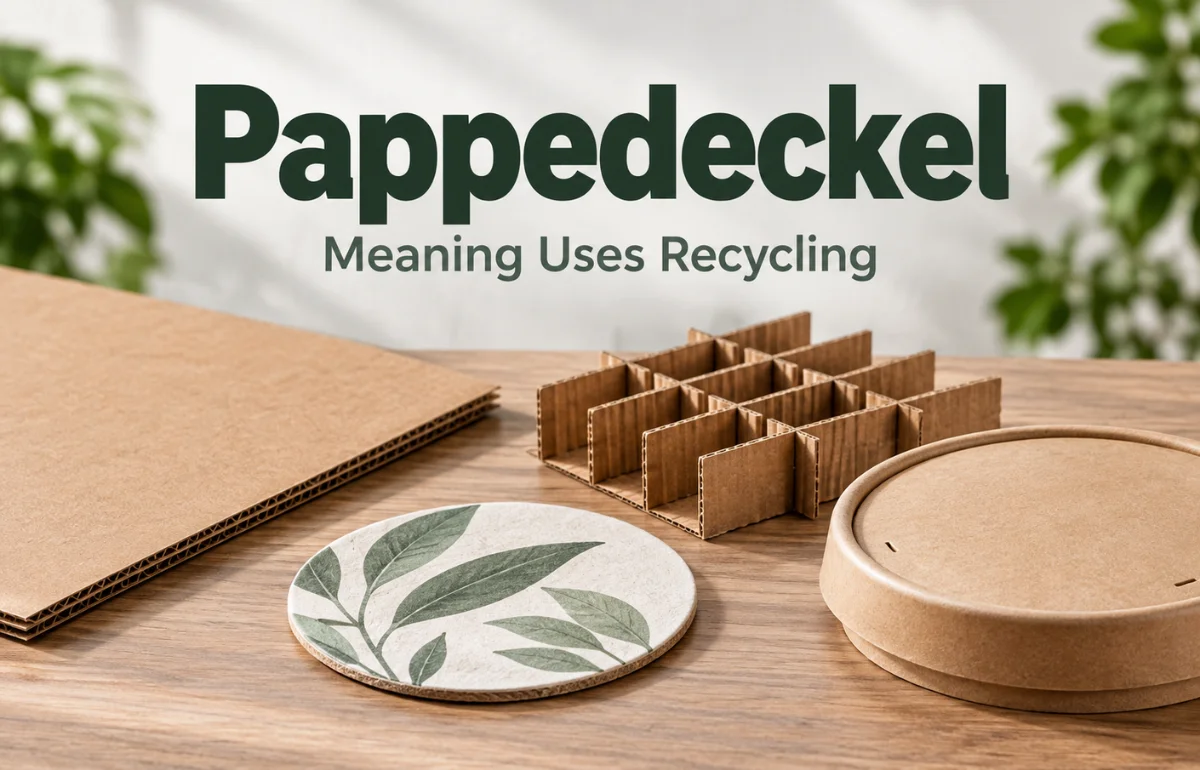
Pappedeckel is a regional German word associated with cardboard, paperboard, or a piece of stiff cardboard. It is closely related to the standard German words Pappdeckel and Pappendeckel, which dictionaries define as a piece of cardboard. Depending on the situation, an English speaker might translate it as “cardboard,” “cardboard piece,” or “cardboard cover.” It does not automatically mean a disposable food-container lid, despite the word Deckel meaning “lid” in German.
You might encounter the term in packaging, craftwork, drink coasters, or regional speech. I find it easiest to identify the object and setting before deciding what it means.
What Does Pappedeckel Mean in German?
The word belongs to a family of terms built around Pappe, meaning cardboard or a stiff paper-based material. Deckel usually means a lid or cover. That makes “cardboard lid” sound plausible.
But language rarely follows such tidy rules. The German dictionary Duden defines Pappdeckel as a piece of cardboard and gives an example involving a drink served on one. It also recognizes Pappendeckel as a related form. That meaning goes beyond packaging lids.
In practical English, I would choose “piece of cardboard” when the context is unclear. If the person is pointing to the cover of a box, “cardboard lid” is more natural. If the object sits under a glass, “drink coaster” describes its job better.
Pappedeckel, Pappdeckel, and Pappendeckel: Are They Different?
Pappdeckel and Pappendeckel are dictionary-recorded German forms. Both are masculine nouns: der Pappdeckel and der Pappendeckel. Their standard plurals are die Pappdeckel and die Pappendeckel, respectively.
Pappedeckel is especially associated with regional and dialect writing. The spellings may point to the same general material without being equally appropriate in formal German. For a school assignment, product specification, or translation into standard German, I would use the dictionary form that matches the context.
| Term | Typical meaning | Best use in English |
|---|---|---|
| Pappedeckel | Regional word for cardboard or a cardboard object | Translate from context |
| Pappdeckel | Standard German term for a piece of cardboard | Cardboard piece or board |
| Pappendeckel | Related recognized German term | Cardboard or cardboard piece |
| Bierdeckel | Coaster placed under a beer glass | Beer mat or drink coaster |
| Kartondeckel | Lid made for a cardboard box or container | Cardboard box lid |
A coaster and a takeaway lid require different properties.
Regional Meanings You Might Not Expect
In southern German dialects, the word can sound quite different from its standard relatives. The Bavarian Academy of Sciences and Humanities’ Bayerns Dialekte Online records Papp(en)deckel in the sense of Pappe or Karton, with spellings resembling Babbadegl and Pappadeckl.
An Alemannic regional glossary also lists Pabbedeggel and Pappedeckel for cardboard, adding that in some places the expression can mean a driving licence. This is a local usage, not a universal definition.
If a sentence mentions a car, a lost licence, or having permission to drive, I would check the regional meaning before translating it as packaging.
Where Do People Use Pappedeckel?
Drink Coasters and Café Tables
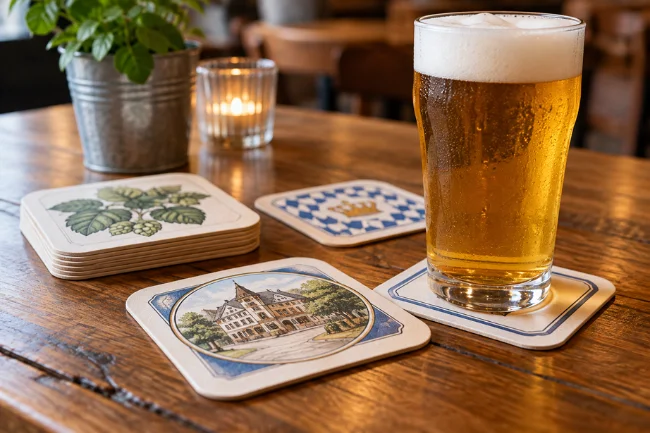
A flat cardboard coaster protects a tabletop from condensation, spills, and marks. Beer mats are especially familiar in German-speaking cafés and pubs. They may carry a brewery logo, a promotional message, or a printed design.
A coaster is not necessarily waterproof. Absorbent board handles condensation, but prolonged moisture softens it. A washable alternative may suit repeated use better.
Boxes, Covers, and Protective Packaging
Cardboard sheets and fitted covers protect goods in shipping, storage, and retail displays. A stiff insert can stop a photograph from bending, separate delicate items, or reinforce the bottom of a package.
Food businesses also use paperboard lids on certain trays, bowls, and takeaway containers. Here the fit matters as much as the material: a lid that slips off a container offers little protection, however sustainable its marketing sounds.
The name alone does not identify the product. Buyers need its shape, dimensions, and purpose.
Books, Schools, and Creative Work
Book covers, presentation mounts, model buildings, greeting cards, and display boards often use sturdy paperboard. Thick board gives a project structure while remaining relatively easy to cut, score, fold, and decorate.
For a small craft project, I would select the board by how it needs to bend. A sheet that folds neatly into a box may be unsuitable as a rigid backing board, while thick greyboard may crack if forced around a sharp fold without scoring.
What Is Cardboard Made From?
Cardboard and paperboard are generally made from cellulose fibers derived from wood or recovered paper. The fibers are mixed with water, formed into a sheet, pressed, and dried. Manufacturers then adjust the surface and structure to meet different demands.
Some boards contain several bonded layers. Corrugated cardboard has a fluted middle layer between flat liners, providing cushioning and stiffness without a solid heavy slab. Solid paperboard is more compact and commonly used where a smooth printing surface or precise shape is useful.
Virgin fibers may serve particular strength or cleanliness requirements. Recycled fibers reduce demand for new fiber but still require processing, water, and energy.
Thickness, Grammage, and Coatings
Packaging descriptions often mention gsm, short for grams per square meter. It measures the mass of a sheet over a defined area, not its thickness. Thickness is usually stated in millimeters or micrometers.
Two boards can have the same gsm yet feel different because one is more compressed or has a different layered structure. That distinction is easy to miss when ordering online. If rigidity matters, I would ask for both thickness and grammage, plus a sample if possible.
Coatings are another variable. Some improve grease or moisture resistance; others create a barrier for demanding foods. However, a coating can affect how the used product is sorted and recycled. “Paper-based” describes the main material, not necessarily every layer in the final product.
Comparing Common Paperboard Materials
Different cardboard products may look similar while doing very different jobs. This comparison is a practical starting point, not a substitute for checking an individual manufacturer’s specifications.
| Material | Typical strengths | Common limitations | Suitable applications |
|---|---|---|---|
| Solid paperboard | Smooth surface, easy printing and die-cutting | Can lose stiffness when wet | Cartons, fitted covers, cards |
| Greyboard or chipboard | Rigid, economical, often recycled | Rough finish, poor wet resistance | Book backs, dividers, craft models |
| Corrugated cardboard | Good cushioning with relatively low weight | Bulky, edges can crush | Shipping boxes, protective inserts |
| Absorbent coaster board | Takes up minor condensation | Swells or deforms when soaked | Beer mats, drink coasters |
| Barrier-coated paperboard | Improved resistance to moisture or grease | Recycling depends on coating and local systems | Selected food trays and lids |
Start with the failure you need to avoid: bending, leaking, scratching, moisture, or damaged printing. That tells you more than a generic cardboard label.
Is Pappedeckel Better Than Plastic or Molded Fiber?
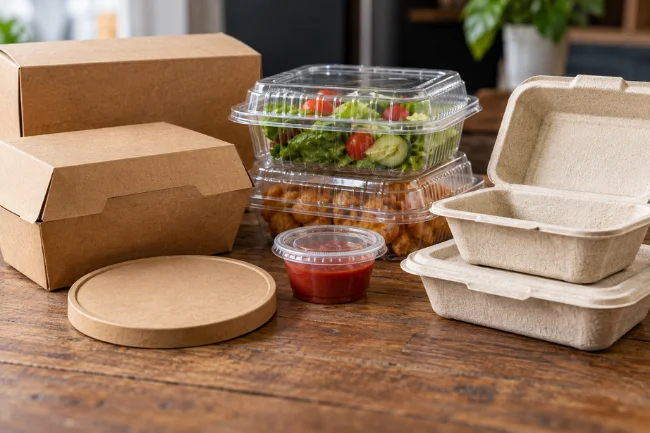
There is no universal winner. Plain paperboard can be light, printable, and easy to collect in established paper-recycling streams when clean. Plastic can provide strong moisture barriers and reliable sealing, although its recycling depends heavily on the polymer, shape, and local collection system.
Molded fiber is often chosen for trays and shaped food-service items. It can give products structure without looking like conventional plastic, but it may still require additives or a barrier treatment for oily or wet food.
For a dry bakery box, uncoated cardboard might be perfectly adequate. For a hot, oily meal being transported on a bicycle, lid security, grease resistance, and food-contact suitability become more important than appearance.
I would compare the intended use, delivery conditions, and waste system—not just the material label.
Is Pappedeckel Recyclable or Environmentally Friendly?
Clean, ordinary cardboard can often be recycled through paper collection. That is a genuine advantage where recycling facilities are available. Still, “made from paper,” “recyclable,” “biodegradable,” and “compostable” are four different claims.
Recyclable means a material can be recovered through an appropriate process and collection system. Biodegradable describes breakdown under certain conditions; compostable materials must meet specified conditions and standards. Neither label proves that an item belongs in a home compost bin.
A cardboard lid with a plastic lining, heavy grease contamination, or several bonded materials may be treated differently from a clean sheet of board. The correct disposal route depends on the complete product and local instructions.
How to Dispose of It in Germany
Germany’s Federal Environment Agency advises putting clean paper and cardboard into the paper collection. Composite packaging, such as many beverage cartons, generally belongs in the yellow bin or bag. Heavily soiled paper should not contaminate paper recycling.
My practical sorting check has three questions: What is the item made from? Is it clean and dry? What does the local collection service accept?
For example, a clean cardboard insert usually belongs with waste paper. A coated takeaway cup may need a different collection route. A food-soaked coaster may be unsuitable for paper recycling. When in doubt, check municipal guidance rather than trusting the appearance of the material.
How to Evaluate Environmental Claims
I look for specifics rather than broad phrases such as “100% green.” A useful product description should state whether the board contains recycled fiber, what barrier layers it uses, and how the packaging is meant to be disposed of.
The Forest Stewardship Council distinguishes FSC 100%, FSC Mix, and FSC Recycled labels. These indicate different sourcing claims. An FSC label does not, by itself, certify that a coated lid is compostable or accepted in every recycling system.
Reducing excess packaging and preventing food waste matter too. A failed container can waste both materials and food.
Food Safety and Packaging Rules in 2026
Not every cardboard sheet is suitable for direct food contact. Printing inks, adhesives, recovered-fiber contaminants, and coatings can affect how packaging performs around food. For a food lid, I would ask the supplier whether it is intended for the specific food type, temperature, and duration of contact.
The European Commission’s food-contact guidance explains that food-contact materials placed on the EU market must comply with Regulation (EC) No 1935/2004 and applicable manufacturing and material rules. Decorative craft board should never be treated as food-safe merely because it is cardboard.
The EU Packaging and Packaging Waste Regulation began applying on August 12, 2026, with phased requirements covering packaging waste, recyclability, and substances of concern. It also introduced limits on PFAS in food-contact packaging placed on the market from that date. Other design-for-recycling and related obligations follow different timetables, so a supplier should verify the specific requirement rather than claiming that all changes happened at once.
Businesses need documentation, not just sustainability slogans.
How I Would Choose the Right Cardboard Product
First, I would name the job clearly. Is the item a coaster, shipping insert, rigid backboard, or food-container lid? That simple question prevents most ordering mistakes.
Next, I would check the actual dimensions. A lid needs to match the container opening and rim design; approximate diameter alone may not ensure a secure fit. Flat board should be measured for length, width, and thickness.
I would then check four things:
- Strength: Can it resist bending, crushing, or tearing during normal use?
- Exposure: Will it meet water, condensation, heat, grease, or direct sunlight?
- Safety: Is it approved or appropriately documented for its intended food contact, if relevant?
- End of life: Can the whole product be collected and recycled locally, or does it contain a separate barrier layer?
For printed commercial packaging, I would also request artwork specifications, minimum order quantities, and a physical sample. A prototype can reveal poor folding, weak edges, or a loose fit before a full production run.
Simple Ways to Reuse Cardboard at Home
Clean, stiff cardboard can be reused. I prefer matching it to modest tasks rather than treating it like wood or plastic.
A dry, flat panel can become a drawer divider, a protective layer under a craft project, or a backing board for a photograph. A small round piece can work as a temporary coaster, although it will need replacing once it becomes soaked.
For neater results, measure first and cut on a protected surface with a suitable tool. Score fold lines lightly rather than forcing thick board to bend. Avoid using previously contaminated packaging for food-related projects, and do not put ordinary board close to open flames or heating elements.
Common Misunderstandings Worth Clearing Up
One mistake is assuming that Pappedeckel always refers to a manufactured lid. Sometimes the intended meaning is simply cardboard; in a local dialect, it might even be an unrelated informal expression.
Another is treating all cardboard as identical. Coaster board, corrugated shipping material, and a grease-resistant takeaway lid do not behave alike. The fiber composition, board structure, coating, and shape all influence performance.
I would also avoid calling every paper product greener than plastic. Good packaging protects its contents, minimizes waste, and fits a real disposal system.
Frequently Asked Questions
What does Pappedeckel mean in English?
It usually refers to cardboard or a piece of cardboard. In a specific context, “cardboard cover,” “lid,” or “coaster” may be more accurate.
Is Pappedeckel the correct German spelling?
It appears in regional German usage. Pappdeckel and Pappendeckel are the established spellings recorded in standard dictionaries.
Can Pappedeckel be used for food packaging?
Yes, when the particular product is designed and documented for its intended food-contact conditions. Ordinary craft cardboard is not automatically food-safe.
Can I put a cardboard lid in the recycling bin?
Clean, uncoated cardboard generally belongs in paper recycling in Germany. Coated, composite, or heavily contaminated items may require another route.
What is the difference between Pappedeckel and Bierdeckel?
Pappedeckel has a broader cardboard-related meaning, while Bierdeckel specifically refers to a coaster used under a beer glass.
Final Thoughts
Pappedeckel is a small word with more range than its literal translation suggests. It can point to cardboard as a material, a useful flat object, a packaging component, or a regional expression. The most reliable way to understand it is to check the context before choosing an English equivalent.
If you are buying or using a cardboard product, start with its function, confirm its material and fit, and check how it should be disposed of locally. Those three decisions will serve you better than a vague “eco-friendly” label.
Related Posts