Header — Holistic Wellbeing Living

Custom Journal Printing: The Complete Guide to Designing, Manufacturing & Selling Custom Journals

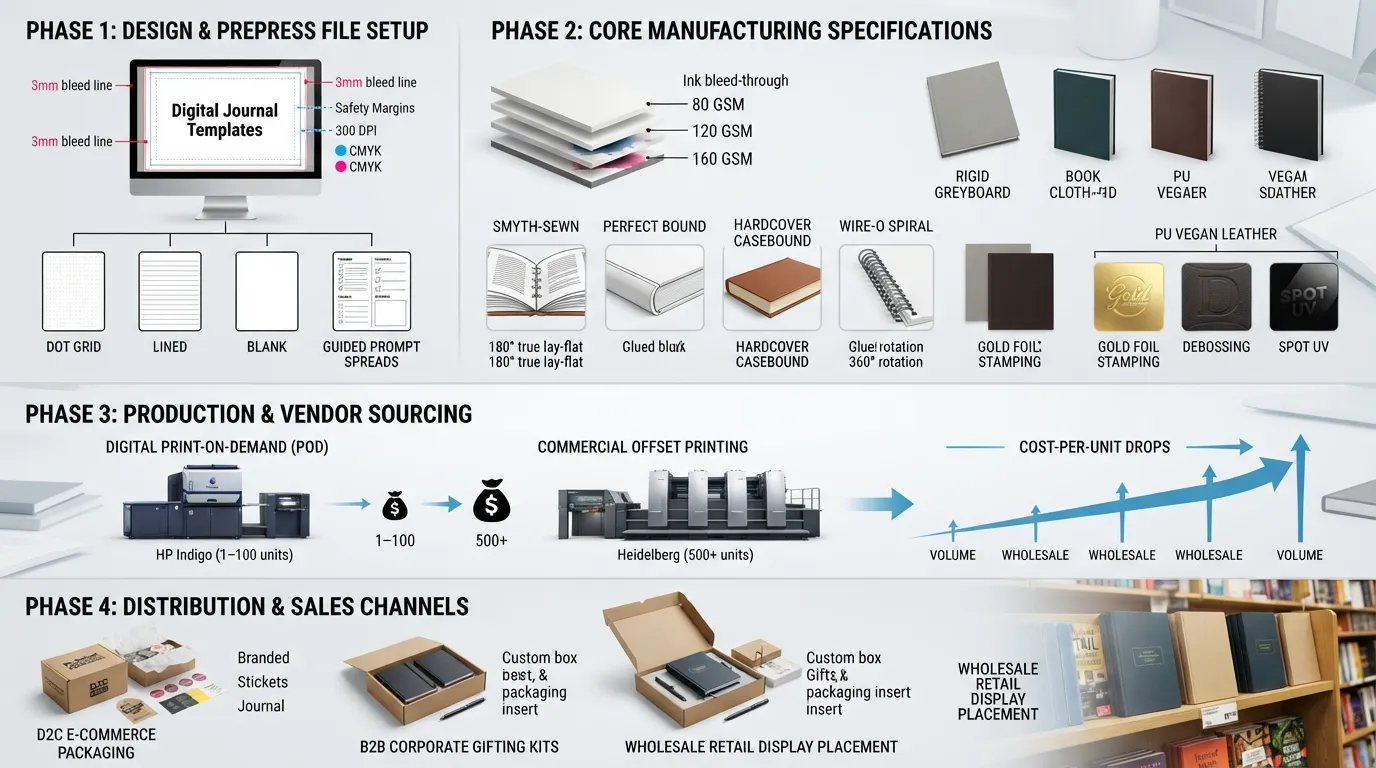
Comprehensive flowchart illustrating the complete custom journal printing lifecycle, showing design preparation, paper and binding selection, commercial manufacturing steps, and retail distribution channels.

Custom journal printing is the end-to-end commercial manufacturing process—encompassing interior paper stock selection, structural binding, cover fabrication, and specialty finishing techniques—used to transform digital design files into physical, shelf-ready journals for personal use, corporate branding, or retail resale.

Whether your goal is to produce a small run of bespoke guided planners or scale a high-volume commercial product line, mastering the technical nuances of custom journal printing ensures your finished product achieves the perfect balance between tactile luxury, structural durability, and manufacturing cost-efficiency.

While supporting a consistent journaling practice  relies on engaging content and intuitive layouts, translating that user experience into a physical product demands deep technical knowledge of press operations, paper physics, and post-press finishing.

Key Takeaways & Manufacturing Lifecycle

  • End-to-End Production: From initial paper stock selection to post-press finishing, every stage dictates the final product’s quality and shelf presence.

  • Paper Physics & Specifications: Understanding GSM options and paper grain direction ensures your interior pages prevent bleed-through and lay naturally flat.

  • Structural Binding Selection: Choosing between Smyth sewn, perfect binding, or Wire-O depending on page count, target budget, and user functionality.

  • Pre-Press File Optimization: Setting exact CMYK color spaces, 300 DPI resolution, and precise bleed/gutter allowances to eliminate costly press errors.

  • Production Cost Modeling: Balancing Print-On-Demand (POD) for short runs against commercial offset printing for maximum wholesale profitability.

  • Vendor Sourcing & Distribution: Strategic choices between domestic fast-turnaround trade printers and overseas mass manufacturers for wholesale scaling.

What Is Custom Journal Printing? Manufacturing Overview

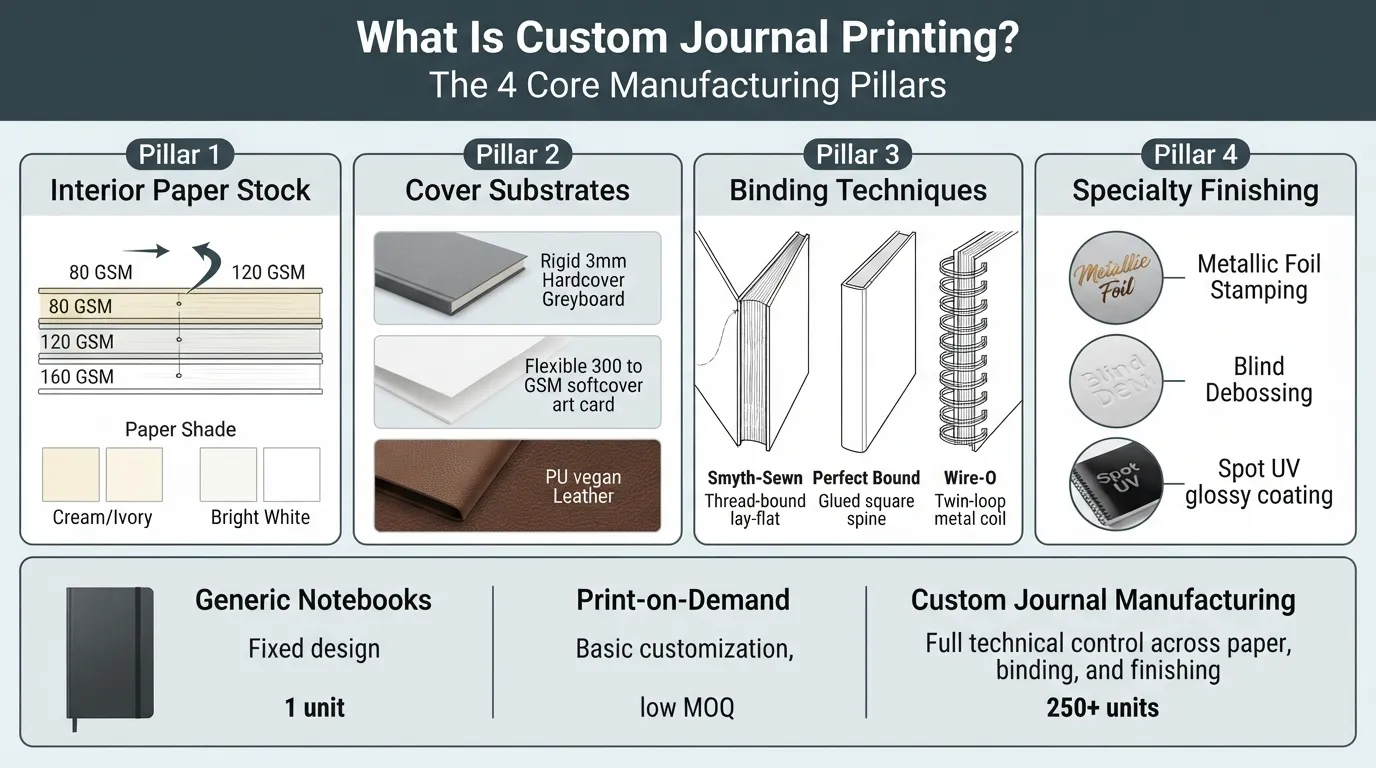
Infographic overview of custom journal printing showing four manufacturing pillars: interior paper weight, cover materials, binding styles, and finishing options.

Custom journal printing is the specialized process of manufacturing notebooks from scratch according to exact technical, structural, and aesthetic specifications. Unlike off-the-shelf stationery, custom journal printing gives you total control over every physical and visual detail of the finished book.

This process rests on four core production pillars:

  • Interior Pages: Tailored paper weights (GSM), opacity levels, textures, and custom-printed page layouts (dot grids, ruled lines, habit trackers, or guided prompts).

  • Cover Stock & Substrates: Rigid board for hardcovers, premium art card for softcovers, or flexible vegan leather wrapped around greyboard.

  • Binding Method: Mechanical assembly techniques such as Smyth sewing, perfect binding, or Wire-O that determine durability and lay-flat performance.

  • Specialty Finishing: Post-press enhancements including foil stamping, debossing, spot UV coatings, ribbon markers, and gilded edges.

Production Models Comparison

Production Model Typical Minimum Order (MOQ) Level of Customization
Generic Notebooks 1 unit Zero (Pre-printed designs)
Print-on-Demand (POD) 1 unit Low (Cover & basic interiors)
Custom Journal Printing 250 – 500+ units Full (Paper, binding, covers)

To choose the best manufacturing path, it helps to understand how true custom journal printing differs from standard consumer buying and automated print-on-demand services. While purchasing generic pre-made journals or choosing essential journaling supplies and tools (https://holisticwellbeingliving.com/journaling/supplies/) works well for personal writing, those retail options strictly limit you to standardized interior layouts and off-the-shelf cover designs.

Print-on-Demand (POD) platforms bridge the gap for single-copy orders, but they enforce fixed paper weights, limited trim sizes, and basic perfect binding that cannot lie 180° flat.

True custom journal printing requires higher Minimum Order Quantities (typically starting at 250 to 500 units for offset production), but it unlocks complete design freedom across paper grades, custom finishes, and durable Smyth-sewn construction.

Custom Journal Printing vs. Buying Pre-Made Journals

The choice between purchasing pre-manufactured retail journals and producing custom-printed runs comes down to cost efficiency at scale and design flexibility.

Choosing Your Journal Model

Pre-Made Journals

  • Fixed interior layouts
  • High per-unit cost ($15–30)
  • Logo overprinting only

Custom Journal Printing

  • Bespoke paper & grid lines
  • Low unit cost at scale ($2–6)
  • Custom binding & finishing
Choosing the right model depends on your required quantity and brand vision.
  • Cost-Per-Unit Dynamics: Pre-made retail journals carry a fixed unit cost ($10 to $30+ each) with little to no volume discounting. Custom journal printing involves initial prepress setup fees (plate making, die creation, press calibration), but unit costs plummet dramatically as run volumes increase—often dropping to $2.00–$5.00 per unit on orders of 1,000+ copies.

  • Customization Ceiling: Pre-made options limit branding to surface-level additions like screen-printing a logo onto a pre-existing cover. Full custom printing allows you to engineer every millimeter of the journal—from custom page sizes, bespoke grid spacing, and brand-matched Pantone cover materials to custom endpapers, ribbon placement, and expandable back pockets.

Who Uses Custom Journal Printing?

Commercial journal manufacturing serves three primary buyer groups, each with distinct volume requirements and functional goals:

Individuals & Gift Buyers

Personal buyers utilize small-run custom printing to produce bespoke keepsake journals for milestones such as weddings, family heritage projects, or specialized event gifts. These projects prioritize premium materials—such as linen covers, foil-stamped titles, and heavyweight archival paper—over bulk unit cost savings.

Brands & Businesses

Corporations, agencies, and service businesses use custom journal printing to manufacture high-end corporate gifts, employee welcome kits, and branded event collateral. These journals incorporate corporate color schemes, custom-printed introductory company pages, and durable hardcovers that act as long-lasting marketing assets on client desks.

Creators & Entrepreneurs

Self-publishers, fitness coaches, mindfulness influencers, and stationery brand founders rely on full custom manufacturing to build proprietary physical products. Whether producing habit trackers, daily planners, or specialized guided journals, these creators leverage custom printing to achieve high profit margins and retail-ready production quality for resale.
Journal Printing and Binding: Choosing the Right Method

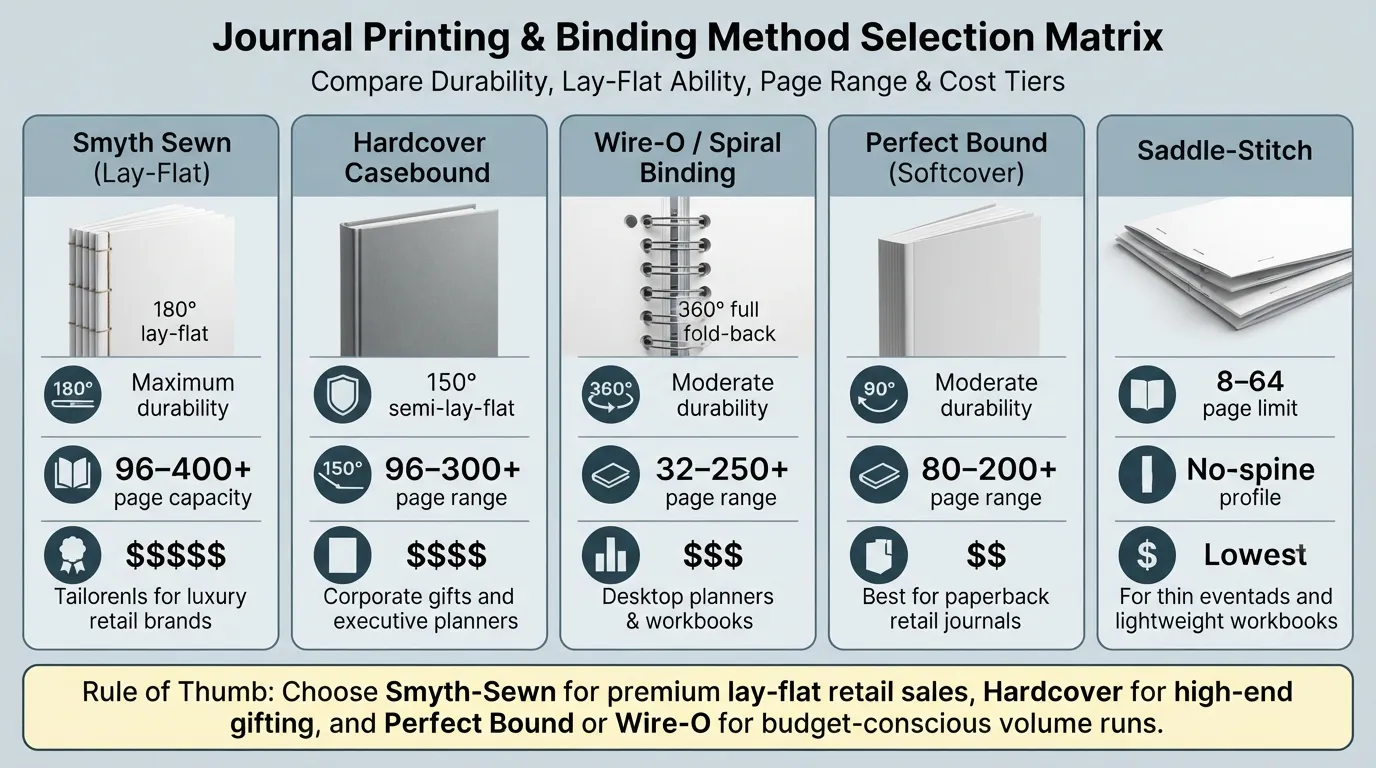
Comparative diagram of five custom journal binding methods showing Smyth sewn, hardcover casebound, Wire-O spiral, perfect bound, and saddle-stitch with durability ratings, lay-flat performance, and cost indicators.

Your binding selection is the single most critical structural decision in the journal manufacturing process. Binding directly dictates three foundational product variables:

  • Mechanical Durability: How many thousands of open-close cycles the journal can endure before pages detach or the spine cracks.

  • Lay-Flat Usability: Whether the user can write effortlessly across the entire page spread without physically holding the journal open.

  • Per-Unit Cost & Profit Margins: How much manufacturing overhead is required, which directly shapes your wholesale and retail retail positioning.

Because binderies cannot alter a book’s physical assembly once press plates are run, you must establish your target binding method before requesting manufacturer estimates.

Binding Methods Comparison

Binding Method Typical Page Count Lay-Flat Rating Per-Unit Cost Best Target Use Case
Saddle-Stitch 8 – 64 pages Moderate (120°) Ultra-Low ($) Workbooks & Event Pads
Perfect Bound 48 – 200+ pages Poor (90°) Low-Moderate ($$) Softcover Trade Journals
Hardcover Case 96 – 300+ pages Moderate (150°) High ($$$$) Corporate Gifts & B2B
Wire-O / Spiral 32 – 250+ pages Superior (360°) Moderate ($$$) Planners & Desk Work
Smyth-Sewn 96 – 400+ pages Perfect (180°) Premium ($$$$$) Luxury Retail Brands

Saddle-Stitch Binding

Saddle-stitching is the simplest, fastest, and most economical binding method available. Printed sheets are collated, nested inside one another, and secured through the center spine fold using two heavy-duty wire staples.

  • Best For: Thin notebooks, pocket journals, event workbooks, and supplemental exercise pads under 60 pages.

  • Cost Profile: Lowest per-unit manufacturing cost with minimal setup fees.

  • Limitations: Saddle-stitching cannot support a square spine, meaning you cannot print titles or logos on the outer edge. It lacks the physical structure for daily, long-term rough use and will flare open if forced beyond ~64 pages.

Perfect Binding (Softcover)

Perfect binding delivers a clean, square-spined paperback appearance. Interior page signatures are stacked, ground down along the spine edge to expose raw paper fibers, and glued directly into a flexible cardstock cover using hot-melt EVA or high-strength PUR adhesive.

  • Best For: Mid-tier softcover journals, wellness workbooks, and retail paperbacks containing 80 to 200+ pages.

  • Cost Profile: Highly cost-effective for moderate-to-large production runs.

  • Limitations: Standard EVA glue forces pages to spring back toward the center fold. Forcing a standard perfect-bound book to lie flat will snap the adhesive spine, causing loose pages to fall out over time.

Case-Bound / Hardcover Binding

Case-binding wraps protective 2mm to 3mm dense rigid greyboard with coated art paper, book cloth, or textured PU vegan leather. The internal page block is glued into the rigid casing using heavy-duty endpapers.

  • Best For: Executive gifts, corporate merchandise, luxury keepsake journals, and high-end retail planners.

  • Cost Profile: High upfront manufacturing investment with elevated Minimum Order Quantities (MOQs) due to multi-step assembly.

  • Resale Positioning: Commands the highest perceived value in retail environments, allowing brands to charge $28.00 to $45.00+ MSRP per unit.

Spiral / Wire-O Binding

Wire-O binding utilizes pre-formed, double-loop metal wire coils passed through mechanical holes punched along the edge of the cover and interior pages.

  • Best For: Daily goal planners, student workbooks, calendar organizers, and desktop bullet journals.

  • Functional Advantage: Offers 360° page rotation, allowing the user to fold the journal back on itself or lay it completely flat on any surface.

  • Design Tradeoff: The exposed metal or plastic coil interrupts the continuous spine aesthetic and increases packaging box bulk during freight transit.

Lay-Flat (Smyth-Sewn) Binding

Smyth-sewn binding is the gold standard of luxury book manufacturing. Folded signatures (groups of 16 or 32 pages) are physically sewn together along the spine fold with durable thread before being reinforced with a thin glue application and cased into a cover.

Smyth-Sewn Binding Detail

Thread Stitching
|   |   |   |
S-T-I-T-C-H
|   |   |   |
Folded Signature
/=============\
Page Section
\=============/
180° Complete Lay-Flat
LEFT
PAGE
||
RIGHT
PAGE
  • Best For: Premium resale journal brands, art journals, and daily planners where seamless edge-to-edge writing is mandatory.

  • Cost Profile: Highest per-unit manufacturing cost among binding types due to double assembly (sewing + casing).

  • Resale Positioning: The ultimate choice for direct-to-consumer e-commerce brands. The true 180° lay-flat performance eliminates spine tension completely, serving as a primary sales feature that justifies premium pricing.

Custom Journal Printing Inside Pages & Notebook Page Options

Selecting your custom journal printing inside pages is the single most important factor determining how your finished product feels, functions, and holds up to real-world writing instruments. While a cover attracts a customer's eye on a store shelf or web page, the weight, texture, tone, and grid layout of the interior text block dictate the actual user experience.

Paper Weight Recommended Purpose Ink Compatibility Paper Characteristics
70 – 80 GSM Mass-market pads, promotional booklets Ballpoint pens, standard pencils + Lightweight, low bulk
- Prone to ghosting & bleed-through
100 – 120 GSM
(Industry Standard)
Daily reflection, premium notebooks Gel pens, fountain pens, fine liners + Ideal balance of opacity & weight
- Minimal ghosting under heavy ink
140 – 160+ GSM Bullet journaling, art & mixed media Markers, watercolors, heavy ink wash + Zero bleed-through, heavy tooth
- Significantly increases spine bulk

Technical Paper Specifications: GSM, Tone & Sustainability

  • Paper Weight & Thickness (GSM): Paper mass is measured in Grams per Square Meter (GSM). Standard copy paper sits at 75–80 GSM, which allows heavy fountain pen ink or alcohol markers to bleed through to the reverse side. Premium writing journals require 100 to 120 GSM uncoated woodfree paper to prevent feathering and ghosting. Art journals or bullet journals using wet mediums require 140 to 160+ GSM cardstock.
  • Paper Tone (Bright White vs. Cream/Ivory): Bright white stock (92–98% brightness) provides high contrast that makes vibrant printed graphics and colored inks pop. Cream or warm ivory paper reduces eye strain during long writing sessions, imparting a vintage, high-end literary feel favored by legacy stationery brands.
  • Paper Finish & Tooth: Writing journals perform best on uncoated matte paper, which provides microscopic texture ("tooth") that absorbs liquid ink quickly and holds graphite cleanly without smudging. Smooth coated papers (gloss or silk) should be avoided for general writing blocks as they cause pen ink to smear.
  • Sustainable & FSC-Certified Options: Modern consumers prioritize eco-conscious manufacturing. Offering FSC-certified (Forest Stewardship Council) paper guarantees that wood pulp is harvested from responsibly managed forests. Alternatively, 100% Post-Consumer Waste (PCW) recycled paper or alternative agricultural fiber options (such as bamboo pulp) strengthen brand positioning for eco-aligned wellness products.

Note Book Pages: Blank, Lined, Dot Grid & Numbered Layouts

Buyers searching for note book pages are usually evaluating interior grid choices before committing to a full manufacturing order. The interior layout dictates how structured or flexible the user's writing experience will be.

Blank / Plain
[ Creative Freedom ]
Total Creative Freedom
Lined / Ruled
—————————
—————————
—————————
Structured Text Writing
Dot Grid
.   .   .   .   .
.   .   .   .   .
.   .   .   .   .
Flexible Layouts & Modules
  • Lined / Ruled Pages: The classic choice for unstructured stream-of-consciousness journaling and long-form note-taking. Common rule spacings include College Rule (7.1mm) for dense writing and Wide Rule (8.7mm) for larger handwriting styles.
  • Dot Grid Pages: Featuring a subtle matrix of light grey dots spaced 5mm apart, dot grids offer the perfect balance between structure and freedom. The dots guide handwriting, habit trackers, and drawn tables without overpowering visual illustrations.
  • Blank / Plain Pages: Ideal for sketchbooks, mind mapping, and unconstrained creative expression. Unprinted pages require precise paper opacity since any paper show-through is immediately visible.
  • Numbered Pages: Adding pre-printed page numbers to dot grid or lined layouts allows users to build an interior Index or Table of Contents—an essential feature for organized planners and bullet journals.
  • Specialty Guided Layouts: Custom printing allows you to print fully custom multi-page spreads, including undated monthly calendars, habit tracking wheels, daily gratitude prompts, or goal-setting worksheets.

How Many Pages Should a Custom Journal Have?

Page counts directly impact manufacturing cost, shipping weight, and binding mechanics. Because books are printed on folded signatures, total page counts must typically be ordered in multiples of 8, 16, or 32 pages.

  • 96 to 120 Pages (Lightweight / Travel): Slim profile, lower production cost, highly portable. Ideal for saddle-stitched or softcover exercise journals.
  • 160 to 192 Pages (Industry Standard): The standard range for retail hardcovers and daily planners. Delivers a substantial spine width (~12mm to 16mm) that feels luxurious in hand while allowing spine title printing.
  • 240 to 300+ Pages (All-In-One / Annual Planners): Heavyweight desk journals designed to last an entire year of daily entry. Requires durable Smyth-sewn binding to support the thick text block without spine breakdown.

Matching Interior Pages to Purpose

Selecting the right paper weight and layout depends on the intended functional use of your journal line:

Journaling & Reflection

Optimal Layout: College-lined or 5mm dot grid.

Recommended Specs: 100–120 GSM cream uncoated paper.

Focus: Soft contrast paper that minimizes eye fatigue during daily reflection sessions.

Bullet Journaling & Productivity

Optimal Layout: 5mm dot grid with pre-printed page numbers and an index spread.

Recommended Specs: 120–160 GSM bright white paper.

Focus: Heavyweight paper that prevents ghosting when using dark fine-liner pens, highlighters, and brush pens.

Art & Mixed Media

Optimal Layout: Completely blank / plain interior pages.

Recommended Specs: 160+ GSM heavyweight textured paper or cotton blend stock.

Focus: Maximum ink absorbency and high paper strength that prevents warping when using light watercolors or heavy marker ink.

Journal Printing Online vs. Local Printing Near Me, Nearby & Staples

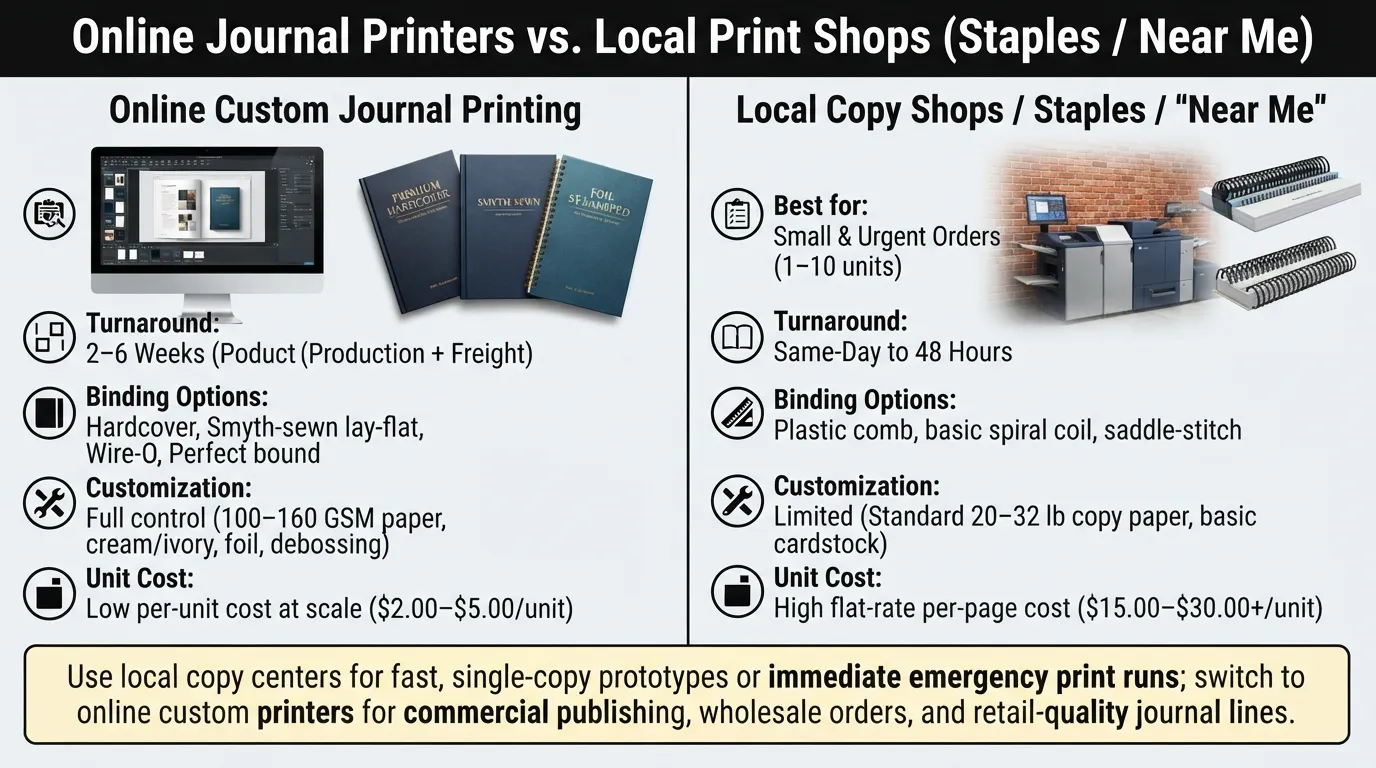
Side-by-side comparison chart analyzing online journal printers versus local copy centers like Staples on quantity tiers, turnaround time, binding methods, paper options, unit costs, and wholesale availability.

When ready to produce a journal, one of the first operational decisions is choosing between a local print shop (such as Staples, Office Depot, or FedEx Office) and an online commercial custom printer.

This decision comes down to a clear tradeoff: speed and convenience for ultra-small orders versus customization depth and unit cost-efficiency for volume production.

Local vs. Online Custom Printer Comparison

Factor Local / Staples / "Near Me" Options Online Custom Printer
Best for Quantity 1 – 10 units 50+ units
Turnaround Time Same day to 48 hours Days to weeks (production + freight)
Binding Options Plastic comb, basic spiral, 3-ring binder, simple staples Smyth-sewn, perfect bound, hardcover case, lay-flat
Paper & Cover Customization Minimal (Standard 20–32 lb copy paper, basic cardstock) Full control (GSM options, ivory/cream, specialty finishes)
Per-Unit Cost at Scale High (Flat per-page pricing) Low (Significant offset volume discounts)
Wholesale Pricing Tiers Rare to non-existent Standard commercial trade pricing

When to Use Staples or Local Print Shops

Local retail copy centers are best suited for immediate, low-stakes, or short-run projects where fast delivery outweighs structural customization.

  • Ideal Use Cases: Single prototype proofing, emergency meeting workbooks, last-minute event pads, or personal notebooks needed within 24 hours.

  • Capabilities: Local centers handle basic double-sided printing, page trimming, laminating, and mechanical plastic comb or wire spiral binding.

    FedEx Office
  • Critical Limitations: In-store print hubs rarely stock premium uncoated 100+ GSM book papers, archival cream stocks, or vegan leather substrates. They cannot manufacture rigid wrapped hardcovers, Smyth-sewn signatures, or debossed foil details, and their flat-rate digital printing fees make producing 100+ journals cost-prohibitive.

When to Use an Online Custom Journal Printing Company

Online commercial trade printers specialize in full-scale manufacturing, custom publishing, and retail line production.

  • Ideal Use Cases: B2B corporate gifts, direct-to-consumer brand launches, wholesale distribution, and self-published planner lines.

  • Capabilities: Complete freedom over physical specifications—including custom trim sizes, 100–160 GSM paper stocks, cloth or leather covers, ribbon bookmarks, elastic closure bands, and back expansion pockets.

  • Tradeoffs: Longer production turnarounds (typically 2 to 6 weeks, depending on whether printing domestically or overseas) and required Minimum Order Quantities (MOQs) starting at 100 to 500 units for offset production runs.

Searching “Journal Printing Nearby”? What Local Options Actually Offer

Searching for “journal printing nearby” almost always stems from an urgent need for same-day pickup or in-person review. Local storefronts excel at printing simple documents on standard 20–32 lb office paper held together by plastic coils.

However, if your project requires a bound spine, heavyweight non-bleed paper, custom foil covers, or commercial durability, standard local copy centers cannot produce those formats on-site. Use local shops to test interior page layouts on paper, then transition to a specialized online custom printer for final production runs.

How to Find “Journal Printing Near Me” — What to Check First

If you prefer working with a regional or local commercial printer over an online platform, evaluate local vendors using this prepress checklist before placing an order:

  • [ ] Verify Minimum Order Quantities (MOQs): Confirm whether the shop operates digital short-run presses (1–50 units) or commercial offset lines (500+ units).

  • [ ] Request Physical Paper & Cover Samples: Visit the shop to test their available paper stocks for ink bleed-through and touch their cover materials in person.

  • [ ] Confirm Exact GSM & Coating Options: Ensure the printer stocks 100–120 GSM uncoated woodfree text paper rather than standard glossy brochure stock.

  • [ ] Inquire About Specialized Finishing Capabilities: Ask if post-press features—such as die-cutting, foil stamping, edge gilding, or case binding—are handled in-house or sub-contracted out (which adds cost and time).

  • [ ] Ask for Wholesale & Volume Tier Quotes: Request a tiered cost breakdown (e.g., pricing at 100, 250, 500, and 1,000 units) to identify where unit margins improve for resale.

Custom Journal Printing Wholesale, Manufacturers & Personalized Notebooks Bulk

Manufacturing personalized notebooks bulk orders through wholesale commercial channels requires moving beyond digital print-on-demand services and working directly with commercial production lines.

Wholesale journal printing refers to bulk manufacturing runs—typically starting at 100 to 500+ units—designed to lower per-unit production costs. Ordering at wholesale scale unlocks offset press capabilities, bespoke material selections, and custom post-press finishing techniques that are cost-prohibitive on single-copy orders.

Custom Journal Company vs. Print Broker

Understanding who actually produces your journals helps prevent communication breakdowns and inflated production costs:

Direct Manufacturer

  • Owns presses & binderies
  • Lower wholesale pricing
  • Direct technical comms
  • Strict quality control

Print Broker

  • Outsources to third parties
  • Higher marked-up prices
  • Middleman communication
  • Variable production quality
  • Custom Journal Manufacturer: A primary printer that owns and operates offset presses, die-cutters, and binding machinery in-house. Working directly with a manufacturer yields the lowest unit costs, faster technical answers regarding prepress files, and direct quality control over paper, glue, and ink laydown.
  • Print Broker: An intermediary who manages your design files and outsources the actual printing and binding to third-party facilities. While brokers can offer convenient project management for beginners, they add a markup (typically 15% to 30%+) to total project costs and introduce communication delays if press adjustments are needed during production.

Custom Journal Manufacturers: How to Vet One Before You Order

Before transferring a deposit or approving a bulk order of personalized notebooks, evaluate potential commercial manufacturers against this prepress verification checklist:

Physical Proofing & Sample Policy: Does the manufacturer provide a fully assembled physical pre-production sample (dummy book) using your exact paper stock, binding, and cover finish before running the full order?
Material Sourcing & Transparency: Can the factory specify the exact origin and brand of their paper stocks (e.g., FSC-certified 120 GSM uncoated woodfree) and cover substrates (e.g., 2.5mm greyboard wrapped in PU vegan leather)?
In-House Binding Capabilities: Does the plant perform specialized binding (such as Smyth sewing or case binding) in-house, or do they outsource binding to a secondary facility?
Turnaround Time & Capacity: What are the estimated prepress proofing, press run, assembly, and transit timelines during peak production seasons (Q3/Q4)?
Domestic vs. Overseas Sourcing Tradeoffs:

Domestic Factories: Higher unit costs, but faster shipping (1–2 weeks), zero import tariffs, and easier legal recourse if quality defects occur.

Overseas Factories (e.g., East Asia): Up to 40–60% savings on large offset runs (1,000+ units), especially for hand-assembled features (ribbon markers, elastic closure bands, back pockets). Requires factoring in 4–6 week ocean freight times, customs duties, and import clearance.

Questions to Ask a Wholesale Journal Manufacturer

Ask these five core technical questions when requesting quotes from commercial sales representatives:

Q1
"What is your Minimum Order Quantity (MOQ) for custom offset production, and how do unit costs scale at higher tiers?"
Q2
"Does your quote include full pre-production physical proofing, or do you only offer digital PDF soft proofs?"
Q3
"Are specialty features—such as foil stamping die creation, custom endpapers, ribbon insertion, and individual shrink-wrapping—included in the base price or itemized as upcharges?"
Q4
"What are your standard defect tolerances, and what is your official policy for reprinting or crediting damaged or misbound units?"
Q5
"Do your freight quotes include door-to-door delivery with customs duty paid (DDP - Delivered Duty Paid), or am I responsible for port clearing and logistics?"

Wholesale Pricing Tiers Explained

Commercial printing relies on heavy initial setup operations—including plate making, paper trimming, ink mixing, and press calibration. Because these fixed setup costs remain the same whether you print 50 copies or 5,000 copies, unit prices decrease significantly as total run volumes increase.

50 Units
~$18.00 / ea

Digital Short-Run: High per-unit costs ($12.00–$20.00+ each). Best for testing small niche markets, corporate board gifts, or prototype validation.

250 Units
~$10.50 / ea

Entry Wholesale: Unit costs drop significantly ($5.00–$10.00 each). Represents the entry-level threshold for profitable retail sales.

500 Units
~$5.50 / ea

Mid Wholesale Tier: Provides stronger margin resilience for growing direct-to-consumer and boutique retail brands.

1,000+ Units
~$3.20 / ea

Commercial Offset Tier: Maximum economies of scale ($2.50–$4.50 per unit). Provides healthy gross profit margins (70–80%+) for wholesale distribution.

Negotiation Best Practices: When ordering 1,000+ units, ask sales representatives for custom volume discounts or negotiate free value-added finishing upgrades—such as complimentary foil stamping dies, ribbon markers, or custom protective tuck boxes.

How Much Does Journal Printing Cost?

nderstanding journal manufacturing costs requires breaking down the core production variables before submitting job files to a commercial printer. While many custom printers lock pricing behind opaque quote request forms, commercial manufacturing follows predictable pricing logic dictated by machine setup, material consumption, and bindery labor.

The total cost of any custom journal print run is driven by five primary manufacturing variables:

  • Order Quantity (Print Volume): The single largest determinant of unit price; larger print runs amortize fixed press setup costs across more units.

  • Page Count & Trim Size: Dictates total paper tonnage, ink usage, and spine width (e.g., doubling page count from 96 to 192 pages increases interior paper material costs by roughly 40% to 60%).

  • Paper Stock & GSM: Standard 80 GSM offset paper costs significantly less than premium 120–160 GSM uncoated, cream, or FSC-certified archival stocks.

  • Binding Method: Mechanical stapling (saddle-stitch) requires minimal bindery labor, whereas thread-sewn hardcover casebinding involves multi-stage signature stitching and hand-assembly.

  • Cover Material & Post-Press Finishing: Standard printed cardstock covers are economical, while heavy greyboard wrapped in PU vegan leather with foil stamping, debossing, or gilding adds material and die-creation charges.

Journal Quantity & Cost Structure Breakdown

Quantity Tier Production Method Typical Per-Unit Cost* Primary Cost Driver
1 – 50 Units Digital Print-On-Demand $15.00 – $35.00+ / unit High individual press calibration
100 – 250 Units Short-Run Digital $8.00 – $15.00 / unit Moderate machine setup fees
500 – 1,000 Units Mid-Volume Offset $3.50 – $7.50 / unit Balanced prepress plate amortization
2,500 – 5,000+ Units Commercial Bulk Offset $1.50 – $3.50 / unit Maximum raw material efficiency

*Note: Estimates based on standard A5/5.5x8.5" 160-page journals. Actual quotes vary by finishing choices and freight.

The Inverse Quantity-to-Unit-Cost Curve

Commercial printing operates on an inverse cost curve: as your total order volume increases, your per-unit cost drops exponentially. Digital presses charge a fixed fee per page printed regardless of quantity, making them cost-effective for micro-runs.

In contrast, commercial offset presses require substantial upfront prepress setup costs—including CTP (Computer-to-Plate) aluminum plate imaging, ink key calibration, and paper feed alignment. On a 50-unit order, a $300 setup charge adds $6.00 to every single book; on a 3,000-unit order, that same setup fee adds just $0.10 per book.

Hidden & Add-On Production Expenses

When evaluating manufacturer estimates, look beyond the base unit price to account for secondary prepress and fulfillment fees:

  • Prepress & Plate Setup Fees: One-time charges for imaging offset printing plates and calibrating press runs.

  • Custom Stamping Die Charges: Physical brass or magnesium dies crafted for foil stamping or debossing cover artwork (typically $75 to $200 per unique design).

  • Physical Proofing & Sample Shipping: Ordering a fully bound physical pre-production prototype (dummy book) to test binding and paper quality typically costs $50 to $150 including express freight.

  • Specialty Hardware & Add-Ons: Custom ribbon bookmarks, elastic closure bands, metal corner protectors, and expandable back pockets add $0.30 to $1.25 per unit in combined material and assembly labor.

  • Freight & Import Duties: Ocean freight, air express shipping, port handling fees, and regional import duties (DDP) can represent 15% to 30% of your total invoice when manufacturing overseas.

Journal Printing Cost by Binding Type

Binding complexity significantly impacts total manufacturing labor and machine time. Below is the relative cost hierarchy across standard binding formats, ranked from most economical to most premium:

Binding Methods Cost Spectrum

Low Cost High Cost
Tier 01
Saddle-Stitch
$0.80 – $2.50
Tier 02
Perfect Bound
$2.00 – $5.00
Tier 03
Spiral / Wire-O
$2.50 – $6.50
Tier 04
Hardcover Case
$4.50 – $12+
  1. Saddle-Stitch ($0.80 – $2.50 / unit): The absolute cheapest binding option. Fast automated folding and wire stapling make it ideal for thin workbooks or short promotional pads.

  2. Perfect Bound Softcover ($2.00 – $5.00 / unit): Highly cost-effective paperback binding using adhesive along a ground spine edge. Offers a clean, professional retail look at a moderate price point.

  3. Spiral / Wire-O Binding ($2.50 – $6.50 / unit): Moderate pricing. Costs slightly more than softcover binding due to mechanical hole punching and metal double-loop coil insertion labor.

  4. Hardcover Casebound & Smyth-Sewn ($4.50 – $12.00+ / unit): The most expensive binding tier. Combines thread-sewn page signatures with wrapped dense greyboard cases. Delivers maximum physical durability and true 180° lay-flat performance that commands top-tier retail pricing.

How to Get an Accurate Quote

To receive a fast, precise production estimate without back-and-forth email delays, provide your printer’s sales team with this complete technical specifications checklist:

  • [ ] Exact Trim Size: State dimensions explicitly (e.g., A5 [148x210mm], B5 [176x250mm], or 5.5″ x 8.5″).

  • [ ] Total Page Count: Total interior pages including front matter, index, and notes (must be in multiples of 8 or 16).

  • [ ] Interior Paper Specifications: Specify GSM weight, paper shade (bright white vs. cream/ivory), and finish (uncoated matte).

  • [ ] Binding Style: Indicate Smyth-sewn hardcover, perfect bound softcover, Wire-O, or saddle-stitch.

    www.lulu.com
  • [ ] Cover Material & Substrate: Specify wrapped greyboard thickness (2mm or 3mm), printed paper wrap, book cloth, or PU vegan leather.

  • [ ] Specialty Finishing Details: Detail foil stamping (color and surface area), debossing, spot UV, ribbon color, elastic band specs, and back pocket requirements.

  • [ ] Target Quantity Tiers: Request tiered pricing (e.g., 250, 500, 1,000, and 2,500 units) to identify your sweet spot for unit margins.

  • [ ] Delivery Timeline & Destination: Provide your zip/postal code and state whether you require standard freight or express turnaround.

How to Design & Create Your Own Journal

Transitioning from a bulk buyer to a journal creator requires translating your creative concept into a precise technical design. Executing a commercial-grade journal follow a strict structural sequence:

Journal Design & Prepress Production Workflow

Step 01
Trim Size

Choose standard dimensions (A5, B5, 6x9")

Step 02
Cover & Finish

Select board, cloth, or PU; pick foil/embossing

Step 03
Interior Layout

Build grid, rule, or prompt spread page-by-page

Step 04
Branding

Define CMYK / Pantone colors & logo scale

Step 05
Prepress File Prep

Set Bleed (3mm), Safety Margins, 300 DPI, & Outlines

  • Establish the Trim Size: Select standard industry dimensions (e.g., A5 [148x210mm], B5 [176x250mm], or 6″ x 9″) to ensure compatibility with press machinery and shipping cartons.

  • Select Cover Material & Finishing Features: Determine cover board thickness (2mm to 3mm greyboard) and material wraps (coated art paper, linen book cloth, or PU vegan leather). Plan specialty accent areas for foil stamping or debossing.

  • Build the Interior Layout: Design the page-by-page user flow. While choosing the right journal supplies  determines whether your customers write with fountain pens, gel liners, or alcohol markers, structuring the actual grid layout dictates how effectively users engage with your daily habit trackers, gratitude prompts, or dot-grid spreads.

  • Apply Color Palettes & Brand Identity: Define precise brand colors using CMYK swatches for standard process printing or specify exact Pantone (PMS) spot colors for critical corporate logo matching.

  • Format Print-Ready Files: Set up digital layout files in professional design tools (Adobe InDesign, Affinity Publisher, or Canva Pro) or partner with a specialized freelance prepress production designer.

Prepress File Layout Schematic

Bleed Line (+3mm / 0.125") — Extend artwork fully to boundary
Trim Line — Actual physical cut boundary
Safety Margin Zone (-5mm to 10mm)
KEEP ALL CRITICAL TEXT, LOGOS & GRIDS INSIDE THIS SAFE ZONE

Technical Prepress Requirements for Press Approval

Submitting flawed artwork files is the leading cause of production delays, proof rejections, and expensive printing mistakes. Ensure your exported files adhere strictly to commercial press standards:

  • 3mm (0.125 in) Outer Bleed: Extend all full-page background images and color blocks 3mm beyond the trim boundary to prevent white paper borders after industrial cutting.
  • Safety Margins & Gutter Allowances: Keep all critical text, grid lines, and page numbers at least 5mm to 8mm inside the outer trim line. Expand the inner spine margin (the gutter) by an additional 3mm to 6mm to account for bound page curves.
  • 300 DPI High-Resolution Asset Rendering: Ensure all raster images, graphics, and background textures are rendered at 300 DPI at 100% print scale (never use 72 DPI web graphics).
  • CMYK Color Mode Conversion: Convert all RGB screen artwork to CMYK process color to eliminate severe color shifts on press.
  • Font Vectorization (Outlining): Convert all typography to vector outlines (curves) in your layout software to prevent automatic font substitution errors during automated plate imaging.

Design Mistakes to Avoid Before Printing

Prepress Design Mistake Physical Production Impact Prevention Strategy
Missing Bleed & Safety Margins Uneven white edges; text chopped off by industrial paper cutters Add 3mm bleed; enforce 8mm safety internal margin zones
RGB Color File Submission Dull, muddy, or shifted colors upon physical ink laydown Convert all design swatches and linked images to CMYK before export
Ignoring Paper Opacity / Ghosting Ink bleed-through obscures text on the reverse side of the page Pair heavy inks or dark lines with 100–120 GSM+ uncoated paper
Skipping Physical Pre-Proofs Mass manufacturing of undetected typos or binding defects Order a fully assembled physical dummy book prior to press run
  • No Bleed Allowance: Exporting artwork trimmed exactly to the page boundary results in thin, unprinted white borders along book edges when the press knife shifts slightly.
  • Low-Resolution Cover Graphics: Using low-DPI screen graphics causes pixelated, blurry text and muddy logo reproduction on printed covers.
  • Ignoring Paper Opacity: Designing heavy, solid-black interior background spreads on thin 70–80 GSM paper causes ghosting and renders the reverse side unusable.
  • Skipping the Physical Sample: Approving a full bulk offset order based solely on a digital PDF soft proof leaves you vulnerable to undetected layout errors, poor glue adhesion, or misaligned foil stamping.

Personalized Notebook Design for Gifting vs. Branding

Structuring personalized notebook designs requires tailoring visual aesthetics to match your core delivery objective—whether crafting individual keepsakes or scaling a commercial product line:

Personalized Gift Design

  • Variable Data Printing (VDP)
  • Monograms, full names, quotes
  • Custom cover photo placement
  • One-off or short digital runs

Commercial Brand Design

  • Fixed brand color palette (CMYK)
  • Pantone (PMS) spot color matching
  • Prominent logo debossing / foil
  • Scalable, unified product line
  • Designing for Personal Gifts & Milestones:

    Variable Data Personalization: Utilize Variable Data Printing (VDP) on digital presses to dynamically swap names, monograms, custom dates, or personalized cover quotes across single-unit print runs.
    Emotional Visual Touches: Incorporate custom endpapers printed with personal photo collages, custom dedication pages, or custom gift presentation boxes.

  • Designing for Corporate Branding & Retail Lines:

    Pantone Spot-Color Precision: Specify Pantone Matching System (PMS) ink codes for cover substrates and endpapers to guarantee 100% brand color accuracy across global marketing collateral.
    Subtle Branding Integration: Place corporate logos using elegant debossing, blind embossing, or subtle hot-foil stamping on the front cover or lower spine to maintain a sophisticated retail aesthetic rather than looking like an inexpensive promotional giveaway.
    Product Line Consistency: Establish fixed design templates—including standard grid margins, typography hierarchies, ribbon colors, and packaging sleeves—to build a cohesive visual family across future journal releases.

People Also Ask (Frequently Asked Questions)

How much does it cost to get a journal printed?

Journal printing costs range from $15.00–$35.00+ per unit for small print-on-demand runs down to $1.50–$3.50 per unit for commercial bulk offset printing. Final pricing depends on order quantity, binding choice, page count, cover finishes, and freight costs.

Can I get a journal printed at Staples?

Yes, Staples handles small print runs with simple coil or comb binding. However, local office centers lack specialized options like hardcover case binding, luxury foil stamping, high-grade uncoated interior paper, or bulk offset pricing.

What is the minimum order quantity (MOQ) for custom journal printing?

MOQs depend entirely on the production method and manufacturer. Digital print-on-demand services offer low or no minimums starting at 1 unit, whereas commercial offset printers generally require higher minimum orders of 500 to 1,000 units to offset setup costs.

How do I design a journal to get printed?

Start by choosing your trim size and selecting cover materials and finishes. Next, build your interior layout grid, define CMYK branding colors, and prepare prepress files with 3mm bleeds, 300 DPI graphics, and vectorized fonts before submitting.

Is it cheaper to print journals online or locally?

Online offset printers are significantly cheaper for large bulk orders due to specialized production capacity. Local printers work better for quick turnaround times, urgent single-copy proofs, or small digital runs where you can inspect physical paper samples in person.

Can I sell journals I get custom printed?

Yes, custom-printed journals offer strong retail margins. Ensure high production quality with durable binding and premium paper, maintain strict brand consistency, and review trademark rights for any custom artwork or copyrighted text prior to printing and selling.

What paper is best for journal pages?

High-opacity uncoated paper between 100 GSM and 120 GSM is ideal for journals. Off-white or cream shades reduce eye strain, while thicker, fountain-pen-friendly stock prevents ink ghosting and bleed-through across double-sided interior spreads.

How do I find a reliable custom journal manufacturer?

Vet prospective manufacturers using a comprehensive checklist: verify physical print samples, review file-proofing protocols, confirm production timelines, request detailed itemized pricing tiers, and evaluate past client portfolios to ensure consistent binding craftsmanship.

Final Thoughts: Choosing the Right Journal Printing Path for You

Selecting the ideal manufacturing strategy ultimately comes down to your primary production goals, budget parameters, and required volume:

  • For Personal & Gift Buyers: Focus on short-run digital options with specialty cover finishes to produce high-value, low-volume keepsakes without excessive upfront setup overhead (see our Overview of Personal & Gift Uses).

  • For Brands & Corporate B2B Buyers: Leverage bulk offset manufacturing to minimize per-unit expenses while securing premium hardcovers, exact Pantone color matching, and custom logo debossing for high-impact branded collateral (see our Custom Journal Wholesale & Bulk Guide).

  • For Self-Publishers & E-Commerce Resellers: Invest in Smyth-sewn lay-flat binding and 100+ GSM uncoated paper to create durable, high-margin products built for retail distribution and high customer retention (see our Journal Printing and Binding Comparison).

Before submitting artwork files or requesting quotes from commercial printers, review your interior paper weights, trim sizes, and binding requirements to ensure your prepress specs align with your budget. As you move from manufacturing design into developing your interior content, explore more journaling guides and inspiration to build engaging layouts, thoughtful prompts, and habit-tracking spreads that turn a beautifully printed journal into an indispensable daily practice.

Link copied to clipboard!

Editorial Integrity

Our content is 100% human-written, evidence-backed, and continuously updated to fulfill reader intent with maximum honesty.

Daily Mindset Shift

"Small, consistent habits compounded over time create unshakeable momentum."

Leave a Comment