Jump to:
ToggleReasons for Procrastination: The Real Psychology Behind Why We Delay
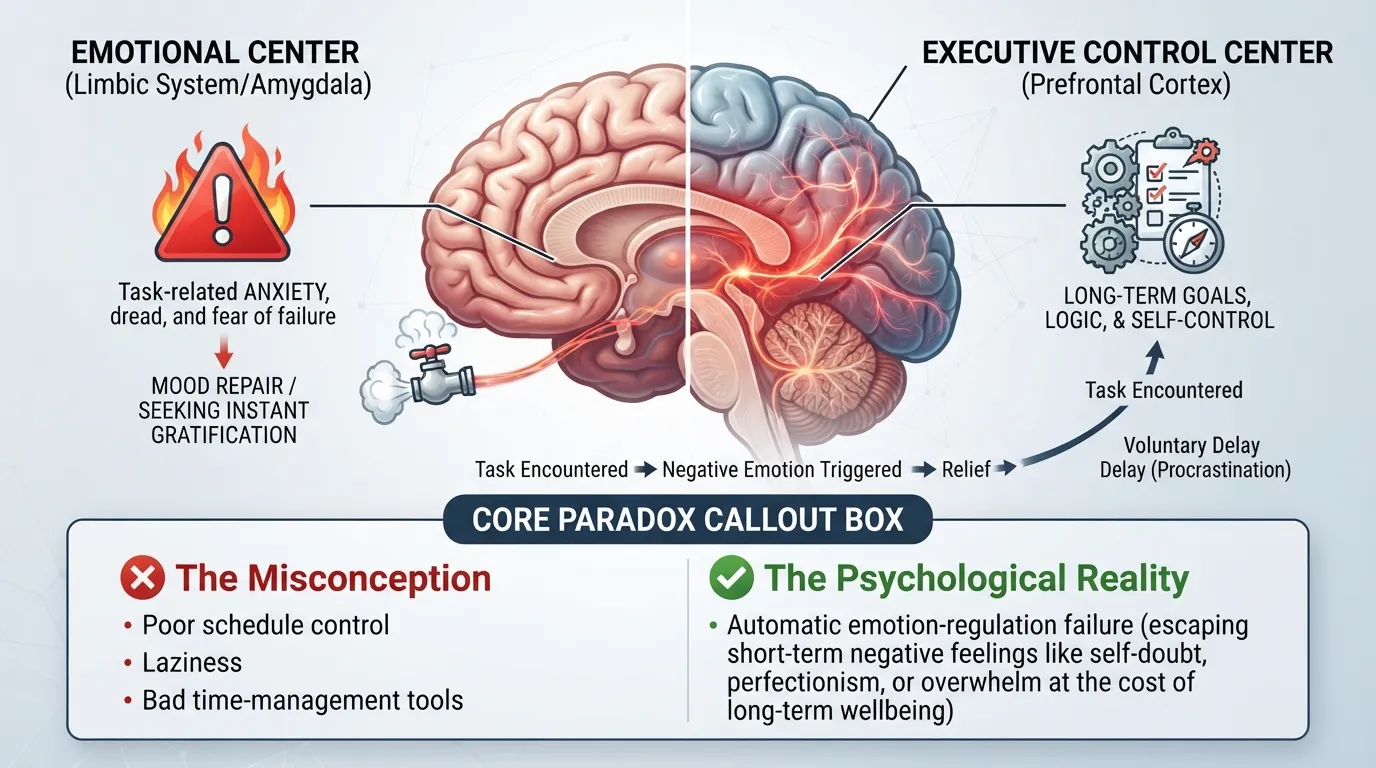
Procrastination is the voluntary delay of an intended action despite knowing you will be worse off for waiting. It is not a character flaw, a lack of willpower, or a failure of time management. At its core, procrastination is an emotional regulation problem—an involuntary strategy your brain uses to escape negative feelings like anxiety, self-doubt, or overwhelm attached to a specific task.
What Procrastination Really Is And What It Isn't
The Real Definition
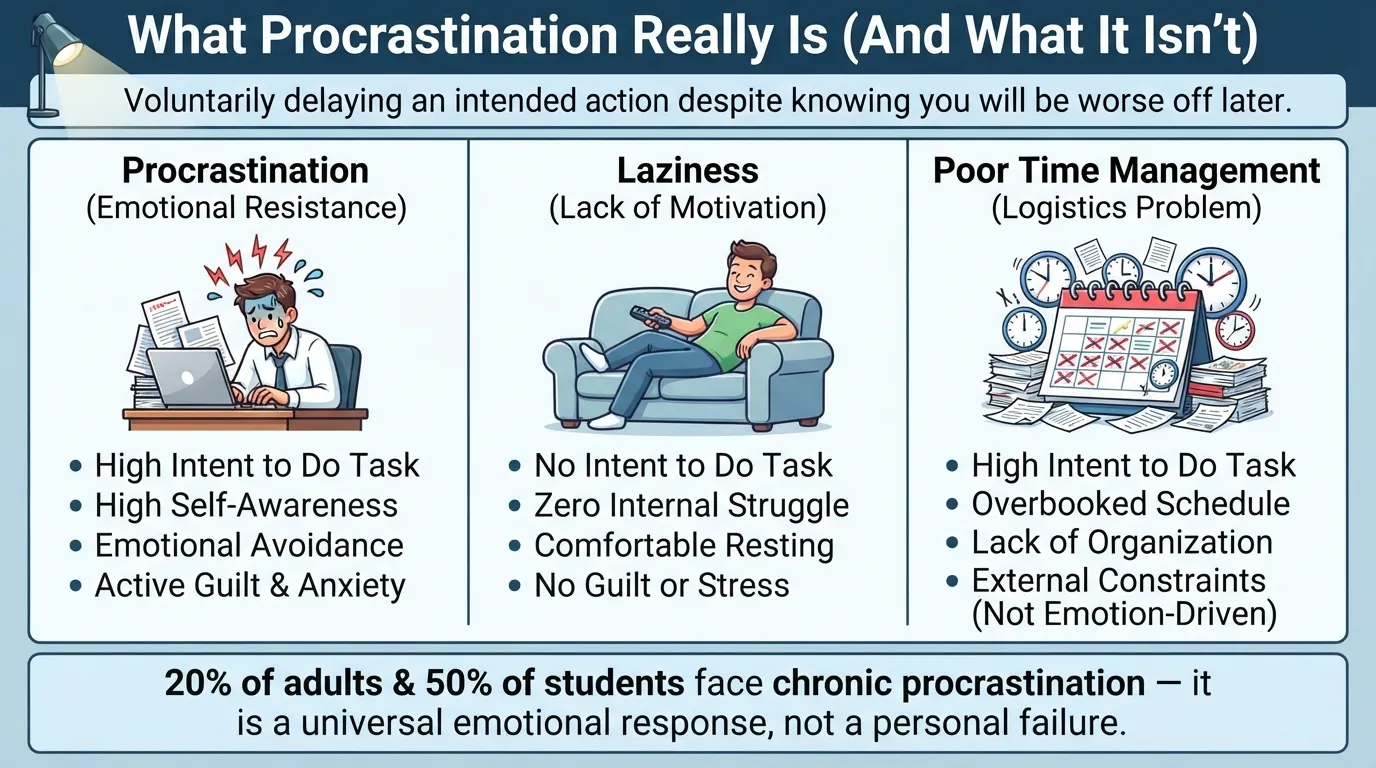
To fix procrastination, you have to define it correctly. At its core, procrastination is voluntarily delaying a task you intended to do, even when you know that waiting will make things harder for you later.
That last part is crucial: the delay is irrational. You aren’t pushing off a project because an emergency popped up or because the timeline naturally shifted. You are choosing to walk away from a task while fully aware that the deadline is closing in, the stress is compounding, and past-you is setting up future-you for a rough night. It is an intentional pushback against an action you meant to take.
Procrastination vs. Laziness
People constantly conflate procrastination with laziness, but biologically and psychologically, they are almost exact opposites.
Laziness is an absence of intent. When you’re feeling lazy, you don’t care about doing the task, you have no desire to start it, and you’re perfectly comfortable staying on the couch. There is no internal struggle.
Procrastination requires intense intent. You desperately want to get the work done—or at least want the relief of having finished it. You spend energy thinking about it, feeling guilty for avoiding it, and negotiating with yourself.
Procrastination is marked by an exhausting tension between intent, delay, and acute self-awareness. You aren’t resting; you’re actively agonizing over the very thing you’re running away from.
Procrastination vs. Poor Time Management
It’s equally common to mistake procrastination for a simple schedule issue. We buy planners, download color-coded apps, and block out our calendars, only to sit in front of the screen watching the cursor blink while we suddenly decide to clean the kitchen.
Not having enough time is a logistics problem. Procrastination is an internal resistance problem. If a packed calendar were the root cause, an open weekend would instantly cure it. Instead, open schedules often make procrastination worse because the loss of structure leaves us face-to-face with the emotional weight of the task. You don’t need a better planner when the real barrier is how you feel about starting.
A Near-Universal Human Experience
If you struggle with this, you aren’t broken. Research led by Dr. Joseph Ferrari shows that roughly 20% of adults and up to 50% of college students identify as chronic procrastinators. It is a shared psychological pattern, not a individual character flaw.
The Real Reason We Procrastinate: It's Emotional, Not Logical
Short-Term Mood Repair
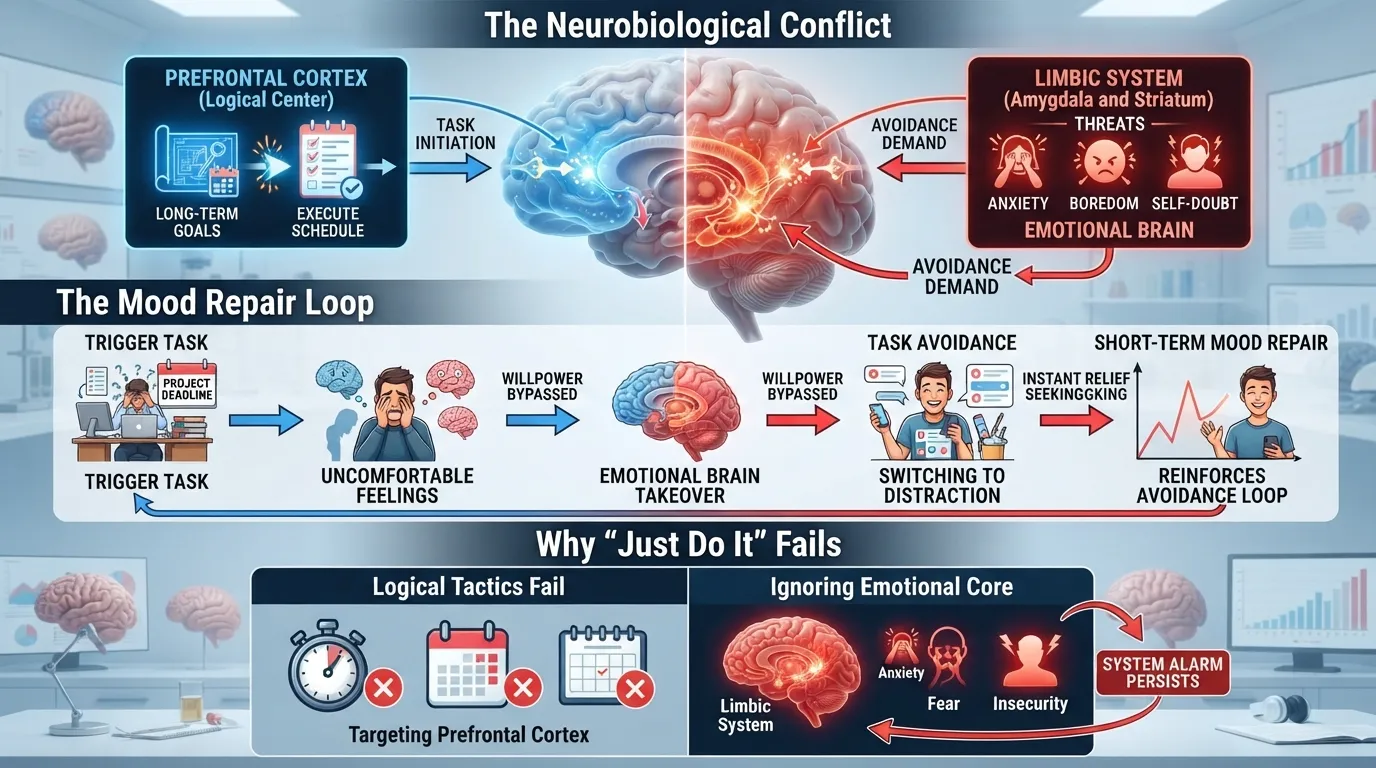
For decades, we were told that people delay work because they are bad at planning. But seminal research by Dr. Roy Baumeister, Dr. Dianne Tice, and later expanded by Dr. Fuschia Sirois, flipped this understanding completely. They proved that procrastination is fundamentally a problem of emotion regulation, not time regulation.
When you sit down to tackle a difficult task—writing a difficult report, opening a scary medical bill, or making an uncomfortable phone call—your brain registers the task as a threat. It triggers unpleasant emotions: anxiety, boredom, insecurity, or self-doubt. Procrastination is simply an unconscious short-term mood repair strategy. You walk away from the desk or open a social media tab to immediately soothe those negative feelings. By avoiding the task, you get a temporary wave of relief, rewarding your brain for running away. You aren’t avoiding the work itself; you’re avoiding the bad feelings the work brings up.
Why “Just Do It” Fails
This emotional root cause is precisely why typical productivity advice fails so spectacularly. Telling someone who is procrastinating to “just have more discipline” or “use a pomodoro timer” is like giving a map to someone who is currently drowning.
When your avoidance is driven by fear of failure or feelings of inadequacy, logic can’t bridge the gap. Traditional willpower requires cognitive energy, but emotional discomfort bypasses your logical brain entirely. “Just do it” assumes that starting is a simple operational decision. In reality, until you address the specific negative emotion attached to the task, your brain will treat every attempt to force action as an attack on your immediate comfort and safety.
The Inner Conflict
At a neurobiological level, every instance of emotional procrastination comes down to an evolutionary tug-of-war. Your limbic system—the ancient, emotional part of the brain that demands immediate relief and shuns pain—clashes with your prefrontal cortex, the logical center responsible for long-term goals and planning.
When a task triggers dread or anxiety, the emotional brain panics and wins the fight. It demands instant comfort right now, overriding your logical intentions for the future and leaving you wondering why you just spent an hour staring at your phone instead of working.
Psychological & Emotional Causes of Procrastination
Fear of Failure
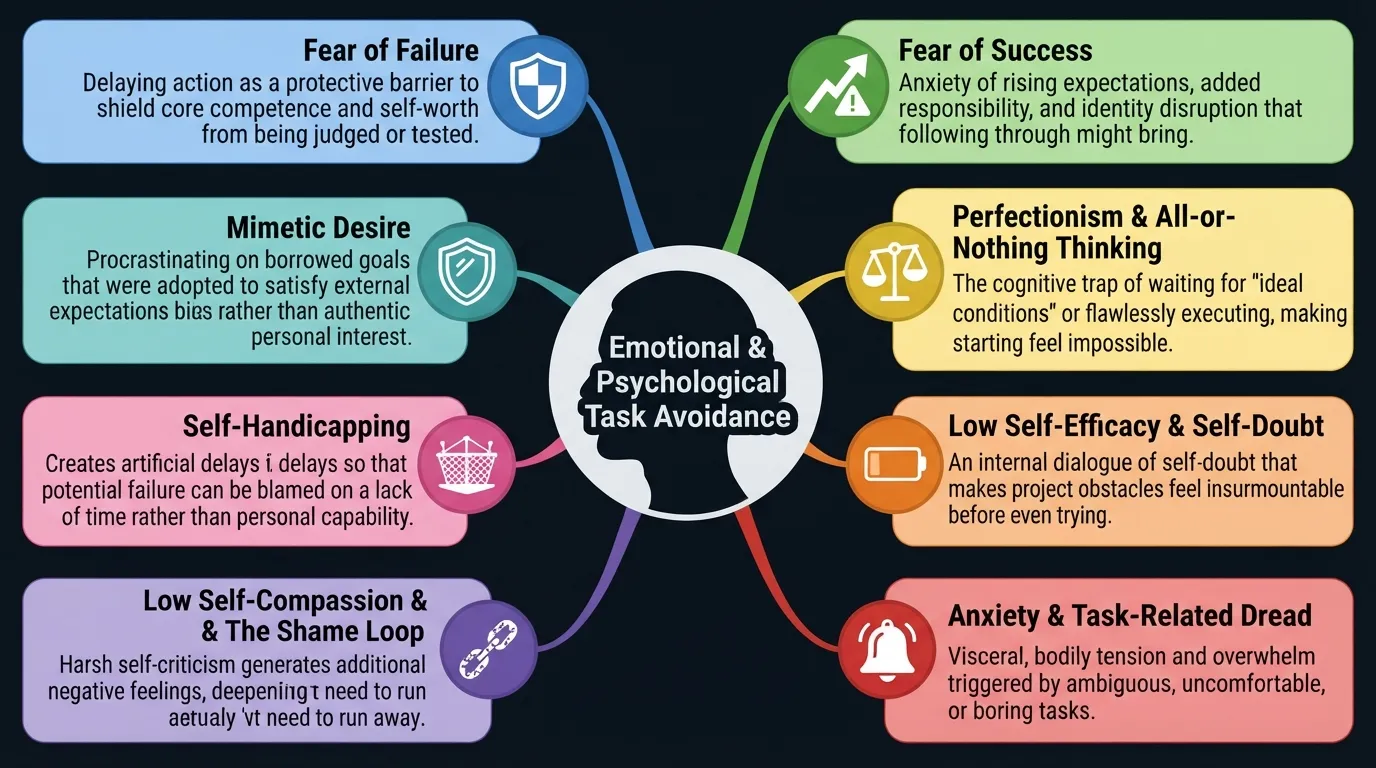
At the core of most task avoidance sits a deep, instinctive self-preservation response: the fear of failure. When a project carries real stakes—a performance review, a creative pitch, or an important life decision—getting started exposes you to the possibility of coming up short.
Your brain interprets this potential failure not as a routine learning experience, but as a threat to your competence, status, or self-worth. By delaying action, you delay the possibility of a disappointing verdict. As long as the work remains in an unwritten, unexecuted state, its potential remains perfect. Delaying becomes a protective shield that keeps your competence from being tested and judged.
Fear of Success
It sounds counterintuitive on the surface, but the fear of success stalls just as many people as the fear of failing. Success rarely comes without consequences—it shifts expectations upward, increases visibility, and usually brings heavier responsibilities.
If you complete a major project ahead of time and perform exceptionally well, your baseline changes. People will expect that same level of output tomorrow, next week, and next year. Subconsciously, you might worry that you won’t be able to sustain that standard, or that reaching the next level will disrupt your personal relationships, drain your energy, or expose you as a fraud. Pushing off key milestones keeps your life predictable and manageable, protecting you from the overwhelming demands that success might demand of you.
Perfectionism and All-or-Nothing Thinking
Perfectionism is rarely about high standards; it is almost always about control. If you operate with an absolutist, “all-or-nothing” mindset, a task is either executed flawlessly or it is a complete waste of time.
This creates an unbearable barrier to entry. When every minor task requires ideal conditions—the perfect uninterrupted three-hour block, a completely quiet environment, or the exact right creative inspiration—you rarely find the “right” moment to start. The gap between your mental ideal and the messy reality of getting down to work creates immense psychological tension. To protect yourself from producing mediocre work, you put off starting altogether, convincing yourself that you’ll do it properly when conditions improve.
Low Self-Efficacy and Self-Doubt
Self-efficacy is your internal belief in your capability to execute the actions required to achieve a specific outcome. When your self-efficacy regarding a task is low, every step feels twice as heavy.
If you don’t believe you possess the skills, intelligence, or resilience to navigate a project, your brain views the effort as futile from the start. You sit down, open the document, and immediately hear a chorus of internal doubt: Who are you kidding? You don’t know how to analyze this data. You’re going to mess this up anyway. When you doubt your capacity to handle the inevitable friction of a task, walking away feels like the only sensible way to save energy.
Anxiety and Task-Related Dread
Anxiety acts as an alarm system for the mind, and task-related dread is its trigger. When you associate a task with intense boredom, physical discomfort, confusion, or emotional awkwardness, your nervous system responds just as it would to physical danger.
The moment you think about filing your taxes, having an uncomfortable conversation with a colleague, or organizing a chaotic archive, a wave of visceral dread washes over you. This isn’t abstract; your body experiences real tension, a drop in energy, or a spike in heart rate. Procrastination in this moment is an instinctive retreat. Switching to an easy, neutral activity—checking news, organizing your desk, scrolling videos—instantly lowers your heart rate and restores emotional equilibrium, reinforcing the habit of avoidance.
Low Self-Compassion
When we catch ourselves procrastinating, our default reaction is usually self-criticism. We tell ourselves we are lazy, undisciplined, or disorganized, believing that a harsh internal reprimand will shock us into action.
Research by Dr. Fuschia Sirois demonstrates that this approach consistently backfires. Harsh self-criticism generates additional negative emotions—shame, guilt, and self-loathing—on top of the anxiety you already felt about the original task. Because procrastination is an attempt to regulate negative moods, adding more emotional pain to the pile only increases your need to escape. Self-compassion isn’t about letting yourself off the hook; it’s about breaking the shame loop so you can approach the work without feeling emotionally battered.
Self-Handicapping
Self-handicapping is an ego safety net we construct to protect our self-esteem when facing a uncertain outcome. It allows you to control the narrative of your performance before you even begin.
When you procrastinate on an important task, you create an ready-made excuse for potential failure. If you start a critical presentation two weeks in advance and it falls flat, the failure belongs entirely to your ability and intellect. But if you start it at midnight the night before it’s due and it falls flat, you can tell yourself—and others—Imagine how great it would have been if I had more than four hours! Procrastination gives you a convenient shield: any flaw in the final product is blamed on a lack of time, preserving your core belief in your own intelligence.
Mimetic Desire
We often procrastinate on goals that we claim to want desperately, simply because they were never genuinely ours to begin with. Borrowed from philosophical and psychological theories of desire, mimetic desire explains how easily we adopt the goals, ambitions, and benchmarks of the people around us.
You might find yourself constantly putting off studying for a specific certification, writing a career proposal, or building a side business. If you dig beneath the surface, you may realize you adopted the goal because it looked prestigious on someone else, or because your family or peers expected it of you. When a task lacks intrinsic alignment with your core values, your deepest internal motivation refuses to online. You procrastinate because your authentic self is quietly rebelling against a path you never actually chose.
Cognitive & Brain-Based Causes
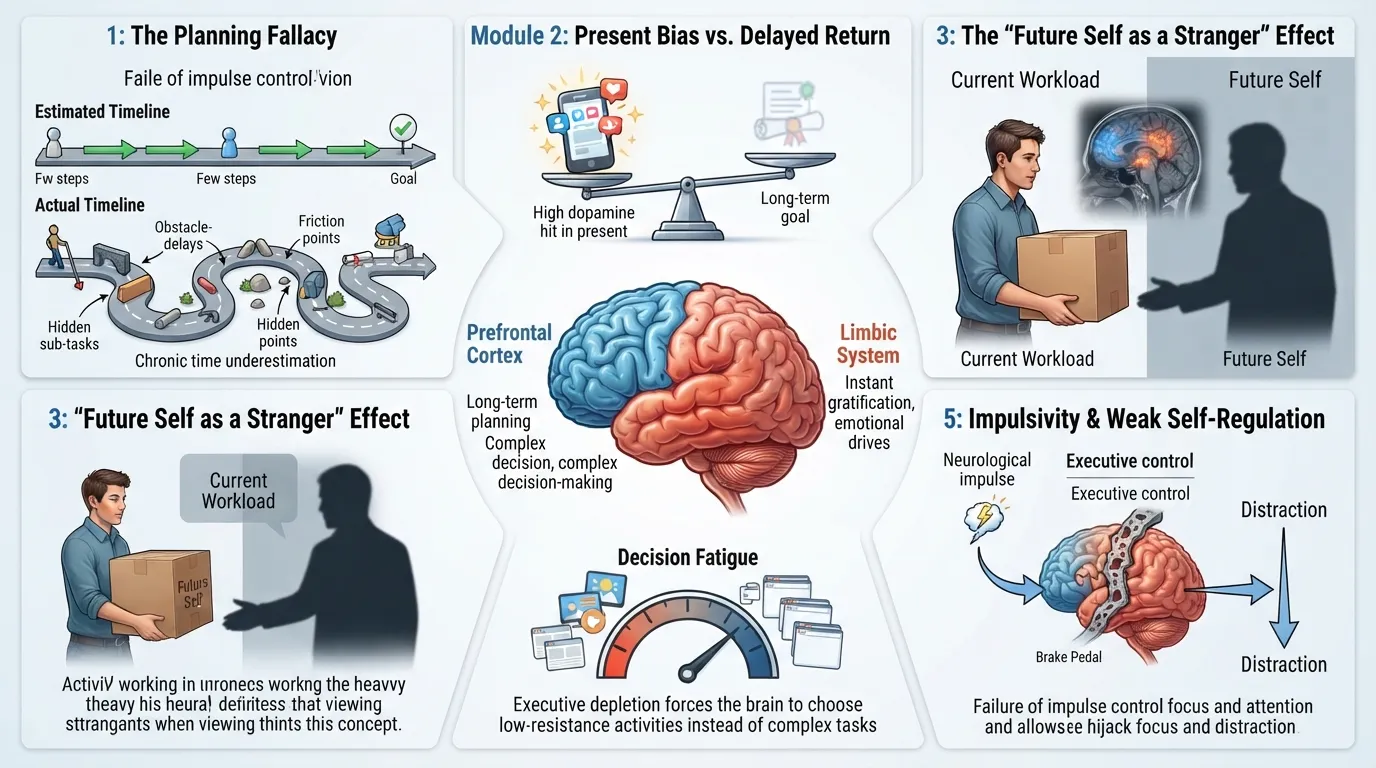
The Planning Fallacy
Even when your intentions are clear and your mood is stable, your brain’s architecture contains built-in cognitive flaws that make delay almost inevitable. Chief among these is the planning fallacy, a term coined by psychologists Daniel Kahneman and Amos Tversky.
The planning fallacy is our persistent tendency to underestimate how long a task will take, even when we have decades of experience showing that similar tasks always take longer than expected. When you map out a project, your brain envisions a best-case scenario—one where you encounter zero interruptions, experience no technical glitches, and maintain steady focus from start to finish. Because your initial time estimate is wildly unrealistic, you convince yourself that you have plenty of time left. You delay starting because you genuinely believe you only need two hours to finish a report that actually requires six.
Present Bias and Instant Gratification
From an evolutionary standpoint, your brain was built for survival in an environment of immediate returns—finding food now, escaping danger now, seeking warmth now. Long-term goals like saving for retirement, writing a thesis, or building a career require operating in a delayed-return environment that our neural wiring struggles to process.
This disconnect manifests as present bias: our hardwired inclination to value immediate rewards far more heavily than future rewards. When faced with a choice between an immediate, guaranteed dopamine hit (scrolling social media, watching a video, checking off quick easy emails) and an abstract, delayed reward weeks or months away (finishing a major project), the present moment almost always wins. The immediate reward is concrete and tangible right now; the future benefit feels theoretical.
The “Future Self as a Stranger” Effect
One of the most fascinating explanations for why we sabotage our own schedules comes from neuroimaging research on how the brain visualizes time. When researchers put people in fMRI scanners and ask them to think about their current self, specific regions of the brain light up with high activity.
However, when asked to think about a stranger, those same neural regions go relatively quiet. The surprising part? When asked to picture themselves five years in the future, the brain lights up in the exact same way it does for a complete stranger.
Subconsciously, your brain treats “Future You” as a different person entirely. When you push a stressful task off to tomorrow or next weekend, your present brain feels genuine relief, while mentally dumping the burden, late nights, and panic onto a stranger who happens to share your name.
Decision Fatigue and Task-Switching Cost
Every decision you make throughout the day—from what to wear in the morning to how to reply to an email—consumes a small portion of your finite cognitive resources. By mid-afternoon, you hit a point of mental depletion known as decision fatigue.
When your executive function is drained, your brain naturally defaults to the path of least resistance. If a task requires complex choices, ambiguous steps, or constant judgment calls, a tired brain simply refuses to engage. Adding to this is the hidden cost of task-switching. Constantly jumping between chat apps, open tabs, and notifications fragments your attention, creating a high cognitive load that makes diving deep into a single, demanding project feel almost physically overwhelming.
Impulsivity and Difficulty with Self-Regulation
While everyone experiences occasional delay, chronic procrastination is strongly linked to the personality trait of impulsivity. Impulsivity reflects a lower capacity for top-down self-regulation—the mental ability to resist immediate distractions in favor of long-term goals.
If you have high impulsivity, your brain has a weaker “brake pedal.” When a momentary urge arises—an impulse to check your phone, look up a random thought, or clean your desk—you act on it before your prefrontal cortex can intervene and remind you of your priorities. Procrastination in highly impulsive individuals isn’t a deliberate decision to wait; it’s a series of rapid, uncontrolled shifts in attention that constantly pull them off course.
Behavioral & Personality-Based Causes
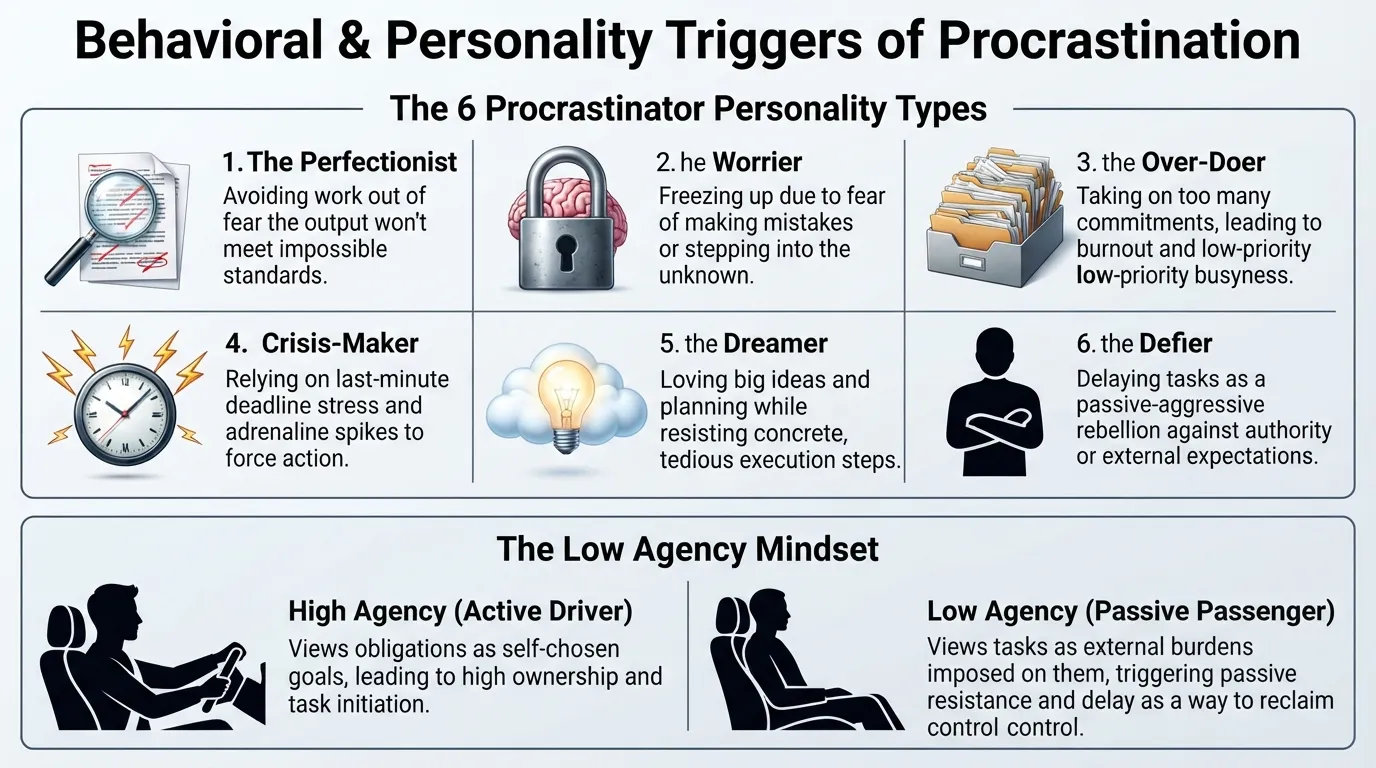
The 6 Types of Procrastinators
Dr. Linda Sapadin, a psychologist specializing in time management and personality patterns, identified six distinct styles of procrastination. Rather than treating avoidance as a single bad habit, her framework shows that procrastination stems from specific, underlying personality traits and coping mechanisms.
The Perfectionist
The Core Pattern: You put off starting or finishing a project because you are terrified that the result won’t match your extraordinarily high standards.
Which one sounds like you? Do you spend hours tweaking formatting, color schemes, or minor details while the core body of work sits untouched? Do you frequently miss deadlines because a project simply “isn’t ready yet”?
The Worrier
The Core Pattern: You avoid taking action because you fear making a mistake, stepping out of your comfort zone, or facing the unknown.
Which one sounds like you? Is your internal dialogue dominated by “what if” scenarios (What if I can’t answer their questions? What if this goes wrong?)? Do you freeze up and seek constant reassurance before taking even routine steps?
The Over-Doer
The Core Pattern: You take on too many responsibilities, struggle to set boundaries, and confuse being busy with being productive until you burn out.
Which one sounds like you? Do you say “yes” to every request out of a need to please others, only to find yourself hopelessly buried under a mountain of low-priority commitments while your most critical goals are pushed aside?
The Crisis-Maker
The Core Pattern: You rely on the adrenaline spike of a tight deadline to force yourself into focus, believing you “only work well under pressure.”
Which one sounds like you? Do you ignore tasks for weeks until the night before they are due, convincing yourself that you need drama, emergency energy, and extreme stress just to get your brain to engage?
The Dreamer
The Core Pattern: You love high-level ideas, vision boards, and theoretical plans, but you deeply dislike dealing with concrete details, structure, and hard execution.
Which one sounds like you? Do you feel a rush of excitement when brainstorming a new goal, only to lose all momentum and abandon the project the moment it requires boring, repetitive daily labor?
The Defier
The Core Pattern: You use procrastination as a passive-aggressive form of rebellion against external authority, expectations, or demands you feel are unfair.
Which one sounds like you? Do you find yourself delaying a task simply because a boss, partner, or colleague told you to do it—taking quiet satisfaction in holding control over when, or if, it actually gets done?
Low Agency Mindset
Underlying many behavioral causes of delay is a psychological concept known as agency—the belief that you have the power to influence your environment, shape your decisions, and direct the course of your life. When you operate with a low agency mindset, you view yourself as a supporting character in your own story, reacting to circumstances rather than driving them.
People with a low agency mindset view tasks as burdens imposed on them by external forces—their boss, their family, their school, or sheer bad luck. When a project feels forced upon you rather than chosen by you, your natural impulse is to resist. You procrastinate because delay becomes your only mechanism for asserting autonomy. By treating your obligations as things that are “happening to you,” you surrender your power to take control, waiting for motivation or permission that rarely arrives.
Situational Causes of Procrastination
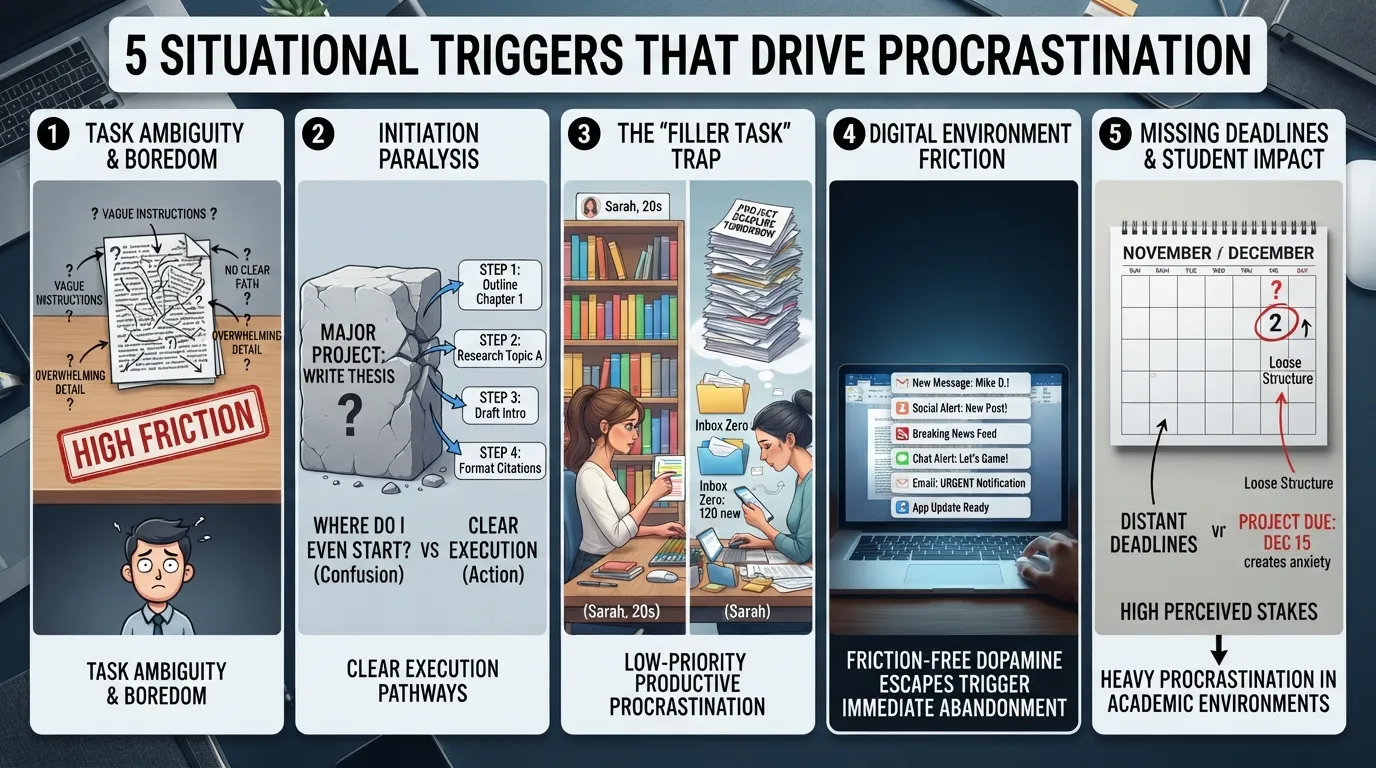
Unappealing, Boring, or Unclear Tasks
Sometimes the root cause of delay isn’t a deep psychological conflict; it is the nature of the task itself. When a assignment is tedious, repetitive, or lacks any intrinsic value to you, your brain naturally resists spending energy on it.
Even worse than a boring task is an unclear task. When instructions are ambiguous, goals are vague, or the final deliverable is poorly defined, your brain categorizes the project as high-friction. If a prompt simply says “update the website” or “research market trends,” you aren’t just facing the work itself—you are facing the mental effort of defining what the work actually requires. Without clarity, the path forward feels chaotic, and avoidance becomes the path of least resistance.
Not Knowing How or Where to Start
The moment a task feels larger than your current capacity, paralysis sets in. When you look at a complex project—writing a book, launching a business, or organizing a massive dataset—as one massive, indivisible obligation, the friction of taking the first step is enormous.
This paralysis happens because your brain cannot process “write a 20-page proposal” as an immediate physical action. It is a destination, not a step. Without a clear, bite-sized starting point, you spend more energy worrying about the total effort required than actually engaging with the material. You sit down to work, feel overwhelmed by the sheer volume of unknowns, and default to walking away until you “figure out a plan.”
The “Filler Task” Trap
Procrastination doesn’t always look like watching videos or taking a nap. Quite often, it looks like intense, enthusiastic productivity. This is productive procrastination—the practice of completing low-priority, easy filler tasks to avoid tackling the single high-stakes project that actually matters.
You clean out your entire inbox, re-organize your desk drawers, adjust your calendar color codes, or scrub the kitchen counters. Because you are actively working, your brain rewards you with a hit of accomplishment, convincing you that you aren’t being lazy. But deep down, it’s an illusion. You are using easy, low-risk chores as a shield to protect yourself from the discomfort, risk of failure, or mental fatigue attached to your primary task.
Constant Distractions and Digital Environments
We live and work in environments engineered to exploit our brain’s natural craving for novelty and short-term reward. Modern devices and platforms provide friction-free escapes every time you hit a point of cognitive struggle.
When you encounter a difficult paragraph, an error in your code, or a complex spreadsheet, your brain experiences a spike of discomfort. A decade ago, working through that friction required pushing forward because alternate options were out of reach. Today, relief is a single click or swipe away. Social media feeds, news alerts, and messaging apps offer instant, low-effort dopamine hits that make sitting with task-related discomfort almost impossibly hard by comparison.
Lack of Deadlines and External Accountability
Parkinson’s Law famously states that work expands to fill the time available for its completion. When a goal lacks a concrete, hard deadline, it frequently drifts into perpetual delay.
Without an external trigger—a client waiting for a delivery, a scheduled presentation, or a hard submission cutoff—a task relies entirely on your internal drive. For most people, internal drive is easily overridden by immediate demands and daily distractions. Open-ended goals (“I’ll start working out more,” “I’ll write that article eventually”) lack urgency, leaving your brain with no operational reason to choose the effort of starting today over the comfort of waiting until tomorrow.
Why Procrastination Hits Students So Hard
Procrastination is uniquely rampant in academic settings, affecting up to half of all students on a chronic basis. This happens because higher education combines three major triggers: distantly spaced deadlines (syllabi given months in advance), unstructured environments (hours of open time between classes), and high perceived stakes (grades directly tied to future identity and career prospects). Without rigid daily structures, the gap between short-term comfort and long-term reward becomes an ongoing operational struggle.
Procrastination and ADHD: Is There a Real Link?
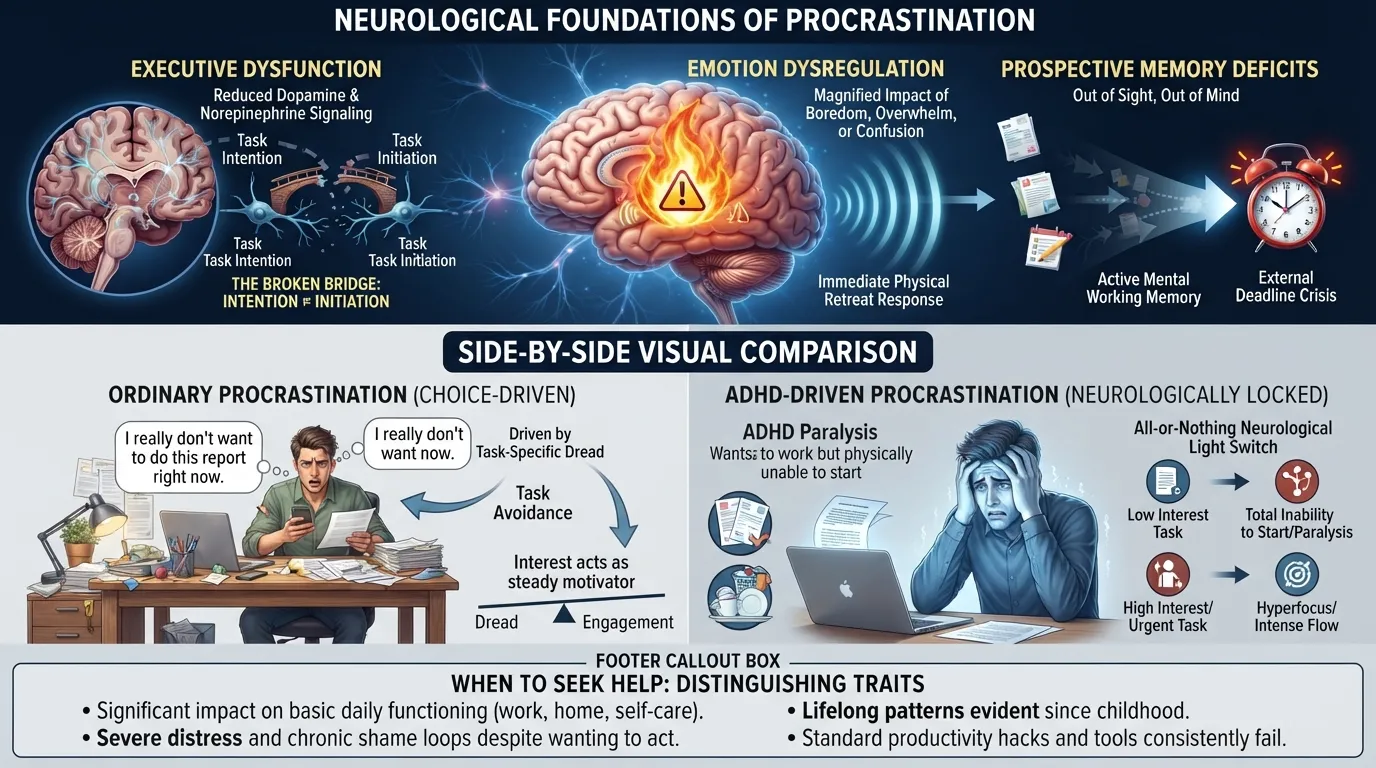
What the Research Actually Shows
The connection between procrastination and Attention-Deficit/Hyperactivity Disorder (ADHD) is strong, documented, and frequently misunderstood. While everyone procrastinates occasionally, for individuals with ADHD, chronic delay is rarely a tactical choice or a bad habit—it is a core manifestation of how their brain processes information, executive function, and emotion.
Research shows that ADHD-related procrastination sits at the intersection of three major neurological mechanisms:
- Executive Dysfunction: The prefrontal cortex acts as the brain's manager, handling working memory, organization, planning, and task initiation. In an ADHD brain, the neural pathways governing these executive functions operate with lower baseline levels of dopamine and norepinephrine, making it significantly harder to bridge the gap between knowing what to do and actually starting it.
- Emotion Dysregulation: Contrary to popular belief, ADHD is not just a challenge with focus; it is also a challenge with emotional intensity. Because emotional self-regulation requires robust executive function, the frustration, boredom, or overwhelm triggered by a task hits an ADHD brain with far greater intensity, triggering an immediate, involuntary avoidance response.
- Prospective Memory Deficits: Prospective memory is the ability to remember to carry out an intended action in the future. Individuals with ADHD often experience "out of sight, out of mind" cognitive patterns, making it easy to completely drop non-urgent tasks from their conscious awareness until a crisis point occurs.
How ADHD Procrastination Differs from "Ordinary" Avoidance
While neurotypical procrastination is usually a localized response to specific negative feelings about a specific task, ADHD procrastination is pervasive, systemic, and often physically paralyzing.
| Dimension | "Ordinary" Procrastination | ADHD-Driven Procrastination |
|---|---|---|
| Primary Driver | Task-specific emotional avoidance (fear of failure, perfectionism, dread). | Neurological dopamine deficiency and executive dysfunction. |
| Physical Experience | Choosing to do something else (watching videos, organizing, filler tasks). | "ADHD Paralysis"—wanting desperately to move, but feeling mentally locked in place. |
| Scope of Impact | Concentrated around challenging, high-stakes, or boring projects. | Affects routine life maintenance (paying bills, eating, returning texts, starting laundry). |
| Role of Interest | High interest reduces delay, but discipline is still required. | Hyperfocus vs. Inability to Start—interest acts as a neurological light switch. |
For someone with ADHD, procrastination isn't solved by breaking a task into smaller steps or using a standard planner, because the brain's internal starter motor simply lacks the necessary neurotransmitters to turn over without intense urgency or novel stimulation.
When to Speak with a Professional
Because procrastination is a universal human experience, it can be tricky to discern whether your delays are standard emotional avoidance or a sign of an underlying neurodevelopmental condition like ADHD.
Consider speaking with a qualified doctor, psychologist, or psychiatrist if your experience with procrastination aligns with the following indicators:
- It impacts basic daily functioning: Your delay isn't just affecting major career milestones, but basic life administration—paying utility bills on time, renewing vehicle registrations, maintaining hygiene, or eating regularly.
- The internal friction causes severe distress: You experience intense, chronic shame, exhaustion, and mental burnout from spending hours every day locked in "waiting mode," wanting to work but unable to initiate action.
- It has been a lifelong pattern: Your struggles with task initiation, forgetfulness, time blindness, and organization were present in childhood or adolescence, even if you managed to compensate for them academically or socially at the time.
- Productivity hacks consistently backfire: Standard advice—making to-do lists, blocking time on calendar apps, or setting alarms—fails to move the needle because the core obstacle is initiation, not schedule structure.
A clinical evaluation can clarify whether executive dysfunction is at play and open up access to evidence-based treatments—such as specialized Cognitive Behavioral Therapy (CBT), ADHD coaching, or targeted medication—that address the root neurological mechanics rather than just the surface behaviors.
Is All Procrastination Bad? Active vs. Passive Procrastination
Passive Procrastination
When we talk about procrastination as a frustrating, self-defeating habit, we are almost always referring to passive procrastination. This is the classic, dysfunctional form of delay.
In passive procrastination, you don’t choose to wait—you freeze. Driven by emotional discomfort, fear, or cognitive overload, you put off an important task while fully knowing the delay will hurt you later. The defining marker of passive procrastination is that it leaves you feeling powerless, anxious, and deeply dissatisfied with your output. You spend the delayed hours trapped in a cloud of background guilt, meaning you neither enjoy the time off nor get the work done.
Active Procrastination
On the flip side sits active procrastination—a concept popularized by researchers like Dr. Jin Nam Choi. Active procrastinators intentionally choose to delay starting a project because they know they perform best under the tight pressure of an approaching deadline.
Unlike passive procrastinators, active procrastinators retain their agency. They assess the timeline, deliberately set the task aside to focus on other priorities, and then jump into action when the clock forces intense focus. There can be a real creative upside to this: stepping away allows your brain to engage in incubation, processing ideas subconsciously in the background. When you finally sit down to work, your thoughts have often clarified. However, this strategy comes with real limits—relying on high-stress pressure stalls out if an unexpected emergency crops up right before the deadline.
Why This Distinction Matters
Distinguishing between active and passive delay is crucial because it stops you from unnecessarily shaming yourself. If you consciously choose to put off a project because you genuinely work faster and more creatively in a short sprint, that is a tactical work-style preference, not a psychological flaw. But if you are delaying out of dread, anxiety, and paralysis, treating it as “active strategy” is just self-deception. Recognizing which category your delay falls into determines whether you need a different workflow or emotional healing.
The Real Consequences of Chronic Procrastination
Mental and Physical Health Effects
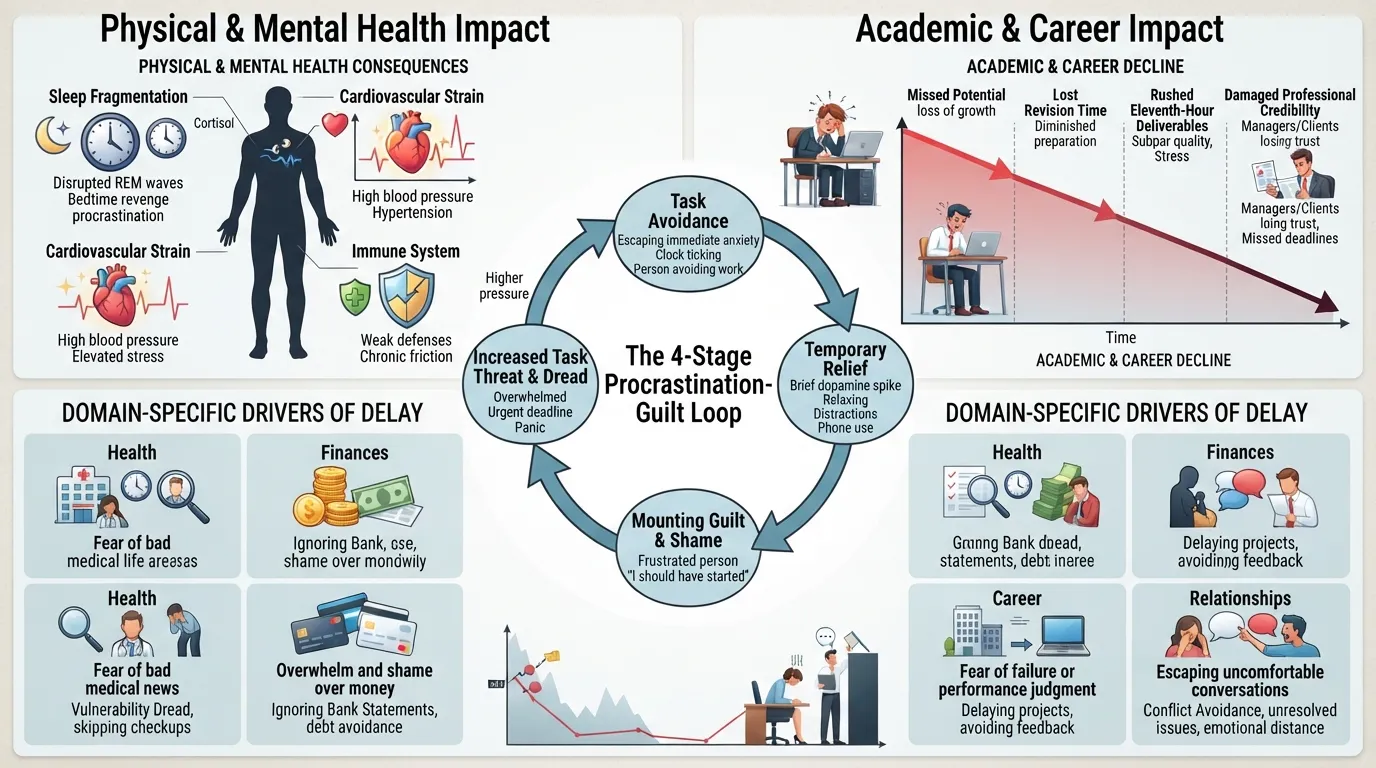
Procrastination is often framed as a minor productivity issue, but chronic delay takes a severe toll on the human body. When you push off high-priority or emotionally charged tasks, your brain doesn’t just forget about them. Instead, those unresolved obligations linger in the background, keeping your nervous system in a state of low-grade, constant arousal.
Research consistently links chronic procrastination to elevated levels of cortisol—the body’s primary stress hormone. Over time, this sustained stress manifests physically:
Sleep Fragmentation: Procrastinating during the day often leaks into the night. Many chronic procrastinators engage in bedtime revenge procrastination, delaying sleep to reclaim personal leisure time, leading to insomnia, disrupted REM cycles, and chronic fatigue.
Cardiovascular Strain: Longitudinal health studies led by researchers like Dr. Fuschia Sirois have found that chronic procrastinators face a significantly higher risk of cardiovascular issues, including hypertension and heart disease, driven by persistent stress and delayed medical check-ups.
Immune System Suppression: Constant internal friction and anxiety gradually weaken the immune response, leaving chronic procrastinators more vulnerable to frequent illnesses, headaches, and digestive distress.
Academic and Career Impact
In professional and academic environments, chronic procrastination acts as an invisible ceiling on potential. It directly undermines performance, regardless of how intelligent or capable you are.
When you consistently start projects at the eleventh hour, you forfeit the time needed for revision, deep critical thinking, and unexpected troubleshooting. The resulting output rarely reflects your actual baseline capability. Beyond the quality of work, delay damages professional relationships and credibility. Missing deadlines, rushing deliverables, and projecting an aura of perpetual crisis signal to peers, managers, and clients that you are unreliable. Over time, this pattern leads to missed promotions, stalled business growth, or academic underperformance—not due to a lack of skill, but due to an inability to execute reliably.
The Procrastination-Guilt Cycle
The most insidious aspect of chronic procrastination is its compounding nature. It creates a self-reinforcing loop that becomes harder to break the longer it continues.
The 4 Stages of the Avoidance Loop
Task Avoidance
You walk away from the task to immediately escape uncomfortable feelings like anxiety, confusion, or fear of failure.
Temporary Relief
Your brain experiences a quick dopamine spike and a wave of calm, rewarding you for removing the source of stress.
Mounting Guilt & Shame
As time slips away, negative self-talk kicks in (“Why did I wait?“, “I’m undisciplined“), creating heavy emotional weight.
Increased Task Threat & Dread
The task now carries twice as much pressure, making it feel even more terrifying to start—which triggers another round of avoidance.
The cycle begins when you avoid a task to gain immediate mood relief. But as the deadline approaches, that relief rapidly turns into acute guilt and self-criticism. You berate yourself for wasting time, which generates negative emotions like shame and self-doubt. Because procrastination is an emotional regulation failure driven by negative feelings, this added emotional baggage makes the original task feel even more threatening and unpleasant than it was initially. Consequently, the urge to escape becomes stronger, locking you in a tighter loop of delay and shame.
Domain-Specific Procrastination
Procrastination rarely hits every area of life equally. You might be fiercely disciplined at work while letting your personal finances fall into total disarray, or maintain a spotless home while putting off critical health appointments for years.
Health Procrastination is usually driven by vulnerability dread—avoiding exams because you fear bad news.
Financial Procrastination often stems from shame and overwhelm—ignoring bank statements to avoid facing bad spending habits.
Career Procrastination is frequently rooted in fear of judgment or failure—delaying pitches or applications where your competence is tested.
Relationship Procrastination is usually fueled by conflict avoidance—putting off awkward or uncomfortable conversations.
A Brief History: Humans Have Procrastinated Since Ancient Times
The Myth of the Modern Distraction
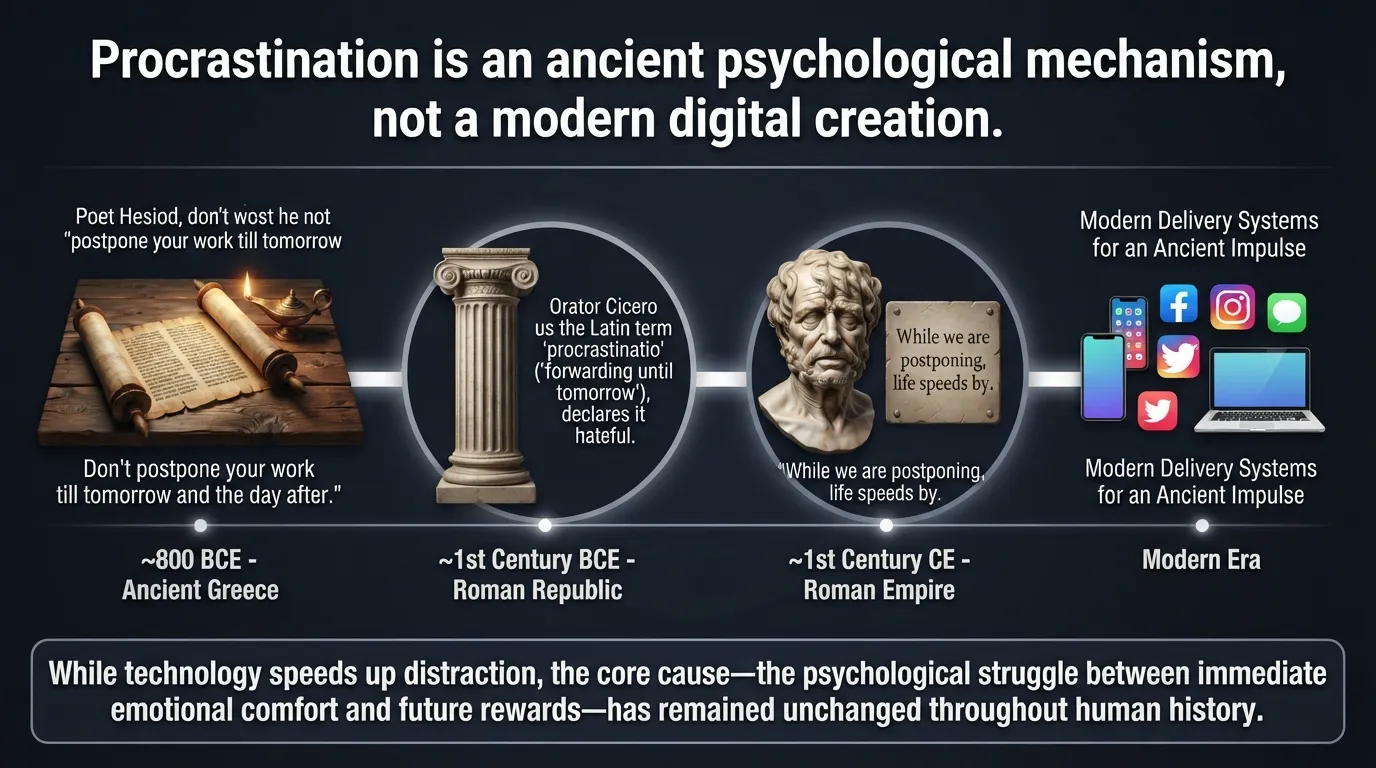
It is easy to blame our constant delay on push notifications, endless video feeds, and smartphones engineered for maximum engagement. But digital media is merely a modern delivery system for an ancient human impulse. While technology has unquestionably accelerated our access to immediate distractions, the urge to put off necessary labor is as old as civilization itself. Blaming technology treats the modern symptom while ignoring a universal psychological mechanism that has been wired into our nervous system for millennia.
Ancient Roots of Delay
Long before screens existed, historical figures were wrestling with the exact same internal resistance we face today. In ancient Greece, the poet Hesiod warned around 800 BCE not to “postpone your work till tomorrow and the day after.” Centuries later, Roman philosopher and statesman Seneca observed that “while we are postponing, life speeds by.”
Even Cicero famously decried procrastination as “hateful” in his political speeches, using the Latin term procrastinatio—literally meaning “forwarding until tomorrow.” Our ancestors didn’t have social media to pull them away from their duties, but they had the same evolutionary brain mechanics, the same struggle between present comfort and future rewards, and the same tendency to escape unpleasant feelings. Procrastination isn’t a byproduct of the digital age; it is a fundamental part of the human condition.
Quick Techniques People Ask About
The 5-Minute Rule: Tell yourself you only have to work on the task for five minutes—once you break the initial barrier of inertia, your brain’s natural momentum usually keeps you going.
The 10-Minute Rule: Commit to staying focused for ten minutes; after that, give yourself explicit permission to stop if the resistance is still unbearable, which lowers the emotional threat of starting.
The 30-Second Rule: The moment you feel the impulse to put off a task, take one micro-physical action toward it within 30 seconds (like opening the document or putting on your shoes) before your brain can rationalise escaping.
The Four-Question Self-Check: Ask yourself four quick questions before starting: What am I avoiding? What emotion am I feeling? What is the absolute smallest next step? What will happen if I wait?
A Quick Reality Check
While these micro-tactics are helpful for breaking immediate paralysis, they only address the surface symptom. To create lasting change, you have to address the underlying emotional, cognitive, and personality triggers detailed above. For a complete, step-by-step guide on rewriting these behavioral patterns, explore our full breakdown on How to Overcome Procrastination: Evidence-Based Strategies That Work.
Frequently Asked Questions
The primary reasons for procrastination are rooted in emotion regulation rather than time management. People delay tasks due to fear of failure, perfectionism, low self-efficacy, task-related dread, decision fatigue, and cognitive traps like present bias and the planning fallacy.
Procrastination is not an anxiety disorder itself, but it is deeply tied to anxiety. It frequently serves as an emotional coping mechanism to temporarily escape the anxiety, dread, or self-doubt triggered by a specific task.
Yes, there is a strong link. For individuals with ADHD, procrastination stems from executive dysfunction, low baseline dopamine, and emotional dysregulation, causing a physical inability to initiate tasks that differs significantly from standard emotional avoidance.
Psychologically, procrastination is a short-term mood repair strategy. When a task triggers negative emotions, the emotional center of the brain (the limbic system) overrides the logical center (the prefrontal cortex), prioritizing immediate relief over long-term goals.
Only when it is "active procrastination"—an intentional choice to set a task aside to incubate ideas or leverage deadline pressure effectively. Passive procrastination, which is paralysis driven by anxiety and guilt, is almost always counterproductive.
To break immediate paralysis, take these two concrete actions right now:
- Name the emotion: Identify the exact feeling making you avoid the task (e.g., fear of messing up, boredom, or confusion). Acknowledging the emotional barrier immediately lowers its intensity.
- Shrink the first step to a micro-action: Reduce your entry point to something absurdly small—like opening a blank document, writing one sentence, or creating a single folder.
While the instinct to seek immediate comfort will always exist, you can permanently disrupt chronic procrastination. By shifting your approach from self-criticism to self-compassion, building awareness around your emotional triggers, and lowering task friction, you change your relationship with internal resistance.
Stopping procrastination requires addressing the emotional root cause before applying productivity hacks. Lasting change happens when you lower the threat level of the task, practice self-compassion to break the guilt loop, and align your goals with true personal intent rather than external pressure.
For a complete, actionable roadmap to rewiring these habits, check out our deep-dive guide on How to Overcome Procrastination: Science-Backed Solutions.
Your Reasons Are Data, Not a Character Flaw
Once you realize that procrastination is an emotional regulation response rather than a personal failure, the way you view your own delays changes completely. The hesitation, dread, or urge to check your phone isn’t proof that you lack discipline—it is valuable psychological data telling you exactly which part of the task feels unsafe, overwhelming, or misaligned. When you stop fighting your reactions with harsh self-criticism and start decoding the emotional root causes, you strip procrastination of its power over your life.
Ready to put this understanding into practice? Read our companion guide on How to Overcome Procrastination: Science-Backed Strategies That Work to learn how to lower task threat, rebuild momentum, and navigate internal resistance with clarity and self-compassion.
Sirinapa Chantarangsu
Sirinapa Chantarangsu is the Procrastination Editor at Holistic Wellbeing Living. She writes about task avoidance, perfectionism, focus, and manageable first steps. With six years of experience creating personal-growth content, Sirinapa helps readers replace guilt with practical strategies that make starting easier.